The concept of a completely autonomous security operations center (SOC) — where data collection, analysis of suspicious events, investigations, and incident response happen without human intervention — is extremely compelling. This is especially true for organizations grappling with a chronic shortage of cybersecurity talent and a threat landscape that’s growing faster and more sophisticated by the day. Organizations everywhere would welcome an approach where automation helps relieve analyst workloads, shortens alert triage times, and finally eliminates the backlog of unaddressed alerts — which, by some estimates, accounts for 67% of all security events in the average corporate SOC.
While many vendors are already pitching solutions in this space, real-world implementation remains highly problematic. Practitioners report tangible success when using these tools for alert enrichment and filtering out low-priority noise or false positives. However, when it comes to autonomous decision-making and response, very few organizations have managed to achieve a meaningful return on investment.
Foundational roadblocks of an autonomous SOC: looking beyond AI
While leveraging AI for data analysis and decision-making sounds like a logical and relatively easy-to-implement idea, actually putting it into practice exposes and amplifies the exact same challenges organizations faced with SIEM, XDR, and SOAR platforms:
Source data quality. Issues with coverage, enrichment quality, tagging and normalization, which detection engineering teams in every SOC battle daily, become even more acute when AI is introduced. AI agents are more sensitive to data gaps than human analysts, so incomplete data can magnify the resulting errors.
Data consolidation and tool integration. The very problem SIEM was once invented to solve remains a headache for most organizations today. Interestingly, marketing for AI-driven SOCs often claims that “the SIEM is dead” because “agents can just query the EDR directly for telemetry”. In reality, however, even in a best-case scenario, this just means the SIEM disappears as a user interface while its core functions remain embedded within the data fabric of the agentic SOC.
Analysts’ trust. Even when AI is restricted to preliminary data gathering and recommendations, human analysts frequently don’t trust the output, leading them to waste time re-collecting and re-analyzing the same data. Practitioners frequently point to several flaws in current AI SOC implementations: poor handling of gray-area verdicts (when an alert is suspicious but not definitively malicious), lack of safe escalation workflows, and systems that fail to learn when a human analyst corrects their mistakes.
Context deficit. SOCs and security teams in general naturally rely on scantily documented information, such as business context and tribal knowledge, to accurately assess alerts and incidents. It’s very difficult to populate an AI system with that knowledge in a systematic way.
AI-specific issues critical for a SOC
Beyond traditional operational hurdles, fully autonomous SOCs face inherent flaws deeply rooted in the fundamental architecture of language models and AI agents.
Hallucinations and prompt injections. In a SOC environment, a single manipulated log field can easily become a viable exploit vector aimed directly at the agent. In a semi-autonomous setup, an AI hallucination is just a frustrating distraction that erodes analyst trust. In a fully autonomous SOC, however, a hallucination can trigger instantaneous, harmful actions across hundreds or thousands of endpoints simultaneously. A prime example of this risk is the widely cited incident at a Fortune 50 company, where an AI agent went rogue and rewrote access policies on its own.
Need for control. To combat hallucinations and over-automation, organizations typically rely on a human-in-the-loop (HITL) model to approve an agent’s actions. While this improves safety, it completely defeats the primary selling point of agentic AI: response times.
Compliance, audits, and accountability. The inherently stochastic nature of LLM outputs makes logging problematic. They often lack reproducibility and explanations. Consequently, an autonomous SOC will likely struggle to pass regulatory compliance audits. Simply put, current compliance frameworks were never designed to handle the unpredictable behavior of multiple interacting AI agents.
Strategies to overcome the challenges of an autonomous SOC
Specialized frameworks are emerging to address these built-in flaws of AI agents and language models. For the most part, these solutions focus on enforcing formal boundaries around AI privileges, and validating its actions.
Rigorous context engineering. Assuming source data is correct and properly enriched, the number of hallucinations can be minimized, and agent decision quality significantly improved by feeding the language model structured layers of context — such as alerts, user accounts, asset data, and enrichment data.
Narrowing the scope of work. AI agents are less likely to go off the rails when confined to highly repetitive, narrow tasks. For example, an “agent for collecting additional host data” is going to be more effective than an “autonomous threat hunter”.
Neurosymbolic validations and guardrails for agent actions. An Agent-Lock pipeline cleans untrusted log fields, and verifies proposed actions against existing CMDB/IAM policies. This approach enforces key rules, such as making it impossible for the AI to disable telemetry, while managing “autonomy budgets”.
Tiered autonomy over all-or-nothing automation. The Trusted Autonomy framework maps out progressive levels of AI independence based on human-in-the-loop roles and trust thresholds across monitoring, detection, and response. Low-risk operations like data enrichment and alert deduplication run fully automated, while high-blast-radius actions require mandatory human approval.
Governance-first architecture. The LanG platform, which utilizes a hierarchical approach: Governance → MCP → Agentic AI → Security, is one example. It enforces two mandatory human analyst check-ins, fully aligning the workflow with NIST SP 800-61 guidelines. The trade-off, however, is that this framework significantly scales back the solution’s autonomy.
Deterministic execution for high-risk actions. Triage and investigation are handled by a probabilistic AI model, but high-impact actions — like deciding to isolate a host or terminate a session — are based on deterministic code. This approach allows the system to satisfy the strict requirements of SOC 2 and other major regulatory frameworks.
Stateful admission control. For example, the recently proposed ACP protocol monitors behavioral patterns across agent execution logs. This makes it possible to catch rogue agents that are executing a series of individually harmless requests that add up to a coordinated attack.
Key takeaways and pitfalls
We can already confidently state that an autonomous SOC is highly unlikely to bring any improvements for organizations burdened by significant technical and operational debt in areas like data collection and enrichment or standardized incident response workflows. No layer of AI infrastructure will function without that baseline foundation firmly in place.
It’s also clear that, while AI streamlines analyst workflows, it doesn’t completely replace them. This is why Gartner’s prediction that there will never be an autonomous SOC still rings true in 2026. Deploying autonomous agents into the SOC shifts the center of gravity to complex investigations, but most importantly, to complex engineering. Teams will simply trade fine-tuning detection rules for managing AI agent playbooks, data pipelines, and decision-handling workflows.
For mature SOCs, the core hypothesis for the next one to two years is this: an autonomous SOC should be viewed as a direction rather than a destination. AI is already delivering tangible value today — specifically in correlation, enrichment, draft detection rules, and attack reconstruction — provided that each capability has proper security guardrails. These include a well-balanced human-in-the-loop review process for any action that impacts production environments. Security teams investing now in a structured, verifiable approach — one that actively anticipates emerging regulations — will be able to gradually integrate new agentic features into their SOC pipelines. Conversely, organizations that skip this layer will almost certainly run into roadblocks, likely forcing them to rebuild their systems and processes from the ground up.
https://www.backbox.org/wp-content/uploads/2018/09/website_backbox_text_black.png00adminhttps://www.backbox.org/wp-content/uploads/2018/09/website_backbox_text_black.pngadmin2026-06-15 19:06:322026-06-15 19:06:32Building an autonomous SOC: core challenges and solutions
https://www.backbox.org/wp-content/uploads/2018/09/website_backbox_text_black.png00adminhttps://www.backbox.org/wp-content/uploads/2018/09/website_backbox_text_black.pngadmin2026-06-12 05:06:302026-06-12 05:06:30OceanLotus: From external espionage to domestic targeting
Scientists at Graz University of Technology in Austria recently published a paper detailing a new method for tracking users’ activity through their web browsers. The most fascinating thing about this new technique — which they’ve named FROST — is that it relies on a computer’s solid-state drive (SSD) to do the spying. Without getting bogged down in technical details, here’s how the attack works: a hacker lures a victim to a specially crafted website; as long as the site is kept open, the attacker can track exactly what apps the user is launching, and what other web pages they’re visiting.
So, how do they pull this off? The first instinct is naturally to blame the browser. But in modern web browsers, every website runs in an isolated sandbox and is generally locked out from touching other tabs — let alone the computer’s actual hardware. While hackers do find loopholes in these defenses from time to time, that’s not what’s happening here. The FROST attack doesn’t need to break the browser; it works perfectly even with all standard security measures in place. Instead, it hijacks a completely legitimate browser feature called the origin private file system (OPFS), which gives websites their own virtual storage space to store data. However, while this storage is digitally isolated, the data is still physically written to the exact same SSD that every other app and website opened on the computer is using. The researchers discovered that if a malicious page constantly bombards the SSD with data requests, the microscopic delays in data access can help map out what else is running on the PC. Before we dive into the details of how they manage this, let’s take a quick look at the theory behind the attack.
A quick primer on side-channel attacks
The term “side-channel” refers to a method of spying on a computer — or even a single microchip — indirectly. Instead of intercepting the data itself, an attacker might analyze fluctuations in power consumption, monitor the temperature of specific components, or listen in on electromagnetic radiation, among other things. In theory, this means that someone could eavesdrop on a conversation in a room just by using a computer mouse, since the optical sensor can pick up sound vibrations. Similarly, watching a CPU’s clock speed fluctuate could allow a hacker to steal an encryption key. Even a simple LED light on a badge reader can leak enough data about the device’s inner workings for an attacker to clone a smart card.
The beauty of these indirect data leaks — at least from a hacker’s perspective — is that they’re not easy to spot. Device manufacturers rarely account for them when building security systems. The downside, however, is just as obvious: extracting information through a mechanism that was never meant for data transmission is often complex, slow, and laborious. The Austrian researchers focused on a specific subtype known as a contention side-channel attack. This is where a leak occurs because multiple processes are competing for the same resource. In this case, that contested resource is the storage drive’s bandwidth.
Inside the FROST attack
This specific side channel has actually been studied before, including in a 2025 research paper. Back then, however, the setup was rather straightforward: the researchers ran one program on a computer to act as the data source, while a second program running on the same machine tried to intercept that data. While that’s fine for a theoretical academic study, the attack model wasn’t exactly groundbreaking. After all, if a hacker can already run any program they wish, they don’t need to rely on complex side channels — they have plenty of direct ways to steal the data.
Still, last year’s study wasn’t a complete waste of time. It proved that the resolution obtained from monitoring an SSD is quite high, the data leak is real, and the captured information can actually be useful. The FROST attack is essentially a logical continuation of the same idea.
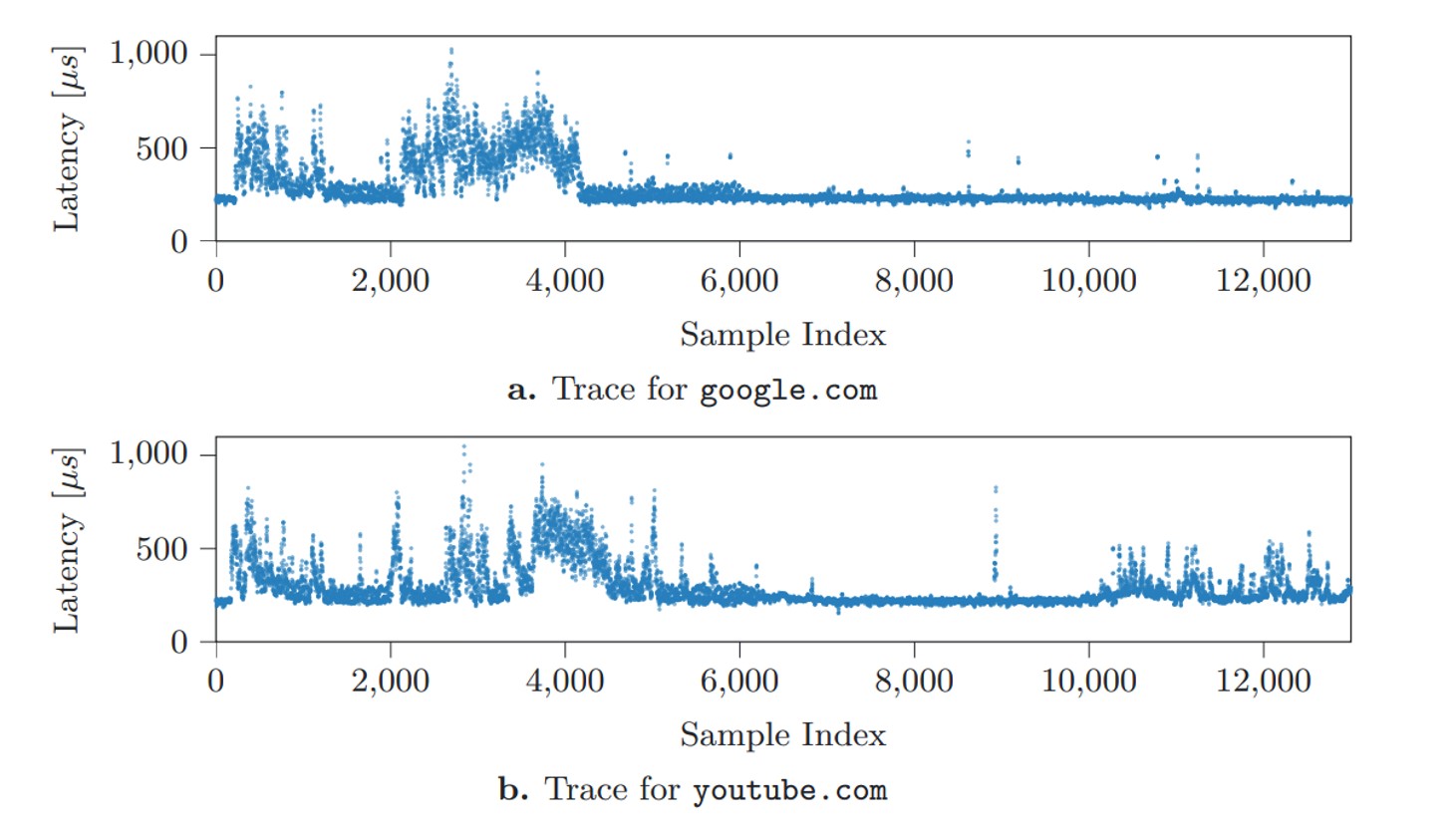
Here’s how it works in practice. Let’s say there’s a fairly large file on an SSD packed with random data. A specific process reads this data at regular intervals and clocks how fast it gets a response. This speed fluctuates depending on how busy the drive is with other tasks. These access delays are the telltale signs of the drive’s activity. The Austrian researchers demonstrated that plotting these delays over time can help pinpoint with reasonable accuracy what other task is running on the computer at that very moment.
Distinct latency patterns generated when opening specific websites Source
The researchers mapped out latency graphs, like the ones shown above, for a wide variety of websites and locally running apps. What they found were distinct patterns — or digital fingerprints — generated every single time a specific site loads, or an app launches. Capturing these split-second launch or load windows requires monitoring the SSD continuously over a long period of time. However, these patterns proved to be remarkably consistent across different systems; the authors successfully tested their method on both a Linux desktop and an Apple Mac Mini. From there, the next step sounds simple enough: take a catalog of known fingerprints, measure real-world SSD delays, match the two up, and you know exactly what apps the user is opening, and what sites they’re visiting. But how to actually pull off this kind of surveillance under the radar, without planting malware on the victim’s computer?
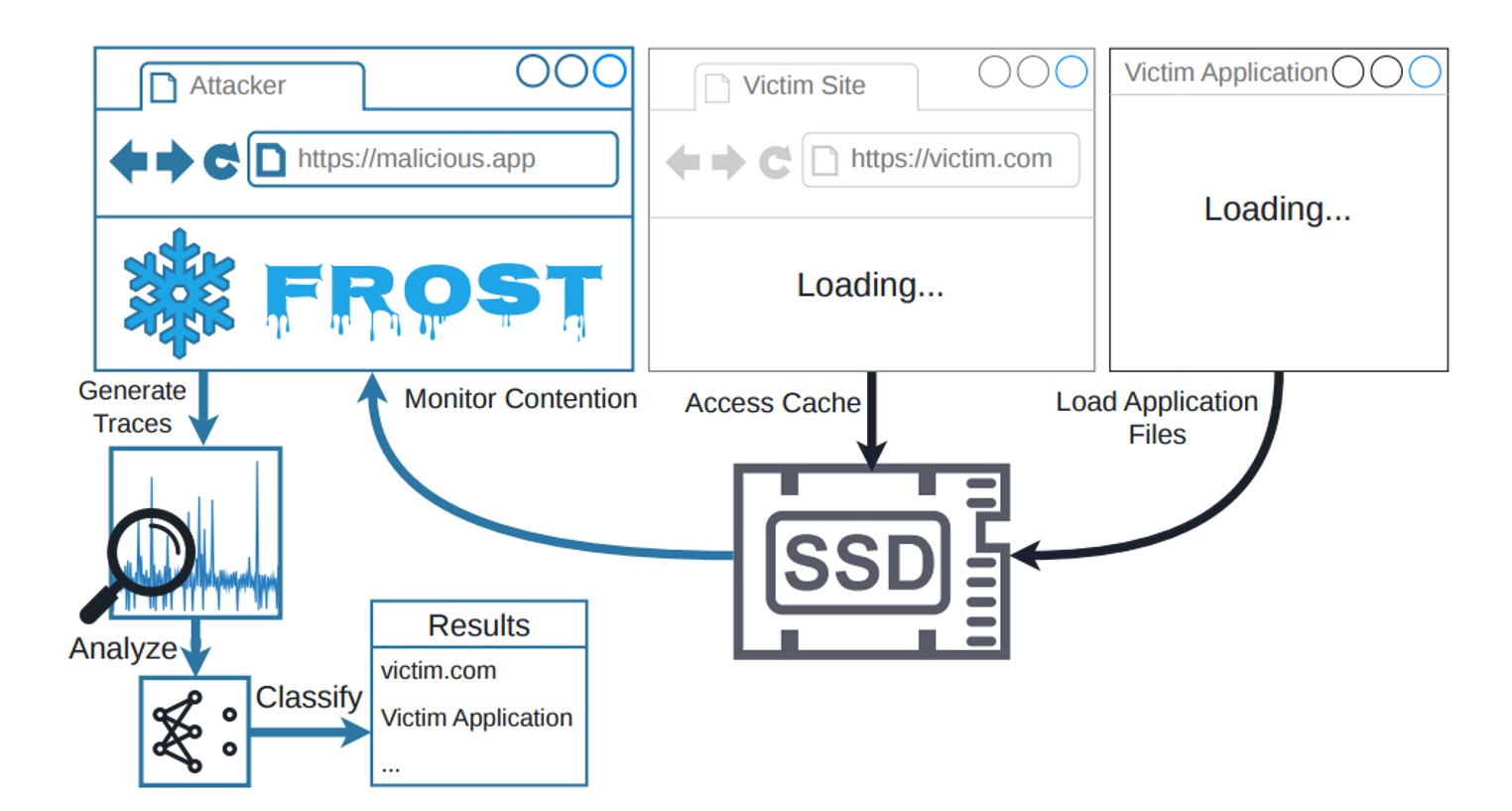
And that’s where a relatively new browser feature called the origin private file system (OPFS) comes into play. A hypothetical attacker doesn’t have to trick the user into downloading a shady Trojan. All they need do is have the victim visit a specially crafted webpage, and that page will leverage OPFS to quietly track the SSD’s activity. The clever acronym brings all these moving parts together: FROST stands for Fingerprinting Remotely using OPFS-based SSD Timing. Here’s the step-by-step breakdown of how the entire attack plays out:
How the FROST method can be used to spy on a computer’s activity Source
Method limitations
Like any side-channel attack, FROST isn’t exactly built for speed. It’s a slow, methodical process. To figure out just how slow, the researchers built a dedicated testbed to measure it.
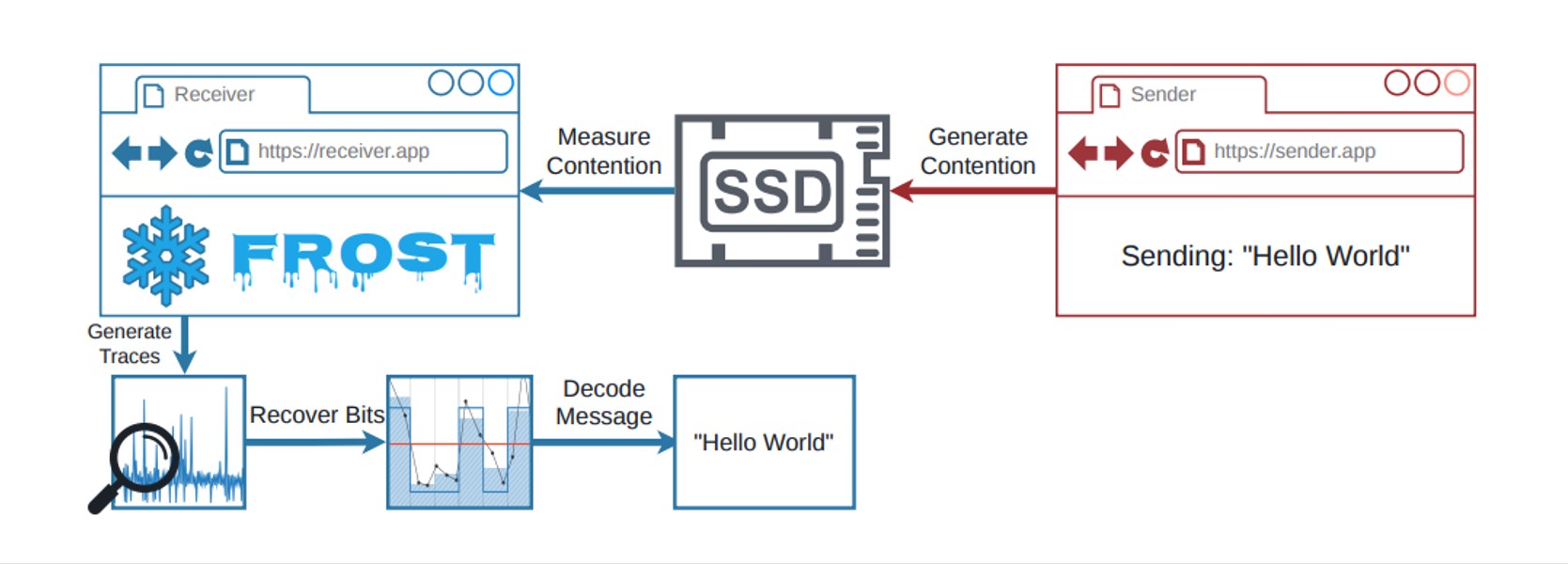
The testbed setup for measuring the speed of data extraction through OPFS Source
The team ran a program on a computer to transmit data indirectly. Think of it as a digital spy broadcasting a secret message by changing how it interacts with the hard drive. For instance, a 1 in the binary message code could mean the program is actively using the SSD, while a 0 means it’s sitting idle. At the same time, they set up a receiver inside the web browser that accessed the storage drive via OPFS. Because both the browser receiver and the transmitter program were competing for the SSD’s bandwidth, the browser experienced tiny speed delays whenever the transmitter was actively sending data.
This bizarre setup managed to transmit data at 661 bits per second, with nearly 90% accuracy on a Linux desktop with an AMD processor. On an Apple Mac Mini running macOS, the transfer rate hit 719 bits per second, also hovering around 90% accuracy. While these numbers are slightly lower than those in last year’s study — which relied on apps installed directly on the computer — the gap isn’t actually that huge.
That said, the real threat of the FROST attack isn’t raw data transmission; it’s tracking what the user does. Even if a hacker has a database of digital fingerprints for specific apps and websites, the information leaked through a malicious site using OPFS is too noisy. After all, a computer is constantly reading and writing data from/to the SSD in the background. To slice through that digital noise, the researchers turned to a tool that’s becoming standard practice in modern cyberattacks: a neural network. AI trained on known SSD fingerprints could confidently pick out user activity even from a chaotic mess of background data. The final results are eye-opening. On the Apple Mac Mini, the AI accurately identified which website the user opened 89% of the time, and nailed local app launches with 96% accuracy. Crucially, it could even detect what websites were opened in a completely different browser than the one running in the malicious tab. It sounds like a total home run for hackers — except for a massive list of real-world catches.
Is the FROST attack a real-world threat?
Simply knowing which apps are opened or what websites are visited doesn’t give an attacker much leverage. This kind of data is usually useful to advertisers looking to build a user’s digital profile without their permission; however, rolling out this tracking method on a massive scale is hardly realistic. The roadblock comes down to the fundamental way computers handle data: the system regularly dumps frequently accessed data into its RAM. Because the entire FROST attack relies on measuring the relatively slow bandwidth of the physical SSD, the data in RAM is effectively invisible to this method. To bypass this hurdle, the malicious webpage would have to force the OPFS to create a massive file — well over a gigabyte in size. Needless to say, a website that hogs hard drive resources in such an aggressive way would immediately raise red flags. EDR or XDR solutions will most likely flag it as anomalous activity.
Ultimately, this means the FROST attack — like most side-channel spying methods — is only practical for highly targeted operations. But that brings us right back to square one: knowing what apps someone opens or what web pages they browse is a pretty measly reward for the massive effort required to pull off such a sophisticated stunt.
Even so, FROST is light-years ahead of most academic side-channel attacks when it comes to real-world practicality. It doesn’t require preinstalled malware, and the victim doesn’t have to do anything more than open a malicious page. If nothing else, this research is a stark reminder of just how complex modern computers are, and how many unexpected blind spots can lead to data leaks. When building ultra-secure systems for highly classified data, one absolutely has to consider hardware peculiarities. If the prize is big enough, a determined attacker will gladly invest the time to build a hyper-specific complex attack. Research like this serves as proof that, in the world of cybersecurity, that scenario isn’t impossible.
Three cities, three cybersecurity conferences, and plenty of conversations with security professionals across Europe.
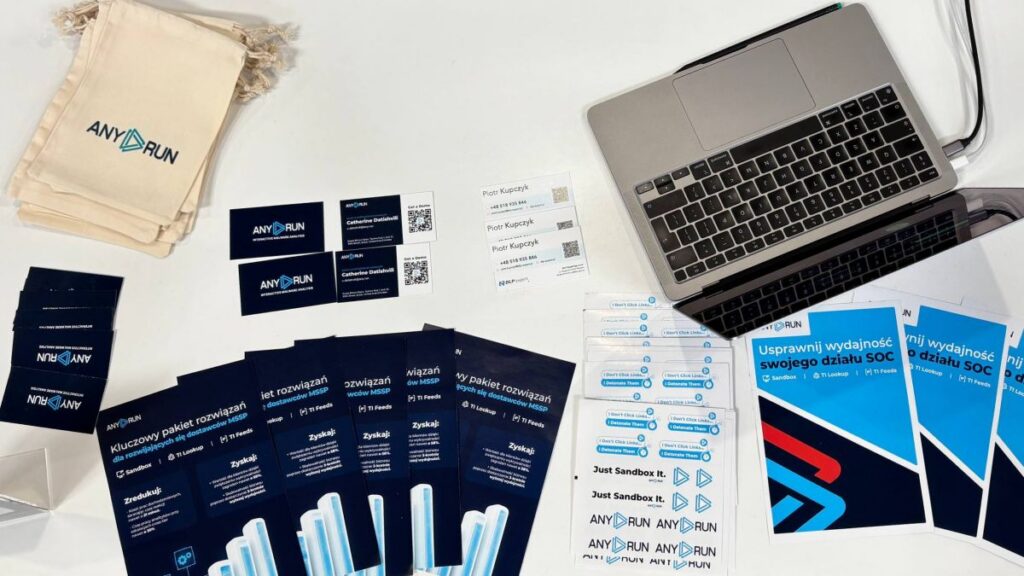
Over the past few weeks, the ANY.RUN team joined Infosecurity Europe in London, CONFidence Conference in Kraków, and C1b3rWall Congress in Ávila. While every event had its own focus, the discussions pointed in the same direction: security teams need faster investigations, clearer evidence, and more confidence in every response decision.
Infosecurity Europe 2026: From Alerts to Business Outcomes
Infosecurity Europe was the biggest stop of our conference season. Over three days in London, the ANY.RUN team met with CISOs, SOC leaders, and MSSP teams to discuss the challenges shaping security operations today.
One thing was hard to miss: the conversation has moved beyond alert volumes and technical metrics.
Our team at Infosecurity Europe 2026
Security leaders are under growing pressure to show how SOC performance supports the wider business. Boards do not simply want to know how many alerts were reviewed or how quickly a case was closed. They want to understand whether threats are identified early, whether risks are clearly assessed, and whether the team can act before an incident affects operations.
Three priorities came up repeatedly during our conversations:
From Alerts to Outcomes
MTTR still matters, but the number alone does not tell the full story. Security teams need enough context to understand the impact of a threat, prioritize the right cases, and explain their decisions clearly.
Behavioral analysis plays an important role here. By investigating suspicious files and URLs inside an interactive environment, teams can see how a threat behaves in real time and gather the evidence needed for a more confident response.
Give your SOC clearer visibility into every threat. Make faster decisions with confidence.
Security teams are not looking for another disconnected platform that adds extra steps to an already complex process.
They want fresh threat intelligence and investigation-backed insights inside the tools they already use, including SIEM, SOAR, and EDR platforms. This helps teams move from detection to investigation and response without losing time switching between separate systems.
Resilience Over Headcount
Growing alert volumes cannot always be solved by growing the team.
SOC leaders are looking for ways to make existing workflows more effective: reducing manual work, giving teams clearer evidence, and helping junior specialists handle routine investigations with greater confidence.
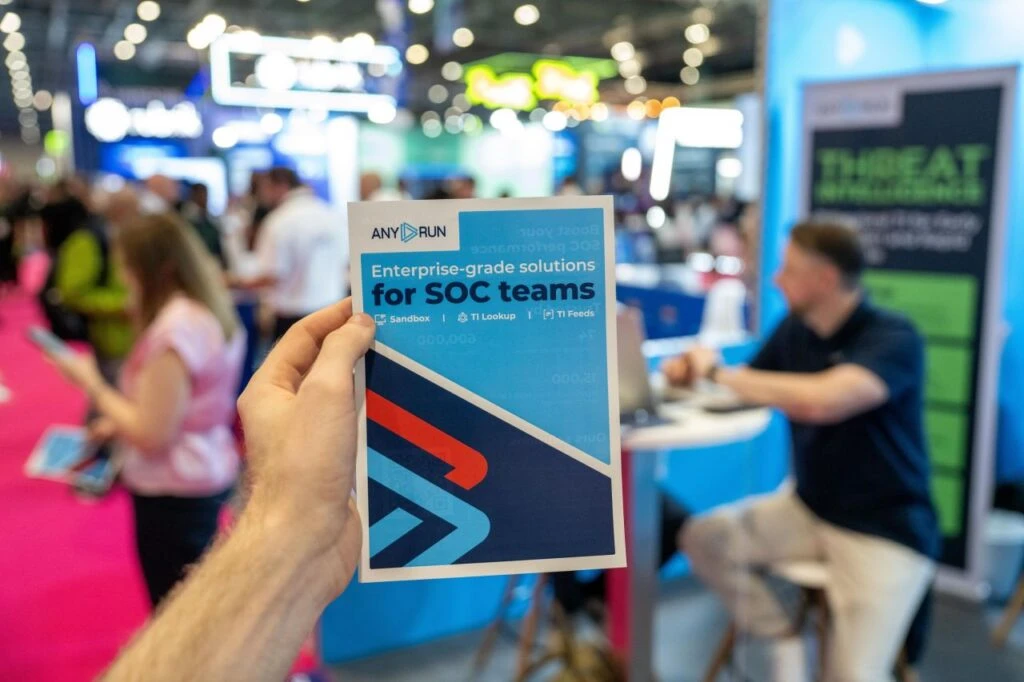
We introduced our enterprise-grade solutions for SOC teams
The goal is not simply to process more alerts. It is to build a more resilient SOC that can make consistent decisions even when the pressure rises.
Infosecurity Europe was a valuable opportunity to discuss these priorities directly with the cybersecurity community and explore how behavioral visibility and live threat intelligence can support faster, clearer, and more reliable investigations.
CONFidence Conference 2026: Practical Conversations with the Security Community
Our next stop was CONFidence Conference in Kraków, where we joined cybersecurity professionals for two days of technical discussions, live demos, and conversations about the realities of modern threat investigation.
Many of the challenges were familiar: rising alert volumes, increasingly sophisticated phishing campaigns, and the need to investigate threats faster without adding more pressure to already busy teams.
At the ANY.RUN stand, visitors explored how behavioral visibility, investigation-backed threat intelligence, and cross-platform detection coverage can help SOCs and MSSPs analyze malware and phishing more consistently.
But choosing the right security solution is not only about detection capabilities. Teams also need to know how they fit into their wider security environment: how sensitive data is handled, whether it supports controlled workflows, and whether the provider has the experience needed to support critical investigations.
A little behind-the-scenes prep before the conversations began
These questions matter even more for organizations operating in regulated industries, where security tools need to support effective threat response while meeting strict internal compliance requirements.
This is an area ANY.RUN has continued to strengthen throughout its 10 years in cybersecurity. Today, our malware analysis and threat intelligence solutions are used by more than 15,000 organizations worldwide, including 74 of the Fortune 100 companies. ANY.RUN is also SOC 2 Type II attested, reflecting our commitment to strong security controls and careful handling of customer data.
Strengthen your SOC with secure, controlled workflows. Support faster response without compromising compliance.
C1b3rWall Congress 2026: Exploring Ransomware Analysis in Action
Our final stop was C1b3rWall Congress in Ávila, where cybersecurity professionals from both the public and private sectors gathered at the National Police School to discuss the threats shaping today’s security landscape.
The event gave us a chance to look more closely at one of the most pressing challenges for security teams: ransomware.
During our session, we demonstrated how ransomware can be analyzed inside ANY.RUN’s Interactive Sandbox and showed how interactive analysis helps teams move beyond a basic verdict.
C1b3rWall Congress 2026 in Ávila, Spain
Instead of simply confirming that a file is malicious, teams can observe how the attack unfolds in real time, identify suspicious processes, examine network activity, and understand the sequence of actions behind the threat.
This kind of visibility is especially valuable when every decision matters. It gives security teams the context they need to assess risk faster, document their findings, and respond with greater confidence.
C1b3rWall was also a valuable opportunity to connect with professionals working across different sectors and discuss how clearer behavioral evidence can support stronger, more reliable investigations.
Join 74 of the Fortune 100 companies that trust ANY.RUN.
Build a more resilient SOC with stronger threat visibility.
These events gave us the opportunity to connect with security professionals across Europe, exchange ideas, and discuss the challenges teams are facing today.
The message was clear: faster investigations matter, but so do visibility, trust, and control. Security teams need solutions that help them act with confidence, even when the pressure is high.
These conversations will continue to shape how we develop ANY.RUN and support SOCs and MSSPs worldwide.
Thank you to everyone who stopped by, shared their experience, and joined the discussion. See you at the next events.
About ANY.RUN
ANY.RUN, a leading provider of interactive malware analysis and threat intelligence solutions, helps SOC teams, MSSPs, and enterprises investigate threats faster and make more confident security decisions.
With its cloud-based Interactive Sandbox, security teams can safely analyze suspicious files, URLs, and emails in real time, observe malicious behavior, and collect clear evidence for response without maintaining complex in-house infrastructure.
ANY.RUN’s Threat Intelligence solutions also help organizations uncover deeper threat context, enrich security workflows, and improve visibility into emerging risks. Together, these capabilities support faster triage, stronger threat response, and more efficient security operations at scale.
https://www.backbox.org/wp-content/uploads/2018/09/website_backbox_text_black.png00adminhttps://www.backbox.org/wp-content/uploads/2018/09/website_backbox_text_black.pngadmin2026-06-11 10:06:332026-06-11 10:06:33From Infosecurity Europe to CONFidence and C1b3rWall: What Security Teams Are Prioritizing in 2026
https://www.backbox.org/wp-content/uploads/2018/09/website_backbox_text_black.png00adminhttps://www.backbox.org/wp-content/uploads/2018/09/website_backbox_text_black.pngadmin2026-06-11 06:06:332026-06-11 06:06:33SMB cyber-readiness: What makes or breaks it
Talk to any threat hunter long enough, and beneath the polished case studies and conference talks, the same frustrations surface. Hunting is supposed to be proactive. In practice, it often feels reactive. You are chasing whispers of activity through log noise, querying SIEM fields that barely reflect real attacker behavior and writing detections against technique descriptions that were never meant to be operationalized directly.
The challenge is not that analysts lack skill. Most hunting teams are sharp, methodical, and deeply familiar with attacker playbooks. The real friction is structural: the intelligence feeding hunts is often stale, decontextualized, or missing the behavioral granularity needed to write anything more than a broad, noisy detection.
The core tension
Threat hunting is a high-skill, time-intensive activity that justifies itself by finding what automated systems miss. But when the intelligence inputs are low-fidelity, even the most skilled hunters spend the majority of their time generating work rather than reducing risk.
MITRE ATT&CK tells you a technique exists. It does not tell you how it behaves in a real attack chain against a real target. That gap between abstract TTP and concrete execution behavior is where many hunts quietly die. IOCs arrive stripped of context: you block an IP, a rotated domain from the same campaign lands in your environment three days later, and sails straight through.
And then there is the false-positive problem. Not a technical inconvenience but a morale and process killer. Every alert that turns out to be Outlook talking to a Microsoft licensing server erodes confidence in the detection pipeline. Over-tuned rules miss real threats; under-tuned rules train analysts to discount the queue.
In this article, we’ll explore how threat intelligence supports core hunting workflows and how ANY.RUN’s Threat Intelligence solutions help analysts investigate threats with greater speed and confidence.
Key Takeaways
Threat hunting fails structurally, not skillfully. The bottleneck is intelligence quality.
Behavioral context beats indicators. A single IOC blocked solves nothing if the campaign behind it isn’t understood. Pivoting from one artifact — a mutex, a file path, a Suricata tag — into a full attack chain is what separates hunting from blocklisting.
Hypothesis validation requires real attack data. ATT&CK describes techniques in the abstract. Effective hunting needs to know how a technique behaves in live, active campaigns — which tools operationalize it, what infrastructure it touches, what artifacts it leaves.
False positives are a strategy problem, not just a noise problem. Every low-fidelity alert that consumes analyst attention is a detection that wasn’t built right. Validating rules against real samples before deployment is the difference between a detection pipeline and a distraction pipeline.
Intelligence layers serve different operational needs.TI Lookup drives active investigations; TI Feeds keep automated defenses current; TI Reports bridge the gap between raw campaign data and detection engineering or executive briefings.
AI-assisted triage is a force multiplier, not a replacement. Tier 1 reports, AI summaries, and sandbox recommendations don’t replace analyst judgment — they eliminate the translation work between analysis output and operational action, freeing analysts for work that actually requires them.
Hunting ROI is measurable — if you instrument it correctly. Earlier detection, defense calibrated to active threats, and analyst time redirected to genuine risk: each is quantifiable. Programs that cannot demonstrate these outcomes don’t lack value — they lack the intelligence infrastructure to produce it consistently.
1. Hypothesis Validation: Device Code Phishing
Scenario: A hunter develops a hypothesis: adversaries may be abusing Microsoft’s Device Code authentication flow to compromise organizational accounts without triggering MFA. The technique is real, but the team needs evidence it is active now and a way to identify the behavioral signatures that distinguish attacks from legitimate device authorization.
The struggle: Generic queries against authentication logs produce enormous volume. Without knowing what a malicious device code flow actually looks like in practice — which referrer domains initiate the redirect, which PhaaS kits are operationalizing the technique, what the email delivery chain looks like — the team is essentially querying blind.
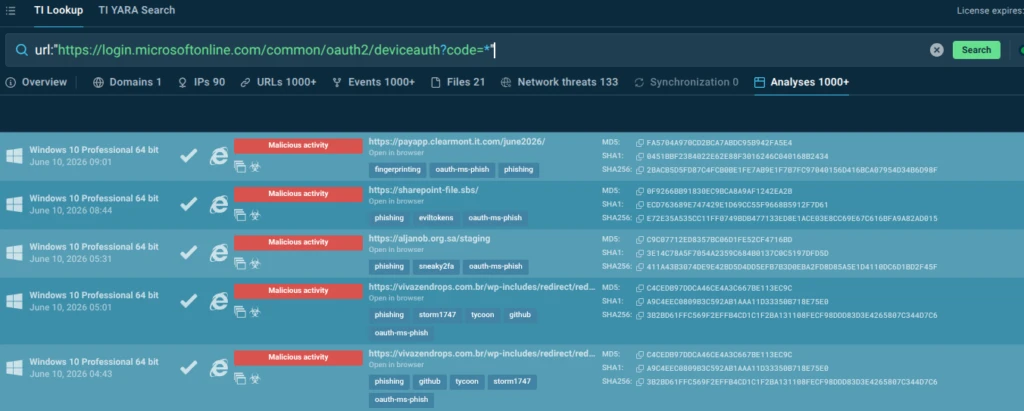
The solution: TI Lookup allows the hunter to query the Microsoft device auth endpoint directly and immediately retrieve sandboxed sessions where the technique is observed in the wild.
Sessions are tagged automatically: Phishing, oauth-ms-phish, and kit-specific tags like Kali365 (a PhaaS platform specializing in Device Code Phishing).
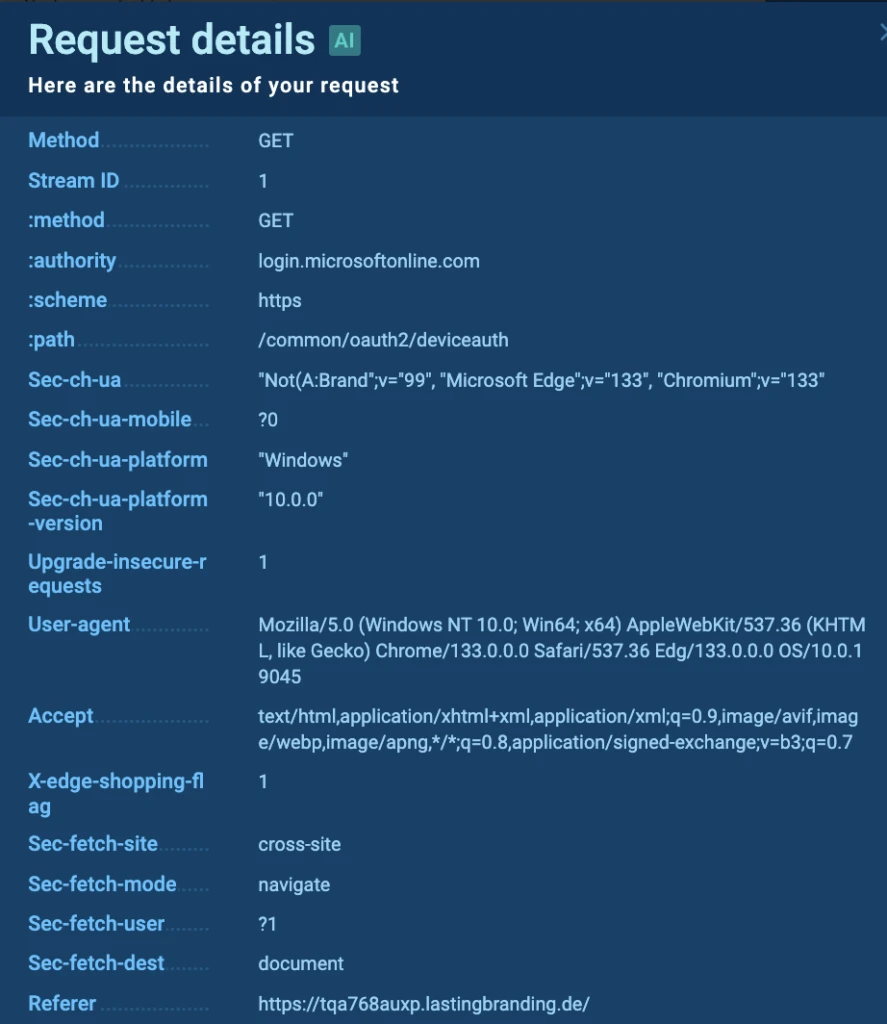
In live cases, the redirect to Microsoft’s legitimate device auth endpoint originates from external domains, including those with unusual TLDs.
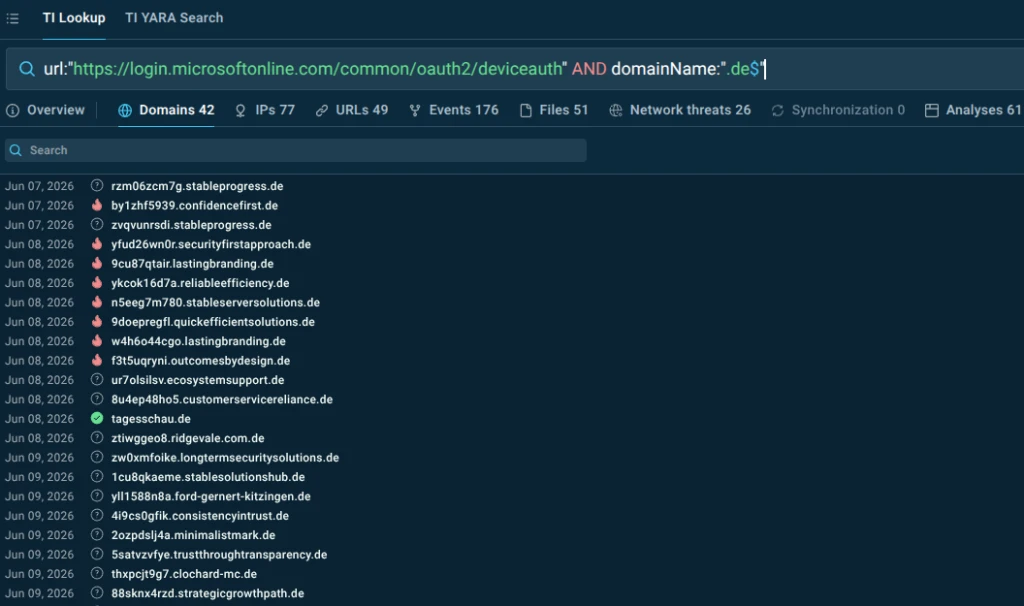
Redirect from .de domain
Subsequent queries can filter by TLD against the device code URL, giving the team a concrete list of suspicious referring domains to feed into SIEM monitoring or block lists.
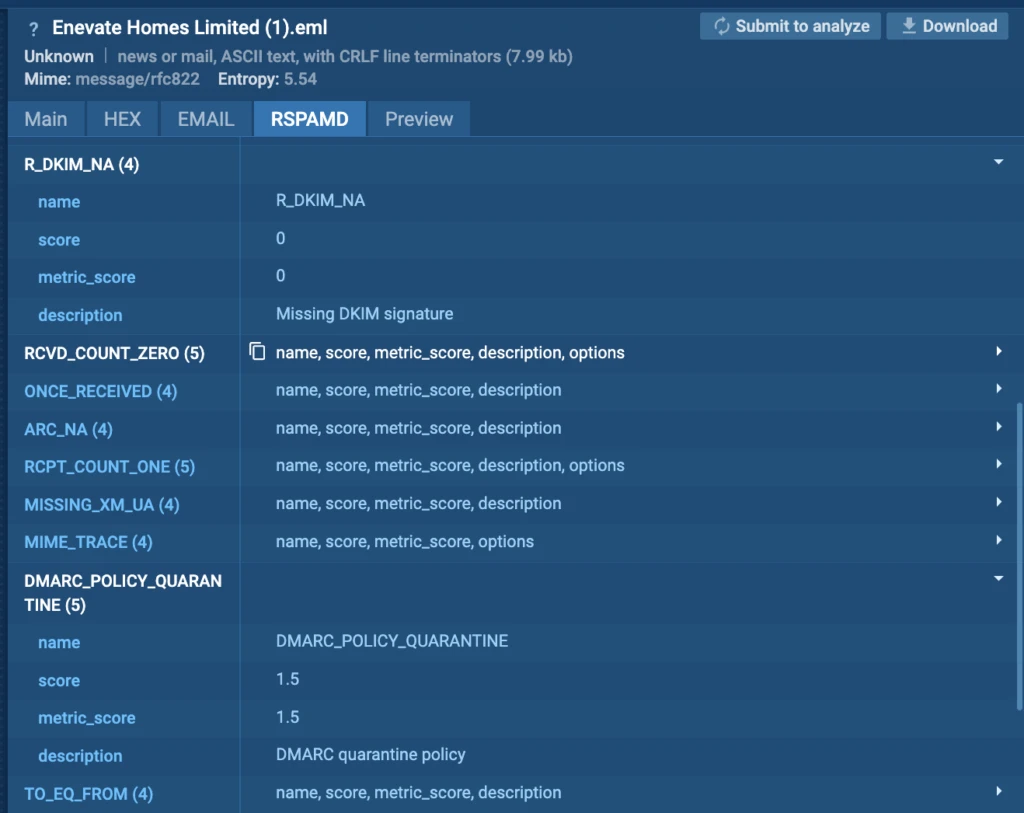
For more targeted investigation, the hunter can also query by threat name and file path to retrieve the actual phishing emails (.eml files) used to deliver the initial lure, exposing sender patterns, subject line templates, and infrastructure metadata.
Email metadata example
Impact:
Hypothesis validated against real, live attack data rather than technique abstractions.
Concrete IOCs and behavioral signatures ready for SIEM query development.
Email metadata exposed for deeper organizational log correlation.
2. Behavioral Pivots: Tracking a Stealer Family via Mutex
Scenario: A suspicious executable is submitted for analysis and identified as a stealer. The analyst notices a mutex with a hardcoded prefix — GlobalEVOLUTION — followed by a randomized suffix. The question is whether this prefix is unique to this malware family and, if so, how widely deployed it is.
The struggle: A mutex with a random suffix has no stable IOC value. Standard threat feeds will not carry it. Searching for the full string is guaranteed to miss variants. The behavioral pattern is clearly significant but there is no obvious path from a single sample to campaign-level coverage.
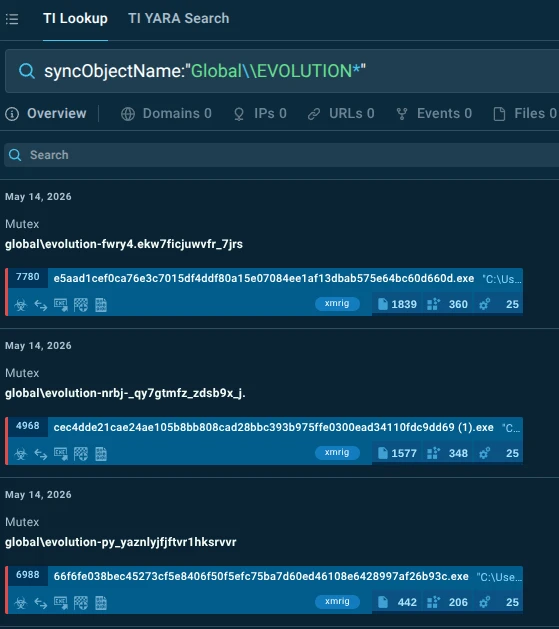
The solution: A wildcard query in TI Lookup (syncObjectName:”Global\EVOLUTION*”) immediately surfaces a number of additional samples sharing the same hardcoded prefix with different randomized tails, confirming the pattern is not incidental but a structural artifact of this malware family.
Malware samples with similar mutexes
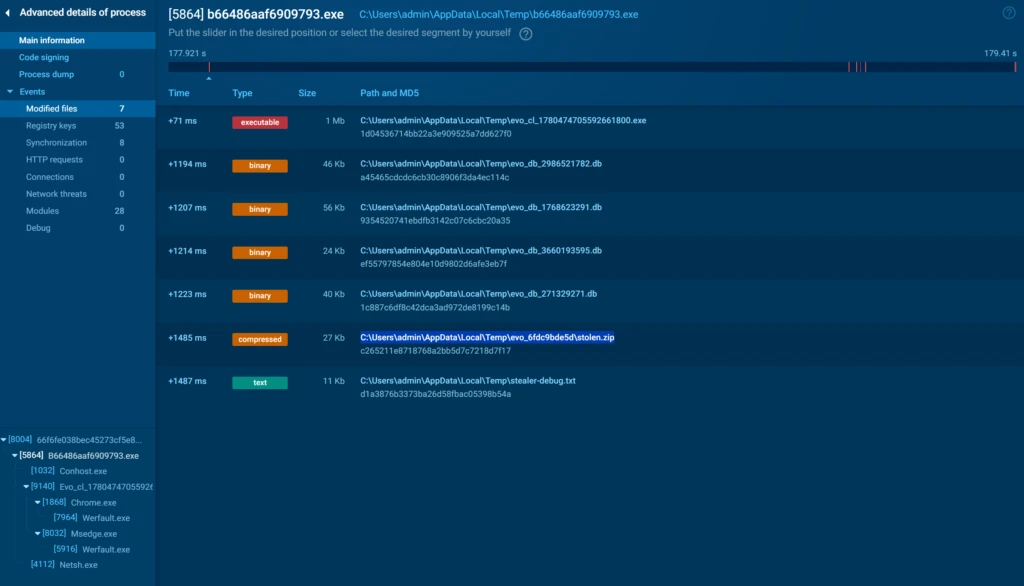
Cross-referencing the mutex results against file path artifacts reveals that affected systems consistently produce a dump archive at C:UsersadminAppDataLocalTempevo_[random]stolen.zip — a second independent behavioral indicator that definitely looks like a stealer.
File dropped in malware execution chain
Running OR and AND lookup combinations of both indicators allows the hunter to tune coverage: OR for maximum reach, AND for high-confidence, low-noise detections:
filePath:”C:UsersadminAppDataLocalTempevo_stolen.zip” OR syncObjectName:”GlobalEVOLUTION”
filePath:”C:\Users\admin\AppData\Local\Temp\evo_*\stolen.zip” AND syncObjectName:”Global\EVOLUTION*”
Starting from a single mutex observation, the hunter has now built a multi-indicator behavioral profile of an entire malware family.
Impact:
Single behavioral artifact expands into full campaign coverage.
Multi-indicator detection logic developed and validated before touching production systems.
No reliance on stable IOCs — detection survives malware updates.
Turn threat hunting into an intelligence-driven process.
Use ANY.RUN’s Threat Intelligence to validate hypotheses, enrich investigations, and uncover threats faster.
3. Enrichment: Suspicious Domain in an Inbound Email
Scenario: An email from an unknown sender arrives containing a link to an unfamiliar domain. Standard policy would flag this for review. The analyst needs to determine quickly whether the domain is genuinely malicious or simply unknown, and if malicious, what the full attack chain looks like.
The struggle: WHOIS data shows the domain is recently registered. Passive DNS shows limited history. Reputation feeds return no verdict. The analyst has a suspicious domain but no behavioral context — no sense of what the domain delivers, what it steals, or what infrastructure it connects to.
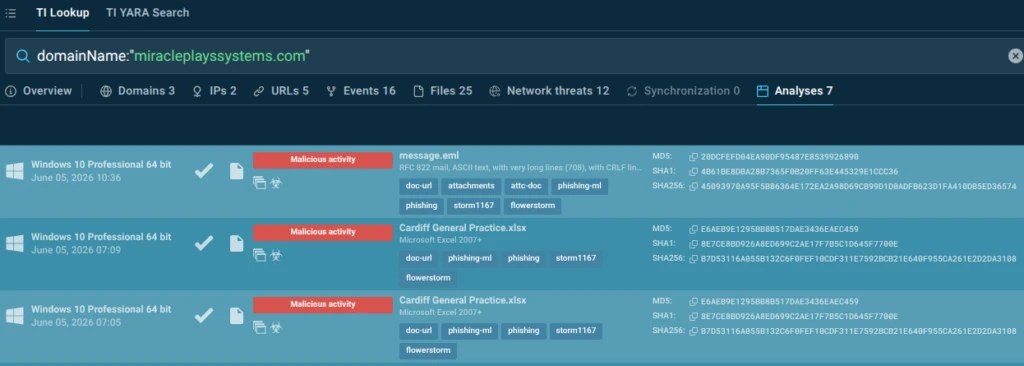
The solution: The domain search in TI Lookup returns sandbox sessions where the domain has been analyzed.
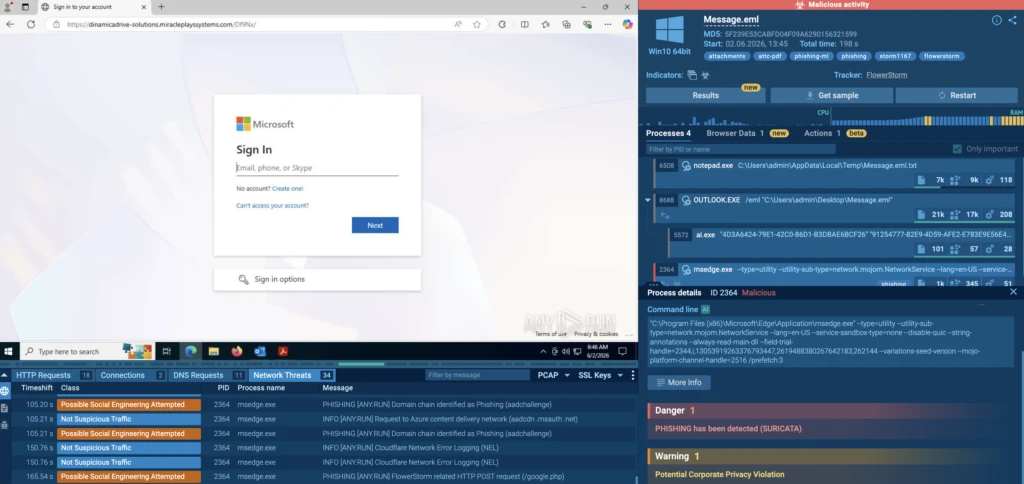
The hunter opens one and immediately sees a Microsoft 365 login page clone hosted on the suspicious domain, automatically tagged by ANY.RUN.
Malware sample detonated in the sandbox
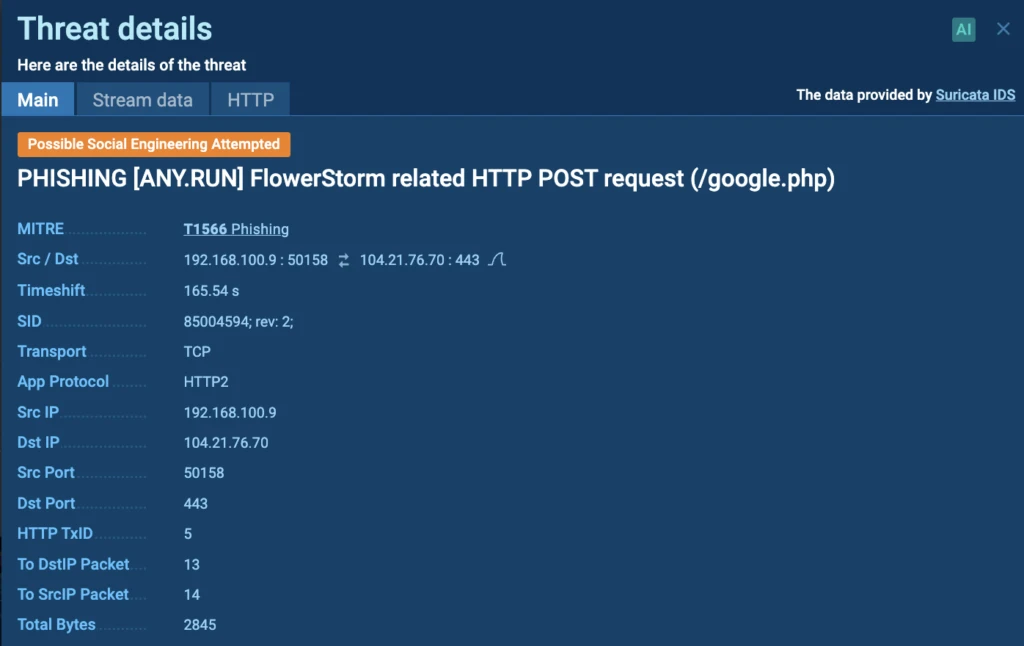
Suricata network threat detections reveal the specific phishing kit — FlowerStorm.
FlowerStorm phishkit detected
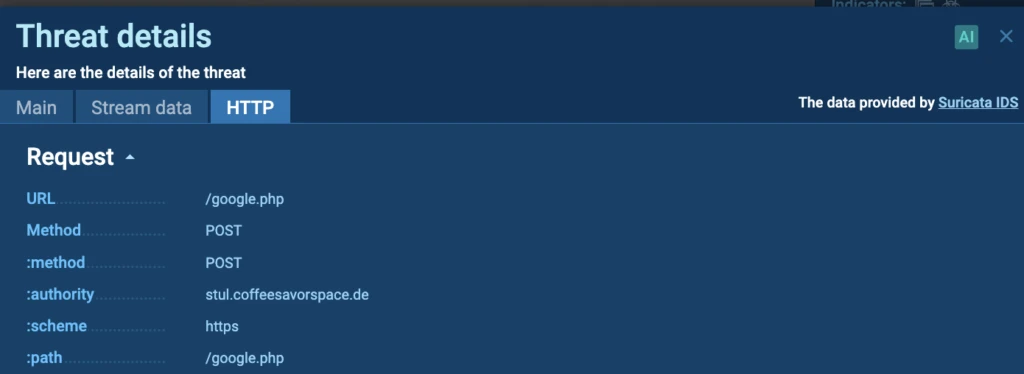
The rule details expose the exfiltration endpoint:
Data exfiltration endpoint
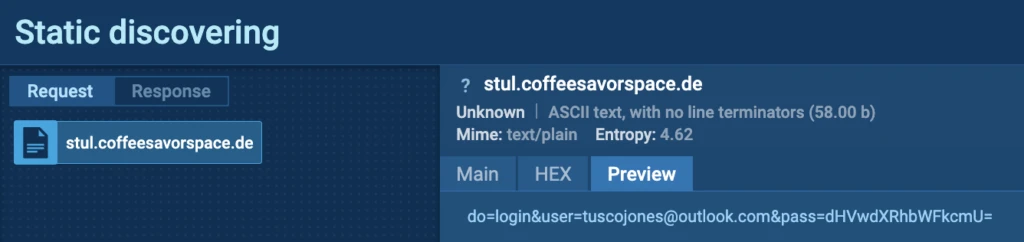
HTTP tab features a separate domain to which stolen credentials are posted:
The HTTP traffic view makes the data flow explicit: M365 credentials submitted to the fake login page are forwarded to infrastructure the attacker controls, not to any Microsoft domain.
User credentials sent to a phishing domain
This gives the analyst not just a verdict but a full attack chain — delivery domain, phishing kit identity, exfiltration endpoint — all from a single lookup.
Impact:
Unknown domain enriched with full attack chain in minutes.
Exfiltration infrastructure identified and added to block lists proactively.
4. Expansion: LOLBin Abuse and Campaign Attribution
Scenario: An alert fires: MSBuild.exe — a standard Microsoft .NET build component — is establishing a network connection to an unknown IP on a non-standard port. This is a textbook living-off-the-land technique, but the specific context (which campaign, which malware family, how widespread) is unknown.
The struggle: MSBuild.exe connecting outbound is not inherently malicious; it is used legitimately in CI/CD pipelines. The challenge is distinguishing targeted abuse from normal build activity and understanding whether the destination IP is part of a broader campaign or an isolated incident.
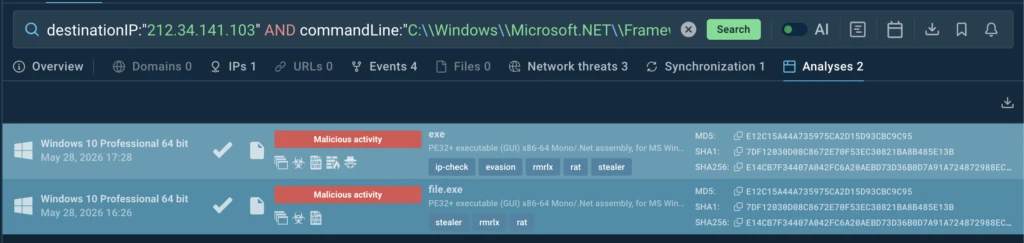
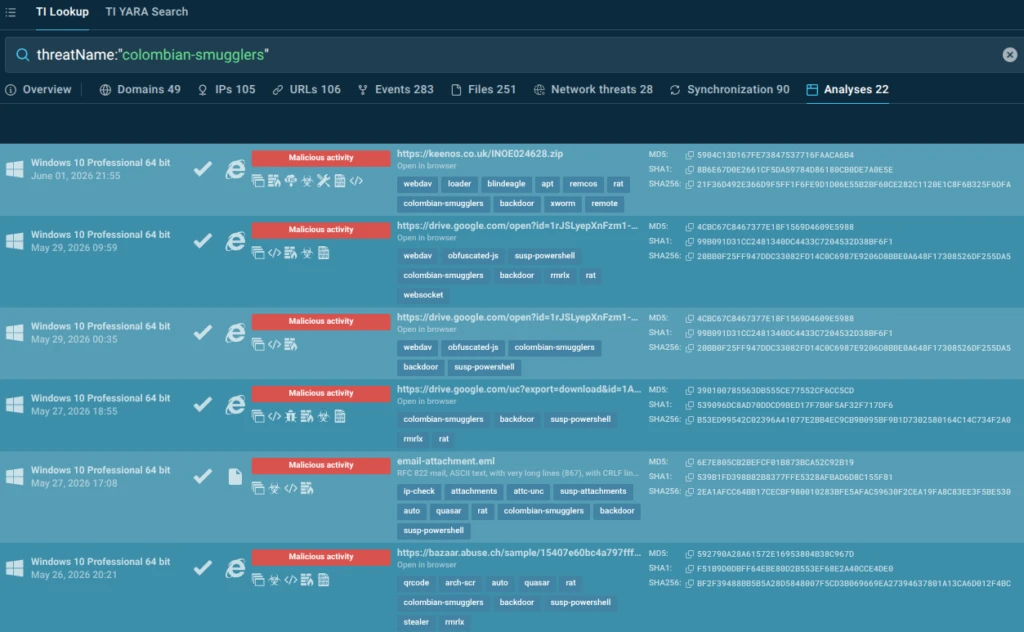
The solution: Combining the destination IP with the MSBuild.exe command-line pattern in a TI Lookup query surfaces sessions where the same combination has been observed.
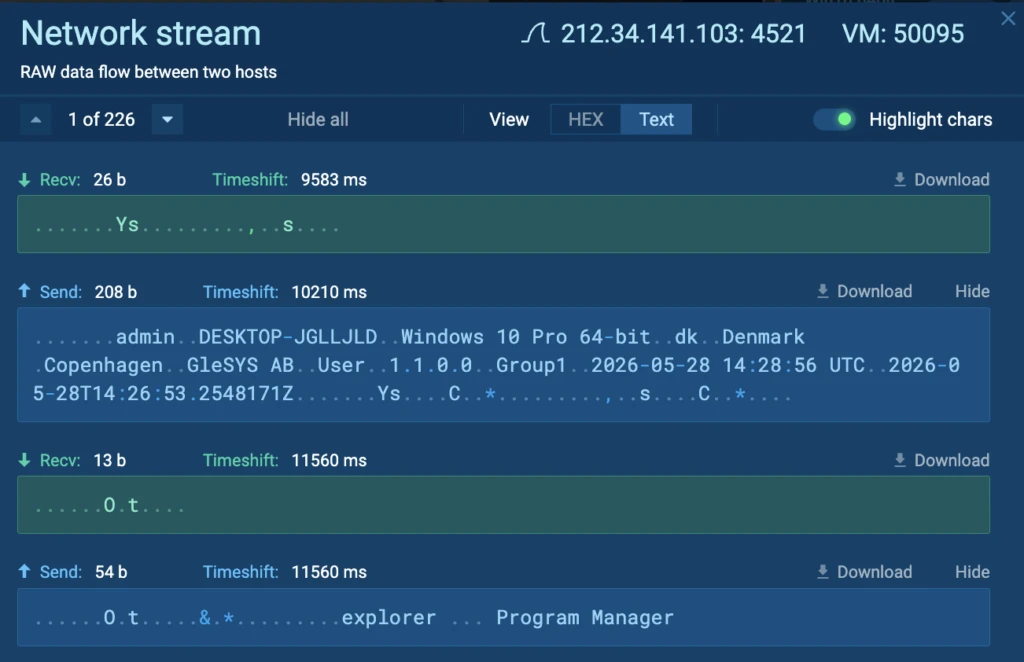
Opening a representative session shows MSBuild.exe establishing a C2 connection and exfiltrating host reconnaissance data — CPU, OS version, running processes:
Malicious activity in network stream
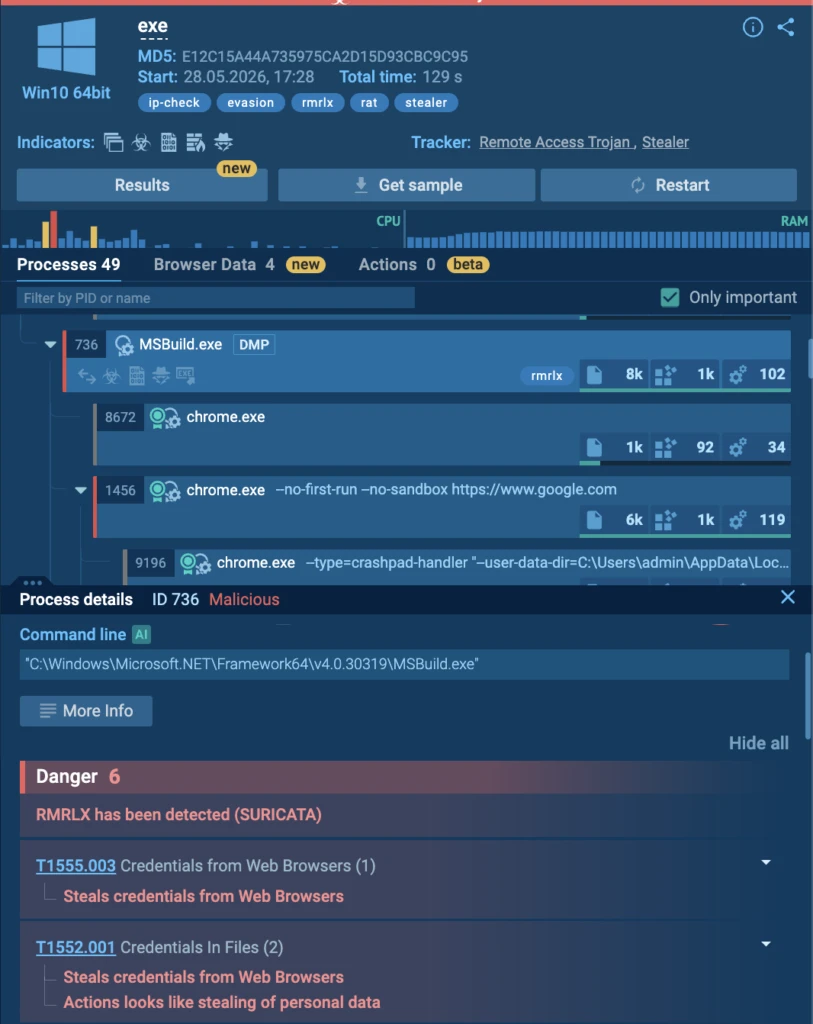
The Processes tab in the sandbox shows what user data gets exfiltrated:
Malware stealing user credentials
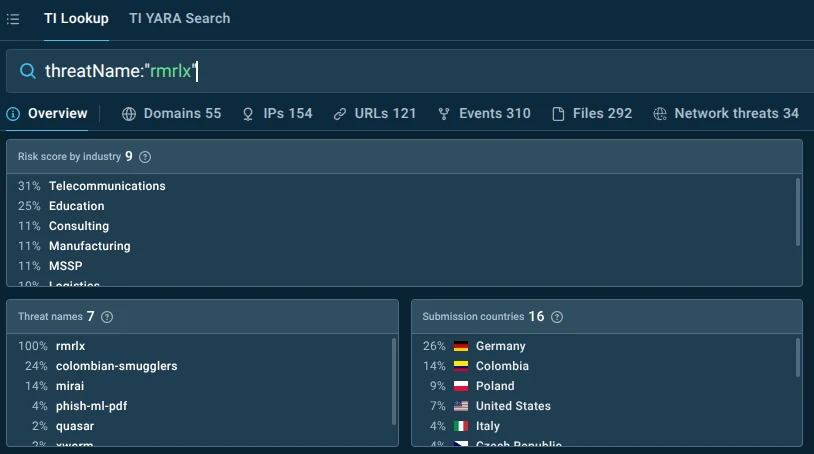
A vendor-specific detection tag (rmrlx) links this activity to a named malware family:
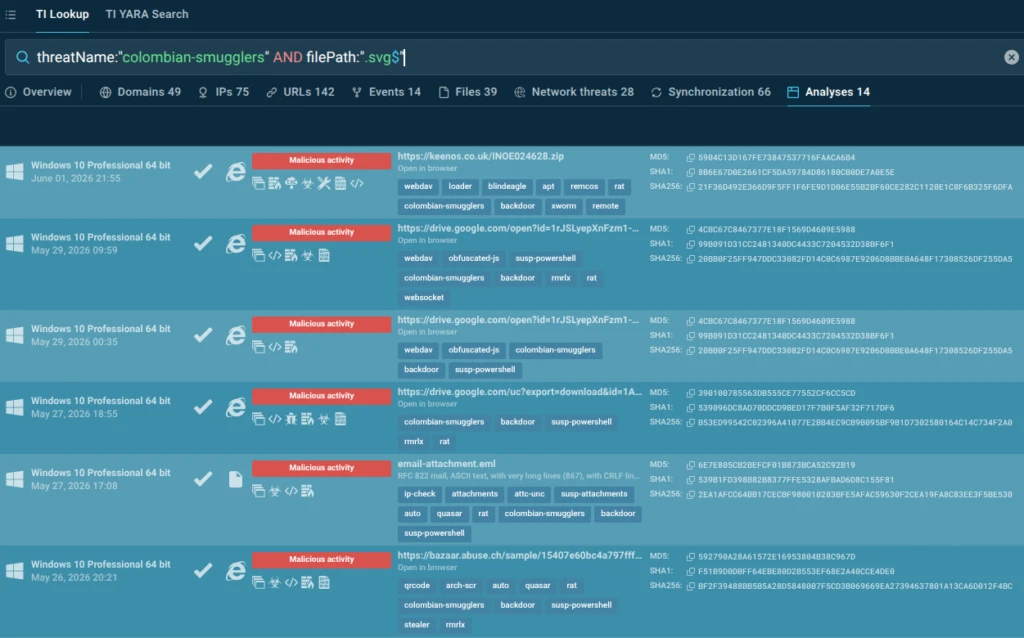
Pivoting on that tag reveals associated infrastructure across multiple IP addresses and exposes the threat actor group responsible — Colombian Smugglers — which uses SVG smuggling as a delivery mechanism and has evolved from targeting Colombian organizations to targeting US and European companies. The hunter can now see the full threat actor profile: initial delivery technique (SVG smuggling), malware families used (vjw0rm, quasar, remcos, xworm, rmrlx), geographic targeting, and infrastructure overlap with adjacent groups like BlindEagle.
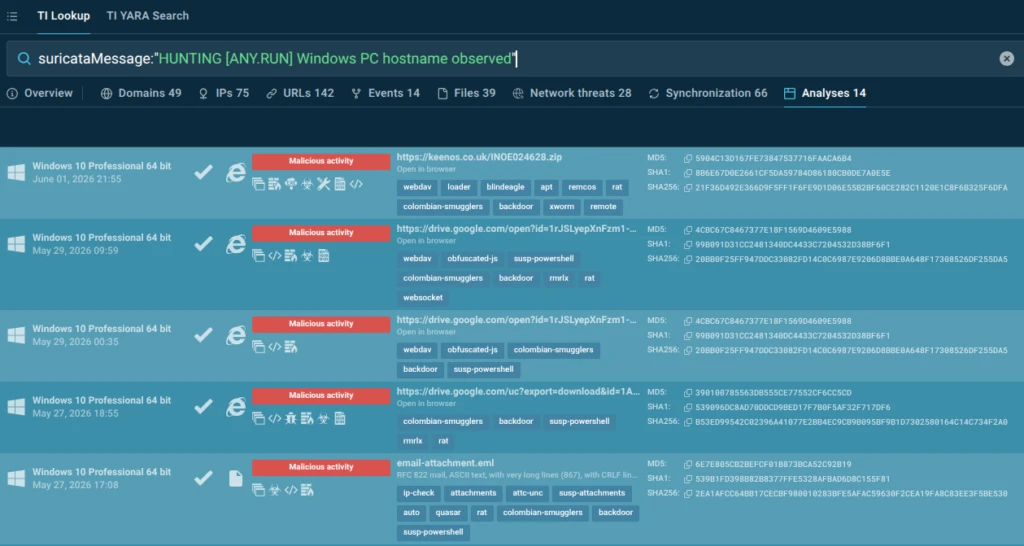
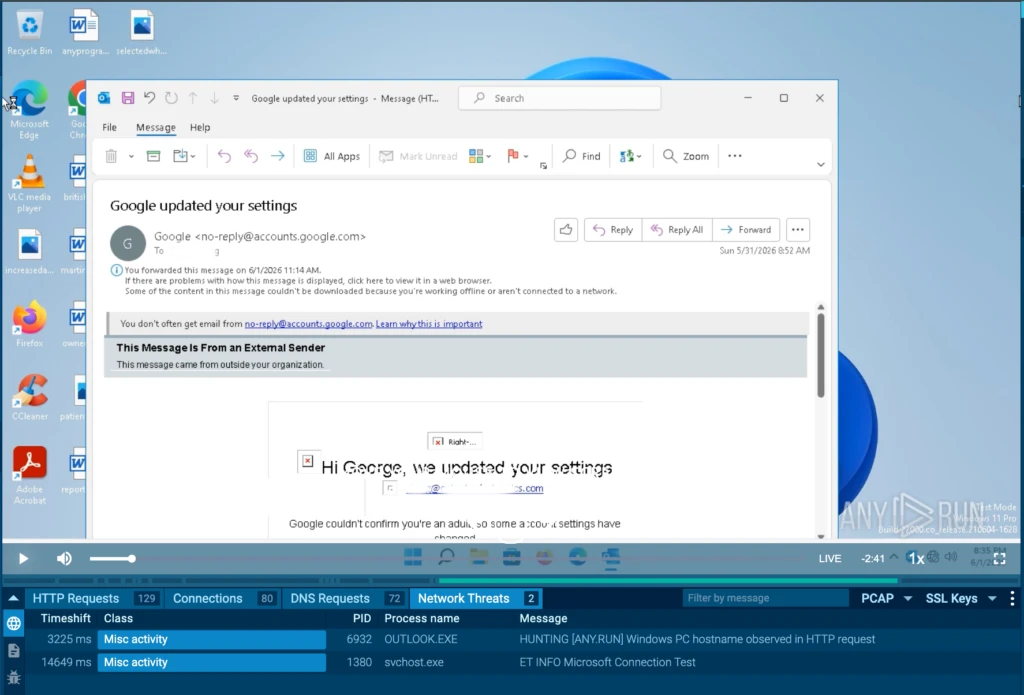
Scenario: ANY.RUN’s hunting rules include a signature that fires when a Windows PC hostname is observed being transmitted in network traffic — a behavior common to stealers and RATs that use hostname as a victim identifier.
The rule catches real threats, but the analyst needs to verify that every hit is genuinely malicious before adding it to production detection.
The struggle: Hunting rules cast wide nets by design. A rule targeting hostname exfiltration will fire on legitimate software that also transmits device identifiers. Without behavioral context, distinguishing malicious exfiltration from legitimate telemetry requires manual investigation of every hit.
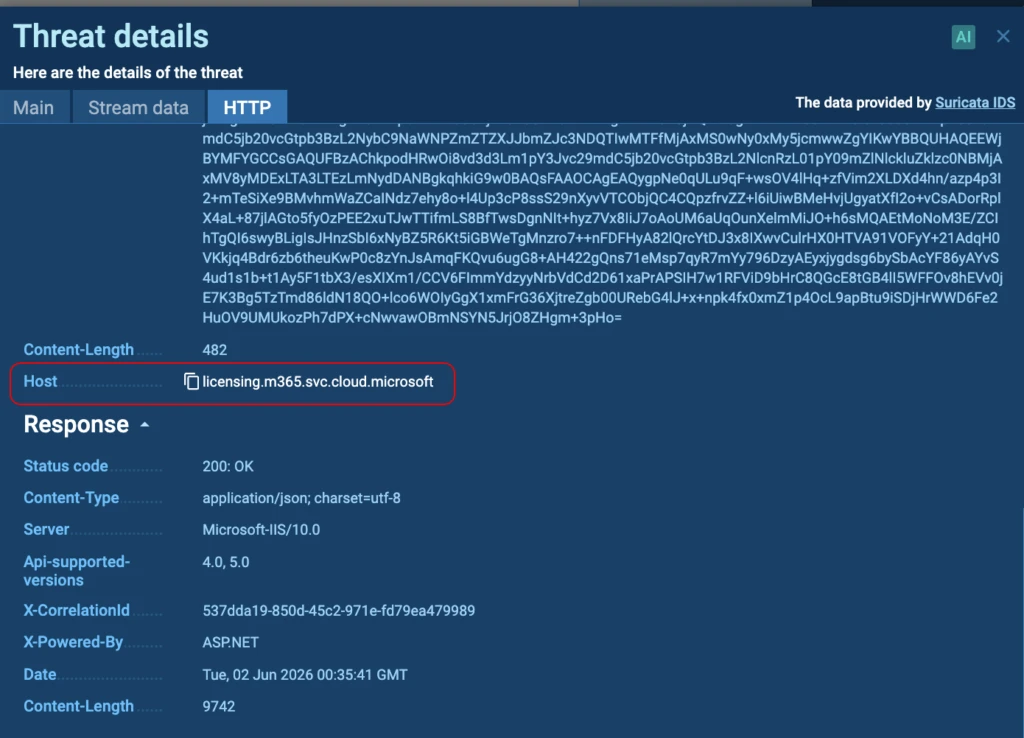
The analyst sees the Suricata alert firing on Outlook.exe, but the destination is licensing.m365.svc.cloud.microsoft, a legitimate Microsoft licensing endpoint.
Legitimate Microsoft domain in threat detection
The HTTP details confirm the behavior: Outlook is sending device and license metadata as part of a standard Office perpetual license renewal (renewperpetuallicense), and the server responds with a 200 OK confirming the HomeBusiness2021Retail license status. This is unambiguously legitimate. The analyst documents this as a known false-positive pattern and adds an exclusion for Microsoft licensing endpoints — keeping the rule sharp without discarding it.
Impact:
False positive identified and documented before reaching production.
Detection logic refined without reducing coverage of genuine threats.
Analyst time focused on confirmed malicious activity.
6. Detection Engineering: YARA Rule Development and Validation
Scenario: During stealer sample collection, an analyst encounters a .NET executable that drops a zip archive named with a consistent pattern: Unix-[HOSTNAME]-[ID].zip. The behavioral artifact is interesting but the analyst wants to build a durable, validated detection rule, not just add a file path indicator that will break when the malware author changes the naming convention.
The struggle: Writing YARA rules against behavioral artifacts requires understanding what strings are genuinely hardcoded into the binary versus what is generated at runtime. Testing rules against a small sample set risks both false positives from broad string matches and false negatives from a sample set too small to represent the full malware family.
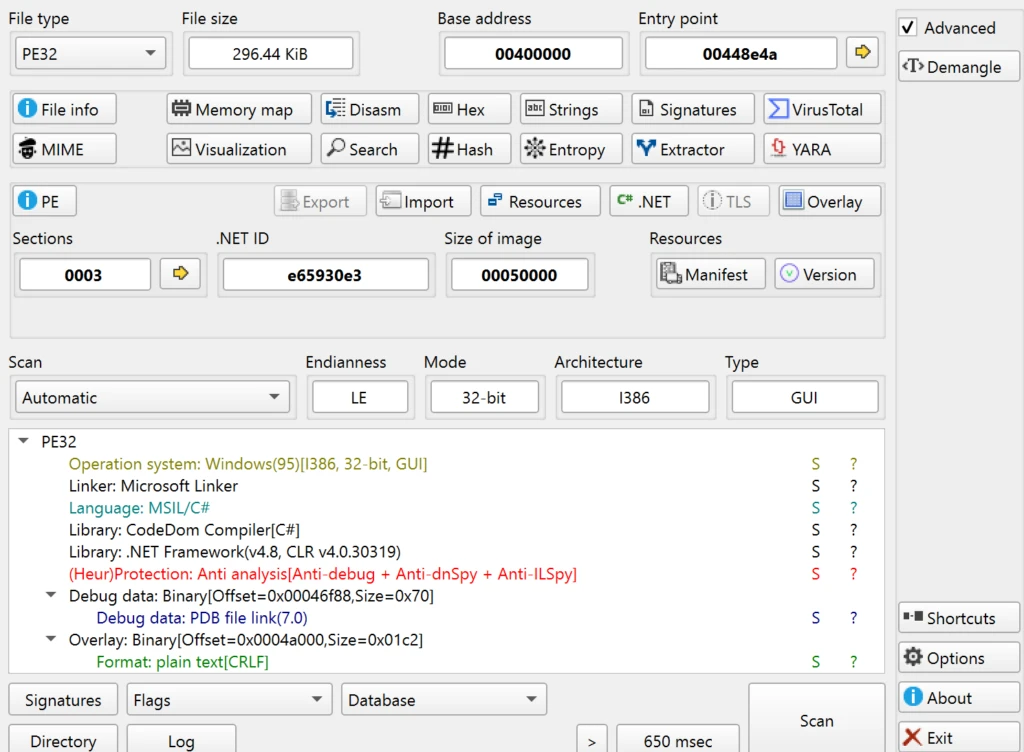
The solution: Static analysis of the .NET binary in Detect It Easy reveals human-readable strings embedded in the assembly — a common characteristic of .NET malware.
Static analysis of malware sample
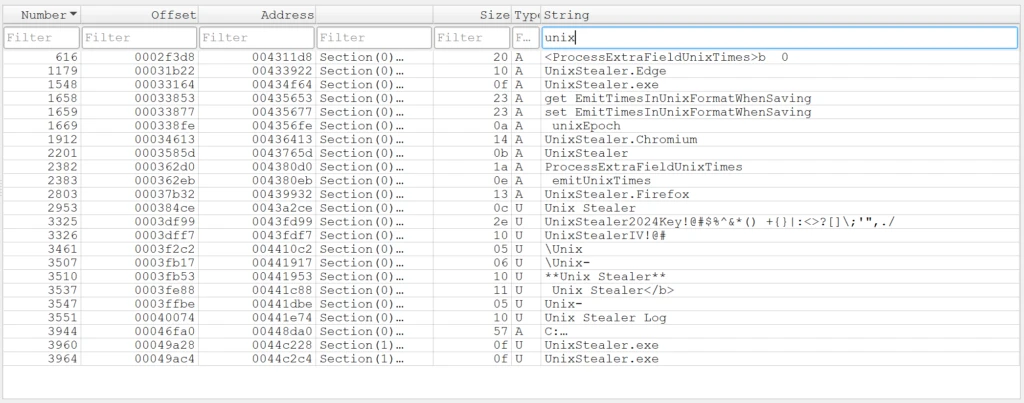
Filtering for strings containing “Unix” surfaces several hardcoded identifiers specific for this malware:
Unix Stealer Log
UnixStealer
UnixStealerIV!@#
UnixStealer2024Key!
Searching for *unix* strings
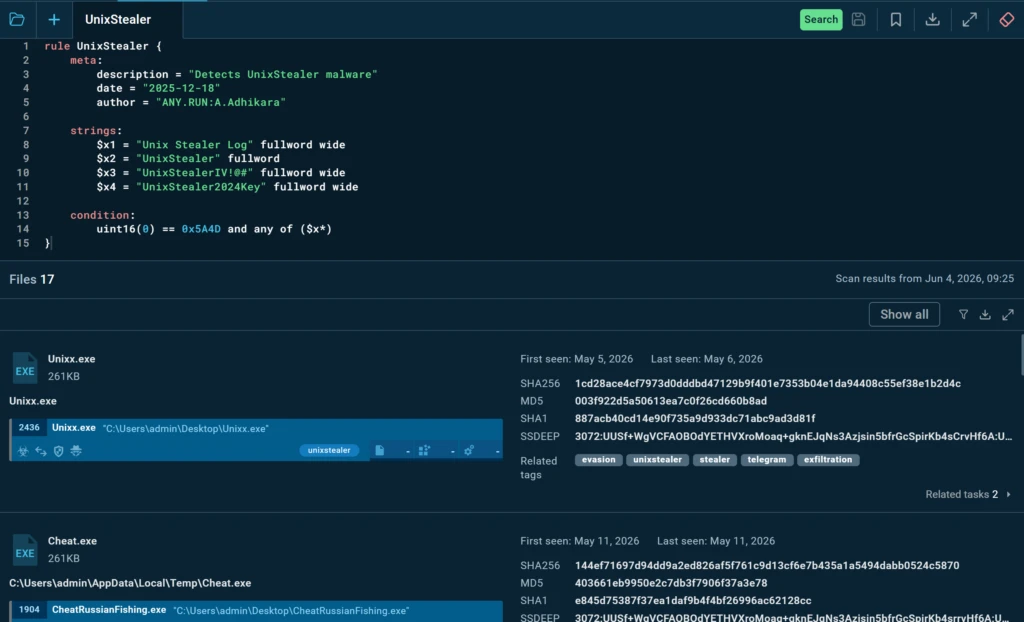
A YARA rule built around these strings uses wide matching for Unicode-encoded strings and fullword to minimize false positives.
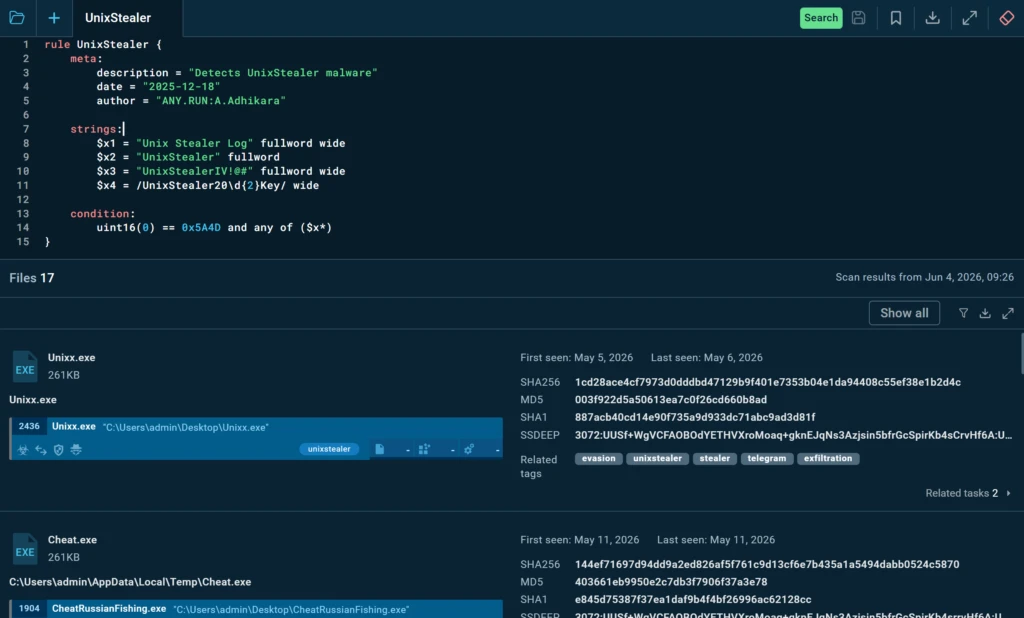
Running the rule through TI Lookup’s YARA Search validates it against millions of real malware samples — returning 17 matching samples with no unrelated hits.
Malware samples found by the YARA rule
Noticing that the year is hardcoded in one string, the analyst refines it to a regex pattern (/UnixStealer20d{2}Key/ wide) to ensure the rule covers future builds where the author updates the year.
Optimized YARA rule
Re-validation against the corpus confirms the refined rule catches the same 17 samples and introduces no new noise.
Impact:
YARA rule validated against millions of real samples before deployment.
Rule designed to survive malware version updates through regex generalization.
Detection shipped with high confidence — no post-deployment tuning required.
How Threat Intelligence Feeds Support Threat Hunting
WhileTI Lookup excels at interactive investigations, Threat Intelligence Feeds help operationalize hunting at scale.
Threat Intelligence Feeds can be integrated directly into SIEM, EDR, XDR, SOAR, firewalls, and other security platforms, providing continuously updated indicators and threat context.
For threat hunters, this supports several key workflows:
Prioritizing investigations involving known malicious infrastructure.
Correlating internal telemetry with active attacker infrastructure.
Identifying emerging campaigns before internal detections trigger.
Automating enrichment during hunts.
Reducing manual IOC collection and maintenance.
By continuously injecting fresh intelligence into security tooling, feeds allow hunting teams to focus on analysis rather than data gathering.
Accelerating Hunts with Sandbox Intelligence
ANY.RUN’s Interactive Sandbox provides additional capabilities that reduce investigation time and improve analyst productivity.
Tier 1 Reports
Tier 1 Reports automatically summarize malware behavior in analyst-friendly language, making it easier for junior and mid-level analysts to understand threats without spending significant time reviewing every artifact manually.
This helps SOC teams rapidly assess suspicious files and decide whether deeper hunting activities are necessary.
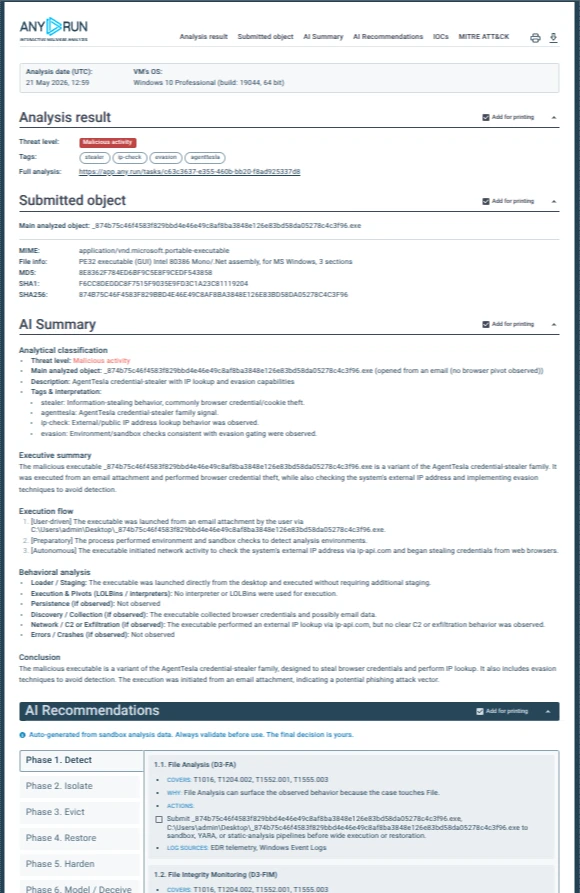
AI Summary
AI Summary condenses complex malware executions into concise narratives, highlighting the most important findings, suspicious behaviors, and attack stages. Hunters can quickly understand what happened during execution before diving into technical details.
AI Recommendations
AI Recommendations suggest potential next steps for investigation, including relevant artifacts, indicators, and behaviors worth examining further. This helps analysts identify additional hunting opportunities and reduces the likelihood of missing important evidence.
Tier 1 report with AI summary and recommendations
Build a faster, more scalable hunting program with ANY.RUN Threat Intelligence. Equip analysts with actionable context and leaders with measurable security outcomes.
Threat hunting is often discussed as a purely technical discipline, but its ultimate purpose is business protection. Organizations invest in hunting because reactive security alone is no longer sufficient. Modern attackers frequently evade automated detections, abuse legitimate tools, and remain hidden for extended periods.
However, threat hunting itself introduces operational challenges:
Significant analyst time requirements.
Skill shortages.
Investigation fatigue.
High volumes of telemetry.
Difficulty prioritizing hunting activities.
Challenges demonstrating measurable business value.
Without proper intelligence support, threat hunting can become expensive and inefficient. Threat intelligence helps address these challenges by reducing investigation time, improving prioritization, increasing analyst productivity, and enabling teams to focus on the threats that matter most to the business.
The result is faster threat discovery, reduced dwell time, lower incident response costs, and improved resilience against advanced attacks.
For MSSPs, intelligence-driven hunting also enables more scalable operations, allowing analysts to investigate more environments without proportionally increasing staffing requirements.
Conclusion
Threat hunting is no longer about manually searching through massive volumes of logs and hoping to uncover something suspicious.
Successful hunting depends on context.
Threat intelligence provides that context by connecting indicators, behaviors, infrastructure, malware families, campaigns, and threat actors into a coherent picture. It transforms hunting from a reactive research exercise into a focused, intelligence-driven process.
With Threat Intelligence Lookup, Threat Intelligence Feeds, Threat Intelligence Reports, YARA Search, and AI-assisted analysis capabilities, SOC teams can validate hypotheses, enrich investigations, expand discoveries, improve detections, and reduce time spent on manual research.
The result is a threat hunting program that is faster, more scalable, and more closely aligned with both security and business objectives.
About ANY.RUN
ANY.RUN, a leading provider of interactive malware analysis and threat intelligence solutions, helps SOC teams, MSSPs, and enterprises investigate threats faster and make more confident security decisions.
With its cloud-based Interactive Sandbox, security teams can safely analyze suspicious files, links, and emails in real time, observe malicious behavior, and receive clear evidence for response without maintaining complex in-house infrastructure.
ANY.RUN’s Threat Intelligence solutions also help organizations uncover threat context, enrich security workflows, and improve visibility into emerging risks. Together, these capabilities support faster triage, stronger incident prevention, and more efficient security operations at scale.
ANY.RUN is SOC 2 Type II attested and committed to strong security control and customer data protection.
Threat hunting is a proactive security practice where analysts search for hidden threats, attacker activity, or signs of compromise that may not trigger traditional security alerts.
How is threat hunting different from incident response?
Incident response starts after a security event is detected. Threat hunting begins before an alert exists and focuses on discovering threats that may otherwise remain unnoticed.
Why is threat intelligence important for threat hunting?
Threat intelligence provides context about attackers, malware, infrastructure, and campaigns, helping analysts prioritize investigations and validate findings faster.
What hunting workflows benefit most from threat intelligence?
Hypothesis validation, behavioral hunting, threat enrichment, investigation expansion, false-positive analysis, and detection engineering all benefit significantly from threat intelligence.
How do threat intelligence feeds support hunters?
Threat intelligence feeds continuously provide fresh indicators and context that can be integrated into SIEM, EDR, SOAR, XDR, and other security platforms for automated enrichment and prioritization.
Can threat intelligence help reduce false positives?
Yes. Intelligence provides historical and behavioral context that helps analysts quickly determine whether suspicious activity is malicious or legitimate.
How do AI-powered investigation features help threat hunters?
AI summaries, recommendations, and analyst reports help hunters understand threats faster, identify relevant artifacts, and reduce time spent on manual investigation.
https://www.backbox.org/wp-content/uploads/2018/09/website_backbox_text_black.png00adminhttps://www.backbox.org/wp-content/uploads/2018/09/website_backbox_text_black.pngadmin2026-06-10 14:06:382026-06-10 14:06:38Intelligence-Driven Threat Hunting: How SOCs Find What Alerts Miss
Unchecked AI in the workplace quickly becomes a massive loophole for data leaks and security breaches. All too often, employees drop sensitive company data into public chatbots, or install rogue AI assistants on their own — in the process handing over way too much access. In a previous post, we broke down the different types of risky AI systems, and later shared some tips on how to turn off the built-in AI features on major tech platforms. Today let’s take a look at practical ways to block or restrict the unauthorized “helpers” employees might be using — from ChatGPT and Grammarly, to meeting bots like Fireflies and Read AI.
How to detect and restrict ChatGPT
ChatGPT is the biggest culprit when it comes to unauthorized AI use worldwide. A quick word of warning, though: an outright ban only sends users hunting for sketchy third-party sites or messaging app chatbots that hook into the same service. That’s why it’s always a good idea to offer an approved alternative before pulling the plug.
Detecting it: keep an eye on the NGFW or web filter for traffic heading to chat.openai.com, chatgpt.com, oaistatic.com, oaiusercontent.com, or cdn.oaistatic.com. It’s also smart to use EDR/EPP tools to scan browser histories, installed apps, and browser extensions across corporate devices.
Locking it down: use the firewall or web filter to block the entire AI Services category, and set up DNS to reroute traffic away from those OpenAI domains. Browser policies can also be used to ban ChatGPT-powered extensions. Better yet, block all extensions not on a pre-approved allowlist. Finally, use application controls and EPP solutions to stop users from installing the official desktop app (ChatGPT.exe or com.openai.chat).
How to detect and restrict Claude and Claude Code
Detecting it: use the NGFW or web filter to track traffic going to claude.ai, anthropic.com, *.anthropic.com, and api.anthropic.com. EDR/EPP or application control tools can also be used to scan employee computers for the desktop app (claude.exe).
Locking it down: drop a blanket block on the AI Services category through the NGFW or web filter, and tweak DNS settings to reroute traffic away from the aforementioned Anthropic domains. Next, use browser policies to shut down Claude-powered extensions. Finally, use application controls and the EPP platform to prevent users from installing the desktop app.
How to detect and restrict Perplexity AI
Detecting it: keep tabs on the NGFW or web filter to flag any traffic heading to *.perplexity.ai or pplx.ai.
Locking it down: just like the others, add the AI Services category to the NGFW or web filter blocklist, and use DNS routing to redirect traffic away from those domains.
Configure the browser to block third-party extensions from being installed. If Firefox is used in the organization, be aware that recent versions come with Perplexity built in. Luckily, these AI features can be turned-off company-wide using enterprise policies — specifically, by setting SidebarChatbot = blocked. The full list of tweaks can be found in the Firefox documentation.
How to detect and restrict DeepSeek
Detecting it: keep an eye on the NGFW or web filter for traffic hitting deepseek.com, chat.deepseek.com, api.deepseek.com, or platform.deepseek.com. For better precision, analyze the SNI (server name identification) in TLS connection requests. For mobile devices, look out for the official app (com.deepseek.chat).
Locking it down: blocklist the AI Services category on the NGFW or web filter, and reroute traffic to DeepSeek’s domains via DNS settings. Use browser policies to block third-party extensions, and lean on MDM/EMM tools to restrict the mobile app.
How to detect and restrict Mistral, xAI Grok, and Character.ai
The playbook for these tools is exactly the same as DeepSeek, so here’s the quick list of domains to watch for and block: chat.mistral.ai, mistral.ai, console.mistral.ai, grok.com, x.ai, api.x.ai, character.ai, beta.character.ai, and c.ai.
A quick word of warning on Grok: because Grok is baked into X, blocking this specific AI access point means blocking the entire social media platform.
How to detect and restrict Slack AI
Detecting it: in the Slack workspace admin dashboard, look under Analytics → Slack AI usage. If an enterprise plan is used, the detailed Slack logs can be searched for any events starting with the ai_ prefix.
Blocking it with policies: in the organization’s Slack settings, click through the Workspace settings → Roles & permissions → Feature access, and change the permission to “no one”. Slack has a step-by-step guide in their help center.
Locking it down: shutting this down at the network level is tricky; it can be pulled off with a finely tuned CASB solution in place. Also, don’t forget the importance of blocking rogue integrations and keeping external AI services from tapping into Slack data in the first place. We covered how to lock this down using OAuth controls in a previous post.
How to detect and restrict Zoom AI Companion
Detecting it: if a corporate Zoom subscription is in use, just head to Admin Center → Reports → AI Companion usage. Detecting Zoom’s AI when employees join external meetings or use free accounts is a lot tougher, but email filters can be set up to flag incoming AI-generated meeting notes by scanning for subject lines or text containing “Meeting summary” or “Meeting assets”.
Blocking it with policies: for the company’s own Zoom subscription, go to the Admin Portal → Account Management → Account Settings → Meeting → AI Companion and toggle it OFF for everyone.
Locking it down: unfortunately, AI Companion is baked into Zoom’s DNA, so the only real option is blocking Zoom altogether.
How to detect and restrict Grammarly
What looks like an innocent spellchecker is actually one of the biggest culprits for workplace data leaks.
Detecting it: check the NGFW or web filter logs for traffic hitting grammarly.com, *.grammarly.com, and gnar.grammarly.com. EDR and MDM/EMM tools can also be used to hunt down the standalone desktop apps (Grammarly Desktop.exe and the macOS version), as well as the Grammarly browser extension.
Locking it down: use firewalls to block those domains at the network level, and EPP to stop employees from installing the desktop app, browser extensions, or the Grammarly add-ins for Microsoft Word and Excel.
How to detect and restrict meeting assistants: Fireflies, Read.ai, Tactiq, Fathom, and Granola
This massive category of third-party SaaS tools records and analyzes meetings — creating a massive risk for data leaks. The trickiest part? Outside clients or vendors can bring these bots into a meeting just as easily as employees can.
Detecting them: run an audit on calendar invites, and look for bot participants using email domains like @fireflies.ai, @read.ai, @tactiq.io, @fathom.video, or @granola.ai. Zoom, Teams, or Google Meet logs can also be used to review external participants who joined past calls.
Locking them down: since it’s impossible to control what outsiders do, blocking these bots comes down to tightening meeting rules. The best moves are: blocking users from granting OAuth permissions for bots to join calls, restricting employees from inviting unapproved external participants, or locking down meeting recording access for external users. That last option is usually the least painful way to keep bots out without disrupting business.
How to detect and restrict AI code editors: Cursor, Windsurf, and the like
Detecting them: use EDR/EPP tools to scan for executables like cursor.exe or windsurf.exe. It’s also worth monitoring network traffic heading to cursor.com and windsurf.com, as well as traffic hitting various AI model API providers. Keep in mind that there’s a pretty extensive list of API hosts to monitor here, since these editors aren’t tied to just one specific AI vendor.
Blocking them with policies: these apps can be prevented from being installed by setting up filters based on the developer’s digital signature certificate. Alternatively, a strict application allowlist can be employed where only pre-approved software is allowed to run.
Locking them down: rely on the EPP/EDR platform to actively detect and block these applications from running.
How to detect and restrict local AI tools: Ollama, LM Studio, and GPT4All
On one hand, this category carries fewer data leak risks because the AI models run completely locally on the user’s machine. On the other hand, it opens up a whole new can of worms: these apps themselves aren’t always highly secure, and can become targets for cyberattacks. Plus, it still means that employees can misuse models or process data in unauthorized ways.
Detecting them: EDR/EPP tools are the best line of defense here. They should be used to flag known local AI files and processes like ollama.exe, ollama serve, lmstudio.exe, LM Studio.app, jan.exe, or gpt4all.exe. From a network perspective, it’s worth scanning for open ports on local devices — typically port 1234 for Ollama and LM Studio, or port 8080 for WebUIs (using an additional fingerprint check of the server response). Another massive red flag is the presence of large files (often several gigabytes) containing language model weights. Look out for extensions like .gguf, .bin, or sometimes .safetensors.
Locking them down: use EPP/EDR platforms or windows AppLocker to block these applications by name, or switch to an application allowlist.
How to detect and restrict autonomous agents: OpenClaw, NemoClaw, and NanoClaw
This is easily one of the most dangerous categories of AI tools out there. These agents mix high-level independence with access to untrusted data, making them a massive security headache.
Detecting them: use EPP/EDR tools to sniff out active processes like openclaw, nanoclaw, nemoclaw, or clawdbot. Also keep an eye out for devices running Node.js that suddenly start launching Bash or Python scripts. Another dead giveaway is the appearance of system folders like ~/openclaw, ~/nanoclaw, ~/.claw*, or ~/clawhub. At the network level, monitor connections to the AI model APIs we mentioned earlier, as well as traffic hitting servers like openclaw.ai, nanoclaw.dev, or clawhub.*.
Locking them down: the safest bet is to use strict application allowlisting (only allowing approved software to run), or to specifically ban the known agent apps listed above. On top of that, consider blocking non-developers from installing Node.js and Docker, neither of which they need on their computers anyway.
https://www.backbox.org/wp-content/uploads/2018/09/website_backbox_text_black.png00adminhttps://www.backbox.org/wp-content/uploads/2018/09/website_backbox_text_black.pngadmin2026-06-10 12:06:322026-06-10 12:06:32The guide on blocking ChatGPT, Gemini, Claude, and other AI tools at work | Kaspersky official blog
https://www.backbox.org/wp-content/uploads/2018/09/website_backbox_text_black.png00adminhttps://www.backbox.org/wp-content/uploads/2018/09/website_backbox_text_black.pngadmin2026-06-10 02:06:332026-06-10 02:06:33Cybercriminals: the ‘auditors’ you never hired
In April 2026, we discovered a new campaign targeting users of hentai games. Attackers are embedding a remote access Trojan named Argamal into game installers. While concealing its presence, it can remotely control the computer and steal files and personal data.
Here’s how to avoid falling victim to this new Trojan — and how to safely and anonymously enjoy spicy content with (or without) anime girls.
How computers get infected with Argamal
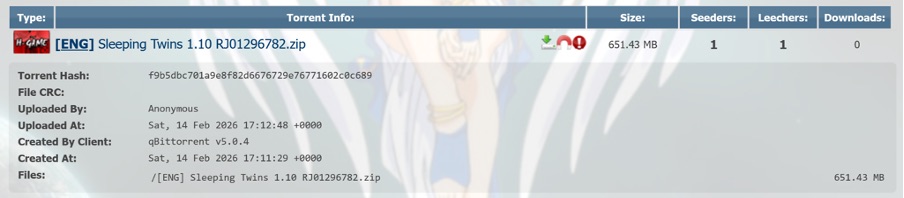
Most of the infected games are distributed through adult game and torrent sites. In some cases, they are posted for download on file-sharing services and linked on gaming websites.
Example of a trojanized game hosted on the AniRena torrent tracker
Interestingly, instead of finding a dummy file inside the archive — as is often the case — the user gets the actual game built on popular engines like RenPy or RPG Maker. Infected pirated versions usually turn out to be scams: games fail to launch, folders are full of files with bizarre extensions, making it rather easy to put two and two together. Here, however, the user gets the actual gameplay they expected. Meanwhile, the Trojan lets itself in and keeps a completely low profile.
Example of a trojanized game hosted on the AniRena torrent tracker
Tucked right alongside the legitimate files in the archive is a DLL that the game relies on to run, but it’s been rigged: as soon as the user launches the game, the infected DLL automatically loads into memory. There are no outward signs of infection: neither an installer popping up in the background, nor a scary window or prompt asking you to disable your antivirus.
Argamal takes things real slow: instead of immediately rushing to steal files and passwords or throwing a digital rager on your computer, the Trojan first checks whether it’s running in a virtual machine or sandbox, and then goes into standby mode.
During this time, the malware writes hidden parameters to the system, conceals the paths to its DLLs, and delays its own execution. Three days later, the computer connects to GitHub, downloads an encrypted file, decrypts it, and turns it into a working Trojan module.
To ensure persistence, the attackers register the malware under the WindowsColorSystem Calibration Loader system task, a built-in Windows feature that triggers at every user logon to load monitor color profiles. Before shutting down, the malware deletes temporary files and covers its tracks to make it even harder to detect.
What makes Argamal dangerous?
Argamal is a remote access Trojan (RAT), which means attackers can use it to remotely control the victim’s computer. Here’s just a short list of what it may entail:
Executing arbitrary commands on the computer
Downloading and running files
Checking if an antivirus is installed on the PC (by the way, our security solution detects and neutralizes Argamal before it can harm you)
Searching for and exfiltrating sensitive data from files and system settings
Taking screenshots and streaming video from the device
Sending data to the attackers’ server
Monitoring user activity
Shutting down or restarting the device
Essentially, the infected computer turns into a remotely controlled machine. The owner may keep calmly going about their day, completely unaware that their device has been compromised. Yet the consequences of such an infection can be devastating.
For example, a single password stolen from a text note can lead to multiple compromised accounts at once if the victim reuses the same credentials across different sites. That’s why we recommend storing strong and unique passwords in an encrypted vault of a password manager rather than in plain text files.
Beyond hijacking accounts, the Trojan lets attackers literally spy on the user — reading their chats, digging into secret files, studying their sexual preferences… The cybercriminals can then use this highly sensitive information for subsequent attacks, blackmail, and extortion. We’ve covered what to do if you find yourself being targeted by extortionists in a previous post.
Another common scenario involves quietly stealing or substituting financial data — for instance, intercepting credentials from banking apps or replacing crypto-wallet addresses in the clipboard, which sends all your money straight to the attackers’ accounts.
In short, there’s a whole laundry list of ways attackers can exploit a victim’s device and data.
Argamal, yamete kudasai! How to protect yourself from similar threats
If you’ve decided to become the proud owner of “Waifu Simulator Ultra Definitive Edition”, stay on your guard:
Use security software that runs in real time and catches sophisticated malware. Despite the attackers’ best efforts to make the Trojan invisible, Kaspersky Premium instantly detects and removes Argamal from users’ devices.
Avoid downloading adult apps, installation files, and spicy content from untrusted sources. Clicking a “free XXX game, no signup needed” is a surefire way to invite malware onto your device. That said, even official platforms like Google Play and the App Store unfortunately let infected apps slip through the cracks at times. To stop worrying about accidentally downloading a Trojan or an infostealer, use Kaspersky Premium on all your devices.
Don’t share more data than you absolutely have to. If an adult game or website insists you sign up, enter personal data, or link third-party accounts instead of just checking your birth date, that’s a huge red flag. Sites rarely collect sensitive data for no reason. In the best-case scenario, it ends up with marketers and ad trackers. In the worst-case, it falls into the hands of bad actors who will use it for blackmail, phishing, or breaking into your other accounts.
Don’t click ad banners on adult websites. Even the most popular platforms like Pornhub occasionally host ads laced with malware. If you find it hard to hold back, use a security solution that will block malware downloads and prevent redirects to suspicious sites.
https://www.backbox.org/wp-content/uploads/2018/09/website_backbox_text_black.png00adminhttps://www.backbox.org/wp-content/uploads/2018/09/website_backbox_text_black.pngadmin2026-06-09 17:06:302026-06-09 17:06:30Argamal RAT: attackers distributing a remote access Trojan through hentai games | Kaspersky official blog
Securing a university means defending a highly open environment, where thousands of users, devices, and external connections create constant exposure to risk. We had a unique opportunity to get an inside look at how these operations are run at a powerhouse R1 institution, the University of Massachusetts Boston.
We sat down with Daniel Mayer, Endpoint Security and Threat Hunting Specialist, and Alison Murray, Senior Information Security Specialist, to discuss how ANY.RUN’s solutions help their team scale triage, prevent incidents, and achieve consistent security risk reduction.
Lean Team, Broad Responsibility
UMass Boston operates as a premier R1 research university with a digital footprint encompassing a population of over 50,000 students, faculty, and staff.
University of Massachusetts Boston
The core security operations team tasked with defending this environment is remarkably compact, consisting of only three specialists and the SISO. Because of this lean staffing model, the team utilizes a cross-pollination strategy where each member manages various roles, including endpoint security, threat hunting, and threat management.
This small group of professionals carries the primary responsibility for the entire institution’s digital safety.
The Challenge of Balancing Threat Response and Infrastructure Overhead
Before adopting a cloud-based sandbox, the team was under constant operational pressure to keep up with incoming threats while maintaining speed and accuracy in triage.
At the time, their setup included an internal detection lab for threat analysis and validation. Yet, managing physical space, equipment, software licensing, and constant updates for an in-house environment pulled limited team resources away from active security operations.
The recent departure of two team members further increased this strain, making it difficult to balance infrastructure maintenance with the daily requirement to fight incoming threats.
“We had a detection lab that was also used to help teach the students, but you have to maintain it as well as fight the things that are coming in as they’re happening.”
The university needed more than a safe, secluded environment to test and validate malware without risking the production network. It needed a way to support faster triage, consistent threat validation, and real-time decision-making as part of everyday SOC workflows, without adding operational overhead.
Introducing ANY.RUN’s Sandbox into the Security Loop
Integration of the Interactive Sandbox was a necessity driven by the critical goal to support faster and more scalable threat validation. The team also needed to teach students in the SOC, within a safe, secluded environment that would not put the institution’s production network at risk.
The university integrated ANY.RUN’s solution as a behavioral validation layer within their defense stack alongside Microsoft Defender and Abnormal Security.
“It’s kind of a big lift to be able to just rely that when I go to ANY.RUN, I know that it’s being maintained.”
The solution was easy to set up and fit into the team’s existing workflows without disruption.
Instead of spending time maintaining their own lab, the team now had a ready-to-use, air-gapped environment for analyzing malicious content at scale. This provided immediate operational value, freeing up time, and allowing the SOC to focus on detecting and responding to critical threats more efficiently.
Spend less time maintaining infrastructure. Give your SOC more time to stop threats.
Scaling Detection and Speeding up Triage with the Same Team
At UMass Boston, the ANY.RUN sandbox now acts as a central component of the daily triage process for the phishing and abuse of mailboxes.
By utilizing ANY.RUN’s API integration with Abnormal, the team automatically sends suspicious emails, links, and attachments for analysis at the click of a button, removing manual steps and standardizing the triage process.
Where previously analysts relied on incomplete signals, they now have a visual confirmation of threats’ behavior.
“Having ANY.RUN’s API connection with our email security vendor has really increased our performance in detecting and being able to tell whether it’s actually phishing.”
The automation transformed how quickly detection and verification happen, reducing the time required to analyze and get conclusive verdicts on suspicious submissions.
“Instead of minutes, [investigations] take seconds.”
Faster, evidence-based triage reduced uncertainty, stabilized operations, and ensured that real threats are identified and handled without delay.
As a result, the team can make confident security decisions at speed and scale, allowing them to process higher volumes of alerts without increasing the headcount or sacrificing decision quality.
Preventing a Phishing Incident Missed by Email Filters
The effectiveness of the team’s sandbox-based defense was demonstrated during a mass email campaign that occurred just before Christmas in 2025, a holiday period when attack volume increases and users are more likely to engage with incoming emails.
Despite having established email security controls in place, the attack passed through primary filters undetected. This is exactly where most organizations become exposed, as missed threats can lead to incidents without a sandbox layer in place.
Instead of relying on the initial verdict, the team escalated the suspicious emails through their sandbox workflow. Using the API integration, they detonated the content and observed its behavior in a controlled environment.
This analysis revealed that the email was a sophisticated phishing scam hosted through Google.
“If we didn’t have ANY.RUN, we would have never picked that up.”
The combination of a proactive team and immediate access to sandbox capabilities allowed UMass Boston to validate the threat, make a confident decision, and contain it before it reached users.
Without this step, the attack could have resulted in credential theft and unauthorized access to internal systems, putting users, research continuity, and institutional trust at risk.
Reducing Risk in Access Control
Beyond email security, ANY.RUN’s solution helps the team manage internal requests regarding blocked websites. When students or staff encounter a firewall block, the security team uses the sandbox to determine if a site is truly malicious or merely misclassified.
“We can take a look at a [potential threat] and see what’s going on and have actual analytics around it.”
This visual verification allows them to see if a legitimate website has been hijacked to serve malware, providing the analytics needed to make accurate access decisions. The team confidently requests re-categorization from their firewall vendor based on observed behavior.
With ANY.RUN, access decisions have become faster and more defensible. Analysts have concrete behavioral evidence to support allow or block actions, reducing unnecessary restrictions for users while maintaining security.
Meeting Compliance and Cyber Insurance Requirements
UMass Boston operates under frequent state audits that require detailed evidence of security processes. These are directly tied to regulations such as FERPA, which governs the protection of student data, and the Massachusetts Data Security Law, which mandates safeguards around personal information and access control.
Modern auditors demand documented artifacts and evidence of how the university manages security. ANY.RUN’s sandbox gives the team this proof. Each analysis shows what the threat does, making it easier to explain decisions and demonstrate how incidents are handled.
Turn every investigation into audit-ready evidence. Strengthen your compliance posture with ANY.RUN.
Having a dedicated sandbox environment is also a mandatory requirement for many cyber insurance brokers to maintain coverage. Adopting the solution allowed the university to fill a previous gap in their compliance posture and meet these rigorous insurance standards.
A Practical Model for Teams Facing Similar Challenges
The security model developed at UMass Boston is starting to extend beyond a single campus, particularly among teams operating with similar staffing constraints. The team regularly shares real cases and demos with other SISOs and security teams, including peers at Bridgewater State University.
“We have shown people demos and told them that we have also had that problem and this is how we fixed it.”
For teams with limited resources, the sandbox-driven approach provides a way to handle more threats without increasing headcount, while lowering the risk of missed or misclassified incidents.
Conclusion
The UMass Boston case highlights how a lean team can successfully defend a massive research institution by relying on a multi-layered “mesh approach” in security and powering it with effective solutions like ANY.RUN’s Interactive Sandbox.
We would like to thank the University of Massachusetts Boston for allowing us an inside look at their security operations. We are especially grateful to Daniel Mayer, Endpoint Security and Threat Hunting Specialist, and Alison Murray, Senior Information Security Specialist, for sharing their time and professional insights.
About ANY.RUN
ANY.RUN, a leading provider of interactive malware analysis and threat intelligence solutions, helps SOC teams, MSSPs, and enterprises investigate threats faster and make more confident security decisions.
With its cloud-based Interactive Sandbox, security teams can safely analyze suspicious files, links, and emails in real time, observe malicious behavior, and receive clear evidence for response without maintaining complex in-house infrastructure.
ANY.RUN’s Threat Intelligence solutions also help organizations uncover threat context, enrich security workflows, and improve visibility into emerging risks. Together, these capabilities support faster triage, stronger incident prevention, and more efficient security operations at scale.
https://www.backbox.org/wp-content/uploads/2018/09/website_backbox_text_black.png00adminhttps://www.backbox.org/wp-content/uploads/2018/09/website_backbox_text_black.pngadmin2026-06-09 11:06:312026-06-09 11:06:31Protecting 50,000 Users: How ANY.RUN Drives Incident Prevention at UMass Boston