In this episode of Humans of Talos, Amy sits down with Wendy Bishop, Head of Creative, to explore the vital role of design in the world of cybersecurity. From her early beginnings in web design and journalism to leading the creative vision for Talos, Wendy shares the unique challenges and rewards of bridging the gap between artistic expression and highly technical research.
Whether you’re a creative professional looking to break into the cybersecurity industry or simply curious about the people behind our security intelligence, this conversation offers a fascinating look at the artistic side of Talos’ mission to keep the digital world safe.
Amy Ciminnisi: Wendy, welcome! We haven’t had anyone from creative here yet. Can you talk to me a little bit about what drew you into creative work and how your career evolved into what it is now at Talos?
Wendy Bishop: I never in my entire life thought I would do anything besides something creative. It’s the only thing I’ve ever known. I have so many memories in my childhood of just being locked in my moody teenage bedroom. In high school, I started doing web design courses, and I think that’s when I really started being interested in a graphic design path. I learned Photoshop and basic HTML/CSS stuff as a side hobby. I moderated a message board for my favorite pop-punk band in high school. When it came time to go to college, there was nothing I wanted to do otherwise besides design. I found myself at Ohio University— that’s where I’m from, Ohio — in the School of Visual Communication.
I went off to a job working in newspapers. I actually never thought I would, but it was the job I found after college, and I designed news pages. It sounds funny now; it was already dying then, probably not the best long career path. But I think my background in journalism and communication-driven design is really what made me a great fit for the kind of design work we do here at Talos. We work with complicated materials, and a lot of the creative work we do is comms-driven. Our blog in some ways functions as a news outlet, so visual storytelling is a lot of my job. But of course, we have a lot of regular, branding-based design work now that comes out of my team.
AC: We just had a really big report come out that has occupied our minds for months, especially over here in design. Can you talk a little bit about the 2025 Year in Review and share what that process is like?
WB: When it starts to take shape, I look over that draft with the team and we talk about each graphic. I say, “That one might be better if we did this,” or “This is missing that piece for when it goes into production.” I really start to wrap my mind around the various assets and how we would go about taking what is essentially an Excel graphic or something created in PowerPoint and making it into a much more polished and designed presentation.
We get a sneak peek, and then one day it lands on your desk, Amy. From there, my designers and I put it together. It’s a lot about putting that puzzle together, thinking about what makes sense on each page, making sure the content flow is clean and linear, and the adjacencies of the graphics are in the right place. I come to you and say, “Amy, I need a headline,” or “Does this make sense?” We come up with a look and feel and theme for the whole report every year that’s greater than just the layout of the document. That gets extended to all the other companion pieces — our videos, social graphics, and any continuing campaign pieces.
Want to see more? Watch the full interview, and don’t forget to subscribe to our YouTube channel for future episodes of Humans of Talos.
https://www.backbox.org/wp-content/uploads/2018/09/website_backbox_text_black.png00adminhttps://www.backbox.org/wp-content/uploads/2018/09/website_backbox_text_black.pngadmin2026-04-16 11:06:422026-04-16 11:06:42More than pretty pictures: Wendy Bishop on visual storytelling in tech
ANY.RUN has observed a sustained surge in a credential-phishing campaign active since 2024. This campaign, dubbed BlobPhish, introduces a sneaky twist: instead of delivering phishing pages via traditional HTTP requests, it generates them directly inside the victim’s browser using blob objects. The result is a phishing payload that lives entirely in memory, leaving little to no trace in logs, caches, or network telemetry.
The campaign targets credentials across multiple platforms, including Microsoft 365, banking services, and webmail portals, making it both widespread and high-impact.
Key Takeaways
Memory-resident evasion: BlobPhish loads entire phishing pages as in-browser blob objects, bypassing file-based and network-based detection entirely.
Broad targeting: The campaign hits Microsoft 365 alongside major U.S. banks (Chase, Capital One, FDIC, E*TRADE, Schwab) and webmail services.
Persistent and active: First observed in October 2024, the operation continues uninterrupted as of April 2026 with a major spike in February 2026.
High-value credential theft: Stolen accounts enable BEC, data exfiltration, and lateral movement — threats that carry multimillion-dollar consequences.
Global but finance-focused: One-third of victims are in the U.S.; phishing pages almost exclusively mimic premium financial and Microsoft services regardless of victim industry.
ANY.RUN delivers proactive defense: Sandbox instantly reveals blob behavior in real browsers, while TI Lookup and TI Feeds provide real-time IOCs and YARA rules for automated blocking and hunting, turning reactive security into prevention.
How BlobPhish works
The attack is based on the abuse of browser Blob objects to serve fake authentication forms. A JavaScript loader, fetched from an attacker-controlled page, constructs a Blob from a Base64-encoded payload and loads it directly into browser memory — never touching disk and never generating the traditional HTTP requests that security tools rely on to detect phishing.
Phishing pseudo-MS365 page loaded as a blob object
Targeted services include: Microsoft 365, OneDrive, SharePoint, Chase, FDIC, Capital One, E*Trade, American Express, Charles Schwab, Merrill Lynch, PayPal, Intuit, and others.
Accelerate investigations and stop threats earlier. Leverage sandbox visibility to improve SOC performance.
Because the phishing page exists only in memory and is referenced by the scheme blob:https://, it cannot be blocked by URL reputation engines, does not appear in proxy logs as a suspicious request, and leaves no cache artefact. This makes BlobPhish significantly harder to detect and investigate than conventional phishing.
The typical initial access point is a phishing email or a link to a trusted-looking service such as DocSend. Example phishing link: hxxps[://]docsend[.]com/view/vsrrknxprh2xt84n
Upon clicking, the victim is redirected to an HTML page that contains the loader script. Example loader URL: hxxps[://]mtl-logistics[.]com/blb/blob[.]html
2. Loader Script — Step by Step
Code responsible for blob object download
The loader uses jQuery to perform the following sequence invisibly to the user:
var a = $(“<a style=’display: none;’/>”) Creates an invisible HTML anchor element;
var decodedStringAtoB = atob(encodedStringAtoB) Decodes the Base64 payload;
const myBlob = new Blob([decodedStringAtoB], { type: ‘text/html’ }); → Constructs the Blob object;
const url = window.URL.createObjectURL(myBlob) Generates the blob: URL;
a.attr(“href”, url) Attaches the URL to the hidden anchor;
$(“body”).append(a) Injects the anchor into the DOM;
a[0].click() Triggers navigation to the phishing page;
window.URL.revokeObjectURL(url); + a.remove() Destroys evidence from memory and DOM.
3. The Phishing Page
The victim sees a convincing Microsoft 365 (or other financial service) login page. The browser address bar shows the scheme blob:https://, which can appear legitimate to an untrained eye.
Code responsible for blob object download
The page contains:
A spoofed credential-capture form:
Fake login form
Specific set of selectors for the used HTML elements:
Selector list
Exfiltration logic that POSTs captured credentials to an attacker-controlled endpoint:
Data exfiltration logic
A failed-login counter to force repeated credential entry (increasing harvest accuracy), a final redirect to the legitimate service website to avoid suspicion:
Handling failed attempt counters and final redirect
Another exfiltration variant exposed in the sandbox
Variants with exfiltration to url:”*/tele.php” with a roughly similar request structure were also observed view a sandbox analysis with exfiltration URL hxxps[://]_wildcard_[.]gonzalezlawnandlandscaping[.]com/zovakmf/exfuzaj/pcnlwyf/cgi-ent/tele[.]php.
Importantly, in some cases calls to the service endpoint /panel.php have been observed. In response to a POST request, an error and its description (e.g., “IP not found”) are returned.
Example POST URL: hxxps[://]hnint[.]net/cgi-bin/peacemind//panel[.]php
/panel.php POST error response
6. HTTP Detection Patterns
The following HTTP traffic signatures reliably identify BlobPhish activity in proxy and SIEM logs:
POST */res.php — credentials in body (MIME: form-data or x-www-form-urlencoded);
POST */tele.php — credentials in body (MIME: form-data or x-www-form-urlencoded);
POST */panel.php — empty body; response: JSON with error & description (e.g., “IP not found”).
7. Delivery Methods
The following initial-access vectors have been observed:
Phishing emails with financial lures (suspicious transaction, personal loan/operation confirmation, invoice & document signature, disputed payment);
Fake payment notification email
PDF attachments containing a QR code that leads to a malicious JS page and subsequently the blob:http scheme and */res.php exfiltration pattern (observed in an energy-sector campaign);
Shortened links (e.g., via t.co) redirecting through JS to the blob:http payload;
Links to legitimate-looking document-sharing services such as DocSend.
Threat Landscape
First spotted in October 2024, BlobPhis has proved itself as a sustained, continuously evolving campaign that remains active at the time of publication.
Analysis of related artefacts shows that the threat actors regularly rotate infrastructure, exfiltration endpoints, loader hosting domains, and phishing lure themes. They also vary the path names of the loader pages (blob.html, blom.html, bloji.html, emailandpasssss.html) and exfiltration scripts (res.php, tele.php), complicating static signature-based detection.
Targeted Industries
Although the phishing lures predominantly impersonate financial and cloud services, the victim organizations span multiple sectors:
Regardless of the victim’s industry, attackers focus on harvesting credentials for high-value financial and cloud corporate services — increasing the probability of capturing credentials that unlock significant monetary or data assets.
Financial institutions and cloud-productivity platforms most frequently spoofed:
Capital One,
American Express,
JPMorgan Chase,
Intuit,
Charles Schwab,
Morgan Stanley’s E*TRADE,
Merrill Lynch,
PayPal,
Microsoft 365 / OneDrive / SharePoint (used as a document-access lure).
Geography
Approximately one-third of observed activity involves US-based users and organisations. BlobPhish activity has been observed from: Germany, Poland, Spain, Switzerland, United Kingdom, Australia, South Korea, Saudi Arabia, Qatar, Jordan, India, and Pakistan.
Business Impact: Why BlobPhish Is a Board-Level Risk
BlobPhish does not just steal one employee’s password. By targeting the financial, cloud, and productivity accounts that employees use every day, a single successful compromise can cascade into:
Unauthorized wire transfers or fraudulent invoices (Business Email Compromise follow-on);
Full Microsoft 365 tenant takeover — email, SharePoint, Teams, and connected SaaS apps;
Regulatory exposure (GDPR, SEC, FFIEC, PCI-DSS) from confirmed data exfiltration;
Reputational damage when customer or partner data is compromised;
Operational disruption if attacker pivots to ransomware after credential harvest.
High-stakes credentials deserve enterprise-grade intelligence. Reduce risk, not just response time.
Security and risk teams should model the following impact chains when a BlobPhish credential is compromised:
Microsoft 365 credential → MFA fatigue or session token theft → full mailbox access → BEC fraud or data exfiltration to partners/clients;
Banking credential (Chase, CapitalOne) → account takeover → wire fraud or ACH manipulation;
Investment platform credential (Schwab, E*TRADE, Merrill) → unauthorized trades or fund transfer;
Any cloud credential → lateral movement to connected SaaS → ransomware deployment.
Regulatory consequences may include mandatory breach notification under GDPR (72-hour window), SEC cybersecurity incident disclosure requirements, and FFIEC guidance on authentication for financial institutions.
How ANY.RUN Helps You Stay Ahead
ANY.RUN provides the complementary capabilities that address BlobPhish at every stage of the threat lifecycle: from proactive hunting to real-time detection and automated feed enrichment.
1. Analyze Alerts & Artifacts to Prevent Attack
When a suspicious link or email is forwarded to the security team, ANY.RUN’s fully interactive cloud sandbox executes the entire BlobPhish kill chain in a safe cloud environment:
The JavaScript loader runs, the Base64 payload is decoded, and the blob: URL is created, exactly as it would on a victim’s machine.
Analysts watch the live session and see the fake login page render, observe the POST to */res.php, and capture all network artefacts.
Because execution happens in a real browser, there are no emulation gaps that the attacker’s anti-sandbox checks could exploit.
Full analysis reports — including screenshots, network traffic, memory artefacts, and extracted IOCs — are generated in minutes.
This means your SOC can definitively confirm or dismiss a BlobPhish suspicion within minutes rather than hours, without risking any internal system.
2. Stop Future Attacks by Enriching Proactive Defense
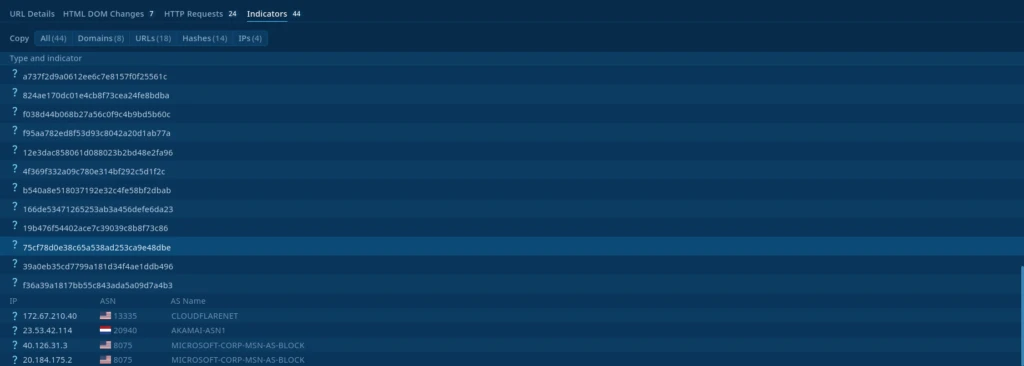
Threat Intelligence Lookup gives threat hunters direct, query-based access to the ANY.RUN database of analyzed samples and infrastructure:
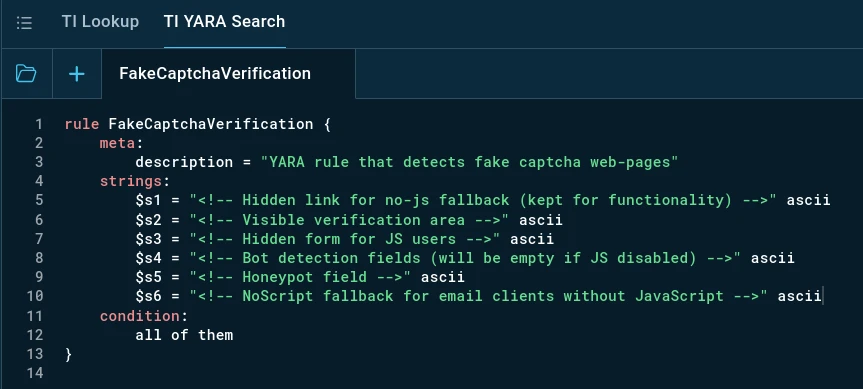
Run YARA-based searches to find all samples matching the BlobPhishLoaderHTML rule.
Pivot on URL patterns (url:”/res.php$”, url:”*/blob.html$”) to discover new attacker infrastructure the moment it appears in the wild.
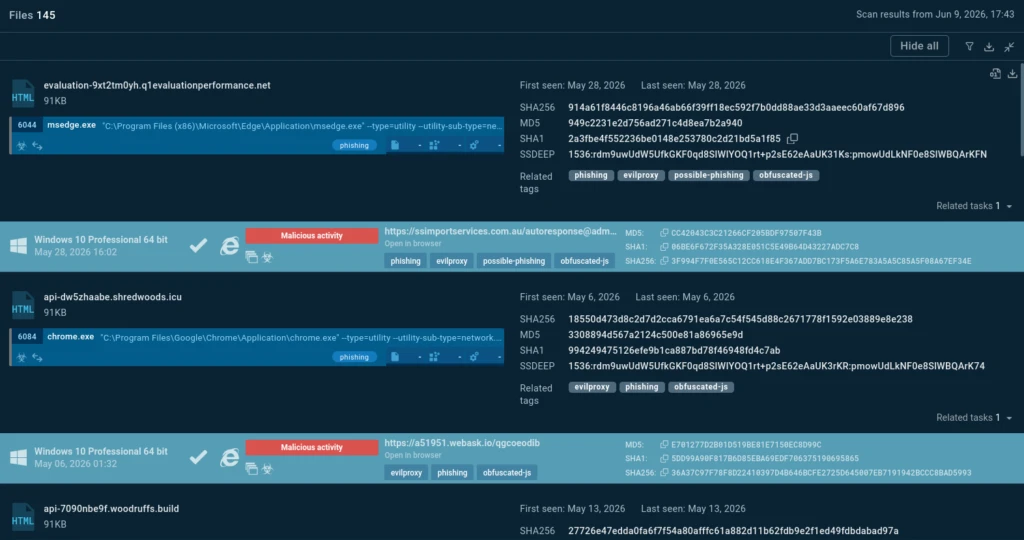
Correlate domains, IPs, file hashes, and HTTP patterns across millions of analyzed tasks.
Export results directly into SIEM, SOAR, or ticketing workflows.
Security teams can monitor this campaign continuously rather than reacting after a compromise. New loader domains and exfiltration endpoints are surfaced as soon as ANY.RUN community members (and automated systems) submit related tasks.
3. Automate Monitoring with Live Intelligence
Threat Intelligence Feeds deliver structured, machine-readable threat intelligence in STIX/TAXII or flat-file formats, enabling automated enforcement across your security stack:
BlobPhish-related domains, IPs, and URL patterns are automatically pushed to firewalls, proxies, and SIEM correlation rules.
Indicators are enriched with context (campaign name, targeted brand, exfiltration pattern, confidence level) so that alerts are actionable, not just noisy.
Feeds are updated in near-real-time as the campaign evolves, meaning your defenses track the attacker’s infrastructure rotation without manual analyst effort.
Integration is supported with leading SIEM/SOAR platforms (Splunk, Microsoft Sentinel, Palo Alto XSOAR, and others) via standard connectors.
Rather than relying solely on reactive detection, TI Feeds shift your posture to proactive blocking: exfiltration endpoints are denied before a single employee credential can be harvested.
BlobPhish represents a mature, well-maintained phishing operation that has been running continuously for over eighteen months. Its core innovation — abusing the browser’s Blob URL API to serve phishing pages entirely in memory — renders the campaign invisible to a wide range of conventional controls including secure email gateways, URL filters, web proxies, and file-based endpoint solutions.
For security teams, the takeaway is clear: static and perimeter-based defenses are insufficient against this class of attack. Effective defense requires dynamic analysis (to execute and observe the full attack chain), proactive threat hunting (to discover attacker infrastructure before it is weaponized against your organization), and automated, continuously updated threat intelligence feeds that propagate IOCs across the entire security stack in near-real-time.
Provide your team with the visibility and speed to stay ahead of BlobPhish and protect business assets.
ANY.RUN, a leading provider of interactive malware analysis and threat intelligence solutions, helps security teams investigate threats faster and with greater clarity across modern enterprise environments.
It allows teams to safely execute suspicious files and URLs, observe real behavior in an Interactive Sandbox, enrich indicators with immediate context through TI Lookup, and monitor emerging malicious infrastructure using Threat Intelligence Feeds. Together, these capabilities help reduce investigation uncertainty, accelerate triage, and limit unnecessary escalations across the SOC.
ANY.RUN is trusted by thousands of organizations worldwide and meets enterprise security and compliance expectations. It is SOC 2 Type II certified, demonstrating its commitment to protecting customer data and maintaining strong security controls.
FAQ
What is BlobPhish?
BlobPhish is an ongoing credential-phishing campaign active since October 2024 that delivers fake login pages as browser blob objects, evading traditional security tools.
How does the blob technique work?
JavaScript decodes a base64 payload, creates a blob object, generates a blob:https:// URL, forces the browser to load it via a hidden link, then immediately cleans up — leaving no file or cache trace.
Which companies and services are impersonated?
Microsoft 365, Chase, Capital One, FDIC, E*TRADE, Charles Schwab, American Express, PayPal, and others — primarily U.S. financial and cloud brands.
What are the main indicators of compromise?
URLs ending in /blob.html, /res.php, /tele.php or /panel.php; the YARA rule provided; and blob:https:// URLs in browser history.
Who is at risk?
Organizations in Finance, Manufacturing, Education, Government, Transport, and Telecommunications — especially those using Microsoft 365 or corporate online banking.
How can executives reduce the business impact?
Enforce MFA, train staff on unexpected login prompts, and integrate proactive threat intelligence that catches memory-resident attacks before they reach employees.
How does ANY.RUN specifically help against BlobPhish?
The interactive Sandbox detonates the attack in a real browser to reveal blob behavior; TI Lookup surfaces related samples instantly; and TI Feeds push live IOCs into your security tools for automated prevention.
Cisco Talos discovered an ongoing malicious campaign, operating since at least December 2025, affecting a broader workforce in the Czech Republic with a previously undocumented botnet we call “PowMix.”
PowMix employs randomized command-and-control (C2) beaconing intervals, rather than persistent connection to the C2 server, to evade the network signature detections.
PowMix embeds the encrypted heartbeat data along with unique identifiers of the victim machine into the C2 URL paths, mimicking legitimate REST API URLs.
PowMix has the capability to remotely update the new C2 domain to the botnet configuration file dynamically.
Talos observed a few tactical similarities of the current campaign with the ZipLine campaign, including the payload delivery mechanism and the misuse of the legitimate cloud platform Heroku for C2 operations.
Victimology
Talos observed that an attacker targeted Czech organizations across various levels, based on the contents of the lure documents used by the attacker in the current campaign.
Impersonating the legitimate EDEKA brand and authentic regulatory frameworks such as the Czech Data Protection Act, the attacker deploys decoy documents with compliance-themed lures, potentially aimed at compromising victims from human resources (HR), legal, and recruitment agencies. In the lure documents, the attacker also used compensation data, as well as the legitimate legislative references, to enhance the authenticity of these decoy documents and to entice the job aspirants across diverse sectors like IT, finance, and logistics.
Figures 1 (left) and 2 (right). First pages of two decoy documents.
TTPs overlaps with the ZipLine campaign
Talos observed a few tactical similarities employed in the current campaign with that of the ZipLine campaign, reported by researchers from Check Point in August 2025.
In the current campaign, the PowMix botnet payload is delivered via an LNK triggered PowerShell loader that extracts it from a ZIP archive data blob, bypasses AMSI, and executes the decrypted script directly in memory. This campaign shares tactical overlaps with the older ZipLine campaign (which deployed the MixShell malware), including identical ZIP-based payload concealment, Windows-scheduled task persistence, CRC32-based BOT ID generation, and the abuse of “herokuapp.com” for command-and-control (C2) infrastructure. Although there are overlaps in the tactics, the attacker’s final payload was unobserved, and the intent remains unknown in this campaign.
Attack summary
Figure 3. Attack summary flow chart.
The attack begins when a victim runs the Windows shortcut file contained within the received malicious ZIP file, potentially through a phishing email. This shortcut file triggers the execution of an embedded PowerShell loader script, which initially creates a copy of the ZIP file along with its contents in the victim’s “ProgramData” folder. Subsequently, it loads the malicious ZIP file, extracts, and executes the embedded PowMix botnet payload directly in the victim’s machine memory and starts to communicate with the botnet C2.
PowerShell loader executes PowMix in memory
The first stage PowerShell script functions as a loader, and its execution routine is designed to bypass security controls and deliver a secondary payload. It begins by defining several obfuscated variables, including file name of the malicious ZIP file that was likely received via a phishing email. Then, the script dynamically constructs paths to the folders such as “ProgramData” and the user’s “Downloads” folder to locate this ZIP file. Once the ZIP file is found, it extracts the contents to the “ProgramData”folder, effectively staging the environment for the next phase of the attack.
Figure 4. Excerpt of the deobfuscated PowerShell Loader main function.
To evade detection, the script employs an AMSI (Antimalware Scan Interface) bypass technique. It uses a reflection technique to browse the loaded assemblies in the current process, specifically searching for the AmsiUtils class. Once located, it identifies the amsiInitFailed field and manually sets its value to true. This action deceives the Windows security subsystem into thinking that AMSI has not initialized, which disables real-time scanning of subsequent commands, enabling the script to run malicious code in memory without being detected by Windows Defender or other endpoint detection and response (EDR) solutions.
Figure 5. Excerpt of the deobfuscated PowerShell Loader AMSI bypass function.
The script parses the malicious ZIP file to locate a specific marker that is hardcoded, such as zAswKoK. This marker is treated as a delimiter, enabling the extraction of a hidden, encoded command that is embedded within the ZIP file data blob.
Figure 6. Malicious ZIP file data blob embedded with an obfuscated PowMix botnet.
Throughout this process, the script performs a series of string replacements, which include the removal of # symbols and the mapping of placeholders, such as {cdm}, to their corresponding specific file paths, reconstructing a functional secondary PowerShell script payload. Then it executes the secondary payload script in the victim machine memory using the Invoke-Expression (IEX) PowerShell command.
Figure 7. PowerShell loader excerpt with instructions to extract payload and execute.
PowMix botnet
Talos discovered that the secondary payload PowerShell script, which we call “PowMix,” is a previously unreported botnet designed for remote access, reconnaissance, and remote code execution.
The main execution of the script begins with an environment check to ensure it is running within a specific loader context at the placeholder {cdm}, which is the path of the Windows shortcut in the ProgramData folder, before immediately attempting to conceal its presence. It invokes a function that utilizes the Win32ShowWindowAsync function of “user32.dll” to hide the current PowerShell console window.
Figure 8. PowMix excerpt to hide the PowerShell console window.
Then it decrypts the C2 domain and a configuration file using a custom XOR-based routine with a hardcoded key. It retrieves the machine’s product ID by querying the HKLM: SOFTWAREMicrosoftWindows NTCurrentVersion registry key for the Windows ProductID. PowMix processes the victim machine’s ProductID and the decrypted configuration data through a CRC32-style checksum function to generate a unique Bot ID and a corresponding Windows schedule task name, which it subsequently uses to establish persistence.
Some of the hardcoded XOR key strings found in this campaign are:
HpSWSb
qDQyxQE
bKUxmhyAe
HymzqLse
KsEYwmgSF
ujCPOEPU
Figure 9. PowMix excerpts with the main function and the function that implements the CRC32 type checksum algorithm.
Instead of using obvious task names, PowMix names the scheduled task by concatenating the Bot ID and Configuration file hash, resulting in names that appear as random hexadecimal strings (such as “289c2e236761”). The task configuration specifies a daily trigger set to execute at 11:00 a.m., and the execution action is configured to launch the benign Windows Explorer binary with the malicious Windows Shortcut file path as an argument. Windows Explorer’s file association handling then automatically launches the malicious shortcut file to execute the PowerShell loader script.
Figure 10. Windows scheduled task created by PowMix.
Before attempting to establish persistence, PowMix performs several validation checks to ensure that another instance of the botnet is not running in the infected machine. It examines the process tree using Common Information Model (CIM) queries to identify its parent processes. If the PowMix is not running under either “svchost.exe” or “powershell.exe”, and if certain environmental variables are not set, it attempts to restart itself in the privileged context.
Figure 11. PowMix excerpts with the instructions to establish persistence.
The mutex implementation in the botnet prevents multiple instances from running at the same time. It creates a mutex with the name “Global[BotID]”. The “Global” prefix makes the mutex visible across all user sessions, stopping separate instances from running in different user sessions.
Figure 12. PowMix excerpts with Mutex creation commands.
PowMix avoids persistent connections to the C2 server. Instead, it implements a jitter via Get-Random PowerShell command to vary the beaconing intervals initially between 0 and 261 seconds, and subsequently between 1,075 and 1,450 seconds. This technique attempts to prevent detection of C2 traffic through predictable network signatures.
Each request from PowMix to C2 is created by concatenating the base C2 domain with the Bot ID, configuration file hash, an encrypted heartbeat, a hexadecimal Unix timestamp, and a random hexadecimal suffix. The standard heartbeat string “[]0” is encrypted using a custom XOR routine using the Bot ID as the key and is then converted to a hex string. The inclusion of a random length hexadecimal suffix further ensures that every URL is unique.
The attacker mimics the REST API calls URLs by embedding these data directly into the URL path, instead of using a URL query string or a POST request for communicating with the C2 server.
Figure 13. C2 URL format.
PowMix establishes a Chrome User-Agent and configures the Accept-Language (en-US) and Accept-Encoding (gzip, deflate, br) headers. It utilizes the GetSystemWebProxy API along with DefaultCredentials to dynamically adopt the host machine’s network proxy settings and automatically authenticates using the logged-in user’s active session tokens, thereby disguising the C2 traffic as legitimate web browser traffic within the victim’s environment.
Figure 14. PowMix excerpts with C2 loop instructions. Figure 15. PowMix excerpts of download function with hardcoded HTTP headers.
The PowMix command processing logic is executed upon receiving the response from the C2 with a period delimiter. It extracts the second segment and decrypts it using the unique Bot ID as the XOR key. The resulting decrypted response is then evaluated through a conditional parser that distinguishes between the command operations hardcoded in the botnet and arbitrary code execution, allowing the attacker to remotely control the victim machine.
The remote management commands that the botnet receives from the C2 are identified by a leading hash symbol (#). We found that the PowMix botnet facilitates the commands described below:
#KILL – The KILL command initiates a self-deletion routine, utilizing the Unregister-ScheduledTask PowerShell command with the parameter Confirm: $false to silently remove persistence, followed by Remove-Item -Recurse–Force command to wipe the malware’s directory in the victim machine.
#HOST – The HOST command enables the C2 infrastructure migration by remotely updating a new C2 URL to a configuration file. By receiving the HOST command, PowMix will encrypt the new domain that it receives using the hardcoded XOR key and save it to a local configuration file via Set-Content PowerShell command. During the next initialization of the botnet through the task scheduler execution, it prioritizes the local configuration file data with the encrypted new C2 domain over hardcoded defaults, providing a robust mechanism for evading domain blacklisting.
For non #-prefixed responses from the C2, the command processing routine of PowMix transitions into an arbitrary execution mode. It bypasses static detection of the Invoke-Expression (IEX) PowerShell command by dynamically reconstructing the command string from the $VerbosePreference variable and executes the decrypted payload while redirecting the output to Out-Null, ensuring erasing the execution traces.
Figure 16. PowMix excerpts with the instructions facilitating the C2 commands.
Coverage
The following ClamAV signature detects and blocks this threat:
Lnk.Trojan.PowMix-10059735-0
Txt.Trojan.PowMix-10059742-0
Txt.Trojan.PowMix-10059778-0
Win.Trojan.PowMix-10059728-0
The following Snort Rules (SIDs) detect and block this threat:
Snort2 and Snort3: 66118
Indicators of compromise (IOCs)
The IOCs for this threat are also available at our GitHub repository here.
In 2023, Tim Utzig, a blind student from Baltimore, lost a thousand dollars to a laptop scam on X. Tim had been a long-time follower of a well-known sports journalist. When that journalist’s account started posting about a “charity sale” of brand-new MacBook Pros, Tim jumped at the chance to get a deal on a laptop he needed for his studies. After a few quick messages, he sent over the money.
Unfortunately, the journalist’s account had been hacked, and Tim’s cash went straight to scammers. The red flags were strictly visual: the page had been flagged as “temporarily restricted”, and both the bio and the Following list had changed. However, Tim’s screen reader — the software that converts on-screen text and graphics into speech — didn’t announce any of those warnings.
Screen readers allow blind users to navigate the digital world like everyone else. However, this community remains uniquely vulnerable. Even for sighted users, spotting a fake website is a challenge; for someone with a visual impairment, it’s an even steeper uphill battle.
Beyond screen readers, there are specialized mobile apps and services designed to assist the blind and low-vision community, with Be My Eyes being one of the most popular. The app connects users with sighted volunteers via a live video call to tackle everyday tasks — like setting an oven dial or locating an object on a desk. Be My Eyes also features integrated AI that can scan and narrate text or identify objects in the user’s environment.
But can these tools go beyond daily chores? Can they actually flag a phishing attempt or catch the hidden fine print when someone is opening a bank account?
Today we explore the specific online hurdles visually impaired users face, when it makes sense to lean on human or virtual assistants, and how to stay secure when using these types of services.
Common cyberthreats facing the blind and low-vision community
To start, let’s clarify the difference between these two groups. Low-vision users still rely on their remaining sight, even though their visual function is significantly reduced. To navigate digital interfaces, they often use screen magnifiers, extra-large fonts, and high-contrast settings. For them, phishing sites and emails are particularly dangerous. It’s easy to miss intentional typos — known as typosquatting — in a domain name or email address, such as the recent example of rnicrosoft{.}com.
Blind users navigate primarily by sound, using screen readers and specific touch gestures. Interestingly, though, unlike those with low vision, blind users are more likely to spot a phishing site using a screen reader: as the software reads the URL aloud, the user will hear that something is off. However, if a service — whether legitimate or malicious — isn’t fully compatible with screen readers, the risk of falling victim to a scam increases. This is exactly what happened to Tim Utzig.
It’s important to remember that screen magnifiers and readers are basic accessibility tools. They’re designed to enlarge or narrate an interface — not act as a security suite. They can’t warn the user of a threat on their own. That’s where more advanced software — tools that can analyze images and files, flag suspicious language, and describe the broader context of what’s happening on-screen — comes into play.
When to lean on an assistant
Be My Eyes is a major player in the accessibility space, boasting around 900 000 users and over nine million volunteers. Available on Windows, Android, and iOS, it bridges the gap by connecting blind and low-vision users with sighted volunteers via video calls for help with everyday tasks. For example, if someone wants to run a Synthetics cycle on their washing machine but can’t find the right button, they can hop into the app. It connects them with the first available volunteer speaking their language, who then uses the smartphone’s camera to guide them. The service is currently available in 32 languages.
In 2023, the app expanded its capabilities with the release of Be My AI — a virtual assistant powered by OpenAI’s GPT-4. Users take a photo, and the AI analyzes the image to provide a detailed text description, which it also reads aloud. Users can even open a chat window to ask follow-up questions. This got us thinking: could this AI actually spot a phishing site?
As an experiment, we uploaded a screenshot of a fake social media sign-in page to Be My Eyes. On a phone, you can do this by selecting a photo in your gallery or files, hitting Share, and choosing Describe with Be My Eyes. In Windows, you can upload a screenshot directly.
An example of a phishing page that mimics the Facebook sign-in form. Note the incorrect domain in the address bar
At first, the AI gave us a detailed description of the page. We then followed up in the chat: “Can I trust this page?” The AI flagged the domain name error immediately, advised us to close the fake login page, and suggested typing the official URL directly into the browser, or to use the official Facebook app.
Be My AI explains why the page looks sketchy: the domain doesn’t match the official site. The app suggests typing the official URL directly into the browser, or using the official Facebook app
We saw the same positive results when testing a phishing email. In fact, the AI flagged the scam during its initial description of the message. It wrapped up with a warning: “This looks like a suspicious email. It’s best not to open any attachments or click any links. Instead, navigate to the official website or app manually, or call the number listed on their official site”.
Beyond just spotting cyberthreats, Be My AI is a solid sidekick for navigating online stores, banking apps, and digital services. For instance, the AI can help you to:
Read descriptions, names, and prices when a store’s website or app doesn’t support screen readers or large fonts
Scan those tricky terms and conditions — often buried in tiny text or otherwise inaccessible to a screen reader — when you’re signing up for a subscription or opening a bank account
Pull key info directly from product cards or instruction manuals
The risks of relying on Be My AI
The most common hiccup with AI is hallucinations, where the language model distorts text, skips crucial details, or invents words out of thin air. When it comes to cyberthreats, an AI’s misplaced confidence in a malicious site or email can be dangerous. Furthermore, AI isn’t immune to prompt injection attacks, which scammers use to trick AI agents beyond just Be My AI.
Even though the AI passed our test, you shouldn’t rely on it unquestioningly. There’s no guarantee it’ll get it right every time. This is a vital point for the blind and low-vision community, as a neural network can often feel like the only eyes available.
At the end of every response, Be My AI suggests checking in with a volunteer if you’re still unsure. However, when you’re trying to spot a fake webpage, we advise against this. You have no way of knowing how tech-savvy or trustworthy a random volunteer might be. Besides, you risk accidentally exposing sensitive data like your email address or password. Before connecting with a stranger, make sure they won’t see anything confidential on your screen. Better yet, use the app’s dedicated feature to create a private group of family, friends, or trusted contacts. This ensures your video call goes to people you actually know, rather than a random volunteer.
To stay safe, we recommend installing a trusted security tool on all your devices. These programs are designed to block phishing attempts and prevent you from landing on malicious sites. Another practical recommendation for visually impaired users is to use a password manager. These apps will only auto-fill credentials on the legitimate, saved website; they won’t be fooled by a clever domain spoof.
How Be My AI handles and stores your data
According to the Be My Eyes privacy policy, video calls with volunteers may be recorded and stored to provide the service, ensure safety, enforce the terms of service, and improve the products. When you use Be My AI, your images and text prompts are sent to OpenAI to generate a response. This data is processed on servers located in the U.S., and OpenAI uses it only to fulfill your specific request. The policy explicitly states that user images and queries aren’t used to train AI models.
Photos and videos are encrypted both in transit and at rest, and the company takes steps to strip away sensitive information. It’s worth noting that video call recordings can be retained indefinitely unless you request their deletion — in which case they’re typically wiped within 30 days. Data from Be My AI interactions is stored for up to 30 days unless you delete it manually within the app. If you decide to close your account, your personal data may be held for up to 90 days. At any time, you can opt out of data sharing, or request the deletion of your existing data by contacting the Be My Eyes support team.
How to use Be My Eyes safely
Despite Be My Eyes’ claims regarding privacy, you should still follow a few ground rules when using the service:
Use Be My AI for a first-pass on suspicious emails or pages, but don’t treat it as the only source of truth. Specialized security software is better at identifying and neutralizing threats.
If a site, email, or message feels off, don’t touch any links or attachments. Instead, manually type the official website address into your browser, or open the official app to verify the info.
Remember: a volunteer sees exactly what your camera sees. Make sure it isn’t capturing things it shouldn’t, like a safe code or an open passport. Avoid sharing your name, showing your face, or revealing too much of your surroundings. Be extra careful about reflections that might show you or your personal details. Only show what is absolutely necessary for the task at hand.
Stick to your inner circle. Create a group in the app and add your friends and family. This ensures your video calls go to people you know — not a random volunteer.
Don’t use Be My AI to read documents that contain confidential info. Remember, your images and text prompts are sent to OpenAI for processing and generating a response.
Remember to delete chats you no longer need. Otherwise, they’ll hang around for 30 days.
If you need to read something personal or confidential, consider apps with real-time reading features like Envision, Seeing AI, or Lookout. These apps process data locally on your device rather than sending it to the cloud.
https://www.backbox.org/wp-content/uploads/2018/09/website_backbox_text_black.png00adminhttps://www.backbox.org/wp-content/uploads/2018/09/website_backbox_text_black.pngadmin2026-04-15 19:06:362026-04-15 19:06:36Spotting cyberthreats: a guide for blind and low-vision users | Kaspersky official blog
In Chile, cybersecurity compliance is becoming an operational issue, not just a legal one. Under the new Cybersecurity Framework Law, organizations must show they have real capabilities for threat detection, incident analysis, and response. For many teams, that exposes a serious gap between regulatory expectations and day-to-day security operations.
Key Takeaways
Chile’s Cybersecurity Framework Law raises the pressure on operational readiness: Security leaders need teams that can detect threats, investigate incidents, and support response decisions without delay.
Slow investigation can quickly become a business risk: Delayed response weakens evidence, increases regulatory pressure, and makes post-incident review harder to manage.
Faster triage and clearer evidence now matter more: Better visibility into suspicious activity helps reduce disruption, improve reporting quality, and support faster decisions under tight deadlines.
For business leaders, this is about continuity as much as compliance: Teams must be able to contain incidents, document actions, and maintain control during regulatory scrutiny.
ANY.RUN’s Enterprise solutions help reduce operational risk under compliance pressure: They support faster investigations, stronger evidence, and more controlled analysis workflows.
The Regulatory Shift
Chile has taken a decisive step toward strengthening its national cybersecurity posture with the approval of Law No. 21.663 – the Cybersecurity Framework Law. This legislation establishes mandatory cybersecurity obligations for organizations classified as:
Operators of Vital Importance (OIV)
Operators of Essential Services
Critical public sector entities
Unlike traditional compliance frameworks that focus on policies and documentation, Chile’s approach is outcome-driven and risk-based. Organizations must demonstrate real operational capabilities– not just checkbox compliance. With enforcement and audits ramping up through 2025-2026, the compliance window is closing fast.
The scope is broad. An estimated 915 organizations across energy, telecommunications, banking and financial services, digital infrastructure, healthcare, and public institutions must now prove their cybersecurity readiness.
What the New Law Requires from Security Teams
Chile’s Cybersecurity Framework Law does not mandate specific tools, but it does set clear expectations for operational readiness. Regulated organizations are expected to have the following:
Effective threat detection: Identify malicious activity before it causes damage Timely incident analysis and response: Understand what happened, how, and what to do Continuous risk management: Adapt defenses as the threat landscape evolves Evidence-based reporting: Provide detailed, defensible reports to Chile’s national CSIRT and regulatory authorities
Regulated entities must permanently apply technical and organizational measures to prevent, report, and resolve cybersecurity incidents in line with ANCI protocols and sector-specific standards. They must also report significant cyberattacks and incidents to the national CSIRT under a defined timeline.
For operators of vital importance, requirements are stricter. They must run a continuous information security management system, document security actions, and maintain certified cybersecurity and continuity plans, reviewed at least every two years.
They are also expected to conduct regular exercises, implement rapid containment measures, train staff, and appoint an independent cybersecurity delegate with direct access to top management and formal responsibility for coordination with ANCI.
Build a compliant and mature SOC Integrate ANY.RUN’s solutions to reduce business risk and boost security
The reporting timelines are especially important for CISOs, SOC leaders, and MSSPs serving regulated clients. The law requires an early warning within three hours after learning of a significant incident, an updated report within 72 hours, and a final report within 15 days.
If the affected entity is an OIV and the incident disrupts its essential service, the second report deadline tightens to 24 hours. OIVs must also communicate a formal action plan within seven days.
The key shift is simple: the law focuses less on documented intent and more on proven capability. It is not enough to say controls are in place. Organizations need to show they can investigate suspicious activity, confirm whether a threat is real, and support response decisions with evidence.
That changes the standard for security teams. Alerts alone are not enough. Teams need visibility, faster analysis, and a reliable investigation trail they can stand behind during reporting, audits, and post-incident review.
What Non-Compliance Can Cost
The legal exposure is serious. Minor infringements can be fined up to 5,000 UTM, serious infringements up to 10,000 UTM, and very serious infringements up to 20,000 UTM. For operators of vital importance, those maximums double to 10,000, 20,000, and 40,000 UTM respectively.
For leadership, the business risk goes beyond the fine itself. When teams cannot investigate suspicious activity quickly, explain what happened, or produce defensible incident evidence, the result can be longer disruption, slower communication with authorities, and more exposure during audits. That is why this law should not be treated as only a legal issue. It is also a detection, response, and operational-readiness issue.
The Compliance Challenge: Why This Is Hard
For SOCs and incident response teams across Chile, the new requirements create significant operational pressure:
Challenges for security teams in Chile
1. Alert Overload, Limited Analysis Capacity
Chilean organizations are facing the same challenge plaguing SOCs globally: too many alerts, not enough time to investigate them properly. SOC teams are drowning in noise from SIEM and EDR platforms, struggling to separate real threats from false positives.
2. Talent Shortage
The cybersecurity skills gap is acute in Latin America. According to industry data, LATAM experiences approximately 2,716 cyberattacks per organization per week,significantly above the global average. Yet there aren’t enough trained analysts to keep pace with investigation demands.
3. Malware Analysis Bottlenecks
Many sandbox solutions provide a verdict, but limited visibility into how the threat behaves or why it matters. When regulators ask for detailed incident reports, security teams need more than a malicious or benign label. They need evidence, context, and a clearer view of the attack chain.
4. Rising Threat Sophistication
Attackers targeting Latin America, particularly Chile’s banking and financial sectors, are deploying region-specific malware families like Mekotio, Grandoreiro, and Casbaneiro. These threats use novel evasion techniques specifically designed to bypass legacy detection systems.
Close the Security Gap with Better Threat Visibility, Analysis, and Response
Under Chile’s new framework, security gaps are no longer just technical weaknesses. They can become compliance failures, reporting delays, and broader business risks. ANY.RUN helps organizations close those gaps with stronger threat visibility, faster analysis, and more defensible response workflows.
1. Threat Intelligence for Better Visibility and Prioritization
One of the hardest parts of compliance is knowing which threats deserve immediate attention. Security teams already deal with large volumes of alerts, but the new law raises the need for monitoring that is not only active, but relevant to actual business risk.
ANY.RUN’s Threat Intelligence Lookup helps teams focus on threats that matter most to their environment. Rather than treating threat intelligence as just another dataset, it works as an operational layer that connects threat context with prioritization and action across the SOC lifecycle. Instead of relying only on generic indicators, organizations can investigate threats through industry- and geo-specific context.
For example, a query such as submissionCountry:”CL” AND industry:”banking” can help teams understand what is actively targeting Chile’s financial sector. This gives analysts faster context for triage, supports continuous risk management, and helps organizations build monitoring around real threats rather than assumptions.
Threat activity targeting Chile’s financial sector, visible inside TI Lookup
With this approach, organizations can:
Focus security efforts on the threats most relevant to their sector
Improve prioritization across monitoring and triage workflows
Reduce investigation delays caused by low-context alerts
Strengthen continuous risk management with more relevant threat visibility
Build a stronger foundation for defensible response and reporting
Strengthen cyber readiness where business risk is highest Improve prioritization and decisions with clearer threat context
2. Behavioral Analysis for Faster Investigation and Clearer Evidence
Threat visibility is only the first step. Once a suspicious file, URL, or email is detected, teams still need to understand what it actually does, how serious it is, and what actions should follow.
ANY.RUN’s Interactive Sandbox helps security teams investigate threats through real behavioral analysis. Instead of receiving only a verdict, analysts can observe malicious activity as it unfolds, understand the attack chain, extract indicators, and see the broader context of the incident. This makes it easier to validate threats faster, support containment decisions, and produce clearer evidence for reporting, audits, and post-incident review.
Threat analysis carried out inside ANY.RUN sandbox
In practice, this allows organizations to:
Understand how a threat behaves, not just whether it is malicious
Confirm impact faster and make response decisions with more confidence
Extract IOCs and other evidence for reporting and follow-up investigation
Support containment with clearer visibility into attacker activity
Build a more defensible investigation trail for audits and incident review
Turn uncertain alerts into faster, defensible decisions Give teams clearer evidence for response and reporting
3. Integrations and Threat Feeds for Faster Detection and Response
Meeting regulatory expectations also depends on how quickly security teams can move from detection to action. When threat data stays locked in separate tools or requires manual handling, triage slows down, response becomes less consistent, and reporting gets harder under tight deadlines.
ANY.RUN helps reduce that friction by connecting threat intelligence and sandbox analysis directly to existing security workflows through ready-made connectors, STIX/TAXII, and API/SDK options. This allows teams to move investigation data into SIEM, SOAR, EDR, and TIP environments faster, so enrichment, correlation, and response can happen with less manual effort.
Integration opportunities for ANY.RUN Threat Intelligence
Threat Intelligence Feeds continuously deliver high-confidence malicious indicators sourced from live attack investigations across 15,000 organizations and 600,000 analysts, helping teams work with fresh threat data instead of static lists.
Strengthen detection with live threat data from real attacks Help your team correlate faster and respond with less effort
Push fresh threat data directly into existing detection and response tools
Reduce manual workload in enrichment and triage workflows
Improve alert quality with validated, high-confidence indicators
Speed up correlation and response across the SOC stack
Build a more scalable and operationally consistent security model
Support Compliance Readiness with Privacy, Control, and Audit Confidence
Security teams also need confidence that sensitive analyses can be handled in a controlled environment that supports internal governance, confidentiality, and audit readiness. That is especially important for organizations working under stricter reporting obligations and higher regulatory scrutiny.
ANY.RUN’s private sandbox sessions remain confidential through strict access controls and encrypted data processing, helping organizations investigate threats without exposing case data to the public community. For leadership, this matters because improving detection and response is not enough on its own. The investigation environment also needs to meet enterprise expectations for security, privacy, and operational reliability.
This becomes especially valuable when incidents involve sensitive internal files, regulated environments, or investigations that may later be reviewed by auditors, executives, or external authorities. With stronger privacy controls around analysis data, organizations can reduce the risk of accidental exposure while giving security teams a safer way to investigate suspicious activity and preserve a defensible trail of evidence.
About ANY.RUN
ANY.RUN, a leading provider of interactive malware analysis and threat intelligence solutions, helps security teams investigate threats faster and with greater clarity across modern enterprise environments.
It allows teams to safely execute suspicious files and URLs, observe real behavior in an Interactive Sandbox, enrich indicators with immediate context through TI Lookup, and monitor emerging malicious infrastructure using Threat Intelligence Feeds. Together, these capabilities help reduce investigation uncertainty, accelerate triage, and limit unnecessary escalations across the SOC.
Frequently Asked Questions
What changes for security leaders under Chile’s Cybersecurity Framework Law?
The law raises the standard from having policies on paper to proving operational readiness in practice. It sets minimum requirements for preventing, containing, resolving, and responding to cyber incidents, creates ANCI as the national authority, and gives regulators a clearer basis for oversight and sanctions. In practice, that means leadership teams need confidence that detection, investigation, reporting, and continuity measures will hold up under pressure.
Which organizations are most exposed to these requirements?
The law applies to providers of essential services and to entities designated as Operators of Vital Importance, or OIVs. The covered sectors include areas such as energy, water, telecom, digital infrastructure, transport, banking and payments, postal services, and healthcare, while ANCI has the power to formally qualify OIVs.
What will regulators expect an organization to be able to show?
At a minimum, regulated entities must permanently apply measures to prevent, report, and resolve incidents. For OIVs, the bar is higher: they must run a continuous information security management system, maintain records of security actions, implement and review continuity and cybersecurity plans, carry out ongoing reviews and exercises, train staff, and appoint a cybersecurity delegate who reports upward.
Why does response speed matter so much under this law?
Because the reporting clock starts quickly. The law requires an early alert within 3 hours of learning about a significant incident, an update within 72 hours, and a final report within 15 days. If an OIV’s essential service is affected, the update deadline tightens to 24 hours, and OIVs must also adopt an action plan within 7 days. For leadership, this makes delayed investigation a business risk, not just a technical issue.
Does the law require specific tools?
No. It does not prescribe named products. What it does require is that organizations can prevent, report, and resolve incidents, follow ANCI protocols and standards, and support continuity and incident handling with real operational capability. That is why the focus for leadership should be less on tool count and more on whether teams can investigate, decide, and report fast enough when it matters.
Why does investigation quality matter for compliance?
Because the law is built around response, reporting, and oversight. ANCI can require information needed to understand incidents, supervise compliance, and enforce sanctions, while the law also emphasizes continuity, risk management, and documented actions. For leadership teams, that makes clear evidence and a defensible investigation trail part of compliance readiness.
Cisco Talos research has uncovered agentic AI workflow automation platform abuse in emails. Recently, we identified an increase in the number of emails that abuse n8n, one of these platforms, from as early as October 2025 through March 2026.
In this blog, Talos provides concrete examples of how threat actors are weaponizing legitimate automation platforms to facilitate sophisticated phishing campaigns, ranging from delivering malware to fingerprinting devices.
By leveraging trusted infrastructure, these attackers bypass traditional security filters, turning productivity tools into delivery vehicles for persistent remote access.
AI workflow automation platforms such as Zapier and n8n are primarily used to connect different software applications (e.g., Slack, Google Sheets, or Gmail) with AI models (e.g., OpenAI’s GPT-4 or Anthropic’s Claude). These platforms have been applied to different application domains, including cybersecurity over the past few months, especially with the progress that has been made in new avenues like large language models (LLMs) and agentic AI systems. However, much like other legitimate tools, AI workflow automation platforms can be weaponized to orchestrate malicious activities, like delivering malware by sending automated emails.
This blog describes how n8n, one of the most popular AI workflow automation platforms, has been abused to deliver malware and fingerprint devices by sending automated emails.
What is n8n?
N8n is a workflow automation platform that connects web applications and services (including Slack, GitHub, Google Sheets, and others with HTTP-based APIs) and builds automated workflows. A community-licensed version of the platform can be self-hosted by organizations. The commercial service, hosted at n8n.io, includes AI-driven features that can create agents capable of using web-based APIs to pull data from documents and other data sources.
Users can register for an n8n developer account at no initial charge. Doing so creates a subdomain on “tti.app.n8n[.]cloud” from which the user’s applications can be accessed. This is similar to many web-based AI-aided development tools, and one that malicious actors have harnessed elsewhere in the past; earlier this year, Talos observed another AI-oriented web application service, Softr.io, being used for the creation of phishing pages used in a series of targeted attacks.
How n8n’s webhooks work
Talos’ investigation found that a primary point of abuse in n8n’s AI workflow automation platform is its URL-exposed webhooks. A webhook, often referred to as a “reverse API,” allows one application to provide real-time information to another. These URLs register an application as a “listener” to receive data, which can include programmatically pulled HTML content. An example of an n8n webhook URL is shown in Figure 1.
Figure 1. Anatomy of an example n8n webhook URL.
When the URL receives a request, the subsequent workflow steps are triggered, returning results as an HTTP data stream to the requesting application. If the URL is accessed via email, the recipient’s browser acts as the receiving application, processing the output as a webpage.
Talos has observed a significant rise in emails containing n8n webhook URLs over the past year. For example, the volume of these emails in March 2026 was approximately 686% higher than in January 2025. This increase is driven, in part, by several instances of platform abuse, including malware delivery and device fingerprinting, as we will discuss in the next sections.
Figure 2. The prevalence of n8n webhook URLs in emails over the past few months.
Abusing n8n for malware delivery
Because webhooks mask the source of the data they deliver, they can be used to serve payloads from untrusted sources while making them appear to originate from a trusted domain. Furthermore, since webhooks can dynamically serve different data streams based on triggering events — such as request header information — a phishing operator can tailor payloads based on the user-agent header.
Figure 3. Example of a malicious email that delivers malware to the victim’s device by abusing the n8n platform.
Talos observed a phishing campaign (shown in Figure 3) that used an n8n-hosted webhook link in emails that purported to be a shared Microsoft OneDrive folder. When clicked, the link opened a webpage in the targeted user’s browser containing a CAPTCHA.
Figure 4. HTML document delivered by the webhook presenting a CAPTCHA.
Once the CAPTCHA is completed, a download button appears, triggering a progress bar as the payload is downloaded from an external host. Because the entire process is encapsulated within the JavaScript of the HTML document, the download appears to the browser to have come from the n8n domain.
Figure 5. HTML and JavaScript payload of the webhook downloads an executable file from a malicious URL.
In this case, the payload was an .exe file named “DownloadedOneDriveDocument.exe” that posed as a self-extracting archive. When opened, it installed a modified version of the Datto Remote Monitoring and Management (RMM) tool and executed a chain of PowerShell commands.
Figure 6. Downloaded executable and the document it deploys (an installer for an RMM tool).
The PowerShell commands generated by the malicious executable extract and configure the Datto RMM tool, configure it as a scheduled task, and then launch it, establishing a connection to a relay on Datto’s “centrastage[.]net” domain before deleting themselves and the rest of the payload.
Figure 7. The webhook-delivered “DownloadedOneDriveDocument.exe” malware attack chain.
Talos observed a similar campaign that also utilized an n8n webhook to deliver a different payload. Like the previous instance, it featured a self-contained phishing page delivered as a data stream from the webhook, protected with a CAPTCHA for human verification.
Figure 8. Second CAPTCHA variant presented by n8n webhook.
This CAPTCHA code was significantly simpler than the first case. The payload delivered upon solving the CAPTCHA was a maliciously modified Microsoft Windows Installer (MSI) file named “OneDrive_Document_Reader_pHFNwtka_installer.msi”. Protected by the Armadillo anti-analysis packer, the payload deployed a different backdoor: the ITarian Endpoint Management RMM tool. When executed by “msiexec.exe”, the file installs a modified version of the ITarian Endpoint RMM, which acts as a backdoor while running Python modules to exfiltrate information from the target’s system. During this process, a fake installer GUI displays a progress bar; once finished, the bar resets to 0% and the application exits, creating the illusion of a failed installation.
Abusing n8n for fingerprinting
Talos observed another common abuse case: device fingerprinting. This is achieved by embedding an invisible image (or tracking pixel) within an email. For example, when the <img> HTML tag is used, it tells the email client (e.g., Outlook or Gmail) to fetch an image from a specific URL. Figure 9 shows an example spam email in the Spanish language that leverages this technique.
Figure 9. Email example where n8n is abused to fingerprint the recipient’s device.
When the email client attempts to load the image, it automatically sends an HTTP GET request to the specified address, which is an n8n webhook URL. These URLs include tracking parameters (such as the victim’s email address), allowing the server to identify exactly which user opened the email. Also, it is clear how this image is made invisible by using the “display” and “opacity” CSS properties.
Figure 10. HTML source snippet of the email in Figure 9.
The second example below uses the same technique to track email opens and fingerprint the recipient’s device. Here, the sender tries to get a hold of recipient by introducing a new gift card feature.
Figure 11. Email example where n8n is abused to fingerprint the recipient’s device.Figure 12. HTML source snippet of email in Figure 11.
Conclusion
The same workflows designed to save developers hours of manual labor are now being repurposed to automate the delivery of malware and fingerprinting devices due to their flexibility, ease of integration, and seamless automation. As we continue to leverage the power of low-code automation, it’s the responsibility of security teams to ensure these platforms and tools remain assets rather than liabilities.
Protection
Because several AI automation platforms exist today that are inherently designed to be flexible and trustworthy, the security community must move beyond simple static analysis to effectively counter their abuse. For instance, instead of blocking entire domains, which would disrupt legitimate business workflows, security researchers should investigate behavioral detection approaches. These should trigger alerts when high volumes of traffic are directed toward such platforms from unexpected internal sources. Similarly, if an endpoint attempts to communicate with an AI automation platform’s domain (e.g., “n8n.cloud”) that is not part of the organization’s authorized workflow, it should trigger an immediate alert.
Collaborative intelligence sharing is another effective approach to countering malicious email campaigns. Security teams should prioritize sharing indicators of compromise (IOCs) — such as specific webhook URL structures, malicious file hashes, and command and control (C2) domains — with platforms like Cisco Talos Intelligence.
Last but not least, safeguarding against these complex threats necessitates a comprehensive email security solution that utilizes AI-driven detection. Secure Email Threat Defense employs distinctive deep learning and machine learning models, incorporating Natural Language Processing, within its sophisticated threat detection systems. It detects harmful techniques employed in attacks against your organization, extracts unmatched context for particular business risks, offers searchable threat data, and classifies threats to identify which sectors of your organization are most at risk of attack. You can register now for a free trial of Email Threat Defense.
IOCs
IOCs for this threat also available on our GitHub repository here.
https://www.backbox.org/wp-content/uploads/2018/09/website_backbox_text_black.png00adminhttps://www.backbox.org/wp-content/uploads/2018/09/website_backbox_text_black.pngadmin2026-04-15 11:06:362026-04-15 11:06:36The n8n n8mare: How threat actors are misusing AI workflow automation
Microsoft has released its monthly security update for April 2026, which includes 165 vulnerabilities affecting a wide range of products, including eight Microsoft marked as “critical.”
CVE-2026-23666 is a critical Denial of Service (DoS) vulnerability that affects the .NET framework. Successful exploitation could allow the attacker to deny service over the network.
CVE-2026-32157 is a critical use after free vulnerability in the Remote Desktop Client that results in code execution. Attack requires an authorized user on the client to connect to a malicious server, which could result in code execution on the client.
CVE-2026-32190 is a critical user after free vulnerability in Microsoft Office that can result in local code execution. Attacker is remote but attack is carried out locally. Code from the local machine needs to be executed to exploit the vulnerability.
CVE-2026-33114 is a critical untrusted pointer deference vulnerability in Microsoft Office Word that could allow the attacker to execute code locally. Code from the local machine needs to be executed to exploit this vulnerability.
CVE-2026-33115 is a critical use after free vulnerability in Microsoft Office word that can result in local code execution. Similar to CVE-2026-33114 and CVE-2026-32190 the attacker is remote, but code needs to be executed from the local machine to exploit the vulnerability.
CVE-2026-33824 is a critical double free vulnerability in the Widows Internet Key Exchange (IKE) extension, allowing remote code execution. An unauthenticated attacker can send specially crafted packets to a Windows machine with IKE version 2 enabled to potentially enable remote code execution. Additional mitigations can include blocking inbound traffic on UDP ports 500 and 4500 if IKE is not in use.
CVE-2026-33826 is a critical improper input validation in Windows Active Directory that can result in code execution over an adjacent network. Requires an authenticated attacker to send specially crafted RPC calls to an RPC host. Can result in remote code execution. Note that successful exploitation requires the attacker be in the same restricted Active Directory domain as the target system.
CVE-2026-33827 is a critical race condition vulnerability in Windows TCP/IP that can result in remote code execution. Successful exploitation requires the attacker to win a race condition along with additional actions prior to exploitation to prepare the target environment. An unauthenticated actor can send specially crafted IPv6 packets to a Windows node where IPSec is enabled to potentially achieve remote code execution.
CVE-2026-32201 is an important improper input validation vulnerability in Microsoft Office SharePoint that can allow an unauthorized user to perform spoofing. An attacker that successfully exploits this vulnerability could view some sensitive information and make changes to disclosed information. This vulnerability has already been detected as being exploited in the wild.
The majority of the remaining vulnerabilities are labeled as important with a two moderate and one low vulnerability also being patched. Talos would like to highlight the several additional important vulnerabilities that Microsoft has deemed as “more likely” to be exploited.
· CVE-2026-32225 – Windows Shell Security Feature Bypass Vulnerability
· CVE-2026-33825 – Microsoft Defender Elevation of Privilege Vulnerability
A complete list of all other vulnerabilities Microsoft disclosed this month is available on its update page. In response to these vulnerability disclosures, Talos is releasing a new Snort rule set that detects attempts to exploit some of them. Please note that additional rules may be released at a future date and current rules are subject to change pending additional information. Cisco Security Firewall customers should use the latest update to their ruleset by updating their SRU. Open-source Snort Subscriber Rule Set customers can stay up to date by downloading the latest rule pack available for purchase on Snort.org.
The rules included in this release that protect against the exploitation of many of these vulnerabilities are: 1:65902-1:65903, 1:66242-1:66251, 1:66259-1:66260, 1:66264-1:66267, 1:66275-1:66276
The following Snort 3 rules are also available: 1:301398, 1:301468-1:3101472, 1:301475, 1:301477-1:301478, 1:301480
https://www.backbox.org/wp-content/uploads/2018/09/website_backbox_text_black.png00adminhttps://www.backbox.org/wp-content/uploads/2018/09/website_backbox_text_black.pngadmin2026-04-14 21:09:462026-04-14 21:09:46Microsoft Patch Tuesday for April 2026 – Snort Rule and Prominent Vulnerabilities
It’s one of those coincidences: independent university research teams stumble onto something new and prep their papers for publication — only to realize they’ve solved the exact same puzzle using slightly different methods. That’s exactly what happened with GDDRHammer and GeForge. These two studies describe Rowhammer-style attacks that are so similar the researchers decided to publish them as a joint effort. Then, while we were putting this post together, a third study surfaced — GPUBreach — detailing yet another comparable attack. So today we’re looking at all three.
All three theoretical attacks target graphics accelerators, though this term is not entirely accurate anymore since these devices are so good at parallel processing, they’ve moved far beyond just rendering frames in a game and are now the backbone of AI systems. It’s this industrial use case that is most at risk. Picture a cloud provider renting out GPU resources to all comers. These new attacks demonstrate how, in theory, a single malicious customer could go beyond seizing control of an accelerator to compromise the entire server, access sensitive data, and potentially hack the provider’s entire infrastructure. Let’s break down why this kind of attack is even possible.
Rowhammer in a nutshell
We covered Rowhammer in-depth in previous posts, but here’s the quick version. The original attack was first proposed back in 2014, and it exploits the actual physical properties of RAM chips. Individual memory cells are simple components arranged in tight rows. In theory, reading or writing to one cell shouldn’t affect its neighbors. However, because these chips are packed so densely — with millions or even billions of cells per chip — writing to one spot can sometimes modify the cells next to it.
The 2014 study showed that this isn’t just a recipe for random data corruption; it can be weaponized. By repeatedly accessing (or “hammering”, hence the name) a specific area of memory, an attacker can intentionally flip bits in adjacent cells. If an attacker manages to flip the right bits, he can bypass critical security measures to snag sensitive data or run unauthorized code with full privileges.
Since that first discovery, we’ve seen a constant arms race between new Rowhammer defenses and clever ways to bypass them. We’ve also seen the attack evolve to target newer standards like DDR4 and DDR5. That’s a key takeaway here: for every new type of memory that hits the market, researchers essentially have to reinvent the attack from scratch.
Attacking GDDR6 video memory
The first Rowhammer attack on GPUs was presented back in 2025, but the results were relatively modest. At the time, researchers were able to force bit-flips in GDDR6 memory cells, and show how that data corruption could degrade the performance of an AI system.
These latest papers, however, warn of much more damaging attacks on video memory. Using slightly different techniques, GDDRHammer and GeForge manipulate the page tables — basically the master structures that track where data lives in the GPU’s memory. This enables an attacker to read or write to any part of the video memory, and even reach into the main system RAM managed by the CPU. Modifications to page tables are possible because the researchers have found a way to hammer memory cells much more efficiently. They pulled this off despite the hardware using Target Row Refresh, a core defense designed specifically to stop Rowhammer. TRR detects repeated access to specific cells, and forces a data refresh in the neighboring rows to hamper the attack. However, the researchers discovered a specific pattern of access that can bypass TRR.
How realistic are these GPU attacks?
As is usually the case with this type of research, pulling off these attacks in the real world comes with a lot of contingencies. First off, different GPUs behave differently. For instance, the GeForge attack was significantly more effective on the consumer-grade GeForce RTX 3060. On the industrial-strength Nvidia RTX A6000, the attack’s efficiency dropped by more than five times — even though both cards use the exact same GDDR6 memory standard. Going back to our hypothetical scenario of a malicious cloud customer: for an attack to work, they’d first need to identify exactly which accelerator they’ve been assigned, then profile their exploit specifically for that hardware. In short, this would have to be an incredibly sophisticated and expensive targeted attack.
It’s also worth noting that GDDR6 isn’t the latest and greatest anymore. Consumer devices are moving to GDDR7, while professional-grade hardware often uses high-speed HBM memory. These systems come with ECC (Error Correction Code), a built-in mechanism that checks data integrity. ECC can actually be enabled on cards like the Nvidia A6000; while it might take a small bite out of performance, it effectively makes both of these attacks impossible.
Another tool available to owners of AI-focused servers is enabling the IOMMU (input–output memory management unit) — a system that isolates the GPU’s memory from the CPU’s memory. This will prevent an attack from escalating from the graphics accelerator to the main processor and compromising the entire server. This is where the third study, GPUBreach, comes into play. Its main differentiator from GDDRHammer and GeForge is that it can actually bypass even IOMMU protection! It pulls this off by exploiting some fairly traditional bugs found in NVIDIA drivers.
So, despite the existing hurdles, these three studies prove that Rowhammer attacks remain a potent threat. This is especially true in our current AI boom, which relies on massive, expensive, and potentially vulnerable infrastructure packed with dozens or even hundreds of thousands of computing devices. The Rowhammer timeline goes to show that technical barriers almost never hold for long. In standard RAM, researchers have managed to bypass not only basic fixes like Target Row Refresh, but also more advanced — and theoretically bulletproof — solutions like ECC memory. While the extreme complexity of these exploits means they’ll likely never become a mass-market threat, for anyone running expensive computing systems, they’re definitely a risk factor that can’t be ignored.
Across the Talos 2025 Year in Review, state-sponsored threat activity from China, Russia, North Korea, and Iran all had varying motivations, such as espionage, disruption, financial gain, and geopolitical influence.
But when you look at how these operations actually unfold, similar tactics, techniques, and procedures (TTPs) keep appearing: access through vulnerabilities and identity, and access that remains under the radar for a considerable period of time.
Here are the dominant themes from the state-sponsored section of the Talos Year in Review, available now.
China
China-nexus threat activity stood out this year for both volume and efficiency, with Talos investigations increasing by nearly 75% compared to 2024.
Newly disclosed vulnerabilities were exploited almost immediately (e.g., ToolShell), sometimes before patches were widely available. At the same time, long-standing, unpatched vulnerabilities in networking devices and widely used software continued to provide reliable entry points for these types of adversary.
Once inside, the focus shifts to persistence. Web shells, custom backdoors, tunneling tools, and credential harvesting all support long-term access.
There’s also more overlap than ever before between state-sponsored and financially motivated activity. It is likely that in some cases, state-sponsored actors conducted operations for personal profit alongside espionage-focused missions, while in others, cybercriminals collected valuable information during an attack that could be sold to espionage-motivated actors for further exploitation, providing them dual revenue streams.
Russia
Russian-linked cyber activity remains closely tied to their geopolitical objectives, particularly the war in Ukraine.
Many operations continue to rely on unpatched, older vulnerabilities (especially in networking devices) to gain initial access. These flaws provide a dependable way in for adversaries and support long-term intelligence gathering.
Russia’s offensive cyber activity is highly correlated with developments in the larger geopolitical sphere. For example, the announcement of sanctions intended to apply pressure on Russia by both the U.S. and E.U. often corresponded with our observed levels of Russian cyber activity.
Common malware families like Dark Crystal RAT (DCRAT), Remcos RAT, and Smoke Loader appeared frequently in Talos investigations on operations against Ukraine in 2025. These families aren’t exclusive to Russia-nexus threat actors, but they continue to be effective in environments where patching and visibility are inconsistent, and should therefore be high priority targets for defense and monitoring.
North Korea
North Korea cyber operations leaned heavily into social engineering and insider access in 2025. These operations were both for financial and espionage purposes.
Campaigns like Contagious Interview (orchestrated by Famous Chollima) used fake recruiters from legitimate companies to socially engineering targets to execute code or hand over credentials. From there, actors stole cryptocurrency, exfiltrated data, and established persistent access.
North Korean cyber actors also pulled off the largest cryptocurrency heist in history in 2025, stealing $1.5 billion. Additionally, thousands of IT workers used stolen identities and AI-generated profiles to secure positions at Fortune 500 companies, generating billions in annual revenue for North Korea’s nuclear weapons and ballistic missiles programs.
Iran
Iranian cyber threat activity in 2025 combined visible disruption with long-term access.
Hacktivist operations increased by 60% in response to geopolitical events, particularly the Israel-Hamas conflict. These campaigns, which include distributed denial-of-service (DDoS) attacks, defacements, and other disruptive operations, are often designed to generate attention and shape narratives.
At the same time, more traditional advanced persistent threat (APT) activity focused on persistence. Groups such as ShroudedSnooper targeted sectors like telecommunications, using custom compact backdoors designed to blend into normal traffic and remain undetected.
ShroudedSnooper is an APT that public reporting widely attributes to Iran’s Ministry of Intelligence and Security (MOIS). It is very likely an initial access group that passes operations off to secondary threat actors for long term espionage or destructive attacks.
For current threat intelligence related to the developing conflict in Iran, follow our coverage on the Talos blog.
Guidance for defenders
Though the state-sponsored activity that we tracked for the Talos Year in Review have different objectives, they still have the same reliance on gaining and maintaining access. The following guidance is recommended for security teams:
Don’t ignore older systems: Both newly disclosed and long-known vulnerabilities are actively exploited.
Prioritize identity security: Credentialed access and social engineering remain reliable entry points.
Increase visibility into network and edge infrastructure: These systems are common targets for persistent access.
Expect activity to follow global events: Sanctions, conflicts, and political developments often correlate with spikes in activity. Follow the Talos blog to keep informed of new state sponsored activity and campaigns.
Inspect for long-term presence: Many state-sponsored operations are designed to persist stealthily over time, not trigger immediate disruption.
https://www.backbox.org/wp-content/uploads/2018/09/website_backbox_text_black.png00adminhttps://www.backbox.org/wp-content/uploads/2018/09/website_backbox_text_black.pngadmin2026-04-14 15:06:382026-04-14 15:06:38State-sponsored threats: Different objectives, similar access paths
Modern phishing campaigns increasingly abuse legitimate services. Cloud platforms, file-sharing tools, trusted domains, and widely used SaaS applications are now part of the attacker’s toolkit. Instead of breaking trust, attackers borrow it.
This shift creates a dangerous asymmetry. Security controls often whitelist or inherently trust these services, while users are far less likely to question them. The result is a smoother path from inbox to infection.
Key Takeaways
Attackers are shifting to trusted cloud infrastructure (Google Storage) to bypass email filters and reputation checks.
The multi-stage chain uses obfuscated JS/VBS/PowerShell and legitimate RegSvcs.exe for process injection, making static detection ineffective.
Remcos RAT provides full remote control, keylogging, and data exfiltration — turning one compromised endpoint into a persistent foothold.
Credential harvesting combined with malware delivery creates dual risk: immediate data theft plus long-term network compromise.
Traditional EDR relying on file reputation misses these attacks; behavioral sandboxing and real-time TI are required.
The New Face of Phishing: When “Legitimate” Becomes Lethal
According to ANY.RUN’s annual Malware Trends Report for 2025, phishing driven by multi-stage redirect chains and trusted-cloud hosting has become the dominant attack vector, with RATs and backdoors rising 28% and 68% respectively. The abuse of legitimate platforms has made traditional reputation-based filtering fundamentally unreliable.
Early detection is no longer simply a technical performance metric. It is a business continuity imperative. When threats hide inside trusted infrastructure, the window between initial infection and serious organizational impact can be measured in hours, not days. Security teams that cannot identify and contain an attack in its earliest stages — before the payload executes, before the C2 channel is established, before the attacker pivots deeper into the network — face an exponentially harder response challenge.
Phishing Campaign Hiding Remcos RAT Inside Google Cloud Storage
In April 2026, ANY.RUN’s threat research team identified a sophisticated multi-stage phishing campaign that perfectly exemplifies this new breed of attack. The campaign abuses Google Cloud Storage to host HTML phishing pages themed as Google Drive document viewers, ultimately delivering the Remcos Remote Access Trojan (RAT).
The attackers parked their phishing pages on a legitimate, widely-trusted Google domain. This single architectural choice allowed the campaign to bypass a wide range of conventional email security gateways and web filtering tools.
Convincing Google Drive-themed phishing pages are hosted on storage.googleapis.com subdomains such as pa-bids, com-bid, contract-bid-0, in-bids, and out-bid. Examples include URLs like hxxps://storage[.]googleapis[.]com/com-bid/GoogleDrive.html. These pages mimic legitimate Google Workspace sign-in flows, complete with branded logos, file-type icons (PDF, DOC, SHEET, SLIDE), and prompts to “Sign in to view document in Google Drive.”
The pages are crafted to harvest full account credentials: email address, password, and one-time passcode. But the credential theft is just the opening act. After a “successful login,” the page prompts the download of a file named Bid-Packet-INV-Document.js, which serves as the entry point for the malware delivery chain.
Attack Chain
The delivery chain is deliberately complex and layered to evade detection at every stage:
1. Phishing Email Delivery. Because the sending domain and the linked domain are both associated with legitimate Google infrastructure, the email passes standard DMARC, SPF, and DKIM authentication checks, and is not flagged by reputation-based email filters.
2. Fake Google Drive Login Page. The googleapis.com link opens a convincing replica of the Google Drive interface, prompting the victim to authenticate with their email address, password, and one-time passcode. Credentials entered here are captured and exfiltrated to the attacker’s command-and-control infrastructure.
3. Malicious JavaScript Download. The victim is prompted to download Bid-Packet-INV-Document.js, presented as a business document. When executed under Windows Script Host, this JavaScript file contains time-based evasion logic — it can delay execution to avoid sandbox detection environments that analyze behavior within a fixed time window.
4. VBS Chain and Persistence. The JavaScript launches a first VBS stage, which downloads and silently executes a second VBS file. This second stage drops components into %APPDATA%WindowsUpdate (folder name chosen to blend in with legitimate Windows processes) and configures Startup persistence, ensuring the malware survives system reboots.
Malicious script activity captured by the sandbox
5. PowerShell Orchestration. A PowerShell script (DYHVQ.ps1) then orchestrates the loading of an obfuscated portable executable stored as ZIFDG.tmp, which contains the Remcos RAT payload. To remain stealthy, the chain simultaneously fetches an additional obfuscated .NET loader from Textbin, a text-hosting service, loading it directly in memory via Assembly.Load, leaving no file on disk for traditional antivirus engines to scan.
6. Process Hollowing via RegSvcs.exe. The .NET loader abuses RegSvcs.exe for process hollowing. Because RegSvcs.exe is signed by Microsoft and carries a clean reputation on VirusTotal, its execution appears benign in endpoint logs. The loader creates or starts RegSvcs.exe from %TEMP%, hollowing the process and injecting the Remcos payload into its memory space. The result is a partially fileless Remcos instance: most of the malicious logic executes entirely in memory, never touching the disk in a form that a signature-based scanner would recognize.
Remcos RAT detected in the sandbox analysis
7. C2 Establishment. Remcos establishes an encrypted communication channel back to the attacker’s command-and-control server and writes persistence entries into the Windows Registry under HKEY_CURRENT_USERSoftwareRemcos-{ID}, ensuring continued access across reboots. From this point, the attacker has full, persistent, covert control over the compromised endpoint.
ANY.RUN’s sandbox analysis clearly visualizes this chain: wscript.exe spawns multiple VBS and JS scripts, cmd.exe and powershell.exe handle staging, and RegSvcs.exe is flagged for Remcos behavior. The entire process tree demonstrates how attackers chain living-off-the-land binaries (LOLBins) with obfuscation and in-memory execution.
Why This Attack Works — and Why Remcos Makes It So Dangerous
The attack succeeds because it weaponizes trust at every layer. Google Storage provides reputation immunity. RegSvcs.exe is a signed Microsoft binary used for .NET service installation: its clean hash means endpoint protection rarely flags it. Combined with heavy obfuscation, time-based evasion, and fileless techniques, the campaign slips past static analysis and many EDR rules that rely on file reputation or known malicious domains.
At the heart of the final payload is Remcos RAT — a commercially available Remote Access Trojan that has become a favorite among cybercriminals due to its affordability, ease of use, and powerful feature set. It grants attackers full remote control over the compromised system. Capabilities include keylogging, credential harvesting from browsers and password managers, screenshot capture, file upload/download, remote command execution, microphone and webcam access, and clipboard monitoring. It supports persistence mechanisms, anti-analysis tricks, and encrypted C2 communication.
The dangers of Remcos extend far beyond initial access. It serves as a beachhead for further attacks: ransomware deployment, lateral movement across the corporate network, data exfiltration of intellectual property or customer records, and even supply-chain compromise if the infected machine belongs to a vendor. Because it runs in memory inside a trusted process, it can remain undetected for weeks or months, silently harvesting sensitive data.
Why This Matters for Businesses
Enterprises face amplified risk because these campaigns target high-value users (executives, finance teams, and procurement staff) who routinely handle sensitive documents and have elevated privileges. A single successful infection can lead to:
Data Breaches and Regulatory Fines: Stolen credentials and exfiltrated files can trigger GDPR, CCPA, or industry-specific compliance violations costing millions.
Financial Losses: Direct wire fraud from compromised email accounts or indirect losses from ransomware.
Operational Disruption: Lateral movement can encrypt servers or exfiltrate intellectual property, halting production or R&D.
Reputation Damage: Clients and partners lose trust when a breach is publicly disclosed.
Supply-Chain Ripple Effects: If a vendor’s system is compromised via this vector, attackers can pivot into larger organizations.
In attacks that exploit legitimate services, the Mean Time to Detect (MTTD) for conventional security tools is dramatically extended. When the initial link is clean, the host domain is trusted, and the payload runs inside a legitimate Microsoft process, the alert chain that SOC teams depend on generates few or no signals. The attacker operates in silence while gathering intelligence, escalating privileges, and expanding their foothold.
Enabling Proactive Protection Against Trust-Abuse Phishing
Defending against phishing campaigns that abuse legitimate services requires a security capability that operates at the behavioral level — one that can observe what happens after a link is clicked or a file is opened, not just assess whether a URL or hash matches a known-bad list. ANY.RUN’s Enterprise Suite is built precisely for this purpose, and its three core modules address the threat at complementary stages of the detection and response lifecycle.
Triage & Response: See the Full Kill Chain Before It Reaches Production
The foundation of ANY.RUN’s detection capability is its Interactive Sandbox: a cloud-based, fully interactive analysis environment that allows security analysts to safely detonate suspicious files and URLs in real time. Unlike automated sandboxes that analyze behavior passively within a fixed time window, ANY.RUN’s sandbox supports genuine human interaction: analysts can click, type, scroll, and navigate within the isolated virtual machine, triggering behavior that might be blocked by time-delay evasion or anti-automation logic.
In the Google Cloud Storage / Remcos campaign, this capability is decisive. The malicious JavaScript embedded time-based evasion logic is a mechanism designed specifically to defeat automated sandbox analysis. An interactive sandbox can wait out that delay, manually trigger the next stage, and observe the complete execution chain from the initial JS download through the VBS stages, the PowerShell orchestration, the process hollowing via RegSvcs.exe, and the final Remcos C2 callback.
Reduce the risk of delayed detection
Help your team investigate faster and respond earlier
The result is not just a verdict but a full behavioral map: every process spawned, every network connection initiated, every registry key written, every file dropped. This map translates directly into actionable detection logic — MITRE ATT&CK-mapped TTPs, Sigma rules that can be deployed to SIEM and EDR platforms, and concrete IOCs that can be operationalized across the security stack.
MITRE ATT&CK matrix of the attack analyzed in the sandbox
For SOC teams, this means the difference between seeing an alert that says ‘suspicious JavaScript file’ and understanding the complete threat: this is Remcos RAT, delivered via process hollowing, with these C2 addresses, using these persistence mechanisms, and these are the detection rules that will catch the next variant.
Threat Hunting: Enrich, Pivot, and Hunt Proactively
ANY.RUN’s Threat Intelligence Lookup is a searchable, continuously updated database of threat intelligence drawn from real-time malware analysis conducted by a community of over 600,000 cybersecurity professionals and 15,000 organizations worldwide. It functions as a force multiplier for threat hunting and incident response, providing instant enrichment for any indicator — IP address, domain, file hash, URL, or behavioral signature.
In the context of the Google Cloud Storage / Remcos campaign, Threat Intelligence Lookup enables analysts to move rapidly from a single observed indicator to a comprehensive understanding of the campaign’s scope. A C2 IP address flagged by sandbox analysis can be pivoted to reveal all associated Remcos samples in the database, the infrastructure pattern used across the campaign, related file hashes, and behavioral indicators that might be present in other systems.
Domain associated with Google Cloud Storage/Remcos campaign in TI Lookup
This pivoting capability is particularly valuable for detecting multi-stage attacks where the initial indicators are clean (a googleapis.com URL, a signed Microsoft binary) but later-stage indicators — C2 domains, specific PowerShell script signatures, anomalous RegSvcs.exe activity — can be correlated against historical data to confirm campaign attribution and expand detection coverage.
For threat hunters, Threat Intelligence Lookup supports proactive campaign identification before an organization is impacted. YARA-based searches, combined with industry and geography filters, allow security teams to identify whether active campaigns are targeting their specific sector and region and to build detection rules based on real-world attacker behavior rather than theoretical models.
ANY.RUN’s Threat Intelligence Feeds deliver a continuous stream of fresh, verified malicious indicators directly into an organization’s security infrastructure — SIEM, SOAR, TIP, XDR — via STIX/TAXII and API/SDK integrations. These feeds are generated from live sandbox analysis across the ANY.RUN community, meaning they reflect actual attacker behavior observed in real-world campaigns, not synthetic or retrospectively compiled threat data.
TI Feeds benefits and integrations
A critical differentiator is the uniqueness rate: ANY.RUN reports that 99% of indicators in its feeds are unique to the platform, not duplicated from public threat intel sources. The feeds also dramatically reduce Tier 1 analyst workload by providing malicious-only alerts with full behavioral context, cutting through the alert fatigue that plagues security operations teams dealing with high volumes of false positives from tools that cannot distinguish between legitimate googleapis.com traffic and the specific pattern of googleapis.com traffic used in this campaign.
The Google Storage phishing campaign delivering Remcos RAT is a wake-up call. As attackers continue to abuse trusted cloud services and legitimate binaries, organizations can no longer rely on reputation or signatures alone. Early detection through behavioral analysis and proactive threat intelligence is no longer optional — it is essential for survival.
By leveraging ANY.RUN’s Enterprise Suite, security leaders can stay ahead of these evolving threats, protect critical assets, and maintain business continuity in an increasingly hostile digital landscape. The time to strengthen defenses is now — before the next bid document lands in your inbox.
About ANY.RUN
ANY.RUN, a leading provider of interactive malware analysis and threat intelligence solutions, helps security teams investigate threats faster and with greater clarity across modern enterprise environments.
It allows teams to safely execute suspicious files and URLs, observe real behavior in an Interactive Sandbox, enrich indicators with immediate context through TI Lookup, and monitor emerging malicious infrastructure using Threat Intelligence Feeds. Together, these capabilities help reduce investigation uncertainty, accelerate triage, and limit unnecessary escalations across the SOC.
ANY.RUN is trusted by thousands of organizations worldwide and meets enterprise security and compliance expectations. It is SOC 2 Type II certified, demonstrating its commitment to protecting customer data and maintaining strong security controls.
FAQ
What makes this Google Storage phishing campaign different from traditional attacks?
It hosts the phishing page on legitimate storage.googleapis.com domains instead of suspicious new sites, bypassing URL reputation filters entirely.
How does the attack ultimately deliver Remcos RAT?
Through a layered chain of JS, VBS, PowerShell, and in-memory loading that culminates in process hollowing of the trusted RegSvcs.exe binary.
Why is RegSvcs.exe particularly dangerous in this context?
It is a signed Microsoft .NET binary with a clean VirusTotal reputation, allowing attackers to inject the Remcos payload without triggering file-based alerts.
What capabilities does Remcos RAT provide to attackers?
Full remote access, keylogging, credential theft, file exfiltration, screenshot capture, and persistence — all while running inside legitimate processes.
How can ANY.RUN’s sandbox help my team detect similar threats?
It detonates suspicious files/URLs in a safe environment, reveals the complete behavioral chain, and provides IOCs and process trees for immediate response.
What should businesses do immediately to protect against these attacks?
Enable behavioral analysis tools, integrate real-time threat intelligence feeds, train staff on cloud-storage lures, and test suspicious links in an interactive sandbox before opening.
https://www.backbox.org/wp-content/uploads/2018/09/website_backbox_text_black.png00adminhttps://www.backbox.org/wp-content/uploads/2018/09/website_backbox_text_black.pngadmin2026-04-14 11:06:342026-04-14 11:06:34When Trust Becomes a Weapon: Google Cloud Storage Phishing Deploying Remcos RAT