Why business architects are poised to lead the corporate AI revolution
Business architects and other like-minded roles elevate human skills by developing deep domain knowledge.
Latest news – Read More

Business architects and other like-minded roles elevate human skills by developing deep domain knowledge.
Latest news – Read More
The flaws could allow attackers to inject malicious code, leading to information disclosure and code execution.
The post SAP Patches Critical S/4HANA, Commerce Vulnerabilities appeared first on SecurityWeek.
SecurityWeek – Read More
The tech giant has also ported the patch for a recent deleted chats recovery issue to older versions of iOS.
The post Apple Patches Dozens of Vulnerabilities in macOS, iOS appeared first on SecurityWeek.
SecurityWeek – Read More
The company took systems offline globally after hackers exfiltrated data and deployed file-encrypting ransomware.
The post West Pharmaceutical Services Hit by Disruptive Ransomware Attack appeared first on SecurityWeek.
SecurityWeek – Read More
The company said its agreement with the hackers involved their data being “returned” to them and digital confirmation of data destruction.
The Record from Recorded Future News – Read More
Security teams don’t lack data. They lack timely, usable intelligence. Analysts spend too much time validating indicators, switching between tools, and figuring out what actually matters. This introduces delays and puts organizations at risk of a missed incident.
ANY.RUN solves this by bringing real-time, behavior-validated threat intelligence from ANY.RUN integrated into Elastic Security, where SOC and MSSP teams detect emerging cyberattacks earlier and respond faster without changing their workflows.
Integrate ANY.RUN’s TI Feeds in Elastic Security →
Elastic Security unifies SIEM, endpoint security, and cloud security to help teams protect, investigate, and respond to threats.
Through the ANY.RUN Threat Intelligence Feeds integration, organizations can ingest third-party threat indicators into Elastic Security and use them in detection, investigation, and threat intelligence workflows. This helps analysts bring external threat context into the same platform they use for security operations.
ANY.RUN’s Threat Intelligence Feeds are built from live sandbox investigations across more than 15,000 organizations and 600,000 SOC professionals. Indicators reflect infrastructure actively used in phishing, malware delivery, and attacker campaigns, not delayed or aggregated data. Each IOC includes context and a direct link to the sandbox report, allowing analysts to quickly understand threat behavior and TTPs.
The integration is available as a plug-and-play solution that only requires an active TI Feeds license (via trial or a paid subscription).
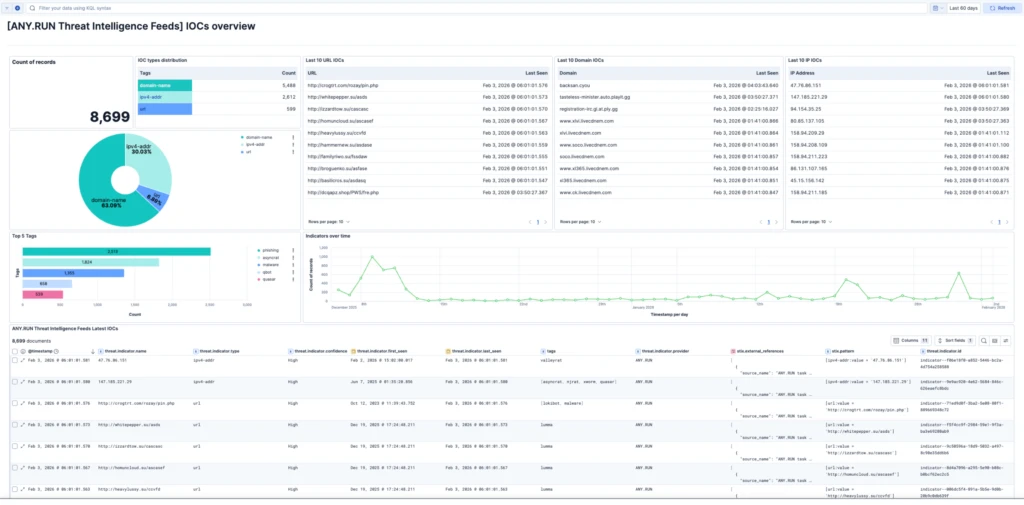
Once configured, Elastic Security can ingest indicators such as IPs, domains, and URLs from the integration on a scheduled basis. Those indicators can then be used across supported detection, investigation, and visualization workflows.
The additional context associated with ingested indicators can help analysts triage and investigate alerts more efficiently.
The integration embeds threat intelligence directly into daily SOC workflows inside Elastic Security. Analysts don’t need to manually check indicators in external tools or move data between systems.
Here is what your team gains:
Together, these improvements help reduce MTTD and MTTR, lower incident response costs, and increase analyst efficiency by enabling teams to handle more cases without expanding headcount.
Better detection coverage and earlier visibility into active threats contribute to overall business risk reduction by limiting the impact and spread of attacks.
The integration is designed to be simple and flexible. Once you get an active TI Feeds access, you can navigate to the integration page and follow the instructions.
Indicators are automatically ingested into Elastic and continuously updated. They become part of detection, search, and response workflows.
With ANY.RUN Threat Intelligence Feeds in Elastic Security, teams can:
With ANY.RUN Threat Intelligence Feeds integrated into Elastic’s Security platform can further enhance customer’s security detection with timely, behavior-validated intelligence., Organizations can detect threats early, reduce manual effort, and make fast, confident decisions.
This leads not only to better SOC performance, but also to measurable business impact. Early detection, fast response, and improved signal quality help reduce the likelihood and impact of incidents, ultimately lowering overall business risk.
ANY.RUN helps security teams understand threats faster and take action with confidence. Its solutions are trusted by over 600,000 security professionals and more than 15,000 organizations across industries where speed and accuracy are critical for effective response.
ANY.RUN’s Interactive Sandbox allows teams to safely analyze suspicious files and URLs, observe real behavior in real time, and confirm threats before they spread.
Combined with Threat Intelligence Lookup and Threat Intelligence Feeds, it provides the context needed to prioritize alerts, reduce uncertainty, and stop advanced attacks earlier in the response cycle.
Request access to ANY.RUN’s solutions →
The post ANY.RUN & Elastic Security: Bring Threat Intelligence into Detection and Investigation Workflows appeared first on ANY.RUN’s Cybersecurity Blog.
ANY.RUN’s Cybersecurity Blog – Read More
Over 400 malicious versions of 170 packages were published as part of the new Mini Shai-Hulud campaign.
The post TanStack, Mistral AI, UiPath Hit in Fresh Supply Chain Attack appeared first on SecurityWeek.
SecurityWeek – Read More
Many AI-first enterprises have already embraced sovereign architectures for general AI initiatives; cybersecurity—and the SOC—should be next.
The post Is The SOC Obsolete, And We Just Haven’t Admitted It Yet? appeared first on SecurityWeek.
SecurityWeek – Read More
Most organizations operate under the assumption that anything residing within their trust boundary is trustworthy. Software arrives from vetted vendors, employees pass background checks, cloud providers hold compliance certifications, and build pipelines produce signed artifacts.
In practice, these assumptions are rarely scrutinized, and state-sponsored actors have constructed their operational methodology around exploiting precisely this gap. They operate inside the trust boundary, using trusted tools, holding valid credentials, and performing actions that appear entirely authorized. Conventional security architecture is not designed to identify this, and that limitation warrants acknowledgment before turning to what incident response looks like when the adversary is a state-sponsored.
Responding to a state-sponsored intrusion is fundamentally different from responding to a criminal one. The adversary is better resourced, more patient, operationally disciplined, and often in pursuit of objectives that do not trigger any alarms, such as espionage or long-term data extraction. Standard incident response playbooks, typically built around malware containment and ransomware recovery, are not adequate for this category of threat. The tooling, decision-making, legal coordination, and even the definition of what constitutes a successful response all need to be reconsidered.
This is also the context in which zero trust architecture becomes essential. This is a fundamental reorientation from a model in which trust is assumed to one in which it is continuously verified, and in which systems are architected to handle the case where verification fails. The operative principle is not “trust nothing,” which no organization can realistically operationalize, but rather “verify continuously and plan for failure.”
The following sections cover how state-sponsored actors operate across the Cyber Kill Chain, why their techniques demand different detection and response approaches, and what organizations need to have in place before, during, and after an intrusion to mount an effective response.
Every cyber attack, from commodity ransomware to state-sponsored espionage, follows the same fundamental sequence as the Cyber Kill Chain developed by Lockheed Martin: reconnaissance, weaponization, delivery, exploitation, installation, command and control (C2), and action on objectives. State-sponsored actors do not deviate from this sequence. They execute each phase with greater patience, greater precision, and a fundamentally different objective.
A financially motivated attacker requires the target to know it has been compromised. The ransomware note, the leak site, and the negotiation channel are all components of the business model. A state-sponsored actor requires the opposite. Whether the objective is espionage, intellectual property theft, or pre-positioning for future disruption, success depends on the target remaining unaware. That requirement for covertness shapes every technical decision the actor makes and determines what defenders need to look for at each phase. The following are common trends that change the dimensions of defense:
Detection methodology does not require reinvention. The Kill Chain remains the same. It does, however, need to be calibrated for an adversary that treats every phase as an exercise in remaining invisible, that can operate using the target’s own tooling, and that measures success in months of undetected access.
Attribution in the context of incident response deserves a straightforward treatment, because it is frequently misunderstood and its operational relevance is often overstated at the tactical level. Technical attribution, associating an intrusion with a known threat actor based on tactics, techniques, and procedures (TTPs); infrastructure; and malware characteristics is possible with varying degrees of confidence and is useful primarily for informing the threat model and anticipating likely next steps. An organization that can assess with reasonable confidence that Volt Typhoon is responsible for an intrusion can make better-informed decisions about what systems to prioritize, what persistence mechanisms to hunt for, and what the likely objectives are. Political attribution, the public or legal assignment of responsibility to a state-sponsored actor, is a government function -not a security team function – and attempting it without the intelligence resources to support it creates more risk than it resolves.
The practical implication for incident response teams is that TTPs and infrastructure indicators should be shared with national authorities and relevant Information Sharing and Analysis Centers (ISACs), who are better positioned to place them in a broader intelligence context. Internal response should focus on containment, scope determination, and recovery regardless of whether attribution is ever formally established.
Encountering a state-sponsored actor during incident response is not the time to discover logging gaps, missing baselines, or that the legal team has never discussed intelligence sharing with government agencies. The following sections cover the areas where preparation most directly determines whether detection and response are feasible.
Default logging configurations are not sufficient for detecting the techniques described above.
More broadly, visibility needs to extend across identity systems, endpoints, network infrastructure, and cloud environments.
Endpoint telemetry alone is insufficient. State-sponsored actors operating through legitimate tools will generate process events that are difficult to distinguish from normal administrative activity, and network-layer visibility provides an independent detection plane that host-based logging cannot replace.
CISA’s joint advisory on living-off-the-land techniques recommends maintaining continuous baselines across network traffic, user behavior, administrative tool usage, and application activity. The emphasis on “continuously” is not incidental. A baseline established once and left unattended can generate more problems than it resolves, creating false confidence that normal has been adequately defined, when in reality theorganization has moved on. Baselines need to reflect seasonal patterns, organizational changes, infrastructure updates, and role transitions. When an administrator changes teams, their access patterns shift. When a new application is deployed, new NetFlow patterns emerge. If the baseline fails to keep pace, genuine threats blend into an outdated picture of normal, and anomaly detection becomes a source of noise rather than signal.
Statistical anomaly detection can surface the low-and-slow deviations characteristic of state-sponsored lateral movement, but tuning is an ongoing commitment, and false positive management carries a real operational cost that should not be underestimated.
State-sponsored actors do not typically maintain access through malware alone. Once inside, they move through identity infrastructure. Privileged access management deserves explicit treatment: administrative accounts should operate on a tiered model that prevents domain administrator credentials from being exposed on workstations, and service accounts should be scoped to the minimum access their function requires. Detection logic needs to account for credential abuse patterns that do not involve any malicious tooling. Pass-the-hash and pass-the-ticket attacks use legitimate authentication protocols and will not trigger antivirus. Kerberoasting, where an attacker requests service tickets for offline cracking, is visible in Kerberos event logs but only if those logs are collected and someone is looking. Anomalous authentication patterns, such as accounts authenticating at unusual hours, from unusual sources, or against systems they have never previously accessed, are among the more reliable behavioral signals available, provided the baseline exists to contextualize them.
If a state-sponsored breach is confirmed, the response needs to assume the adversary can see internal communications. If they have domain admin access, they can likely read email. If they have compromised a collaboration platform, they may be able to see the incident response channel. Here are some of the common aspects that should be considered:
Organizations should also have a pre-established relationship with national authorities, including the relevant contacts at national CERTs or intelligence agencies, rather than trying to find the right person during a crisis.
For organizations with OT environments, the threat model extends beyond what most IT-centric IR plans address.
The IT-OT boundary that appears on network diagrams is a logical construct, and state-sponsored actors treat it as a lateral movement path rather than a barrier. Volt Typhoon demonstrated this in concrete terms by moving from compromised IT infrastructure toward OT-adjacent systems, including those controlling water treatment plants and electrical substations. Through 2025, the group progressed from IT reconnaissance to directly interacting with OT network-connected devices and extracting sensor and operational data, representing a transition from passive espionage to what amounts to a sabotage-ready foothold, maintained quietly and positioned for activation when circumstances require it. Important aspects are:
Vendors, software dependencies, and network infrastructure are all extensions of the trust boundary, and preparing for supply chain compromise means understanding those dependencies and having response procedures ready before one of them is exploited. Some critical measures are as follows:
In the state-sponsored context, the insider threat is not about a disgruntled employee stealing files. It is a structured intelligence operation that uses the hiring process itself as an attack vector, and preparation requires a cross-functional program spanning security, HR, legal, and finance because the indicators span all four domains.
For planted insiders, the DPRK IT worker scheme being the most documented example, hiring verification needs to go beyond standard background checks. This includes live, multi-stage video interviews with liveness verification that current deepfake technology cannot reliably defeat (for now), digital footprint validation across independent data sources, detection of VoIP phone numbers and shared credentials across applications, and cross-referencing candidate information for the kinds of inconsistencies a fabricated identity cannot fully conceal.
For all insider categories, behavioral baselines and data loss prevention policies should be in place before an incident occurs. Legal pre-authorization for employee monitoring is also important to establish ahead of time. Trying to build that legal framework during an active investigation will either delay the response or create legal exposure.
If your current IR plan covers malware and ransomware but typically it does not address supply chain compromise, insider threats, or living-off-the-land techniques. Most IR plans simply reflect a threat landscape that has already shifted. These gaps should be addressed through distinct playbooks, each with its own containment decision trees, evidence collection procedures, legal coordination requirements, and recovery verification steps. Each playbook should be tested through tabletop exercises built around realistic scenarios.
One aspect of state-sponsored incident response sets it apart from criminal incident response is that the adversary may be observing the response in real time, will likely attempt to regain access after eviction, and the diplomatic, legal, and intelligence dimensions of the incident extend well beyond the security operations center.
The containment decision in a state-sponsored incident is rarely straightforward. Treating it as a binary choice between immediate isolation and inaction understates the complexity involved. In a criminal incident, early containment is almost always the correct approach. In a state-sponsored incident, premature containment can eliminate the opportunity to understand the full scope of the adversary’s access, forfeit the ability to collect intelligence on their infrastructure, and signal to the adversary that they have been detected. That signal may trigger accelerated action on their objectives before defenses are fully in place.
The deliberate choice to monitor silently while the adversary operates introduces its own legal, ethical, and operational risks. That decision should never be made unilaterally by the SOC. It requires input from legal counsel and senior leadership, and in many cases a conversation with national authorities before it is exercised.
The incident response plan should define in advance who holds decision authority over containment timing, what criteria govern the transition from silent monitoring to active containment, and what evidence collection must be completed before containment begins. Tabletop exercises that do not incorporate this decision point are not adequately preparing teams for the reality of state-sponsored incident response.
After containment and recovery, the work is not finished. The intelligence collected during the incident has value beyond the organization that was targeted, and sharing it through ISACs and government channels contributes to a broader defensive picture that benefits the entire sector. Internally, the after-action review should map findings to MITRE ATT&CK, not as a compliance exercise but as a structured way to identify where detection failed, where response was too slow, and where controls need to be strengthened. That review should feed directly into updated detection logic, revised access controls, and adjusted monitoring priorities.
Threat hunting should not stop when the incident is closed. A state-sponsored actor that has been evicted will often attempt to regain access using different infrastructure or modified techniques, and sustained hunting focused on the specific actor’s TTPs is the most reliable way to catch that early. Tabletop exercises should also be updated to reflect what was learned, so the next time a similar scenario plays out, the team is not relearning the same lessons under pressure.
None of this is new guidance, but in the context of state-sponsored threats, where the adversary is persistent, well-resourced, and likely to return, these activities stop being procedural housekeeping and become direct preparation for the next intrusion.
Everything covered above assumes an organization can invest in logging, baselines, segmentation, supply chain controls, and dedicated IR planning in parallel. In reality, most security teams are operating under hiring freezes, flat budgets, and competing priorities, and the guidance to “do all of this” is not actionable without a sense of sequencing. The following is a pragmatic order of operations for teams that need to make meaningful progress without a step-change in resourcing.
Start with visibility, because you cannot defend what you cannot see. Before buying new tooling, turn on what you already own. Enabling Windows command-line logging (Event ID 4688), PowerShell script block logging (Event ID 4104), and centralized log forwarding costs nothing in licensing and addresses the single largest gap most organizations have. If logs are not being collected and retained centrally, no amount of downstream investment will compensate.
After this, prioritize identity over endpoints. State-sponsored actors move through credentials, not malware that can be easily fingerprinted, blocked, and made public through sandboxes. Enforcing multi-factor authentication (MFA) on all administrative accounts, implementing tiered admin models, and reviewing service account privileges typically delivers more risk reduction per hour invested than any endpoint initiative. These are configuration changes, not procurement cycles.
Next, focus monitoring where the adversary has to go. If Sysmon everywhere is not feasible, then deploy it on domain controllers, identity infrastructure, externally facing systems, and critical servers. An adversary pursuing meaningful objectives will eventually touch these systems, and concentrated visibility on them is more valuable than thin visibility everywhere.
The underlying principle is that state-sponsored readiness is not a single large investment. It is a sequence of smaller decisions where the early ones disproportionately determine whether the later ones are ever useful. Visibility and identity come first. Everything else builds on them.
Cisco Talos Blog – Read More
OpenAI has launched Daybreak, a new cybersecurity initiative that brings together frontier artificial intelligence (AI) model capabilities and Codex Security to help organizations identify and patch vulnerabilities before attackers find a way in using the same issues.
“Daybreak combines the intelligence of OpenAI models, the extensibility of Codex as an agentic harness, and our partners across
The Hacker News – Read More