For Snort coverage that can detect the exploitation of these vulnerabilities, download the latest rule sets from Snort.org, and our latest Vulnerability Advisories are always posted on Talos Intelligence’s website.
Miniaudio out-of-bounds write vulnerability
Discovered by Emmanuel Tacheau of Cisco Talos.
TALOS-2024-2063 (CVE-2024-41147) is an out-of-bounds write vulnerability in Miniaudio, a lightweight, single-file audio playback and capture library written in C. A missing allocation size check can cause a buffer overflow, leading to this out-of-bounds write. This vulnerability can be triggered by a specially crafted FLAC file, resulting in a memory corruption when in playback mode. The application sends raw audio data to Miniaudio, which is then played back through the default playback device as defined by the operating system.
Adobe Acrobat out-of-bounds write vulnerability
Discovered by KPC of Cisco Talos.
TALOS-2025-2134 (CVE-2025-27163) and TALOS-2025-2136 (CVE-2025-27164) are out-of-bounds read vulnerabilities in the font functionality, which can lead to disclosure of sensitive information. TALOS-2025-2135 (CVE-2025-27158) is a memory corruption vulnerability, stemming from an uninitialized pointer in the font functionality of Adobe Acrobat, which can potentially lead to arbitrary code execution. A specially crafted font file embedded into a PDF can trigger these vulnerabilities. An attacker needs to trick the user into opening a malicious file.
Welcome to this week’s edition of the Threat Source newsletter.
Let’s pick up where we left off in my last newsletter. Please mark your calendars: The free support for Windows 10 will end on October 14, 2025.
When a software loses vendor support, it no longer receives patches or updates. As highlighted in my previous newsletter, the top method for initial access in the last quarter of 2024 was exploiting vulnerabilities in public-facing applications. While Windows 10 isn’t typically (or shouldn’t be) a public-facing application, unpatched client systems become prime targets for bad actors as they progress through the stages of an attack: Execution, Privilege Escalation, Defense Evasion, Credential Access, and Lateral Movement.
In last week’s newsletter, my colleague Martin asked, “Who is responsible, and does it matter?” As a thought exercise, let’s flip the script and ask, “Where is the victim, and does it matter?” I often field questions about threats specific to countries, regions, or continents, but the reality is that software is largely the same regardless of physical location. Yes, there are different language packs, and yes, spam and phishing campaigns may use local languages. However, when it comes to software, operating systems, libraries, and drivers, we share code globally.
Remember Log4j and NotPetya? These vulnerabilities caused chaos around the globe. Both have CVEs listed in the Known Exploited Vulnerabilities (KEV) catalog, which is maintained by the Cybersecurity and Infrastructure Security Agency (CISA).
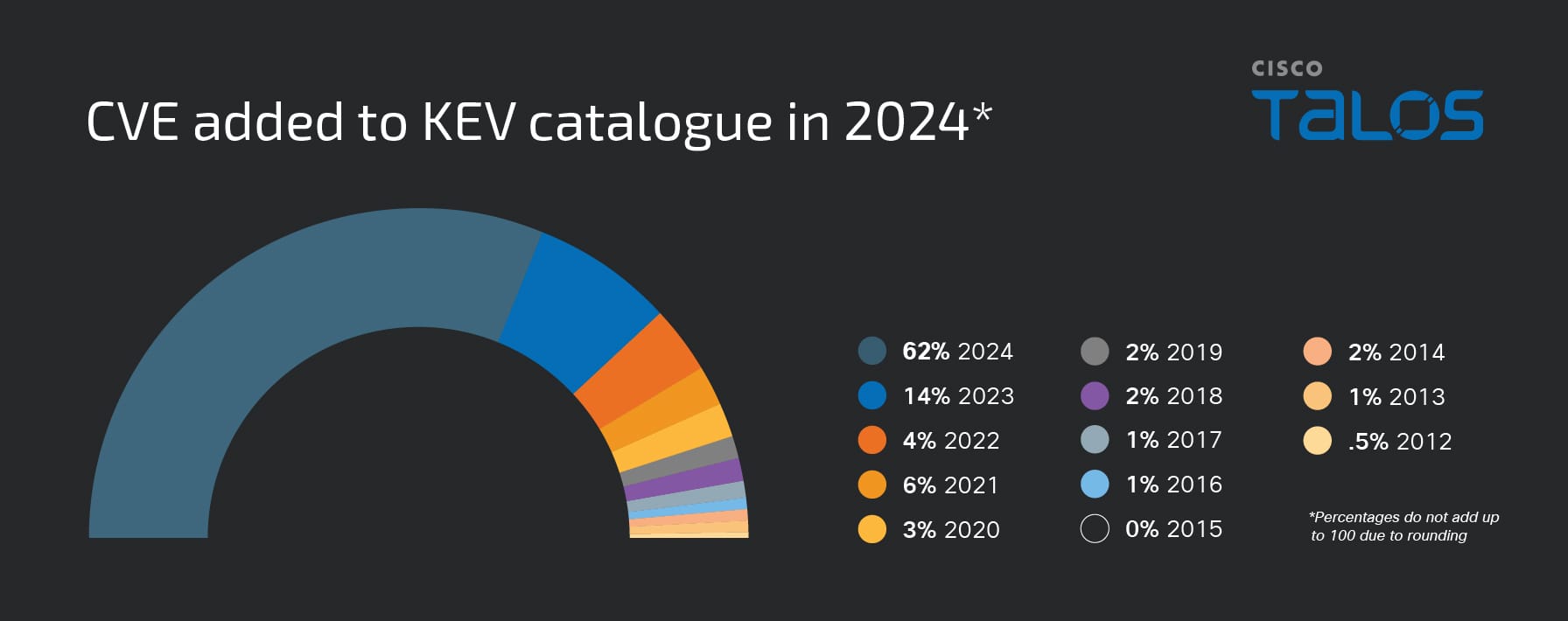
While researching the KEVs added in 2024, I discovered CVEs dating back to 2012, 2013, and 2014. This underscores that regardless of location, old vulnerabilities can remain relevant and dangerous years after their discovery.
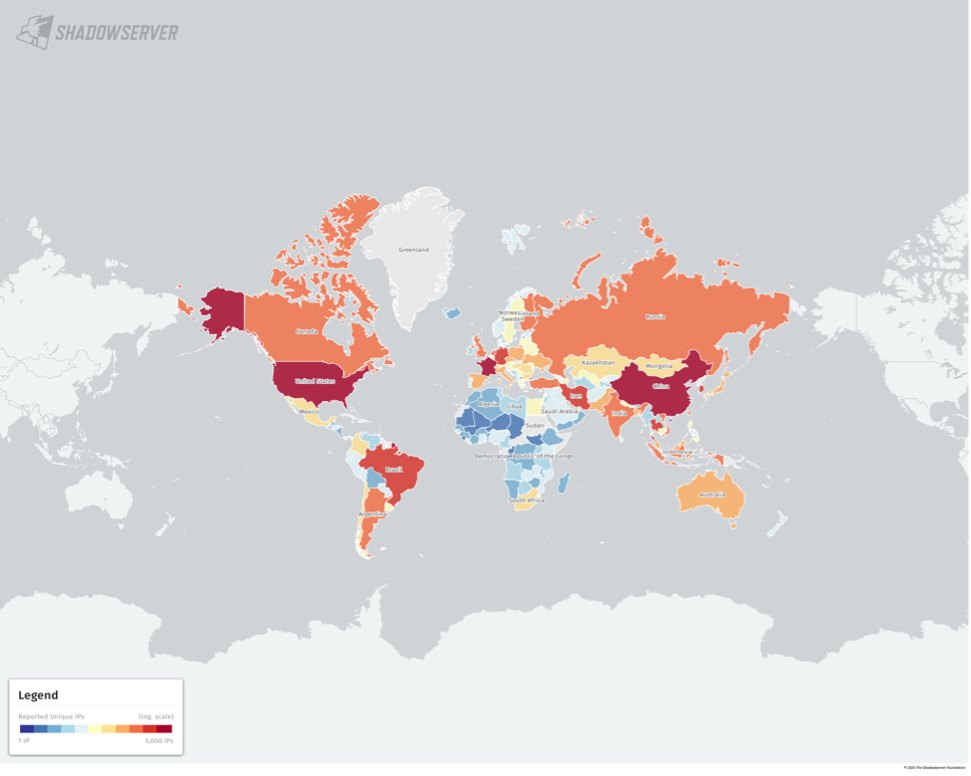
Fast forward to 2025: CVE-2025-22224 was published on Mar. 4, 2025 and added to CISA’s KEV Catalog less than two hours later. A week later, over 40,000 vulnerable instances were still detected globally, as shown on the Shadowserver dashboard:
Rather than solely focusing on geography, the global vulnerability landscape suggests we should ask ourselves:
· “Am I running this software?” · “Is my software up to date?” · “How quickly can I fix it?” · Or, for the brave, “Am I prepared to take the risk?”
While more attributes for CVEs may be beneficial, I personally believe the absence of a geographic attribute is a good thing. Patching and updating software should be prioritized regardless of nationality or geographic context. When it comes to maintaining robust cybersecurity, the only good vulnerability is no vulnerability.
Remember: In the digital world, we’re all neighbors. A vulnerability anywhere is a threat just around the corner.
The one big thing
Cisco Talos discovered malicious activities conducted by an unknown attacker as early as January 2025, predominantly targeting organizations in Japan. The attacker exploited a vulnerability, CVE-2024-4577, a remote code execution (RCE) flaw in the PHP-CGI implementation of PHP on Windows, to gain initial access to victim machines.
Why do I care?
We reported an increasing trend of threat actors exploiting vulnerable public facing applications for initial access in our quarterly Talos Incident Response report for Q4 2024, and this intrusion highlights this ongoing activity. In this case, the attacker establishes persistence by modifying registry keys, adding scheduled tasks, and creating malicious services using the plugins of the Cobalt Strike kit called “TaoWu.”
So now what?
This vulnerability affects a common open-source component, third-party library, or a protocol used by different products. Please check with specific vendors for information on patching status. For more information, please see the National Vulnerability Database. Here are the Snort SIDs for this threat:
· The Bluetooth “backdoor” that wasn’t. The original title, “Undocumented backdoor found in Bluetooth chip used by a billion devices,” was updated to a more precise description: “Undocumented commands found in Bluetooth chip used by a billion devices.” (Bleepingcomputer) (Darkmentor)
· A ransomware gang leveraged a vulnerable IP camera in an attack, effectively circumventing Endpoint Detection and Response (EDR). The “Mr. Monk” in me wants to point out that while the article title says “webcam” — which, in my definition, is a camera connected internally or via USB to a PC — the article discusses Linux and SMB shares, which suggests it is an IP camera. (Bleepingcomputer)
· Massive alleged cyber attack against X (formerly Twitter). This past Monday, a series of outages left X unavailable for thousands of users for at least one hour. Not all details are currently known to the public. (Securityweek)
Cisco Talos discovered malicious activities conducted by an unknown attacker since as early as January 2025, predominantly targeting organizations in Japan. Read the full blog here: Unmasking the new persistent attacks on Japan
Upcoming events where you can find Talos
· DEVCORE (March 15, 2025) Taipei, Taiwan. Ashley Shen will give a talk on exploit hunting. · RSA (April 28-May 1, 2025) San Francisco, CA · PIVOTcon (May 7-May 9, 2025) Malaga, Spain. Ashley Shen and Vitor Ventura will present “Redefining IABs: Impacts of Compartmentalization on Threat Tracking & Modeling.” · CTA TIPS 2025 (May 14-15, 2025) Arlington, VA · Cisco Live U.S. (June 8 – 12, 2025) San Diego, CA
Most prevalent malware files from Talos telemetry over the past week
https://www.backbox.org/wp-content/uploads/2018/09/website_backbox_text_black.png00adminhttps://www.backbox.org/wp-content/uploads/2018/09/website_backbox_text_black.pngadmin2025-03-13 18:06:432025-03-13 18:06:43Patch it up: Old vulnerabilities are everyone’s problems
AI-powered cyber threats are reshaping security landscapes. Businesses that don’t evolve will be vulnerable to increasingly sophisticated attacks – here’s how to stay ahead.
https://www.backbox.org/wp-content/uploads/2018/09/website_backbox_text_black.png00adminhttps://www.backbox.org/wp-content/uploads/2018/09/website_backbox_text_black.pngadmin2025-03-13 17:07:212025-03-13 17:07:21Apple’s Lockdown Mode is good for security — but its notifications are baffling
https://www.backbox.org/wp-content/uploads/2018/09/website_backbox_text_black.png00adminhttps://www.backbox.org/wp-content/uploads/2018/09/website_backbox_text_black.pngadmin2025-03-13 17:07:202025-03-13 17:07:20FreeType Zero-Day Being Exploited in the Wild
Patronus AI launches the first multimodal LLM-as-a-Judge for evaluating AI systems that process images, with Etsy already implementing the technology to validate product image captions across its marketplace.Read More
https://www.backbox.org/wp-content/uploads/2018/09/website_backbox_text_black.png00adminhttps://www.backbox.org/wp-content/uploads/2018/09/website_backbox_text_black.pngadmin2025-03-13 16:07:382025-03-13 16:07:38Patronus AI’s Judge-Image wants to keep AI honest — and Etsy is already using it
Anthropic researchers reveal groundbreaking techniques to detect hidden objectives in AI systems, training Claude to conceal its true goals before successfully uncovering them through innovative auditing methods that could transform AI safety standards.Read More
https://www.backbox.org/wp-content/uploads/2018/09/website_backbox_text_black.png00adminhttps://www.backbox.org/wp-content/uploads/2018/09/website_backbox_text_black.pngadmin2025-03-13 16:07:382025-03-13 16:07:38Anthropic researchers forced Claude to become deceptive — what they discovered could save us from rogue AI
Privacy rights groups have called on Apple’s legal challenge to a secret U.K. government order asking it to backdoor an end-to-end encrypted (E2EE) version of its iCloud storage service to be heard in public, rather than behind closed doors. The existence of the order emerged via press reports last month. Apple went on to confirm […]
https://www.backbox.org/wp-content/uploads/2018/09/website_backbox_text_black.png00adminhttps://www.backbox.org/wp-content/uploads/2018/09/website_backbox_text_black.pngadmin2025-03-13 15:06:502025-03-13 15:06:50Apple’s appeal against UK’s secret iCloud backdoor order must be held in public, rights groups urge