The Future of Serverless Security in 2025: From Logs to Runtime Protection

Serverless environments, leveraging services such as AWS Lambda, offer incredible benefits in terms of scalability, efficiency, and reduced operational overhead. However, securing these environments is extremely challenging. The core of current serverless security practices often revolves around two key components: log monitoring and static analysis of code or system configuration. But here is

The Hacker News – ​Read More

T-Mobile Shares More Information on China-Linked Cyberattack

T-Mobile has confirmed being targeted by hackers, likely China’s Salt Typhoon, but reiterated that the attack was blocked.

The post T-Mobile Shares More Information on China-Linked Cyberattack appeared first on SecurityWeek.

SecurityWeek – ​Read More

Top ICS Vulnerabilities This Week: Schneider Electric, mySCADA, and Automated Logic

ICS

This week’s Cyble ICS vulnerability report includes critical vulnerabilities like CVE-2024-10575 in Schneider Electric’s EcoStruxure IT Gateway, CVE-2024-47407 in mySCADA myPRO Manager/Runtime, and CVE-2024-8525 in Automated Logic that need urgent patching.

Overview

Cyble Research and Intelligence Labs (CRIL) analyzed the latest ICS vulnerabilities disclosed by the Cybersecurity and Infrastructure Security Agency (CISA) between November 19–25, 2024. These vulnerabilities highlight pressing security concerns across critical sectors, including manufacturing, energy, and communications.

Key insights include:

  1. CISA issued seven security advisories addressing 15 vulnerabilities in ICS products from Schneider Electric, Automated Logic, CODESYS GmbH, and mySCADA.
  2. A critical “Missing Authorization” flaw (CVE-2024-10575) affecting Schneider Electric’s EcoStruxure IT Gateway could allow attackers unauthorized access to critical systems.
  3. mySCADA and Automated Logic WebCTRL exposures show the growing attack surface, stressing the importance of proactive security measures.

Below, we delve into the most significant vulnerabilities and their implications for security teams.

The Week’s Top ICS Vulnerabilities

Key vulnerabilities identified in this report include:

CVE-2024-10575 (Schneider Electric):

  • Product: EcoStruxure IT Gateway
  • Severity: Critical
  • Issue: Missing Authorization
  • Impact: Unauthorized access to critical systems, risking data breaches and operational disruptions.
  • Patch Link

CVE-2024-47407 (mySCADA):

  • Product: myPRO Manager/Runtime
  • Severity: Critical
  • Issue: OS Command Injection
  • Impact: Remote execution of arbitrary commands compromising SCADA and HMI systems.
  • Patch Link

CVE-2024-8525 (Automated Logic):

  • Product: WebCTRL Server (v7.0)
  • Severity: Critical
  • Issue: Unrestricted File Upload
  • Impact: Uploading malicious files to building automation systems.
  • Patch Link

CVE-2024-8933 (Schneider Electric):

  • Product: Modicon M340, MC80, Momentum
  • Severity: High
  • Issue: Message Integrity Bypass
  • Impact: Potential manipulation of system communications.
  • Patch Link

CVE-2024-50054 (mySCADA):

  • Product: myPRO Manager/Runtime
  • Severity: High
  • Issue: Path Traversal
  • Impact: Unauthorized file access and data compromise.
  • Patch Link

For the complete list of vulnerabilities and their respective mitigations subscribe to Cyble’s AI-powered threat intelligence product suite!

Vendor Spotlight

Schneider Electric reported 50% of vulnerabilities, spanning industrial automation and energy management systems.

mySCADA followed with 33%, reflecting issues in SCADA and HMI platforms.

Automated Logic and CODESYS GmbH accounted for 17%, impacting building automation and PLC software.

Figure 1. Vendors who reported and released patches for ICS vulnerabilities, this week. (Source: Cyble)

Impacted Critical Infrastructure Sectors

Critical Manufacturing dominated the impacted sectors with seven vulnerabilities (50%).

The interconnected sectors of manufacturing, energy, and communications accounted for six vulnerabilities (43%), showcasing the criticality of cross-sector dependencies.

Impacted critical Infrastructure Sectors

Figure 2. Impacted critical infrastructure sectors. (Source: Cyble)

Recommendations

To address these vulnerabilities and reduce exploitation risks, CRIL recommends:

  • Monitor Alerts: Regularly review security advisories from vendors and government agencies like CISA.
  • Implement Zero-Trust: Restrict access to critical systems using risk-based management approaches.
  • Network Segmentation: Isolate sensitive ICS components to prevent lateral movement during attacks.
  • Patch Management: Develop a strategy for inventory, assessment, testing, and deployment of patches.
  • Regular Assessments: Conduct vulnerability assessments, penetration tests, and audits to identify weaknesses.
  • Secure Access: Restrict access to ICS devices, ensuring strong authentication measures are in place.
  • Incident Response Plans: Establish and test procedures for detecting and responding to cyber incidents.
  • Employee Training: Train employees to recognize phishing attempts and adhere to security protocols.

Conclusion

This week’s ICS vulnerability report shows the persistent threats to critical infrastructure. The vulnerabilities in Schneider Electric, mySCADA, and Automated Logic products demonstrate the importance of prioritizing cybersecurity measures to safeguard essential systems.

Organizations must act swiftly to patch critical flaws, enhance monitoring, and strengthen overall cybersecurity posture. Proactive measures are crucial in mitigating risks and maintaining the integrity of critical operations.

The post Top ICS Vulnerabilities This Week: Schneider Electric, mySCADA, and Automated Logic appeared first on Cyble.

Blog – Cyble – ​Read More

XMLRPC npm Library Turns Malicious, Steals Data, Deploys Crypto Miner

Cybersecurity researchers have discovered a software supply chain attack that has remained active for over a year on the npm package registry by starting off as an innocuous library and later adding malicious code to steal sensitive data and mine cryptocurrency on infected systems.
The package, named @0xengine/xmlrpc, was originally published on October 2, 2023 as a JavaScript-based XML-RPC

The Hacker News – ​Read More

Microsoft Patches Exploited Vulnerability in Partner Network Website

Microsoft informed customers that vulnerabilities affecting cloud, AI and other services have been patched, including an exploited flaw.

The post Microsoft Patches Exploited Vulnerability in Partner Network Website appeared first on SecurityWeek.

SecurityWeek – ​Read More

Cybercriminals Exploit Popular Game Engine Godot to Distribute Cross-Platform Malware

A popular open-source game engine called Godot Engine is being misused as part of a new GodLoader malware campaign, infecting over 17,000 systems since at least June 2024.
“Cybercriminals have been taking advantage of Godot Engine to execute crafted GDScript code which triggers malicious commands and delivers malware,” Check Point said in a new analysis published Wednesday. “The technique

The Hacker News – ​Read More

Flipper Zero goes retro with this cool limited-edition version (and it’s back for Black Friday)

If you want one, you’d better act fast.

Latest stories for ZDNET in Security – ​Read More

Telegram Premium gift subscription scam | Kaspersky official blog

We at Kaspersky recently conducted a study and found that the average person spends $938 a year on 12 subscriptions. This just confirms that in today’s world, being subscribed to numerous services is just as much a part of everyday life as having your smartphone with you at all times.

There are subscriptions for everything: music, movies, fitness, security solutions, and even messaging apps. In this article, we’ll focus on one of the latter — Telegram Premium, a subscription that doubles almost all the messenger’s free-version’s limits. And the coolest thing about it is that you can give it to your friends as a present. If you have a large contact list, Telegram frequently reminds you of this possibility. Of course, scammers are exploiting this feature, sending out fake Telegram Premium gift subscriptions left and right.

So what’s behind these gift subscriptions from cybercriminals — and how can you protect your Telegram account?

How the Telegram gift-subscription scam works

It all starts with an innocent-looking Telegram message from someone in your contact list (actually — an impostor): “You’ve been sent a gift — a Telegram Premium subscription”. Beneath it is a link that, at first glance, seems legitimate. And indeed, it leads to an official-looking Telegram Premium channel. But there’s a catch…
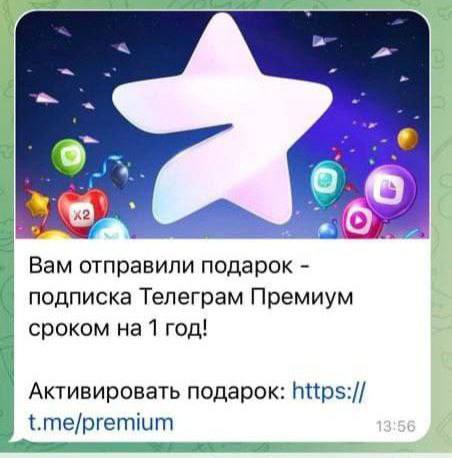
Admit it, receiving a message like this feels great, and in a moment of excitement, it's easy not to cotton on to the trap

Admit it, receiving a message like this feels great, and in a moment of excitement, it’s easy not to cotton on to the trap

The text you see — https://t.me/premium — actually hides a link to a completely different phishing page. It’s a simple trick. Consider this example: here’s a link to the Kaspersky Daily blog homepage — https://kaspersky.com/blog, but it actually redirects to the homepage of our other blog, Securelist. Scammers use the same principle: they mask their phishing links with seemingly legitimate addresses.

Let’s return to the Telegram gift-subscriptions scam. The phishing page looks like a regular Telegram login page in a browser. However, the scam is betrayed by the dodgy URL: the address starts with the familiar https://t.me, but then has something extra, which wouldn’t be there if were a legitimate page:
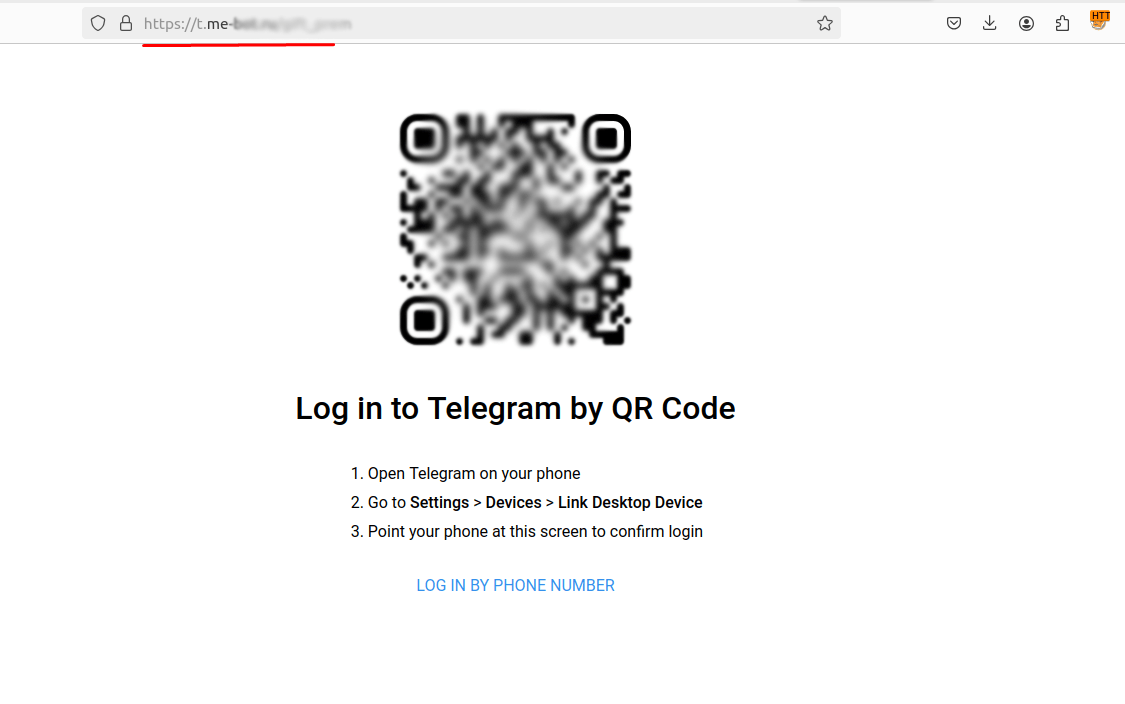
Nice try, scammers — it looks almost identical to the real site

Nice try, scammers — it looks almost identical to the real site

If you enter your account details here, consider them stolen. Your user name, password, and possibly your two-factor authentication code will end up in bad guys’ hands. Once you’ve handed over your credentials, the scammers display a congratulatory message and start a 24-hour timer, claiming it’s the activation period for Telegram Premium. This delay is a classic cybercriminal tactic. They’re counting on the user either forgetting about the subscription or believing it’s genuinely on its way. Most likely, the only thing that will happen during these 24 hours is that you’ll permanently lose access to your account.
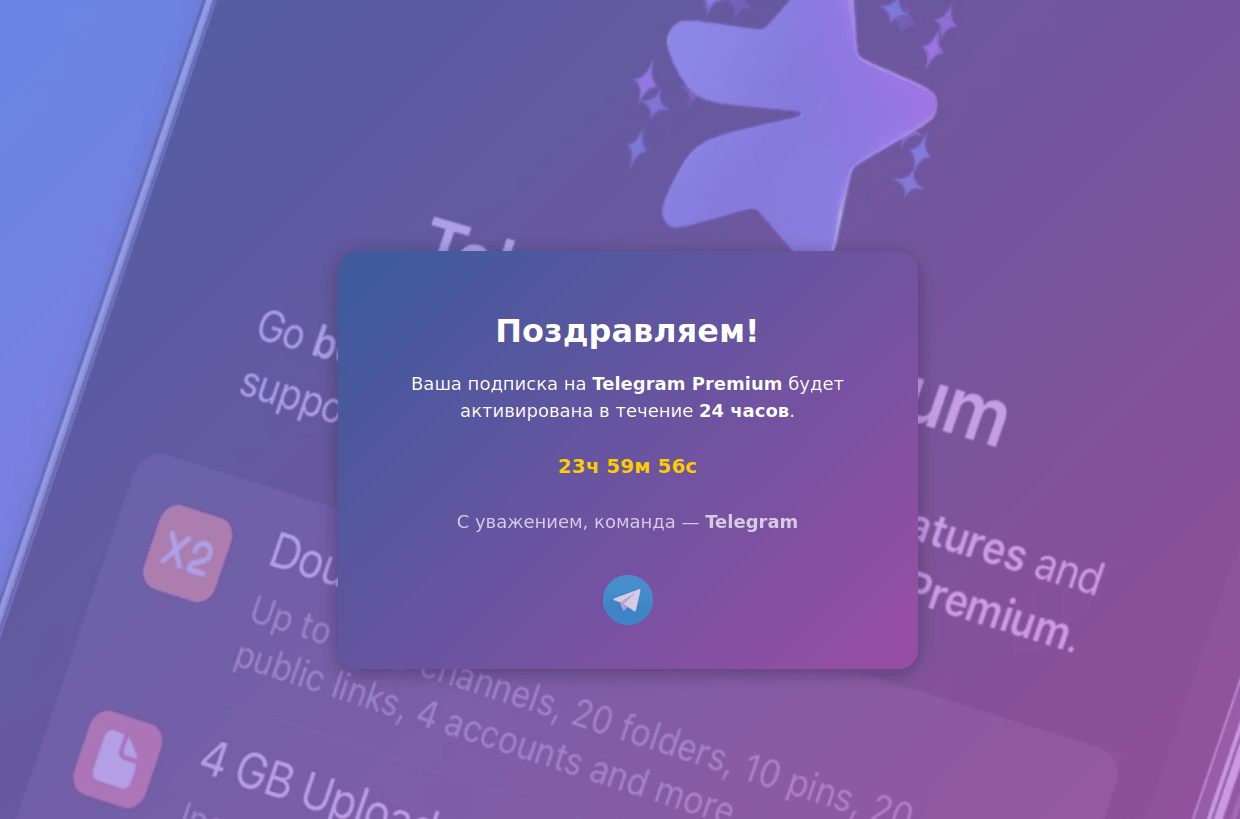
After 24 hours, the timer ends, but the subscription never materializes

After 24 hours, the timer ends, but the subscription never materializes

How else do scammers exploit gift Telegram subscriptions?

Since Telegram Premium launched several years ago, various scam scenarios have emerged. Unsurprisingly, these scams bear similarities to other primitive forms of fraud we frequently discuss on the Kaspersky Daily blog.

For example, cybercriminals might claim to host a free raffle for a three-month Telegram Premium subscription. However, there’s no real drawing of the winning “tickets” — everyone’s a winner; however, the prize isn’t a genuine gift subscription. Victims are directed to click a link and log in to Telegram on a phishing site. And that’s where their accounts get compromised.
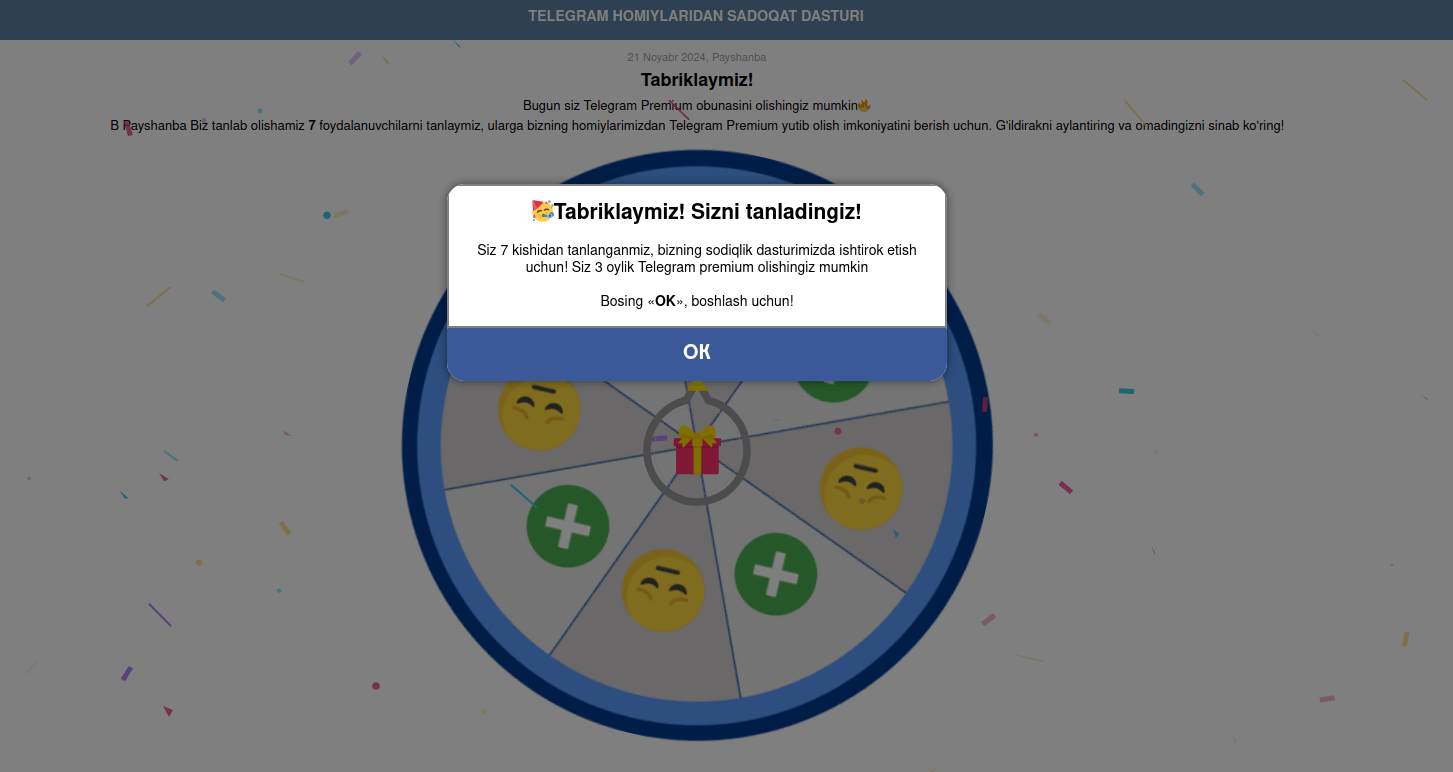
Cybercriminals play to your ego with false claims like: "You've been selected as one of seven participants in our exclusive prize draw!"

Cybercriminals play to your ego with false claims like: “You’ve been selected as one of seven participants in our exclusive prize draw!”

Another common tactic involves distributing APK files for supposedly “hacked” Telegram apps bundled with Premium subscriptions. Needless to say, such modified apps are often nothing more than malware in disguise.
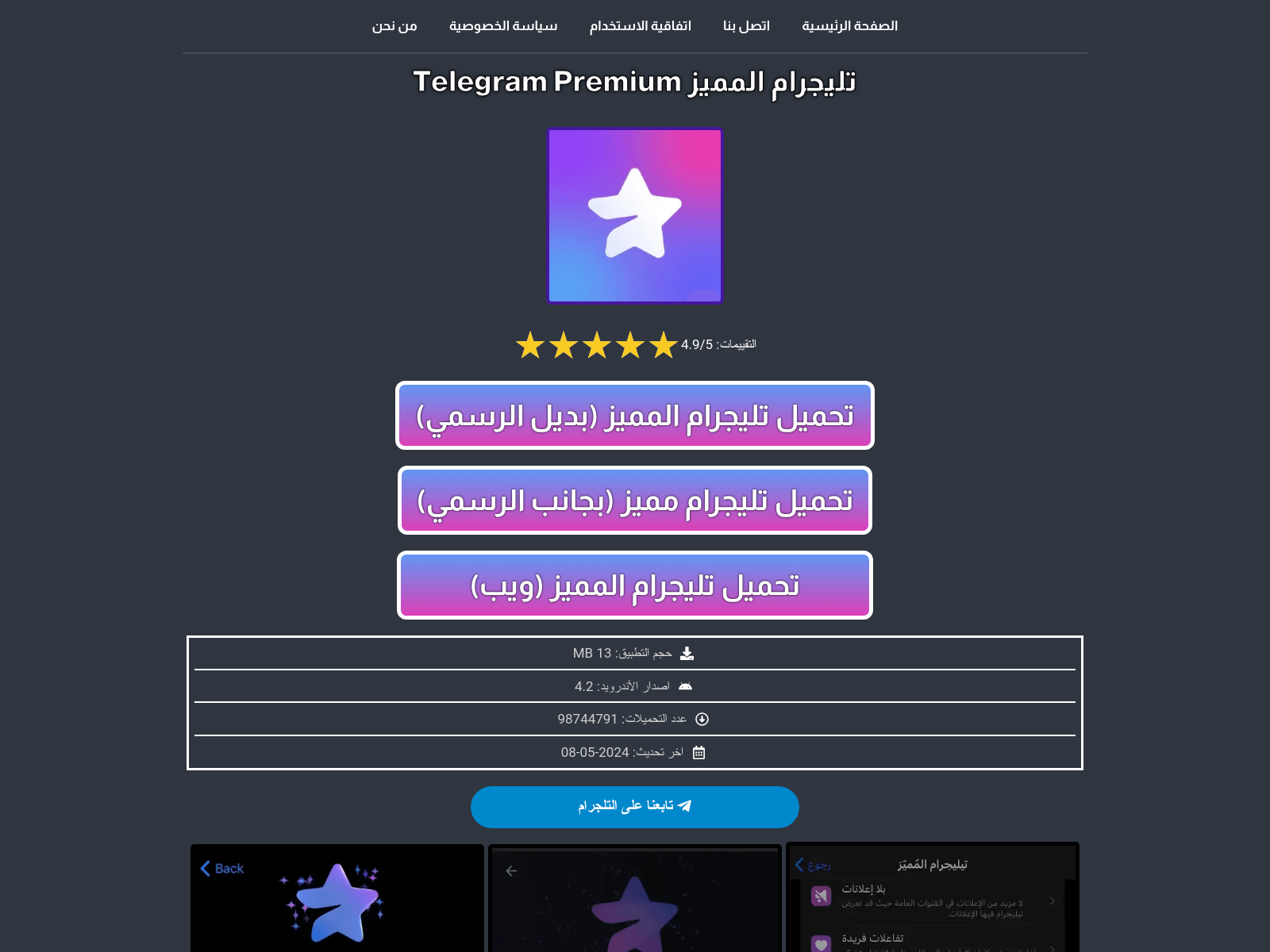
Always be skeptical of allegedly hacked or alternative versions of popular apps

Always be skeptical of allegedly hacked or alternative versions of popular apps

Now, you’ll have noticed that the screenshots above are in various languages. The fact is that these scammers operate all over the world, and if this scheme hasn’t reached your region yet, rest assured it surely soon will. Therefore, you should ensure the security of your devices and accounts with reliable protection.

How to protect your Telegram account

To start, we recommend setting up your Telegram security and privacy using our guide. If you’ve already done this, here are some additional tips to help you avoid becoming a victim of these and other scams:

  • Remember that there’s no such thing as a free lunch. Before celebrating a sudden gift, double-check if the sender really has good intentions. At the very least, contact them via a different communication channel — call them, use another messenger, or verify in person. As your personal account is at stake, you’d better err on the side of excessive caution.
  • Purchase subscriptions only through official channels. Telegram, for example, has a designated bot for buying subscriptions.
  • Enable two-factor authentication. This could be your last line of defense in case you fall for a scam. One way to store your 2FA tokens conveniently and securely is in Kaspersky Password Manager.
  • Learn more about other ways scammers can steal your Telegram account. There are countless fraudulent schemes — many of which are more sophisticated than they appear.
  • Slow down, even if you’re being rushed. Scammers love pressuring victims with timers. When it comes to your digital safety, ignore countdowns and take your time.
  • Be cautious about alternative versions of apps. We recommend only using official apps, because unofficial versions are almost always loaded with Trojans.

Kaspersky official blog – ​Read More

U.S. Telecom Giant T-Mobile Detects Network Intrusion Attempts from Wireline Provider

U.S. telecom service provider T-Mobile said it recently detected attempts made by bad actors to infiltrate its systems in recent weeks but noted that no sensitive data was accessed.
These intrusion attempts “originated from a wireline provider’s network that was connected to ours,” Jeff Simon, chief security officer at T-Mobile, said in a statement. “We see no instances of prior attempts like

The Hacker News – ​Read More

T-Mobile says telco hackers had ‘no access’ to customer call and text message logs

The phone giant said hackers did not access the contents or logs of customer phone calls or text messages, during an industry-wide attack on phone and internet companies.

© 2024 TechCrunch. All rights reserved. For personal use only.

Security News | TechCrunch – ​Read More