How to stay on top of your subscriptions and save money | Kaspersky official blog

Subscriptions are everywhere these days. So much so, it’s becoming increasingly difficult to keep track of them all. More often than not, we drastically — by more than 2.5x! — underestimate how much we spend, because those small recurring charges fly under the radar and don’t add up to a clear picture in our minds. Yet, statistics* show that many users in developed countries spend annually the equivalent of a month’s salary on subscriptions.

Our research* indicates the average subscriber globally spends $938 annually on 12 subscriptions. Leading the pack are US residents — averaging 18 subscriptions totaling $2349 per year. Brazilians, Indians, and Russians average around 10 subscriptions — costing them $732 annually. Turks get the best deal, spending just $478 for 12 subscriptions.

Why such a disparity? The average cost of a single subscription in the US, Germany, and the UK ($12/month) is three times higher than in Russia ($4/month).

The average annual spend on subscriptions is comparable to a month's salary

The average annual spend on subscriptions is comparable to a month’s salary

The US government has even taken notice of this subscription management conundrum, recently announcing an initiative to simplify canceling unwanted services. But how did these subscriptions come to permeate every aspect of our lives?

The rise of subscription services

Historically, subscriptions have been a niche market since at least the 17th  century — when people could pay a monthly fee for regular publications like newspapers, magazines, or book collection volumes. Even daily milk delivery — common in some countries since the mid-19th century — could be considered a subscription of sorts.

Cable television — offering hundreds of channels packed with movies, series and shows — reigned supreme as the most popular subscription of the late 20th century. When Netflix arrived, it didn’t need to reinvent the wheel — the audience was already primed.

Dollar Shave Club pioneered applying this business model to everyday goods. Since 2011, it’s delivered monthly shaving kits at prices significantly lower than retail. The company received 12,000 orders within the first 48 hours of its launch.

Over the past decade, subscriptions have expanded to encompass practically everything — from weekly meal kits and daily fresh socks to… monthly deliveries of real animal bones for collectors and accessories for backyard chicken farmers.

Among the strangest subscriptions are cooking kits with recipes and vinyl records, and even houseplants — delivered monthly

Among the strangest subscriptions are cooking kits with recipes and vinyl records, and even houseplants — delivered monthly

Subscriptions weren’t initially popular in the software world. Most applications were sold in beautiful boxes, on floppy disks or CDs, requiring a hefty one-off payment. But once purchased, you could use the application indefinitely. The few exceptions to this rule were applications needing frequent updates, such as antivirus software, which adopted the subscription model back in the 1990s.

Subscriptions began to penetrate the software sphere with the rise of cloud services, which store user data on the providers’ servers: Dropbox, web hosting, and so on. Here, recurring payments made sense. However, software companies then realized that recurring payments ultimately generate more revenue than one-time purchases. As a result, they started shoehorning the subscription model onto services that didn’t inherently require regular updates or ongoing vendor involvement. Today, you can subscribe to traditionally “boxed” products like office suites, as well as gaming services, music services, and much more. There are even blatantly exploitative offers like a subscription-based calculator.

“Multi-subscriptions” bundling various services under a single payment are gaining traction. Sometimes these services are at least related — like Microsoft 360, but there are also more complex hybrids like Amazon Prime, which combines free shipping, movies, music, games, discounts on groceries, fuel, medications, and much more. Seemingly convenient, it makes evaluating and managing these subscriptions even more complex.

The most popular subscriptions worldwide

The most popular subscriptions worldwide

The number of subscriptions per person will likely continue to rise as the vast majority of new software products are released exclusively under a subscription model. Subscription prices are also steadily increasing — over the past two years, the cost of some subscriptions has increased by nearly a third. That’s why subscriptions need to be monitored carefully.

Why managing subscriptions is difficult

With subscriptions so ubiquitous, managing them becomes another basic healthy habit akin to daily exercise or meticulously tracking finances. Not everyone is up to the task. Several technical and psychological factors make it easier to let subscriptions run wild than to actively manage them.

Forgetting to unsubscribe. The very thing that attracts app and service creators to subscriptions is a drawback for customers. It’s not often that people decisively tell themselves, “I’m done with this service!” They typically just use it less and less, eventually forgetting about it for months. Meanwhile, the charges continue. According to various sources, users spend from £39 to $133 monthly on unused subscriptions.

Accumulated data. Migrating data accumulated within a service can be a major hassle. Even after deciding to unsubscribe, people continue paying to avoid losing their data. Sometimes the need for migration dawns just days before renewal, leading users to pay for another year just to buy time for data export.

Duplicate features. For example, subscribing to both Microsoft 365 and Dropbox essentially results in paying twice for cloud storage, as Microsoft 365 includes a direct alternative to Dropbox called OneDrive.

Duplicate subscriptions. Confusing interfaces or poor communication between family members can lead to multiple subscriptions for the same service. Different devices may have different accounts for the same service — each incurring separate charges.

Difficult cancellation process. Some services make unsubscribing incredibly complicated, so frustrated users keep putting it off. As a result, subscriptions can linger around for months or even years, completely unused — but paid for. That’s why the US government decided to step in to streamline cancellation, requiring companies to make it just as simple as subscribing and to make contacting a live support agent easier.

How to get your subscriptions under control

One way to organize your digital life in a subscription-driven world is to cultivate the good habit of diligently documenting your household’s subscriptions as soon as they’re activated and periodically making sure they’re still in use. Even more critical is analyzing every service before subscribing. Will you really be using it regularly? Is pay-as-you-go, or even better, a one-time purchase available? Service and app providers tend to loudly advertise subscription options on their websites while burying alternative payment options like one-time purchases. If you can’t find them, a site-specific Google search may help — just be sure you’re purchasing legitimate software from the official website and not malware from a fake site.

When it comes to “subscription accounting”, the dedicated subscription management service SubsCrab can help. It keeps track of all your subscriptions and sends advance notifications about upcoming payments and subscription expirations. The hardest (and most tedious) part of keeping track of subscriptions is recording them immediately, but SubsCrab can help with this, too. You can connect it to your mailbox, and in some countries to incoming bank statements, and it will automatically scan these sources to detect new subscriptions. This way, all your services will gradually be accounted for, including forgotten ones — and unexpected bank charges reduced. Additionally, SubsCrab lets you manually add other recurring payments, like a mortgage. For more details on the features and settings of SubsCrab, check our review.

Make sure to let your family members know about the new system, and regularly review your subscriptions to cancel those that are no longer needed. Before renewing a subscription, be sure to check the SubsCrab app — it tracks special offers and promo codes, helping you make significant savings on renewals.

* Statistics are based on anonymized data from SubsCrab users (over 150,000 users worldwide, excluding China, from January 2023 to August 2024). This may not reflect the entire market but is representative of a certain audience of users who actively track their subscriptions.

Kaspersky official blog – ​Read More
Don’t become a statistic: Tips to help keep your personal data off the dark web

You may not always stop your personal information from ending up in the internet’s dark recesses, but you can take steps to protect yourself from criminals looking to exploit it

WeLiveSecurity – ​Read More
Ransomware Vulnerability Matrix: A Comprehensive Resource for Cybersecurity Analysts 

Overview 

The Ransomware Vulnerability Matrix, a vital repository on GitHub, represents a new step forward in understanding ransomware vulnerabilities. This invaluable repository catalogs known Common Vulnerabilities and Exposures (CVEs) that ransomware groups exploit, providing insights into ransomware types, vulnerable technologies, and the threat actors involved, including ransomware gangs, affiliates, and state-backed actors. 

The Ransomware Vulnerability Matrix serves as a critical resource for cybersecurity professionals tasked with prioritizing threats and assessing exposure to ransomware vulnerabilities. Each entry within the matrix details the specific ransomware gang that exploited a particular CVE, links to verification sources, and includes crucial data about the affected technologies. By compiling this information, the matrix aids teams in tracking and mitigating ransomware vulnerabilities effectively. 

By providing detailed insights into ransomware vulnerabilities, the matrix highlights the methods and tools employed by ransomware operators, offering a framework for assessing risks and enhancing defenses. 

Detailed Vulnerability Insights 

The matrix encompasses a wide array of products and corresponding CVEs exploited by various ransomware groups. Here are a few notable entries: 

Adobe ColdFusion 


CVE(s): CVE-2023-29300 & CVE-2023-38203 


Ransomware Group(s): Storm-0501 


Source(s): Microsoft 

Apache ActiveMQ 


CVE(s): CVE-2023-46604 


Ransomware Group(s): RansomHub 


Source(s): CISA 

Atlassian Confluence 


CVE(s)


CVE-2023-22515 (RansomHub) 


CVE-2023-22518 (Cerber) 


CVE-2022-26134 (Cerber) 

These entries not only identify the vulnerabilities but also the associated threat actors, underscoring the complex landscape of ransomware attacks. For instance, the notorious group LockBit has leveraged vulnerabilities in Apache’s Log4j, specifically CVE-2021-44228, to facilitate their attacks. 

Implications of Ransomware Vulnerabilities 

Ransomware vulnerabilities pose significant risks to organizations, as they can lead to data breaches, operational disruptions, and financial losses. Ransomware gangs exploit these vulnerabilities to infiltrate systems, encrypt critical data, and demand ransoms for decryption keys. Understanding the specific CVEs associated with ransomware attacks allows organizations to implement effective cybersecurity measures. 

State-backed actors also play a crucial role in the ransomware ecosystem. Their involvement complicates the threat landscape, as they often have access to advanced tools and techniques that can bypass traditional defenses. The Ransomware Vulnerability Matrix provides insights into these state-backed threats, helping organizations recognize and prepare for potential attacks. 

Recommendations and Mitigations 

To leverage the insights from the Ransomware Vulnerability Matrix effectively, organizations should consider the following recommendations: 


Continuously update the matrix with data from CVE databases to ensure it reflects the latest vulnerabilities and trends. 


Implement a system to categorize the severity of each CVE, allowing teams to prioritize patching efforts based on risk. 


Include information on when specific CVEs began to be exploited by ransomware groups, providing context for emerging threats. 


Offer specific mitigation recommendations for each CVE, enabling organizations to implement targeted defenses. 


Develop a notification system for newly discovered vulnerabilities to keep organizations ahead of potential threats. 


Link vulnerabilities to tactics and techniques outlined in the MITRE ATT&CK framework for better threat modeling. 

Conclusion 

The Ransomware Vulnerability Matrix is an organized and insightful resource that empowers cybersecurity professionals in their fight against ransomware attacks. By detailing known vulnerabilities and associating them with specific ransomware types and threat groups, the matrix enhances the ability to assess risks and prioritize defenses.  

By utilizing the Ransomware Vulnerability Matrix, organizations can not only upgrade their defenses but also contribute to the broader fight against the cyber threats posed by ransomware gangs. This proactive approach is essential for protecting networks and ensuring the integrity of vital systems. 

The post Ransomware Vulnerability Matrix: A Comprehensive Resource for Cybersecurity Analysts  appeared first on Cyble.

Blog – Cyble – ​Read More
Phishing Campaign Targeting Ukraine: UAC-0215 Threatens National Security

Overview

CERT-UA, the Cyber Emergency Response Team for Ukraine, uncovered a phishing campaign orchestrated by the threat actor UAC-0215. This campaign specifically targeted public institutions, major industries, and military units across Ukraine.   

The phishing emails were cleverly disguised to promote integration with popular platforms like Amazon and Microsoft, as well as advocating for Zero Trust Architecture (ZTA). However, the emails contained malicious .rdp configuration files that, when opened, established a connection to an attacker-controlled server.   

This connection provided unauthorized access to a variety of local resources, including disk drives, network assets, printers, audio devices, and even the clipboard. The sophistication of this campaign raises security concerns for critical infrastructure in Ukraine.  

Campaign Overview  

The campaign was first detected on October 22, 2024, with intelligence suggesting that the preparatory groundwork was laid as early as August 2024. The phishing operation’s extensive reach highlights not only a localized threat but also a broader international concern, as multiple cybersecurity organizations worldwide have corroborated it. The implications of this attack extend beyond individual organizations, threatening national security.  

The primary targets of the phishing campaign include public authorities, major industries, and military organizations within Ukraine. This operation is assessed to have a high-risk score, indicating a threat to these sectors. The campaign is attributed to the advanced persistent threat (APT) group known as UAC-0215, utilizing rogue Remote Desktop Protocol (RDP) techniques.  

Technical Details

The phishing campaign attributed to UAC-0215 utilizes rogue Remote Desktop Protocol (RDP) files to infiltrate key Ukrainian institutions. The malicious emails are designed to appear legitimate, enticing recipients to open attachments that ultimately compromise their systems. When a victim unwittingly opens the .rdp configuration file, it connects their computer to the attacker’s server, granting extensive access to critical local resources, including:  


Disk Drives  


Network Resources  


Printers  


COM Ports  


Audio Devices  


Clipboard  


This access allows the attackers to execute unauthorized scripts and programs, further compromising the system.  

Conclusion  

The intelligence gathered suggests that the UAC-0215 campaign extends beyond Ukrainian targets, indicating a potential for broader cyberattacks across multiple regions, especially amid heightened tensions in the area, including recent cyberattacks on Ukraine that have garnered international concern.   

This campaign highlights the growing sophistication of phishing tactics employed against Ukraine, as the attackers exploited RDP configurations to gain significant control over critical systems within public and industrial sectors, jeopardizing sensitive information and operational integrity.   

Recommendations and Mitigations  

To mitigate the risks posed by UAC-0215 and similar threats, organizations are advised to implement the following strategies:  


Establish better filtering rules at the mail gateway to block emails containing .rdp file attachments. This measure is critical in reducing exposure to malicious configurations.  


Limit users’ ability to execute .rdp files unless specifically authorized. This precaution will minimize the risk of accidental executions that could lead to breaches.  


Configure firewall settings to prevent the Microsoft Remote Desktop client (mstsc.exe) from establishing RDP connections to external, internet-facing resources. This step will thwart unintended remote access and reduce the potential for exploitation.  


Utilize Group Policy to disable resource redirection in RDP sessions. By setting restrictions under “Device and Resource Redirection” in Remote Desktop Services, organizations can prevent attackers from accessing local resources during RDP sessions. 

The post Phishing Campaign Targeting Ukraine: UAC-0215 Threatens National Security appeared first on Cyble.

Blog – Cyble – ​Read More
How TI Feeds Support Organizational Performance

Using Threat Intelligence (TI) feeds in your cybersecurity strategy can significantly impact not only your organization’s security posture but also its business performance. Such an integration brings many benefits that directly and indirectly improve cost-efficiency, operational effectiveness, and strategic decision-making.

Let’s explore these improvements in detail.

Cost Savings and ROI

Investing in TI feeds can lead to significant cost savings by preventing costly data breaches and minimizing the need for reactive security measures. By avoiding breaches, businesses can sidestep the high costs associated with incident response, legal fees, and regulatory fines.

Proactive security measures allow for more efficient use of security budgets by enabling organizations to allocate resources where they are needed most, improving the efficiency of security spend.

Key metrics:

Reduction in incident response costs

Lower cost per security incident

Improved ROI on security investments

Informed Decision-Making

Quality TI feeds provide critical insights that guide better decision-making across the organization, ensuring that security efforts are focused on the most pressing threats. The strategic insights extracted from TI feeds help security leaders make more informed decisions, improving the organization’s risk posture. By identifying the most critical threats, TI feeds allow companies to focus resources more efficiently, reducing wasted security spend.

Key metrics:

Improvement in risk scoring

Reduction in time to detect and respond to threats

Increased efficiency in security spend

Integrate ANY.RUN TI Feeds into your security systems 


Try demo sample


Brand Reputation and Customer Trust

A company’s reputation is one of its most valuable assets, and Cyber Threat Intelligence feeds help protect this by informing organizations of incidents that could harm their brand image. Early detection of threats reduces the likelihood of incidents that could damage a company’s name and negatively impact shareholder value.

Businesses with strong security postures stand out in the market, appealing to new security-conscious clients and reassuring existing customers, which leads to greater trust.

Key metrics:

Improvement in Net Promoter Score (NPS)

Positive impact on Customer Lifetime Value (CLV)

Better business opportunities

Operational Efficiency

TI feeds also help businesses streamline their cybersecurity efforts by automating threat detection and reducing downtime caused by attacks. Integrating CTI feeds with existing security tools can contribute to wider and more accurate threat detection, as well as better response process, improving mean time to resolution (MTTR).

Key metrics:

Improvement in MTTR

Reduction in system downtime

Increase in operational uptime

Compliance and Reporting

For many industries, regulatory compliance is essential, and TI feeds are a key element of a business’s cybersecurity blueprint for keeping pace with required standards. Apart from improved threat detection, TI feeds help document incidents, enrich security reports, and meet requirements for frameworks like GDPR, HIPAA, and PCI.

Key metrics:

Reduction in non-compliance penalties

Decrease in audit preparation time

Improvement in audit scores

Integrate Cyber Threat Intelligence Feeds from ANY.RUN

ANY.RUN offers advanced Threat Intelligence Feeds that provide accurate and fresh Indicators of Compromise (IOCs) for precise threat identification, including:

Command-and-control (C2) IP addresses: Addresses used by malware to communicate with attackers.

URLs and domain names: Infrastructure associated with malicious activities.

Our feeds data is extracted from millions of sandbox analyses of the latest malware and phishing samples. These samples are publicly uploaded to ANY.RUN by our global community of over 500,000 analysts. The data is carefully processed using advanced algorithms and proprietary technology to reduce false positives.

Our feeds offer more than just simple Indicators of Compromise. They provide direct links to full sandbox analysis sessions. For each indicator, users can view the entire malware interaction, including memory dumps, network traffic, and event timelines.

Try TI Feeds and other Threat Intelligence services
from ANY.RUN 


Request free trial


Wrapping Up 

In an environment where cyber threats are constantly evolving, Threat Intelligence feeds are invaluable for businesses looking to maintain a strong security posture. From cost savings and better decision-making to brand protection and operational efficiency, TI feeds provide the insights and automation needed to safeguard your business and maintain growth. By integrating TI feeds into your cybersecurity strategy, you can ensure proactive protection and long-term resilience. 

About ANY.RUN     

ANY.RUN helps more than 500,000 cybersecurity professionals worldwide. Our interactive sandbox simplifies malware analysis of threats that target both Windows and Linux systems. Our threat intelligence products, TI Lookup, YARA Search and Feeds, help you find IOCs or files to learn more about the threats and respond to incidents faster. 

With ANY.RUN you can:

Detect malware in seconds 

Interact with samples in real time 

Save time and money on sandbox setup and maintenance 

Record and study all aspects of malware behavior 

Collaborate with your team  

Scale as you need 

Request free trial of ANY.RUN’s products →

The post How TI Feeds Support Organizational Performance appeared first on ANY.RUN’s Cybersecurity Blog.

ANY.RUN’s Cybersecurity Blog – ​Read More
U.S. Agencies Investigate China-Linked Telecom Hacks Targeting High-Profile Politicians

The FBI and the Cybersecurity and Infrastructure Security Agency (CISA) have launched an investigation into a series of cyber intrusions linked to hackers believed to be affiliated with the Chinese state-linked threat actors

This investigation follows reports that the phone communications of prominent U.S. political figures, including former President Donald Trump, Vice President Kamala Harris’ campaign team, and vice-presidential candidate JD Vance, have been targeted in a sweeping cyber-espionage effort.

Allegations of Unauthorized Access by Chinese State Linked Threat Actors

The FBI and CISA issued a statement confirming their investigation into “unauthorized access to commercial telecommunications infrastructure” perpetrated by actors associated with the People’s Republic of China, reported CBS News. This response was prompted by specific malicious activities detected within the telecommunications sector, which the agencies say are part of a larger Chinese hacking campaign aimed at gathering sensitive information from high-level U.S. officials.

The agencies emphasized their quick action, stating that upon identifying the threat, they immediately notified affected telecommunications companies, provided technical assistance, and shared crucial information to help potential victims mitigate their exposure.

High-Profile Targets

Reports indicate that the hacking campaign targeted the phone communications of several key political figures, including Donald Trump and JD Vance, as part of a broader strategy to compromise the communications of U.S. officials.

According to sources cited by CNN, the Chinese hackers also sought to infiltrate the communications of senior officials within the Biden administration. The gravity of these allegations raises concerns over the potential for foreign espionage and the safety of sensitive government communications.

Reacting to these findings, Steven Cheung, a spokesperson for Trump’s campaign, criticized the Harris campaign for allegedly “emboldening” China, reflecting the heightened political tensions surrounding the issue. However, it remains unclear whether the hackers succeeded in accessing any specific information from the targeted communications, reported Asian News International.

The Broader Context

The New York Times was among the first to report on this breach, revealing that the hacking effort is part of a wider Chinese campaign that has successfully infiltrated several U.S. telecommunications companies over the past few months. 

Investigators believe that these hackers aim to access sensitive national security information, including information on wiretap warrant requests made by the U.S. Justice Department. Notably, there is currently no evidence suggesting that the hackers targeted communications linked to law enforcement activities involving Trump and Vance.

Major U.S. broadband and internet providers, such as AT&T, Verizon, and Lumen, have also been identified as targets in this ongoing campaign.

The Response from U.S. Authorities

In light of these events, U.S. agencies are taking a coordinated approach to combat the threat posed by foreign hackers. CISA reiterated its commitment to working closely with industry partners to strengthen cybersecurity in U.S. elections. They encouraged any organization that suspects it may be a victim of similar attacks to reach out to local FBI field offices or CISA for assistance.

The information about this breach coincides with other cybersecurity threats facing the U.S. political domain. Iranian hackers have also targeted Trump’s campaign, leading to the theft and subsequent publication of sensitive campaign emails. 

These hackers, linked to Iran’s Basij paramilitary force, shared the stolen material with a Democratic operative who subsequently published it through various channels. The ongoing conflict between foreign actors and U.S. political campaigns highlights the precarious nature of cybersecurity in U.S. elections.

In a related investigation, the hacking group known as Mint Sandstorm, or APT42, reportedly compromised multiple Trump campaign staff accounts earlier this year. The U.S. Department of Justice has indicted three Iranian hackers involved in this breach, underscoring the persistent threat posed by foreign actors in U.S. elections cybersecurity.

International Response

As the investigation into the Chinese-linked hacks unfolds, the Chinese government has denied involvement in these alleged cyber activities. The geopolitical implications of such hacking campaigns are profound as China, Iran, and Russia continue to explore avenues to influence or monitor aspects of U.S. elections.

While U.S. intelligence agencies indicate that China has not made a significant effort to influence the presidential election directly, it has targeted various congressional and local election races through covert social media campaigns.

The investigation into the telecom hacks targeting high-profile U.S. politicians represents a critical moment in the ongoing struggle against cyber espionage. As authorities work to unravel the details of this sophisticated breach, the implications for national security remain an open question.

The post U.S. Agencies Investigate China-Linked Telecom Hacks Targeting High-Profile Politicians appeared first on Cyble.

Blog – Cyble – ​Read More
New Vulnerabilities Identified in Philips Smart Lighting and Matrix Door Controller

Overview

The Indian Computer Emergency Response Team (CERT-In) has issued two critical vulnerability advisories related to Philips Smart Lighting products and the Matrix Door Controller. Both vulnerabilities are classified as high severity, signaling significant risks for users that cannot be ignored. If left unaddressed, these vulnerabilities could lead to serious repercussions, including unauthorized access to sensitive information and potential data breaches.

The implications of these vulnerabilities extend beyond mere inconvenience; they threaten the security and integrity of users’ home networks and connected devices. Affected users must take immediate action to protect their systems and ensure they are not exposed to potential exploitation.

By staying informed and implementing the recommended security measures stated in these vulnerability advisories, users can help mitigate these risks and protect their personal information from malicious actors.

Breakdown of Vulnerability Advisories

The first vulnerability advisory, labeled CIVN-2024-0329, addresses a vulnerability that impacts various Philips smart lighting devices. Specifically, the affected products include the Philips Smart Wi-Fi LED Batten 24-Watt, the Philips Smart Wi-Fi LED T Beamer 20-Watt, and the Philips Smart Bulb models (9, 10, and 12-Watt), as well as the Philips Smart T-Bulb models (10 and 12-Watt).  

All of these devices are at risk if they are operating on firmware versions prior to 1.33.1. The vulnerability arises from the storage of sensitive information, specifically Wi-Fi credentials, in cleartext within the firmware of these devices. This flaw allows an attacker with physical access to the device to extract the firmware and analyze the binary data, ultimately revealing the plaintext Wi-Fi credentials.  

Once obtained, these credentials could enable unauthorized access to the Wi-Fi network, jeopardizing the security of other connected devices and private information. Shravan Singh, Amey Chavekar, Vishal Giri, and Dr. Faruk Kazi, a team of researchers from the CoE-CNDS Lab at VJTI Mumbai, India, reported this vulnerability. 

To mitigate this vulnerability, CERT-In strongly advises users to upgrade their Philips Smart Wi-Fi LED Batten, LED T Beamer, Smart Bulb, and Smart T-Bulb to firmware version 1.33.1 or later. This update will secure the devices against potential exploitation.

The second advisory, CIVN-2024-0328, addresses an authentication bypass vulnerability in the Matrix Door Controller Cosec Vega FAXQ. This vulnerability affects all firmware versions prior to V2R17.

The flaw in the Matrix Door Controller is attributed to improper implementation of session management within its web-based management interface. A remote attacker could exploit this vulnerability by sending specially crafted HTTP requests to the device, potentially gaining unauthorized access and complete control over it.

If exploited, this vulnerability could compromise the confidentiality, integrity, and availability of the system. While there is currently no evidence of public proof-of-concept exploitation, the potential risks remain significant, warranting immediate attention from users.

Recommendations and Mitigation Strategies

To protect against these two vulnerabilities, users are urged to follow these mitigations and mitigation strategies, as reported by the vulnerability advisories.


Ensure that better authentication mechanisms are in place for the web-based management interface.

Limit access to the Matrix Door Controller devices through effective network segmentation.

Regularly monitor and log all access attempts to these devices to detect any unauthorized activity.

Apply any security updates or patches provided by the vendor as soon as they are available.

Consider deploying a web application firewall (WAF) to protect against malicious HTTP requests.

Conclusion

The vulnerability advisories issued by CERT-In related to the technical flaws in Philips Smart Lighting products and the Matrix Door Controller highlight the sophistication of cyber threats and the importance of maintaining updated firmware. As smart devices become increasingly integrated into everyday life, ensuring their security is important.

Users of the affected Philips lighting devices are strongly encouraged to upgrade to firmware version 1.33.1, while Matrix Door Controller users should promptly move to firmware version V2R17. Adopting these updates and implementing the recommended security measures will help mitigate the risks associated with these vulnerabilities and enhance overall cybersecurity resilience.

The post New Vulnerabilities Identified in Philips Smart Lighting and Matrix Door Controller appeared first on Cyble.

Blog – Cyble – ​Read More
How to track Kia car owners online | Kaspersky official blog

A group of security researchers discovered a serious vulnerability in the web portal of the South Korean car manufacturer Kia, which allowed cars to be hacked remotely and their owners tracked. To carry out the hack, only the victim’s car license plate number was needed. Let’s dive into the details.

Overly connected cars

If you think about it, in the last couple of decades, cars have essentially become big computers on wheels. Even the less “smart” models are packed with electronics and equipped with a range of sensors — from sonars and cameras to motion detectors and GPS.
And not only that; in recent years, these computers have been constantly connected to the internet — with all the ensuing risks. Not long ago, we wrote about how today’s cars collect huge amounts of data about their owners and send it to the manufacturer. Moreover, the manufacturers also sell this collected data to other companies — particularly insurers.

However, there’s another side to this issue: being constantly connected to the internet means that, if there are vulnerabilities — either in the car itself or in the cloud system it communicates with — someone could exploit them to hack the system and track the car’s owner without the manufacturer even knowing.

The so-called “head unit” of a car is just the tip of the iceberg; in fact, today’s cars are stuffed with electronics

One bug to rule them all, one bug to find them

This is exactly what happened in this case. Researchers found a vulnerability in Kia’s web portal, which is used by Kia owners and dealers. It turned out that by using the API, the portal allowed anyone to register as a car dealer with just a few fairly simple moves.

The Kia portal in which a serious vulnerability was discovered. Source

This gave the attacker access to features that even car dealers shouldn’t have — at least, not once the vehicle has been handed over to the customer. Specifically, the portal permits first finding any Kia car, and then accessing the owner’s data (name, phone number, email address, and even physical address) — all with just the vehicle’s VIN number.

It should be noted that VIN numbers aren’t exactly secret information — in some countries, they’re publicly available. For instance, in the USA there are many online services you can use to look up a VIN number using a car’s license plate number.

A general scheme of the Kia web portal attack, allowing control over any car using its VIN number. Source

After successfully finding the car, the attacker can use the owner’s data to register any attacker-controlled account in Kia’s system as a new user for the vehicle. From there, the attacker would gain access to various functions normally available to the car’s actual owner through the mobile app.

What’s particularly interesting is that all these features weren’t just available to the dealer who sold that car, but to any dealer registered in Kia’s system.

Hacking a car in seconds

The researchers then developed an experimental app that could take control of any Kia vehicle within seconds simply by entering its license plate number into the input fields. The app would automatically find the car’s VIN through the relevant service and use it to register the vehicle to the researchers’ account.

The researchers even created a handy app to simplify hacking — all you need is the Kia car’s license plate number. Source

After that, a single button press in the app would allow the attacker to obtain the vehicle’s current coordinates, lock or unlock the doors, start or stop the engine, or honk the horn.

The app could be used to obtain the hacked car’s coordinates and send commands. Source

It’s important to note that in most cases these functions wouldn’t be enough to steal the car. Modern models are usually equipped with immobilizers, which require the physical presence of the key to be disabled. There are some exceptions, but generally these are the cheapest cars that are unlikely to be of much interest to thieves.

Nevertheless, this vulnerability could easily be used to track the car owner, steal valuables left inside the car (or plant something there), or simply disrupt the driver’s life with unexpected actions from the vehicle.

The researchers followed responsible disclosure protocol, informing the manufacturer of the issue and only publishing their findings after Kia fixed the bug. However, they note that they’ve found similar vulnerabilities before and are confident they’ll continue to discover more in the future.

Kaspersky official blog – ​Read More

Recent Cyber Attacks Discovered by ANY.RUN: October 2024

Identifying new cyber threats is no simple task. They’re always evolving, adapting, and finding new ways to slip through the defenses.  

But no stress—ANY.RUN has you covered! 

Our team of researchers are always on the lookout, analyzing the latest attacks to keep you informed.  

In this article, we’re sharing some of the most recent threats our team has uncovered over the past month. Let’s dive in and see what’s out there! 

APT-C-36, aka BlindEagle, Campaign in LATAM 

Original post on X

APT-C-36, better known as BlindEagle, is a group that has been actively targeting the LATAM region for years. Their primary goal? To gain remote control of victims’ devices through continuous phishing attacks, installing Remote Access Tools (RATs) like Remcos and AsyncRAT for financial gain. 

Attack details 

Information on of the APT-C-36 attack

We discovered that in recent cases attackers invite victims to an online court hearing via email. This official-sounding invitation creates a sense of urgency, pushing the target to download the malicious payload. 

You can view analysis of this attack inside ANY.RUN’s sandbox.

Phishing email with fake invitation in ANY.RUN’s sandbox

To deliver their malware, BlindEagle often relies on well-known online services, such as:  

Discord

Google Drive

Bitbucket  

Pastee  

YDRAY

This tactic helps them bypass certain security filters since these services are typically trusted by users. 

The malicious payload is stored in the archive, which is usually protected by a password that can be found in the initial email.

Thanks to ANY.RUN’s interactivity, you can manually enter the password right inside the sandbox.

Analyze malware and phishing threats
in ANY.RUN sandbox for free 


Set up free account


As mentioned, BlindEagle use Remcos and AsyncRAT as their primary tools for remote access. The current attack involved Remcos distribution.

ANY.RUN provides helpful tags specifying the identified threats

In the current analysis session, we observed a Remcos RAT connection attempting communication with a Command and Control (C2) server.  

Remcos command and control activity detected

This activity involves establishing TLS connection to an external server, which was immediately flagged by a Suricata IDS rule in the ANY.RUN sandbox. 

Threat Intelligence on APT-C-36 attacks 

To collect intel on other attacks belonging to BlindEagle’s campaigns, you can use ANY.RUN’s Threat Intelligence Lookup

Specify the country from where the phishing sample originated: 
submissionCountry:”Co” 

Filter for sessions that involve an email client, like Outlook: 
commandLine:”OUTLOOK.EXE” 

Since the payload is often stored in an archive, filter for an archiving tool, such as WinRAR: 
commandLine:”WinRAR” 

Look for sessions flagged as suspicious or malicious: 
threatLevel:”malicious” 

To find active RATs like Remcos, add a condition for Remote Access Tools: 
threatName:”rat” 

Here is the final query:

The search takes just a few seconds and reveals a wealth of information.

The service returns a hundred samples of APT-C-36 and other similar attacks

TI Lookup offers a list of samples matching the query each with their corresponding sandbox analysis. You can navigate to any sandbox session of your interest to explore these threats further.

Learn to Track Emerging Cyber Threats

Check out expert guide to collecting intelligence on emerging threats with TI Lookup


Fake CAPTCHA Exploitation to Deliver Lumma 

Original post on X

Another phishing campaign discovered by ANY.RUN’s team exploited fake CAPTCHA prompts to execute malicious code, delivering Lumma malware onto victims’ systems. 

Attack details

Fake CAPTCHA attack

In this phishing attack, victims were lured to a compromised website and asked to complete a CAPTCHA. They either needed to verify their human identity or fix non-existent display errors on the page. 

The campaign included different fake messages

Once the user clicked the fake CAPTCHA button, the attackers prompted them to copy and run a malicious PowerShell script through the Windows “Run” function (WIN+R).

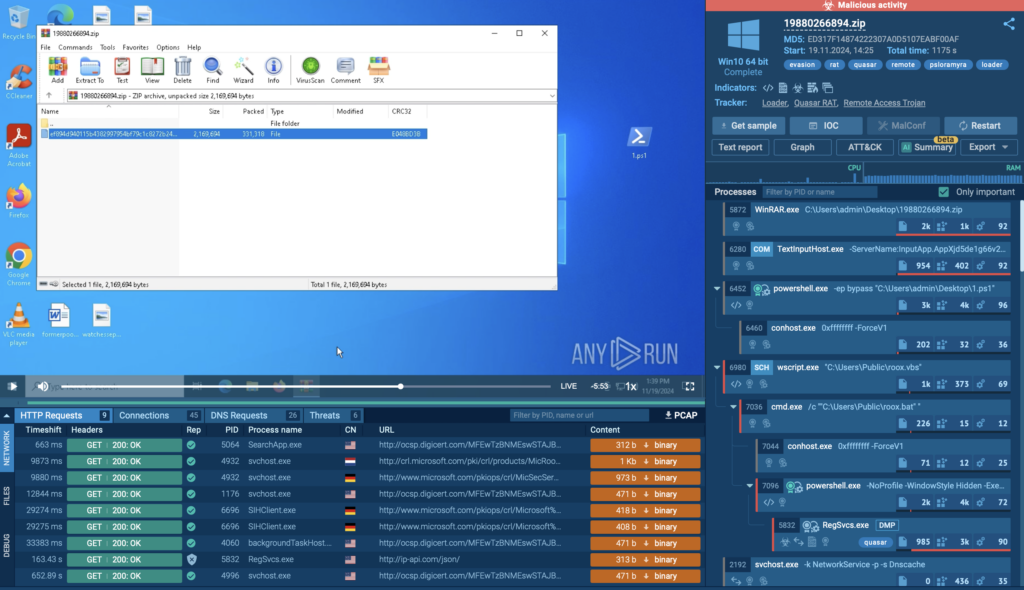
Malicious process execution via PowerShell shown in the ANY.RUN sandbox

The instruction deceived users into executing harmful code, leading to system infection with Lumma malware for further exploitation.

More samples of the campaign

For further investigation into attacks leveraging fake CAPTCHA prompts, you can use ANY.RUN’s TI Lookup to locate additional samples and associated data.

As part of your search query, you can use a domain involved in the attack:

TI Lookup identifies the domain as malicious and offers additional threat context

This query reveals multiple related domains, IP addresses, and sandbox sessions tied to the attacks outlined above.

Abuse of Encoded JavaScript

Original post on X

We also identified a growing use of encoded JavaScript files for hidden script execution.

Microsoft originally developed Script Encoder as a way for developers to obfuscate JavaScript and VBScript, making the code unreadable while remaining functional through interpreters like wscript.

Intended as a protective measure, Script Encoder has also become a resource for attackers. By encoding harmful JavaScript in .jse files, cybercriminals can embed malware in scripts that look legitimate, tricking users into running the malicious code. 

Steps for decoding a JS script

This type of obfuscation not only conceals the code but also complicates detection, as security tools struggle to identify the harmful intent within encrypted data. 

Encoded .jse files are commonly delivered through phishing emails or drive-by-downloads.  

See analysis of a .jse file disguised as a calculator software in the ANY.RUN sandbox.

The ANY.RUN sandbox lets you see how a script executes

Using the built-in Script Tracer feature, you can view entire script execution process to avoid manual decryption.

Conclusion

Our analysts are constantly on the lookout for emerging phishing and malware attacks, as well as new malicious techniques used by cyber criminals. To stay updated on the latest research of ANY.RUN’s team, make sure to follow us on X, LinkedIn, YouTube, Facebook, and other social media.

About ANY.RUN  

ANY.RUN helps more than 500,000 cybersecurity professionals worldwide. Our interactive sandbox simplifies malware analysis of threats that target both Windows and Linux systems. Our threat intelligence products, TI LookupYARA Search and Feeds, help you find IOCs or files to learn more about the threats and respond to incidents faster.  

With ANY.RUN you can: 

Detect malware in seconds

Interact with samples in real time

Save time and money on sandbox setup and maintenance 

Record and study all aspects of malware behavior

Collaborate with your team 

Scale as you need

Request free trial → 

The post Recent Cyber Attacks Discovered by ANY.RUN: October 2024 appeared first on ANY.RUN’s Cybersecurity Blog.

ANY.RUN’s Cybersecurity Blog – ​Read More

How LLMs could help defenders write better and faster detection

Most users will associate large language models (LLMs) like ChatGPT with answering basic questions or helping to write basics lines of text.  

But could these tools actually help defenders in the cybersecurity industry write more effective detection content?  

Several security researchers from across Cisco recently looked into how LLMs, which have surged in popularity over the past year, could assist them in the detection research process. 

Part of their jobs is to try and perform test behavior that will trigger existing detection rules to check their effectiveness and try to emulate the behavior of a typical adversary — all in the name of updating that detection content to catch the latest tactics, techniques and procedures (TTPs). 

LLMs may be able to assist in this complex, time-consuming tax, as Darin Smith, Yuvi Meiyappan, Moazzam Khan and Ray McCormick write in this paper, which you can download below. 

Khan, a security researcher for Cisco, will be presenting the findings of this paper at the upcoming BSides Portland conference. 

Cisco Talos Blog – ​Read More