Phishing and MFA exploitation: Targeting the keys to the kingdom
In 2025, attackers increasingly targeted weaknesses in multi-factor authentication (MFA) workflows, and phishing attacks leveraged valid, compromised credentials to launch lures from trusted accounts. The trends focused entirely on trust, or the lack thereof, in everyday business operations.
Phishing
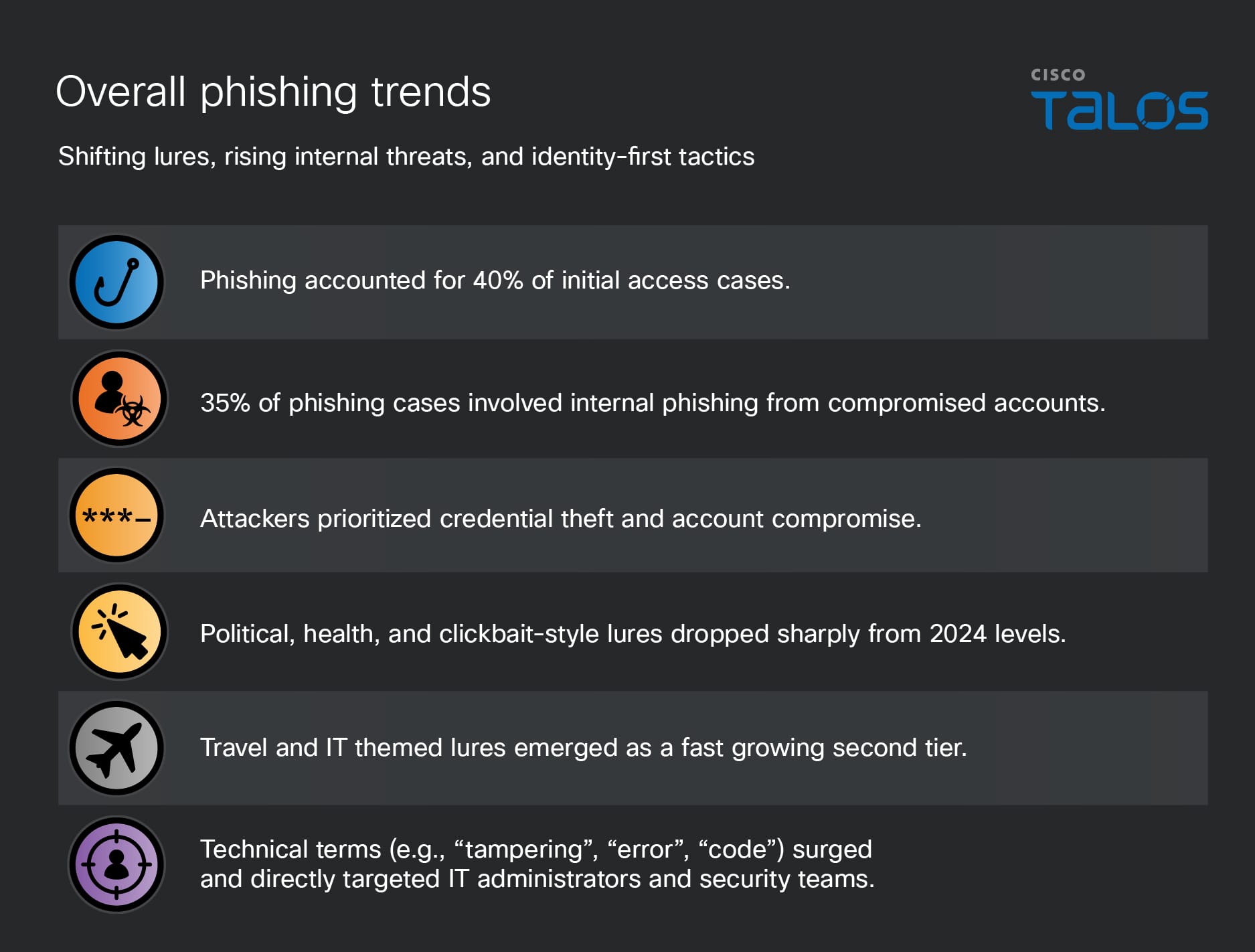
In 2025, phishing attacks were used for initial access in 40% of incidents, maintaining their prevalence. Attackers ramped up cascaded phishing campaigns, where attackers leveraged the trust of the initial compromised account to create specialized phishing attempts, within the network and out of it, aimed at trusted partners and third parties.
Email composition trends
The content of phishing emails changed somewhat. Transitioning away from spam offers, they took the form of workflow-style emails — IT, travel, and other everyday business tasks that look familiar to employees and executives. Travel and logistics lures in particular surged, while political lures dropped off. Internal expensing and travel emails, even when legitimate, are often repetitive and come from disparate sources with changeable formats or poorly-rendered templates, leading to a lowered guard toward spotting malicious intent. Attackers were likely aiming to steal credentials, payment information, or MFA tokens via fake single sign-on (SSO) pages.
In reviews of thousands of blocked-email keywords, 60% contained subject lines with “request,” “invoice,” “fwd,” “report,” and similar. IT-focused phishing keywords turned more technical, to words like “tampering,” “domain,” “configuration,” “token,” and others, showing that attackers were making plays toward IT and security workflows.
Attackers also abused Microsoft 365 Direct Send to capitalize on internal email trust. Direct Send is the method by which networked devices like printers and scanners deliver documents to users. The messages appear to be sent and received by the same email address. These internal messages do not receive the same scrutiny that external emails do, from employees or automated email filters. Direct Send allowed attackers to spoof internal email addresses and deliver highly convincing lures from inside the organization, without compromising real accounts, to target key attack services and deliver high-impact damage.
MFA and identity attacks
Identity and access management (IAM) applications have grown popular with organizations hoping to consolidate user privileges. Unfortunately, it has also grown in popularity with attackers. Nearly a third of 2025 MFA spray attacks targeted IAM, turning the tools companies used to maintain access control into a point of failure. Device compromise surged by 178%, largely driven by voice phishing designed to trick administrators into registering malicious devices.
MFA spray and device compromise
MFA attack strategy changed by sector. A successful attack could glean SSO tokens and give adversaries the ability to change user roles and credentials, or even the MFA policies themselves. Attackers increasingly exploited authentication workflows to gain and maintain access.
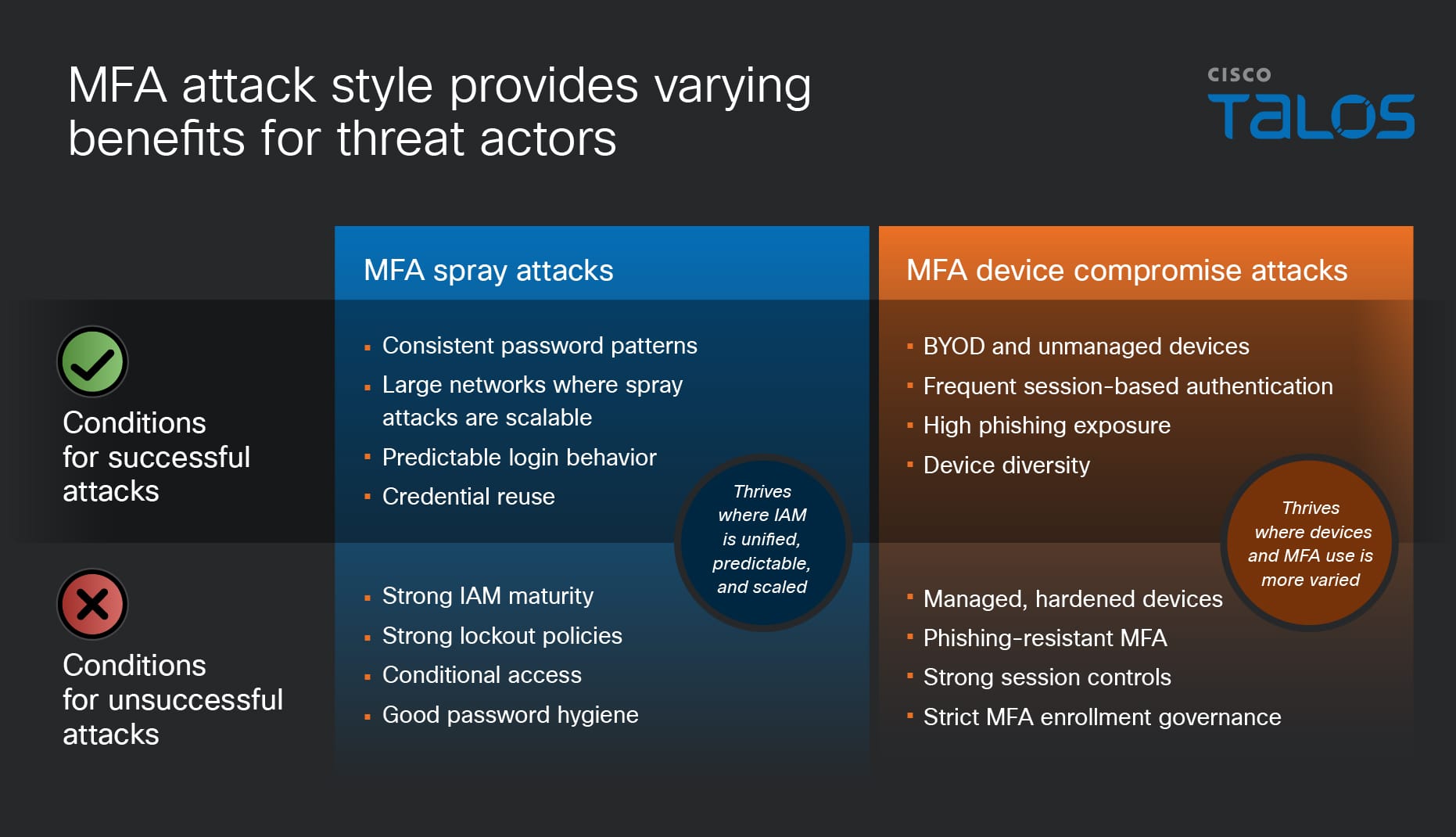
Spray attacks were deployed against networks with predictable identity behavior, while diverse, unmanaged, or high-turnover device ecosystems proved weaker to device compromise attacks.
Notably, higher education was the most targeted device compromise sector. Several factors could contribute to the trend:
· Diverse unmanaged device population
· Poorly patched and managed operating systems
· Necessarily low new-device verification policies
· Large, public-facing directories for targeted phishing
Higher education was a very unfavorable target for MFA spray attacks, however. Passwords and MFA are also highly varied and segmented, and most universities have strong login portal policies, enforced lockouts, and login attempt limits.
Guidance for defenders
As always, prioritize based on your own environment.
Organizations should keep in mind that living-off-the-land binaries (LOLBins) and open-source and dual-use tools, which are not inherently malicious, are key to further exploitation. Blocking external IPs from using a feature, enabling Microsoft’s newer “Reject Direct Send” control, tightening SPF/DMARC enforcement, and treating “internal-looking” emails with the same scrutiny as inbound mail are currently the most effective defenses.
Likewise, MFA attack protection should be tailored to the style of environment and sector.
MFA spray attacks work well on stable, scaled identity controls. Counter these attacks with strong lockout policies, good password hygiene, and conditional access.
Device compromise works best on variable networks where devices change over fast and MFA use is spotty. Work on establishing better device hardening and management, session controls, and strict phishing-resistant MFA with enrollment governance. Solutions such as Cisco Duo provide controls for phishing-resistant MFA, device trust, and secure enrollment, helping reduce risk from phishing and identity-based attacks. Solutions such as Cisco Duo provide controls for phishing-resistant MFA, device trust, and secure enrollment, helping reduce risk from phishing and identity-based attacks.
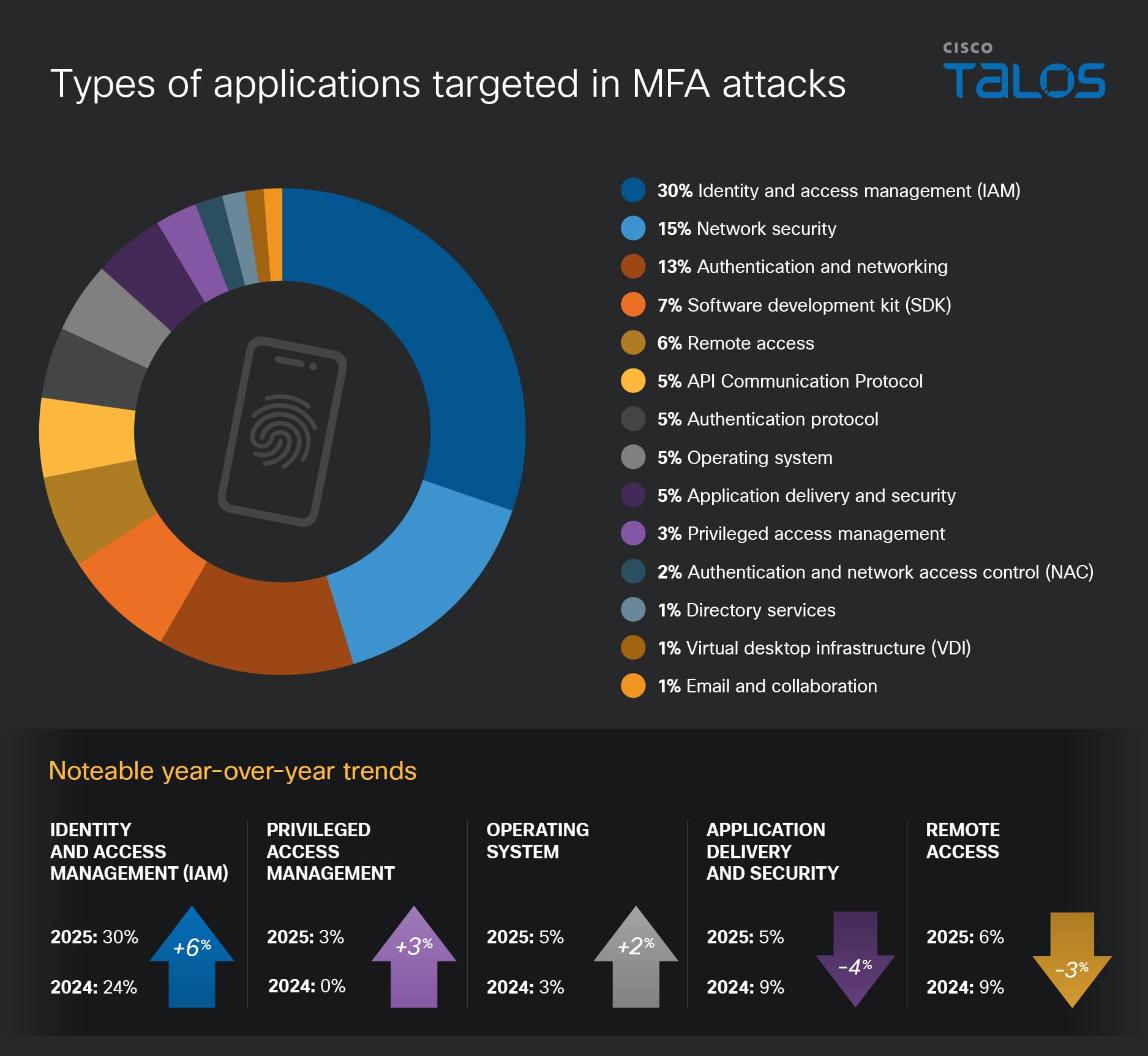
This blog only scratched the surface on 2025 threat trends. See the full Year in Review report for a detailed explanation of Microsoft 365 Direct Send and how it was used for attacks, infographic breakdowns of MFA spray vs. device compromise attacks, the full list of targeted tools and sectors by percentage, and more.
Cisco Talos Blog – Read More