Fake Purchase Order Emails Spread Fileless PureLogs Malware via RAR Archives

Hackers are using fake purchase order emails and process hollowing to deploy fileless PureLogs malware to steal Windows users’ browser, crypto, and Discord data.

Hackread – Cybersecurity News, Data Breaches, AI and More – ​Read More

Critical WP Maps Pro Flaw Actively Exploited to Create Admin Accounts

Threat actors are attempting to actively exploit a critical security flaw impacting WP Maps Pro, a WordPress plugin that has had over 15,000 sales on the Envato Market, to create malicious administrator accounts on susceptible sites.

WP Maps Pro allows site owners to embed customizable Google Maps and OpenStreetMap with markers, listings, and advanced location features on WordPress sites. It is

The Hacker News – ​Read More

Websites Can Now Spy on You Through Your Hard Drive

Thanks to the newly detailed FROST technique, telltale SSD activity can be measured in the browser using simple JavaScript.

Security Latest – ​Read More

Scams in messengers: exposing the global scam-cartels exploiting everyday messagesng-heist | Kaspersky official blog

It starts with the familiar: a short message, a trusted name, a routine tone. Delivery updates, work pings, brand alerts hum in the background, rarely attracting scrutiny. You check, you answer… — until minutes later you’ve slipped into a trap built to lower your guard and hijack your trust.

That’s why messaging scams cut deep: they exploit everyday habits where instinct, not caution, leads. Communication once moved slowly, leaving room for doubt. Now it’s instant — and that speed is a weapon in criminal hands.

On our blog, we’ve already examined numerous scam schemes in messaging apps — from pig butchering, where the victim is groomed for a very long time, or catfishing, where the scammer creates a fake identity, to phishing via chatbots or through gift-giving campaigns in messaging apps.

Now, for the first time, Kaspersky has set out to capture the full end-to-end reality of messaging-based scams to understand how quickly harm occurs, how they impact trust and what remains after the interaction ends. What emerges is a highly organized and industrialized scam ecosystem embedded within everyday messaging channels such as SMS, WhatsApp, and email.

Kaspersky experts have prepared a report on targeted scams in messaging apps, detailing not only the financial but also the emotional damage caused by such attacks, as well as providing tips on how to protect yourself and avoid them. In this post, we explore the most interesting facts, but you can find more details in the full report.

The damage is underestimated

How much do you think a single successful attack via a messaging app costs the average victim? Ten dollars? Or maybe 50? You’re underestimating the scammers. Although more than a third (36%) of victims incur losses of less than $135, on average a victim loses… $733!

Country Average loss per victim
Senegal $392.94
Serbia $493.32
Morocco $504.28
Greece $609.32
United Kingdom $617.38
Côte d’Ivoire $654.11
Spain $672.67
United States $724.73
Portugal $868.20
Italy $896.02
France $1,193.58
Germany $1,369.35

The average amount lost by a victim in a successful attack via a messaging app

On the one hand, the financial hit doesn’t look catastrophic in isolation. These are micro-losses by design. Small enough that some never report them to the police. Small enough that banks don’t always investigate. Small enough to be dismissed as bad luck rather than organized crime.

But $733 is not nothing. It’s enough to cover a month’s worth of groceries, school or daycare fees, or utility bills. Against the backdrop of the global cost-of-living crisis, a single such loss can seriously dent a family’s budget.

In 11% of cases, losses exceed $1,350, and more than a quarter of victims (28%) report having been scammed three or more times in the past six months. Once scammers discover that a phone number responds, that contact becomes an asset, circulating from one database to another.

Now imagine the scale of the problem: if just 10% of the three billion messaging‑app users worldwide fell victim with the average loss, the total damage would amount to… nearly $220 billion! This is comparable to the GDP of Greece, and exceeds that of Morocco, Serbia, or Côte d’Ivoire.

It becomes clear that behind the daily flood of fraudulent schemes lie large scam cartels operating on an industrial scale, using AI to personalize messages that mimic those of family members, friends, and familiar brands. This, in essence, forms the basis of a full-fledged economy built on digital identity theft.
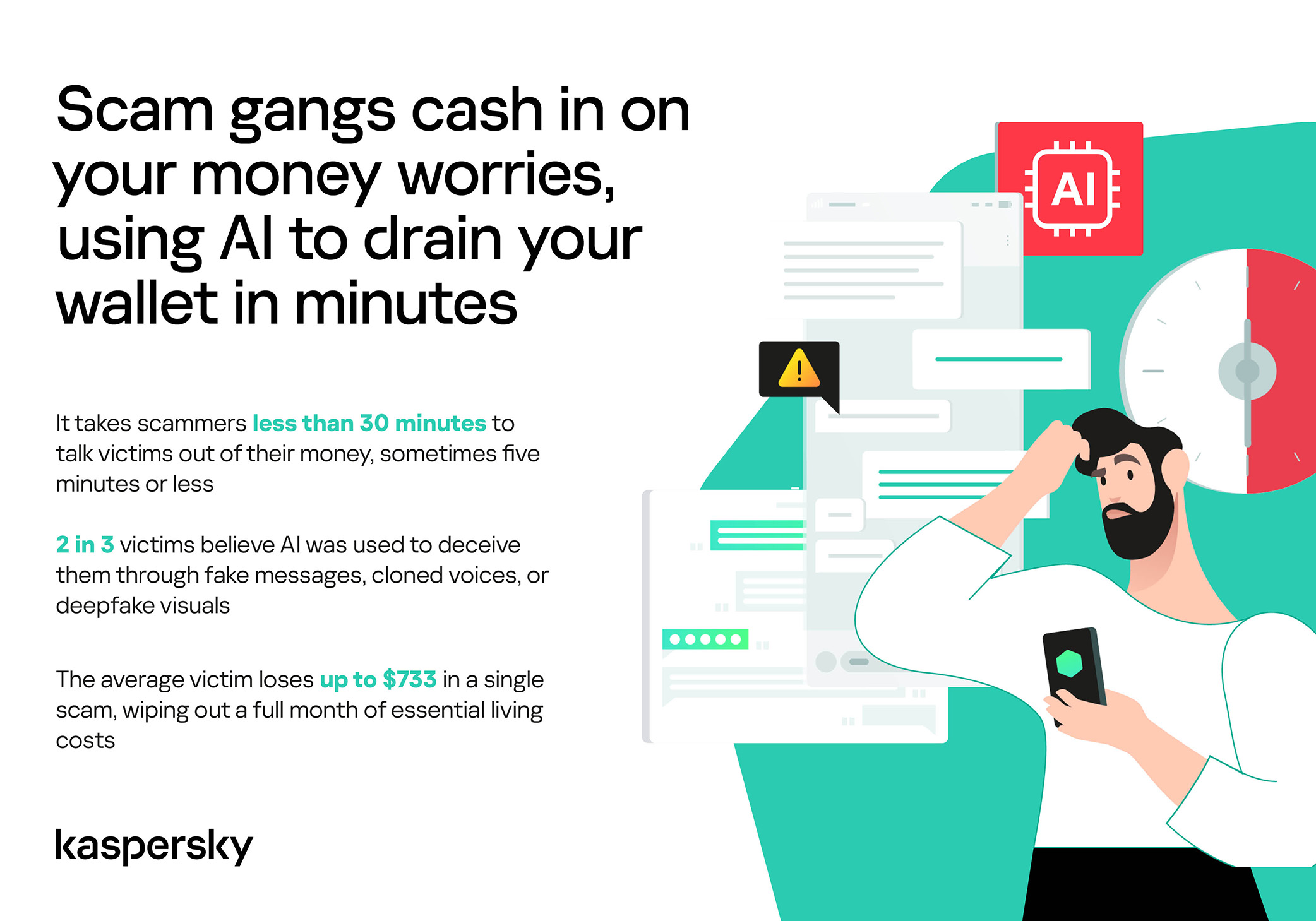
Scam gangs cash in on your money worries, using AI to drain your wallet in minutes

Speed beats scrutiny

More than half of successful messaging scams (52%) unfold in under 30 minutes — from first contact to the moment money or personal data changes hands — or even faster, before the victim begins to doubt the legitimacy of the sender. In fact, one in seven scams takes less than five minutes — quicker than boiling an egg!

The speed isn’t accidental. It’s the method. Scammers structure their schemes to deny the victim a chance to come to their senses. Every element is engineered to compress the decision-making window: the urgency of the scenario, the familiarity of the format, the plausibility of the request.

They rush you — faster, faster, don’t tell anyone, you only have a few minutes, solve the problem, don’t ask questions. Click the link, fill in the details, approve the transaction, or else… Or else what? The scammers’ imagination knows no bounds here, but if you don’t do something right now, you’ll definitely regret it.

Alas, the realization of what has happened usually comes when the damage is already irreversible. More than half of victims (51%) lose money; another 43% hand over their personal data — most commonly phone numbers, names, and email addresses — to scammers, and often the victim loses both.

Where and how attacks occur

A delivery notification, a bank alert, a message from a merchant you ordered from last week — messaging apps permeate every aspect of everyday life, making such interactions completely normal. An attack shouldn’t feel like an attack. It should feel like the same message you’ve received hundreds of times.

It’s no surprise that scammers focus their attention on this method of communication first and foremost. The most popular platforms for scams are predictable: WhatsApp (43%), SMS/iMessage (40%), Facebook (27%), Telegram (22%), and Instagram (19%) — these are the ones that people trust most.

A wide variety of schemes is used. Brand impersonation is now one of the three most common types of messaging scam worldwide — accounting for 31% of cases. Fake delivery notifications top the list at 38%, followed by investment scams at 37%.

At the same time, nearly two-thirds (63%) of fraudulent schemes span multiple platforms, moving from SMS to WhatsApp, from WhatsApp to Telegram, etc. In this way, scammers achieve two goals: they mimic organic messaging and evade moderation algorithms.

AI has taken scams to a new level

Just a couple of years ago, fraudulent messages gave themselves away with bad grammar, awkward phrasing, illogical requests, and an obsessive sense of urgency. Today, a phishing message looks, sounds, and reads just like the real thing.

Scam cartels want to catch people in motion — between meetings, on a commute, or during everyday tasks — when your attention is already fragmented. They mimic your mother’s turn of phrase. They match your bank’s tone of voice. They copy your courier’s format exactly. They mirror the rhythm, structure, and style of authentic brand communications across messaging platforms. And AI is accelerating all of it.

What this creates is overlap. Legitimate and fraudulent messages appear in the same environment, using the same formats, language, and triggers. The difference between them is no longer obvious.

The data shows that two-thirds of victims (66%) believe AI was used in the scam against them, 42% cite messages written by AI, 31% report generated or cloned voices, and 25% encountered deepfake images or videos.

That’s why mere awareness and “tech-savviness” may no longer be enough to protect oneself. From Gen Z to Gen X, messaging scams cut across every generation.

And what about the emotional toll?

But money is far from the only problem a victim is left with after an attack. After what they’ve been through, people develop distrust toward incoming messages, unfamiliar numbers, and any requests for action. As a result, 99% of fraud victims say they no longer trust incoming notifications in messaging apps.

This creates a crisis of trust in all digital channels in general. Every legitimate message can now be perceived as a scam. Brands, banks, and delivery services are forced to operate in an environment where the customer is, by default, in a state of distrust.

Dr. Elizabeth Carter, a forensic linguist and criminologist at Kingston University in London, notes that scammers use familiar contexts, common social settings and embedded linguistic norms to create the illusion for the victim that their decision-making is rational and reasonable in the moment. However, what is actually happening is that they construct false realities in which those decisions end up causing financial and psychological harm. She also notes that it is very hard to identify a false reality while you are in it.

After realizing they had been deceived, more than half of victims felt anger — the kind that comes from having trusted something and discovering it was used against you. 42% of victims report frustration, 38% — feeling upset. Moreover, several months later, these feelings haven’t gone away: nearly half of all victims (48%) are still angry, a third (33%) remain frustrated, and 30% are upset.

And nearly one in 10 victims don’t tell anyone what happened. They feel shame, a sense of having fallen for something so obvious. This leaves a significant portion of the actual damage unreported: only 24% of victims contact the police, and only 23% report it to their bank.
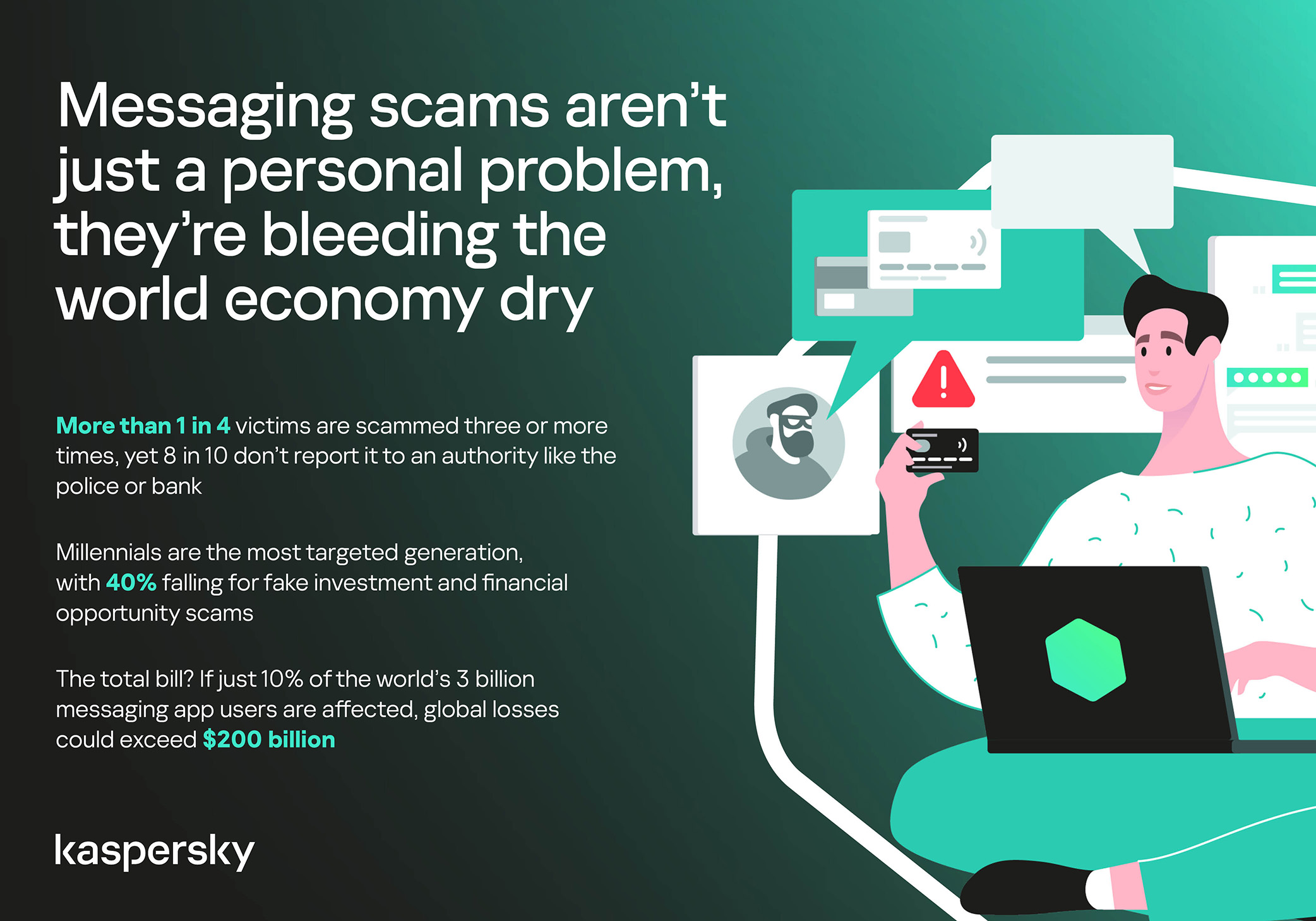
Messaging scams aren't just a personal problem, they're bleeding the world economy dry

So what can be done?

The crisis of trust — and even a touch of paranoia — that has arisen due to widespread attacks on users can linger in victims’ minds for a long time, affecting their quality of life. To prevent this, follow these guidelines:

  • Pause before you act. The sense of urgency you feel is almost always artificial. A legitimate bank, retailer, or delivery service won’t penalize you for taking 30 seconds to verify before clicking a link or confirming details. It’s precisely this instinct to resolve the situation quickly that scammers are counting on.
  • Verify through another channel. If a message appears to be from a relative, colleague, or company you trust — contact them through another channel before taking any action. Use secure verification methods, and cross-check identities when something doesn’t feel right. For families, agreeing on a “safe word” in advance can defeat even the most convincing voice clones.
  • Use a password manager. It will not only help you generate strong, unique passwords for all your accounts and store them securely, syncing them across all your devices, but also protect you from spoofed sites. Even if you click a phishing link and land on such a site, our password manager will notify you about the domain mismatch and refuse to autofill your username and password.
  • Use protection that works in real time. Modern security solutions, such as Kaspersky Premium, provide real-time protection against malicious links and phishing attempts in the apps and websites you use every day. On Android devices, a dedicated layer of anti-phishing security scans and neutralizes suspicious links as they appear, even within notifications, before you even have a chance to click them.

We’ve covered other threats in messaging apps in similar articles:

Kaspersky official blog – ​Read More

Dell XPS 13 (2026) vs. MacBook Neo: I compared both budget laptops, here’s which one I’d buy

Dell just announced its new 13-inch XPS for $599 with student pricing, making it a direct competitor to the Neo.

Latest news – ​Read More

Dell’s new XPS 13 is a MacBook Neo rival that costs $599 and retains premium features

Announced at Computex, Dell’s new XPS 13 takes aim at the MacBook Neo with a touchscreen display and backlit keyboard.

Latest news – ​Read More

Claude Mythos exposed a hard truth: Your enterprise patching process is way too slow

In 2024, researchers from the University of Illinois found that GPT-4, when provided with a common vulnerabilities and exposures (CVE) description, could autonomously exploit 87% of a curated 15-vulnerability one-day dataset. Without the description, it could only exploit 7%. This provided a “margin of safety” for the industry because while AI could exploit known vulnerabilities, it could not discover them.

However, on April 7, Anthropic announced that Claude Mythos Preview had closed that margin, with the model autonomously discovering thousands of zero-day vulnerabilities across major operating systems and browsers. Separately, Mythos scored 83.1% on the CyberGym vulnerability reproduction benchmark. In one campaign targeting OpenBSD across 1,000 scaffold runs, the total compute cost was less than $20,000.

Exploitation timelines are collapsing. Langflow’s CVE-2026-33017 (CVSS 9.8) was exploited 20 hours after disclosure with no public proof-of-concept. Marimo’s CVE-2026-39987 (CVSS 9.3) was hit in 9 hours and 41 minutes.

The defensive infrastructure most organizations rely on wasn’t designed for this. Rapid7’s 2026 threat landscape report states that the median time from CVE publication to CISA’s known exploited vulnerabilities (KEV) listing is five days. Google’s M-Trends 2026 report found that exploitation is happening before a patch is even released. When the Langflow advisory was published, the first exploit arrived in 20 hours. When the Marimo advisory was published, it took under 10 hours.

The assumption that your patch window is safe because exploitation takes time is no longer true. Here are your building blocks.

Replace CVSS-only prioritization with a three-layer filter

Most vulnerability management programs still prioritize by CVSS score alone. CVSS quantifies a vulnerability’s “theoretical” severity without considering whether a vulnerability is being exploited in the wild or how quickly someone could weaponize it. A CVSS 8.8 vulnerability with a history of active exploitation (like Docker’s CVE-2026-34040) gets lower priority than a CVSS 9.8 vulnerability that may never be exploited in the wild.

A recent study validated against 28,377 real-world vulnerabilities offers a concrete replacement: A three-layer decision tree incorporating CISA KEV status, Exploit Prediction Scoring System (EPSS) scores, and CVSS, thus forming a singular prioritization filter.

Three-Layer Vulnerability Prioritization Filter

Layer

Data source

Threshold

Action

SLA

1. Active exploitation

CISA KEV catalog

Listed

Immediate patching

Hours

2. Predicted exploitation

EPSS via FIRST.org

Score ≥ 0.088

Escalate to Tier 0 pipeline

24 hours

3. Severity baseline

CVSS via NVD

Score ≥ 7.0

Typical remediation

Per policy

Validated result: 18x efficiency gain, 85.6% coverage of exploited vulnerabilities, ~95% reduction in urgent remediation workload. All three data sources are open and free.

The described integration is entirely automatable. It’s possible to build a script to query the CISA KEV API, the EPSS API from FIRST.org, and the NVD, and have that script run against your asset inventory for every published CVE. The human in this process should remain in the loop as an approver, but not as the trigger.

Close the agent authorization gap

Creating exploits quickly not only changes how patches are prioritized, but how controls are configured for all the agent-driven systems that now possess privileged credentials. Your authorization policies have not been assessed against the behavior of AI agents, and that is now a measurable risk. CVE-2026-34040 showed that Docker’s authorization plugin architecture silently bypasses every plugin when the request body exceeds 1MB. Common AuthZ plugins (OPA, Casbin, Prisma Cloud) are unaware of this type of bypass, which occurs in Docker’s middleware before the request reaches the plugin.

When Cyera demonstrated this vulnerability, they showed that an AI agent debugging infrastructure could infer the bypass path while completing a legitimate task, without any instruction to exploit anything.

The Internet Engineering Task Force (IETF) is working on authorization models for agents. The document draft-klrc-aiagent-auth-01, published in March by participants from AWS, Zscaler, Ping Identity, and OpenAI, proposes the use of the current Secure Production Identity Framework for Everyone (SPIFFE) and OAuth 2.0 for AI agents to obtain dynamically provisioned and short-lived credentials.

Separately, the IETF Agent Identity Protocol draft (draft-prakash-aip-00) reports that out of about 2,000 surveyed model context protocol (MCP) servers, none had authentication.

But these standards are months to years away from implementation. For now, security teams must proactively incorporate agent-level test scenarios for all authorization boundaries, such as oversized requests, burst frequency, and multi-step escalation of privileged requests.

Map your credential blast radius

In a survey conducted by CSA/Zenity and published on April 16, 53% of organizations said they had already seen cases where AI agents exceeded their intended permissions, and 47% experienced a security incident involving an agent.

When AI builder tools such as Flowise (CVE-2025-59528, CVSS 10.0), Langflow, or n8n become compromised, the blast radius extends far beyond the host. These tools contain API keys to frontier models, database credentials, vector store tokens, and OAuth tokens to business systems. A compromised AI builder host is not just a single-system breach. It is a credential harvest that unlocks authenticated access to every connected service.

Without credential dependency maps for each AI tool host, incident response for agent compromise is guesswork. For every instance, document each credential, the extent of its access, and the relevant credential rotation process. Also begin migrating static API keys to short-lived tokens where downstream services allow.

Five actions for this quarter

1. Deploy the three-layer KEV-EPSS-CVSS filter

Substitute CVSS-only prioritization according to the table above. Automate the collection of data from all three APIs as part of a scheduled script against your asset inventory. Desired outcome: 18 times more efficient, 85.6% coverage of exploited vulnerabilities, 95% reduction in urgent remediation workload.

2. Implement event-driven patching for Tier 0 services.

Determine which services fall under the critical exposure tier: Services exposed directly to internet users, AI builder hosts, and container orchestration control plane. Trigger event-driven patching on a CVE publication instead of waiting for the next maintenance window for this tier.

Goal: deploy patch to canary within four hours of a CVE being declared critical. Use the CISA KEV and EPSS feeds to trigger event-driven patching. In situations where it is impossible to meet the goal of four-hour patching because of legacy dependencies, change-freeze windows, or rollback risk, immediately apply compensating controls such as removing internet exposure to the vulnerable service, rotating credentials for the vulnerable service, disabling affected functionality of the service (if applicable), and identifying an exception owner for the exposure until a patch can be deployed.

It is not acceptable to allow unbounded exposures for extended periods while awaiting a maintenance window.

3. Test authorization boundaries at agent scale.

Create test cases for every API that AI agents may communicate with via AuthZ policies. Specifically, include test cases for requests exceeding 1MB, 5MB, and 10MB body sizes. This includes test cases for burst rate > 100 requests per second and test cases for unusual parameter combinations (privileged flags, host mounts, capability additions). Additionally, patch to Docker Engine 29.3.1 to fix CVE-2026-34040.

4. Credential blast radius mapping for all AI builder hosts.

Document each credential for each Langflow, Flowise, n8n, and custom AI pipeline instance. Classify each credential by its lifespan (static key vs. short-lived token). Identify what each credential can access. Set up alerts for anomalous IP or identity for any credential access.

5. Shadow AI discovery scan for this week.

According to CSA data, there is a greater than 50% chance that your agents have exceeded their expected boundaries. Check your Security Information and Event Management (SIEM) and network monitoring tools for communications to the default ports of the AI builder: Langflow 7860, Flowise 3000, and n8n 5678. Any unauthorized instances are an unmonitored attack surface.

The takeaway

AI agents are emerging, and the standards bodies are responding. The IETF has multiple drafts related to agent authentication and authorization. The Coalition for Secure AI has published its MCP Security taxonomy and Secure-by-Design principles.

But these standards move at standards-body speed, and the exploit window is now measured in hours. Organizations that implement the three-layer filter and event-driven patching this quarter will have a measurable reduction in exposure. Those who wait will be running calendar-based patch cycles against an adversary that operates in less than 20 hours. 

Nik Kale is a principal engineer specializing in enterprise AI platforms and security

Security | VentureBeat – ​Read More

I’ve used Android Auto with Gemini for 2 months now – it’s transformed my drives in 4 ways

Gemini has made voice control in my car fun and useful, and I’m still discovering new ways to use it.

Latest news – ​Read More

27,000-Download Codex UI Tool Secretly Stole OpenAI Refresh Tokens

A malicious Codex UI npm package with 27,000 weekly downloads was caught exfiltrating OpenAI refresh tokens, exposing developers to account takeover risks.

Hackread – Cybersecurity News, Data Breaches, AI and More – ​Read More

Dutch Authorities Dismantle Botnet Linked to 17 Million Infected Devices

Dutch authorities have announced the takedown of a botnet that enslaved millions of infected devices, including computers, tablets, smartphones, and IoT devices, to carry out malicious attacks.

The bot network, per the Dutch Politie and the National Cyber Security Center (NCSC), consisted of at least 17 million infected devices. More than 200 servers located in the Netherlands acted as the

The Hacker News – ​Read More