Godent Rolls Out Scanner-as-a-Service Model to Drive Digital Transformation in European Dentistry

Godent has announced the launch of its scanner-as-a-service program for European DSOs, combining free intraoral scanners with a fully integrated digital lab infrastructure to modernize dental workflows.

Hackread – Cybersecurity News, Data Breaches, AI and More – ​Read More

Firefox users didn’t want AI, so Mozilla is giving them a way to kill it

Mozilla heard your complaints, and now Firefox 148 gives you an AI opt-out.

Latest news – ​Read More

Researchers Expose Network of 150 Cloned Law Firm Websites in AI-Powered Scam Campaign

Criminals are using AI to clone professional websites at an industrial scale. A new report shows how one AI-powered network grew to 150+ domains by hiding behind Cloudflare and rotating IP ranges.

The post Researchers Expose Network of 150 Cloned Law Firm Websites in AI-Powered Scam Campaign appeared first on SecurityWeek.

SecurityWeek – ​Read More

Your ExpressVPN is getting three huge upgrades – including a private AI assistant

ExpressVPN is expanding beyond basic VPN protection to better compete with NordVPN. Here’s what’s new.

Latest news – ​Read More

Nullify Secures $12.5 Million in Seed Funding for Cybersecurity AI Workforce

This latest infusion, led by SYN Ventures, brings the company’s total funding to $16.9 million.

The post Nullify Secures $12.5 Million in Seed Funding for Cybersecurity AI Workforce appeared first on SecurityWeek.

SecurityWeek – ​Read More

How Threat Intelligence Helps Protect Financial Organizations from Business Risk

The financial sector resembles a treasure vault under constant siege. Banks, insurers, and fintech firms are not just custodians of money. They are guardians of irreplaceable personal and corporate data, payment flows, transactional integrity, and trust itself.  

When cybercriminals strike, the ripple effects cascade outward, threatening individual savings, corporate balance sheets, national infrastructures, and broader economic confidence. 

The Biggest Cybersecurity Risks for Financial Businesses 

The threat landscape for finance keeps getting worse, and the numbers make that clear: 

  • 90% of attacks start with phishing, based on sandbox analyses from 15,000 organizations using ANY.RUN’s solutions 
  • 65% of financial organizations were hit by ransomware, the highest rate across industries 
  • Ransomware recovery costs reached $2.73M on average in 2024, excluding ransom payments (Sophos) 
  • Nearly one-third of attacks bypass existing defenses, despite increased security spend (Picus Blue Report) 
  • 14.5 million stolen credit cards were listed on underground markets in 2024, a 20% YoY increase (Bitsight) 

Together, these numbers point to the same underlying risk: attacks are getting faster, stealthier, and more expensive, while traditional controls struggle to keep up.  

For financial organizations, even small gaps in visibility or delayed decisions can lead to halted transactions, customer impact, and regulatory scrutiny. The difference between early detection and late response is not measured in alerts, but in downtime avoided, losses prevented, and trust preserved

Why Traditional Cyber Defenses Are Not Enough in Finance 

Most financial SOCs already have SIEM, EDR, and email security in place. The problem is not a lack of tools, but a lack of actionable data on the latest attacks that can help them prevent incidents rather than react to them. 

Common issues include: 

  • Too many alerts, too little context: SOC analysts in financial organizations spend hours validating indicators with no clear verdict. 
  • Late visibility into real campaigns: Traditional threat intelligence sources provide information on threats after damage has started elsewhere. 
  • Slow escalation decisions: Teams hesitate between false positives and overreaction. 
  • High investigation costs: Manual research consumes Tier 1 and Tier 2 capacity. 

These gaps directly translate into higher MTTR, higher incident costs, and higher operational risk. 

How Threat Intelligence Helps Reduce Business Risks 

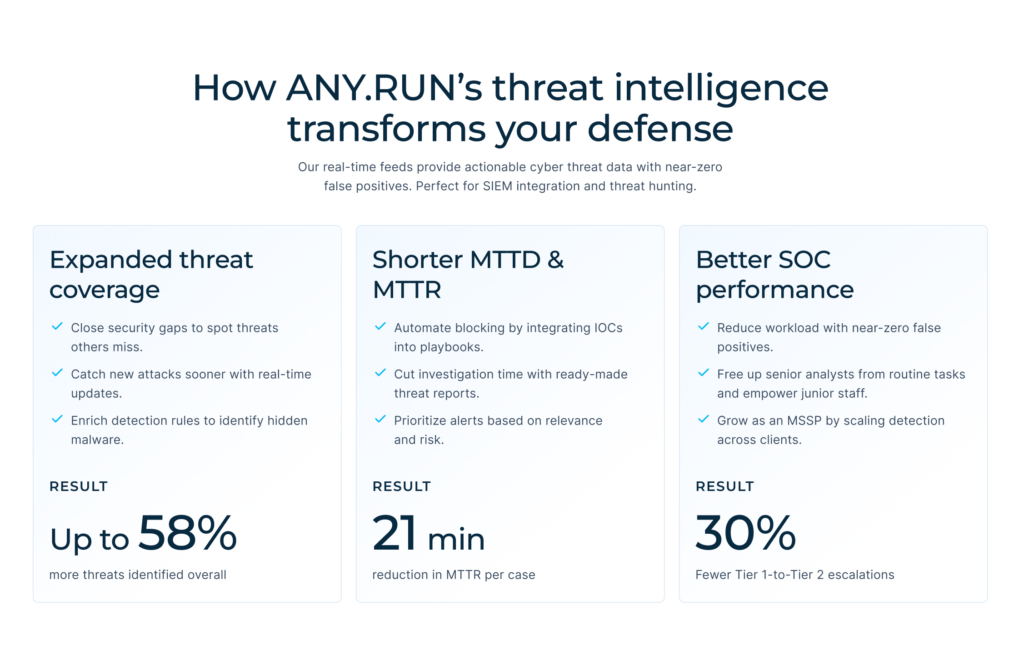
ANY.RUN’s actionable threat intelligence offers real impact on business security 

Threat intelligence changes the situation by shifting security from reaction to prevention. Instead of waiting for incidents to unfold, it lets SOC teams spot and stop threats earlier in the attack lifecycle. 

ANY.RUN’s Threat Intelligence supports this across three core SOC processes. 

Monitoring: Spot Threats Before They Reach Your Infrastructure 

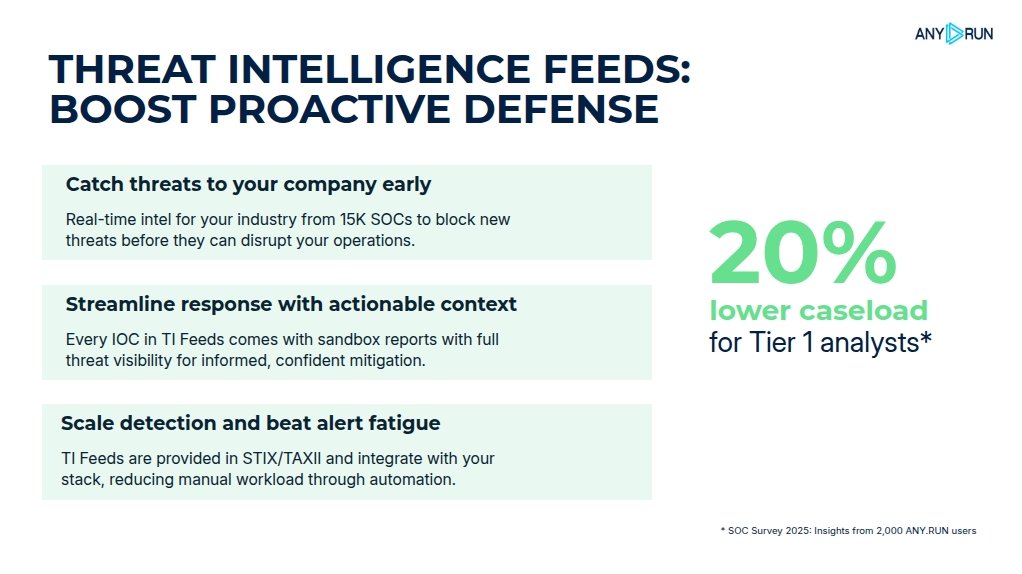
Threat Intelligence Feeds enable finance SOCs to detect threats early

ANY.RUN’s Threat Intelligence Feeds bring unique advantages to financial institutions seeking to strengthen their defensive posture against the sophisticated threats targeting the sector. 

TI Feeds are powered by a global community of over 600,000 cybersecurity professionals and 15,000+ organizations who analyze threats daily in ANY.RUN’s Interactive Sandbox

Plus, each indicator comes with a sandbox analysis that gives SOC teams a full attack context that eliminates the need for additional investigations and allows analysts to move on to the remediation stage instantly, significantly cutting MTTR

What this means for your SOC and business: 

  • 36% higher detection rate of threats: Helps SOC teams spot real threats to the financial industry before they reach critical systems, reducing the risk of fraud and service outages. 
  • Visibility into emerging attacks not covered by traditional feeds: Gives security teams a head start on new campaigns, lowering the chance of being hit by previously unseen threats. 
  • Cleaner alerts with fewer false positives: Analysts spend less time on noise and more time on real incidents, keeping response fast during peak attack periods. 
  • Faster triage and confident response decisions: Clear context around indicators shortens investigations and limits attacker dwell time in financial environments. 
  • Proactive protection instead of reactive firefighting: Threats are blocked earlier, helping prevent business disruption, regulatory exposure, and customer impact. 

Protect financial operations with early threat detection

Enrich your defense with actionable intel from TI Feeds


Integrate in your SOC


Indicators can be streamed directly into SIEM and SOAR platforms using APIs, SDKs, and STIX/TAXII, enabling automated detection, enrichment, and response without changing established workflows. 

Triage: Make Faster, More Confident Security Decisions 

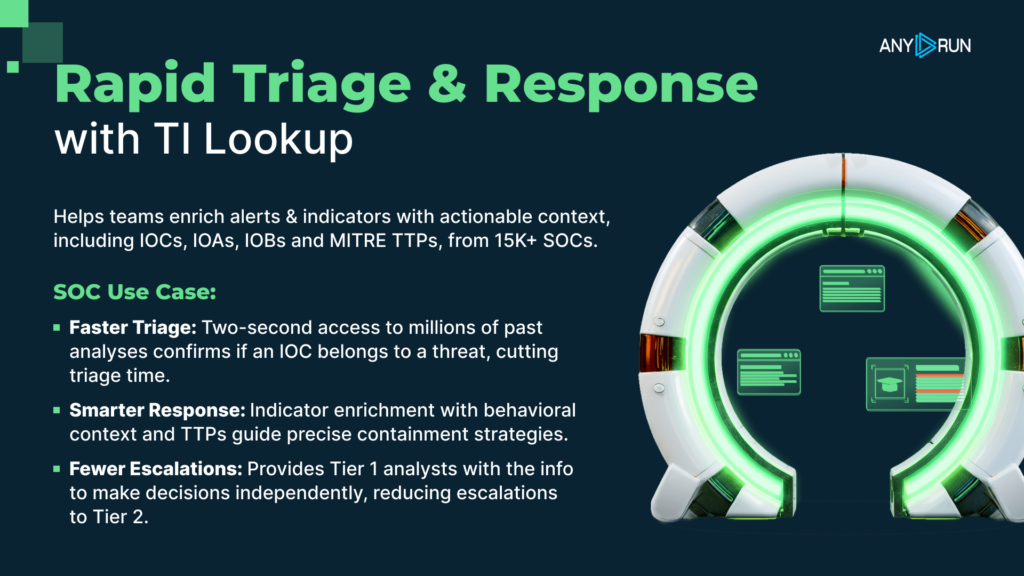
TI Lookup acts as a single source of context for SOC teams, accelerating triage and MTTR 

Threat Intelligence Lookup gives analysts immediate context for suspicious IPs, domains, URLs, and over 40 other types of indicators. This helps financial SOCs close more alerts faster and with more confidence, reducing the risk of a missed attack and a resulting business impact due to incidents. 

What this means for your SOC and business: 

  • Clear understanding of threats to your company: Analysts immediately see whether an indicator is tied to real malicious activity, reducing uncertainty and missed risks. 
  • 21-minute faster MTTR: Alerts are validated or closed quickl, helping SOC teams stay in control even when attack volume increases. 
  • Lower investigation effort per incident: Less manual research means faster containment and fewer resources spent on non-critical alerts. 

Shorter investigations mean lower response costs and reduced operational impact during incidents. 

Accelerate triage and reduce MTTR to avoid missed incidents

Empower your SOC with TI Lookup’s rich threat intel


Try for your team


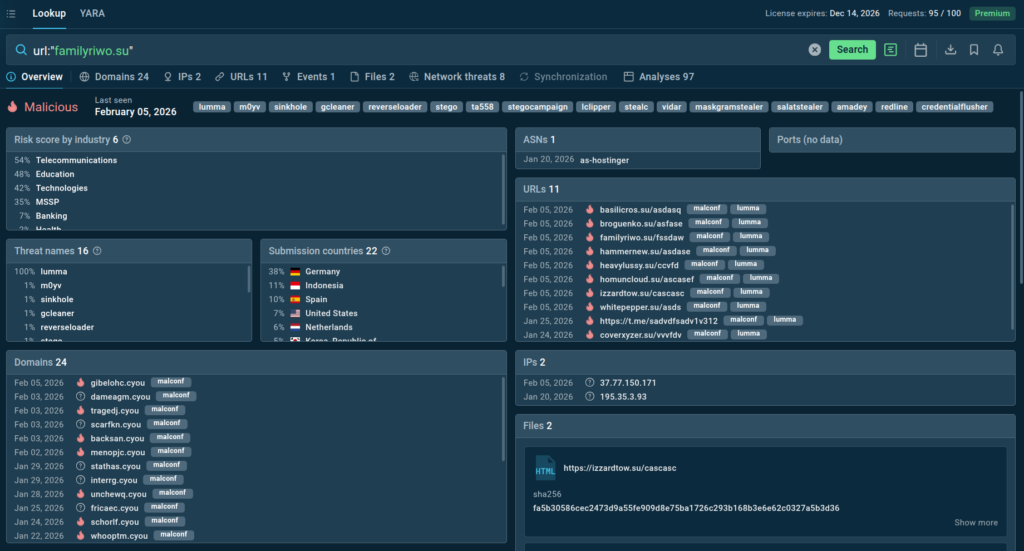
To demonstrate how TI Lookup accelerates the triage processes, we simulate a typical scenario where a SOC analyst needs to verify an alert about a suspicious URL. Instead of checking it across multiple sources and wasting precious time, the analyst can submit it to TI Lookup and get a 2-second response with full context. 

url:”familyriwo.su” 

TI Lookup gives a fast overview of the indicator, showing how it relates to active attacks 

TI Lookup shows that this URL is related to a currently active Lumma Stealer campaign, which has been observed by companies in banking, telecommunications across Germany, Spain, and the United States. 

Threat Hunting: Find Risks Before Alerts Exist 

Threat Intelligence Lookup also supports proactive threat hunting by exposing patterns across real campaigns, not just isolated IOCs. 

What this enables: 

  • Focus on threats that actually matter: Hunters prioritize campaigns, techniques, and infrastructure relevant to financial organizations, not generic threat noise. 
  • Earlier visibility into hidden or low-noise attacks: Real attack patterns help uncover threats before they escalate into full incidents. 
  • More effective detection improvements: Hunting insights translate into better rules and coverage, reducing blind spots over time. 

Earlier risk exposure prevents silent compromises that lead to major incidents later. 

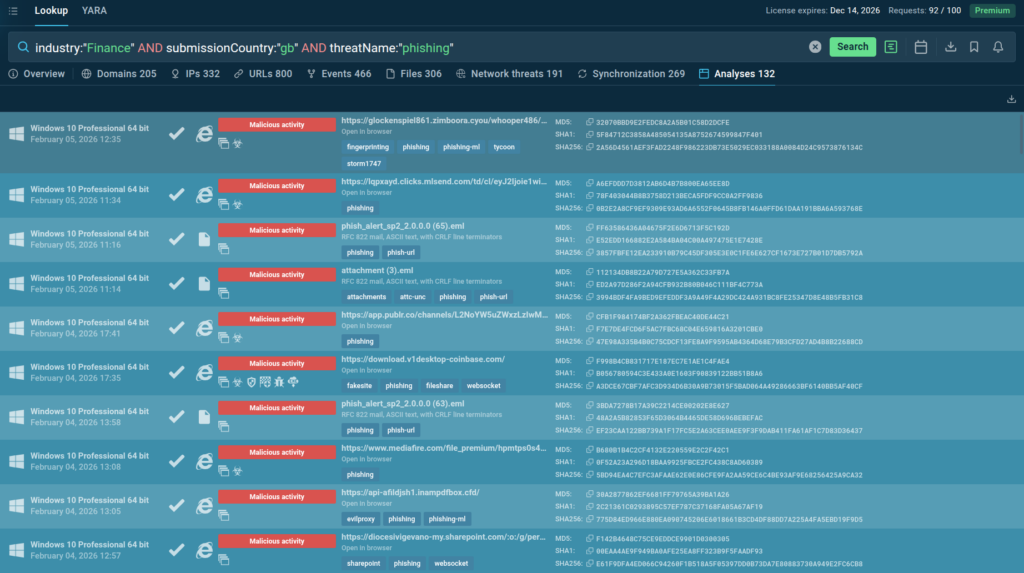
For example, TI Lookup provides a clear picture of the current threat landscape for companies in different industries and countries.  

By combing the three parameters for the industry, country, and threat type, we can instantly see phishing threats facing financial organizations in the United Kingdom: 

industry:”Finance” AND submissionCountry:”gb” and threatName:”phishing” 

TI Lookup provides actual examples of current attacks affecting finance organizations

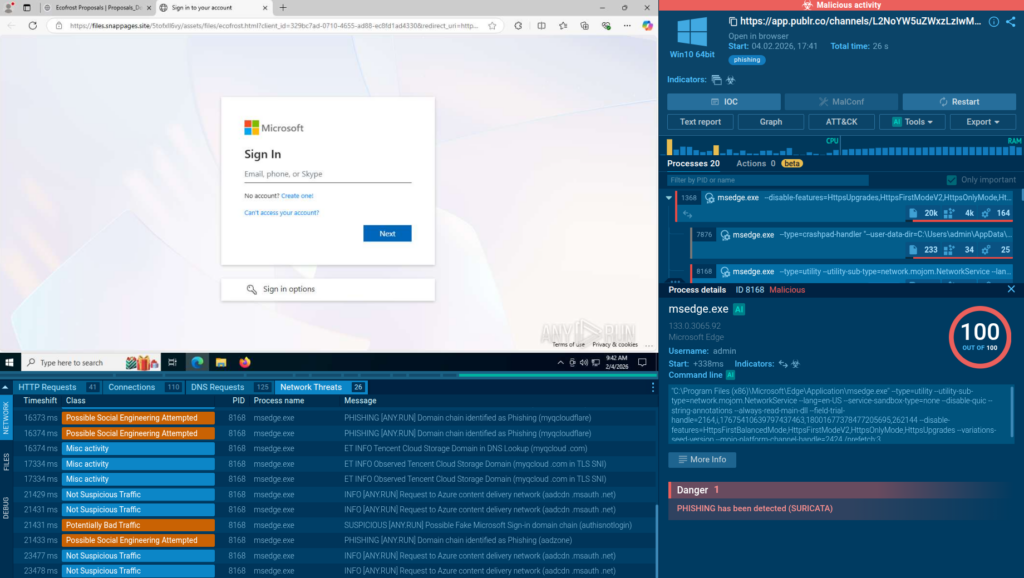
TI Lookup shows the latest phishing attacks analyzed in the sandbox, allowing analysts to view each of them to study the current attack flows used by criminals. 

A real phishing attack targeting financial organizations in the UK analyzed in the sandbox

Fresh, extensive intelligence from TI Lookup gives SOC teams the ability to enrich the existing detection capabilities and ensure that the organization’s defenses stay relevant and impenetrable for active attacks. 

Business Outcomes of Integrating Threat Intelligence in Finance 

ANY.RUN’s Threat Intelligence delivers value when it protects business operations, not just SOC metrics. 

Key outcomes include: 

  • Risk Reduction: By enabling earlier detection and prevention of attacks, threat intelligence directly reduces the probability and impact of security incidents. This translates to lower financial losses from breaches, reduced regulatory fines, and minimized business disruption. 
  • Compliance Demonstration: Documentation of threat intelligence integration shows due diligence to auditors and regulators, supporting compliance with frameworks like PCI DSS, GDPR, DORA, and SEC cybersecurity rules. 
  • Operational Efficiency: Automated threat intelligence integration reduces the manual effort required for threat research and indicator validation. Security teams can handle more alerts with the same resources, improving overall SOC efficiency and enabling organizations to do more with existing budgets. 
  • Cost Optimization: While threat intelligence feeds represent an investment, they deliver ROI through reduced breach costs, lower cyber insurance premiums, minimized overtime and emergency response costs, and decreased need for expensive forensics and recovery services.  
  • Customer Trust and Reputation: Demonstrating robust security measures through threat intelligence integration helps maintain customer confidence. 

For financial institutions, these outcomes directly protect revenue and operational continuity. 

Reduce business risks for your organization

Integrate ANY.RUN’s TI solutions in your SOC


Contact us


Conclusion 

Threat intelligence is most effective when it supports clear decisions at the right time. By combining early signals, real attack context, and continuous updates, SOC teams can act before small issues turn into business-critical incidents. 

That is where security starts protecting the business, not after the damage is done. 

About ANY.RUN  

ANY.RUN develops advanced solutions for malware analysis and threat hunting, trusted by 600,000+ cybersecurity professionals worldwide.  

Its interactive malware analysis sandbox enables hands-on investigation of threats targeting Windows, Linux, and Android environments. ANY.RUN’s Threat Intelligence Lookup and Threat Intelligence Feeds help security teams quickly identify indicators of compromise, enrich alerts with context, and investigate incidents early. Together, the solutions empowers analysts to strengthen overall security posture at financial institutions and banks.   

Request ANY.RUN access for your company   

FAQ

Why is the financial sector targeted more than others? 

Because it combines direct access to money, sensitive personal data, and critical infrastructure with strict uptime and regulatory pressure. 

What role does threat intelligence play in early attack detection? 

Threat intelligence exposes malicious infrastructure, tools, and behaviors at the earliest stages of attacks, enabling preventive blocking. 

How does threat intelligence reduce SOC workload? 

By enriching alerts with context, it helps analysts quickly distinguish real threats from false positives and prioritize incidents. 

Can threat intelligence help with compliance requirements? 

Yes. It supports continuous monitoring, documented response processes, and risk-based security controls required by financial regulations. 

How is ANY.RUN different from traditional TI sources? 

ANY.RUN combines real-time threat feeds with interactive analysis and deep behavioral context, making intelligence immediately actionable.

The post How Threat Intelligence Helps Protect Financial Organizations from Business Risk appeared first on ANY.RUN’s Cybersecurity Blog.

ANY.RUN’s Cybersecurity Blog – ​Read More

The best business messaging apps of 2026: Expert tested

I tested the top business messaging platforms to find the best solutions for team collaboration, security, and productivity in 2026.

Latest news – ​Read More

The best Windows laptops of 2026: Expert tested and reviewed

We’ve gone hands-on with dozens of Windows laptops, evaluating their performance, portability, and value. Here are our top picks.

Latest news – ​Read More

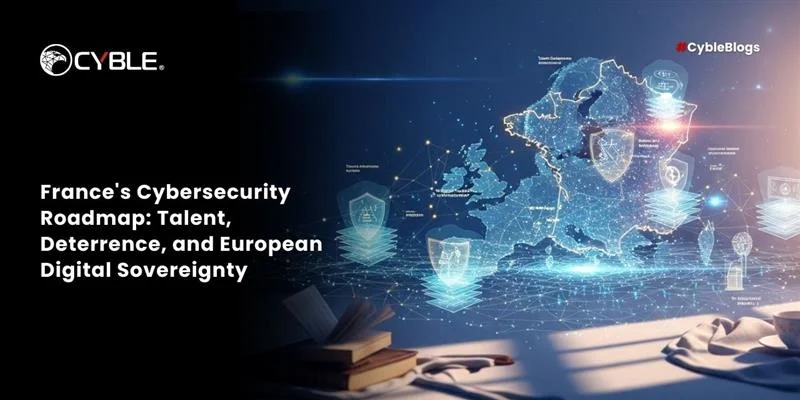
France’s Cybersecurity Roadmap: Talent, Deterrence, and European Digital Sovereignty

France National Cybersecurity Strategy

Introduction 

France has released its National Cybersecurity Strategy for 2026-2030, and the document reveals an ambitious vision that extends far beyond traditional defense postures. Under the directive of President Emmanuel Macron, who frames cybersecurity as “a prerequisite for freedom” and “a strategic imperative,” France is positioning itself not merely as a secure nation, but as Europe’s cybersecurity powerhouse. 

The strategy’s structure is telling. While most national cybersecurity frameworks lead with infrastructure protection or threat response, France places talent development as Pillar 1—the foundational priority before all others. This sequencing isn’t accidental. It signals a fundamental recognition that sustainable cybersecurity advantage isn’t built on technology alone, but on the human capital capable of wielding it. 

Pillar 1: Building Europe’s Largest Cyber Talent Pool 

France’s most ambitious commitment is becoming “the largest pool of cyber talent in Europe,” backed by initiatives addressing the global cybersecurity labor shortage at its roots. The strategy confronts persistent barriers directly: the perception of cybersecurity as “male-dominated, solitary, essentially technical, and accessible only to those with high education.” 

The approach spans the entire talent pipeline. Mentoring programs will target young women. Cybersecurity will integrate into civic engagement programs for youth. A national platform will coordinate public and private efforts guiding people toward cyber careers. MOOCs and self-training tools will democratize access to cybersecurity knowledge. 

Most notably, France commits to “bridge strategies” between cyber and non-cyber scientific disciplines—recognizing that tomorrow’s challenges require expertise spanning AI, quantum computing, cryptography, and emerging domains. At the European level, France will champion harmonized training courses across all EU member states and promote professional mobility, establishing itself as the gravitational center of European cyber talent development. 

Pillar 2: National Resilience Through Proportionate Protection 

France’s second pillar acknowledges that cyber threats “affect all sectors of the economy and society,” requiring resilience extending beyond government to encompass the entire economic and social fabric. The framework operates on proportionate principles: vital services receive the highest protection capable of withstanding sophisticated threats, while broader entities face cybersecurity obligations aligned with the European NIS2 Directive. 

Beyond mandatory requirements, a trust label system will allow businesses, local authorities, and associations to demonstrate security efforts to stakeholders, creating market incentives for voluntary investment. A national portal for everyday cybersecurity will provide a single access point for information and resources, while the 17Cyber platform will function as a public service desk for incident victims. 

Critically, France commits to national cyber crisis exercises testing coordination and response efficiency at territorial, sectoral, national, European, and international levels—ensuring resilience isn’t merely documented but operationally validated. 

Pillar 3: Multi-Lever Deterrence 

France explicitly states its determination “to halt the expansion of this cyber threat” by mobilizing judicial, technical, diplomatic, military, and economic instruments to “increase the financial, human and reputational cost for potential adversaries.” 

The Cyber Crisis Coordination Centre (C4) brings together ANSSI, COMCYBER, and intelligence services DGSE and DGSI. Its mandate will expand to activate broader response measures and propose options to political authorities—including public attribution of attacks. France will coordinate with European partners in implementing the EU’s cyber-diplomatic toolbox, particularly its sanctions regime. 

Uniquely, France will mobilize private sector participation in national cyber defense. Internet operators will implement protective measures to detect, characterize, and potentially block attacks early. A cybersecurity filter will prevent public access to malicious websites. Technical threat information sharing between government and private actors will strengthen through InterCERT France.       

Pillar 4: Technological Sovereignty and Industrial Consolidation 

France’s fourth pillar addresses dependence on digital technologies potentially controlled by foreign entities or vulnerable to sophisticated attacks. The approach centers on maintaining “autonomy of judgement and freedom of action in cyberspace” through sustained mastery of critical technologies and autonomous assessment capabilities.       

Investment focuses on critical cryptography technologies and products capable of countering advanced threats for sovereign uses. Industrial policy instruments will stimulate European sector consolidation, supporting the emergence of world-leading cyber industrial players. France will leverage European funds and private partnerships to drive investment in world-class companies, including specialized investment funds. 

The European certification framework for cybersecurity products and services will structure this industrial development. France will also continue developing its internationally recognized security evaluation sector while promoting autonomous European evaluation capability. 

Pillar 5: International Cooperation Without Geopolitical Blocs 

France’s fifth pillar promotes cyberspace security and stability while explicitly rejecting “the logic of geopolitical blocs.” The governance approach combines multilateral frameworks with multi-stakeholder participation—states, private sector, research, and civil society. 

France will continue leading initiatives like the Paris Call (over 1,200 stakeholders around nine principles for open, secure cyberspace) and the Pall Mall Process addressing commercial cyber intrusion capability proliferation (27 governments endorsed its code of best practices by August 2025). Within the UN, France supports establishing a Global Cybersecurity Mechanism by 2026 to operationalize 2015 UN standards of responsible behavior. 

At the European level, France regards the EU as “essential and preferred” for safeguarding its cyberspace initiative and action. France will strengthen EU strategic autonomy through full involvement in cooperation forums like the CSIRT Network, CyCLONe, and CYBERCO, emphasizing threat information sharing to achieve greater European autonomy. 

France will also develop cyber solidarity capabilities through structural cooperation (long-term capacity building via advice, training, logistical support) and operational cooperation (specific assistance through IT audits and incident response). The EU Cyber Reserve, operational by 2026, will deploy incident response services from trusted private providers to help EU member states and associated third countries. 

The Distinctive Governance Model 

France’s organizational approach explicitly separates defensive and offensive cyber missions while ensuring effective coordination—guaranteeing civil liberties while maintaining operational effectiveness. 

Defensive governance operates across three missions: “The State defends the Nation” (understanding threats and developing responses), “The State secures itself” (protecting state systems and critical operators), and “The Nation strengthens itself” (coordinating public action and private efforts across individuals, businesses, associations, and local authorities). 

This multi-stakeholder governance integrates professional sectors, local government, academia, and civil society as both victims and essential partners in response development—recognizing cyber threats affect all areas of society, economy, and national territory. 

Strategic Implications 

France’s strategy arrives amid heightened geopolitical tension, explicitly acknowledging Russia’s war in Ukraine and the “increasingly fragmented world.” The emphasis on deterrence, technological sovereignty, and European cooperation reflects assessment that cybersecurity has become inseparable from national sovereignty and international power dynamics. 

The talent development prioritization deserves particular attention. While other nations focus primarily on defensive capabilities and threat response, France recognizes sustainable advantage requires building human infrastructure capable of continuous innovation. Becoming Europe’s largest cyber talent pool isn’t subsidiary to technical capabilities—it’s the foundation enabling all other strategic objectives. 

The European dimension permeates every pillar. France consistently frames cybersecurity advancement as contribution to European strategic autonomy rather than purely national capability, positioning itself as architect and leader of European cyber policy. 

The timeline extending to 2030 provides sufficient horizon for structural changes in talent pipelines, industrial capabilities, and international frameworks to materialize—allowing investments whose benefits compound over time. 

From Vision to Execution 

Implementation challenges are substantial. Talent development initiatives require long-term cultural shifts that educational programs alone cannot achieve—industry must provide accessible entry points, competitive compensation, and inclusive workplace cultures. The deterrence posture requires careful calibration to avoid escalation while maintaining credibility. The multi-stakeholder governance demands coordination across fragmented communities with divergent interests.       

For organizations observing France’s strategic evolution, implications extend beyond French borders. European cooperation, standardization, and industrial consolidation will shape the continental cybersecurity market. Talent pipeline investments will affect where expertise concentrates. Regulatory frameworks aligned with NIS2 will establish compliance baselines affecting multinational operations. 

France’s 2026-2030 National Cybersecurity Strategy represents one of the most comprehensive national frameworks released by any country. Its success depends not just on French execution, but on European coordination, private sector engagement, and the broader international community’s response to the governance models and cooperation frameworks France promotes. 

Strengthening Organizational Resilience 

As nations like France invest in comprehensive cybersecurity strategies emphasizing talent, deterrence, and digital sovereignty, organizations worldwide face similar imperatives at the enterprise level. Building resilience requires understanding attack surfaces, monitoring threats across surface and dark web channels, and maintaining continuous visibility over evolving risks.  

Cyble’s threat intelligence platform provides capabilities aligned to these strategic priorities—from attack surface management and dark web monitoring to vulnerability intelligence and incident response support.  

Request a demo to explore comprehensive threat intelligence solutions. 

The post France’s Cybersecurity Roadmap: Talent, Deterrence, and European Digital Sovereignty appeared first on Cyble.

Cyble – ​Read More

Cyberspy Group Hacked Governments and Critical Infrastructure in 37 Countries

Palo Alto Networks has not attributed the APT activity to any specific country, but evidence points to China.

The post Cyberspy Group Hacked Governments and Critical Infrastructure in 37 Countries appeared first on SecurityWeek.

SecurityWeek – ​Read More