Cities Hosting Major Events Need More Focus on Wireless, Drone Defense
Major events like the FIFA World Cup need to look beyond traditional physical and cyber security to active and passive wireless threats, say experts.
darkreading – Read More

Major events like the FIFA World Cup need to look beyond traditional physical and cyber security to active and passive wireless threats, say experts.
darkreading – Read More
AI agents now carry more access and more connections to enterprise systems than any other software in the environment. That makes them a bigger attack surface than anything security teams have had to govern before, and the industry doesn’t yet have a framework for it. “If that attack vector gets utilized, it can result in a data breach, or even worse,” said Spiros Xanthos, founder and CEO of Resolve AI, speaking at a recent VentureBeat AI Impact Series event.
Traditional security frameworks are built around human interactions. There’s not yet an agreed-upon construct for AI agents that have personas and can work autonomously, noted Jon Aniano, SVP of product and CRM applications at Zendesk, at the same event. Agentic AI is moving faster than enterprises can build guardrails — and Model Context Protocol (MCP), while decreasing integration complexity, is making the problem worse.
Agentic AI is moving faster than enterprises can build guardrails around them, according to Aniano and other enterprises leaders. And Model Context Protocol (MCP), while decreasing integration complexity, doesn’t help.
“Right now it’s an unsolved problem because it’s the wild, wild West,” Aniano said. “We don’t even have a defined technical agent-to-agent protocol that all companies agree on. How do you balance user expectations versus what keeps your platform safe?”
Enterprises are increasingly hooking into MCP servers because they simplify integration between agents, tools and data. However, MCP servers tend to be “extremely permissive,” he said.
They are “actually probably worse than an API,” he contended, because APIs at least have more controls in place to impose upon agents.
Today’s agents are acting on behalf of humans based on explicit permissions, thus establishing human accountability. “But you might have tens, hundreds of agents in the future with their own identity, their own access,” said Xanthos. “It becomes a very complex matrix.”
Even as his startup is developing autonomous AI agents for site reliability engineering (SRE) and system management, he acknowledged that the industry “completely lacks the framework” for autonomous agents.
“It’s completely on us and to anybody who builds agents to figure out what restrictions to give them,” he said. And customers must be able to trust those decisions.
Some existing security tools do offer fine-grained access — Splunk, for instance, developed a method to provide access to certain indexes in underlying data stores, he noted — but most are broader and human-oriented.
“We’re trying to figure this out with existing tools,” he said. “But I don’t think they’re sufficient for the era of agents.”
At Zendesk and other customer relationship management (CRM) platform providers, AI is involved in a number of user interactions, Aniano noted — in fact, now it’s at a “volume and a scale that we haven’t contemplated as businesses and as a society.”
It can get tricky when AI is helping out human agents; the audit trail can become a labyrinth.
“So now you’ve got a human talking to a human that’s talking to an AI,” Aniano noted. “The human tells the AI to take action. Who’s at fault if it’s the wrong action?” This becomes even more complicated when there are “multiple pieces of AI and multiple humans” in the mix.
To prevent agents from going off the rails, Zendesk tends to be “very strict” about access and scope; however, customers can define their own guardrails based on their needs. In most cases, AI can access knowledge sources, but they’re not writing code or running commands on servers, Aniano said. If an AI does call an API, it is “declaratively designed” and sanctioned, and actions are specifically called out.
However, customer demand is flooding these scenarios and “we’re kind of holding the gates right now,” he said.
The industry must develop concrete standards for agent interactions. “We’re entering a world where, with things like MCP that can auto-discover tools, we’re going to have to create new methods of safety for deciding what tools these bots can interact with,” said Aniano.
When it comes to security, enterprises are rightly concerned when AI takes over authentication tasks, such as sending out and processing one-time passwords (OTP), SMS codes, or other two-step verification methods, he said. What happens if an AI mis-authenticates or misidentifies someone? This can lead to sensitive data leakage or open the door for attackers.
“There’s a spectrum now, and the end of that spectrum today is a human,” Aniano said. However, “the end of that spectrum tomorrow might be a specialized agent designed to do the same kind of gut feeling or human-level interaction.”
Customers themselves are on a spectrum of adoption and comfort. In certain companies — particularly financial services or other highly-regulated environments — humans still must be involved in authentication, Aniano noted. In other cases, legacy companies or old guards only trust humans to authenticate other humans.
He noted that Zendesk is experimenting with new AI agents that are “a little more connected to systems,” and working with a select group of customers around guardrailing.
In some future, agents may actually be more trusted than humans to do some tasks, and granted permissions “way beyond” what humans have today, Xanthos said. But we’re a long way from that, and, for the most part, the fear of something going wrong is what’s holding enterprises back.
“Which is a good fear, right? I’m not saying that it is a bad thing,” he said. Many enterprises simply aren’t yet comfortable with an agent doing all steps of a workflow or fully closing the loop by itself. They still want human review.
Resolve AI is on the cusp of giving agents standing authorization in a few cases that are “generally safe,” such as in coding; from there they’ll move to more open-ended scenarios that are not all that risky, Xanthos explained. But he acknowledged that there will always be very risky situations where AI mistakes could “mutate the state of the production system,” as he put it.
Ultimately, though: “There’s no going back, obviously; this is moving faster than maybe even mobile did. So the question is what do we do about it?”
Both speakers pointed to interim measures available within existing tooling. Xanthos noted that some tools — Splunk among them — already offer fine-grained index-level access controls that can be applied to agents. Aniano described Zendesk’s approach as a practical starting point: declaratively designed API calls with explicitly sanctioned actions, strict access and scope limits, and human review before expanding agent permissions.
The underlying principle, as Aniano put it: “We’re always checking those gates and seeing how we can widen the aperture” — meaning don’t grant standing authorization until you’ve validated each expansion.
Security | VentureBeat – Read More
You can choose how long you want to share your location or turn it off at any time.
Latest news – Read More
ShinyHunters hackers leak 2 million records from Dutch telecom Odido after ransom refusal, claiming up to 21 million customer records were stolen in the breach.
Hackread – Cybersecurity News, Data Breaches, AI and More – Read More
Google’s new default model for generating images, Nano Banana 2 offers faster speeds, better text rendering, and higher resolutions than its predecessor.
Latest news – Read More
The Shadowserver Foundation has revealed that over 900 Sangoma FreePBX instances still remain infected with web shells as part of attacks that exploited a command injection vulnerability starting in December 2025.
Of these, 401 instances are located in the U.S., followed by 51 in Brazil, 43 in Canada, 40 in Germany, and 36 in France.
The non-profit entity said the compromises are likely
The Hacker News – Read More
The Ultrahuman Ring Pro also packs a new safety feature that makes the smart ring easier to cut off – just in case.
Latest news – Read More
In a previous post, we walked through a practical example of how threat attribution helps in incident investigations. We also introduced the Kaspersky Threat Attribution Engine (KTAE) — our tool for making an educated guess about which specific APT group a malware sample belongs to. To demonstrate it, we used the Kaspersky Threat Intelligence Portal — a cloud-based tool that provides access to KTAE as part of our comprehensive Threat Analysis service, alongside a sandbox and a non-attributing similarity-search tool. The advantages of a cloud service are obvious: clients don’t need to invest in hardware, install anything, or manage any software. However, as real-world experience shows, the cloud version of an attribution tool isn’t for everyone…
First, some organizations are bound by regulatory restrictions that strictly forbid any data from leaving their internal perimeter. For the security analysts at these firms, uploading files to a third-party service is out of the question. Second, some companies employ hardcore threat hunters who need a more flexible toolkit — one that lets them work with their own proprietary research alongside Kaspersky’s threat intelligence. That’s why KTAE is available in two flavors: a cloud-based version and an on-prem deployment.
First off, the local version of KTAE ensures an investigation stays fully confidential. All the analysis takes place right in the organization’s internal network. The threat intelligence source is a database deployed inside the company perimeter; it is packed with the unique indicators and attribution data of every malicious sample known to our experts; and it also contains the characteristics pertaining to legitimate files to exclude false-positive detections. The database gets regular updates, but it operates one-way: no information ever leaves the client’s network.
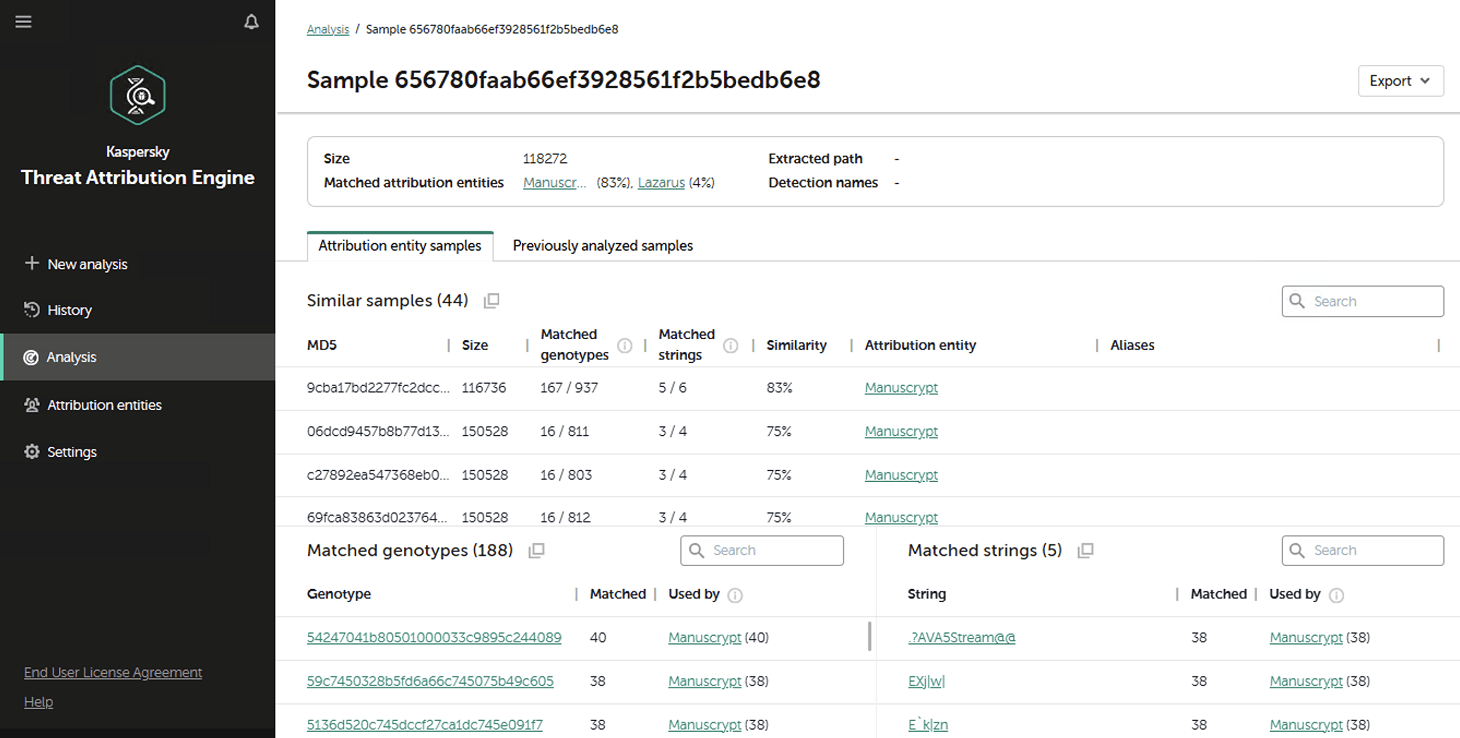
Additionally, the on-prem version of KTAE gives experts the ability to add new threat groups to the database and link them to malware samples they discovered on their own. This means that subsequent attribution of new files will account for the data added by internal researchers. This allows experts to catalog their own unique malware clusters, work with them, and identify similarities.
Here’s another handy expert tool: our team has developed a free plugin for IDA Pro, a popular disassembler, for use with the local version of KTAE.
For a SOC analyst on alert triage, attributing a malicious file found in the infrastructure is straightforward: just upload it to KTAE (cloud or on-prem) and get a verdict, like Manuscrypt (83%). That’s sufficient for taking adequate countermeasures against that group’s known toolkit and assessing the overall situation. A threat hunter, however, might not want to take that verdict at face value. Alternatively, they might ask, “Which code fragments are unique across all the malware samples used by this group?” Here an attribution plugin for a disassembler comes in handy.
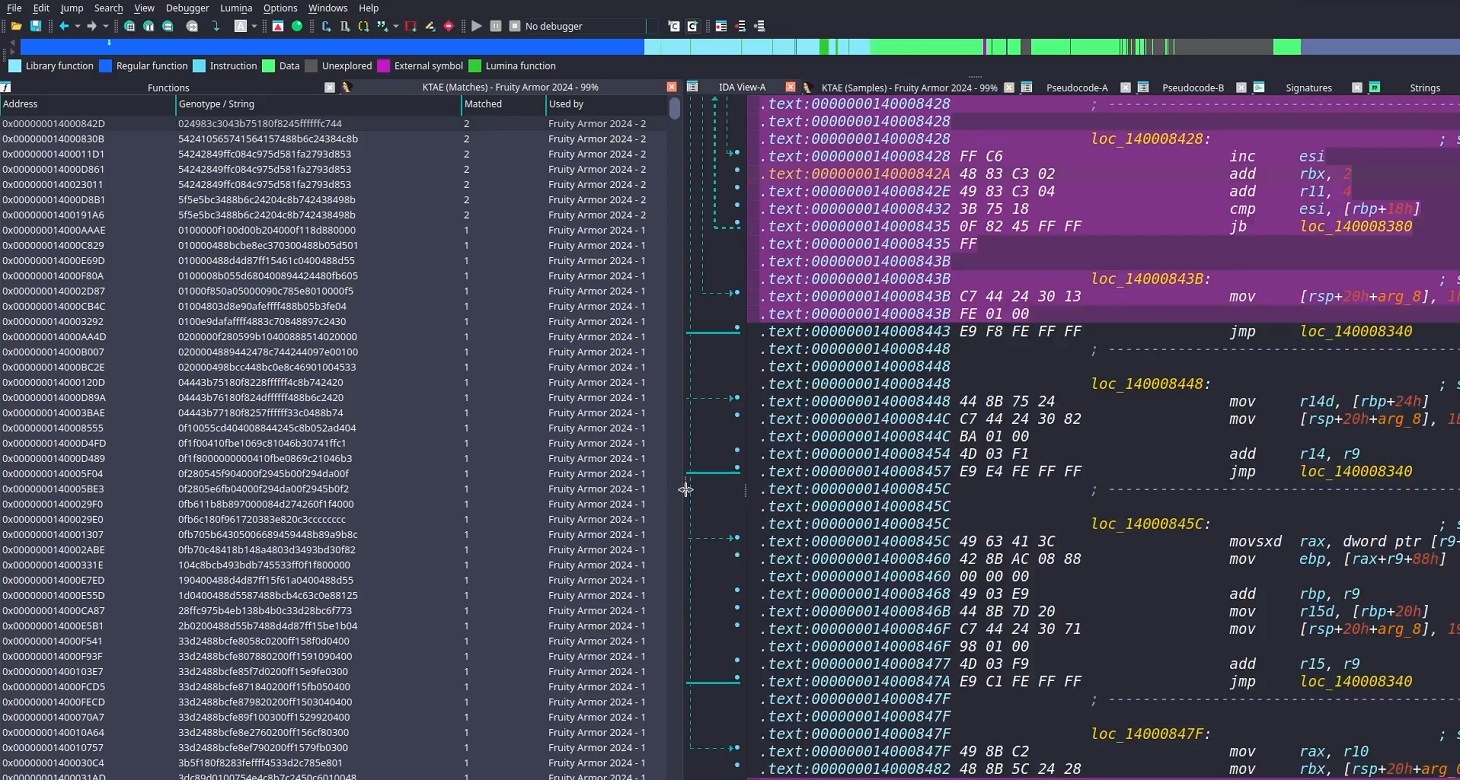
Inside the IDA Pro interface, the plugin highlights the specific disassembled code fragments that triggered the attribution algorithm. This doesn’t just allow for a more expert-level deep dive into new malware samples; it also lets researchers refine attribution rules on the fly. As a result, the algorithm — and KTAE itself — keeps evolving, making attribution more accurate with every run.
The plugin is a script written in Python. To get it up and running you need IDA Pro. Unfortunately, it won’t work in IDA Free, since it lacks support for Python plugins. If you don’t have Python installed yet, you’d need to grab that, set up the dependencies (check the requirements file in our GitHub repository), and make sure IDA Pro environment variables are pointing to the Python libraries.
Next, you’d need to insert the URL for your local KTAE instance into the script body and provide your API token (which is available on a commercial basis) — just like it’s done in the example script described in the KTAE documentation.
Then you can simply drop the script into your IDA Pro plugins folder and fire up the disassembler. If you’ve done it right, then, after loading and disassembling a sample, you’ll see the option to launch the Kaspersky Threat Attribution Engine (KTAE) plugin under Edit → Plugins:
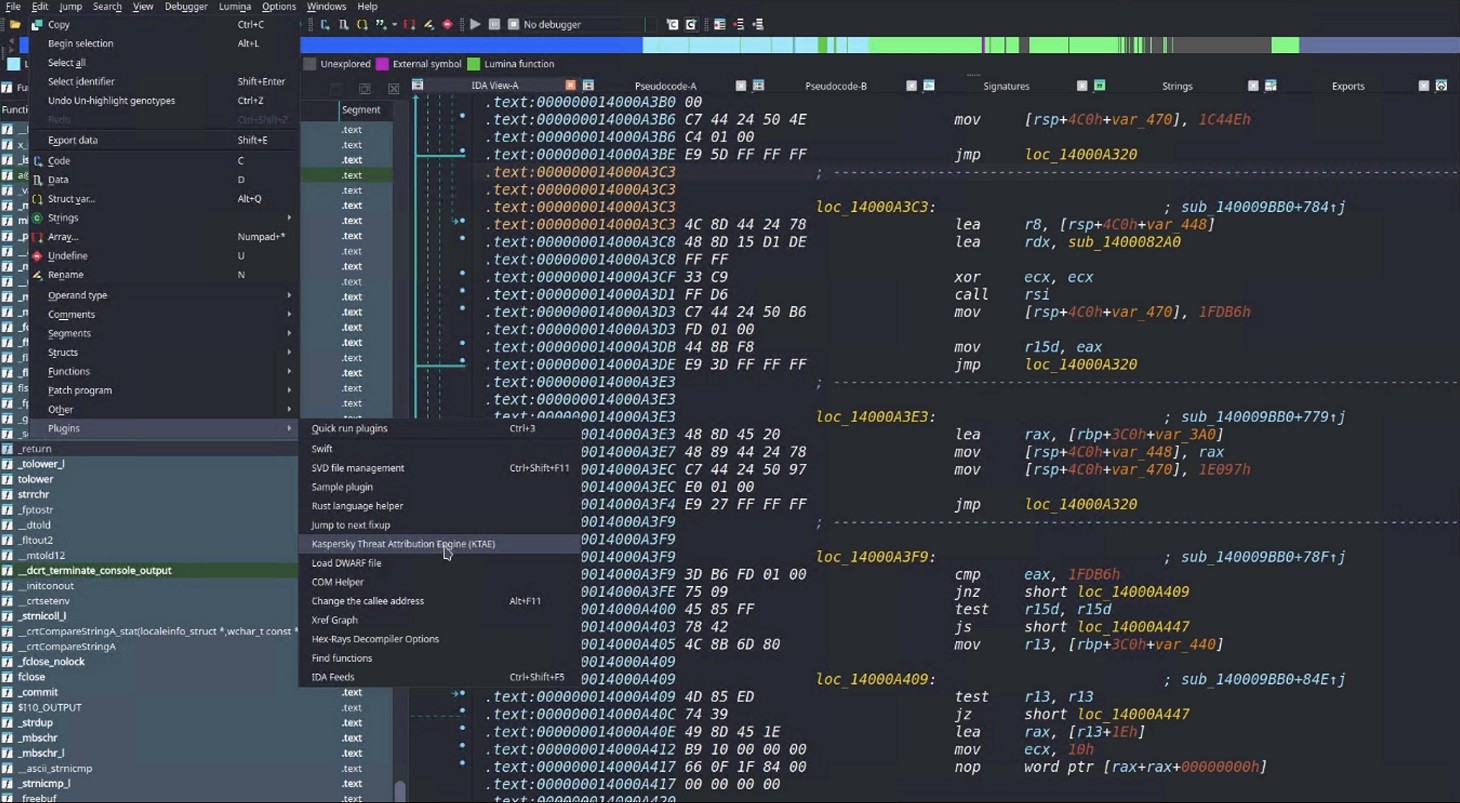
When the plugin is installed, here’s what happens under the hood: the file currently loaded in IDA Pro is sent via API to the locally installed KTAE service, at the URL configured in the script. The service analyzes the file, and the analysis results are piped right back into IDA Pro.
On a local network, the script usually finishes its job in a matter of seconds (the duration depends on the connection to the KTAE server and the size of the analyzed file). Once the plugin wraps up, a researcher can start digging into the highlighted code fragments. A double-click leads straight to the relevant section in the assembly or binary code (Hex view) for analysis. These extra data points make it easy to spot shared code blocks and track changes in a malware toolkit.
To learn more about the Kaspersky Threat Attribution Engine and how to deploy it, check out the official product documentation. And to arrange a demonstration or piloting project, please fill out the form on the Kaspersky website.
Kaspersky official blog – Read More
It’s become a standard practice for organizations to disclose the bare minimum about a data breach, or worse — not disclose the incident at all.
darkreading – Read More
Hackers exploited a critical Cisco SD-WAN flaw, prompting a rare joint warning from the US, UK, Australia, Canada, and New Zealand.
The post 5 Nations Alert: Critical Cisco Bug Used in Global Espionage Campaign appeared first on TechRepublic.
Security Archives – TechRepublic – Read More