DarkSword iPhone Exploit Leaked Online, Hundreds of Millions at Risk
DarkSword exploit leak puts up to 270 million iPhones at risk, with hackers able to access data through…
Hackread – Cybersecurity News, Data Breaches, AI and More – Read More

DarkSword exploit leak puts up to 270 million iPhones at risk, with hackers able to access data through…
Hackread – Cybersecurity News, Data Breaches, AI and More – Read More
Cybersecurity researchers have uncovered a new set of malicious npm packages that are designed to steal cryptocurrency wallets and sensitive data.
The activity is being tracked by ReversingLabs as the Ghost campaign. The list of identified packages, all published by a user named mikilanjillo, is below –
react-performance-suite
react-state-optimizer-core
react-fast-utilsa
ai-fast-auto-trader
The Hacker News – Read More
A variety of AI-powered app builders promise to bring your ideas to life quickly and effortlessly. Unfortunately, we know exactly who’s always on the lookout for new ideas to bring to life — mostly because we’re rather good at spotting and blocking their old ones. We’re talking about phishers, of course. Recently, we discovered they’ve added a new trick to their arsenal: generating websites using the Bubble AI-powered web-app builder. It’s highly likely that this tactic is now available through one or more phishing-as-a-service platforms, which virtually guarantees these decoys will start appearing in a wide range of attacks. But let’s break this down step-by-step.
Including a direct link to a phishing site in an email is a one-way ticket to failure. There’s a high probability the message won’t even reach its destination, as security filters will likely block it before a user ever sees it. Similarly, using automated redirects has long been a major red flag for modern security solutions. What about QR codes? While having a victim scan a code with their phone instead of clicking a link might work in theory, phishers inevitably lose traffic at that step — not everyone is willing to enter corporate credentials on a personal device. This is where automated code-generation services come to the rescue for the cybercriminals.
Bubble positions itself as a no-code platform for developing web and mobile applications. Essentially, a user describes what they need through a visual interface, and the platform generates a finished solution. Phishers have adopted this technology to create web apps whose addresses they then embed in their phishing emails. While the actual function of these apps boils down to the same old automated redirect to a malicious site, there are a couple of specific nuances at play.
First, the resulting web application is hosted directly on the platform’s servers. The URL ready for use in a phishing email looks something like https://%name%.bubble.io/. From the perspective of security solutions, this appears to be a legitimate, long-standing site.
Second, the code for this web application doesn’t look like a typical redirect. To be honest, it’s hard to say what it looks like. The code generated by this no-code platform is a massive jumble of JavaScript and isolated Shadow DOM (Document Object Model) structures. Even for an expert, it’s difficult to grasp what’s happening at first glance; you really have to dig through it to understand how it all works and what the purpose is. Automated web-code analysis algorithms are even more likely to get tripped up, frequently reaching the verdict that this is just a functional, useful site.
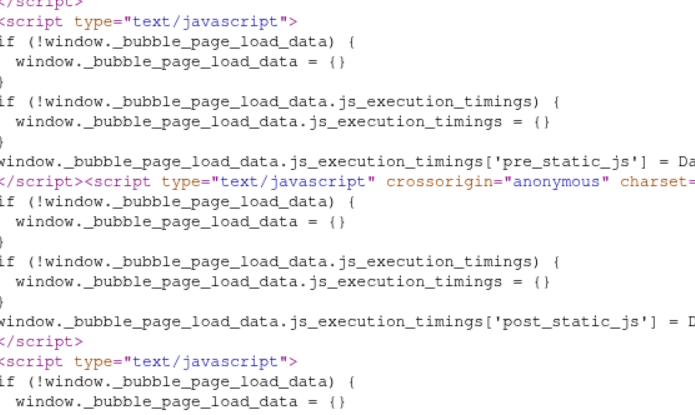
A code fragment of a web application hosted on the Bubble platform
Today’s phishers rarely develop and implement new tricks from scratch. Most use phishing kits — essentially DIY builders for launching fraudulent schemes — or even full-scale phishing-as-a-service platforms.
These platforms provide attackers with a sophisticated (and highly frustrating) toolkit that’s constantly evolving to improve email delivery and bypass anti-phishing defenses. For example, these tools allow attackers, among many other things, to do the following: intercept session cookies; conduct phishing through Google Tasks (a tactic we covered in a previous post); execute adversary-in-the-middle (AiTM) attacks to validate two-factor authentication (2FA) and bypass it in real time; create phishing sites equipped with honeypots and geofencing to hide from security crawlers; and use AI assistants to generate unique phishing emails. To make matters worse, the infrastructure for these platforms is usually hosted on perfectly legitimate services like AWS, making their tactics even harder to spot.
The same platforms are used to make the final destination page that harvests credentials. In this specific case, the web app hosted on Bubble redirects victims to a site — complete with a Cloudflare verification check — that mimics a Microsoft sign-in window.
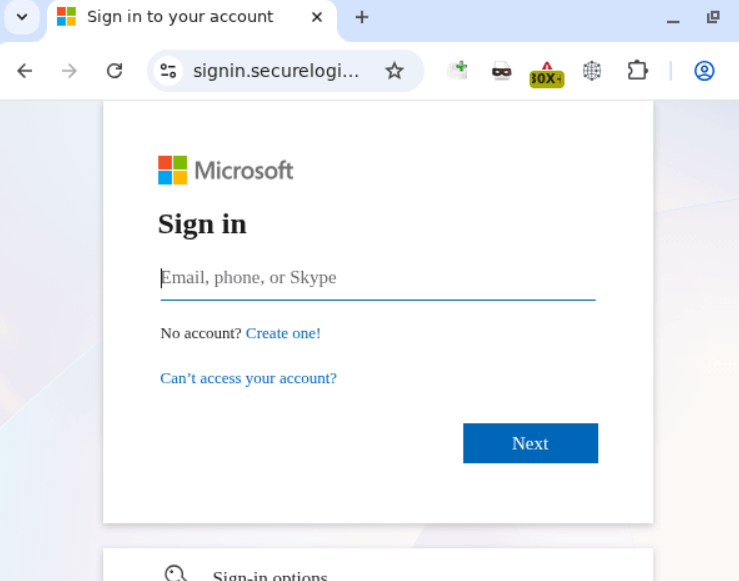
Phishing form designed to harvest corporate credentials
Apparently, in the attackers’ parallel universe, Skype is still a viable communication tool, but otherwise, the site looks remarkably convincing.
In today’s digital landscape, employees need to clearly understand that corporate credentials should only be entered on services and websites that undeniably belong to the company. You can raise your team’s awareness of modern cyberthreats using Kaspersky Automated Security Awareness Platform for online training.
Of course, even the most cautious employee might occasionally take the bait. We recommend equipping all internet-connected workstations with robust security solutions that’ll simply block any attempt to visit a malicious site. Finally, to cut down on the number of dangerous emails cluttering up corporate inboxes in the first place, we suggest deploying a gateway security product with advanced anti-phishing technologies.
Kaspersky official blog – Read More
The 2026 Moto G sticks to a proven formula, offering great performance at an affordable price.
Latest news – Read More
Sony’s Bravia 8 II is worth every penny of its retail price, but it’s even better when you can buy one for this much off.
Latest news – Read More
Attachment to smart devices and biometric surveillance leaves Americans more vulnerable to police searches than ever. Left unchecked it will only get worse.
Security Latest – Read More
Under a Homeland Security program, police departments around the US are signing up to assist in immigration enforcement. The cops of Carroll, New Hampshire, are going all in—and they’re likely not alone.
Security Latest – Read More
A 26-year-old Russian citizen has been sentenced in the U.S. to 6.75 years (81 months) in prison for his role in assisting major cybercrime groups, including the Yanluowang ransomware crew, in conducting numerous attacks against U.S. companies and other organizations.
According to the U.S. Department of Justice (DoJ), Aleksei Olegovich Volkov facilitated dozens of ransomware attacks across the
The Hacker News – Read More
Luxembourg, Luxembourg, 24th March 2026, CyberNewswire
Hackread – Cybersecurity News, Data Breaches, AI and More – Read More
Denon is back with new Home 200, 400, and 600 speakers, debuting a fresh look and more ways to expand your system.
Latest news – Read More