
Closing the Supplier Security Gap: How a US Manufacturer Cut Third-Party Risk and Doubled SOC Triage Speed
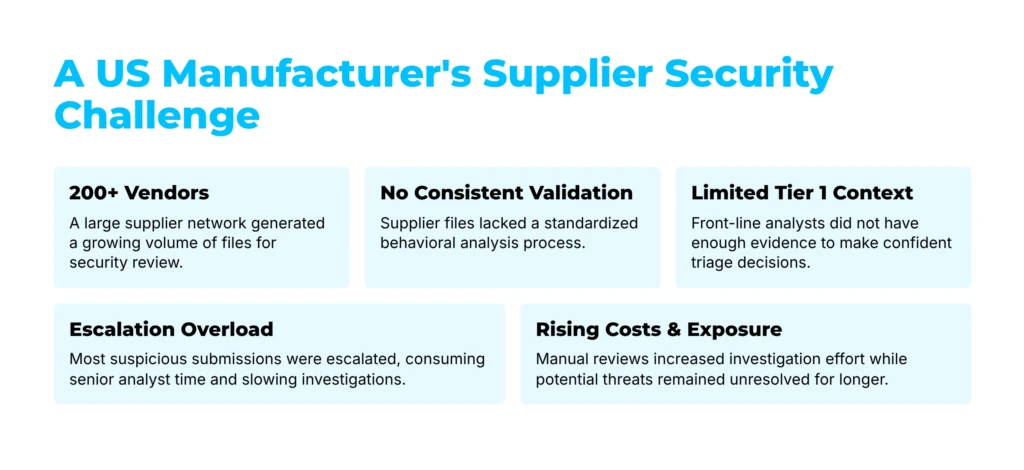
For a US automotive manufacturer working with more than 200 active vendors, supplier file intake had become a growing security and cost challenge. Suspicious submissions often reached the SOC without enough context, forcing Tier 1 analysts to escalate most cases and slowing detection and response across the business.
By introducing a scalable triage and analysis process with behavioral sandboxing and threat intelligence, the company made alert processing and threat analysis 2x faster, improved MTTD and MTTR, increased its detection rate, reduced escalation pressure, and analyzed hundreds of files every week without adding headcount.
A US Automotive Manufacturer Built Around a Large Supplier Ecosystem
The company is a US-based automotive manufacturer operating within a highly interconnected supply chain. Its daily operations depend on continuous collaboration with more than 200 active vendors and third-party contractors.
These external partners regularly exchange files with the organization to support ongoing manufacturing, technical, and business processes. This makes supplier communication essential to keeping operations moving, but it also creates a large and constantly changing entry point for risk.
The SOC is responsible for protecting the company’s environment while ensuring legitimate supplier activity is not delayed. As the volume of incoming files grew, the team needed a way to analyzesubmissions consistently, improve detection and response speed, and reduce third-party exposure without increasing staffing costs.
The Challenge: Supplier Files Were Entering Without a Consistent Analysis Process
Before ANY.RUN, the company had no systematic process for analyzing files received from vendors and third-party contractors.
Existing security controls could flag a submission as suspicious, but they did not always show what the file would actually do after execution. Without behavioral evidence, analysts were left with incomplete indicators and uncertain verdicts.
“The volume itself was not the only challenge. The bigger issue was that analysts did not have enough context to quickly decide which supplier files were safe and which required further action.”
Head of SOC, US automotive manufacturer
This created several problems for the SOC:
A Security Gap in Supplier File Intake
Files could enter the environment without passing through a dedicated behavioral analysis layer.
This limited the company’s ability to identify threats that appeared harmless during static inspection but revealed malicious activity only after execution.
For a manufacturer with a large supplier ecosystem, this created meaningful third-party risk. A compromised vendor could become an indirect route into the organization, even when the manufacturer’s own internal defenses remained strong.
High Escalation Rates
Tier 1 analysts often lacked enough context to confidently close suspicious submissions.
As a result, the majority of these files were escalated to more experienced analysts. Senior team members had to spend time reviewing cases that could have been resolved earlier with clearer evidence.
Rising Investigation Costs
The supplier network continued to generate a high volume of files. Handling that growth through manual investigation would have required more analyst hours and, eventually, additional headcount.
Without a more scalable process, the company risked paying more just to maintain the same level of protection.
Longer Exposure to Potential Threats
Every delay in validating a suspicious file extended the period during which the organization could not confidently allow, block, or contain it.
In a manufacturing environment, a missed threat can affect more than an individual endpoint. It can disrupt operations, expose sensitive data, and weaken trust across the supplier network.
Building a Scalable Supplier File Triage and Analysis Process with ANY.RUN
The manufacturer introduced a consistent process for analyzing files received from vendors and third-party contractors.
By combining behavioral analysis with threat intelligence, the SOC gained both the evidence needed to understand what a file does and the context required to assess the wider threat behind it.
“We have over 200 active vendors sending files into the environment. ANY.RUN gave us a scalable way to analyze that volume and make triage much faster without adding headcount”
Head of SOC, automotive manufacturer
Instead of relying on isolated alerts or incomplete indicators, analysts could detect malicious submissions more accurately, reach verdicts faster, resolve more cases at Tier 1, and reduce the amount of senior analyst time spent on routine reviews.
This improved detection quality while contributing to lower MTTD and MTTR across supplier-related investigations.
Reaching Faster Verdicts with Behavioral Evidence
The SOC reduced triage time by giving analysts direct visibility into what suspicious supplier files did after execution.
Files were safely analyzed in ANY.RUN’s cloud-based Interactive Sandbox, where the team could review process activity, network connections, system changes, commands, and other behavior without exposing the production environment.
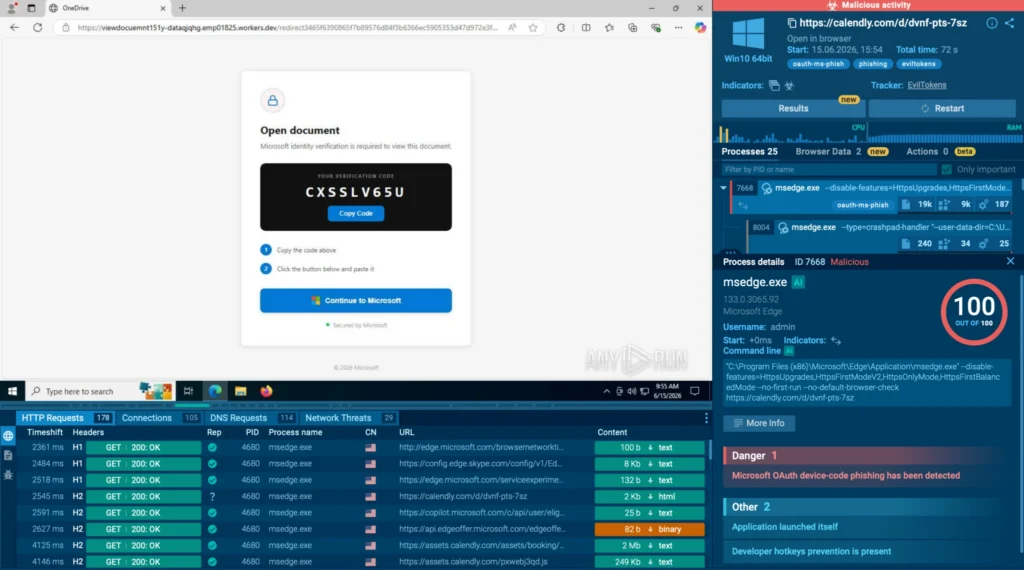
This replaced incomplete indicators with clear evidence of whether a submission was malicious and how it could affect the business.
“We no longer have to spend time piecing together what a supplier file might do. The behavior is visible in one place, which makes decisions faster and easier to defend.”
Head of SOC, US automotive manufacturer
Structured and visual results also helped Tier 1 analysts move from alert to verdict with fewer manual checks. Instead of reconstructing file behavior across disconnected tools, they could validatesuspicious submissions faster and make more confident decisions.
The faster path from alert to confirmed verdict contributed to improved MTTD, while clearer evidence and fewer repeated checks helped reduce MTTR.
Connecting Supplier Files to Wider Threat Activity
Behavioral analysis showed the team what each suspicious file did. Threat intelligence helped reveal whether the submission was connected to a larger risk.
Indicators uncovered during analysis could be linked to malicious infrastructure, related samples, known campaigns, and attacker activity. This gave analysts a clearer view of whether they were dealing with an isolated file or broader activity involving the company’s supplier ecosystem.
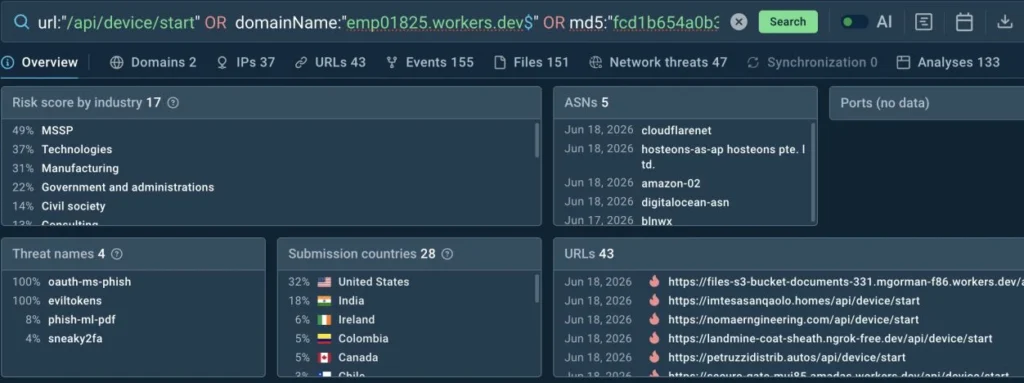
The SOC also used this context to uncover additional indicators and behavioral patterns, strengthening internal detection controls beyond the original submission.
As a result, each investigation contributed to wider threat visibility. The team could resolve the immediate case while also identifying related activity that might otherwise remain hidden across the supply chain.
Resolving More Supplier Files at Tier 1
Before ANY.RUN, suspicious supplier files often moved up the escalation chain because Tier 1 analysts lacked enough evidence to confidently determine whether they were safe or malicious.
With behavioral analysis, threat intelligence, and structured Tier 1 Reports available in the same workflow, first-line analysts received clearer summaries of each case, along with practical recommendations for the next step.
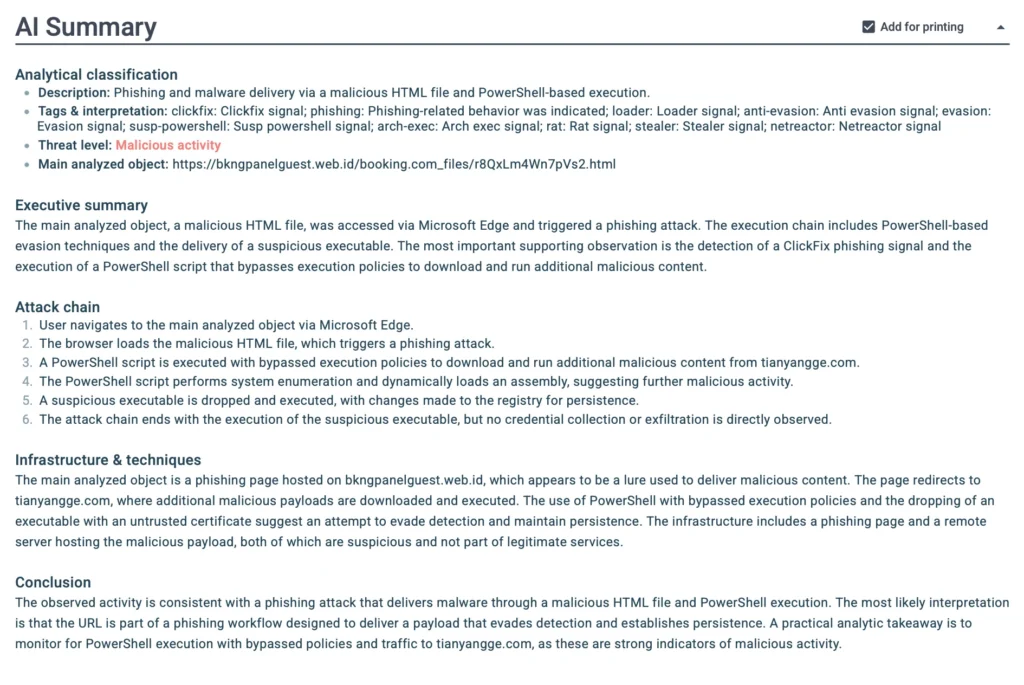
This reduced the need to interpret every technical detail manually and helped analysts reach decisions faster. The company recorded a significant reduction in Tier 1 escalations, while Tier 2 received fewer low-context cases.
“Cases that can be resolved at the first level no longer consume Tier 2 time. When escalation is necessary, senior analysts receive the relevant evidence instead of having to restart the investigation.”
Head of SOC, US automotive manufacturer
The change reduced duplicated work and made better use of specialist expertise. Senior analysts spent less time repeating initial validation and more time investigating complex or high-impact threats.
More supplier files were resolved at the right level the first time, helping investigation queues move faster and lowering the cost of each case.
Analyzing Hundreds of Files Without Adding Headcount
The company now analyzes hundreds of supplier files every week without hiring additional analysts.
For the business, this is one of the clearest returns from the new process. The manufacturer increased its triage and analysis capacity while keeping staffing costs stable.
Instead of treating headcount growth as the only solution to rising file volumes, the company gave its existing team a faster and more consistent way to detect malicious activity and reach verdicts.
The SOC now absorbs more supplier activity without creating the same increase in labor costs or investigation backlogs.
This also gives the company a more sustainable foundation for growth. As the vendor network expands or file volume rises, the security team has a triage process that can scale with it.
Improving MTTD and MTTR with 2x Faster Triage
The manufacturer achieved a 2x improvement in alert processing and threat analysis speed, contributing to lower mean time to detect and mean time to respond.
Suspicious supplier files moved through triage twice as fast. Analysts identified malicious behavior sooner, reached confirmed verdicts with less delay, and passed high-risk cases into response with clearer evidence already collected.
Legitimate submissions were also cleared faster, reducing the time business teams spent waiting for a security decision.
“We cut the time it takes to move from a suspicious supplier file to a clear decision in half. That gave the business faster answers and reduced the time potential threats remained unresolved.”
Head of SOC, US automotive manufacturer
This faster process also reduced the company’s exposure window. Analysts reached evidence-backed verdicts sooner without sacrificing investigation depth, helping the SOC protect operations while keeping supplier workflows moving.
| Before ANY.RUN | Result with ANY.RUN | Business Impact |
|---|---|---|
| No systematic process for analyzing vendor files | Hundreds of supplier files analyzed weekly | Greater triage capacity without additional hiring |
| No behavioral analysis layer in supplier file intake | Malicious behaviordetected through direct execution evidence | Higher detection rate and lower third-party exposure |
| Most suspicious submissions escalated by Tier 1 | Significant reduction in Tier 1 escalations | More senior analyst capacity for critical incidents |
| Slow, context-limited investigations | 2x faster alert processing and threat analysis | Improved MTTD and MTTR with a shorter exposure window |
A Practical Model for Manufacturing Leaders Managing Third-Party Risk
For manufacturing leaders, supplier security is not only a SOC issue. It affects operational continuity, staffing costs, executive accountability, and the company’s ability to grow without increasing exposure.
A scalable approach should combine consistent file validation, broader threat context, and measurable outcomes.
Turn Supplier File Intake into a Defined Risk Control
A consistent triage helps the SOC apply the same standard to files received from vendors and contractors.
With behavioral evidence from the Interactive Sandbox and additional context from Threat Intelligence, teams can replace inconsistent manual checks with a repeatable validation workflow.
For leadership, this creates clearer oversight of one of the company’s most exposed third-party risk channels.
Increase Capacity Without Matching Growth with Headcount
Faster verdicts and fewer unnecessary escalations allow the existing team to handle more supplier submissions.
ANY.RUN reduces duplicated work, protects senior analyst capacity, and helps the SOC process higher file volumes without expanding at the same rate.
The result is lower investigation cost and greater value from existing security resources.
Protect Operations Without Slowing Supplier Activity
Suspicious files can be analyzed in a controlled environment before they reach internal systems, while legitimate submissions move through review faster.
This helps reduce the risk of supplier-borne threats without creating unnecessary delays for manufacturing, procurement, engineering, or other teams that depend on third-party collaboration.
Connect Individual Submissions to Wider Exposure
A suspicious file may be only one part of a larger campaign.
ANY.RUN’s Threat Intelligence solutions help teams connect indicators to known infrastructure, related samples, active campaigns, and broader attacker activity.
This gives leadership a clearer view of whether the company is dealing with an isolated submission or wider exposure involving suppliers and other external partners.
Demonstrate Measurable Business Value
The strongest supplier security programs are measured by outcomes, not by the number of files processed.
With ANY.RUN, organizations can track improvements such as lower MTTD and MTTR, higher detection rates, fewer Tier 1 escalations, greater analysis capacity, and shorter exposure windows.
These results make it easier to show how supplier security investments reduce risk, avoid additional staffing costs, and support business growth.
Conclusion
For this US automotive manufacturer, supplier file intake had become both a security risk and a growing cost center. More than 200 vendors were sending files into the environment, while analysts lacked a consistent way to validate behavior, add threat context, and reach fast decisions.
With ANY.RUN, the company built a scalable triage process that now supports hundreds of supplier files every week without additional headcount. Threat analysis became 2x faster, MTTD and MTTR improved, detection increased, and fewer cases required Tier 2 escalation.
The result is a stronger security model for a complex supplier ecosystem: lower third-party exposure, better use of analyst time, and faster decisions that keep business operations moving.
About ANY.RUN
ANY.RUN, a leading provider of interactive malware analysis and threat intelligence solutions, helps SOC teams, MSSPs, and enterprises investigate cyber threats faster and make evidence-based security decisions.
Its cloud-based Interactive Sandbox enables teams to safely analyze suspicious files, URLs, and emails in real time, observe malicious behavior as it unfolds, and collect clear evidence for triage and response.
ANY.RUN’s Threat Intelligence solutions provide additional context around indicators, malicious infrastructure, emerging campaigns, and attacker activity. Together, these capabilities help organizations improve threat detection, reduce investigation time, and manage growing security demands without adding unnecessary operational costs.
The post Closing the Supplier Security Gap: How a US Manufacturer Cut Third-Party Risk and Doubled SOC Triage Speed appeared first on ANY.RUN’s Cybersecurity Blog.
ANY.RUN’s Cybersecurity Blog – Read More