How to Track Advanced Persistent Threats

Advanced persistent threats (APTs) stand out as one of the most formidable challenges for businesses in the cybersecurity landscape. These threats can cause irreparable damage, leading to financial losses, data breaches, and reputational harm. 

APTs are defined as sophisticated targeted attacks typically conducted by highly funded adversaries: national agencies, state-sponsored groups, organized crime groups, corporate espionage actors.  

What Are APTs 

The name speaks for itself, APTs are:   

  • Advanced: Having at hackers’ disposal the full (and ever-growing) arsenal of techniques and tools to get and maintain access to the target.  
  • Persistent: The aim is to keep long-term access to the targeted system or network. This involves constant improving and updating of the tools to evade detection.  
  • Threats: Such campaigns are intentionally malicious and inevitably harmful. They are backed by coordinated actions of skilled, motivated, organized, and well-resourced professionals.  

Why Are APTs a Significant Threat to Businesses 

APTs prefer to target large corporations, government entities, and critical infrastructure. Finance, manufacturing, healthcare, and energy are prime targets for APTs due to the high value of their assets, data and infrastructure. The consequences of a successful APT attack extend beyond financial loss and corporate damage — they can impact national security, cause market instability, disrupt economies, and put lives at risk. 
 
But no business, however modest-scale and unrelated to strategic industries, can consider itself safe:  

  • Small and medium companies still possess valuable assets, handle sensitive customer information, financial data, or intellectual property 
  • They are part of supply chains that can be disrupted by attacks 
  • A successful infiltration into their communications grants access to larger partners or clients. 
  • Along with all this, they have weaker security posture, invest less in cyber threat prevention. 

Detect Early, Defend Better: The Power of Threat Intelligence 

Threat intelligence is a pivotal element of an APT-resistant cybersecurity strategy. By gathering, analyzing, and applying intelligence on cyber threats, organizations can proactively detect and neutralize them before they escalate.  
 
TI provides: 

  • Early Detection: Identifying indicators of compromise (IOCs) before damage occurs. 
  • Behavioral Analysis: Understanding attacker tactics, techniques, and procedures (TTPs) to anticipate movements. 
  • Threat Hunting: Actively searching for hidden threats within the network. 
  • Stronger Security Posture: Defenses based on real-world threat insights. 
  • Incident Response Efficiency: Rapidly responding to and mitigating APT incidents. 

How Threat Intelligence Lookup Facilitates APT Reconnaissance 
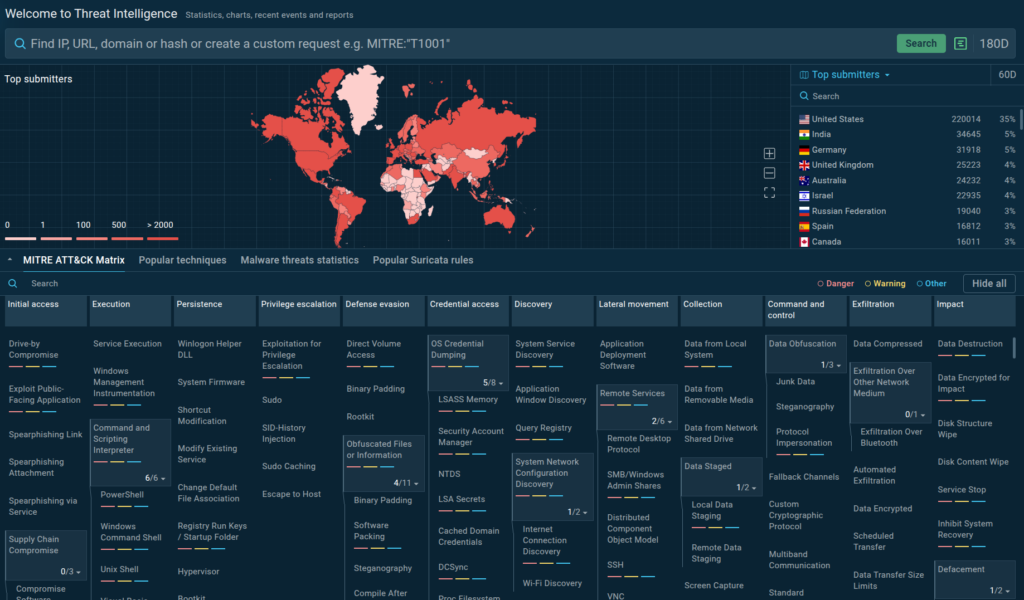
TI Lookup helps organizations enrich threat data on the latest cyber attacks

ANY.RUN’s Threat Intelligence Lookup is a solution fit for all these tasks: a state-of-the-art search engine for threat researchers and cybersecurity teams. It provides detailed insights into indicators of compromise (IOCs), malware behavior, and attack patterns.  
 
It supports over 40 search parameters to query a constantly updated database of threat data, collected from millions of public malware and phishing samples and manually analyzed by a team of threat analysts.  
 
For a business, it’s a source of actionable information for preventing, detecting and mitigating all sorts of cyberattacks up to APTs, thus avoiding operational disruptions, financial and reputational damages.  

Collect intelligence on active APTs
with ANY.RUN’s TI Lookup 


Get free requests to test it


How TI Lookup helps track APTs 

Wicked Panda APT: Closer Look at an Abused Registry Key 

A notorious Chinese APT group, APT41 aka Wicked Panda, employs a PowerShell-backdoor for compromising systems.

To maintain persistence, it adds its payload in Windows registry entry HKCUEnvironmentUserInitMprLogonScript which allows it to run malicious code automatically at each user login into the system. Besides, the hackers abuse a legitimate Microsoft’s forfiles.exe utility.  
 
This data is enough to combine a query for TI Lookup:
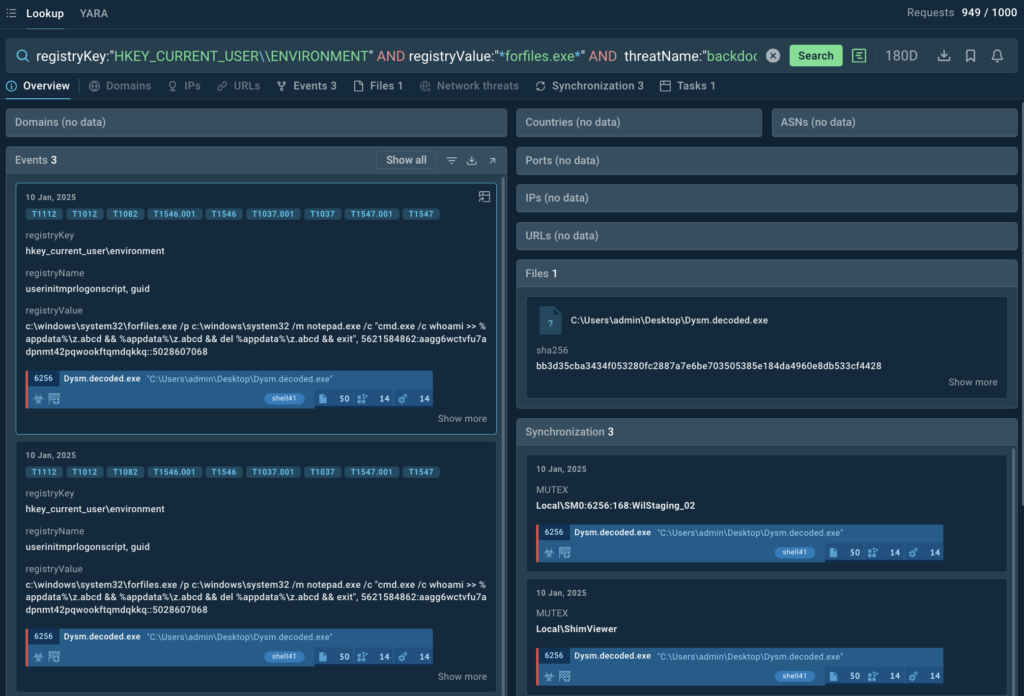
registryKey:”HKEY_CURRENT_USERENVIRONMENT” AND registryValue:”forfiles.exe” AND threatName:”backdoor” AND registryName:”USERINITMPRLOGONSCRIPT” 

IOC and event search by registry key and value 

From the search results, we can extract additional IOCs associated with such campaigns, like file hashes or mutexes, and use them for setting up threat detection and alerts.
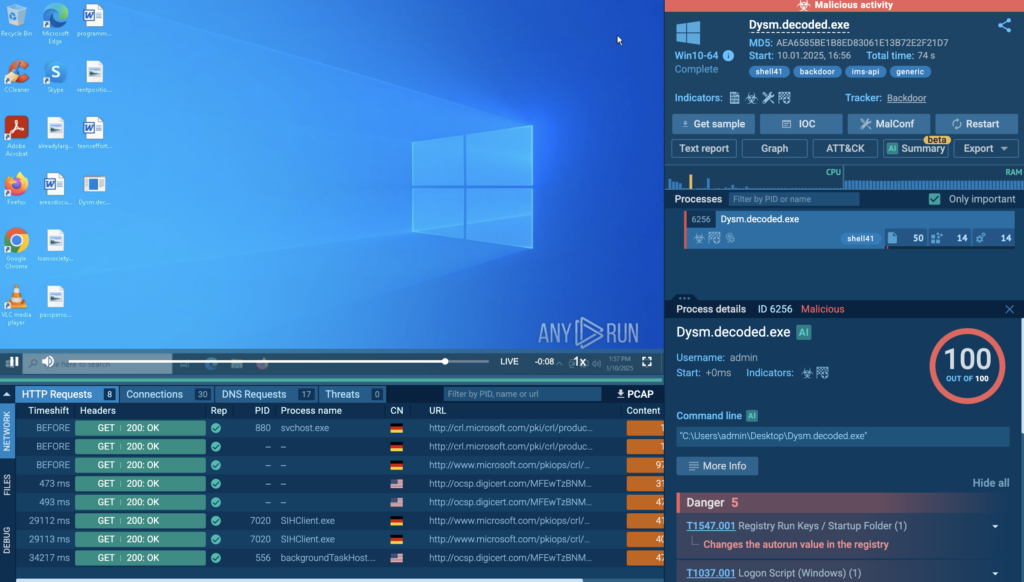
Sandbox session with an APT41 backdoor attack 

The Tasks tab shows recent sandbox sessions with analysis of the attack. The sessions can be viewed in ANY.RUN’s Interactive Sandbox to study TTPs and other components of the attack.

MuddyWater APT: Identifying a Backdoor via Mutexes 

Another example: MuddyWater APT group from Iran is known for using PackageManager and DocumentUpdater mutexes in their malware campaigns. The mutexes are generated by their BugSleep backdoor.  
 
The attack starts through a phishing email, BugSleep gets deployed, creates a mutex and decrypts its configuration, including the addresses of command-and-control servers. This behavior has been observed in MuddyWater campaigns targeting organizations in Israel and other countries. 
 
We can accommodate both mutexes into a TI Lookup search request:  
 
(syncObjectName:”PackageManager” or syncObjectName:”DocumentUpdater”) and syncObjectOperation:”Create” and threatName:”muddywater” 
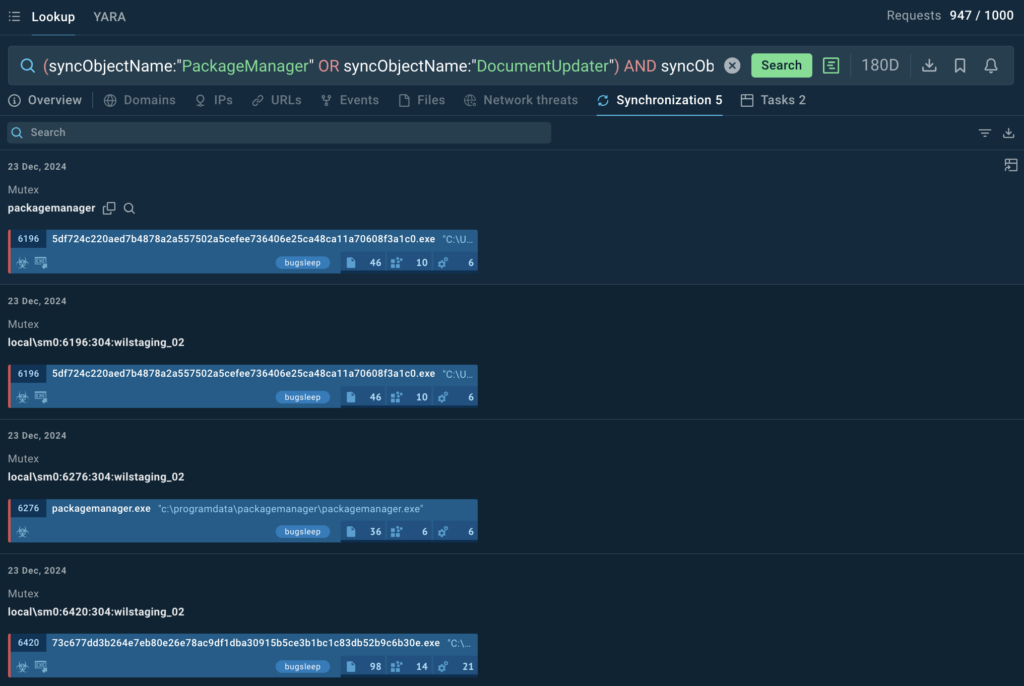
Mutex name search results in TI Lookup Synchronization tab 

Diving deeper in the search results, we can identify the actual samples that use this mutex.
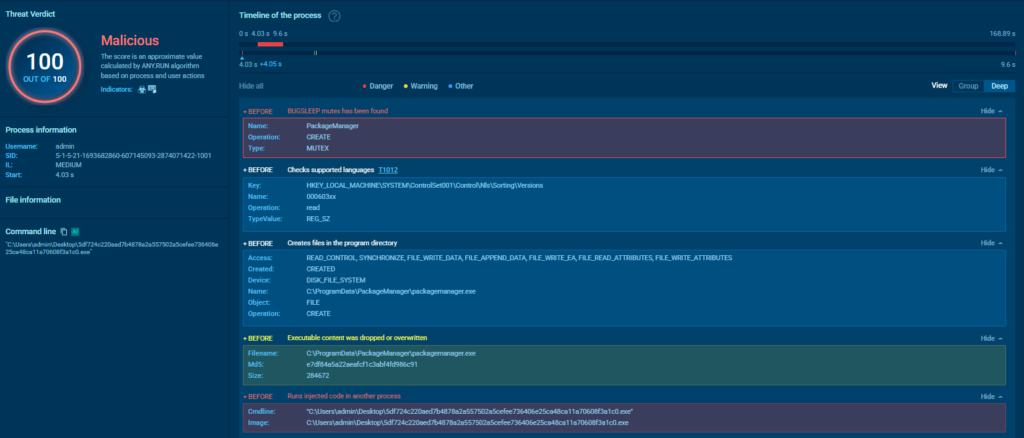
Bugsleep backdoor and its behavior demonstrated by the ANY.RUN Sandbox  

We can navigate to the sandbox sessions where these mutexes were used to explore the threat and its behavior in greater detail.


Enrich your threat knowledge with TI Lookup

Learn to Track Emerging Cyber Threats

Check out expert guide to collecting intelligence on emerging threats with TI Lookup


Lazarus Group: Following North Korea’s Biggest APT

Lazarus is one of the most active threats coming from North Korea. The group has been involved in many cyber attacks on both businesses and individuals. One of the recent examples involved conducting fake interviews with tech professionals to install malicious programs on their devices.

With TI Lookup, we can not only explore the most recent samples and collect indicators related to Lazarus but also subscribe to receive updates on specific queries.
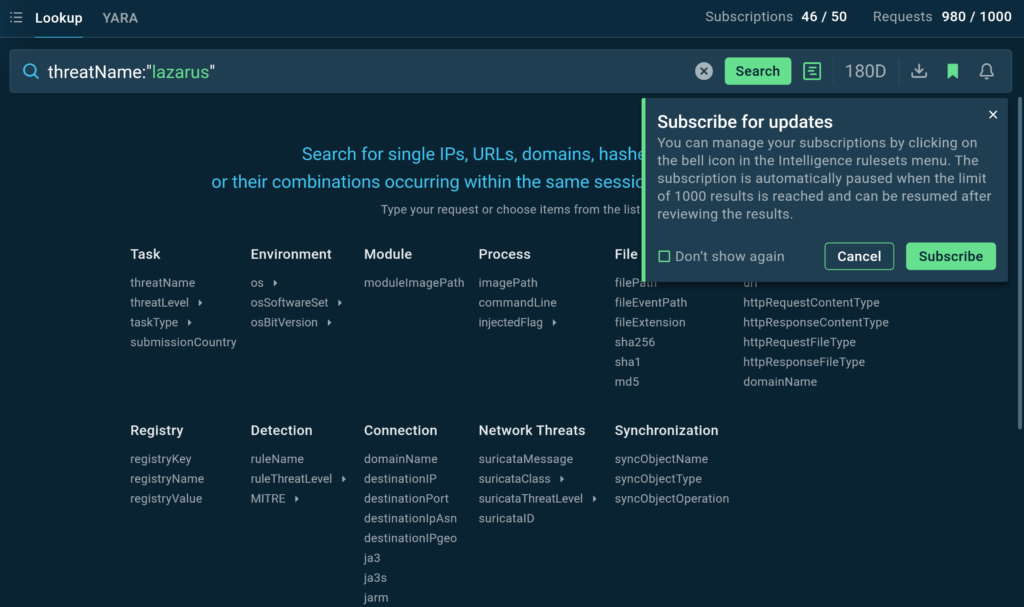
TI Lookup lets users subscribe to specific queries and receive updates on new results

Let’s use the simple query like threatName:”lazarus” and click the bell icon to subscribe to updates.
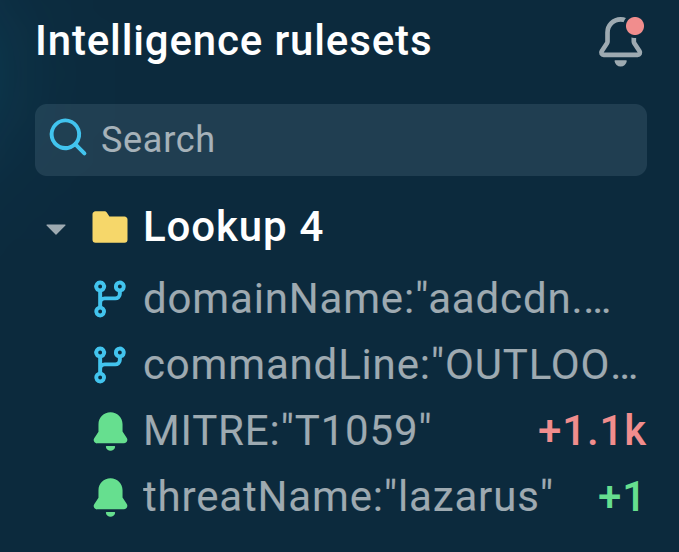
TI Lookup lists all of your subscriptions along with info on new results

As soon as new indicators or sandbox sessions relevant to the query appear in TI Lookup’s database, we will be notified about them.

Learn more about notifications in TI Lookup

Conclusion 

APTs represent a high level of cyber threat due to their strategic nature, the resources behind them, and their capability to adapt and evolve over time. Organizations, especially those in critical sectors or handling sensitive information, need robust cybersecurity strategies to defend against such threats. Threat intelligence is a cornerstone of such a strategy, and TI Lookup from ANY.RUN has proven itself as a comprehensive tool for fueling intelligence with fresh contextual data. 

About ANY.RUN

ANY.RUN helps more than 500,000 cybersecurity professionals worldwide. Our interactive sandbox simplifies malware analysis of threats that target both Windows and Linux systems. Our threat intelligence products, TI Lookup, YARA Search, and Feeds, help you find IOCs or files to learn more about the threats and respond to incidents faster.

Request free trial of ANY.RUN’s services → 

The post How to Track Advanced Persistent Threats appeared first on ANY.RUN’s Cybersecurity Blog.

ANY.RUN’s Cybersecurity Blog – ​Read More

Ivanti Patches Critical Flaws in Connect Secure and Policy Secure – Update Now

Ivanti has released security updates to address multiple security flaws impacting Connect Secure (ICS), Policy Secure (IPS), and Cloud Services Application (CSA) that could be exploited to achieve arbitrary code execution.
The list of vulnerabilities is below –

CVE-2024-38657 (CVSS score: 9.1) – External control of a file name in Ivanti Connect Secure before version 22.7R2.4 and Ivanti Policy

The Hacker News – ​Read More

Microsoft Patch Tuesday, February 2025 Edition

Microsoft today issued security updates to fix at least 56 vulnerabilities in its Windows operating systems and supported software, including two zero-day flaws that are being actively exploited.

All supported Windows operating systems will receive an update this month for a buffer overflow vulnerability that carries the catchy name CVE-2025-21418. This patch should be a priority for enterprises, as Microsoft says it is being exploited, has low attack complexity, and no requirements for user interaction.

Tenable senior staff research engineer Satnam Narang noted that since 2022, there have been nine elevation of privilege vulnerabilities in this same Windows component — three each year — including one in 2024 that was exploited in the wild as a zero day (CVE-2024-38193).

“CVE-2024-38193 was exploited by the North Korean APT group known as Lazarus Group to implant a new version of the FudModule rootkit in order to maintain persistence and stealth on compromised systems,” Narang said. “At this time, it is unclear if CVE-2025-21418 was also exploited by Lazarus Group.”

The other zero-day, CVE-2025-21391, is an elevation of privilege vulnerability in Windows Storage that could be used to delete files on a targeted system. Microsoft’s advisory on this bug references something called “CWE-59: Improper Link Resolution Before File Access,” says no user interaction is required, and that the attack complexity is low.

Adam Barnett, lead software engineer at Rapid7, said although the advisory provides scant detail, and even offers some vague reassurance that ‘an attacker would only be able to delete targeted files on a system,’ it would be a mistake to assume that the impact of deleting arbitrary files would be limited to data loss or denial of service.

“As long ago as 2022, ZDI researchers set out how a motivated attacker could parlay arbitrary file deletion into full SYSTEM access using techniques which also involve creative misuse of symbolic links,”Barnett wrote.

One vulnerability patched today that was publicly disclosed earlier is CVE-2025-21377, another weakness that could allow an attacker to elevate their privileges on a vulnerable Windows system. Specifically, this is yet another Windows flaw that can be used to steal NTLMv2 hashes — essentially allowing an attacker to authenticate as the targeted user without having to log in.

According to Microsoft, minimal user interaction with a malicious file is needed to exploit CVE-2025-21377, including selecting, inspecting or “performing an action other than opening or executing the file.”

“This trademark linguistic ducking and weaving may be Microsoft’s way of saying ‘if we told you any more, we’d give the game away,’” Barnett said. “Accordingly, Microsoft assesses exploitation as more likely.”

The SANS Internet Storm Center has a handy list of all the Microsoft patches released today, indexed by severity. Windows enterprise administrators would do well to keep an eye on askwoody.com, which often has the scoop on any patches causing problems.

It’s getting harder to buy Windows software that isn’t also bundled with Microsoft’s flagship Copilot artificial intelligence (AI) feature. Last month Microsoft started bundling Copilot with Microsoft Office 365, which Redmond has since rebranded as “Microsoft 365 Copilot.” Ostensibly to offset the costs of its substantial AI investments, Microsoft also jacked up prices from 22 percent to 30 percent for upcoming license renewals and new subscribers.

Office-watch.com writes that existing Office 365 users who are paying an annual cloud license do have the option of “Microsoft 365 Classic,” an AI-free subscription at a lower price, but that many customers are not offered the option until they attempt to cancel their existing Office subscription.

In other security patch news, Apple has shipped iOS 18.3.1, which fixes a zero day vulnerability (CVE-2025-24200) that is showing up in attacks.

Adobe has issued security updates that fix a total of 45 vulnerabilities across InDesign, Commerce, Substance 3D Stager, InCopy, Illustrator, Substance 3D Designer and Photoshop Elements.

Chris Goettl at Ivanti notes that Google Chrome is shipping an update today which will trigger updates for Chromium based browsers including Microsoft Edge, so be on the lookout for Chrome and Edge updates as we proceed through the week.

Krebs on Security – ​Read More

India’s Cybercrime Problems Grow as Nation Digitizes

More than half of attacks on Indian businesses come from outside the country, while 45% of those targeting consumers come from Cambodia, Myanmar, and Laos.

darkreading – ​Read More

This Ad-Tech Company Is Powering Surveillance of US Military Personnel

In a letter to a US senator, a Florida-based data broker says it obtained sensitive data on US military members in Germany from a Lithuanian firm, revealing the global nature of online ad surveillance.

Security Latest – ​Read More

Anthropic CEO Dario Amodei warns: AI will match ‘country of geniuses’ by 2026

Credit: VentureBeat made with Midjourney


Anthropic CEO Dario Amodei warns AI will reach genius-level capabilities by 2026, calling Paris Summit a “missed opportunity” as U.S. and European leaders clash over regulation of rapidly advancing artificial intelligence systems.Read More

Security News | VentureBeat – ​Read More

Cybercrime Threatens National Security, Google Threat Intel Team Says

On the eve of the Munich Security Conference, Google argues that the cybercriminal threat should be treated as a national security threat like state-backed hacking groups.

The post Cybercrime Threatens National Security, Google Threat Intel Team Says appeared first on SecurityWeek.

SecurityWeek – ​Read More

Microsoft’s February Patch a Lighter Lift Than January’s

But there’s plenty in it — including two zero-days — that need immediate attention.

darkreading – ​Read More

Arizona woman pleads guilty to running laptop farm for N. Korean IT workers, faces 9-year sentence

A U.S. citizen pleaded guiltyTuesday to playing a role in a wide-ranging scheme that allowed multiple North Korean nationals to collect paychecks from more than 300 U.S. companies.

The Record from Recorded Future News – ​Read More

Apple Releases Urgent Patch for USB Vulnerability

The vulnerability could allow a threat actor to disable the security feature on a locked device and gain access to user data.

darkreading – ​Read More