Salt Typhoon Targeting Old Cisco Vulnerabilities in Fresh Telecom Hacks

China-linked APT Salt Typhoon has been exploiting known vulnerabilities in Cisco devices in attacks on telecom providers in the US and abroad.

The post Salt Typhoon Targeting Old Cisco Vulnerabilities in Fresh Telecom Hacks appeared first on SecurityWeek.

SecurityWeek – ​Read More

Germany is Strengthening Cybersecurity with Federal-State Collaboration and Digital Violence Prevention 

Cybersecurity

BSI Expands Cybersecurity Cooperation with Hamburg 

Germany continues to strengthen its cybersecurity framework as the Federal Office for Information Security (BSI) and the Free and Hanseatic City of Hamburg formalize their collaboration. The agreement, signed on February 7, at Hamburg City Hall, establishes a structured approach to cyber threat intelligence sharing, incident response coordination, and awareness initiatives for public sector employees. 

BSI Vice President Dr. Gerhard Schabhüser called for the urgency of strengthening cybersecurity across federal and state levels: 

“In view of the worrying threat situation in cyberspace, Germany must become a cyber nation. State administrations and municipal institutions face cyberattacks daily. Attacks on critical infrastructure threaten social order. Germany is a target of cyber sabotage and espionage. Our goal is to enhance cybersecurity nationwide. To achieve this, we must collaborate at both federal and state levels.” 

This partnership is part of a broader federal initiative, with BSI having previously signed cooperation agreements with Saxony, Saxony-Anhalt, Lower Saxony, Hesse, Bremen, Rhineland-Palatinate, and Saarland. These agreements provide a constitutional framework for joint cyber defense efforts, strategic advisory services, and rapid response measures following cyber incidents. 

With cyber threats growing in complexity, state-level cooperation plays a vital role in reinforcing Germany’s cybersecurity resilience, ensuring government agencies, public sector institutions, and critical infrastructure operators have the necessary tools and expertise to prevent, detect, and mitigate cyber threats effectively. 

Addressing Digital Violence 

Days later, on February 11, BSI hosted “BSI in Dialogue: Cybersecurity and Digital Violence” in Berlin, bringing together representatives from politics, industry, academia, and civil society to address the growing risks associated with digital violence in an increasingly interconnected world. 

While cybercriminals typically operate remotely, digital violence introduces a new layer of cyber threats, where attackers exploit personal relationships, home technologies, and social connections to manipulate, monitor, or harm individuals. This includes: 

  • Unauthorized access to smart home devices for spying, stalking, or harassment. 
  • Misuse of digital vulnerabilities to monitor victims or leak personal data. 
  • Exploitation of location tracking features to stalk or control individuals. 

The event initiated several working groups to develop strategic responses to digital violence and was mainly focused on: 

Defining Digital Violence 

  • International research has varied definitions of digital violence, making it difficult to establish a legal and policy framework in Germany. 
  • Experts emphasized the need for a standardized definition to develop measurement tools and track digital violence cases more effectively. 

Technical Support for Victims 

  • The WEISSER RING initiative presented concepts for a technical contact point to assist victims. 
  • Discussions concluded that victims and advisors need greater technical expertise to counter digital violence effectively. 

Corporate Responsibility 

  • Businesses were encouraged to implement protective policies for employees and integrate security-by-design principles in their products to prevent misuse. 
  • Manufacturers and service providers must take accountability for securing digital products against exploitation. 

Empowerment Through Cybersecurity Education 

  • Widespread digital literacy programs can help individuals identify and mitigate digital threats. 
  • BSI-led initiatives will focus on consumer awareness, IT security training, and response strategies for digital violence victims. 

Schabhüser pressed on the human aspect of cybersecurity during the meet: 

“People can only move safely in a digitalized environment if they recognize the opportunities and risks of digital technologies and can overcome challenges through their own actions.” 

BSI’s dual efforts in federal-state cybersecurity collaboration and digital violence prevention reflect Germany’s proactive stance against emerging cyber threats. As cybercriminals adapt and evolve their tactics, both government agencies and individual users must be equipped with the necessary knowledge, tools, and policies to fortify digital resilience. 

Conclusion 

Through structured cooperation, regulatory frameworks, and public awareness programs, BSI aims to build a secure and cyber-resilient society, ensuring state institutions, businesses, and individuals can operate safely in an increasingly digital world. 

References: 

The post Germany is Strengthening Cybersecurity with Federal-State Collaboration and Digital Violence Prevention  appeared first on Cyble.

Blog – Cyble – ​Read More

Hackers Exploit Palo Alto Firewall Vulnerability Day After Disclosure

Attempts to exploit CVE-2024-0108, an authentication bypass vulnerability in Palo Alto firewalls, started one day after disclosure. 

The post Hackers Exploit Palo Alto Firewall Vulnerability Day After Disclosure appeared first on SecurityWeek.

SecurityWeek – ​Read More

FBI, CISA Urge Memory-Safe Practices for Software Development 

Software Development 

In a strongly worded advisory, the FBI and the U.S. Cybersecurity and Infrastructure Security Agency (CISA) have urged software developers to cease unsafe development practices that lead to “unforgivable” buffer overflow vulnerabilities. 

“Despite the existence of well-documented, effective mitigations for buffer overflow vulnerabilities, many manufacturers continue to use unsafe software development practices that allow these vulnerabilities to persist,” the agencies said in the February 12 Secure By Design alert. “For these reasons—as well as the damage exploitation of these defects can cause—CISA, FBI, and others designate buffer overflow vulnerabilities as unforgivable defects.” 

The agencies said threat actors leverage buffer overflow vulnerabilities to gain initial access to networks, thus making them a critical point for preventing attacks. 

We’ll look at the prevalence of buffer overflow vulnerabilities, some examples cited by CISA and the FBI, and guidance for secure development and use of memory-safe programming languages. 

Buffer Overflow Vulnerabilities: Prevalence and Examples 

The FBI-CISA guidance specifically mentions the common software weaknesses CWE-119 (Improper Restriction of Operations within the Bounds of a Memory Buffer), along with stack-based buffer overflows (CWE-121) and heap-based buffer overflows (CWE-122). 

The phrase “buffer overflow” occurs in 67 of the 1270 vulnerabilities in CISA’s Known Exploited Vulnerabilities (KEV) catalog, or 5.28% of the KEV database. The words “buffer” and “overflow” occur in 84 of the KEV vulnerabilities (6.6%). 

CISA and the FBI cited six examples of buffer overflow vulnerabilities in IT products: 

  • CVE-2025-21333, a Windows Hyper-V NT Kernel Integration VSP Elevation of Privilege vulnerability 
  • CVE-2025-0282, a stack-based buffer overflow in Ivanti Connect Secure before version 22.7R2.5, Ivanti Policy Secure before version 22.7R1.2, and Ivanti Neurons for ZTA gateways before version 22.7R2.3 
  • CVE-2024-49138, a Windows Common Log File System Driver Elevation of Privilege vulnerability 
  • CVE-2024-38812, a VMware vCenter Server heap-overflow vulnerability 
  • CVE-2023-6549, an Improper Restriction of Operations within the Bounds of a Memory Buffer vulnerability in Citrix Systems’ NetScaler ADC and NetScaler Gateway 
  • CVE-2022-0185, a heap-based buffer overflow flaw in the way the legacy_parse_param function in the Filesystem Context functionality of the Linux kernel verified the supplied parameters length (the CWE in this case was CWE-190, Integer Overflow or Wraparound). 

“These vulnerabilities can lead to data corruption, sensitive data exposure, program crashes, and unauthorized code execution,” the agency guidance said. “Threat actors frequently exploit these vulnerabilities to gain initial access to an organization’s network and then move laterally to the wider network.” 

They added that “the use of unsafe software development practices that allow the persistence of buffer overflow vulnerabilities—especially the use of memory-unsafe programming languages—poses unacceptable risk to our national and economic security.” 

Memory-Safe Software Development 

The agencies urged manufacturers “to take immediate action to prevent these vulnerabilities from being introduced into their products. … Software manufacturer senior executives and business leaders should ask their product and development teams to document past buffer overflow vulnerabilities and how they are working to eliminate this class of defect.” 

Customers should hold manufacturers accountable by requesting a Software Bill of Materials (SBOM) and a secure software development attestation, the FBI and CISA said. 

For development teams, the agencies recommended the following secure by design practices to prevent buffer overflow vulnerabilities: 

  • Memory-safe languages should be used whenever possible “to shift the burden of memory management from the developer to the programming language’s built-in safety features.” They added that developers should never disable or override memory safety guarantees in languages when it’s possible to do so, and that using a memory-safe language in one part of a software package will not fix memory-unsafe code in other libraries. 

  • A phased transition plan for implementing memory-safe languages should be used for upgrading existing codebases while using technologies to limit memory vulnerabilities in existing code. “Ideally, this plan should include using memory-safe languages to develop new code and—over time and when feasible—transition their software’s most highly privileged/exposed code to memory-safe languages,” the agencies said. 

  • Enable compiler flags that implement compile time and runtime protections against buffer overflows to the extent that application performance allows, and “implement canaries that alert if an overflow occurs.” 

  • Conduct unit tests with an instrumented toolchain such as AddressSanitizer and MemorySanitizer that checks source code for buffer overflows and other memory safety issues. 

  • Perform adversarial product testing that includes static analysis, fuzzing, and manual reviews to ensure code safety and quality throughout the development lifecycle. 

  • Publish amemory-safety roadmap that outlines plans to develop new products with memory-safe languages and to migrate older ones based on risk. 

  • Conduct root cause analysis of past vulnerabilities, including buffer overflows,to identify patterns. “Where possible, take actions to eliminate entire classes of vulnerabilities across products, rather than the superficial causes,” the agencies said. 

The alert said eliminating buffer overflow vulnerabilities “can help reduce the prevalence of other memory safety issues, such as format string, off-by-one, and use-after-free vulnerabilities.” 

Conclusion 

As an initial entry point for attackers into a network, the importance of buffer overflow vulnerability prevention can’t be overstated. Development teams would be wise to implement CISA and the FBI’s advice to the maximum extent possible. 

Customers also have a role to play by demanding memory-safe documentation from suppliers. But they also shouldn’t neglect basic cybersecurity practices for the eventual vulnerabilities that will slip past even the most vigilant development teams. Zero trust, risk-based vulnerability management, segmentation, tamper-proof backups and network and endpoint monitoring are all critically important practices for limiting the damage from any cyberattacks that do occur. 

The post FBI, CISA Urge Memory-Safe Practices for Software Development  appeared first on Cyble.

Blog – Cyble – ​Read More

PostgreSQL Vulnerability Exploited Alongside BeyondTrust Zero-Day in Targeted Attacks

Threat actors who were behind the exploitation of a zero-day vulnerability in BeyondTrust Privileged Remote Access (PRA) and Remote Support (RS) products in December 2024 likely also exploited a previously unknown SQL injection flaw in PostgreSQL, according to findings from Rapid7.
The vulnerability, tracked as CVE-2025-1094 (CVSS score: 8.1), affects the PostgreSQL interactive tool psql.
“An

The Hacker News – ​Read More

Roundtable: Is DOGE Flouting Cybersecurity for US Data?

Cybersecurity experts weigh in on the red flags flying around the new Department of Government Efficiency’s handling of the mountains of US data it now has access to, potentially without basic information security protections in place.

darkreading – ​Read More

Microsoft Uncovers ‘BadPilot’ Campaign as Seashell Blizzard Targets US and UK

Russian GRU-linked hackers exploit known software flaws to breach critical networks worldwide, targeting the United States and the…

Hackread – Latest Cybersecurity, Tech, Crypto & Hacking News – ​Read More

Chinese APT ‘Emperor Dragonfly’ Moonlights With Ransomware

Pivoting from prior cyber espionage, the threat group deployed its backdoor tool set to ultimately push out RA World malware, demanding $2 million from its victim.

darkreading – ​Read More

Nearly a Year Later, Mozilla is Still Promoting OneRep

In mid-March 2024, KrebsOnSecurity revealed that the founder of the personal data removal service Onerep also founded dozens of people-search companies. Shortly after that investigation was published, Mozilla said it would stop bundling Onerep with the Firefox browser and wind down its partnership with the company. But nearly a year later, Mozilla is still promoting it to Firefox users.

Mozilla offers Onerep to Firefox users on a subscription basis as part of Mozilla Monitor Plus. Launched in 2018 under the name Firefox Monitor, Mozilla Monitor also checks data from the website Have I Been Pwned? to let users know when their email addresses or password are leaked in data breaches.

The ink on that partnership agreement had barely dried before KrebsOnSecurity published a story showing that Onerep’s Belarusian CEO and founder Dimitiri Shelest launched dozens of people-search services since 2010, including a still-active data broker called Nuwber that sells background reports on people. This seemed to contradict Onerep’s stated motto, “We believe that no one should compromise personal online security and get a profit from it.”

Shelest released a lengthy statement (PDF) wherein he acknowledged maintaining an ownership stake in Nuwber, a consumer data broker he founded in 2015 — around the same time he started Onerep.
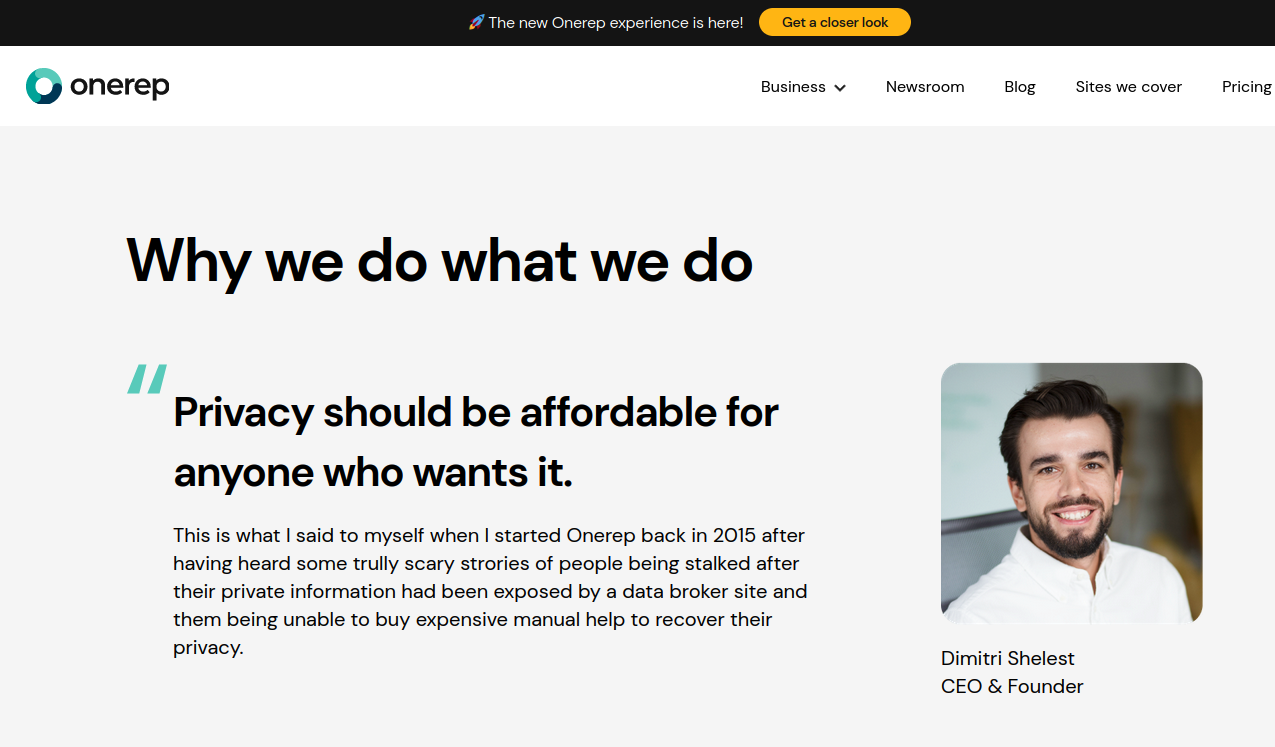
Onerep.com CEO and founder Dimitri Shelest, as pictured on the “about” page of onerep.com.

Shelest maintained that Nuwber has “zero cross-over or information-sharing with Onerep,” and said any other old domains that may be found and associated with his name are no longer being operated by him.

“I get it,” Shelest wrote. “My affiliation with a people search business may look odd from the outside. In truth, if I hadn’t taken that initial path with a deep dive into how people search sites work, Onerep wouldn’t have the best tech and team in the space. Still, I now appreciate that we did not make this more clear in the past and I’m aiming to do better in the future.”

When asked to comment on the findings, Mozilla said then that although customer data was never at risk, the outside financial interests and activities of Onerep’s CEO did not align with their values.

“We’re working now to solidify a transition plan that will provide customers with a seamless experience and will continue to put their interests first,” Mozilla said.

In October 2024, Mozilla published a statement saying the search for a different provider was taking longer than anticipated.

“While we continue to evaluate vendors, finding a technically excellent and values-aligned partner takes time,” Mozilla wrote. “While we continue this search, Onerep will remain the backend provider, ensuring that we can maintain uninterrupted services while we continue evaluating new potential partners that align more closely with Mozilla’s values and user expectations. We are conducting thorough diligence to find the right vendor.”

Asked for an update, Mozilla said the search for a replacement partner continues.

“The work’s ongoing but we haven’t found the right alternative yet,” Mozilla said in an emailed statement. “Our customers’ data remains safe, and since the product provides a lot of value to our subscribers, we’ll continue to offer it during this process.”

It’s a win-win for Mozilla that they’ve received accolades for their principled response while continuing to partner with Onerep almost a year later. But if it takes so long to find a suitable replacement, what does that say about the personal data removal industry itself?

Onerep appears to be working in partnership with another problematic people-search service: Radaris, which has a history of ignoring opt-out requests or failing to honor them. A week before breaking the story about Onerep, KrebsOnSecurity published research showing the co-founders of Radaris were two native Russian brothers who’d built a vast network of affiliate marketing programs and consumer data broker services.

Lawyers for the Radaris co-founders threatened to sue KrebsOnSecurity unless that story was retracted in full, claiming the founders were in fact Ukrainian and that our reporting had defamed the brothers by associating them with the actions of Radaris. Instead, we published a follow-up investigation which showed that not only did the brothers from Russia create Radaris, for many years they issued press releases quoting a fictitious CEO seeking money from investors.

Several readers have shared emails they received from Radaris after attempting to remove their personal data, and those messages show Radaris has been promoting Onerep.
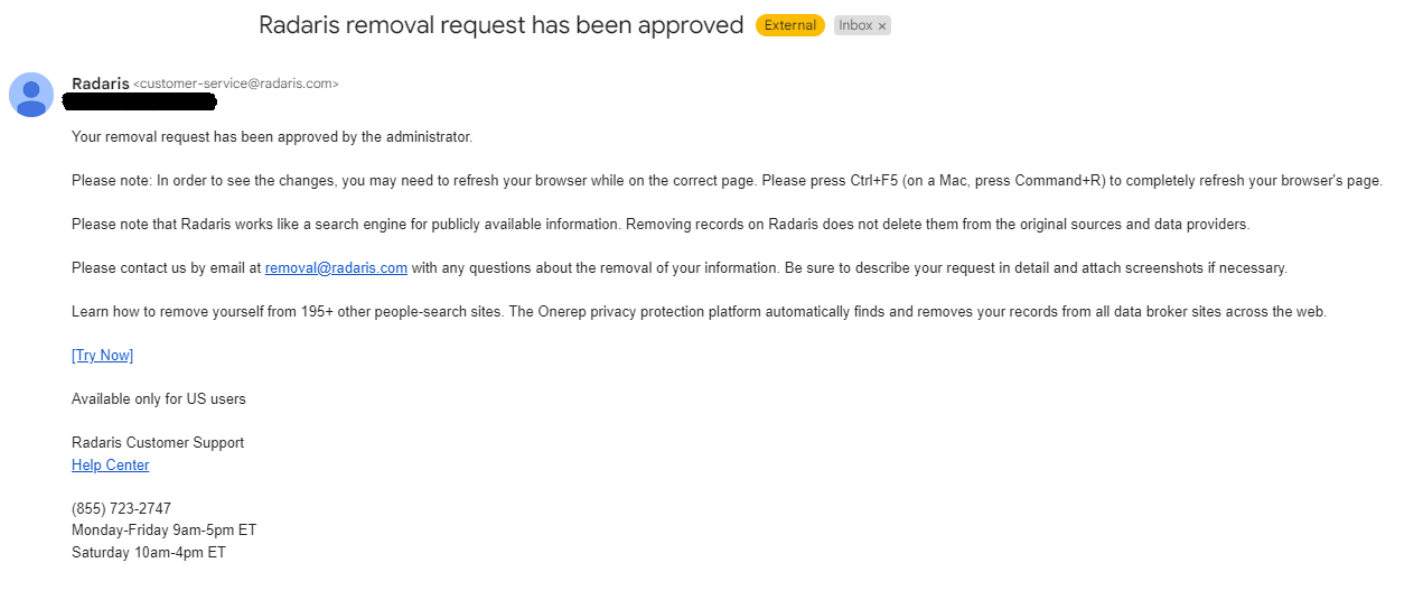
An email from Radaris promoting Onerep.

Krebs on Security – ​Read More

Google Hub in Poland to Develop AI Use in Energy and Cybersecurity Sectors

Poland is being targeted by various forms of cyberattacks and sabotage actions believed to be sponsored by Russia.

The post Google Hub in Poland to Develop AI Use in Energy and Cybersecurity Sectors appeared first on SecurityWeek.

SecurityWeek – ​Read More