Users who are on the lookout for popular games were lured into downloading trojanized installers that led to the deployment of a cryptocurrency miner on compromised Windows hosts.
The large-scale activity has been codenamed StaryDobry by Russian cybersecurity company Kaspersky, which first detected it on December 31, 2024. It lasted for a month.
Targets of the campaign include individuals and
https://www.backbox.org/wp-content/uploads/2018/09/website_backbox_text_black.png00adminhttps://www.backbox.org/wp-content/uploads/2018/09/website_backbox_text_black.pngadmin2025-02-19 11:06:522025-02-19 11:06:52How Russian Hackers Are Exploiting Signal ‘Linked Devices’ Feature for Real-Time Spying
Google warns that hackers tied to Russia are tricking Ukrainian soldiers with fake QR codes for Signal group invites that let spies steal their messages. Signal has pushed out new safeguards.
https://www.backbox.org/wp-content/uploads/2018/09/website_backbox_text_black.png00adminhttps://www.backbox.org/wp-content/uploads/2018/09/website_backbox_text_black.pngadmin2025-02-19 11:06:512025-02-19 11:06:51A Signal Update Fends Off a Phishing Technique Used in Russian Espionage
Phishing kits have invested greatly in the popularity of phishing. They drop the entry threshold for cybercriminals enabling even low-skilled hackers to conduct successful attacks.
In general, a phishing kit is a set of tools for creating convincing fake webpages, sites, or emails that trick users into divulging sensitive information like passwords or credit card credentials. Security specialists should never underestimate this type of malware and fail to be ready to counter its users.
What Phishkits are made of
These ready-to-use packages can be basic, with some pre-written code and website and email templates, and they can be advanced phishing-as-a-service (PHaaS) kits that offer more sophisticated and customizable features. These may even contain automated updates or encryption features.
Data harvesting scripts that capture input in webpage forms
Automated deployment tools for quick setup
Bypass techniques such as reverse proxies that intercept multi-factor authentication
Server-side components that manage the data collected from victims
Some notable Phishkits
16Shop: targeted Apple, PayPal, and Amazon users and was distributed as a subscription service.
Evilginx2: a framework to intercept authentication tokens that helped to bypass MFA.
BulletProofLink: a PHaaS platform that offered pre-hosted phishing pages and even reused stolen credentials to maximize profit.
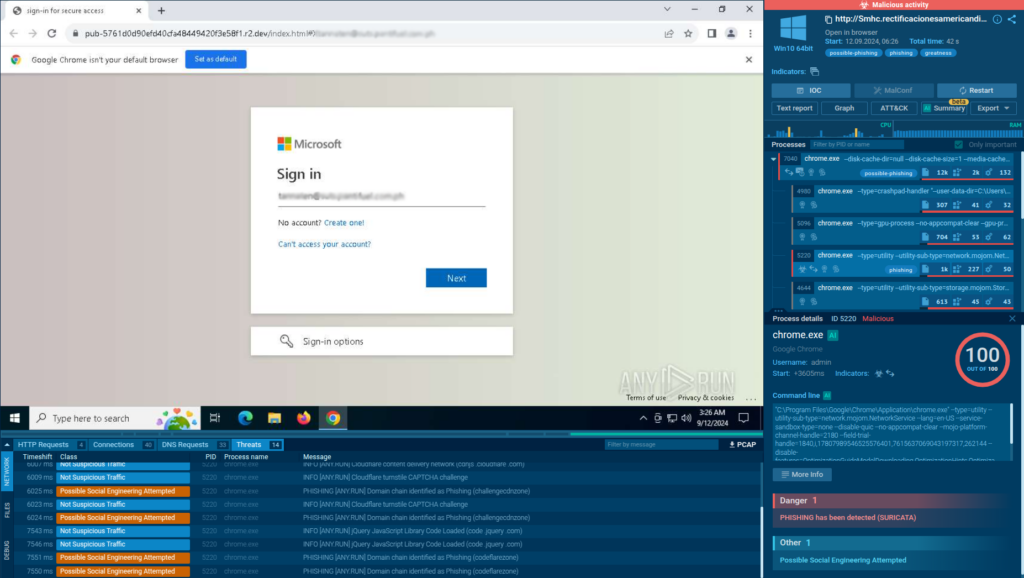
Example of a Greatness phishkit attack analyzed in ANY.RUN’s Interactive Sandbox
Greatness: targets Microsoft 365 users and can dynamically generate fake login pages customized for the victim.
GoPhish: an open-source framework meant for businesses to test their exposure to phishing by imitating attacks but also used maliciously.
King Phisher: offers advanced features like campaign management and cloning of websites.
Blitz: known for its simplicity and quick creation of phishing webpages.
Why Phishkits are a serious issue for businesses
Phishing kits are employed to attack both individuals and organizations, but they represent a specific threat to businesses by inviting wider audience of would-be hackers to the industry, multiplying risks and providing an increased workload to security systems.
Besides, phishing kit attacks make it easier to turn any employee into a soft spot of the cyber security perimeter. Even targeted at people, such attacks are a headache for SOC teams.
The features of phishkits that pose increased risks for organizations are:
Scalability: They allow attackers to automate and run phishing campaigns against thousands of employees simultaneously.
MFA Bypass: Modern phishkits integrate Adversary-in-the-Middle (AiTM) techniques to steal session cookies, bypassing multi-factor authentication.
Brand Abuse & Reputation Damage: Phishing pages tend to impersonate well-known brands, leading to loss of their customer trust when credentials are stolen.
Supply Chain Attacks: Phishkits can be used to target third-party vendors and gain access to corporate networks via compromised partners.
Defusing Phishkits with Threat Intelligence
Cyber threat intelligence has long proven useful in countering phishkit-based attacks. It involves gathering, analyzing, and acting upon information about current and emerging threats. For countering phishkits, it enforces:
Early detection: TI helps to collect the indicators of compromise associated with the use of certain phishkits and set up network monitoring for detecting the elements of phishkit infrastructure.
Behavioral Analys: TI is used to analyze patterns and behaviors of phishing campaigns, to identify new kits or variations of known ones before they cause harm.
Proactive Blocking: Intelligence feeds are used to update security systems like firewalls, email gateways, or intrusion detection systems to block known malicious domains or IPs.
Employee Training: By helping to understand phishkits’ anatomy and behavour, TI can facilitate realistic phishing simulations based on actual threats, training staff to recognize and report phishing attempts.
Vulnerability Management: Seeing what types of phishkits are targeting specific sectors or technologies, organizations prioritize patching vulnerabilities or enhance security measures where they are most needed.
How to Track and Identify Phishing Kit Attacks with TI Lookup
TI Lookup lets you identify and investigate phishkit attacks
Threat Intelligence Lookup from ANY.RUN provides access to an extensive database of the latest threat data extracted from millions of public sandbox sessions.
It allows analysts to conduct targeted indicator searches with over 40 different parameters, from IPs and hashes to mutexes and registry keys, to enrich their existing intel on malware and phishing attacks.
With TI Lookup, users can collect as well as pin their existing indicators to specific cyber threats. Each indicator in TI Lookup can be observed as part of wider context
Streamlined Access to Threat Information: Simplifies and speeds up the process of finding threat-related information, making it more convenient and efficient.
Detailed Insights into Attacks: Provides detailed information on attacker methods, helping to determine the most effective response measures. Deep analysis makes the actions of analysts more precise and effective.
Reduced Mean Time to Respond (MTTR): Offers quick access to key threat information, enabling analysts to make swift decisions.
Increased Detection and Response Speed: Ensures data is up-to-date, helping businesses improve the speed of detecting and responding to new threats.
Collect intelligence on phishkit attacks with ANY.RUN’s TI Lookup
1. Collecting Intel on Tycoon2FA Phishkit Abusing Cloudflare Workers
Tycoon2FA is a phishkit that has been offered as a service to cyber criminals since 2023. This threat’s specialty is adversary-in-the-middle attacks that make it possible to not only steal victims’ login credentials but also bypass two-factor authentication (2FA).
Tycon2FA operators make extensive use of Cloudflare Workers and Cloudflare Pages for hosting fake login forms that are abused for stealing personal data.
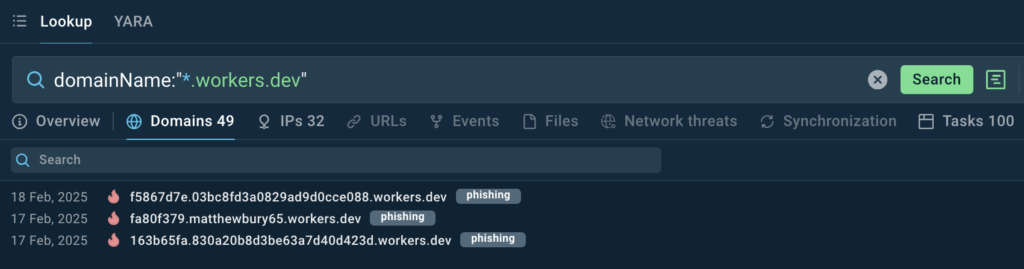
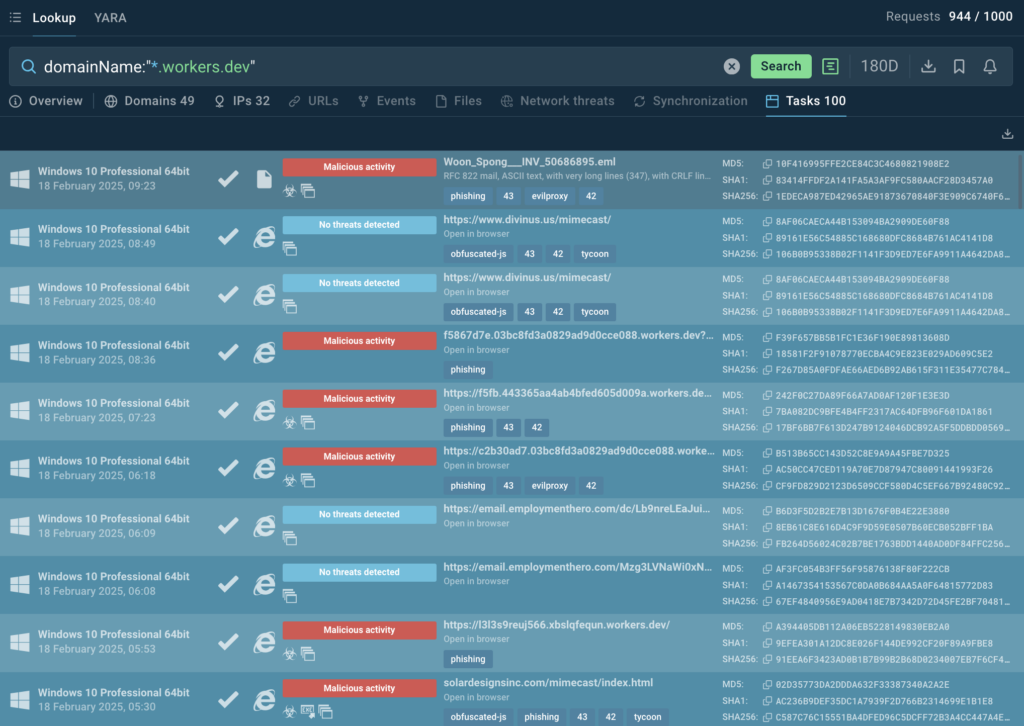
With TI Lookup, we can collect the latest example of domains utilized for Tycoon2FA attacks using the following query:
Use wildcards like the asterisk in TI Lookup for more flexible searches
TI Lookup provides 49 domains, with some of them being labeled with the “phishing” tag. At this point, users can collect these indicators to enrich their defense.
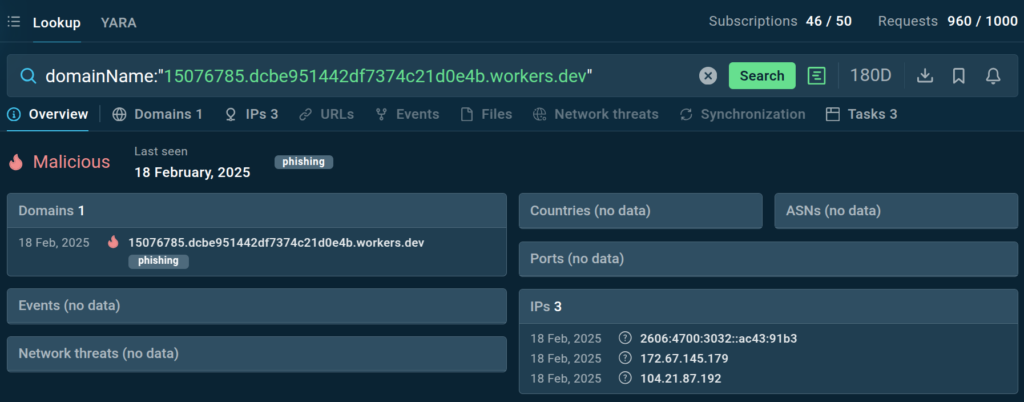
TI Lookup provides verdicts on known malicious indicators
Using TI Lookup can be also helpful during triage, when you need to check if a certain Cloudflare Workers domain is malicious. As you can see in the image above, the service instantly informs you about the threat level of the queried domain.
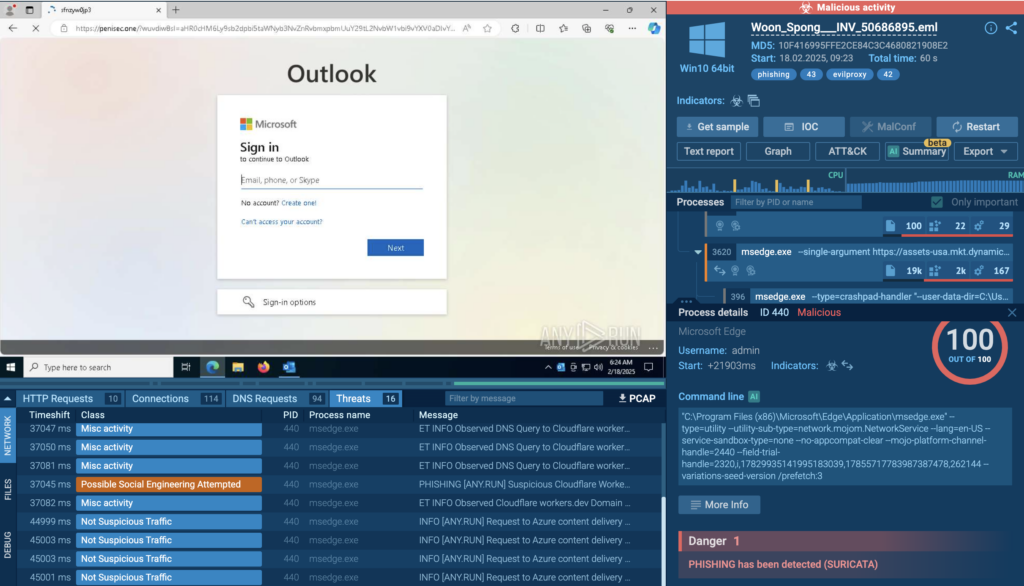
The Tasks tab in TI Lookup provides a list of the latest analysis reports performed in ANY.RUN’s Interactive Sandbox featuring the requested domains.
TI Lookup provide a list of sandbox sessions featuring the requested indicators
Here, we can discover that Cloudflare’s domain is also used by another phishing-as-a-service tool, EvilProxy.
Fake Outlook page created with the help of a phishing kit
If you want to dig deeper, you can open any of these reports inside the sandbox and observe real-world attacks as they unfolded and rerun analysis of these URLs yourself.
Get 50 free TI Lookup requests to try it in your organization
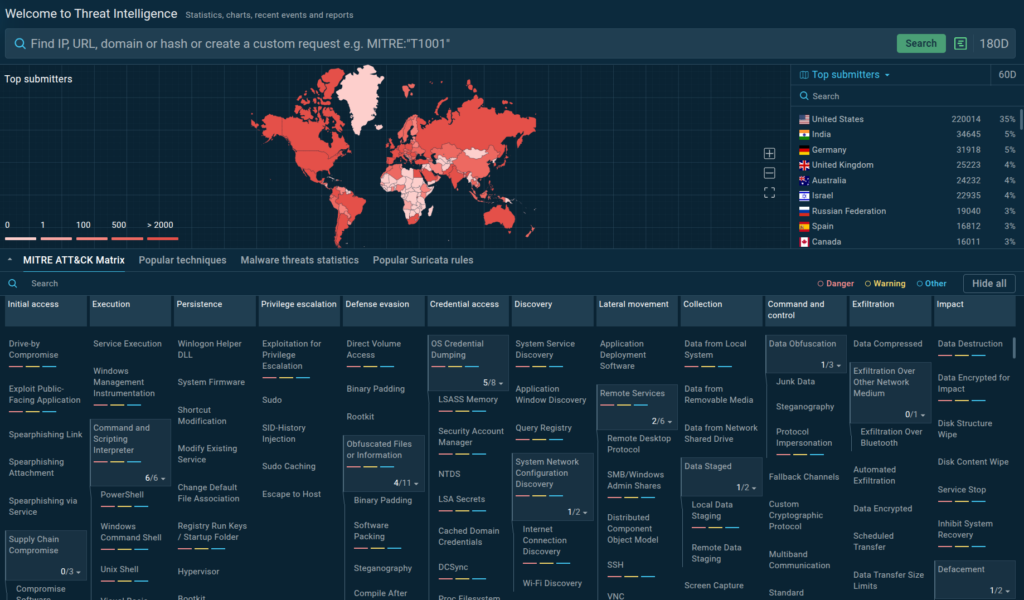
2. Researching Phishkit Campaigns via Suricata rules
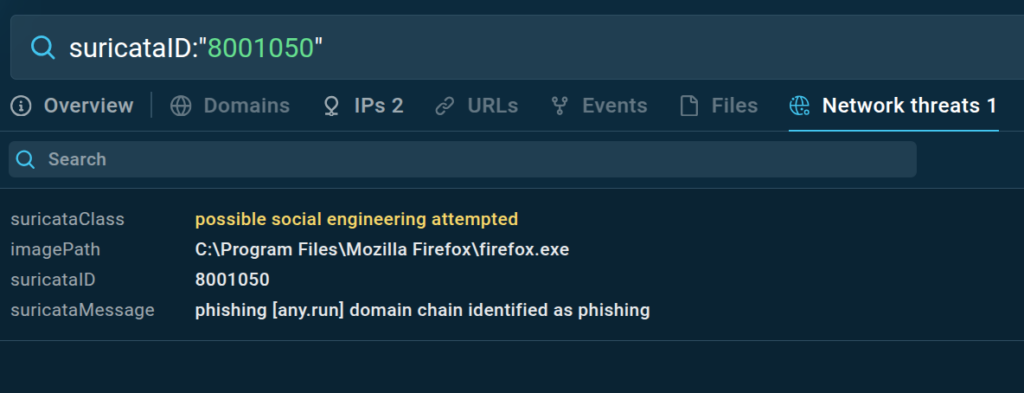
Threat Intelligence Lookup supports search by Suricata IDS rules. Add a rule ID (SID) and see an assortment of incidents where the same rule was triggered.
Suricata rule for detecting social engineering attempts
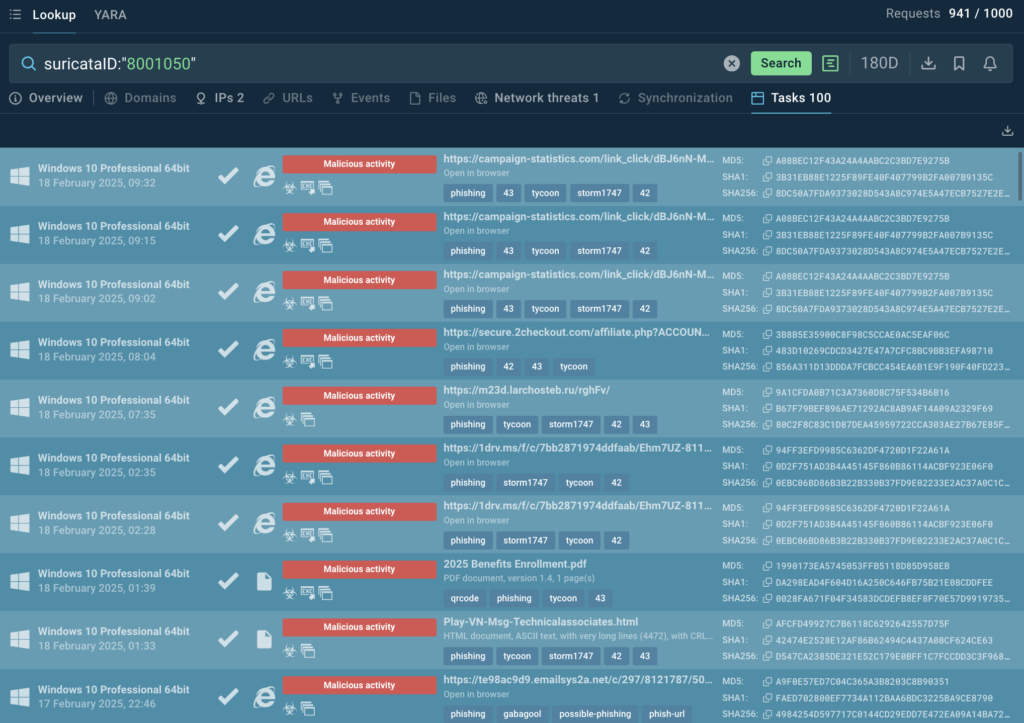
Let’s use the rule with the class “Possible social engineering attempted” via the following query:
You can download data on all of these samples, which includes hashes, and use it to further enrich your security systems. As always, you can also explore each report in detail to collect even more insights into these attacks.
TI Lookup lets you receive fresh updates on the results for any query
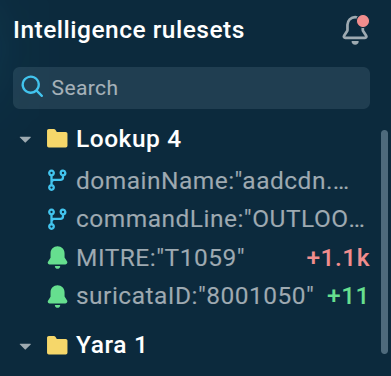
TI Lookup also lets you automatically receive notifications about the new results available for specific search queries. All you need to do is click the bell icon, and all of the updates will be displayed in the left side menu.
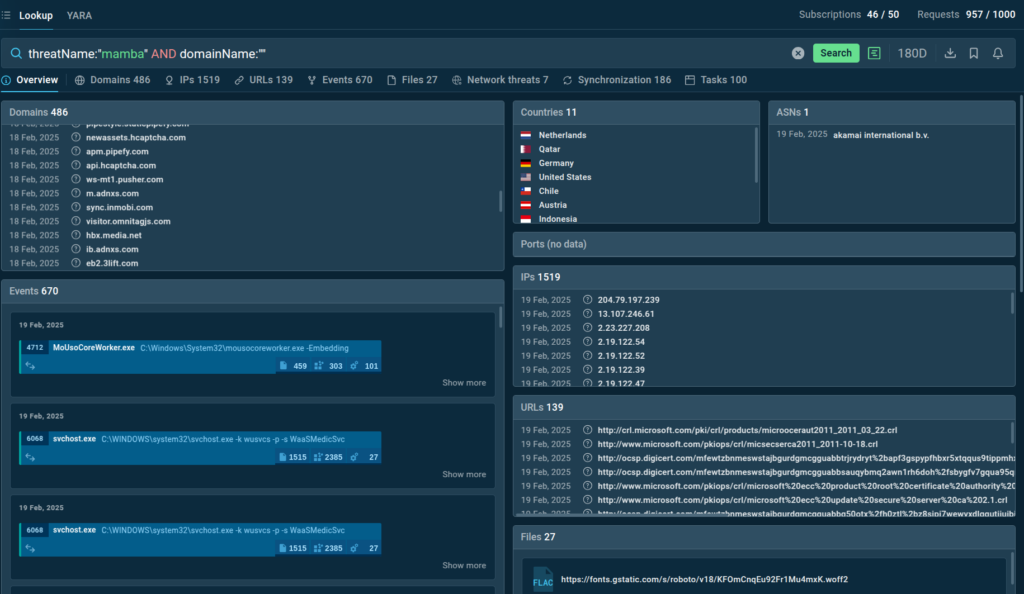
3. Tracking new samples of Mamba2FA Phishkit
If your organization has been previously attacked with a certain phishing kit, then you can easily stay updated on the newest indicators related to it.
Let’s take Mamba2FA as an example. It is a widely utilized phishkit that has been used in numerous attacks against businesses in the financial and manufacturing sectors.
With a simple query that combines the name of the phishkit with an empty domain name field, we can quickly discover both new attacks, as well as network indicators like domains and URLs recorded during sandbox analysis:
Check out expert guide to collecting intelligence on emerging threats with TI Lookup
Read full guide
Conclusion
Security experts are far from underestimating the risks behind phishing kits. They don’t just open gates to a mass of low-skilled beginners to the cybercrime market. They abuse known brands and trademarks by impersonating their resources, employ sophisticated infiltration and anti-evasion techniques, and are constantly evolving.
To avoid financial and reputational loss, organizations should consider investing in high-end threat intelligence solutions as well as emphasize employee educating and training.
About ANY.RUN
ANY.RUN helps more than 500,000 cybersecurity professionals worldwide. Our interactive sandbox simplifies malware analysis of threats that target both Windows and Linux systems. Our threat intelligence products, TI Lookup, YARA Search, and Feeds, help you find IOCs or files to learn more about the threats and respond to incidents faster.
https://www.backbox.org/wp-content/uploads/2018/09/website_backbox_text_black.png00adminhttps://www.backbox.org/wp-content/uploads/2018/09/website_backbox_text_black.pngadmin2025-02-19 11:06:412025-02-19 11:06:41How to Identify and Investigate Phishing Kit Attacks
From December 31, 2024, our telemetry began detecting a significant surge in the activity of the XMRig cryptominer. While most of the malware launches were detected by home security solutions, some were found on corporate systems. A thorough investigation revealed that cybercriminals had been distributing the malware through game torrents. The attack likely targeted gamers in various countries, including Russia, Brazil, and Germany. However, the cryptominer also surfaced on corporate networks — probably due to employees using work computers for personal use.
Malicious campaign
The campaign, affectionately named StaryDobry (“the good old one” in Russian) by our analysts, was carefully planned: malicious distributions were created and uploaded to torrent sites between September and December 2024. Of course, the infected games were repacks — modified versions designed to bypass authenticity checks (in other words, cracked).
Users began downloading and installing these trojanized games, and for a while, the malware showed no signs of activity. But then, on December 31, it received a command from the attackers’ remote server, triggering the download and execution of the miner on infected devices. The list of trojanized titles included popular sim games such as Garry’s Mod, BeamNG.Drive, and Universe Sandbox.
We closely examined a sample of the malware and discovered the following:
Before launching, the program checks whether it’s running in a debugging environment or sandbox. If it is, the installation is immediately terminated.
If the infected device has fewer than 8 CPU cores, the miner doesn’t run.
Our products detect the malware used in this campaign as Trojan.Win64.StaryDobry.*, Trojan-Dropper.Win64.StaryDobry.*, and HEUR:Trojan.Win64.StaryDobry.gen. More technical details and indicators of compromise can be found in the Securelist publication.
How to protect your corporate network from miners
From a corporate security perspective, the real concern isn’t just the malware itself, but where it was discovered. A miner in a corporate network is certainly unpleasant — but at least it doesn’t steal data. However, there’s no guarantee that, next time, a repacked game won’t be hiding a stealer or ransomware. As long as employees install pirated games on work computers, gaming-related malware will keep infiltrating corporate systems.
Therefore, the main recommendation for information security personnel is to block torrents at the security policy level (unless, of course, they’re necessary for your company’s business processes). Ideally, all non-work-related software should be completely prohibited. In addition, we have two traditional recommendations:
Train employees in cybersecurity hygiene basics. In the vast majority of cases, human actions serve as the entry point for cyberattacks on corporate systems. That’s why it’s crucial to educate personnel on how to recognize and respond to relevant cyberthreats. One effective way to do this is using our interactive online training platform Kaspersky Automated Security Awareness Platform.
The U.S. Cybersecurity and Infrastructure Security Agency (CISA) on Tuesday added two security flaws impacting Palo Alto Networks PAN-OS and SonicWall SonicOS SSLVPN to its Known Exploited Vulnerabilities (KEV) catalog, based on evidence of active exploitation.
The flaws are listed below –
CVE-2025-0108 (CVSS score: 7.8) – An authentication bypass vulnerability in the Palo Alto Networks PAN-OS
https://www.backbox.org/wp-content/uploads/2018/09/website_backbox_text_black.png00adminhttps://www.backbox.org/wp-content/uploads/2018/09/website_backbox_text_black.pngadmin2025-02-19 06:07:102025-02-19 06:07:10CISA Adds Palo Alto Networks and SonicWall Flaws to Exploited Vulnerabilities List
The campaign heavily uses Dropbox folders and PowerShell scripts to evade detection and quickly scrapped infrastructure components after researchers began poking around.
https://www.backbox.org/wp-content/uploads/2018/09/website_backbox_text_black.png00adminhttps://www.backbox.org/wp-content/uploads/2018/09/website_backbox_text_black.pngadmin2025-02-19 02:07:082025-02-19 02:07:08North Korea’s Kimsuky Taps Trusted Platforms to Attack South Korea