Cryptominer hidden in pirated games lands mostly on Russian computers

Cybercriminals are sneaking the cryptominer XMRig into pirated versions of popular games, and Russians appear to be the most frequent victims, according to researchers at Kaspersky.

The Record from Recorded Future News – ​Read More

Efficiency? Security? When the quest for one grants neither.

Efficiency? Security? When the quest for one grants neither.

Welcome to this week’s edition of the Threat Source newsletter. 
 
Benjamin Franklin once said, “Those who would give up essential Liberty, to purchase a little temporary Safety, deserve neither Liberty nor Safety.” In much the same way, those who rush for efficiency without taking into account security end up neither efficient nor secure.  

The past week the Department of Government Efficiency (or DOGE) has put on a clinic of how not to do things. For example, the Doge.gov website was easily and immediately compromised. Researchers were able to push updates to the public website via access to a database of government employment information. Not to be outdone the DOGE team hastily stood up the Waste.gov website which still had a placeholder WordPress default template, including the sample text which features an imaginary architecture firm called Études, from a default WordPress theme called Twenty Twenty-Four. This slapdash nonsense was hidden behind a password wall after the research information became public.  

It’s really an excellent lesson in what happens when security is not taken into account and the instant ramifications. As an entire infosec community we’ve talked at length about how baking security into every decision is incredibly important and that trying to bolt on fixes after the fact not only doesn’t work but highlights the lack of rigor and awareness of security in the room – creating an attractive target.

Let’s take a deep breath, take a moment to create a more secure process, follow those processes, and ensure security is in place at every step – then we can attack matters of efficiency.  

Newsletter reader survey

We want your feedback! Tell us your thoughts and five lucky readers will receive Talos Swag boxes.

Launch survey

The one big thing 

Cisco Talos has published a blog on the ongoing research into Salt Typhoon. Cisco Talos been closely monitoring reports of widespread intrusion activity against several major U.S. telecommunications companies, an issue that we have been concerned with for a long time here at Talos. The activity, initially reported in late 2024 and later confirmed by the U.S. government, is being carried out by a highly sophisticated threat actor dubbed Salt Typhoon.  

A hallmark of this campaign is the use of living-off-the-land (LOTL) techniques on network devices. It is important to note that while the telecommunications industry is the primary victim, the advice contained herein is relevant to, and should be considered by, all infrastructure defenders. 

Why do I care? 

State sponsored actors have been aggressively targeting global network infrastructure and understanding and mitigating these actions will help you improve your network infrastructure resilience. 

So now what? 

Cisco Talos has released an extensive list of preventative measures for general and Cisco-specific devices which can be found in the Salt Typhoon blog post.  

Top security headlines of the week 

Palo Alto Networks has warned that hackers are exploiting another vulnerability in its firewall software to break into unpatched customer networks. (TechCrunch)  

Security researchers warn a critical vulnerability in SonicWall’s SonicOS is under active exploitation.(CyberSecurityDrive

Two security vulnerabilities have been discovered in the OpenSSH secure networking utility suite that, if successfully exploited, could result in an active machine-in-the-middle (MitM) and a denial-of-service (DoS) attack, respectively, under certain conditions. (TheHackerNews

Can’t get enough Talos? 

Upcoming events where you can find Talos 

RSA (April 28-May 1, 2025) 

San Francisco, CA 

CTA TIPS 2025 (May 14-15, 2025)
 
Arlington, VA 

Most prevalent malware files from Talos telemetry over the past week  

SHA 256:7b3ec2365a64d9a9b2452c22e82e6d6ce2bb6dbc06c6720951c9570a5cd46fe5  MD5: ff1b6bb151cf9f671c929a4cbdb64d86   
VirusTotal : https://www.virustotal.com/gui/file/7b3ec2365a64d9a9b2452c22e82e6d6ce2bb6dbc06c6720951c9570a5cd46fe5 
Typical Filename: endpoint.query
Claimed Product: Endpoint-Collector 
Detection Name: W32.File.MalParent     

SHA 256: a31f222fc283227f5e7988d1ad9c0aecd66d58bb7b4d8518ae23e110308dbf91   
MD5: 7bdbd180c081fa63ca94f9c22c457376  
VirusTotal: https://www.virustotal.com/gui/file/a31f222fc283227f5e7988d1ad9c0aecd66d58bb7b4d8518ae23e110308dbf91/details%C2%A0 
Typical Filename: c0dwjdi6a.dll  
Claimed Product: N/A
Detection Name: Trojan.GenericKD.33515991 

SHA 256:9f1f11a708d393e0a4109ae189bc64f1f3e312653dcf317a2bd406f18ffcc507 
MD5: 2915b3f8b703eb744fc54c81f4a9c67f 
VirusTotal: https://www.virustotal.com/gui/file/9f1f11a708d393e0a4109ae189bc64f1f3e312653dcf317a2bd406f18ffcc507 
Typical Filename: VID001.exe 
Detection Name: Simple_Custom_Detection 

SHA 256: 47ecaab5cd6b26fe18d9759a9392bce81ba379817c53a3a468fe9060a076f8ca
MD5: 71fea034b422e4a17ebb06022532fdde
VirusTotal: https://www.virustotal.com/gui/file/47ecaab5cd6b26fe18d9759a9392bce81ba379817c53a3a468fe9060a076f8ca 
Typical Filename: VID001.exe
Claimed Product: N/A
Detection Name: Coinminer:MBT.26mw.in14.Talos 

Cisco Talos Blog – ​Read More

Google Adds Quantum-Resistant Digital Signatures to Cloud KMS

The new Cloud Key Management Service is part of Google’s new roadmap for implementing the new NIST-based post-quantum cryptography (PQC) standards.

darkreading – ​Read More

The complete story of the 2024 ransomware attack on UnitedHealth

About a year ago, UnitedHealth Group, the U.S. health-insurance giant, was targeted in one of the largest ransomware attacks ever. It had such far-reaching, severe consequences that new details about the attack and its aftermath have continued to emerge since the incident. To mark its anniversary, we’ve compiled a summary of all the data available today.

The ransomware attack on UnitedHealth Group

Before we proceed, let’s briefly introduce this organization to those unfamiliar with it. With a capitalization of approximately $500 billion, UnitedHealth Group is the largest company in the U.S. market for health insurance and healthcare services. It ranks ninth globally in terms of revenue — right after Apple.

UnitedHealth Group comprises two companies. One of them, UnitedHealthcare, focuses on health insurance. The other, Optum, specializes in delivering a broad spectrum of healthcare services ranging from pharmaceuticals and direct medical care to the IT systems underlying healthcare operations.

Optum Insight, one of Optum’s three divisions (and the most profitable), handles the latter. In the fall of 2022, UnitedHealth Group acquired the Change Healthcare platform, and Optum Insight integrated it. This digital platform processes insurance claims — acting as a financial intermediary between patients, healthcare providers, and insurers.

Change Healthcare was the target of the attack. On February 21, 2024, its systems were infected with ransomware — rendering the platform inaccessible. The incident wreaked havoc on the U.S. healthcare system, leaving many patients to shoulder the financial burden of medical expenses as insurance claims couldn’t be processed quickly. Healthcare providers were forced to process bills manually.

Recovering the compromised systems took several months. For instance, the Change Healthcare clearing service didn’t resume full operations until November. UnitedHealth Group even set up a dedicated website to track the restoration efforts. Even now, a year after the attack, the company is still regularly publishing updates on the website, and some systems are still listed as only “partially available”.

Timeline of the attack on UnitedHealth Group

A few months after the incident, on May 1, the CEO of UnitedHealth Group, Andrew Witty, was summoned to testify before Congress. From that testimony, the general public was finally able to learn about how the attack on the company unfolded.

According to Witty, the attack began on February 12. The attackers used compromised credentials to gain access to the Change Healthcare Citrix portal, which was used for remote desktop connections. Two-factor authentication should have stopped them but… it wasn’t enabled. Thus, attackers were able to gain entry simply by using the compromised credentials.

After gaining initial access, they began to move laterally and harvest data. The attackers clearly managed to collect a substantial amount of valuable data within the following nine days. In any case, on February 21, they deployed ransomware — initiating the encryption of Change Healthcare’s systems.

Faced with this situation, UnitedHealth decided to disconnect Change Healthcare data centers from the network to contain the ransomware attack.

Witty argued that the decision effectively prevented the infection from spreading to Optum, UnitedHealthcare, UnitedHealth Group, and any external organizations. However, the complete shutdown of a critical digital platform had a devastating impact on both UnitedHealth Group’s business operations and the broader U.S. healthcare system as a whole.

Thus, the most extensive ransomware attack of 2024 was caused by the absence of two-factor authentication on a remote desktop access portal — precisely the place where it absolutely should have been enabled. As Oregon Senator, Ron Wyden, summarized, “This hack could have been stopped with cybersecurity 101”.

UnitedHealth Group pays up

Several days after the breach, the BlackCat/ALPHV cybercrime gang claimed responsibility for it. The attackers claimed to have exfiltrated 6TB of confidential data — including medical records, financial documents, and personal information belonging to U.S. civilians and military personnel, among other sensitive information.

In March 2024, UnitedHealth Group paid a ransom of $22 million to the gang. But the story didn’t end there: after receiving the ransom, ALPHV feigned having their infrastructure seized by the FBI again. This was likely a ploy to double-cross one of their associates — pocketing the funds and disappearing into the ether.

Said associate claimed ALPHV had failed to give them their cut, and later teamed up with another ransomware gang — RansomHub. That gang made some of the stolen data public in April 2024, and then tried to extort more money from UnitedHealth.
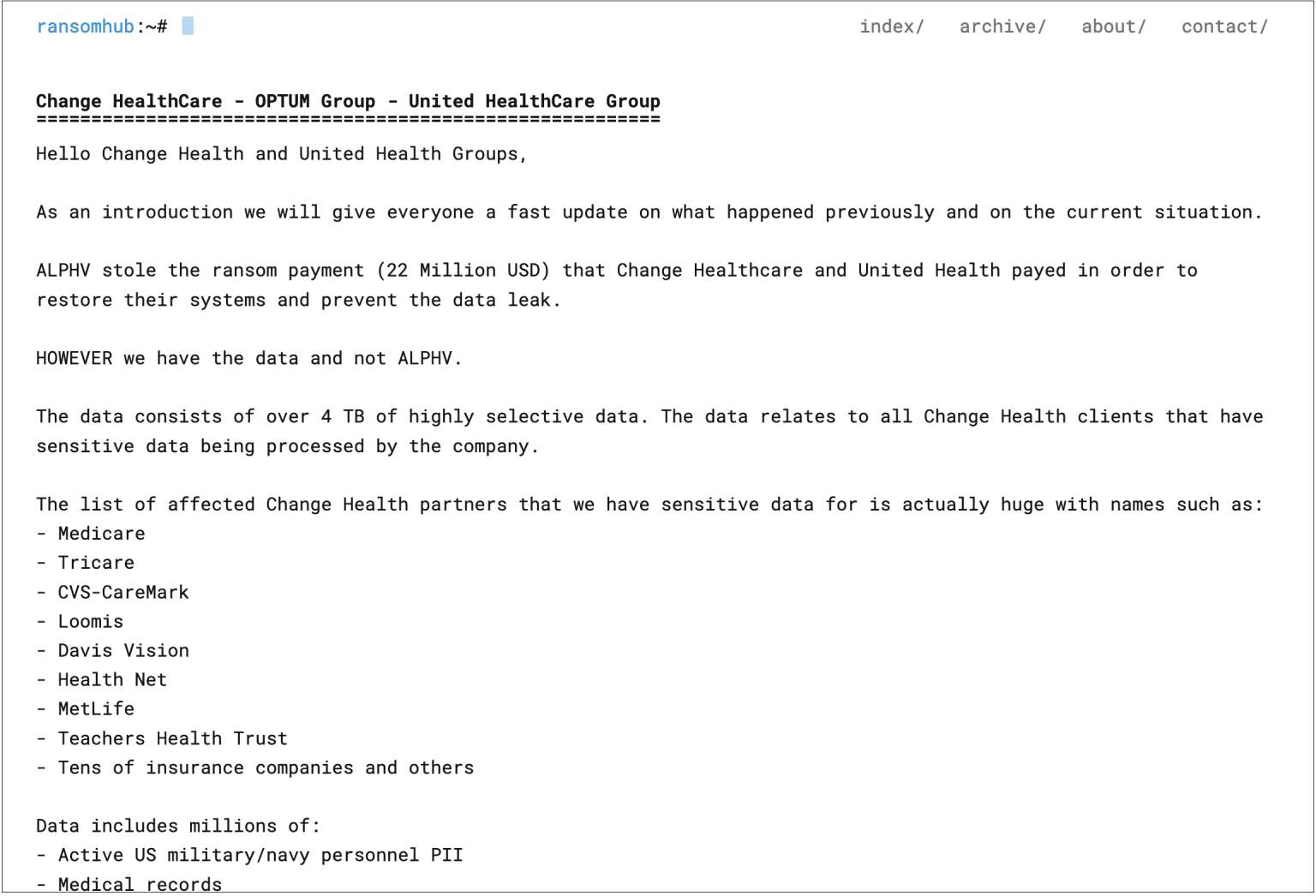
ALPHV website announcing the UnitedHealth breach

Post by RansomHub demanding a second ransom from UnitedHealth Group. Source

It remains unclear whether UnitedHealth ever paid the second ransom, as there was no official confirmation. However, the demand was later removed from RansomHub’s website, and no further leaks of the stolen company data have been observed. Therefore, it can be assumed that the company did, in fact, pay twice. This is even more likely if one considers that the ransom amounts are dwarfed by the massive financial impact the attack had on UnitedHealth Group.

The aftermath of the ransomware attack on UnitedHealth Group

UnitedHealth Group posted $872 million in losses associated with the cyberattack in Q1 2024 alone. The company also estimated in its Q1 report that the annual cost of the breach could reach $1.35 to $1.6 billion.

Those initial estimates proved to be far too optimistic: predicted damage kept growing quarter after quarter, first increasing to $2.3 to $2.45 billion, and then to $2.87 billion.

By the end of the fiscal year, as reported by UnitedHealth Group in January 2025, the incident resulted in a total annual loss of $3.09 billion. Although the damage estimate for 2024 is now finalized, the total damage could still increase substantially as the company continues to deal with the consequences of the attack.

An official estimate of the number of individuals whose data could have been stolen by the cybercriminals took a long time to materialize. It was only eight months after the incident, on October 24, 2024, that UnitedHealth Group finally came up with a tally. It was a mind-boggling figure: 100 million, or nearly a third of the entire population of the United States.

Nevertheless, it would become evident that these estimations were as overly hopeful as the original predictions about the financial losses. Three months later, at the end of January 2025, UnitedHealth Group released an updated report that put the number of those impacted by the breach at 190 million.

Protecting your company against ransomware

Clearly, the most obvious lesson to be learned from the UnitedHealth Group breach is that two-factor authentication is a must for any public-facing service. Otherwise, a single compromised password could cause massive problems and billions of dollars in losses.

Essential as it is, two-factor authentication is by no means sufficient protection against ransomware. Defending corporate infrastructure from ransomware attacks must be multilayered. Here are some additional tips:

Kaspersky official blog – ​Read More

Identity is the breaking point — get it right or zero trust fails

Source: Adobe


It’s on security leaders to shift their security strategies to better fight against identity-driven attacks.Read More

Security News | VentureBeat – ​Read More

Milliseconds to breach: How patch automation closes attackers’ fastest loophole

Credit: Adobe


Patching shouldn’t be the action item teams get to when other higher-priority tasks are completed. It’s core to keeping a business alive.Read More

Security News | VentureBeat – ​Read More

Chinese APT Tools Found in Ransomware Schemes, Blurring Attribution Lines

China-linked cyberespionage toolkits are popping up in ransomware attacks, forcing defenders to rethink how they combat state-backed hackers.

The post Chinese APT Tools Found in Ransomware Schemes, Blurring Attribution Lines appeared first on SecurityWeek.

SecurityWeek – ​Read More

California privacy regulator seeks to fine Florida data broker after huge breach of Social Security numbers

The California agency said National Public Data failed to register in the state as a data broker.

© 2024 TechCrunch. All rights reserved. For personal use only.

Security News | TechCrunch – ​Read More

Mining Company NioCorp Loses $500,000 in BEC Hack

NioCorp Developments has informed the SEC that it lost $0.5 million after its systems were compromised.

The post Mining Company NioCorp Loses $500,000 in BEC Hack appeared first on SecurityWeek.

SecurityWeek – ​Read More

AI Can Supercharge Productivity, But we Still Need a Human-in-the-Loop

AI systems can sometimes struggle with complex or nuanced situations, so human intervention can help identify and address potential issues that algorithms might not.

The post AI Can Supercharge Productivity, But we Still Need a Human-in-the-Loop appeared first on SecurityWeek.

SecurityWeek – ​Read More