The US military and law enforcement learned to outthink insurgents. It’s time for cybersecurity to learn to outsmart and outmaneuver threat actors with the same framework.
https://www.backbox.org/wp-content/uploads/2018/09/website_backbox_text_black.png00adminhttps://www.backbox.org/wp-content/uploads/2018/09/website_backbox_text_black.pngadmin2025-04-02 14:06:572025-04-02 14:06:57How an Interdiction Mindset Can Help Win War on Cyberattacks
Linux cyber threats may be less common than Windows ones, but they can be equally if not more damaging. Defending against these requires proactive efforts.
Eric Parker, a popular YouTube blogger and malware analyst, recently showed his approach to investigating and collecting intelligence on Linux malware.
Here is a recap of his video.
How to find Linux malware in Threat Intelligence Lookup
TI Lookup offers a centralized database of fresh IOCs, IOAs, and IOBs. It lets you search across threat data extracted from the latest malware and phishing samples analyzed by over 500,000 professionals and 15,000 companies around the globe in ANY.RUN’s Interactive Sandbox.
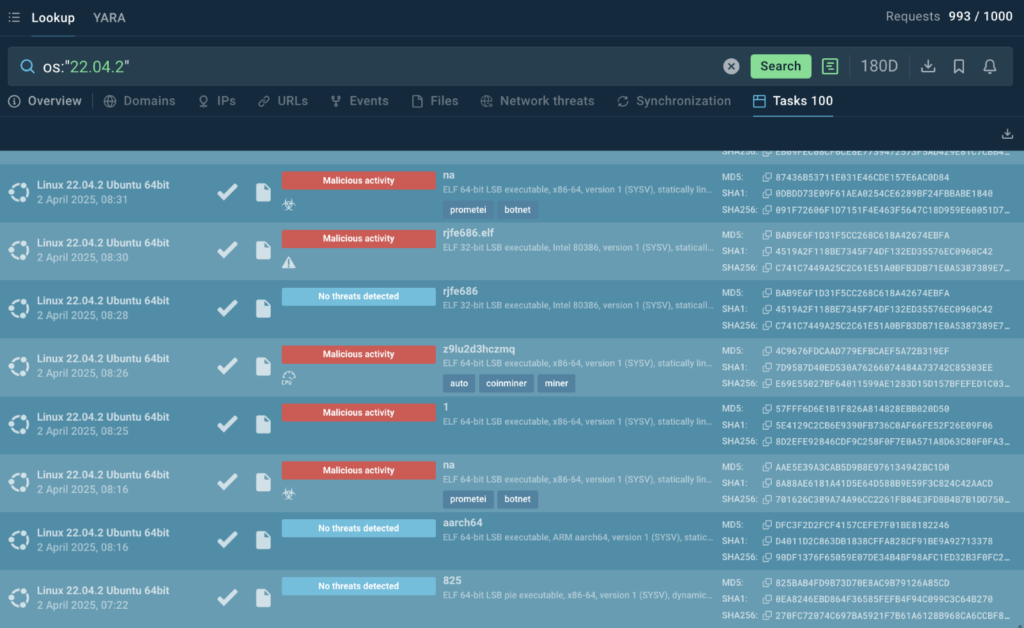
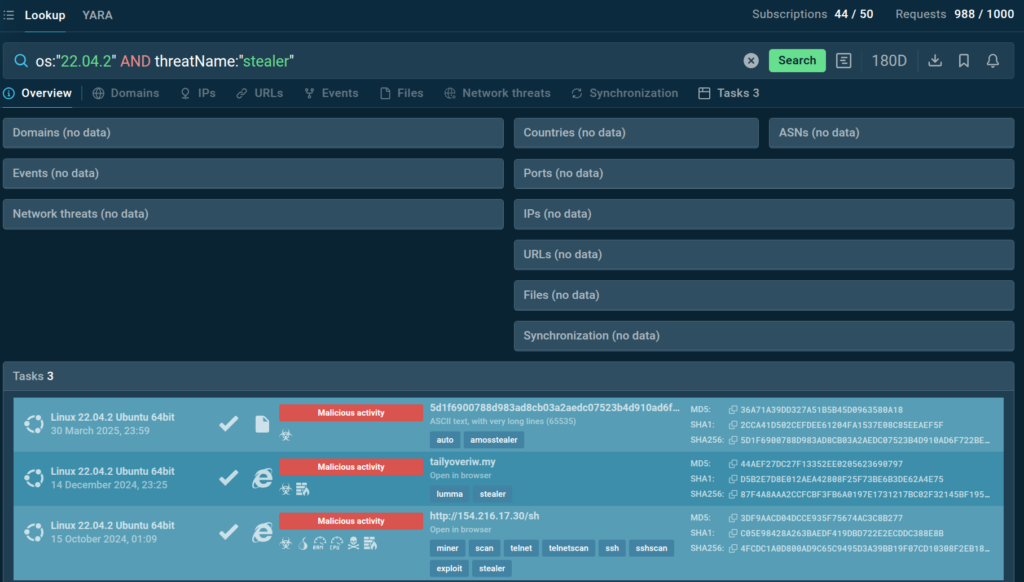
To start searching for Linux threats in TI Lookup, we can begin with the search query specifying the Ubuntu OS version used in the Interactive Sandbox.
The big thing you are probably starting to notice is that Linux malware is very different from Windows malware. It is not usually targeting a desktop user.
It’s not likely to have a campaign like email attachments or fake Fortnite swappers.
Those do very rarely exist, but because very few people use Linux as their primary desktop operating system, it’s much easier to target servers.
This puts at risk corporate infrastructure and makes it particularly important for companies to use proper tools for proactive security like ANY.RUN’s Threat Intelligence Lookup and Interactive Sandbox.
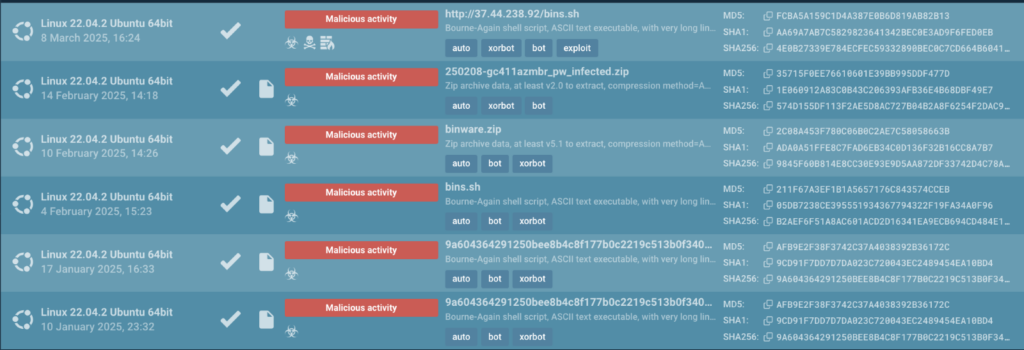
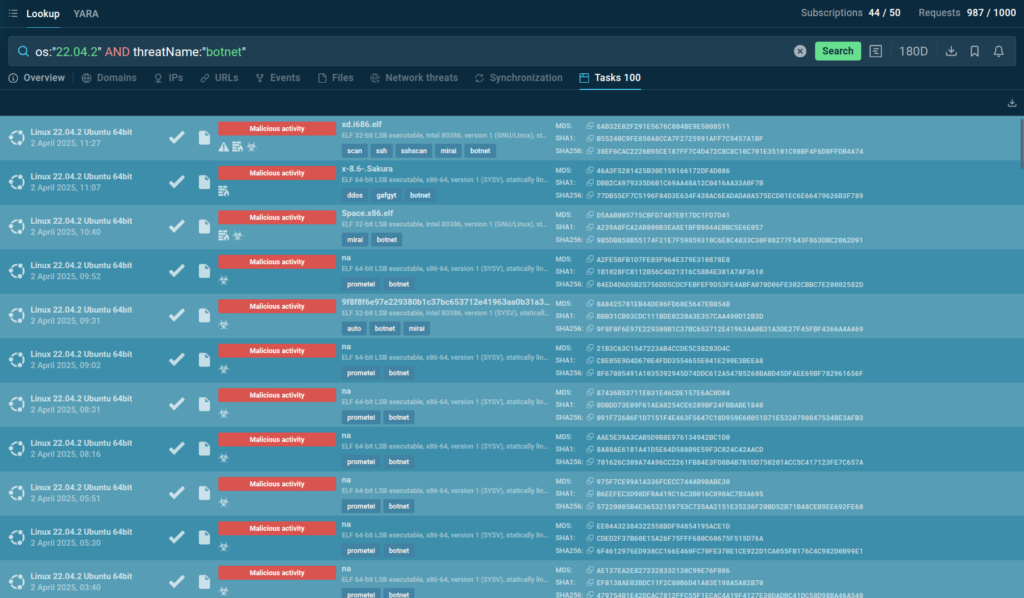
Sandbox reports featuring analyses of Linux botnets displayed by TI Lookup
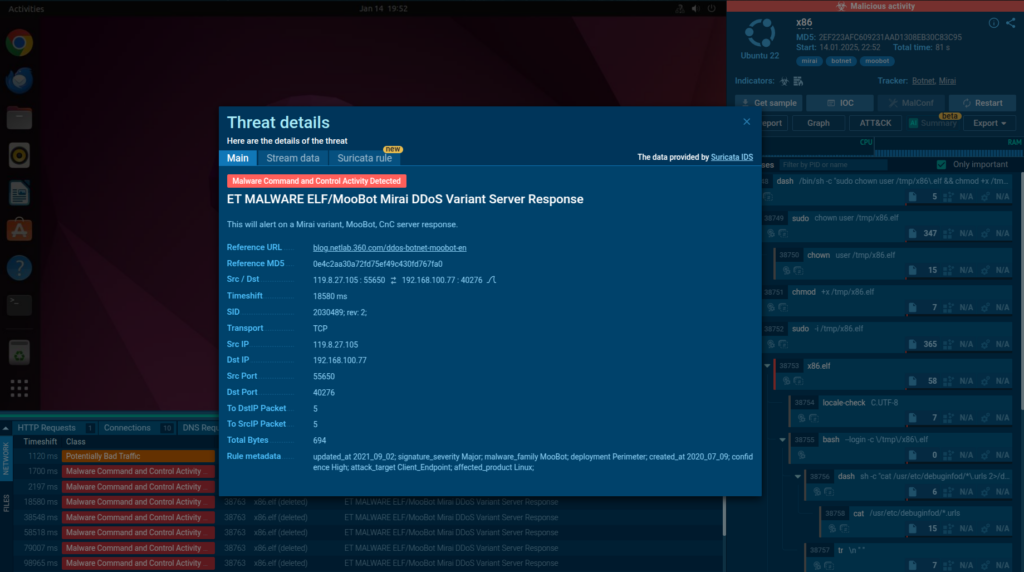
Let’s pick this sandbox session, which includes analysis of the Moobot version of Mirai.
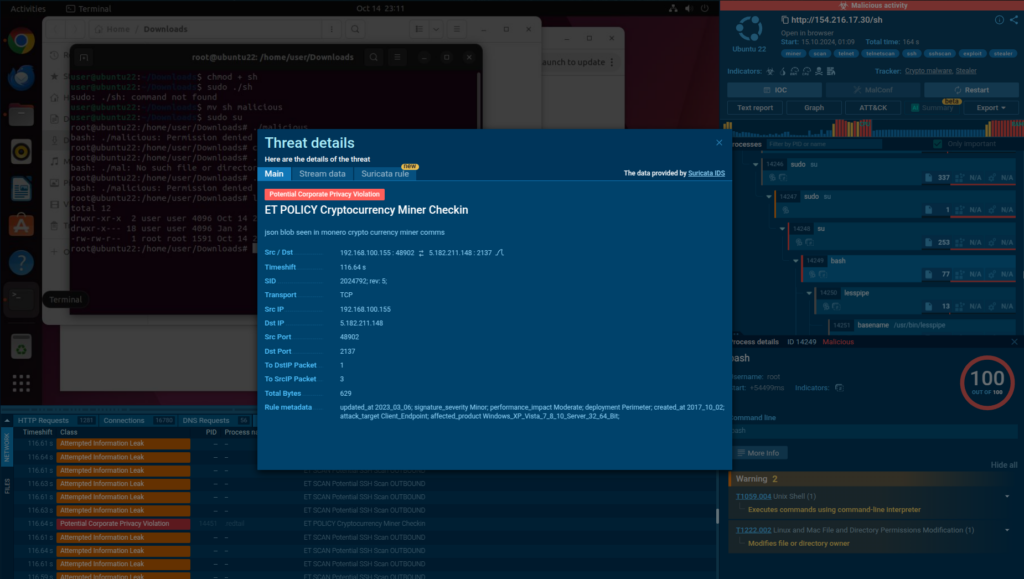
The Interactive Sandbox instantly detects Mirai’s activity with Suricata IDS
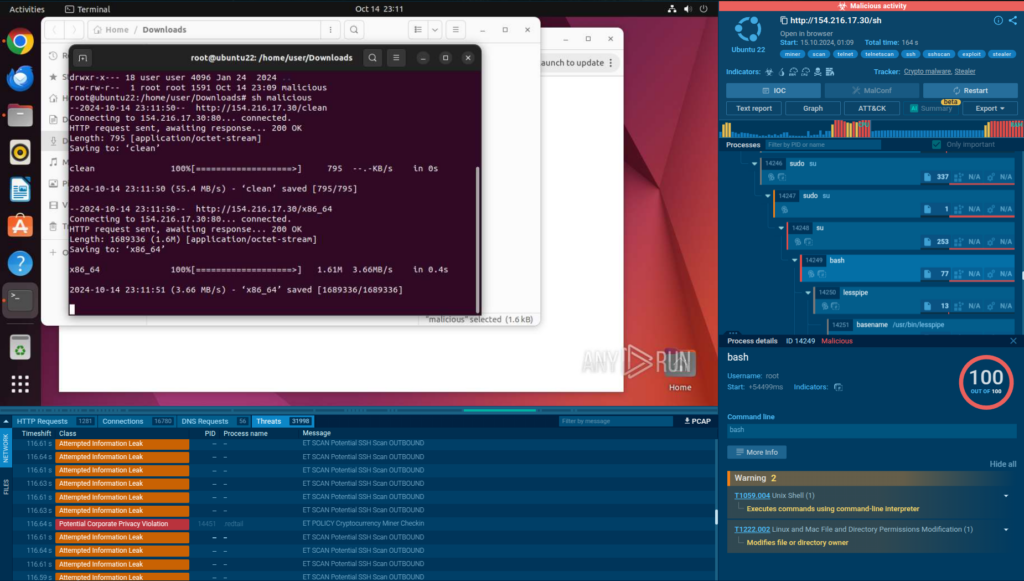
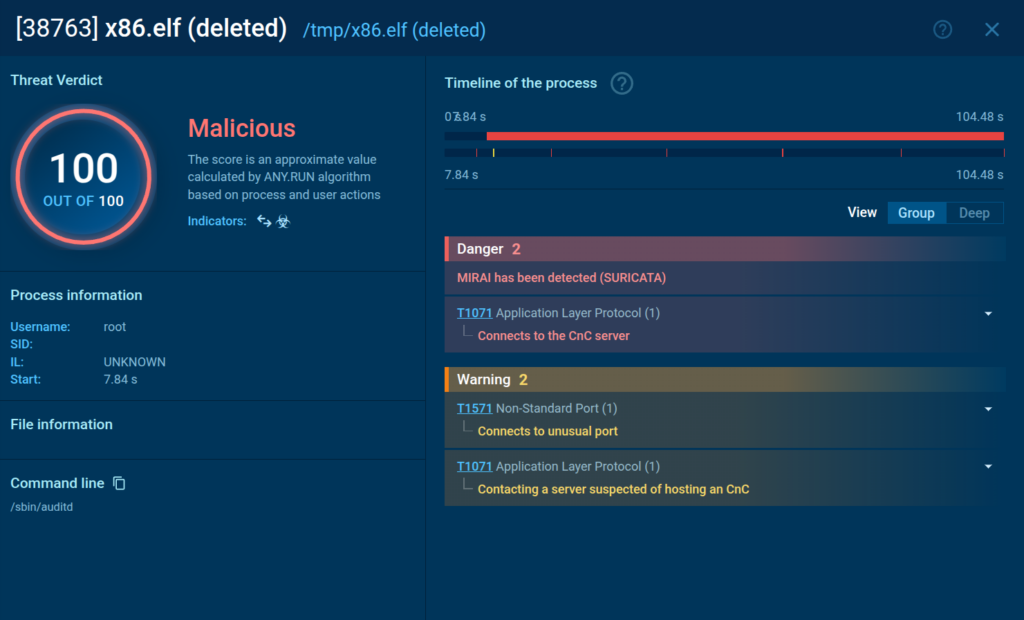
The infection starts with the download of x86.elf file, which is the process that seems to start, then it goes through and then it ultimately gets deleted, which is another stealthing technique.
If we watch a sandbox session replay – nothing visibly happens which is very common with this kind of malware: on the system that it is targeting, there wouldn’t even be a graphical user interface.
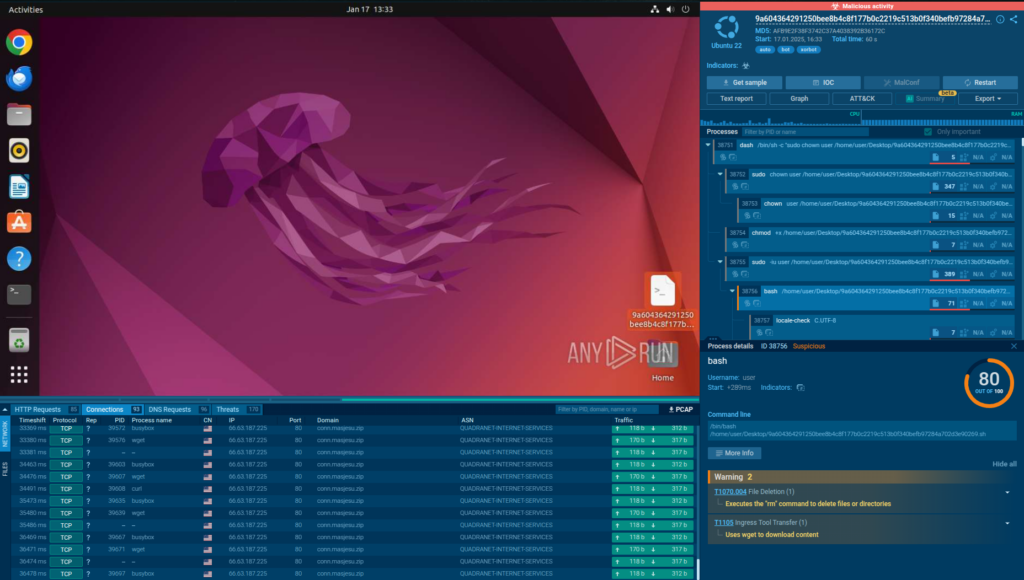
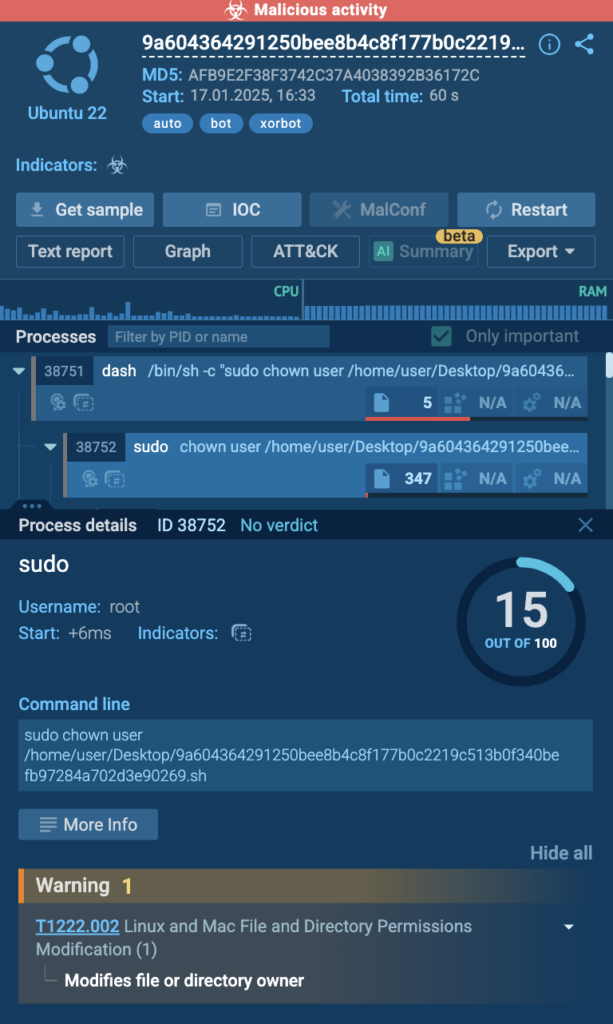
Process analysis inside ANY.RUN’s Interactive Sandbox
The only way you might be able to detect it is if you went through the processes, which can be done thanks to ANY.RUN’s real-time logging of all processes and system activities.
Enrich your threat knowledge with TI Lookup
Learn about TI Lookup and its capabilities to see how it can contribute to your company’s security
Explore more
Secure Your Company Against Linux Threats
So how do you prevent Linux malware? The main thing is – watch out and make sure you don’t have a weak root password on your system.
To investigate and collect proactive intelligence on Linux threats that may target your infrastructure, use Threat Intelligence Lookup.
With TI Lookup, your company can streamline:
Proactive Threat Identification: Search the database to proactively identify and update your defense based on the discovered intelligence.
Faster Research: Accelerate threat research by quickly connecting isolated IOCs to specific threats or known malware campaigns.
Real-Time Monitoring: Monitor evolving threats by receiving updates on new results related to your indicators of interest.
Incident Forensics: Enhance forensic analysis of security incidents by searching for contextual information on existing artifacts.
IOC, IOB, and IOA Collection: Discover additional indicators by searching the database for relevant threat information.
About ANY.RUN
ANY.RUN helps more than 500,000 cybersecurity professionals and 15,000 organizations worldwide. The Interactive Sandbox simplifies malware analysis of threats that target both Windows and Linux systems. The threat intelligence products, TI Lookup, YARA Search, and Feeds, help you find IOCs or files to learn more about the threats and respond to incidents faster.
https://www.backbox.org/wp-content/uploads/2018/09/website_backbox_text_black.png00adminhttps://www.backbox.org/wp-content/uploads/2018/09/website_backbox_text_black.pngadmin2025-04-02 14:06:462025-04-02 14:06:46How to Hunt and Investigate Linux Malware
Augment Code launches AI technology that outperforms GitHub Copilot by 70% through real-time context understanding of massive codebases, securing $270M funding and achieving the highest score on SWE-bench verified.Read More
https://www.backbox.org/wp-content/uploads/2018/09/website_backbox_text_black.png00adminhttps://www.backbox.org/wp-content/uploads/2018/09/website_backbox_text_black.pngadmin2025-04-02 13:07:092025-04-02 13:07:09Augment Code debuts AI agent with 70% win rate over GitHub Copilot and record-breaking SWE-bench score
Introduction
As the cybersecurity landscape evolves, service providers play an increasingly vital role in safeguarding sensitive data and maintaining compliance with industry regulations. The National Institute of Standards and Technology (NIST) offers a comprehensive set of frameworks that provide a clear path to achieving robust cybersecurity practices.
For service providers, adhering to NIST
https://www.backbox.org/wp-content/uploads/2018/09/website_backbox_text_black.png00adminhttps://www.backbox.org/wp-content/uploads/2018/09/website_backbox_text_black.pngadmin2025-04-02 12:07:142025-04-02 12:07:14Helping Your Clients Achieve NIST Compliance: A Step by Step Guide for Service Providers
The financially motivated threat actor known as FIN7 has been linked to a Python-based backdoor called Anubis (not to be confused with an Android banking trojan of the same name) that can grant them remote access to compromised Windows systems.
“This malware allows attackers to execute remote shell commands and other system operations, giving them full control over an infected machine,” Swiss
https://www.backbox.org/wp-content/uploads/2018/09/website_backbox_text_black.png00adminhttps://www.backbox.org/wp-content/uploads/2018/09/website_backbox_text_black.pngadmin2025-04-02 08:07:012025-04-02 08:07:01FIN7 Deploys Anubis Backdoor to Hijack Windows Systems via Compromised SharePoint Sites