Trump administration planning major workforce cuts at CISA

The agency is looking to remove some 1,300 people by cutting about half its full-time staff and another 40 percent of its contractors, a source with direct knowledge of the developing plans told Recorded Future News.

The Record from Recorded Future News – ​Read More

Google Eyes User Browsing Data Search in New Patent Filing

Tech giant Google may soon help users find content they’ve previously seen, not by searching the web but by scanning their own digital history.

Hackread – Latest Cybersecurity, Hacking News, Tech, AI & Crypto – ​Read More

Threat actors thrive in chaos

Threat actors thrive in chaos

Welcome to this week’s edition of the Threat Source newsletter. 

If there’s one thing that threat actors love, it’s chaos. Headlines in the news that provoke an emotional response make excellent phishing lures because the intense feelings invoked by a provocative subject line cause our critical thinking faculties to be bypassed. Without cautious reflection, we’re likely to engage with bait, fall for the lure and “click the link” rather than pausing to ask ourselves what the headline’s writer is trying to achieve. 

Economic disruption also works in the bad guys’ favor. In budgetary crises, investments in cyber defenses may be postponed or the hiring of sorely needed additional team members delayed. Alternatively, an end-of-life device that is still functional despite obsolescence and many unpatched vulnerabilities may get an additional year of operation before replacement. 

In such a climate, security teams are often asked to do more with less. However, security can be improved simply by getting the basics right and addressing gaps that don’t require investment. Patching might be time-consuming, but it doesn’t require extra budget. Prioritize removing the most exploited vulnerabilities as listed in our 2024 Year in Review report. Next, review your MFA implementation, ensuring that it is deployed everywhere throughout the organization and that it can’t be bypassed. 

When times are tough, focus on getting the basics right and fixing what can be fixed without needing costly investment. Each vulnerability fixed, each weakness remediated helps move the security posture forwards and makes your organization a tougher target for the bad guys who in turn are more likely to seek easier quarry.

The one big thing 

We are continuing our discussion of Talos’ 2024 Year in Review report, looking at each section in detail. This week, let’s examine the evolution of email lures and the nature of the most frequently targeted vulnerabilities.

Why do I care? 

In a world of limited resources, effective defense requires identifying areas that are more likely to be targeted by threat actors and prioritizing shoring up these areas. Not all vulnerabilities or systems are exploited equally, and remediating the most frequently exploited vulnerabilities maximizes security effectiveness. 

So now what? 

Educate users on the types of social engineering that threat actors are currently using in email lures. Social engineering is not static but constantly changing to try and outwit unwary targets. 

Exploitation of the Shellshock series of vulnerabilities should not be continuing for over 10 years since disclosure. Aggressively identify systems within your IT estate that are vulnerable to this attack and urgently patch them.

Top security headlines of the week 

Hackers strike Australia’s largest pension funds. A series of coordinated attacks has reportedly led to criminals compromising in excess of 20,000 pension accounts and stealing funds. (Reuters

Ireland Plans 300-Strong Military Cyber Command. The Irish armed forces are creating a Joint Cyber Defence Command to support defensive and offensive cyber operations. (Irish Times

Baltimore City Falls Victim to Vendor Fraud. Two payments totaling $1.5 million were reportedly paid to a fraudulent bank account that had been swapped for a contractor’s genuine account. (CBS News

CISA Warns of Vulnerabilities in ICS Software. The US Cybersecurity & Infrastructure Agency released advisories relating to five series vulnerabilities in Industrial Control Systems software. (CISA)

Can’t get enough Talos?

  • Unraveling the U.S. toll road smishing scams. Talos has observed a widespread and ongoing smishing campaign since October 2024 that targets toll road users in the U.S. Read the blog here.
  • Beers with Talos: 2024 Year in Review. Joe, Hazel, Bill and Dave break down 2024 Year in Review and discuss how and why cybercriminals are learning on attacks based in stealth and simplicity. Listen here.
  • The TTP Ep 10 (Part 1). Peeling back the layers of the threats that dominated 2024. Watch now.
  • The TTP Ep 10 (Part 2). Ransomware groups, and why we’re seeing more identity attacks. Watch now.

Upcoming events where you can find Talos 

Most prevalent malware files from Talos telemetry over the past week 

SHA 256: 9f1f11a708d393e0a4109ae189bc64f1f3e312653dcf317a2bd406f18ffcc507   
MD5: 2915b3f8b703eb744fc54c81f4a9c67f   
VirusTotal: https://www.virustotal.com/gui/file/9f1f11a708d393e0a4109ae189bc64f1f3e312653dcf317a2bd406f18ffcc507/details 
Typical Filename: VID001.exe   
Detection Name: Simple_Custom_Detection

SHA 256: a31f222fc283227f5e7988d1ad9c0aecd66d58bb7b4d8518ae23e110308dbf91  
MD5: 7bdbd180c081fa63ca94f9c22c457376  
VirusTotal: https://www.virustotal.com/gui/file/a31f222fc283227f5e7988d1ad9c0aecd66d58bb7b4d8518ae23e110308dbf91/details 
Typical Filename: IMG001.exe 
Detection Name: Simple_Custom_Detection  

SHA 256: 47ecaab5cd6b26fe18d9759a9392bce81ba379817c53a3a468fe9060a076f8ca    
MD5: 71fea034b422e4a17ebb06022532fdde    
VirusTotal: https://www.virustotal.com/gui/file/47ecaab5cd6b26fe18d9759a9392bce81ba379817c53a3a468fe9060a076f8ca/details 
Typical Filename: VID001.exe   
Detection Name: Coinminer:MBT.26mw.in14.Talos   

SHA 256: 7bf7550ae929d6fea87140ab70e6444250581c87a990e74c1cd7f0df5661575b 
MD5: f5e908f1fac5f98ec63e3ec355ef6279 
VirusTotal: https://www.virustotal.com/gui/file/7bf7550ae929d6fea87140ab70e6444250581c87a990e74c1cd7f0df5661575b/details 
Typical Filename: IMG001.exe 
Detection Name: Win.Dropper.Coinminer::tpd 

Cisco Talos Blog – ​Read More

Europol Targets Customers of Smokeloader Pay-Per-Install Botnet

Law enforcement agencies in multiple countries have announced the arrests of users of the malicious Smokeloader botnet.

The post Europol Targets Customers of Smokeloader Pay-Per-Install Botnet appeared first on SecurityWeek.

SecurityWeek – ​Read More

China-based SMS Phishing Triad Pivots to Banks

China-based purveyors of SMS phishing kits are enjoying remarkable success converting phished payment card data into mobile wallets from Apple and Google. Until recently, the so-called “Smishing Triad” mainly impersonated toll road operators and shipping companies. But experts say these groups are now directly targeting customers of international financial institutions, while dramatically expanding their cybercrime infrastructure and support staff.
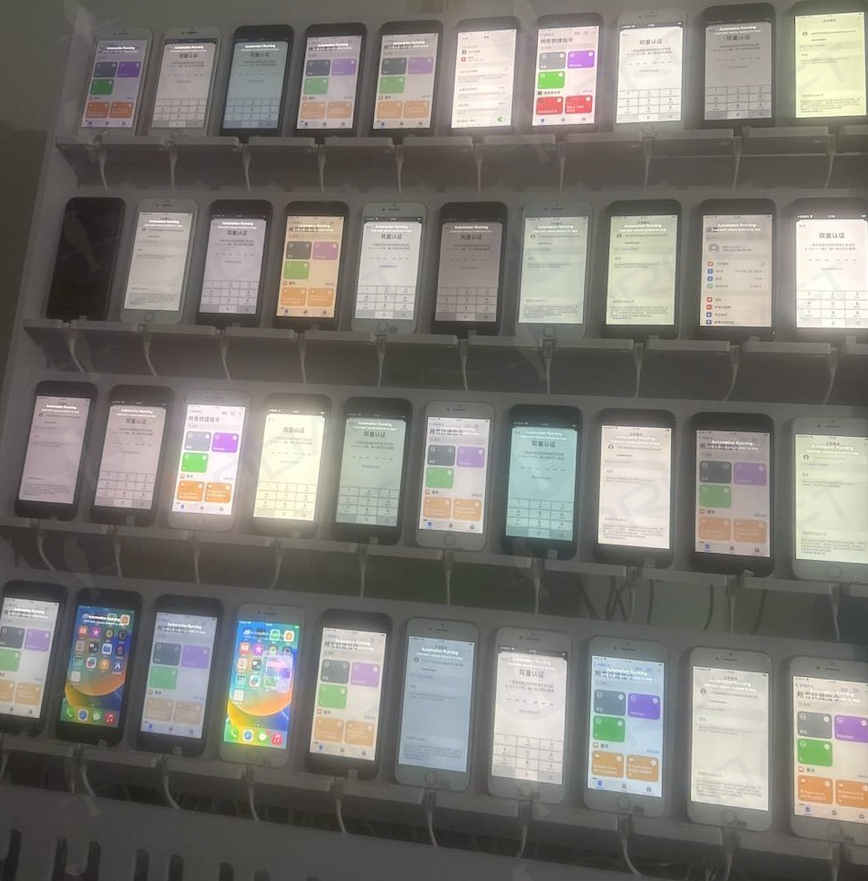
An image of an iPhone device farm shared on Telegram by one of the Smishing Triad members. Image: Prodaft.

If you own a mobile device, the chances are excellent that at some point in the past two years you’ve received at least one instant message that warns of a delinquent toll road fee, or a wayward package from the U.S. Postal Service (USPS). Those who click the promoted link are brought to a website that spoofs the USPS or a local toll road operator and asks for payment card information.

The site will then complain that the visitor’s bank needs to “verify” the transaction by sending a one-time code via SMS. In reality, the bank is sending that code to the mobile number on file for their customer because the fraudsters have just attempted to enroll that victim’s card details into a mobile wallet.

If the visitor supplies that one-time code, their payment card is then added to a new mobile wallet on an Apple or Google device that is physically controlled by the phishers. The phishing gangs typically load multiple stolen digital wallets onto a single Apple or Android device, and then sell those phones in bulk to scammers who use them for fraudulent e-commerce and tap-to-pay transactions.
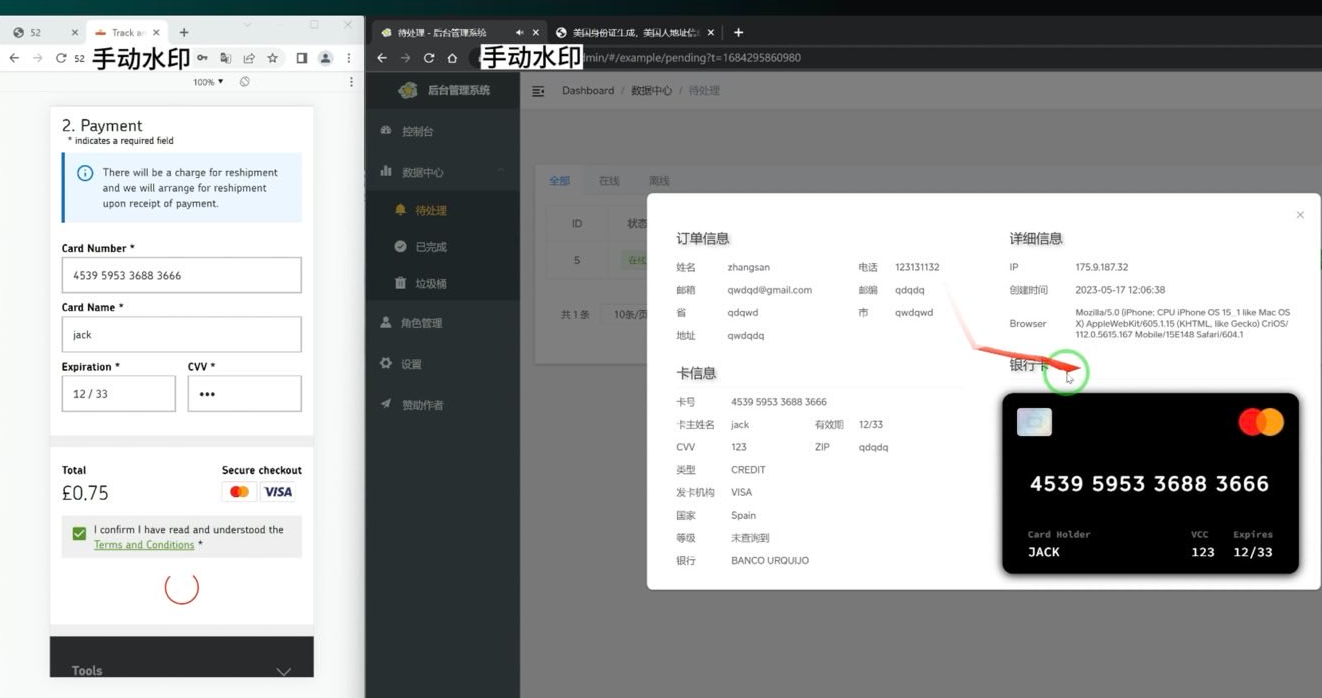
A screenshot of the administrative panel for a smishing kit. On the left is the (test) data entered at the phishing site. On the right we can see the phishing kit has superimposed the supplied card number onto an image of a payment card. When the phishing kit scans that created card image into Apple or Google Pay, it triggers the victim’s bank to send a one-time code. Image: Ford Merrill.

The moniker “Smishing Triad” comes from Resecurity, which was among the first to report in August 2023 on the emergence of three distinct mobile phishing groups based in China that appeared to share some infrastructure and innovative phishing techniques. But it is a bit of a misnomer because the phishing lures blasted out by these groups are not SMS or text messages in the conventional sense.

Rather, they are sent via iMessage to Apple device users, and via RCS on Google Android devices. Thus, the missives bypass the mobile phone networks entirely and enjoy near 100 percent delivery rate (at least until Apple and Google suspend the spammy accounts).

In a report published on March 24, the Swiss threat intelligence firm Prodaft detailed the rapid pace of innovation coming from the Smishing Triad, which it characterizes as a loosely federated group of Chinese phishing-as-a-service operators with names like Darcula, Lighthouse, and the Xinxin Group.

Prodaft said they’re seeing a significant shift in the underground economy, particularly among Chinese-speaking threat actors who have historically operated in the shadows compared to their Russian-speaking counterparts.

“Chinese-speaking actors are introducing innovative and cost-effective systems, enabling them to target larger user bases with sophisticated services,” Prodaft wrote. “Their approach marks a new era in underground business practices, emphasizing scalability and efficiency in cybercriminal operations.”

A new report from researchers at the security firm SilentPush finds the Smishing Triad members have expanded into selling mobile phishing kits targeting customers of global financial institutions like CitiGroup, MasterCard, PayPal, Stripe, and Visa, as well as banks in Canada, Latin America, Australia and the broader Asia-Pacific region.
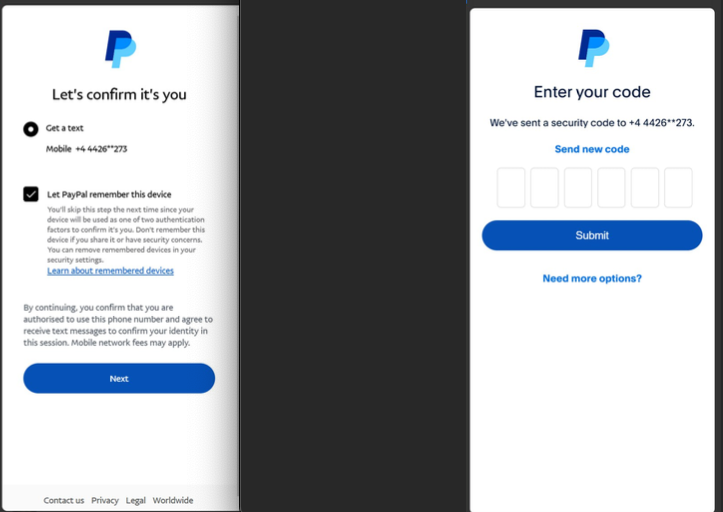
Phishing lures from the Smishing Triad spoofing PayPal. Image: SilentPush.

SilentPush found the Smishing Triad now spoofs recognizable brands in a variety of industry verticals across at least 121 countries and a vast number of industries, including the postal, logistics, telecommunications, transportation, finance, retail and public sectors.

According to SilentPush, the domains used by the Smishing Triad are rotated frequently, with approximately 25,000 phishing domains active during any 8-day period and a majority of them sitting at two Chinese hosting companies: Tencent (AS132203) and Alibaba (AS45102).

“With nearly two-thirds of all countries in the world targeted by [the] Smishing Triad, it’s safe to say they are essentially targeting every country with modern infrastructure outside of Iran, North Korea, and Russia,” SilentPush wrote. “Our team has observed some potential targeting in Russia (such as domains that mentioned their country codes), but nothing definitive enough to indicate Russia is a persistent target. Interestingly, even though these are Chinese threat actors, we have seen instances of targeting aimed at Macau and Hong Kong, both special administrative regions of China.”

SilentPush’s Zach Edwards said his team found a vulnerability that exposed data from one of the Smishing Triad’s phishing pages, which revealed the number of visits each site received each day across thousands of phishing domains that were active at the time. Based on that data, SilentPush estimates those phishing pages received well more than a million visits within a 20-day time span.

The report notes the Smishing Triad boasts it has “300+ front desk staff worldwide” involved in one of their more popular phishing kits — Lighthouse — staff that is mainly used to support various aspects of the group’s fraud and cash-out schemes.

The Smishing Triad members maintain their own Chinese-language sales channels on Telegram, which frequently offer videos and photos of their staff hard at work. Some of those images include massive walls of phones used to send phishing messages, with human operators seated directly in front of them ready to receive any time-sensitive one-time codes.

As noted in February’s story How Phished Data Turns Into Apple and Google Wallets, one of those cash-out schemes involves an Android app called Z-NFC, which can relay a valid NFC transaction from one of these compromised digital wallets to anywhere in the world. For a $500 month subscription, the customer can wave their phone at any payment terminal that accepts Apple or Google pay, and the app will relay an NFC transaction over the Internet from a stolen wallet on a phone in China.

Chinese nationals were recently busted trying to use these NFC apps to buy high-end electronics in Singapore. And in the United States, authorities in California and Tennessee arrested Chinese nationals accused of using NFC apps to fraudulently purchase gift cards from retailers.

The Prodaft researchers said they were able to find a previously undocumented backend management panel for Lucid, a smishing-as-a-service operation tied to the XinXin Group. The panel included victim figures that suggest the smishing campaigns maintain an average success rate of approximately five percent, with some domains receiving over 500 visits per week.

“In one observed instance, a single phishing website captured 30 credit card records from 550 victim interactions over a 7-day period,” Prodaft wrote.

Prodaft’s report details how the Smishing Triad has achieved such success in sending their spam messages. For example, one phishing vendor appears to send out messages using dozens of Android device emulators running in parallel on a single machine.
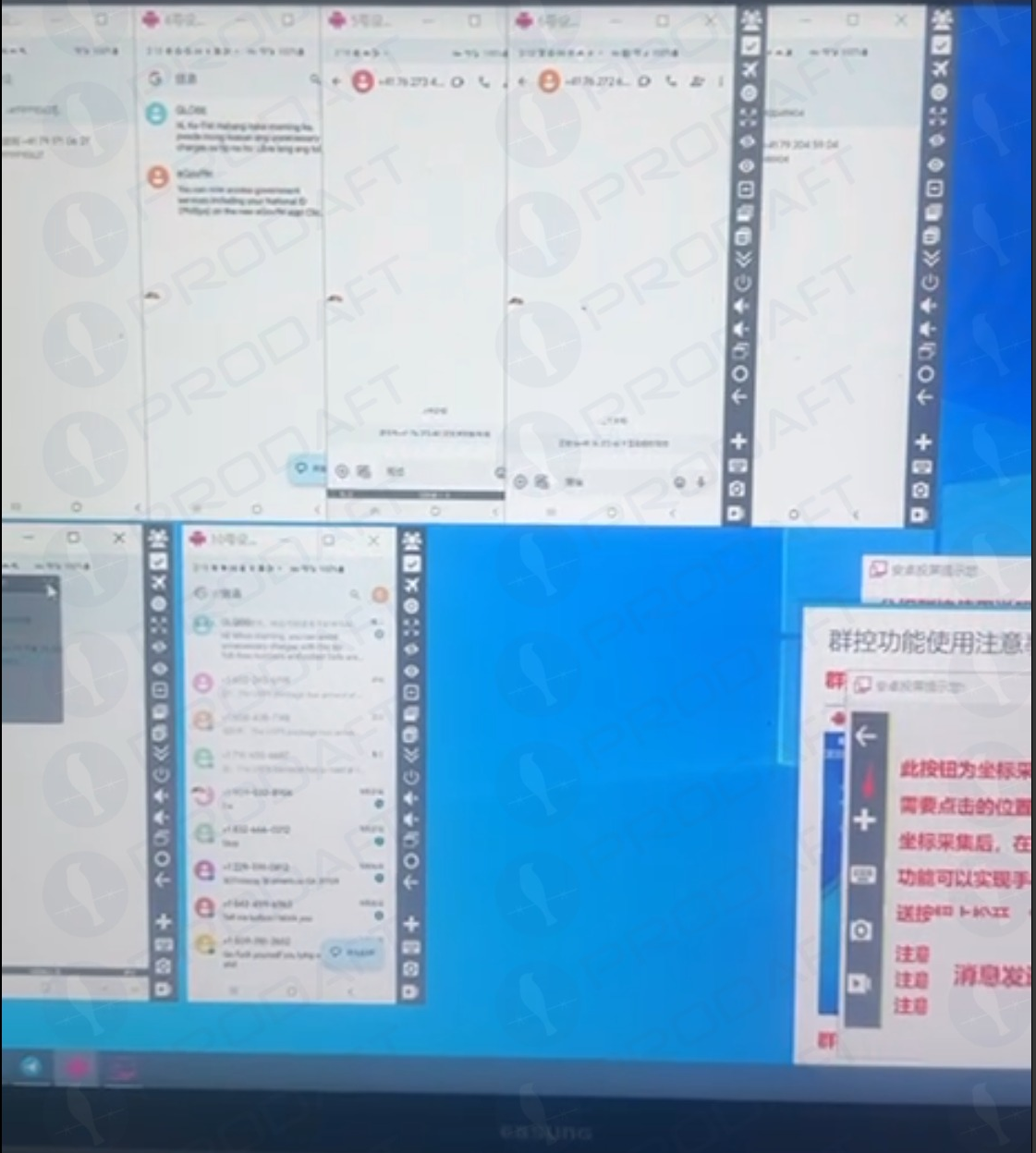
Phishers using multiple virtualized Android devices to orchestrate and distribute RCS-based scam campaigns. Image: Prodaft.

According to Prodaft, the threat actors first acquire phone numbers through various means including data breaches, open-source intelligence, or purchased lists from underground markets. They then exploit technical gaps in sender ID validation within both messaging platforms.

“For iMessage, this involves creating temporary Apple IDs with impersonated display names, while RCS exploitation leverages carrier implementation inconsistencies in sender verification,” Prodaft wrote. “Message delivery occurs through automated platforms using VoIP numbers or compromised credentials, often deployed in precisely timed multi-wave campaigns to maximize effectiveness.

In addition, the phishing links embedded in these messages use time-limited single-use URLs that expire or redirect based on device fingerprinting to evade security analysis, they found.

“The economics strongly favor the attackers, as neither RCS nor iMessage messages incur per-message costs like traditional SMS, enabling high-volume campaigns at minimal operational expense,” Prodaft continued. “The overlap in templates, target pools, and tactics among these platforms underscores a unified threat landscape, with Chinese-speaking actors driving innovation in the underground economy. Their ability to scale operations globally and evasion techniques pose significant challenges to cybersecurity defenses.”

Ford Merrill works in security research at SecAlliance, a CSIS Security Group company. Merrill said he’s observed at least one video of a Windows binary that wraps a Chrome executable and can be used to load in target phone numbers and blast messages via RCS, iMessage, Amazon, Instagram, Facebook, and WhatsApp.

“The evidence we’ve observed suggests the ability for a single device to send approximately 100 messages per second,” Merrill said. “We also believe that there is capability to source country specific SIM cards in volume that allow them to register different online accounts that require validation with specific country codes, and even make those SIM cards available to the physical devices long-term so that services that rely on checks of the validity of the phone number or SIM card presence on a mobile network are thwarted.”

Experts say this fast-growing wave of card fraud persists because far too many financial institutions still default to sending one-time codes via SMS for validating card enrollment in mobile wallets from Apple or Google. KrebsOnSecurity interviewed multiple security executives at non-U.S. financial institutions who spoke on condition of anonymity because they were not authorized to speak to the press. Those banks have since done away with SMS-based one-time codes and are now requiring customers to log in to the bank’s mobile app before they can link their card to a digital wallet.

Krebs on Security – ​Read More

Smokeloader Users Identified and Arrested in Operation Endgame

Authorities arrest 5 Smokeloader botnet customers after Operation Endgame; evidence from seized data links customers to malware, ransomware, and more.

Hackread – Latest Cybersecurity, Hacking News, Tech, AI & Crypto – ​Read More

Incomplete Patch in NVIDIA Toolkit Leaves CVE-2024-0132 Open to Container Escapes

Cybersecurity researchers have detailed a case of an incomplete patch for a previously addressed security flaw impacting the NVIDIA Container Toolkit that, if successfully exploited, could put sensitive data at risk.
The original vulnerability CVE-2024-0132 (CVSS score: 9.0) is a Time-of-Check Time-of-Use (TOCTOU) vulnerability that could lead to a container escape attack and allow for

The Hacker News – ​Read More

Trump Revokes Security Clearance for Ex-CISA Director Chris Krebs

Trump orders a termination of any active security clearances held by Krebs and a suspension of clearances held by individuals at SentinelOne.

The post Trump Revokes Security Clearance for Ex-CISA Director Chris Krebs appeared first on SecurityWeek.

SecurityWeek – ​Read More

Unraveling the U.S. toll road smishing scams

  • Cisco Talos has observed a widespread and ongoing financial theft SMS phishing (smishing) campaign since October 2024 that targets toll road users in the United States of America.  
  • We observed that the campaign targets people across several states in the U.S. according to the domain names used in the smishing messages. 
  • Talos assesses with moderate confidence that the toll road smishing attacks are being carried out by multiple financially motivated threat actors using the smishing kit developed by “Wang Duo Yu”, according to the intelligence obtained by Talos. 

Toll road smishing attacks 

Unraveling the U.S. toll road smishing scams

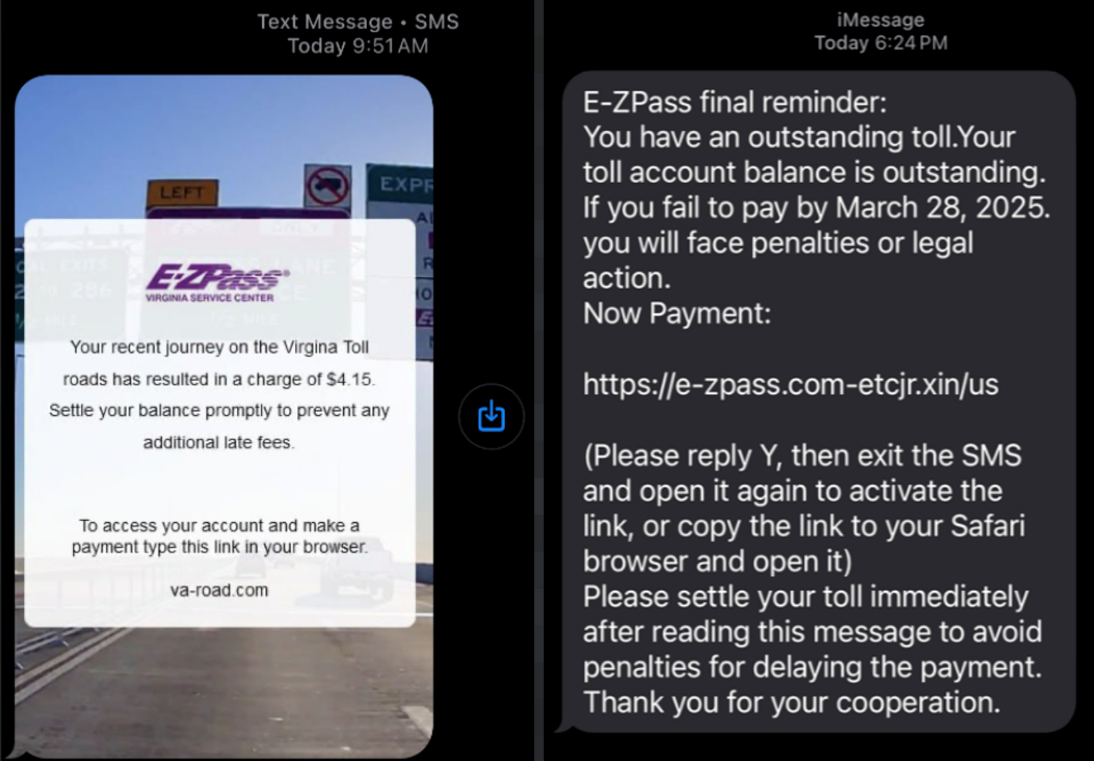
Since the middle of Oct. 2024, Talos has seen ongoing smishing attacks impersonating U.S toll road automatic payment services (such as E-ZPass) with the intent of financial theft. The actors have so far sent SMS messages to individuals in about eight states in the U.S., including Washington, Florida, Pennsylvania, Virginia, Texas, Ohio, Illinois and Kansas. Talos identified these states via spoofed domains containing the states’ two-letter abbreviations that we observed in the SMS messages. 

The actors send an SMS notification for an outstanding bill claiming that the potential victim owes a small amount of money, under $5 USD. They warn of potential late fees, prompting victims to visit a spoofed domain for the payment.  

Unraveling the U.S. toll road smishing scams
Sample phishing SMS messages. 

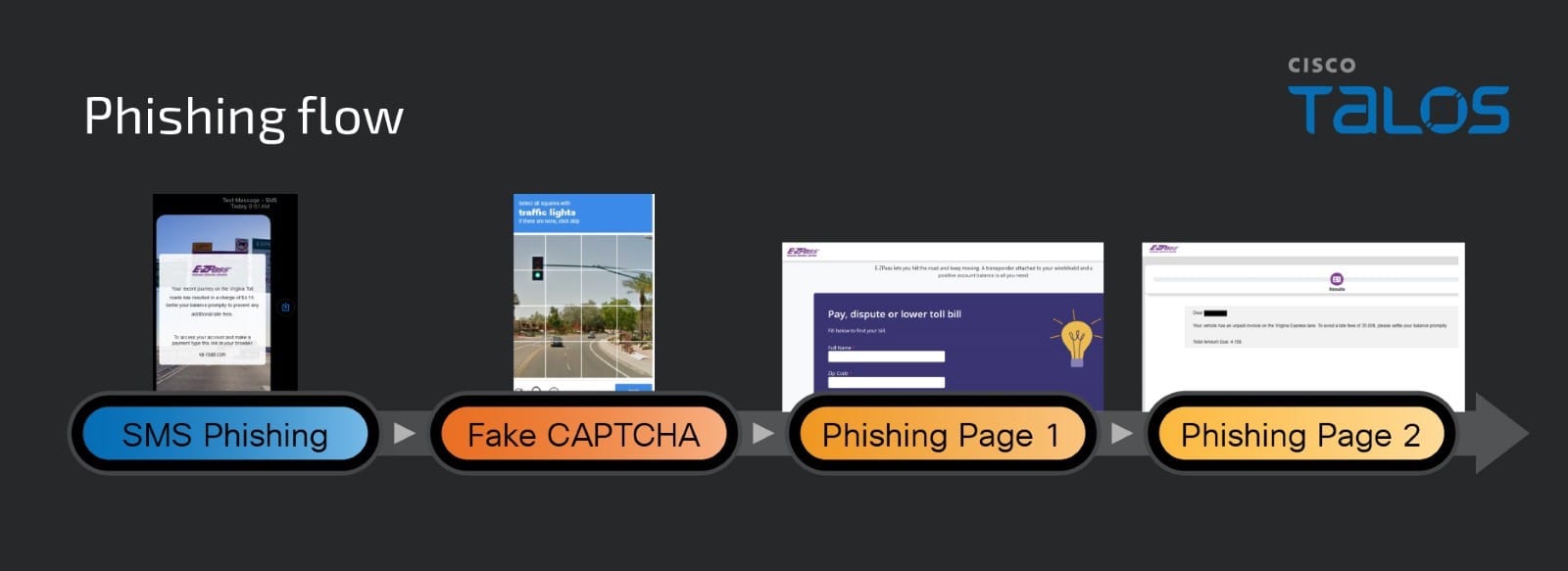
When the victim visits the domain, they are prompted to solve a fake image-based CAPTCHA, after which it redirects the victims to a fake webpage with the legitimate toll service’s logo. This webpage prompts the victims to enter their name and ZIP code to view their fake bill. The fake bill displays the victim’s name with a message showing that they owe approximately $4 and warning of a $35 late payment fee. 

Unraveling the U.S. toll road smishing scams

After the victim views their fake bill, they click the “Proceed Now” button which redirects them to another fake webpage. This site prompts the victim to enter their name, address, phone number and credit card information, which the threat actor eventually steals. Due to the limited visibility of the threat actor phishing infrastructure, Talos is unsure if there are any further payloads delivered to the victims’ devices. 

In April 2024, FBI’s Internet Crime Complaint Center (IC3) warned about a similar toll road smishing campaign where the threat actor used the same brand impersonation technique but with a slight difference in the SMS message language, monetary values and formatting. 

Targeting toll road users in multiple states indicates the likelihood of the threat actor leveraging user information publicly leaked from large databases. For example, the threat actor behind the 2024 National Public Data leak released billions of records publicly which were then shared on private Telegram channels for further abuse. However, Talos currently does not have any evidence to suggest that the toll road smishing campaign is fueled by the National Public Data leaks.  

Phishing infrastructure 

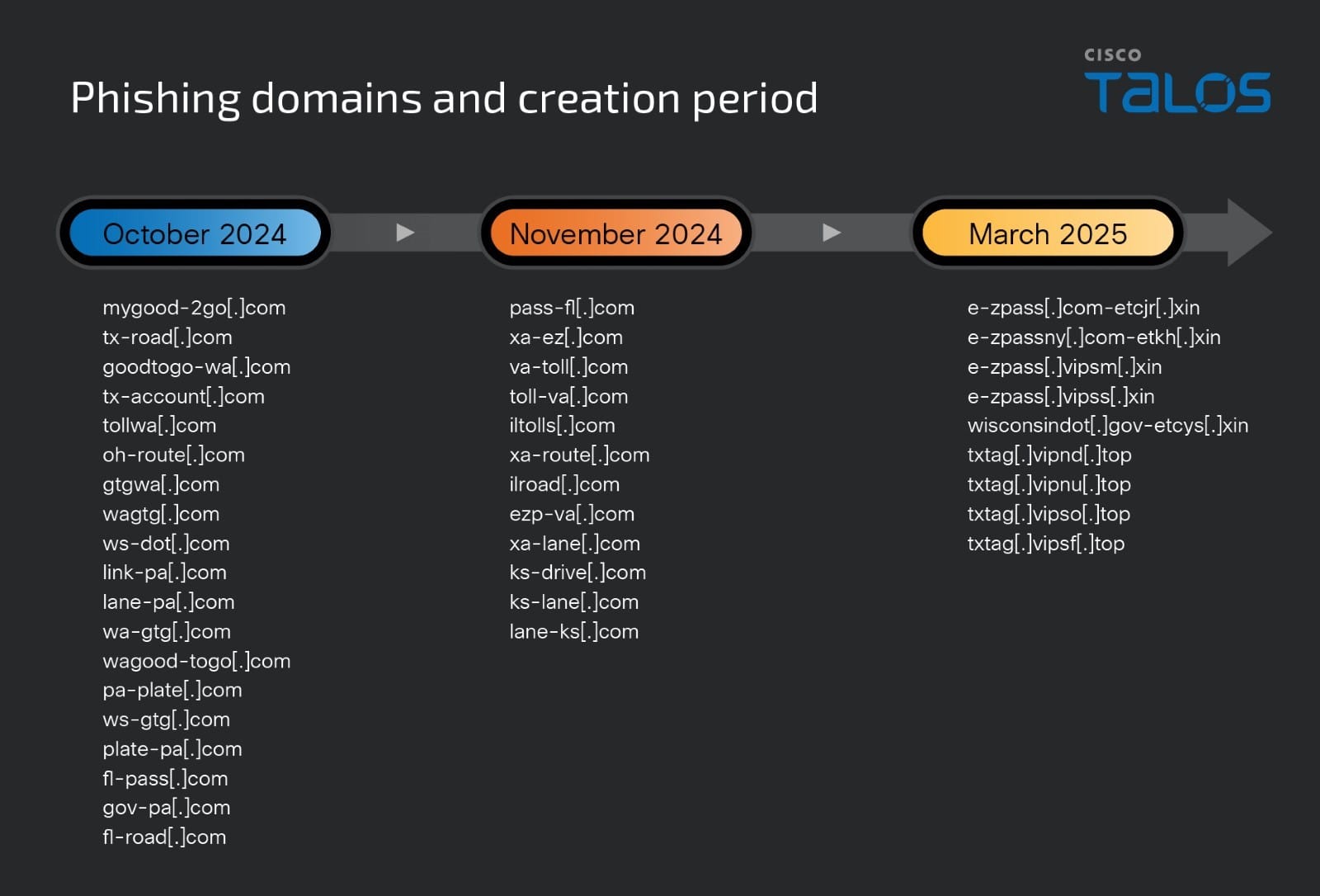
Talos observed that the actors have used several typosquatted domains in the SMS phishing messages to convince the potential victims to visit them. These typosquatted phishing domains were created during Oct. and Nov. 2024 and were observed resolving to one of the following IP addresses: 45[.]152[.]115[.]161 and 82[.]147[.]88[.]22.  

As of March 2025, Talos is still seeing new domains registered by the threat actors for the toll road scams, implying that the campaign is ongoing. During our research period, these newly registered domains resolved to the IP address 43[.]156[.]47[.]209. 

Unraveling the U.S. toll road smishing scams

Smishing kits likely used in the U.S. toll road scams 

Talos assesses with moderate confidence that multiple threat actors are operating the toll road smishing campaign by leveraging a smishing kit developed by the actor known as “Wang Duo Yu”, according to the intelligence obtained by Talos. 

We have observed similar smishing kits being used by the organized cybercrime group known as the “Smishing Triad.” This group has conducted large-scale smishing attacks targeting mail services in multiple countries, including the United States Postal Service (USPS), as well as the financial and commercial sectors previously reported by Resecurity

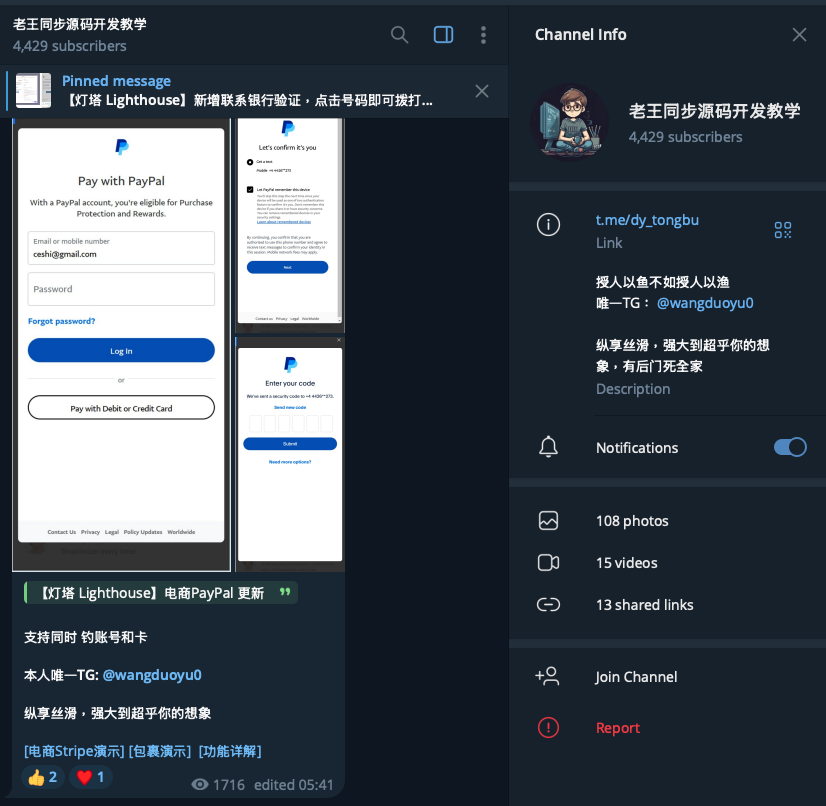
Talos discovered references to specific phishing kits that are targeting toll systems in the DY Tongbu Telegram channel on “老王同步源码开发教学” translated to “Lao Wang Synchronized Source Code Development Tutorial.”  

Unraveling the U.S. toll road smishing scams
Public Lao Wang Synchronized Source Code Development Tutorial Telegram channel.

The Telegram channel shared details about a phishing module that allegedly spoofs the Massachusetts MassDOT’s EZDriveMA toll system, as well as a phishing module that targets customers of the North Texas Toll Authority. At the time of publication, the Telegram channel had more than 4,400 subscribers. 

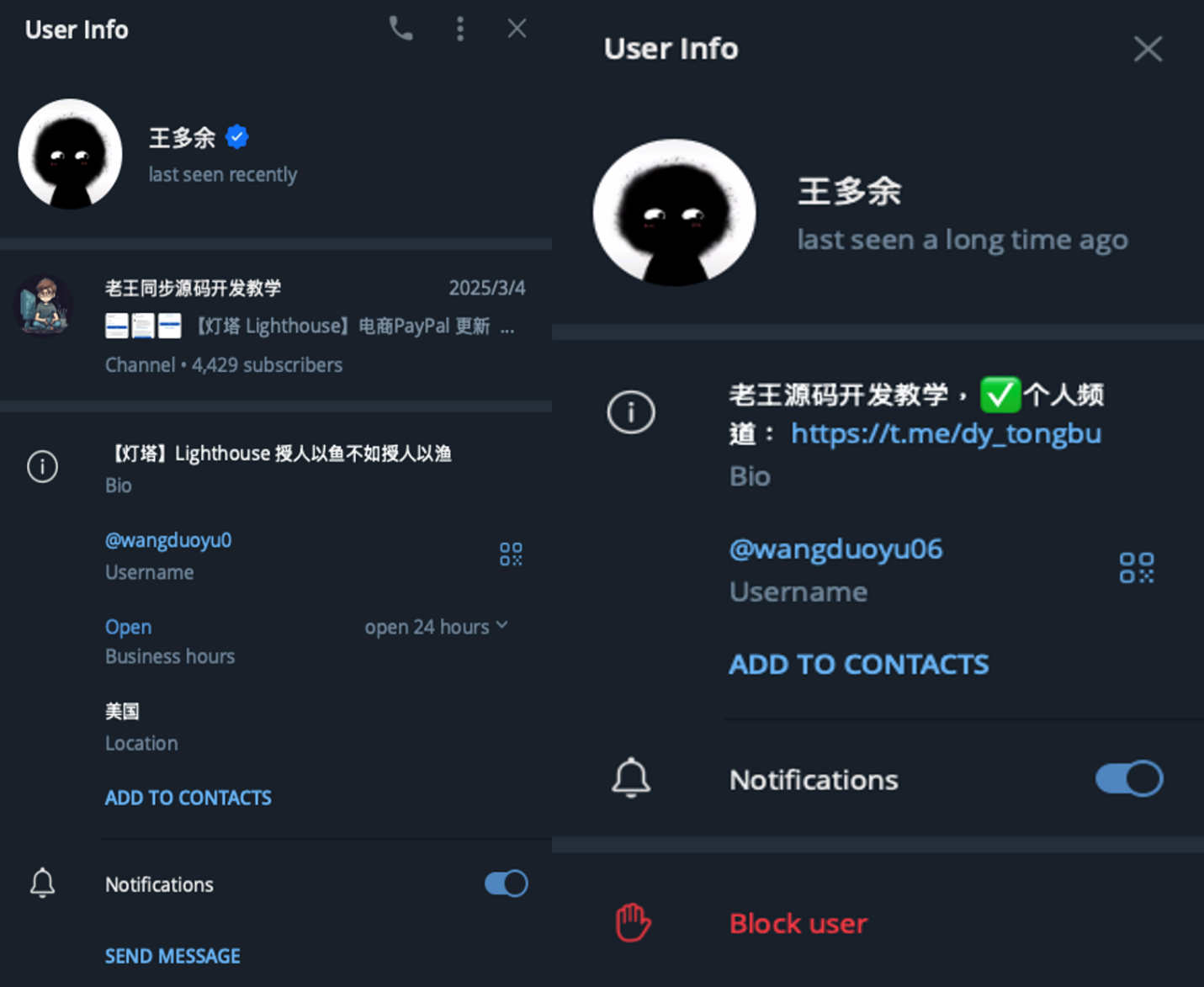
Further investigation has revealed that the developer, 王多余 (translated to Wang Duo Yu), has developed a similar smishing kit and operates the Lao Wang Synchronized Source Code Development Tutorial Telegram channel from two separate accounts. The pictures shown below display screenshots of the two telegram accounts related to Wang Duo Yu. 

Unraveling the U.S. toll road smishing scams
Two telegram accounts related to Wang Duo Yu. 

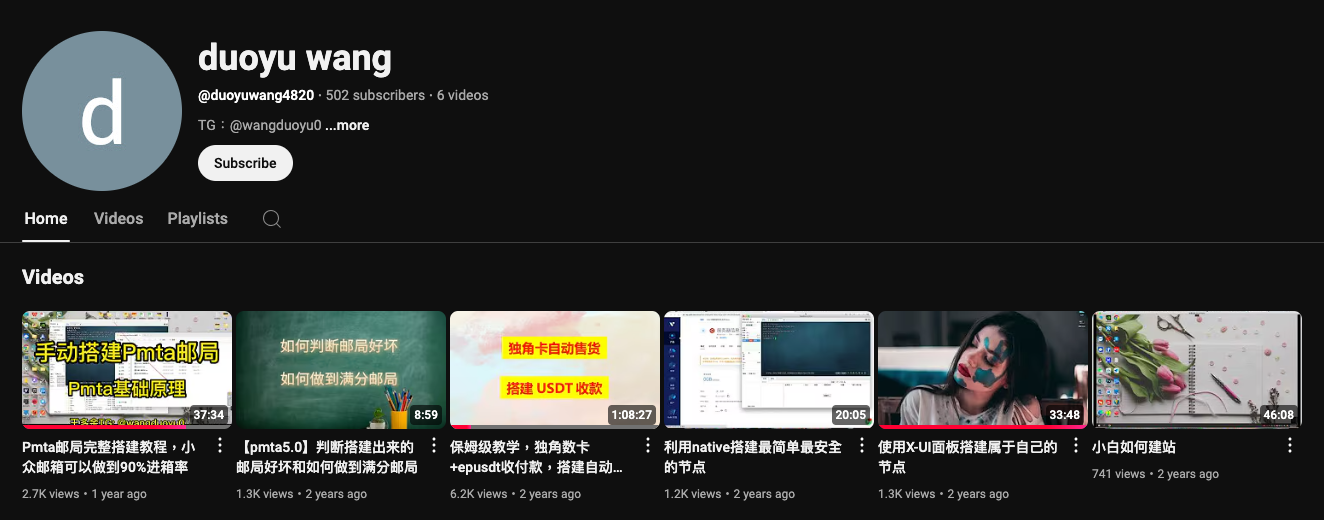
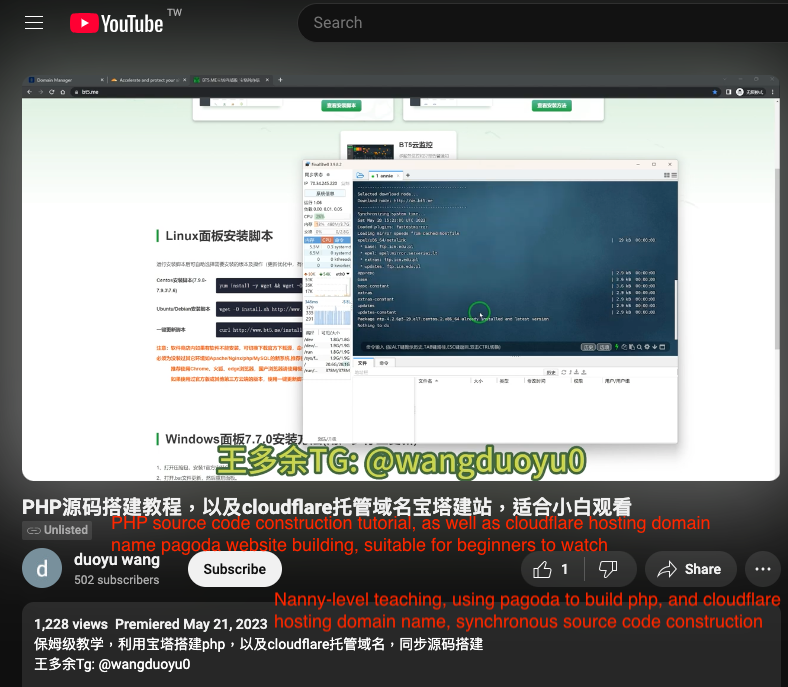
Additionally, we noticed that the developer has created a YouTube channel where they upload tutorial videos. These videos cover topics such as “How to Build a PMTA Mail Server,” “Setting Up an Automatic EPUSD Payment and Vending System,” “Creating a Pagoda Panel Website (宝塔面板),” “Building the Simplest and Safest Node Using Native Tools,” and “Using the X-UI Panel to Set Up a VMess+WS+TLS+Web or VLess+WS+TLS+Web Node.”  Each video guides users on building basic web services or mail servers. 

Unraveling the U.S. toll road smishing scams
Wang Duo Yu’s YouTube channel. 

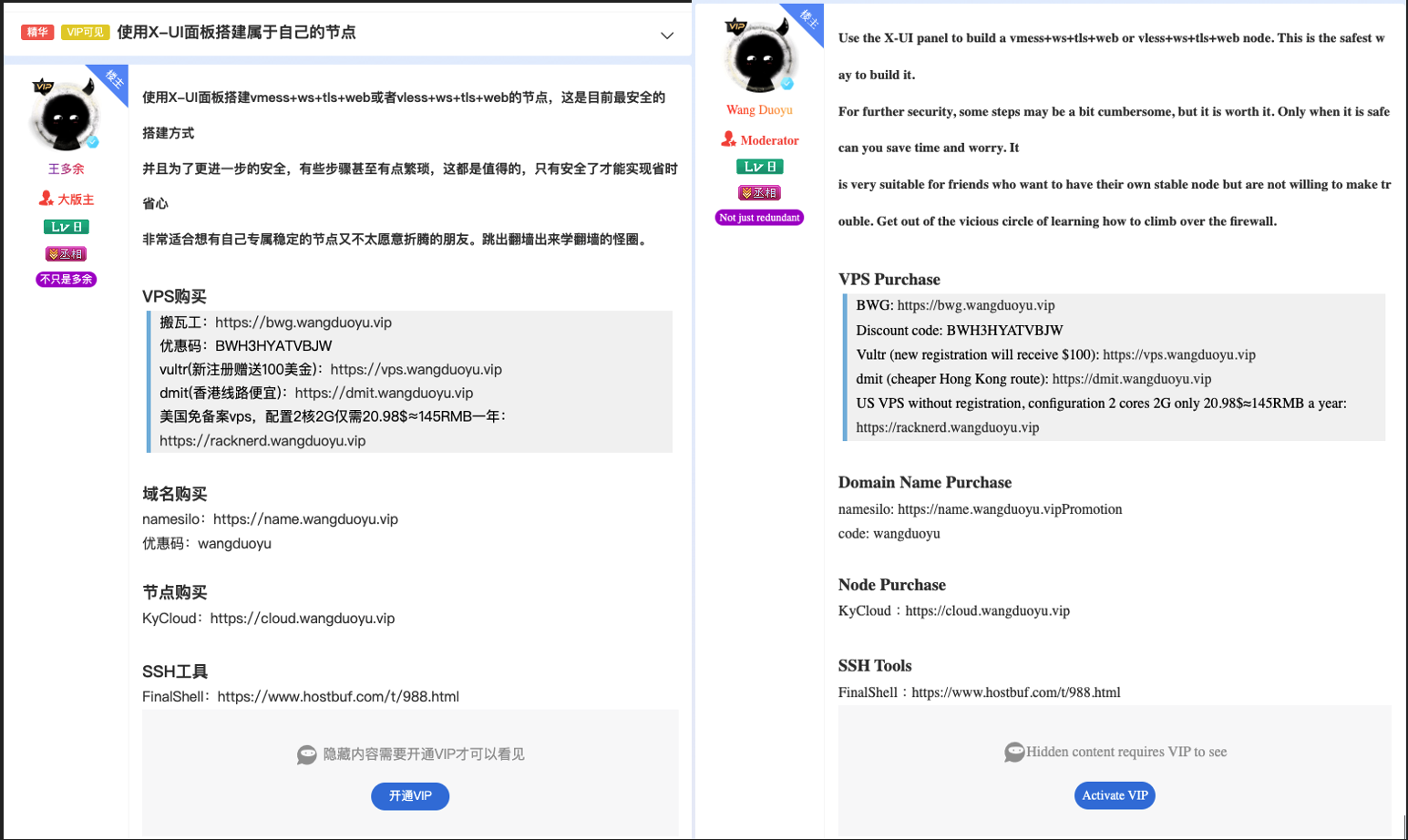
There are also some private video links that cannot be found elsewhere. Talos found one such video on a Chinese forum. To access the post with the video link, users need special permissions in that forum. 

Unraveling the U.S. toll road smishing scams
Wang Duo Yu’s YouTube channel with private video. 

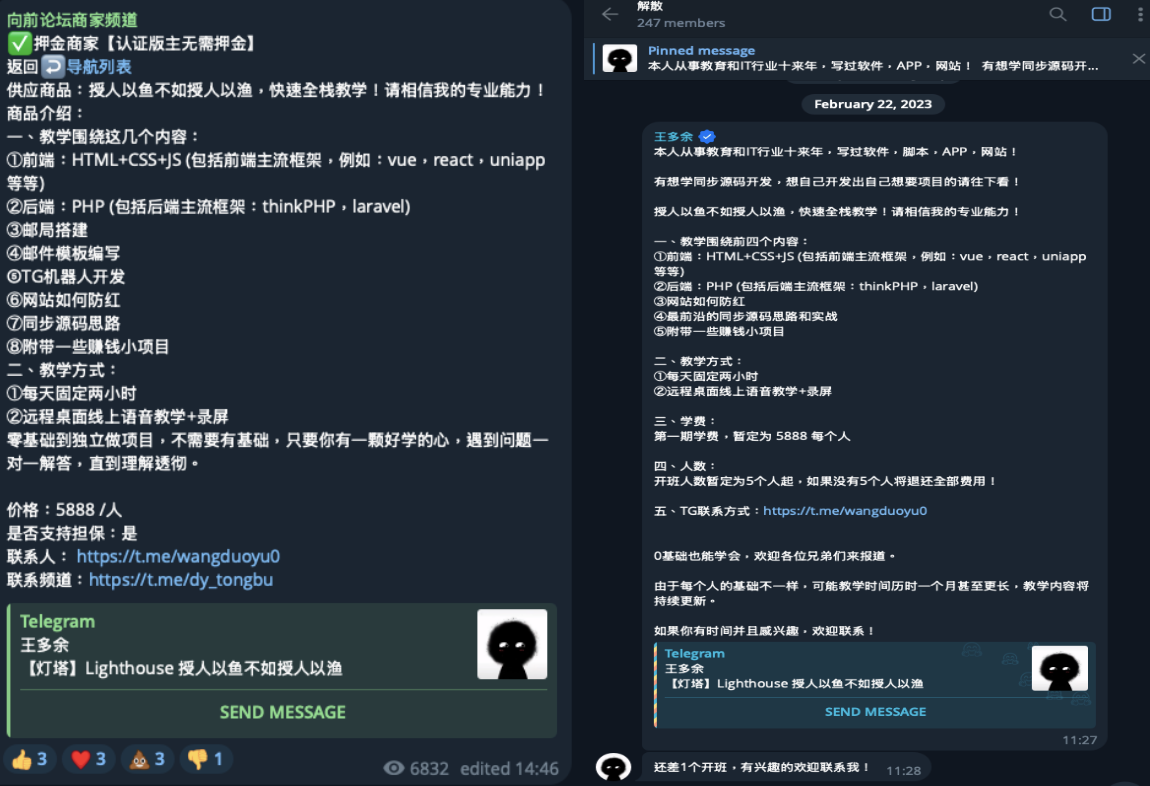
We also observed Wang Duo Yu promoting their smishing kits business and tutorials on other Telegram channels, also offering personal lessons that include full-stack development, mail server setup and Telegram bot development. The threat actor offers a two-hour lesson each day and provides one-on-one instruction via remote desktop, charging ¥5888 (converting to approx. US $806 at time of publication) per class. 

Unraveling the U.S. toll road smishing scams
Wang Duo Yu marketing the kits in telegram channels. 

One of the Telegram channels shown in the above picture is called, “向前论坛,” translating to ” Xiangqian Forum,” of which Wang Duo Yu is a moderator. Wang Duo Yu posted articles in this forum to increase subscribers, promoted their own teaching courses, and provided links and discount codes for purchasing VPS and domains. 

Unraveling the U.S. toll road smishing scams
Wang Duo Yu selling the VPS and cloud services through his website. 

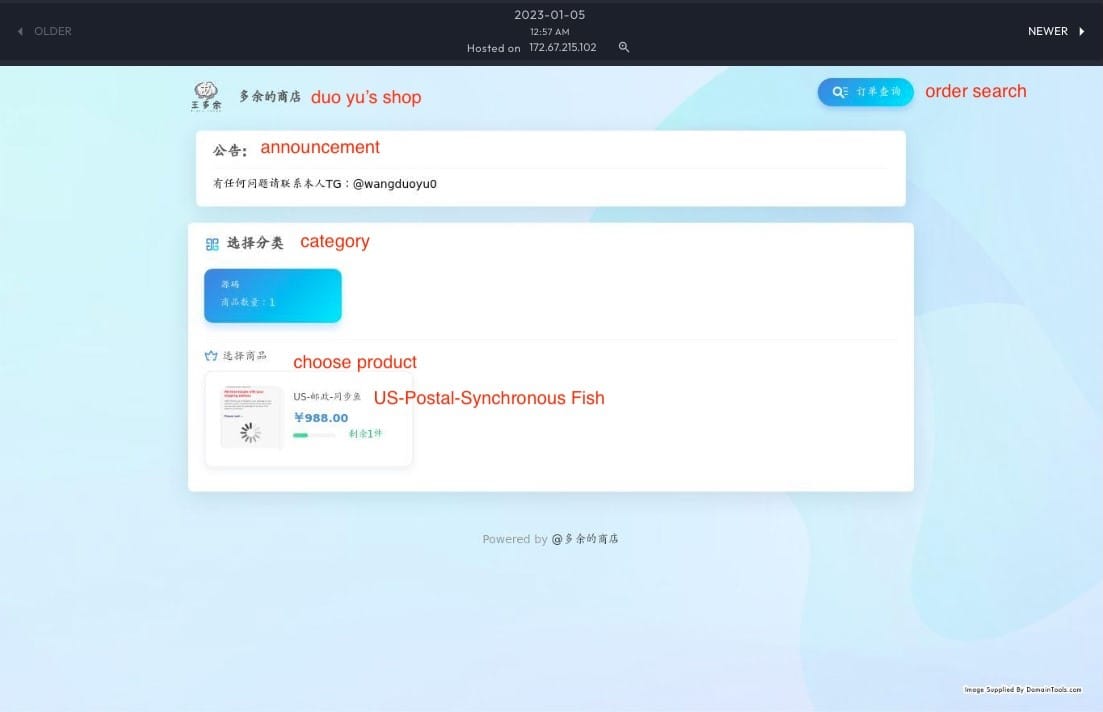
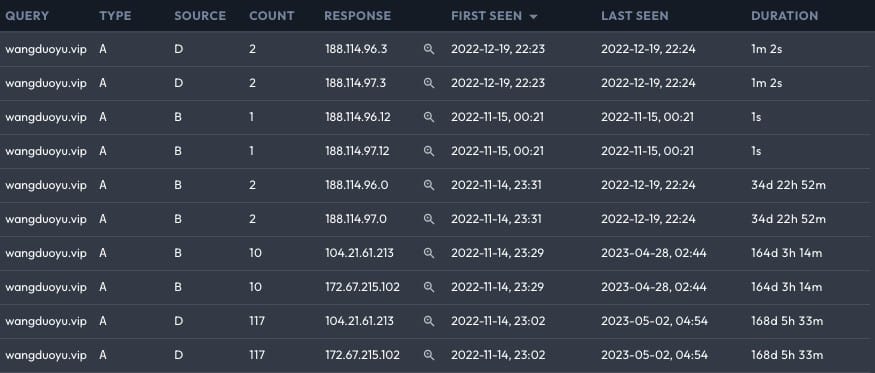
We also found an additional website selling the VPS and cloud services, confirmed to be owned by Wang Duo Yu.  The “wangduoyu[.]vip” website was active from 2022 to 2023. 

Unraveling the U.S. toll road smishing scams
Wang Duo Yu’s shop website. 
Unraveling the U.S. toll road smishing scams
Wang Duo Yu’s shop DNS resolved IPs and active periods of time. 

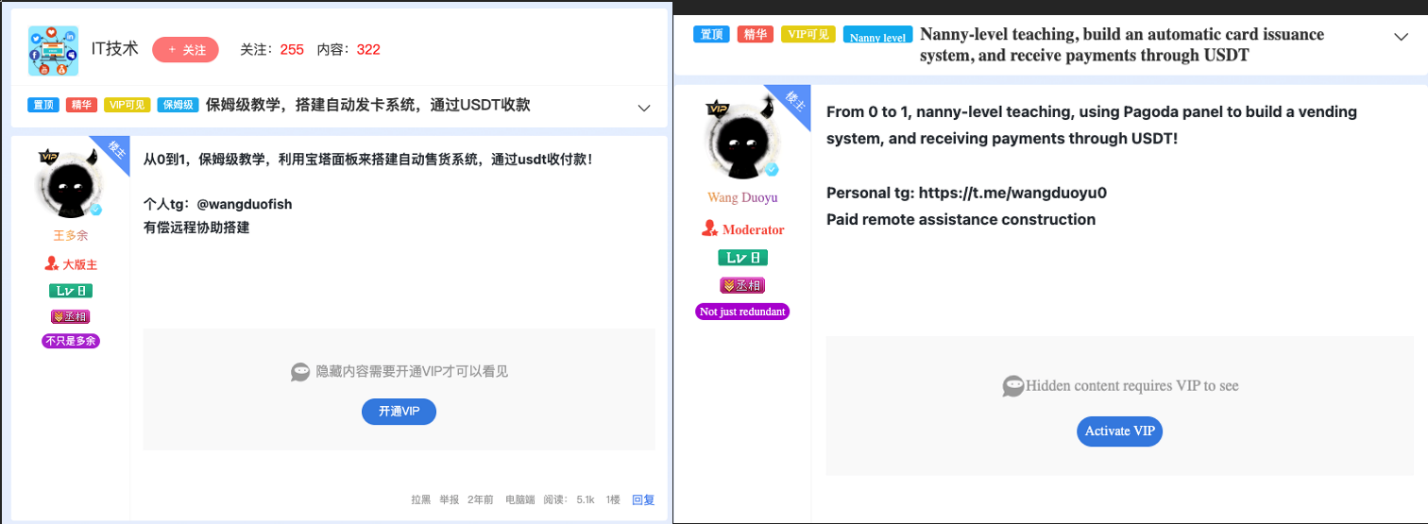
We observed that Wang Duo Yu offers the toll smishing kit source code for sale and provides services to assist in setting up the whole system. In a forum post, they stated that anyone interested can reach out to their personal Telegram account “@wangduofish”. The post also includes hidden content only visible to users with VIP access. 

Unraveling the U.S. toll road smishing scams
Wang Duo Yu’s post includes hidden content only visible with VIP access. 

Wang Duo Yu has crafted and designed specific smishing kits and has been selling access to these kits on their Telegram channels. The kits are available with different infrastructure options, priced at US $50 each for a full-feature development, $30 each for proxy development (when the customer has a personal domain and server), $20 each for version updates, and $20 for all other miscellaneous support. The threat actor also offers updated releases for multiple source code versions. The offers on the Telegram channel revealed that the smishing kits and source code primarily target large public-facing entities with a large end-userbase, such as toll road operators, banks and postal services. 

Coverage

Unraveling the U.S. toll road smishing scams

Cisco Secure Endpoint (formerly AMP for Endpoints) is ideally suited to prevent the execution of the malware detailed in this post. Try Secure Endpoint for free here

Cisco Secure Email (formerly Cisco Email Security) can block malicious emails sent by threat actors as part of their campaign. You can try Secure Email for free here

Cisco Secure Firewall (formerly Next-Generation Firewall and Firepower NGFW) appliances such as Threat Defense Virtual, Adaptive Security Appliance and Meraki MX can detect malicious activity associated with this threat. 

Cisco Secure Network/Cloud Analytics (Stealthwatch/Stealthwatch Cloud) analyzes network traffic automatically and alerts users of potentially unwanted activity on every connected device. 

Cisco Secure Malware Analytics (Threat Grid) identifies malicious binaries and builds protection into all Cisco Secure products. 

Cisco Secure Access is a modern cloud-delivered Security Service Edge (SSE) built on Zero Trust principles.  Secure Access provides seamless transparent and secure access to the internet, cloud services or private application no matter where your users work. Please contact your Cisco account representative or authorized partner if you are interested in a free trial of Cisco Secure Access. 

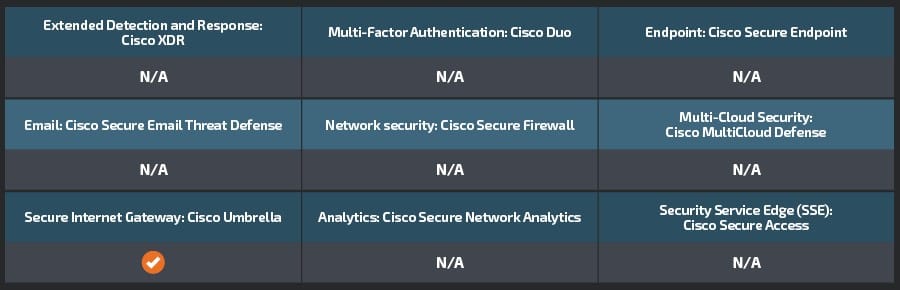
Umbrella, Cisco’s secure internet gateway (SIG), blocks users from connecting to malicious domains, IPs and URLs, whether users are on or off the corporate network.  

Cisco Secure Web Appliance (formerly Web Security Appliance) automatically blocks potentially dangerous sites and tests suspicious sites before users access them.  Additional protections with context to your specific environment and threat data are available from the Firewall Management Center

Cisco Duo provides multi-factor authentication for users to ensure only those authorized are accessing your network. 

Indicators of Compromise  

IOCs for this threat can be found in our GitHub repository here

Cisco Talos Blog – ​Read More

Juniper Networks Patches Dozens of Junos Vulnerabilities

Juniper Networks has patched two dozen vulnerabilities in Junos OS and Junos OS Evolved, and dozens of flaws in Junos Space third-party dependencies.

The post Juniper Networks Patches Dozens of Junos Vulnerabilities appeared first on SecurityWeek.

SecurityWeek – ​Read More