Forget the Stack; Focus on Control
Security teams are under more pressure than ever — and cybersecurity debt is adding fuel to the fire. While it can’t be eliminated overnight, it can be managed.
darkreading – Read More

Security teams are under more pressure than ever — and cybersecurity debt is adding fuel to the fire. While it can’t be eliminated overnight, it can be managed.
darkreading – Read More
About 20 percent of the logistics workers for U.K. retail giant M&S were told they could stay home as the company responded to a cyberattack.
The Record from Recorded Future News – Read More
Using Linux is a good start – but it is not enough. These easy privacy tricks could mean the difference between secure and sorry.
Latest stories for ZDNET in Security – Read More
Toronto, Canada, 28th April 2025, CyberNewsWire
Hackread – Latest Cybersecurity, Hacking News, Tech, AI & Crypto – Read More
Not every security vulnerability is high risk on its own – but in the hands of an advanced attacker, even small weaknesses can escalate into major breaches. These five real vulnerabilities, uncovered by Intruder’s bug-hunting team, reveal how attackers turn overlooked flaws into serious security incidents.
1. Stealing AWS Credentials with a Redirect
Server-Side Request Forgery (SSRF) is a
The Hacker News – Read More
Planet Technology industrial switches and network management products are affected by several critical vulnerabilities.
The post Critical Vulnerabilities Found in Planet Technology Industrial Networking Products appeared first on SecurityWeek.
SecurityWeek – Read More
JokerOTP dismantled after 28,000 phishing attacks across 13 countries; UK and Dutch police arrest two suspects linked to £7.5M cyber fraud.
Hackread – Latest Cybersecurity, Hacking News, Tech, AI & Crypto – Read More
“I’m giving away $125 000! Join the project via the link in my profile!” — suddenly, a popular Russian blogger launches a massive cash giveaway on Instagram. A familiar face, speaking in upbeat voice and confident tone, appears in Stories. It all looks too good to be true…
That’s because it is. There’s no real project. The blogger didn’t launch anything. Her account was simply hijacked. And the scammers went beyond the usual tricks: not only did they steal access and post a fake giveaway link, but they also stitched together a new video from old footage and dubbed it with a voice generated by neural networks. Read the whole story to learn how Instagram accounts are stolen by swapping SIM cards — and what you can do to protect yourself.
With the rise of AI tools, scammers have suddenly gotten “smarter”. Before, having hacked a blogger, they’d have just posted phishing links and hoped the audience would bite. Now they can run full-fledged PR campaigns from the stolen account. Here’s what the scammers did this time:
All this lends the fake project an air of legitimacy — since bloggers often use content like this across different formats to promote real initiatives. The scammers spared no effort — even throwing in some testimonials from grateful fans; fake ones, of course.

Fake testimonials aimed at encouraging more fans to participate
Let’s take a closer look at the video. At first glance, it’s surprisingly high-quality. It follows all the blog’s rules: the blog’s topic (home renovation), voiceover narration, quick editing. But upon closer examination, the illusion is shattered. Check out the screenshot below: only one video has a watermark in the top-left corner — from the free version of the editing app CapCut. That’s the fake. The other videos don’t have this watermark — because the real blogger either uses the premium version or edits with another app.

The first video is the fake one created by the scammers
There’s another detail: the subtitles. In all her real videos, the blogger uses plain white text with no background. In the fake video, the text is white on a black background. Sure, bloggers sometimes change their style, but usually settings like font and color are saved in their editing software and stay consistent.
Here’s where it gets interesting. What kind of “project” exactly were the scammers promoting, and what happens if you click the link?
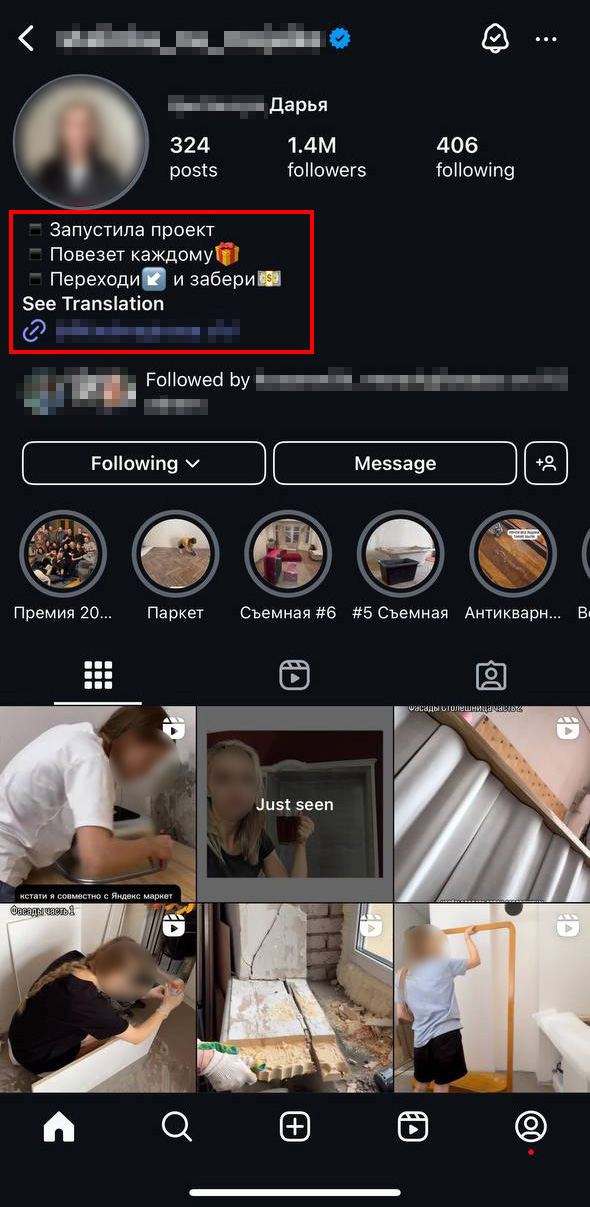
The bio looks suspicious
If you’re using a device without reliable protection (which would warn you if you try to visit a phishing site), you’ll land on a very basic page: a flashy image, some eye-catching text, and a Claim your prize button. Clicking such buttons typically leads to one of two outcomes: you’ll be asked to pay a commission, or prompted to enter your data — purportedly to receive your winnings. In any case, you’ll be asked to share your bank details. Of course, no prize is coming — it’s pure phishing.

A girl with dollars and a smartphone symbolizes the riches that await… the scammers after they steal your banking account
Important: there’s no official version of how the account was compromised yet. It’s a high-profile case, and the blogger has reported it to the police. She currently suspects she fell victim to a SIM-swap attack. In short, this means that the scammers convinced her mobile provider to transfer her phone number to a new SIM card. There are two main ways this can be done:
SIM swapping allowed scammers to bypass two-factor authentication and convince Instagram support that they were the real account owners. Similar tricks can be used with any service that sends verification codes via text — including online banks.
As for the blogger’s original SIM card, it instantly turned into a useless piece of plastic: no internet, no calls, no texts.
Here are the basic rules to prevent most types of account hacks — whether on messaging apps, social networks, forums, or other sites:
More to read on protecting your accounts from hacking:
Kaspersky official blog – Read More
Records reviewed by WIRED show law enforcement agencies are eager to take advantage of the data trails generated by a flood of new internet-connected vehicle features.
Security Latest – Read More
Government and telecommunications sectors in Southeast Asia have become the target of a “sophisticated” campaign undertaken by a new advanced persistent threat (APT) group called Earth Kurma since June 2024.
The attacks, per Trend Micro, have leveraged custom malware, rootkits, and cloud storage services for data exfiltration. The Philippines, Vietnam, Thailand, and Malaysia are among the
The Hacker News – Read More