
Mamona: Technical Analysis of a New Ransomware Strain

Editor’s note: The current article is authored by Mauro Eldritch, offensive security expert and threat intelligence analyst. You can find Mauro on X. 

These days, it’s easy to come across new ransomware strains without much effort. But the ransomware threat landscape is far broader than it seems, especially when you dive into the commodity ransomware scene. This type of ransomware is developed by a group that sells a builder to third-party operators, with no formal agreement or contract between them, unlike the more organized Ransomware-as-a-Service (RaaS) model. 

On this side of the fence, we see countless new products appearing on the cybercrime shelf every day. They’re much harder to track, as victims, strains, infrastructure, and builds often have no direct connection to each other. 

Let’s take a look at one of them: Mamona Ransomware. Never heard of it? That’s probably because it’s a new strain but despite its short lifespan, it has already made some noise. It’s been spotted in campaigns run by BlackLock affiliates (who are also linked to Embargo), one of its online builders was exposed and later leaked on the clearnet, and the DragonForce group even stole the main website’s .env file, publishing it on their Dedicated Leak Site on Tor under the headline: “Is this your .env file?” 

So, let’s find out what this is all about. 
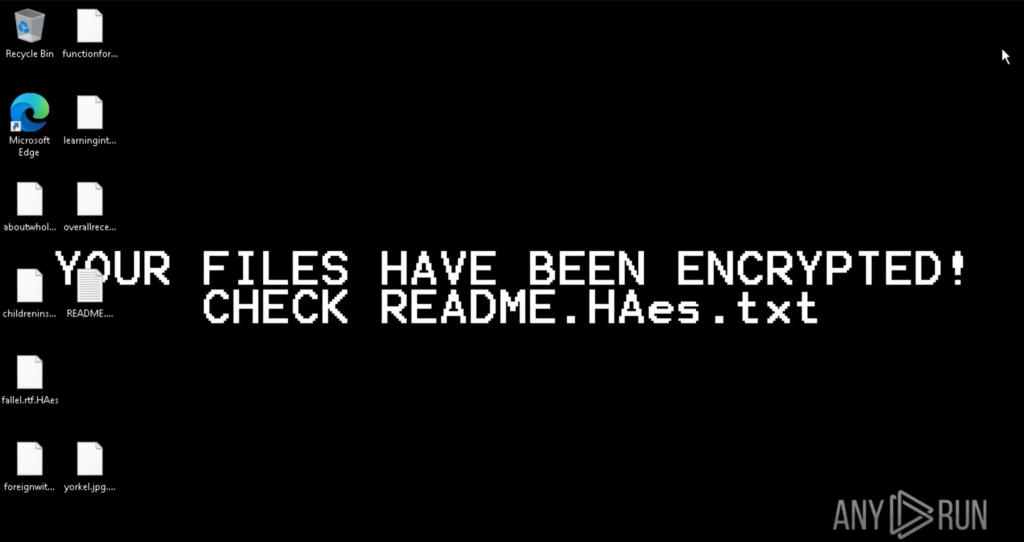
Mamona Ransomware in action

Mamona Ransomware: Key Takeaways 

  • Emerging threat: Mamona is a newly identified commodity ransomware strain. 
  • No external communication: The malware operates entirely offline, with no observed Command and Control (C2) channels or data exfiltration. 
  • Local encryption only: All cryptographic processes are executed locally using custom routines, with no reliance on standard libraries. 
  • Obfuscated delay technique: A ping to 127[.]0.0[.]7 is used as a timing mechanism, followed by a self-deletion command to minimize forensic traces. 
  • False extortion claims: The ransom note threatens data leaks, but analysis confirms there is no actual data exfiltration. 
  • File encryption behavior: User files are encrypted and renamed with the .HAes extension; ransom notes are dropped in multiple directories. 
  • Decryption available: A working decryption tool was identified and successfully tested, enabling file recovery. 
  • Functional, despite poor design: The decrypter features an outdated interface but effectively restores encrypted files. 

This emerging ransomware can be clearly observed within ANY.RUN’s cloud-based sandbox environment. You can explore a full analysis session below for a detailed visual breakdown. 

View analysis session with Mamona ransomware 

Offline and Dangerous: Mamona’s Silent Tactics 

When you hear about ransomware, your first educated guess is usually a threat that comes from the outside, exfiltrates sensitive files, encrypts the local versions, and then demands a ransom. Pretty much the full ransomware cycle. But this one is different. it has no network communication at all, acting surprisingly as a mute ransomware. So far, the only connections it attempts are local, plus one to port 80 (HTTP), where no data is actually sent or received. 
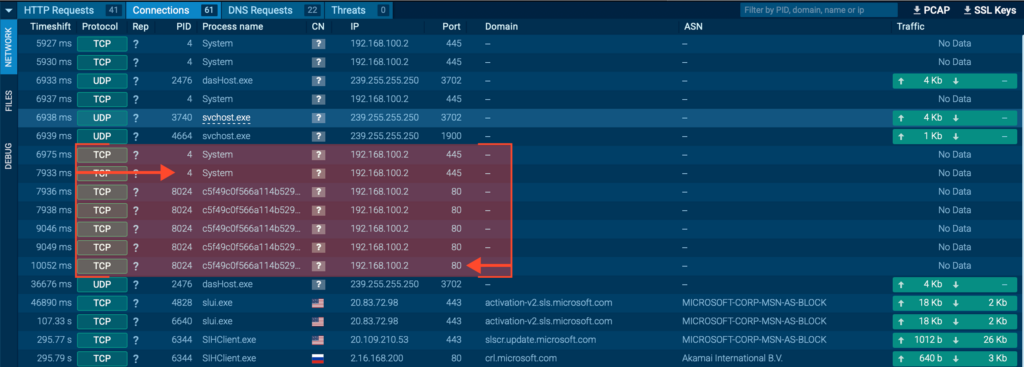
A connection to port 80 is attempted, but not established 

This lack of network communication strongly suggests that the encryption key is either generated locally on the fly or hardcoded within the binary itself. In the medium term, this increases the chances of reverse-engineering a working decrypter which, fortunately, we already have in this case. 

A closer look reveals that the encryptor relies entirely on homemade routines. There are no calls to standard cryptographic libraries, no use of the Windows CryptoAPI, and no references to external modules like OpenSSL. Instead, all cryptographic logic is implemented internally using low-level memory manipulation and arithmetic operations. 

Speed up and simplify analysis of malware and phishing threats with ANY.RUN’s Interactive Sandbox 


Sign up with business email


One key routine is located at internal offsets such as 0x40E100. This function is repeatedly called after pushing registers and buffer pointers to the stack and exhibits patterns typical of custom symmetric logic. 
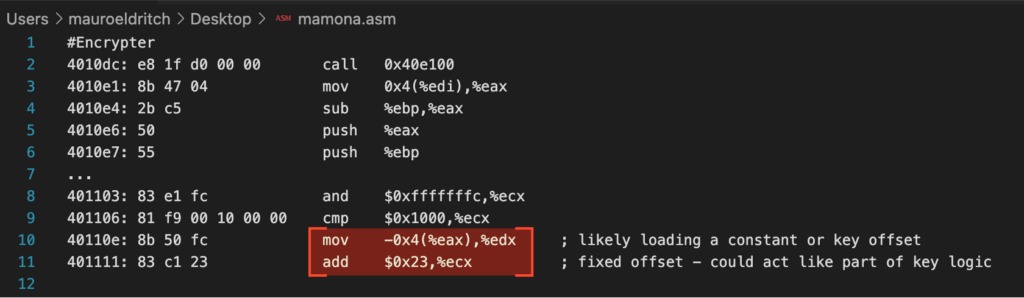
Custom encryption logic with no standard crypto 

The symmetric structure reinforces the hypothesis of a static or trivially derived key, making Mamona a strong example of commodity ransomware that prioritises simplicity over cryptographic robustness. 

Still, just because this malware doesn’t communicate with external hosts doesn’t mean it can’t cause serious local damage. Let’s take a closer look. 

How Mamona Executes Its Attack 

The first thing Mamona does is execute a ping command as a crude time delay mechanism, chaining it with a self-deletion routine via cmd.exe. 

The use of ping 127[.]0.0[.]7 is a classic trick in commodity malware: instead of using built-in sleep APIs or timers (which can be flagged by behavioural monitoring), the malware sends ping requests to a loopback IP address, effectively pausing execution.  

Interestingly, it uses 127[.]0.0[.]7 instead of the more common 127[.]0.0[.]1, likely as a basic form of obfuscation. It’s still within the reserved localhost block (127[.]0.0[.]0/8) but may bypass simple detection rules that specifically target 127[.]0.0[.]1. 
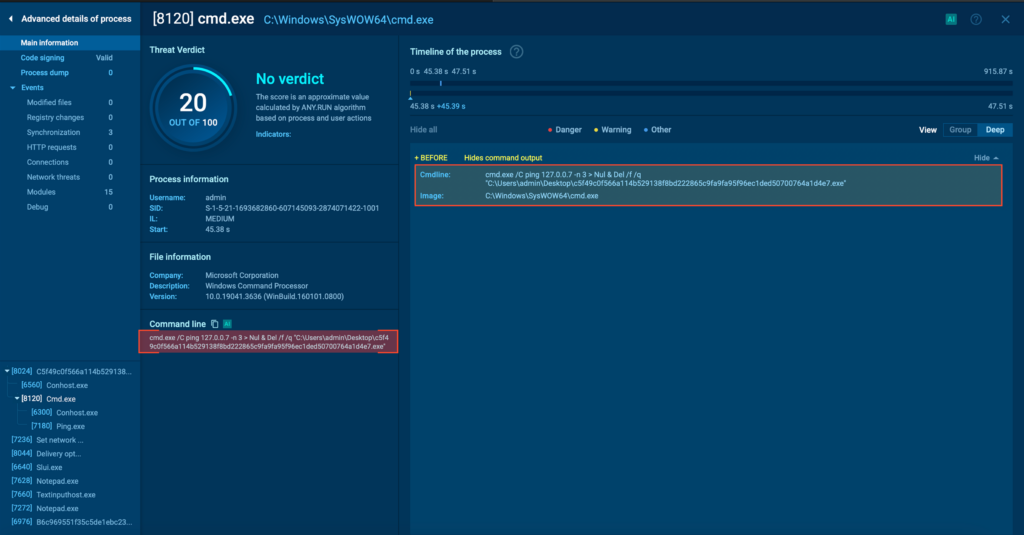

A crude yet useful delay mechanism

Once the short delay is complete, the second part of the command attempts to delete the executable from disk using Del /f /q. Since a process can’t delete itself while it’s still running, this whole sequence is executed in a separate shell process. This is a simple but effective form of self-cleanup, aimed at reducing forensic traces post-infection. 
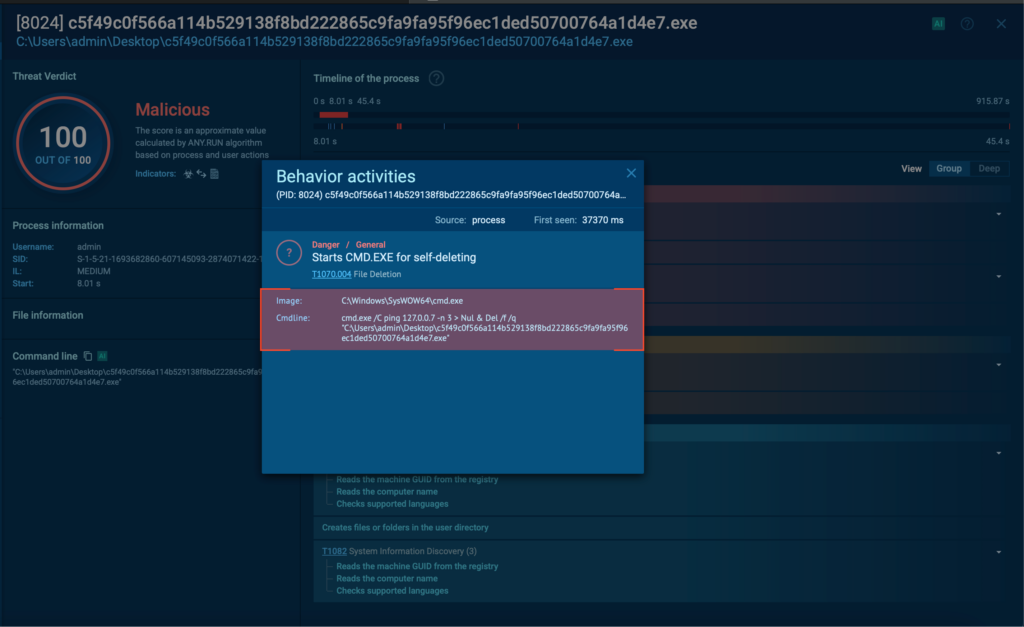
Even if the mechanism isn’t simple, ANY.RUN understands the hidden intention and flags the behavior

Mamona begins with a straightforward reconnaissance phase, harvesting basic host data like the system’s name and configured language. It then proceeds to drop a ransom note (README.HAes.txt) not only on the Desktop, but recursively inside multiple folders, increasing the chances the victim will see it. 
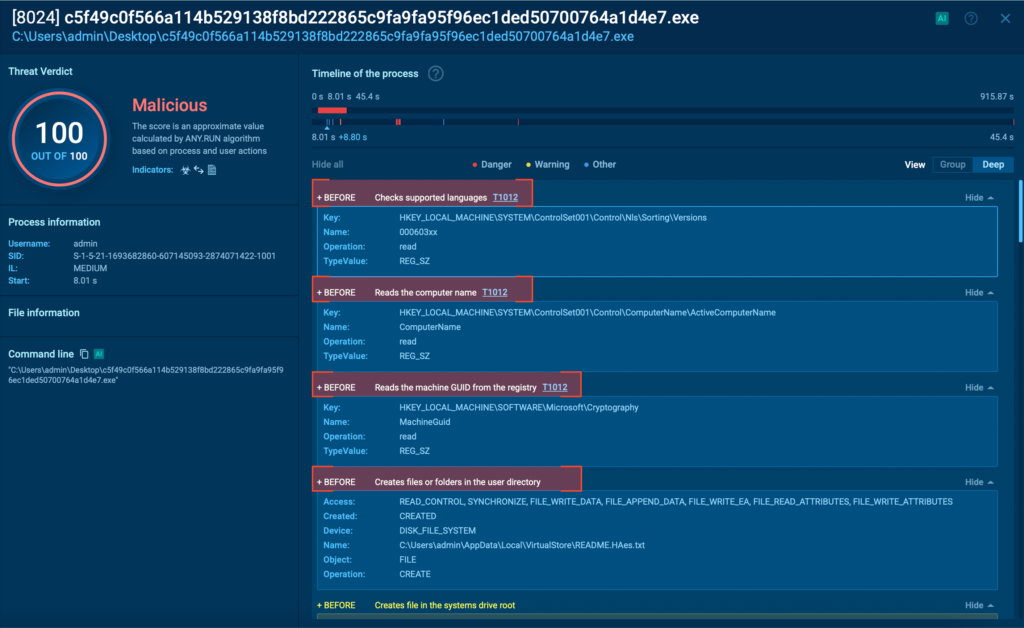
Recon routine and ransom note dropping

Following the ransom note deployment, Mamona begins encrypting user files, renaming them with the .HAes extension and making them inaccessible. To reinforce the impact, it changes the system wallpaper to a stark warning: “Your files have been encrypted!” 
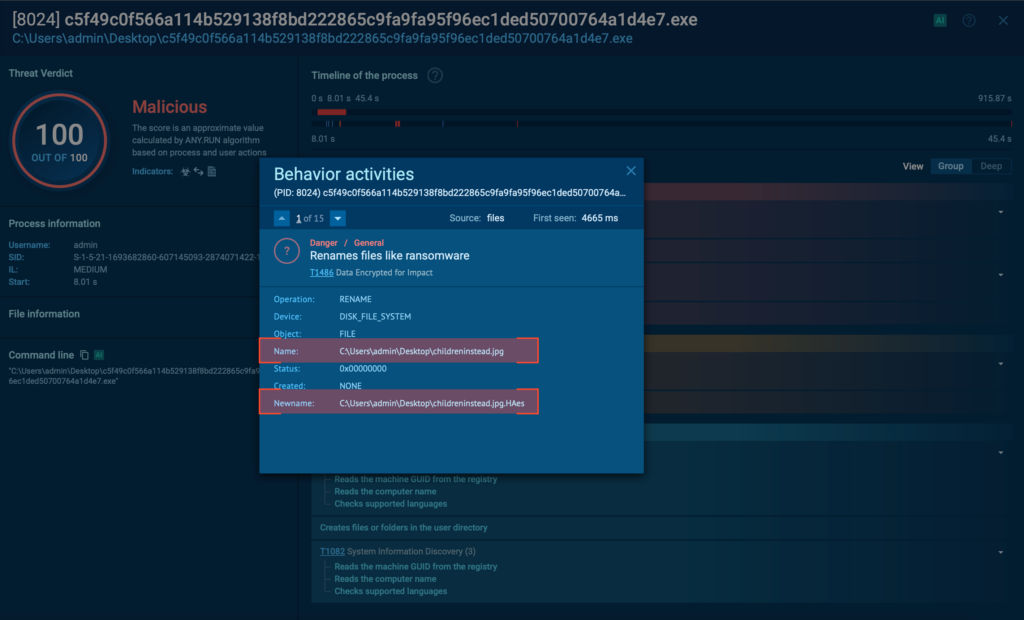
Files receive a new extension

The ransom note shares links to a dedicated leak site (DLS) and a victim’s chat support, both on Tor. Also, it states that “we have stolen a significant amount of your important files from your network” and “Refuse to pay: your stolen data will be published publicly” but that actually does not happen, as we discussed earlier. There’s literally no network activity so this seems to be a threat to coerce the victim into paying the ransom. 
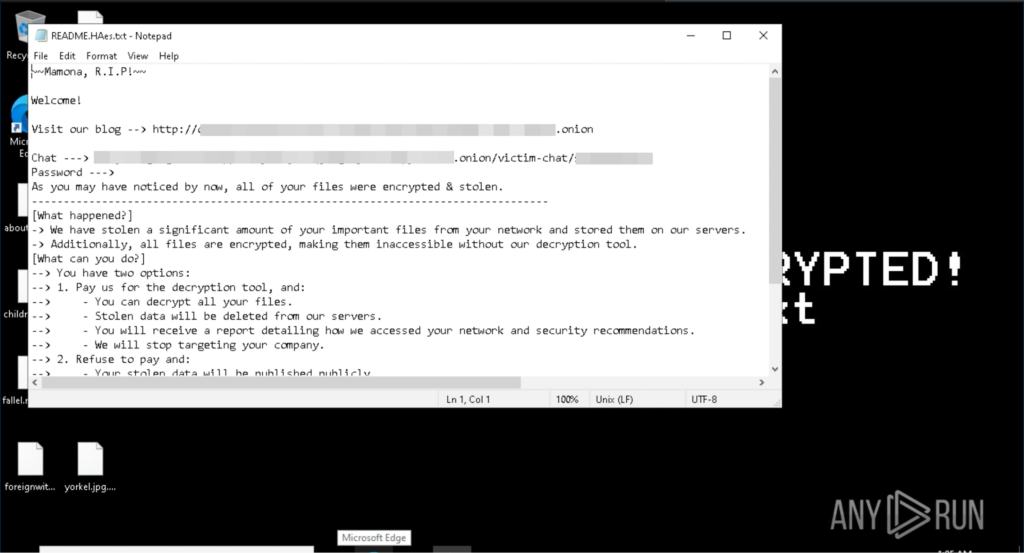
“Mamona, R.I.P!”. Ransom note, with a couple of lies

But we have an ace up our sleeve. For this engagement, alongside the malware sample, we also managed to obtain a decrypter thanks to Merlax, a friend and fellow malware researcher. Let’s take a look at how it works. 

Undoing Mamona’s Damage 

We’re dealing with a Ctrl-Z in .exe form, so let’s give it a chance and see how it performs. Visually, it’s a mess: the interface looks like a homemade project built with an older version of Visual Studio. UI elements are poorly rendered, often misaligned or clipping outside window boundaries.  

But the backend does its job far better than the frontend, and the files are back to normal. 
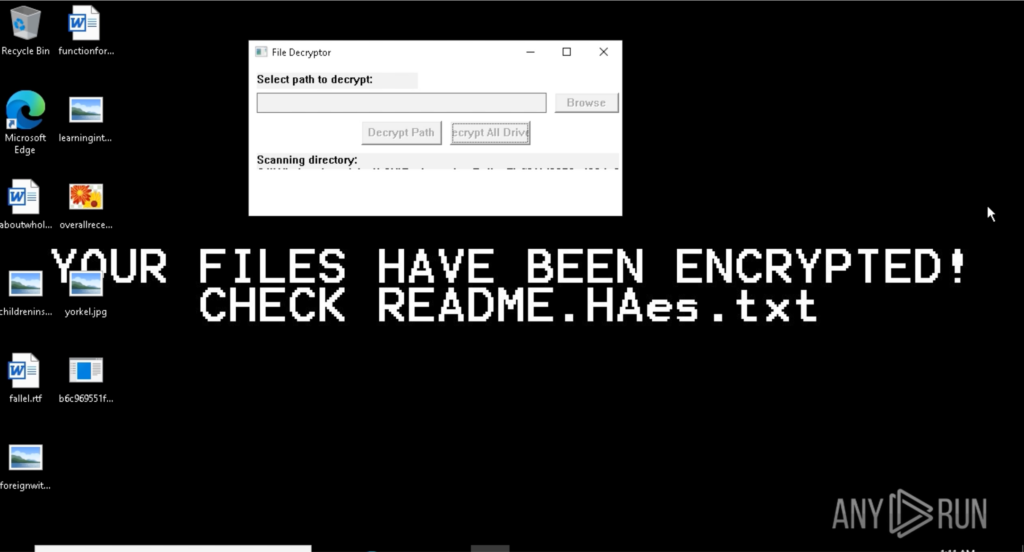
Files on the desktop went back to normal

By analysing the decrypter, we find an interesting internal function at offset 0x40C270. Much like in the ransomware sample, we observe a series of low-level operations: alignment to 4-byte boundaries (and $0xfffffffc, %ecx), fixed memory offsets (add $0x23), and repeated use of instructions such as mov, lea, and arithmetic operations, all indicative of a custom-built symmetric routine. 

Despite the absence of a traditional XOR operation, the logic appears reversible and consistent with homemade encryption mechanisms. 
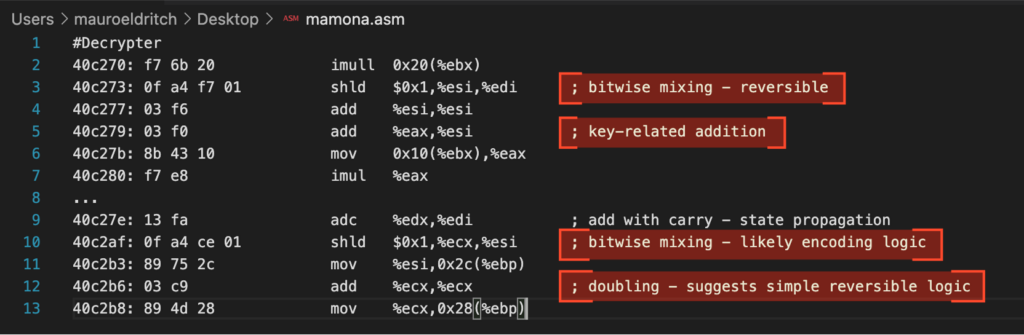
Disassembly of the decrypter around offset 0x40C270

We have already infected our test machine and vaccinated it, and we are ready for the next stop on our journey: the ATT&CK Matrix. As usual, ANY.RUN takes care of that automagically. 


Learn to analyze malware in a sandbox

Learn to analyze cyber threats

Follow along a detailed guide to using ANY.RUN’s Interactive Sandbox for malware and phishing analysis


Mapping the Threat: Mamona via MITRE ATT&CK 

ANY.RUN’s ATT&CK integration makes it easy to understand and track malware behaviour by profiling its events, tactics, and techniques.  
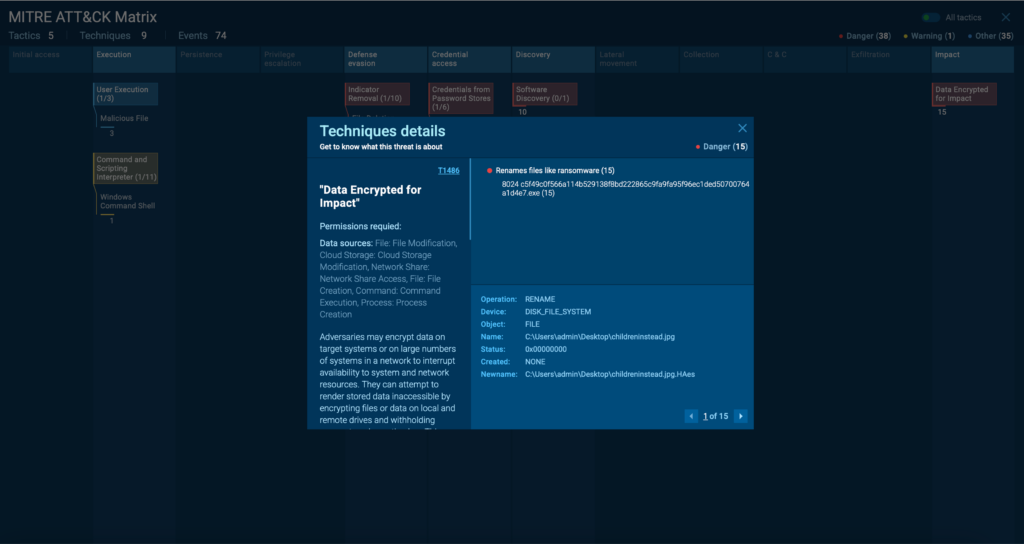
Mamona’s ATT&CK Matrix on ANY.RUN

Let’s take a look at how Mamona’s behaviour fits into this framework: 

  • Discovery: T1012: Query Registry + T1082: System Information Discovery. The reconnaissance routine where the malware queries different local registries like hostname and language. 
  • Execution: T1059.003: Command and Scripting Interpreter. Since Mamona spawns CMD to invoke ping as a cheap delay mechanism and then moves on to its self-deletion. 
  • Defense Evasion: T1070.004: Indicator Removal. The self deletion routine attached to the previous ping command. 
  • Impact: T1486: Data Encrypted for Impact. The encryption process where all our files end up having the “.HAes” extension. 

This sums up Mamona’s behavior, which deviates from the usual pattern seen in commodity ransomware. It shows no network activity, no Command and Control channels over Telegram, Discord, or similar platforms. Instead, it relies on a weak, locally executed key generation routine and doesn’t include any form of double extortion, making its threats of data theft and publication purely coercive. 

What it does have is a retro-styled decrypter that, despite its clunky and outdated interface, simply works. 

Mamona Threat Impact 

The Mamona ransomware campaign presents significant risks despite its offline, minimalistic design: 

For end users: Victims face immediate file encryption, system disruption, and psychological pressure through false claims of data theft. The ransom note’s threatening tone adds urgency, even though there’s no actual data exfiltration. 

For organizations: Mamona can interrupt workflows, encrypt shared drives, and complicate incident response, especially in environments lacking offline backups or real-time monitoring. Its simplicity also makes it harder to detect through conventional network-based defenses. 

For security teams: The absence of C2 traffic and use of locally executed logic reduce visibility in traditional detection systems. Its use of basic commands like ping and cmd.exe mimics legitimate activity, requiring deeper behavioral analysis to flag accurately. 

For the broader threat landscape: Mamona exemplifies the rise of easy-to-use, builder-based ransomware that favors simplicity over sophistication. Its leaked builder lowers the entry barrier for attackers, raising concerns about wider adoption by low-skilled threat actors. 

Conclusion 

The analysis of Mamona Ransomware shows how even a quiet, offline threat can cause disruptions.  

This strain highlights a rising trend: ransomware that trades complexity for accessibility. It’s easy to deploy, harder to detect with traditional tools, and still effective enough to encrypt systems and pressure victims into paying. Its leaked builder and low barrier to entry only raise the risk of widespread abuse by less sophisticated attackers. 

By analyzing Mamona in real time using ANY.RUN’s Interactive Sandbox, we were able to capture the full attack chain, from initial execution and system changes to ransom note deployment and encryption logic, all without needing external network traces. 

Here’s how this type of dynamic analysis helps defenders stay ahead: 

  • Detect threats faster: Spot unusual behavior, even in offline-only attacks. 
  • See everything in motion: Monitor local activity, file operations, and persistence techniques as they happen. 
  • Speed up investigations: Gather and interpret IOCs without jumping from one tool to another. 
  • Respond more effectively: Share artifacts and tactics across security teams. 

Experience real-time visibility with ANY.RUN and catch threats others might miss. 

Try ANY.RUN’s Interactive Sandbox today 

IOCs 

SHA256:b6c969551f35c5de1ebc234fd688d7aa11eac01008013914dbc53f3e811c7c77 

SHA256:c5f49c0f566a114b529138f8bd222865c9fa9fa95f96ec1ded50700764a1d4e7 

Ext:.HAes 

File:README.HAes.txt 

References 

https://bazaar.abuse.ch/sample/c5f49c0f566a114b529138f8bd222865c9fa9fa95f96ec1ded50700764a1d4e7

https://bazaar.abuse.ch/sample/b6c969551f35c5de1ebc234fd688d7aa11eac01008013914dbc53f3e811c7c77

https://app.any.run/tasks/cdcc75cd-d1f0-4fae-8924-d1aa44525e7e

The post Mamona: Technical Analysis of a New Ransomware Strain appeared first on ANY.RUN’s Cybersecurity Blog.

ANY.RUN’s Cybersecurity Blog – ​Read More

Entra ID Data Protection: Essential or Overkill?

Microsoft Entra ID (formerly Azure Active Directory) is the backbone of modern identity management, enabling secure access to the applications, data, and services your business relies on. As hybrid work and cloud adoption accelerate, Entra ID plays an even more central role — managing authentication, enforcing policy, and connecting users across distributed environments.
That prominence also

The Hacker News – ​Read More

US Border Agents Are Asking for Help Taking Photos of Everyone Entering the Country by Car

Customs and Border Protection has called for tech companies to pitch real-time face recognition technology that can capture everyone in a vehicle—not just those in the front seats.

Security Latest – ​Read More

Proactive threat hunting with Talos IR

Proactive threat hunting with Talos IR

At Cisco Talos, we understand that effective cybersecurity isn’t just about responding to incidents — it’s about preventing them from happening in the first place. One of the most powerful ways we do this is through proactive threat hunting. Our Talos Incident Response (Talos IR) team works closely with organizations to not only address existing threats but to anticipate and mitigate potential future risks. A key component of our threat-hunting approach is the Splunk SURGe team’s PEAK Threat Hunting Framework, which enables us to conduct comprehensive and proactive hunts with precision.

What is the PEAK Threat Hunting Framework?

The PEAK Framework (Prepare, Execute, and Act with Knowledge) offers a structured methodology for conducting effective and focused threat hunts. It ensures that every hunt is aligned with an organization’s specific needs and threat landscape. At the core of the PEAK framework are baseline hunts, which lay the foundation for proactive threat detection, alongside advanced techniques such as hypothesis-driven hunts and model-assisted threat hunts (M-ATH), which further enhance threat detection and mitigation.

Baseline hunts: the foundation of proactive threat hunting

Baseline hunts involve establishing a clear understanding of an organization’s normal operating environment in terms of user activity, network traffic and system processes. By documenting and analyzing this baseline, Talos IR can identify anomalous behavior that may signal malicious activity.

While these hunts can be a reactive measure, it’s important to use them proactively to detect threats trying to blend in with regular operations, such as insider threats, advanced persistent threats (APTs) and even novel attack techniques that might otherwise go undetected.

The key steps in baseline hunts are:

  1. Defining Normal Activity: Understanding what “normal” looks like in your environment, using data from system logs, user behavior, and network traffic.
  2. Anomaly Detection: Proactively hunting for deviations from the baseline that could indicate potential threats.
  3. Refining the Baseline: Continuously improving and updating the baseline to account for emerging threats and changes in your infrastructure.

Hypothesis-driven hunts: Testing assumptions about threats

In addition to baseline hunts, Talos IR also uses hypothesis-driven hunts to proactively test assumptions about potential threats. These hunts are guided by specific hypotheses or educated guesses about what attackers might be doing in a given environment. Rather than relying on a static, one-size-fits-all approach without adjustments, hypothesis-driven hunts are dynamic, adapting to the specific questions and emerging threats that arise.

For example, a hypothesis-driven hunt might begin with the assumption that a particular group of users is being targeted by a phishing campaign. The hunt would focus on testing this assumption by looking for evidence of malicious emails, unusual login patterns or attempts to collect or exfiltrate data.

The key steps in hypothesis-driven hunts are:

  1. Forming Hypotheses: Based on threat intelligence and past incidents, teams generate specific hypotheses about possible attack vectors or adversary behaviors.
  2. Testing Hypotheses: Using data sources such as endpoint telemetry, authentication logs or network traffic, the hypothesis is tested to see if evidence supports the theory.
  3. Analyzing Results: If the hypothesis is validated, further investigation is done to understand the full scope of the potential threat.

Model-assisted threat hunts: Leveraging machine learning to find hidden threats

Another powerful tool in Talos IR’s proactive hunting approach is model-assisted threat hunts (M-ATHs). These hunts leverage machine learning and advanced statistical models to sift through vast amounts of data and identify patterns that may indicate hidden threats. M-ATHs allow our team to detect threats that would be difficult to find using traditional methods.

Machine learning models are trained to detect suspicious behavior across different domains — such as user activity, network traffic or system logs — by looking for deviations from typical patterns. Over time, as these models learn from new data and threat intelligence, they improve in their ability to detect emerging threats.

The key steps in M-ATHs are:

  1. Data Collection: Gathering large datasets from multiple sources, including network traffic, endpoint data, authentication logs, and more.
  2. Model Training: Using machine learning algorithms to identify patterns in normal and malicious behavior.
  3. Anomaly Detection: The trained model helps identify new, previously undetected anomalies or potential threats by looking for deviations from established patterns.
  4. Refinement: The model is refined as new data is collected and analyzed, improving its ability to detect subtle threats.

Empowering threat hunts with Talos Threat Intelligence

A crucial element that enriches and empowers every Talos IR threat hunt is Talos Threat Intelligence. By integrating up-to-date, high-fidelity threat intelligence into our hunts, we enhance the accuracy, relevance, and speed of our investigations. Talos Threat Intelligence provides a continuous stream of data on emerging threats, attack trends and adversary tactics, which helps us refine hypotheses, adjust baselines and improve our machine learning models.

This intelligence is not just a complement to our hunting process; it is embedded in every stage. It helps guide our hypothesis-driven hunts, sharpens our baseline detections and feeds into the models we use for anomaly detection. With Talos Threat Intelligence, we ensure that every hunt is aligned with the latest threat landscape, empowering your team with the knowledge needed to stay one step ahead of attackers.

Proactive engagements for IR Retainer customers

For Talos IR Retainer customers, baseline hunts, hypothesis-driven hunts, and model-assisted threat hunts provide a valuable layer of ongoing, proactive support. These hunts help organizations detect and mitigate threats before they escalate into full-blown incidents. Our expert hunters work directly with your teams, ensuring that you stay ahead of evolving threats.

Some key benefits of these proactive engagements include:

  • Early Detection: Identifying abnormal activities that could signal a breach or malicious action, reducing the risk of an attack spreading.
  • Continuous Improvement: As we refine the baseline and hunting models, your security posture improves over time, allowing for faster and more accurate threat detection.
  • Actionable Insights: Proactive hunts deliver actionable intelligence that helps your teams strengthen their defenses, based on the latest threat trends and attack methods.

Why it matters

The cybersecurity landscape is constantly evolving, and traditional defensive methods alone are no longer sufficient. Threat actors are adept at blending malicious activity with normal operations, making it difficult to spot attacks using conventional means. By conducting baseline hunts, hypothesis-driven hunts and model-assisted threat hunts, Talos IR gives your organization the tools it needs to stay ahead of adversaries.

As new evidence is uncovered during a hunt, our team adapts and refines the investigation in real time — evolving the hypothesis, adjusting the scope or pivoting to new areas of focus based on what the data reveals.

If an active threat, adversary or malicious activity is detected during a hunt, Talos IR can dynamically pivot the engagement and escalate the situation to our 24/7 on-call Incident Response team. This ensures rapid response for containment, mitigation and eradication, effectively minimizing the potential impact of the threat.

Our Talos IR team collaborates seamlessly with the hunting team to deliver real-time support in identifying, isolating and neutralizing active threats. This integrated approach ensures your systems remain secure and prevents the threat from escalating further.

At Talos, our goal is to empower your team with the knowledge and tools to detect threats proactively, before they turn into incidents. Through our IR Retainer services, we provide continuous support to help you improve your security posture and stay one step ahead of emerging threats, all while leveraging the full power of Talos Threat Intelligence.

For more information about this service, download our At-a-Glance:

Cisco Talos Blog – ​Read More

Android Update Patches FreeType Vulnerability Exploited as Zero-Day

Android’s May 2025 security update includes patches for an exploited vulnerability in the FreeType open source rendering engine.

The post Android Update Patches FreeType Vulnerability Exploited as Zero-Day appeared first on SecurityWeek.

SecurityWeek – ​Read More

Google Fixes Actively Exploited Android System Flaw in May 2025 Security Update

Google has released its monthly security updates for Android with fixes for 46 security flaws, including one vulnerability that it said has been exploited in the wild.
The vulnerability in question is CVE-2025-27363 (CVSS score: 8.1), a high-severity flaw in the System component that could lead to local code execution without requiring any additional execution privileges.
“The most severe of

The Hacker News – ​Read More

Critical Langflow Flaw Added to CISA KEV List Amid Ongoing Exploitation Evidence

A recently disclosed critical security flaw impacting the open-source Langflow platform has been added to the Known Exploited Vulnerabilities (KEV) catalog by the U.S. Cybersecurity and Infrastructure Security Agency (CISA), citing evidence of active exploitation.
The vulnerability, tracked as CVE-2025-3248, carries a CVSS score of 9.8 out of a maximum of 10.0.
“Langflow contains a missing

The Hacker News – ​Read More

Meta, Cisco put open-source LLMs at the core of next-gen SOC workflows

RSAC 2025: Cisco and Meta put open-source AI at the heart of enterprise threat defense


Cisco’s Foundation-sec-8B LLM & Meta’s AI Defenders redefine cybersecurity with open-source AI for scalable SOCs.Read More

Security News | VentureBeat – ​Read More

AI Domination: RSAC 2025 Social Media Roundup

Documented in a series of social media posts, cybersecurity experts shared with Dark Reading their insights on RSAC 2025 throughout the week.

darkreading – ​Read More

Chat App Used by Trump Admin Suspends Operation Amid Hack

TM SGNL, a chat app by US-Israeli firm TeleMessage used by Trump officials, halts operations after a breach…

Hackread – Latest Cybersecurity, Hacking News, Tech, AI & Crypto – ​Read More