Attacker Specialization Puts Threat Modeling on Defensive
Specialization among threat groups poses challenges for defenders, who now must distinguish between different actors responsible for different facets of an attack.
darkreading – Read More

Specialization among threat groups poses challenges for defenders, who now must distinguish between different actors responsible for different facets of an attack.
darkreading – Read More
Some of the suspects allegedly “cold-called victims and used social engineering to convince them their accounts were the subject of cyberattacks and the enterprise callers were attempting to help secure their accounts,” according to the DOJ.
The Record from Recorded Future News – Read More
Ivanti EPMM users urgently need to patch against actively exploited 0day vulnerabilities (CVE-2025-4427, CVE-2025-4428) that enable pre-authenticated remote…
Hackread – Latest Cybersecurity, Hacking News, Tech, AI & Crypto – Read More
The ransomware group Interlock has started using the ClickFix technique to gain access to its victims’ infrastructure. In a recent post, we discussed the general concept of ClickFix. Today we’ll look at a specific case where a ransomware group has put this tactic into action. Cybersecurity researchers have discovered that Interlock is using a fake CAPTCHA imitating a Cloudflare-protected site on a page posing as the website of Advanced IP Scanner — a popular free network scanning tool. This suggests the attack is aimed at IT professionals working in organizations of potential interest to the group.
The Interlock attackers lure victims to a webpage with an URL mimicking that of the official Advanced IP Scanner site. The researchers found multiple instances of this same page hosted at different addresses across the web.
When the user clicks the link, they see a message asking them to complete a CAPTCHA, seemingly provided by Cloudflare. The message states that Cloudflare helps companies “regain control of their technology”. This legitimate-looking marketing text is in fact copied from Cloudflare’s own What is Cloudflare? webpage. It’s followed by instructions to press Win + R, then Ctrl + V, and finally Enter. Next come two buttons: Fix it and Retry.
Finally, a message claims that the resource the victim is trying to access needs to verify the connection’s security.
In reality, when the victim clicks Fix it, a malicious PowerShell command is copied to the clipboard. The user then unknowingly opens the command console with Win + R and pastes the command with Ctrl + V. Pressing Enter then executes the malicious command.
Executing the command downloads and launches a 36-megabyte fake PyInstaller installer file. And to distract the victim, a browser window with the real Advanced IP Scanner website opens.
Once the fake installer is launched, a PowerShell script is activated that collects system information and sends it to a C2 server. In response, the server can either send the ooff command to terminate the script, or deliver additional malware. In this case the attackers used Interlock RAT (remote access Trojan) as the payload. The malware is saved in the %AppData% folder and runs automatically, allowing the attackers to access confidential data and establish persistence in the system.
After initial access, the Interlock operators try to use previously stolen or leaked credentials and the Remote Desktop Protocol (RDP) for lateral movement. Their primary target is the domain controller (DC) — gaining access to it allows the attackers to spread malware across the infrastructure.
The final step before launching the ransomware is to steal the victim organization’s valuable data. These files are uploaded to Azure Blob Storage controlled by the attackers. After exfiltrating the sensitive data, the Interlock group publishes it on a new Tor domain. A link to this domain is then provided in a new post on the group’s .onion site.
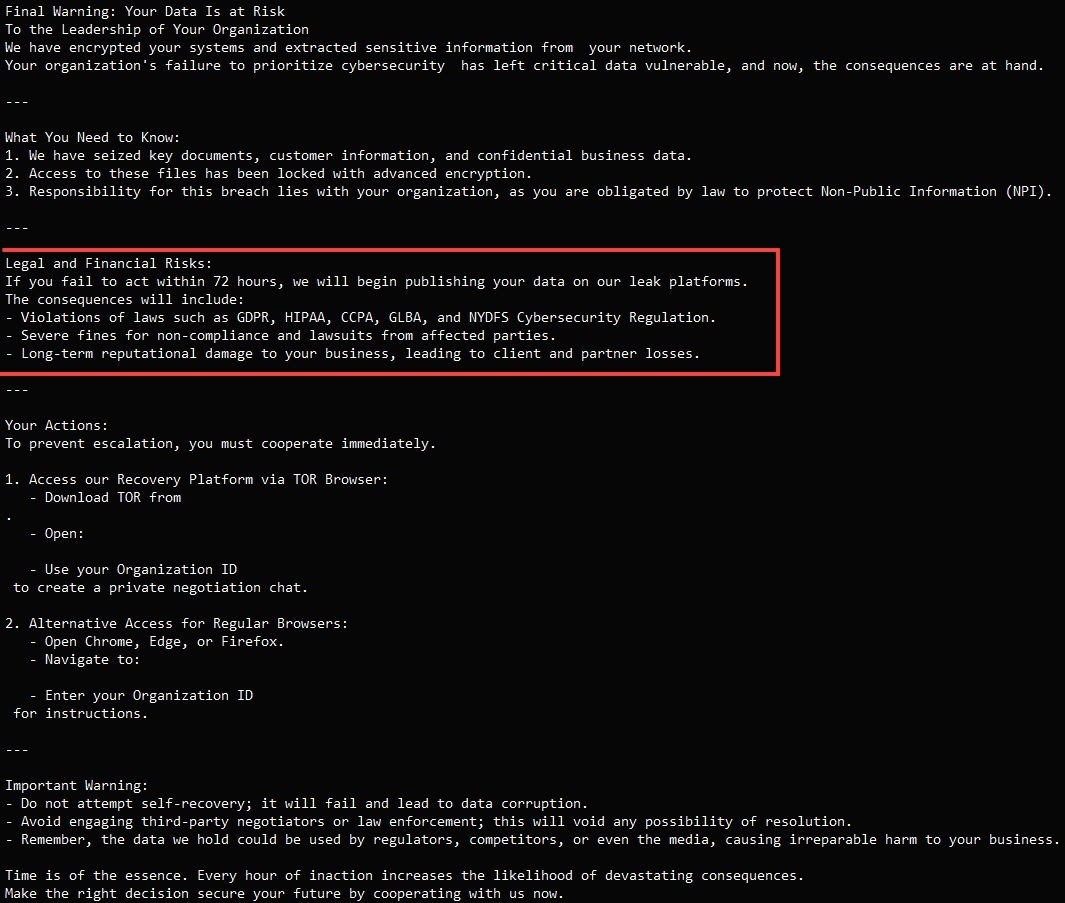
Example of a ransom note sent by the Interlock ransomware group. Source
ClickFix and other similar techniques rely heavily on social engineering, so the best protection is a systematic approach focused primarily on raising employee awareness. To help with this, we recommend our Kaspersky Automated Security Awareness Platform, which automates training programs for staff.
In addition, to protect against ransomware attacks, we recommend the following:
Kaspersky official blog – Read More
ReversingLabs discovers dbgpkg, a fake Python debugger that secretly backdoors systems to steal data. Researchers suspect a pro-Ukraine…
Hackread – Latest Cybersecurity, Hacking News, Tech, AI & Crypto – Read More
A well-documented cybersecurity incident response program (CSIRP) provides the transparency needed for informed decision-making, protecting the organization in a constantly changing threat environment.
darkreading – Read More
A summary of noteworthy stories that might have slipped under the radar this week.
The post In Other News: Hackers Not Behind Blackout, CISO Docuseries, Dior Data Breach appeared first on SecurityWeek.
SecurityWeek – Read More
Google says the hacking group behind the recent cyberattacks on UK retailers is now shifting focus to the US.
The post Google Warns UK Retailer Hackers Now Targeting US appeared first on SecurityWeek.
SecurityWeek – Read More
The new law, which was first mooted in 2022, is intended to help Japan strengthen its cyber defense “to a level equal to major Western powers” and marks a break from the country’s traditional approach to cyber defense.
The Record from Recorded Future News – Read More
Authorities in the republic of Chuvashia confirmed attackers targeted software used to manage patient records and medical histories.
The Record from Recorded Future News – Read More