The August acquisition will bring together Red Canary’s extensive integration ecosystem with Zscaler’s cloud transaction data to deliver an AI-powered security operations platform.
https://www.backbox.org/wp-content/uploads/2018/09/website_backbox_text_black.png00adminhttps://www.backbox.org/wp-content/uploads/2018/09/website_backbox_text_black.pngadmin2025-05-28 13:06:542025-05-28 13:06:54Zscaler Announces Deal to Acquire Red Canary
Embedded Linux-based Internet of Things (IoT) devices have become the target of a new botnet dubbed PumaBot.
Written in Go, the botnet is designed to conduct brute-force attacks against SSH instances to expand in size and scale and deliver additional malware to the infected hosts.
“Rather than scanning the internet, the malware retrieves a list of targets from a command-and-control (C2) server
Hackers likely based in Vietnam advertised websites offering AI-powered video generation tools, according to Google’s Mandiant unit, and then used the sites to spread infostealers and other malware.
https://www.backbox.org/wp-content/uploads/2018/09/website_backbox_text_black.png00adminhttps://www.backbox.org/wp-content/uploads/2018/09/website_backbox_text_black.pngadmin2025-05-28 13:06:532025-05-28 13:06:53Google warns of Vietnam-based hackers using bogus AI video generators to spread malware
Phishing attacks have become a pervasive and escalating threat across various industries, notably in finance, manufacturing, and healthcare. For Managed Security Service Providers (MSSPs), the challenge lies in swiftly identifying and mitigating these threats to safeguard client infrastructures and uphold service integrity.
This case study explores how ANY.RUN’s Threat Intelligence Lookup and Interactive Sandbox can empower MSSPs to detect, investigate, and respond to phishing attacks more effectively.
About the Case Study
As an example, we’ll use a payload from Delivr.to (a platform designed to help organizations assess and enhance their email security by simulating real-world threats). We’ll see how Threat Intelligence Lookup and Interactive Sandbox help with:
Access to real-world phishing samples: Use our extensive threat database to study current phishing samples, simulate email filter bypasses, and prepare more resilient defenses.
Deep behavior analysis: Examine samples in the sandbox to uncover IOCs, IOBs, IOAs, TTPs, and link attacks to specific malware families and threat actors.
Targeted threat discovery: Search phishing samples by country, time period, known artifacts.
Training and awareness: Use real phishing cases to educate your team and clients, improving detection and response readiness.
Let’s begin.
1. Introducing the payload
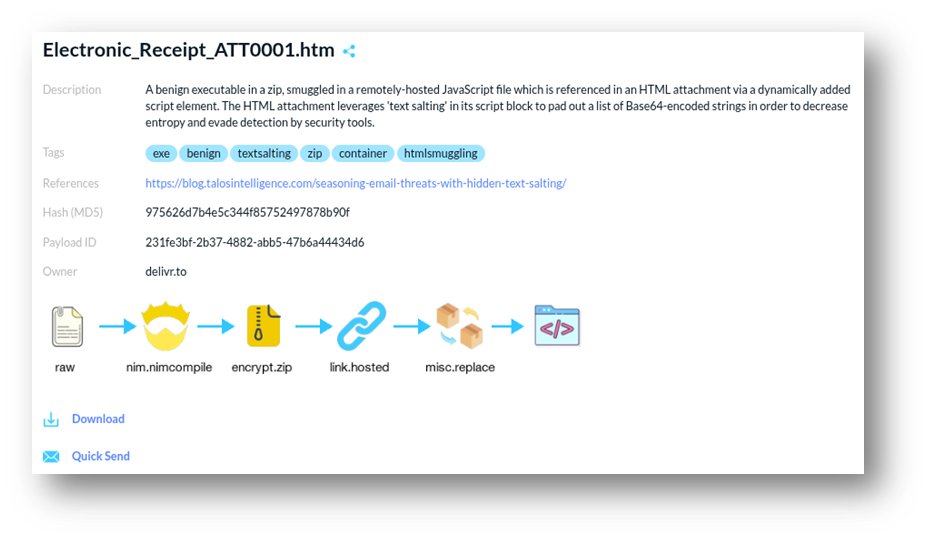
We have chosen an HTML file Electronic_Receipt_ATT0001.htm from the payload sample library of Delivr.to.
Payload’s credentials via Delivr.to
The attachment’s description contains its ID, hash sum, payload chain deployment steps, and the tags describing the attack chain scenario.
Such payloads are meant to be emailed in order to put to test corporate cybersecurity policies. However, a full-fledged understanding of a threat implies not only the detection of email filters bypass, but a full analysis of an activated payload behavior. This is why we shall use ANY.RUN’s TI Lookup to search for this HTML file.
2. Detecting the payload in malware campaigns
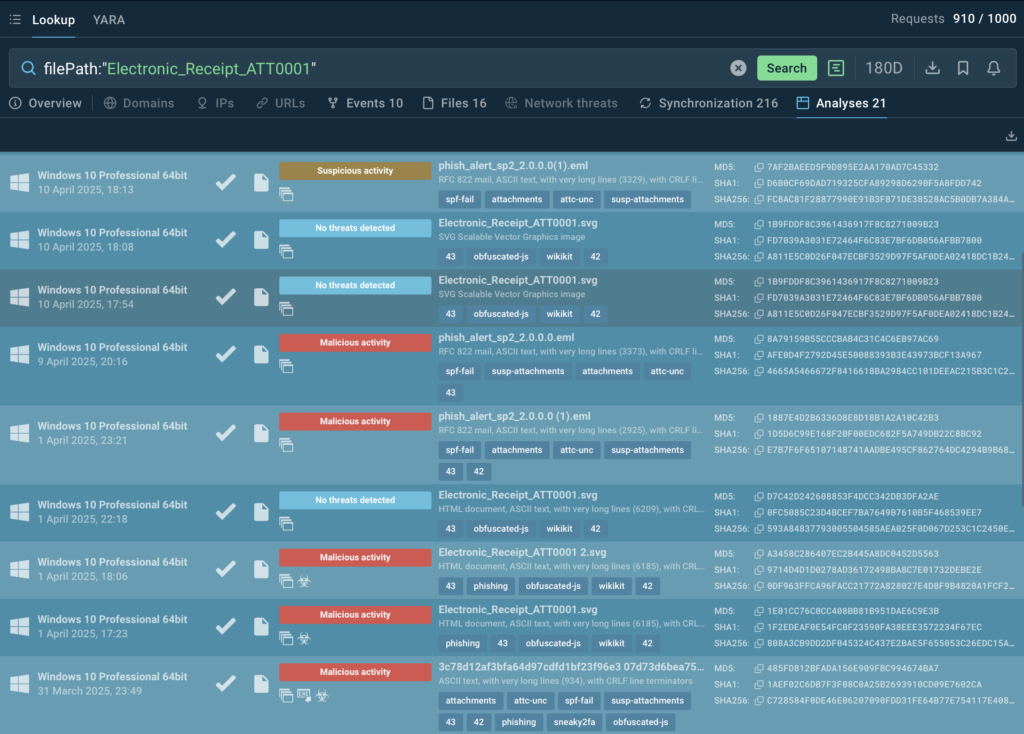
Our request to TI Lookup includes the parameter indicating an attached file and the file’s name.
The test attachment is often found in malware samples
21 malware samples containing this payload have been discovered in TI Lookup at the moment. Besides providing links to the samples and their analyses, TI Lookup highlights the fact that most samples featuring our benign file have been tagged as malicious and attributed to Tycoon phishing kit distributed as Phishing-as-a-Service (PhaaS).
This means that the chosen payload is actually employed in real phishing campaigns.
Level up malware analysis and threat intelligence capabilities See all ANY.RUN’s 9th Birthday offers
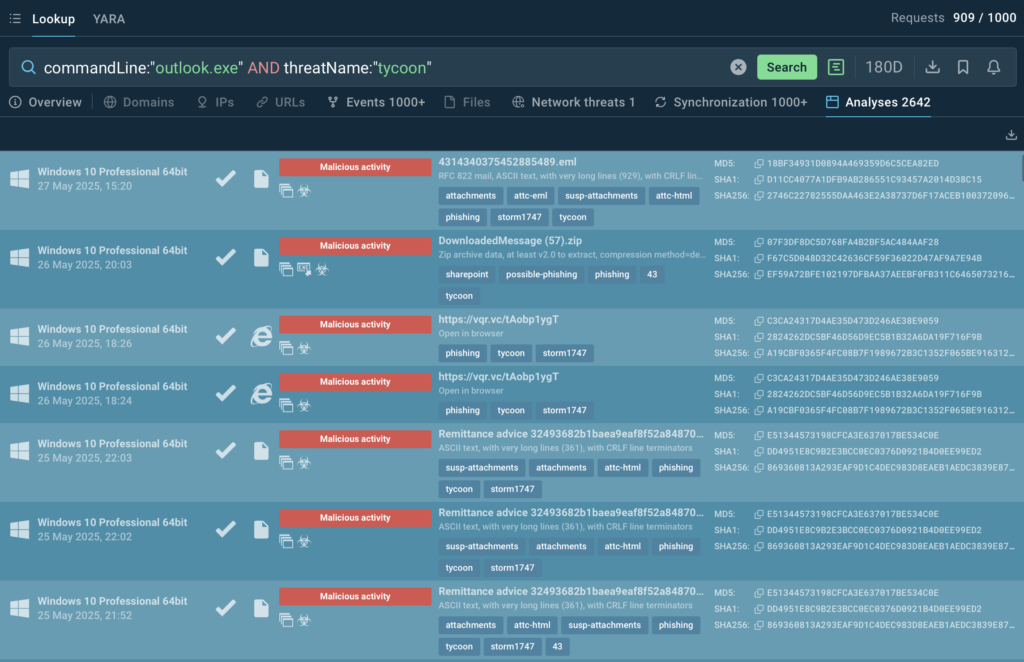
We can also search for other payloads related to Tycoon’s activity. The search query combines the name of the process “outlook.exe” — used when opening emails — and the threat name “tycoon”. As a result, we obtain a broad set of analyses containing various malicious attachment variants associated with Tycoon. This allows us to analyze real-world examples of phishing campaigns and identify recurring delivery patterns.
Phishing samples with Tycoon payloads in the Sandbox
ANY.RUN provides not only attribution to a specific threat but also an overview of the activity landscape — including the number of related samples analyzed by the professional community, the timeframe of the payload’s usage, and the frequency of its appearance. The most recent sample featuring Electronic_Receipt_ATT0001.htm, as of the time of analysis, is dated May 27, 2025, which helps assess the threat’s current relevance.
4. Watching the malware in action
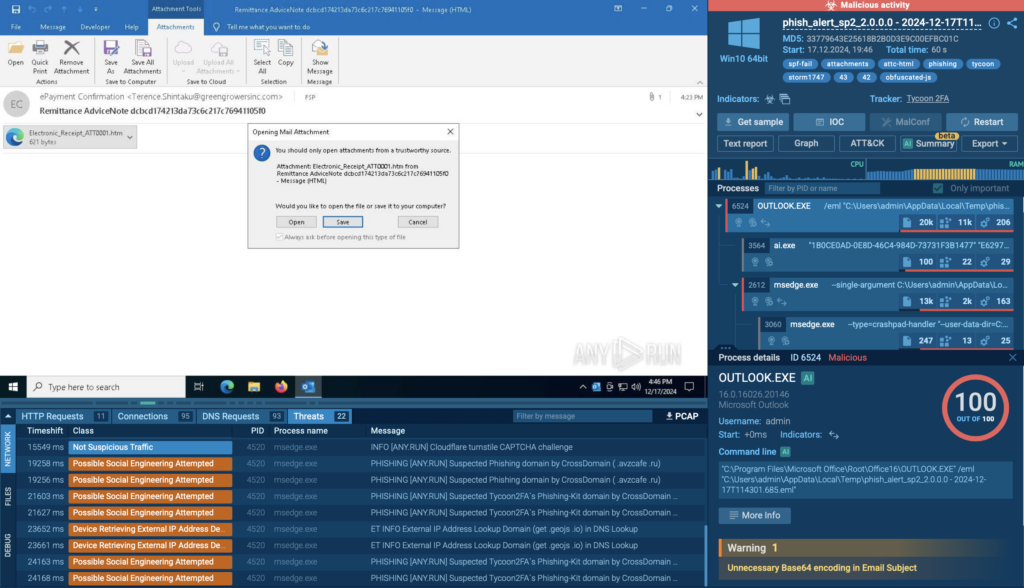
Let’s conduct a more detailed analysis of the payload in the ANY.RUN Sandbox. We’ll view one of the malware analyses.
A sandbox analysis of Tycoon malware sample with phishing email
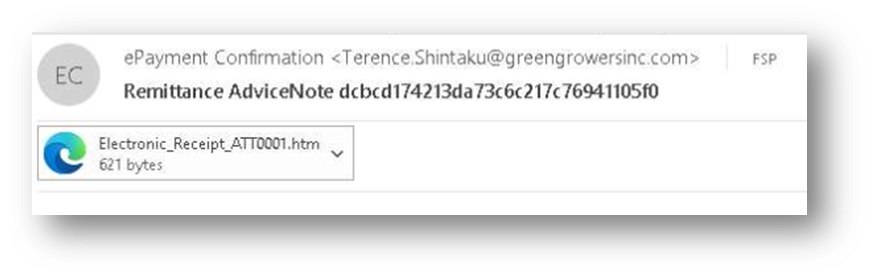
First of all, we can explore malicious email information. The recipient’s address helps identify the likely aim of the attack and the organization it may have been directed against. The email subject is also available, and in some cases, its context—allowing us to assess the social engineering tactics used by the attacker to persuade the recipient to open up the malicious attachment.
Email subject and attachment signaling phishing
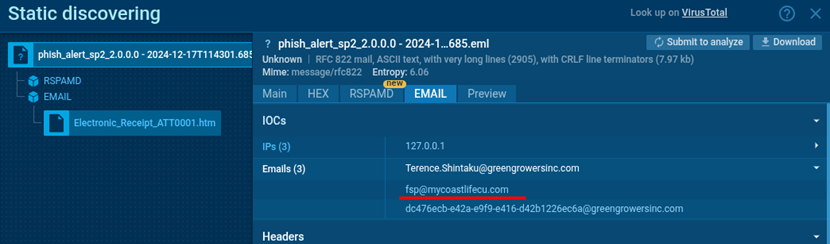
Detailed email header information can be retrieved from the Static Discovering tab:
Traces to Tycoon’s victimology
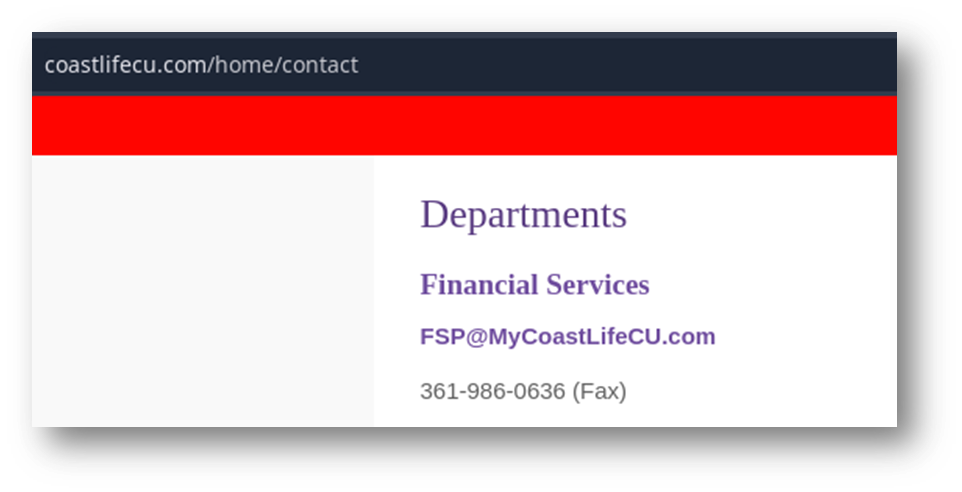
The email recipient’s address — fsp@mycoastlifecu.com — belongs to CoastLife Credit Union, a U.S.-based financial institution, which is confirmed by its presence on the company’s official website.
The use of a legitimate corporate email as the recipient suggests that this attachment was part of an actual phishing campaign targeting employees of financial organizations. This, in turn, indicates the attackers’ likely focus — U.S.-based companies providing banking or financial services.
The attack’s illustrative target
“Authentication-Results” indicates that the email failed SPF verification. Specifically, it shows that the sender’s IP address 141.95.114.239 was not authorized to send emails on behalf of the domain greengrowersinc.com. This data confirms sender spoofing and identifies the specific IP address involved in the email campaign.
Another evidence of malicious behavior, authentication failed
5. Performing interactive analysis
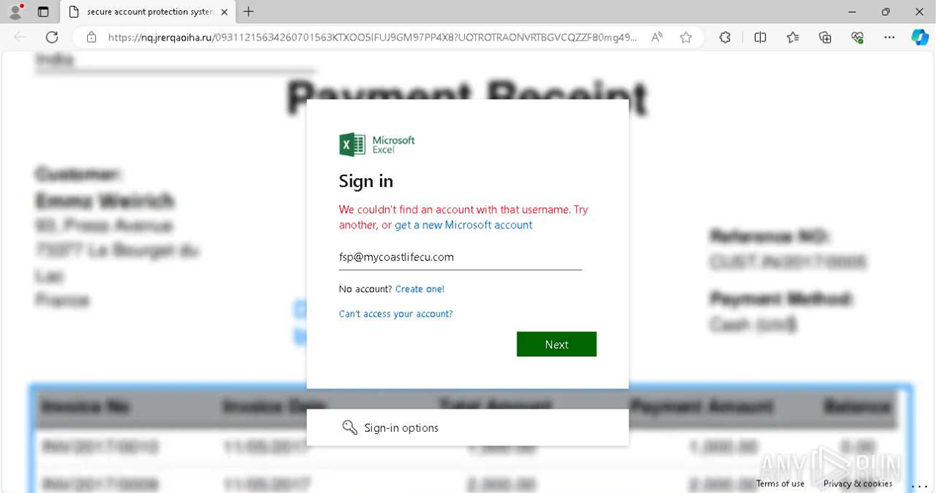
On executing the malicious HTML attachment in the ANY.RUN environment, we can observe the phishing page that loads upon its activation. The execution triggers the download of a webpage hosted on the domain nq.jrerqaoiha.ru which looks like a typical part of malicious infrastructure. Besides, a Microsoft authentication page appearing on a .ru domain is highly unusual and suggests a fraudulent scheme.
A typical phishing page impersonating Microsoft corporate login
The page mimics a Microsoft Excel login form with official Microsoft branding. The interface prompts the user to enter their credentials, suggesting an attempt at credential harvesting.
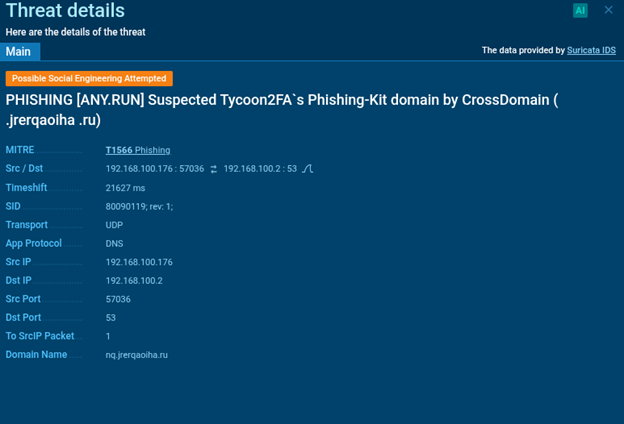
Malware’s network activity details with IOCs
“Network → Threats” tab shows detected network threats. For each recorded activity, you can view detailed detection results based on Suricata IDS, including:
Signature description
Protocol used
Relevant IP addresses and ports
MITRE ATT&CK technique mapping. In this case, a connection to the domain nq.jrerqaoiha.ru classified as part of the Tycoon2FA phishing kit was linked to T1566 (Phishing) technique and tagged as Potential Social Engineering.
These steps, which cover several analytical aspects critical for cybersecurity professionals, demonstrate how ANY.RUN enables in-depth research of phishing attacks, which is highly relevant for most MSSP companies.
Integrate ANY.RUN’s Solutions in Your MSSP
Integrating ANY.RUN’s Threat Intelligence Lookup and Interactive Sandbox into your MSSP operations equips you with advanced tools to combat phishing and other cyber threats efficiently.
These solutions deliver precise, actionable intelligence to ensure:
Stronger Client Protection: Proactively investigate and identify malware and phishing attacks using ANY.RUN’s services to take faster actions for safeguarding clients’ infrastructure.
Accelerated Research: Uncover extensive context on any threat, slashing threat investigation time and enabling faster analyst response.
Maximized ROI: Speed up triage and response with TI Lookup and the Interactive Sandbox to prevent incidents faster and avoid financial and reputational losses.
In-depth Threat Analysis: Leverage ANY.RUN’s Interactive Sandbox for real-time detonation and analysis of malicious files and URLs missed by automated systems.
Streamlined SOC Processes: Take advantage of 2-second searches to reduce triage, investigation, and response times, enhancing team productivity.
ANY.RUN’s Threat Intelligence Lookup and Interactive Sandbox offer robust solutions for analyzing and preventing phishing attacks. The services enable MSSPs to conduct in-depth behavioral analyses of suspicious emails and attachments, identify indicators of compromise, and attribute threats to specific malicious actors. By integrating these capabilities into their security operations, MSSPs can enhance their threat detection and response times, providing clients with proactive defense mechanisms against phishing threats.
https://www.backbox.org/wp-content/uploads/2018/09/website_backbox_text_black.png00adminhttps://www.backbox.org/wp-content/uploads/2018/09/website_backbox_text_black.pngadmin2025-05-28 13:06:432025-05-28 13:06:43How MSSPs Can Analyze and Investigate Phishing Attacks with ANY.RUN
A financially motivated threat actor has been observed exploiting a recently disclosed remote code execution flaw affecting the Craft Content Management System (CMS) to deploy multiple payloads, including a cryptocurrency miner, a loader dubbed Mimo Loader, and residential proxyware.
The vulnerability in question is CVE-2025-32432, a maximum severity flaw in Craft CMS that was patched in
https://www.backbox.org/wp-content/uploads/2018/09/website_backbox_text_black.png00adminhttps://www.backbox.org/wp-content/uploads/2018/09/website_backbox_text_black.pngadmin2025-05-28 12:07:052025-05-28 12:07:05Mimo Hackers Exploit CVE-2025-32432 in Craft CMS to Deploy Cryptominer and Proxyware
Google and Mozilla released patches for Chrome and FireFox to address a total of 21 vulnerabilities between the two browsers, including three rated high severity.
Security researchers warn that OneDrive’s file sharing tool may grant third-party web apps access to all your files—not just the one you choose to upload.
https://www.backbox.org/wp-content/uploads/2018/09/website_backbox_text_black.png00adminhttps://www.backbox.org/wp-content/uploads/2018/09/website_backbox_text_black.pngadmin2025-05-28 12:07:042025-05-28 12:07:04OneDrive Gives Web Apps Full Read Access to All Files
Would you expect an end user to log on to a cybercriminal’s computer, open their browser, and type in their usernames and passwords? Hopefully not! But that’s essentially what happens if they fall victim to a Browser-in-the-Middle (BitM) attack.
Like Man-in-the-Middle (MitM) attacks, BiTM sees criminals look to control the data flow between the victim’s computer and the target service, as
https://www.backbox.org/wp-content/uploads/2018/09/website_backbox_text_black.png00adminhttps://www.backbox.org/wp-content/uploads/2018/09/website_backbox_text_black.pngadmin2025-05-28 10:07:102025-05-28 10:07:10The Root of AI Hallucinations: Physics Theory Digs Into the ‘Attention’ Flaw
https://www.backbox.org/wp-content/uploads/2018/09/website_backbox_text_black.png00adminhttps://www.backbox.org/wp-content/uploads/2018/09/website_backbox_text_black.pngadmin2025-05-28 10:07:102025-05-28 10:07:10Vulnerabilities in CISA KEV Are Not Equally Critical: Report