
U.S. Sanctions Cloud Provider ‘Funnull’ as Top Source of ‘Pig Butchering’ Scams

Image: Shutterstock, ArtHead.

The U.S. government today imposed economic sanctions on Funnull Technology Inc., a Philippines-based company that provides computer infrastructure for hundreds of thousands of websites involved in virtual currency investment scams known as “pig butchering.” In January 2025, KrebsOnSecurity detailed how Funnull was being used as a content delivery network that catered to cybercriminals seeking to route their traffic through U.S.-based cloud providers.

“Americans lose billions of dollars annually to these cyber scams, with revenues generated from these crimes rising to record levels in 2024,” reads a statement from the U.S. Department of the Treasury, which sanctioned Funnull and its 40-year-old Chinese administrator Liu Lizhi. “Funnull has directly facilitated several of these schemes, resulting in over $200 million in U.S. victim-reported losses.”

The Treasury Department said Funnull’s operations are linked to the majority of virtual currency investment scam websites reported to the FBI. The agency said Funnull directly facilitated pig butchering and other schemes that resulted in more than $200 million in financial losses by Americans.

Pig butchering is a rampant form of fraud wherein people are lured by flirtatious strangers online into investing in fraudulent cryptocurrency trading platforms. Victims are coached to invest more and more money into what appears to be an extremely profitable trading platform, only to find their money is gone when they wish to cash out.

The scammers often insist that investors pay additional “taxes” on their crypto “earnings” before they can see their invested funds again (spoiler: they never do), and a shocking number of people have lost six figures or more through these pig butchering scams.

KrebsOnSecurity’s January story on Funnull was based on research from the security firm Silent Push, which discovered in October 2024 that a vast number of domains hosted via Funnull were promoting gambling sites that bore the logo of the Suncity Group, a Chinese entity named in a 2024 UN report (PDF) for laundering millions of dollars for the North Korean state-sponsored hacking group Lazarus.

Silent Push found Funnull was a criminal content delivery network (CDN) that carried a great deal of traffic tied to scam websites, funneling the traffic through a dizzying chain of auto-generated domain names and U.S.-based cloud providers before redirecting to malicious or phishous websites. The FBI has released a technical writeup (PDF) of the infrastructure used to manage the malicious Funnull domains between October 2023 and April 2025.
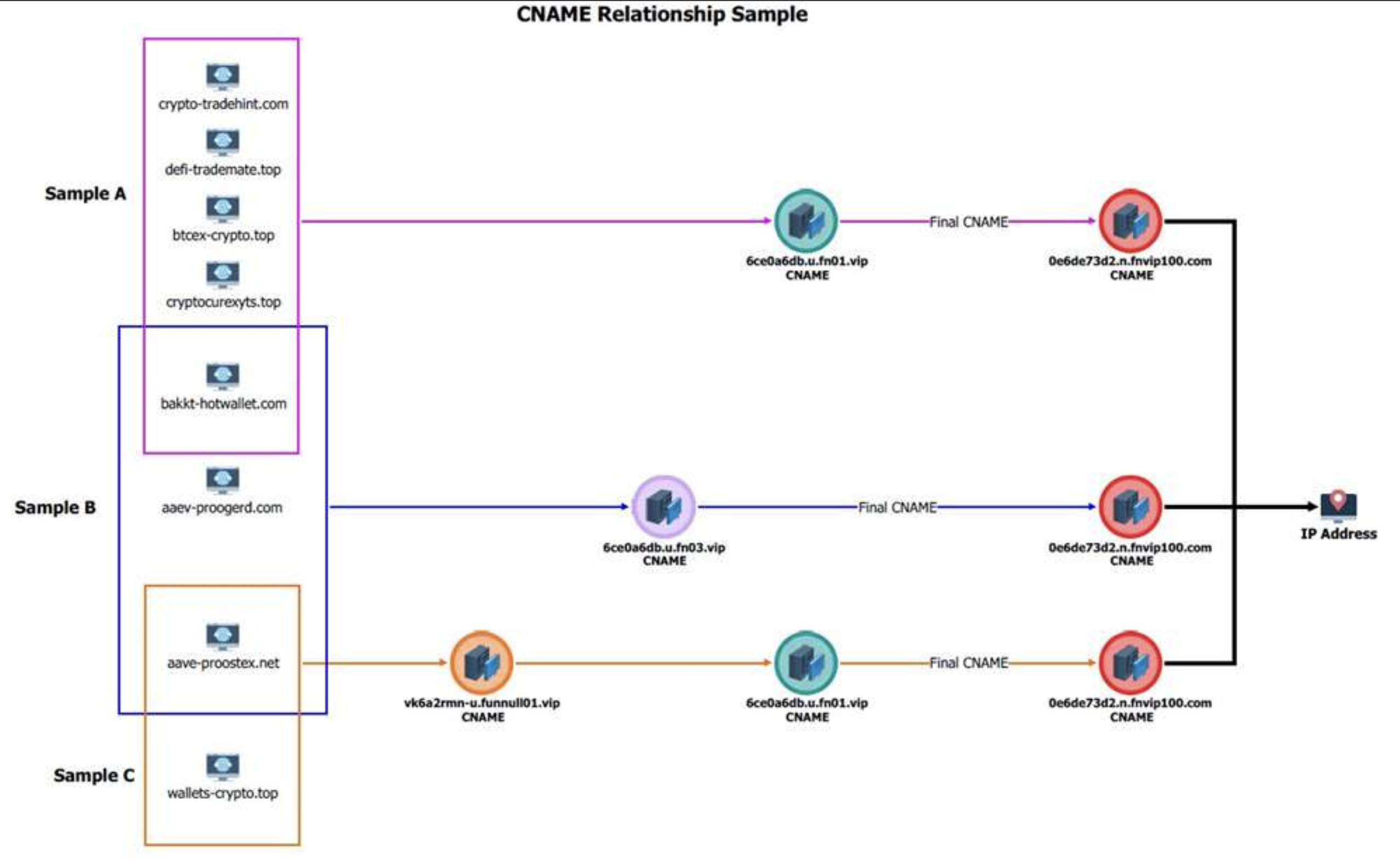
A graphic from the FBI explaining how Funnull generated a slew of new domains on a regular basis and mapped them to Internet addresses on U.S. cloud providers.

Silent Push revisited Funnull’s infrastructure in January 2025 and found Funnull was still using many of the same Amazon and Microsoft cloud Internet addresses identified as malicious in its October report. Both Amazon and Microsoft pledged to rid their networks of Funnull’s presence following that story, but according to Silent Push’s Zach Edwards only one of those companies has followed through.

Edwards said Silent Push no longer sees Microsoft Internet addresses showing up in Funnull’s infrastructure, while Amazon continues to struggle with removing Funnull servers, including one that appears to have first materialized in 2023.

“Amazon is doing a terrible job — every day since they made those claims to you and us in our public blog they have had IPs still mapped to Funnull, including some that have stayed mapped for inexplicable periods of time,” Edwards said.

Amazon said its Amazon Web Services (AWS) hosting platform actively counters abuse attempts.

“We have stopped hundreds of attempts this year related to this group and we are looking into the information you shared earlier today,” reads a statement shared by Amazon. “If anyone suspects that AWS resources are being used for abusive activity, they can report it to AWS Trust & Safety using the report abuse form here.”

U.S. based cloud providers remain an attractive home base for cybercriminal organizations because many organizations will not be overly aggressive in blocking traffic from U.S.-based cloud networks, as doing so can result in blocking access to many legitimate web destinations that are also on that same shared network segment or host.

What’s more, funneling their bad traffic so that it appears to be coming out of U.S. cloud Internet providers allows cybercriminals to connect to websites from web addresses that are geographically close(r) to their targets and victims (to sidestep location-based security controls by your bank, for example).

Funnull is not the only cybercriminal infrastructure-as-a-service provider that was sanctioned this month: On May 20, 2025, the European Union imposed sanctions on Stark Industries Solutions, an ISP that materialized at the start of Russia’s invasion of Ukraine and has been used as a global proxy network that conceals the true source of cyberattacks and disinformation campaigns against enemies of Russia.

In May 2024, KrebsOnSecurity published a deep dive on Stark Industries Solutions that found much of the malicious traffic traversing Stark’s network (e.g. vulnerability scanning and password brute force attacks) was being bounced through U.S.-based cloud providers. My reporting showed how deeply Stark had penetrated U.S. ISPs, and that Ivan Neculiti for many years sold “bulletproof” hosting services that told Russian cybercrime forum customers they would proudly ignore any abuse complaints or police inquiries.

The homepage of Stark Industries Solutions.

That story examined the history of Stark’s co-founders, Moldovan brothers Ivan and Yuri Neculiti, who each denied past involvement in cybercrime or any current involvement in assisting Russian disinformation efforts or cyberattacks. Nevertheless, the EU sanctioned both brothers as well.

The EU said Stark and the Neculti brothers “enabled various Russian state-sponsored and state-affiliated actors to conduct destabilising activities including coordinated information manipulation and interference and cyber-attacks against the Union and third countries by providing services intended to hide these activities from European law enforcement and security agencies.”

Krebs on Security – ​Read More

Best home automation systems 2025: I’m a smart home reviewer and these are the top ones

The top home automation systems combine all your smart home devices in one hub, creating an intuitive interface with smart home convenience to make your life easier.

Latest stories for ZDNET in Security – ​Read More

New Botnet Plants Persistent Backdoors in ASUS Routers

Thousands of ASUS routers have been infected and are believed to be part of a wide-ranging ORB network affecting devices from Linksys, D-Link, QNAP, and Araknis Network.

darkreading – ​Read More

Zscaler’s Buyout of Red Canary Shows Telemetry’s Value

Red Canary’s MDR portfolio complements Zscaler’s purchase last year of Israeli startup Avalor, which automates collection, curation, and enrichment of security data.

darkreading – ​Read More

SentinelOne Reports Services Are Back Online After Global Outage

The outage reportedly hit 10 commercial customer consoles for SentinelOne’s Singularity platform, including Singularity Endpoint, XDR, Cloud Security, Identity, Data Lake, RemoteOps, and more.

darkreading – ​Read More

Victoria’s Secret Goes Offline After ‘Incident’ Claims

The lingerie retailer isn’t revealing much about the security incident it’s dealing with but has brought in third-party experts to address the issue.

darkreading – ​Read More

ConnectWise says nation-state attack targeted multiple ScreenConnect customers

The company said it “recently learned of suspicious activity” within its environment that it believes “was tied to a sophisticated nation state actor, which affected a very small number of ScreenConnect customers.”

The Record from Recorded Future News – ​Read More

PumaBot Targets Linux Devices in Latest Botnet Campaign

While the botnet may not be completely automated, it uses certain tactics when targeting devices that indicate that it may, at the very least, be semiautomated.

darkreading – ​Read More

A Swedish MMA Tournament Spotlights the Trump Administration’s Handling of Far-Right Terrorism

A member of a California-based fight club seems to have attended an event hosted by groups with ties to an organization the US government labeled a terrorist group. Will the Trump administration care?

Security Latest – ​Read More

A new author has appeared

A new author has appeared

Welcome to this week’s edition of the Threat Source newsletter. 

In the words of Game Changer host Sam Reich, “And your host, me! I’ve been here the whole time!”  

Okay, maybe it’s not the whole time, but for the past three months, I’ve been settling into my role here at Cisco Talos. Editing blogs, writing and publishing social media posts, and organizing this newsletter every week — I’ve been working behind the scenes to ensure everything runs smoothly and delivers the most helpful information to the cybersecurity community. 

I often get raised eyebrows when I mention that, prior to my last job as a technical writer, I had never worked in STEM. I don’t blame them, because how could someone who had never opened Terminal (and admittedly, up until last month sometimes forgot what it was called) end up with a job offer from Talos? 

My college degree is in anthropology, or the study of humans and culture, past and present. Though my niche research interest was/is Malaysian culture, LGBTQ+ history, and politics (even getting a research grant to travel to peninsular Malaysia for a month), my first career out of college was fundraising for a homeless services nonprofit in Arlington, Virginia. After I moved to another state, I held a content writing position at a startup, where I wrote fundraising letters and emails for a portfolio of over 200 nonprofits.

A new author has appeared
Learning the four-string Malaysian sape’

While I felt invested in these organizations’ missions, I began to feel understimulated. I craved a career that would build on my experiences and skills while giving me the chance to learn and grow in new, exciting ways. While searching for new jobs on LinkedIn, I happened upon a nearby physical layer encryption startup that was seeking a technical writer. I had no clue what the physical layer even was, so I was grateful when they took a chance on hiring me, and found that my background in anthropological research, as well as my ability to adapt content for a lot of different audiences, became a huge asset in technical writing. 

I’ve always said that if I could magically be paid to go to school forever, I would. Technical writing (and its cousins, like my current position) is as close as I can get! After I joined Talos, I found that people here are incredibly kind and very patient. Like Jon Munshaw, the person who held this role before me, my favorite question to Talos researchers is “Can you explain this to me like I’m your grandmother?” Not only does it help me grasp the concepts they’re sharing, but it also helps me find the clearest way to communicate them. 

Talosians are brilliant people, and I’m only human, so it’s easy to feel like you don’t belong when you don’t have a STEM background. In a recent moment of doubt, I remembered that Joe had published a newsletter introduction about imposter syndrome two days after I started at Talos. One line stuck out to me: “You are where you are because others saw value in your work.” 

As I took in the sentence, I realized that it was entirely true. If there’s one thing that I’ve learned over the past few months, it’s that everyone you meet has something to teach and everyone has something to learn. Our collective knowledge and experience are gifts we share with one another. I hope that the content I edit and produce will bring value to you. 

So what kind of content will I bring to this newsletter? You can expect intros that aren’t just informative, but also relatable and engaging. They may even remind you of your beginnings in cybersecurity. I’ll make complex topics feel accessible, highlight the human side of cybersecurity, and share insights that help the community grow stronger. 

At the end of the day, our work isn’t just about threats, but about the humans working tirelessly to defend against them.

The one big thing 

Talos has identified threats disguised as legitimate AI solution installers, including ransomware like CyberLock and Lucky_Gh0$t, and a destructive malware called Numero. These threats highlight how malicious actors are leveraging the rise of AI to distribute harmful software. 

Why do I care? 

Cybercriminals are targeting the trust and excitement around AI tools to deliver malware, which could affect anyone looking to adopt AI for personal or business use, putting their systems and data at risk. Understanding these threats helps you stay vigilant and avoid falling victim to such deceptive tactics. 

So now what? 

Snort SIDs and ClamAV detections are available at the bottom of the blog post. Otherwise, always verify the source of any AI tools or software before downloading, use trusted cybersecurity solutions to protect your systems, and stay informed about emerging threats by keeping up with updates from reliable sources like Cisco Talos.

Top security headlines of the week 

MathWorks, Creator of MATLAB, Confirms Ransomware Attack 
The attack dirsupted MathWorks’ systems and online applications, but it remains unclear which ransomware group targeted the software company and whether they stole any data. (DarkReading

Deepfakes, Scams, and the Age of Paranoia 
This hit home, both as a jobseeker within the past year and a young(er) person who’s worried about her parents’ security. I may be able to parse AI portraits with six fingers and hair phasing through their clothes, but have you ever seen a convincing deepfake? (Wired

Companies Warned of Commvault Vulnerability Exploitation 
CISA says that the ongoing exploitation of a Commvault vulnerability that was targeted as a zero-day is likely part of a broader campaign against software-as-a-service (SaaS) solutions. (SecurityWeek

US student agrees to plead guilty to hack affecting tens of millions of students
A Massachusetts student has agreed to plead guilty to federal charges relating to hacking and extorting one of the largest U.S. education tech companies. PI included names, addresses, phone numbers, Social Security numbers, medical information, and school grades. (TechCrunch)

Can’t get enough Talos? 

UAT-6382 exploits Cityworks zero-day vulnerability to deliver malware Talos has found intrusions in enterprise networks of local governing bodies in the United States (U.S.), beginning January 2025 when initial exploitation first took place. Read the blog here.

The day I found an APT group in the most unlikely place 
In this Dark Reading Confidential episode, Talosian Vitor Ventura shares stories about the tricks he used to track down APTs, and the surprises discovered along the way. Listen to the podcast here.

Upcoming events where you can find Talos 

Most prevalent malware files from Talos telemetry over the past week 

SHA 256: 9f1f11a708d393e0a4109ae189bc64f1f3e312653dcf317a2bd406f18ffcc507 
MD5: 2915b3f8b703eb744fc54c81f4a9c67f 
VirusTotal: https://www.virustotal.com/gui/file/9f1f11a708d393e0a4109ae189bc64f1f3e312653dcf317a2bd406f18ffcc507  
Typical Filename: VID001.exe 
Claimed Product: N/A 
Detection Name: Win.Worm.Coinminer::1201 

SHA 256: 59f1e69b68de4839c65b6e6d39ac7a272e2611ec1ed1bf73a4f455e2ca20eeaa 
MD5: df11b3105df8d7c70e7b501e210e3cc3 
VirusTotal: https://www.virustotal.com/gui/file/59f1e69b68de4839c65b6e6d39ac7a272e2611ec1ed1bf73a4f455e2ca20eeaa 
Typical Filename: DOC001.exe 
Claimed Product: N/A 
Detection Name: Win.Worm.Coinminer::1201 

SHA256:3294df8e416f72225ab1ccf0ed0390134604bc747d60c36fbb8270f96732e341 
MD5: b6bc3353a164b35f5b815fc1c429eaab 
VirusTotal: https://www.virustotal.com/gui/file/3294df8e416f72225ab1ccf0ed0390134604bc747d60c36fbb8270f96732e341 
Typical Filename: b6bc3353a164b35f5b815fc1c429eaab.msi 
Claimed Product: n/a  
Detection Name: Simple_Custom_Detection 

SHA 256: a31f222fc283227f5e7988d1ad9c0aecd66d58bb7b4d8518ae23e110308dbf91   
MD5: 7bdbd180c081fa63ca94f9c22c457376  
VirusTotal: https://www.virustotal.com/gui/file/a31f222fc283227f5e7988d1ad9c0aecd66d58bb7b4d8518ae23e110308dbf91 
Typical Filename: c0dwjdi6a.dll  
Claimed Product: N/A   
Detection Name: Trojan.GenericKD.33515991 

Cisco Talos Blog – ​Read More