https://www.backbox.org/wp-content/uploads/2018/09/website_backbox_text_black.png00adminhttps://www.backbox.org/wp-content/uploads/2018/09/website_backbox_text_black.pngadmin2025-12-30 11:07:032025-12-30 11:07:03Chinese APT Mustang Panda Caught Using Kernel-Mode Rootkit
The threat actor known as Silver Fox has turned its focus to India, using income tax-themed lures in phishing campaigns to distribute a modular remote access trojan called ValleyRAT (aka Winos 4.0).
“This sophisticated attack leverages a complex kill chain involving DLL hijacking and the modular Valley RAT to ensure persistence,” CloudSEK researchers Prajwal Awasthi and Koushik Pal said in an
https://www.backbox.org/wp-content/uploads/2018/09/website_backbox_text_black.png00adminhttps://www.backbox.org/wp-content/uploads/2018/09/website_backbox_text_black.pngadmin2025-12-30 11:07:022025-12-30 11:07:02Silver Fox Targets Indian Users With Tax-Themed Emails Delivering ValleyRAT Malware
https://www.backbox.org/wp-content/uploads/2018/09/website_backbox_text_black.png00adminhttps://www.backbox.org/wp-content/uploads/2018/09/website_backbox_text_black.pngadmin2025-12-30 10:07:082025-12-30 10:07:08Korean Air Data Compromised in Oracle EBS Hack
The Chinese hacking group known as Mustang Panda has leveraged a previously undocumented kernel-mode rootkit driver to deliver a new variant of backdoor dubbed TONESHELL in a cyber attack detected in mid-2025 targeting an unspecified entity in Asia.
The findings come from Kaspersky, which observed the new backdoor variant in cyber espionage campaigns mounted by the hacking group targeting
https://www.backbox.org/wp-content/uploads/2018/09/website_backbox_text_black.png00adminhttps://www.backbox.org/wp-content/uploads/2018/09/website_backbox_text_black.pngadmin2025-12-30 09:06:462025-12-30 09:06:46Mustang Panda Uses Signed Kernel-Mode Rootkit to Load TONESHELL Backdoor
https://www.backbox.org/wp-content/uploads/2018/09/website_backbox_text_black.png00adminhttps://www.backbox.org/wp-content/uploads/2018/09/website_backbox_text_black.pngadmin2025-12-30 09:06:452025-12-30 09:06:45AI killed the cloud-first strategy: Why hybrid computing is the only way forward now
https://www.backbox.org/wp-content/uploads/2018/09/website_backbox_text_black.png00adminhttps://www.backbox.org/wp-content/uploads/2018/09/website_backbox_text_black.pngadmin2025-12-30 08:07:042025-12-30 08:07:04Why your coding skills are more essential than ever in the AI age
SOAR platforms are excellent at moving work forward. They trigger playbooks, route incidents, and enforce consistent response steps. What they don’t do well on their own is confirm what’s actually SOAR helps teams move faster, but speed isn’t the real problem.
The real issue is figuring out what an alert actually means. A sandbox solves that by safely running the file or link and showing what it really does. With clear evidence in hand, playbooks make better decisions, triage moves quicker, and fewer incidents turn into long investigations.
Let’s walk through how teams use a sandbox inside SOAR, and what that means for faster decisions and lower risk.
Why a Sandbox Changes SOAR Outcomes
SOAR platforms are excellent at moving work forward. They trigger playbooks, route incidents, and enforce consistent response steps. What they don’t do well on their own is confirm what’s actually happening.
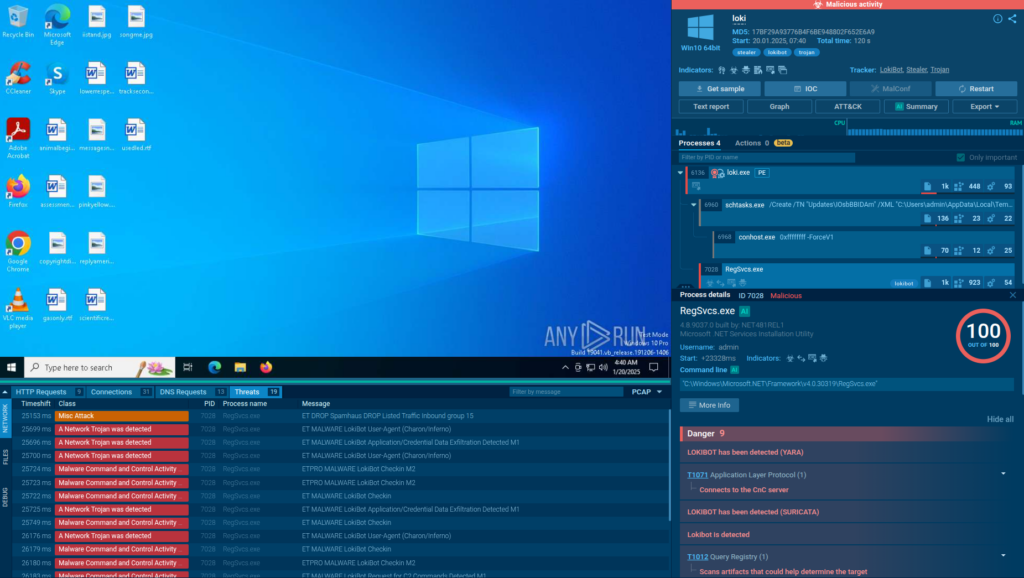
Execution of a suspicious file in ANY.RUN’s safe sandbox environment
That gap matters. When alerts arrive with limited context, automation can only go so far. Teams hesitate, escalations increase, and playbooks stall while someone manually checks files, links, or indicators across multiple tools.
A sandbox changes this dynamic by adding behavior-based proof directly into the workflow. Instead of relying on assumptions or partial signals, SOAR receives concrete answers: what executed, what connected out, what dropped, and how risky it really is.
With that clarity:
Triage decisions happen faster
Playbooks trigger with more confidence
Fewer cases get escalated “just in case”
In practice, SOAR stops being a traffic controller and starts acting like a decision engine; one that’s backed by real evidence, not guesses.
What a Sandbox Does Inside SOAR Workflows
ANY.RUN’s sandbox auto-detonates and detects malware inside an archive attached to an email
When integrated into SOAR, ANY.RUN’s sandbox covers a few critical steps that static tools alone can’t reliably handle:
Validates alerts with real behavior: Suspicious files and links are executed in a safe environment to confirm whether they’re actually malicious. This replaces guesswork with evidence early in the workflow.
Uncovers multi-stage and evasive attacks: Many threats reveal their intent only after redirects, downloads, or user interaction. A sandbox follows the full execution chain so SOAR can act on what truly happens, not what appears safe at first glance.
Returns decision-ready context to playbooks: SOAR receives clear verdicts, risk scores, and indicators tied to observed behavior, giving playbooks the confidence to move forward without manual checks.
Reduces unnecessary escalations: With reliable evidence available upfront, fewer cases are passed up the chain “just in case,” keeping response focused and queues under control.
Enables safer automation: Once behavior is confirmed, SOAR can trigger containment, enrichment, and documentation steps with much lower risk of false positives.
Together, these capabilities allow SOAR workflows to run with more confidence and consistency, even during alert spikes, and without increasing operational overhead.
Add sandbox execution to your SOAR workflows Detect faster, improve DR, and lower response costs
Where Sandbox-Driven SOAR Fits in Real Security Stacks
In enterprise environments, SOAR operates across SIEM, endpoint, and threat intelligence platforms. A sandbox fits into this layer as the system that validates behavior and feeds trusted context back into automation.
That’s why Interactive Sandbox integrations and connectors are designed to work directly inside widely used SOAR and security platforms, including:
Within these environments, sandbox execution is triggered automatically from incidents or alerts. Files, URLs, and artifacts are analyzed in a safe environment, and the results, verdicts, risk scores, indicators, and behavioral context, are returned directly into the SOAR case.
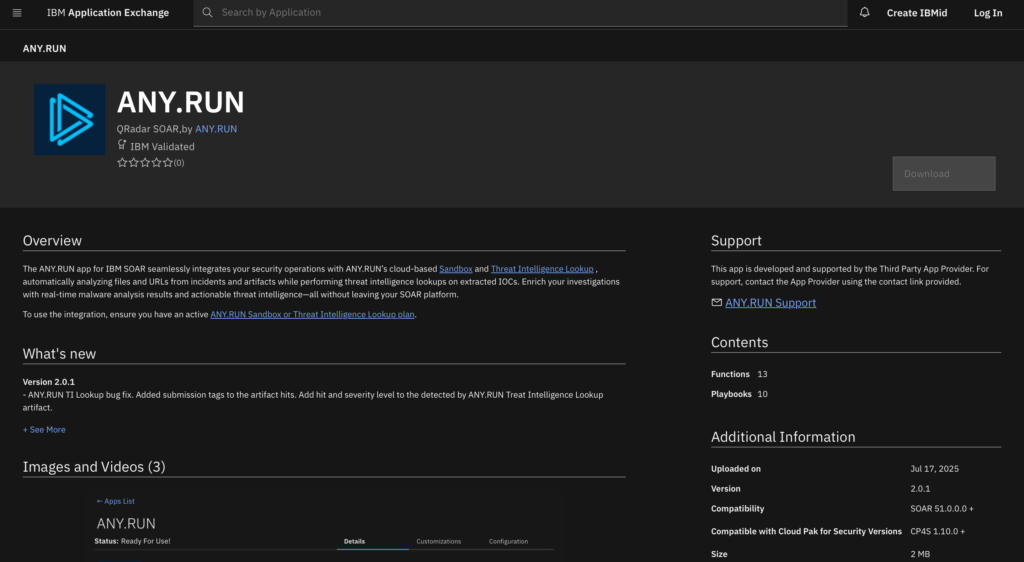
ANY.RUN’s app for IBM SOAR
This means teams don’t have to switch tools to understand what’s happening. Automation continues with confidence, response actions are triggered earlier, and threat intelligence is enriched as part of the same workflow.
Sandbox-driven SOAR is embedded into the platforms large organizations rely on today, making it easier to scale response without adding operational complexity.
Connect ANY.RUN with your existing security stack Add behavior-based insight directly to SOAR workflows
From Faster Triage to Lower Risk: The Business Impact of Sandbox-Driven SOAR
When ANY.RUN’s sandbox is embedded into SOAR workflows, the impact goes beyond faster investigations. It changes how incidents are prioritized, handled, and closed with measurable effects at both the SOC and business level.
Real-time threat visibility: Observe full attack chains as they unfold, with 90% of malicious activity exposed within the first 60 seconds, significantly accelerating mean time to detect (MTTD).
Higher detection rates for evasive threats: Sandbox execution uncovers low-detection attacks, including multi-stage malware and interaction-dependent phishing, resulting in up to 58% more threats identified and fewer missed incidents.
Lower MTTR across common incidents: With behavior confirmation available early, response steps trigger sooner and manual verification is removed from first-line playbooks, consistently shortening response cycles.
Operational efficiency at scale: Automated sandbox execution reduces manual analysis time, cutting Tier 1 workload by up to 20% and allowing less experienced team members to handle more complex cases with confidence.
Stronger performance during alert spikes: Evidence-driven automation keeps workflows stable during phishing waves or malware campaigns, helping teams avoid backlog growth and burnout.
Clear business-level impact: Faster containment reduces the risk of lateral movement, data loss, and downtime, while automation lowers the cost per incident by minimizing repeated manual effort.
Turning Sandbox-Driven SOAR into a Scalable Security Strategy
SOAR works best when automation is backed by proof. By adding a sandbox into the workflow, teams replace uncertainty with clear behavior, shorten response cycles, and keep decisions consistent even under pressure.
With ready-made integrations across common SOAR and security platforms, sandbox-driven workflows fit naturally into existing stacks. The result is faster response, lower operational load, and reduced business risk, without expanding teams or tools.
ANY.RUN helps security teams make faster, clearer decisions when it matters most. The platform is trusted by over 500,000 security professionals and 15,000+ organizations across industries where response speed and accuracy are critical.
ANY.RUN’s Interactive Sandbox allows teams to safely execute suspicious files and links, observe real behavior in real time, and confirm threats before they escalate. Combined with Threat Intelligence Lookup and Threat Intelligence Feeds, it adds the context needed to prioritize alerts, reduce uncertainty, and stop advanced attacks earlier in the response cycle.
SOAR moves tickets fast but can’t tell you what’s really happening. Malware sandbox gives you the proof: what ran, what connected out, what files dropped. Your playbooks turn into decision engines instead of waiting on manual checks.
2. How does a malware sandbox fit into SOAR?
Connectors trigger malware sandbox on alerts. You send files or URLs. Results come back fast. Verdicts, risk scores, IOCs, TTPs. Playbooks use that to triage, contain, or close without humans jumping in.
3. What threats does a malware sandbox catch?
Multi-stage phishing and evasive malware. Malware sandbox follows redirects and downloads to show the full chain. Static scans miss this stuff.
4. Does a malware sandbox cut escalations?
Yes. Tier 1 gets clear evidence upfront. They close 70% more cases without passing them up. No more “just in case” handoffs.
5. How quick are malware sandbox results?
For ANY.RUN’s Interactive Sandbox, 90% of malicious behavior shows up in 60 seconds. Your playbooks act right away.
6. Which SOAR platforms work with a malware sandbox?
FortiSOAR, Cortex XSOAR, Splunk SOAR, Microsoft Sentinel, IBM QRadar SOAR, Google SecOps, and more.
7. How do you start with a malware sandbox?
Grab a 2-week trial. Pick your connector. Test it on real alerts. See the difference yourself.
https://www.backbox.org/wp-content/uploads/2018/09/website_backbox_text_black.png00adminhttps://www.backbox.org/wp-content/uploads/2018/09/website_backbox_text_black.pngadmin2025-12-30 07:09:512025-12-30 07:09:51Integrating a Malware Sandbox into SOAR Workflows: Steps, Benefits, and Impact
https://www.backbox.org/wp-content/uploads/2018/09/website_backbox_text_black.png00adminhttps://www.backbox.org/wp-content/uploads/2018/09/website_backbox_text_black.pngadmin2025-12-30 02:06:432025-12-30 02:06:43Finally, Bluetooth trackers for Android users that function even better than AirTags (and they’re on sale)
https://www.backbox.org/wp-content/uploads/2018/09/website_backbox_text_black.png00adminhttps://www.backbox.org/wp-content/uploads/2018/09/website_backbox_text_black.pngadmin2025-12-29 23:32:102025-12-29 23:32:10US, Australia say ‘MongoBleed’ bug being exploited
KrebsOnSecurity.com celebrates its 16th anniversary today! A huge “thank you” to all of our readers — newcomers, long-timers and drive-by critics alike. Your engagement this past year here has been tremendous and truly a salve on a handful of dark days. Happily, comeuppance was a strong theme running through our coverage in 2025, with a primary focus on entities that enabled complex and globally-dispersed cybercrime services.
Image: Shutterstock, Younes Stiller Kraske.
In May 2024, we scrutinized the history and ownership of Stark Industries Solutions Ltd., a “bulletproof hosting” provider that came online just two weeks before Russia invaded Ukraine and served as a primary staging ground for repeated Kremlin cyberattacks and disinformation efforts. A year later, Stark and its two co-owners were sanctioned by the European Union, but our analysis showed those penalties have done little to stop the Stark proprietors from rebranding and transferring considerable network assets to other entities they control.
In December 2024, KrebsOnSecurity profiled Cryptomus, a financial firm registered in Canada that emerged as the payment processor of choice for dozens of Russian cryptocurrency exchanges and websites hawking cybercrime services aimed at Russian-speaking customers. In October 2025, Canadian financial regulators ruled that Cryptomus had grossly violated its anti-money laundering laws, and levied a record $176 million fine against the platform.
In September 2023, KrebsOnSecurity published findings from researchers who concluded that a series of six-figure cyberheists across dozens of victims resulted from thieves cracking master passwords stolen from the password manager service LastPass in 2022. In a court filing in March 2025, U.S. federal agents investigating a spectacular $150 million cryptocurrency heist said they had reached the same conclusion.
Phishing was a major theme of this year’s coverage, which peered inside the day-to-day operations of several voice phishing gangs that routinely carried out elaborate, convincing, and financially devastating cryptocurrency thefts. A Day in the Life of a Prolific Voice Phishing Crew examined how one cybercrime gang routinely abused legitimate services at Apple and Google to force a variety of outbound communications to their users, including emails, automated phone calls and system-level messages sent to all signed-in devices.
In January, we highlighted research into a dodgy and sprawling content delivery network called Funnull that specialized in helping China-based gambling and money laundering websites distribute their operations across multiple U.S.-based cloud providers. Five months later, the U.S. government sanctioned Funnull, identifying it as a top source of investment/romance scams known as “pig butchering.”
In April, the U.S. Department of Justice indicted the proprietors of a Pakistan-based e-commerce company for conspiring to distribute synthetic opioids in the United States. The following month, KrebsOnSecurity detailed how the proprietors of the sanctioned entity are perhaps better known for operating an elaborate and lengthy scheme to scam westerners seeking help with trademarks, book writing, mobile app development and logo designs.
In June, KrebsOnSecurity.com was hit by the largest DDoS attack that Google had ever mitigated at the time (we are a grateful guest of Google’s excellent Project Shield offering). Experts blamed that attack on an Internet-of-Things botnet called Aisuru that had rapidly grown in size and firepower since its debut in late 2024. Another Aisuru attack on Cloudflare just days later practically doubled the size of the June attack against this website. Not long after that, Aisuru was blamed for a DDoS that again doubled the previous record.
In October, it appeared the cybercriminals in control of Aisuru had shifted the botnet’s focus from DDoS to a more sustainable and profitable use: Renting hundreds of thousands of infected Internet of Things (IoT) devices to proxy services that help cybercriminals anonymize their traffic.
However, it has recently become clear that at least some of the disruptive botnet and residential proxy activity attributed to Aisuru last year likely was the work of people responsible for building and testing a powerful botnet known as Kimwolf. Chinese security firm XLab, which was the first to chronicle Aisuru’s rise in 2024, recently profiled Kimwolf as easily the world’s biggest and most dangerous collection of compromised machines — with approximately 1.83 million devices under its thumb as of December 17.
XLab noted that the Kimwolf author “shows an almost ‘obsessive’ fixation on the well-known cybersecurity investigative journalist Brian Krebs, leaving easter eggs related to him in multiple places.”
Image: XLab, Kimwolf Botnet Exposed: The Massive Android Botnet with 1.8 million infected devices.
I am happy to report that the first KrebsOnSecurity stories of 2026 will go deep into the origins of Kimwolf, and examine the botnet’s unique and highly invasive means of spreading digital disease far and wide. The first in that series will include a somewhat sobering and global security notification concerning the devices and residential proxy services that are inadvertently helping to power Kimwolf’s rapid growth.
Thank you once again for your continued readership, encouragement and support. If you like the content we publish at KrebsOnSecurity.com, please consider making an exception for our domain in your ad blocker. The ads we run are limited to a handful of static images that are all served in-house and vetted by me (there is no third-party content on this site, period). Doing so would help further support the work you see here almost every week.
And if you haven’t done so yet, sign up for our email newsletter! (62,000 other subscribers can’t be wrong, right?). The newsletter is just a plain text email that goes out the moment a new story is published. We send between one and two emails a week, we never share our email list, and we don’t run surveys or promotions.
Thanks again, and Happy New Year everyone! Be safe out there.