Digitalization of business – especially in the small and medium-sized segment – allows for quick upscaling, better customer service, and entry into new markets. On the downside, digitalization amplifies the damage caused by a cyberattack, and complicates the recovery process. Given that company resources are always limited, which attacks should be deflected first?
To answer this question, we studied the INTERPOL Africa Cyberthreat Assessment Report 2025. The document is useful because it collates police cybercrime statistics and data from information security companies – including Kaspersky – allowing us to compare the number and types of attacks with the actual damage they caused. This data can be used to build a company’s information security strategy.
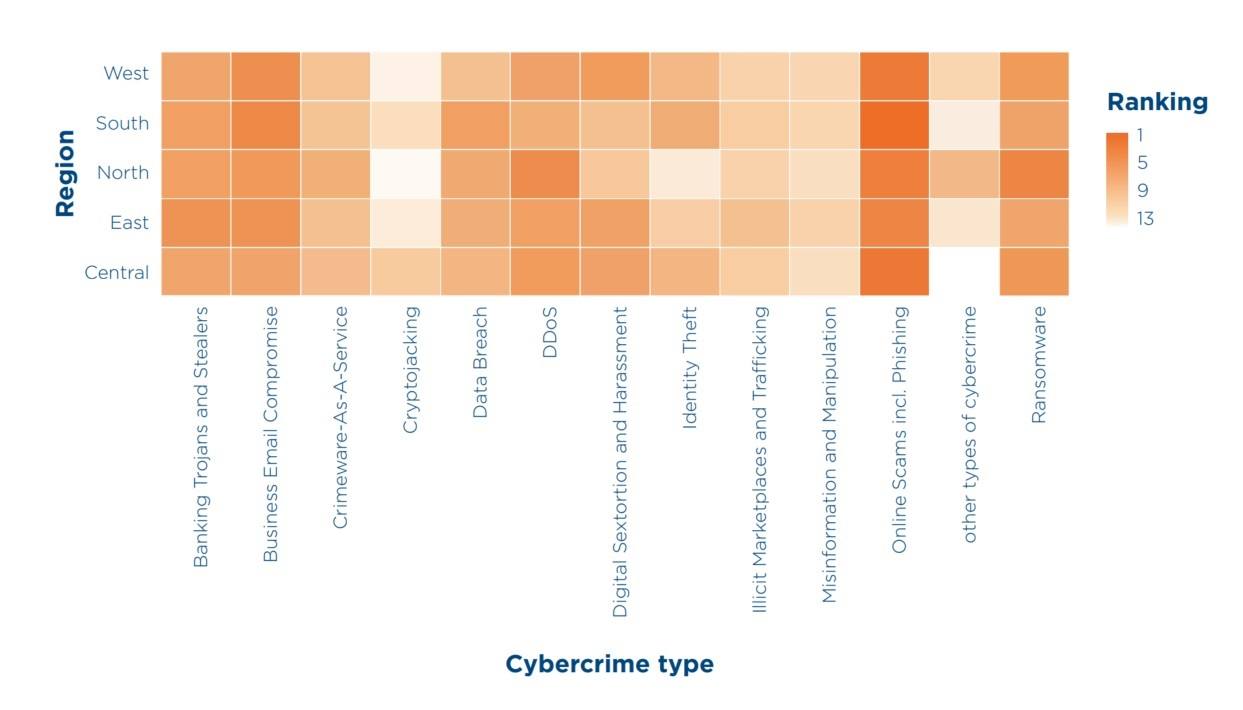
Average ranking of cybercrime types by reported financial impact across African subregions, based on INTERPOL member country data. Source
Targeted online fraud
Fraudulent operations were the clear leader in terms of damage caused across the continent. They’re gaining momentum in line with the rising popularity of mobile banking, digital commerce, and social media. In addition to mass phishing aimed at personal and payment data theft, targeted attacks are growing at a rapid rate. Scammers are grooming potential victims in messenger apps for months, building trust and guiding them into a money extortion scheme – for example, a fake cryptocurrency investment. Such schemes often exploit romantic relationships and are therefore called romance scams, but there are other variations. In Nigeria and Ivory Coast, for example, scammers were arrested for attacking small media platforms and advertising agencies. Posing as advertisers, they stole almost 1.5 million U.S. dollars from victims.
The fact that 93% of Africans use plain old WhatsApp rather than corporate communication tools for work significantly boosts the success rate of attacks on employees and company owners.
Ransomware incidents
Press headlines may give the impression that ransomware operators mainly target large organizations, but the statistics in the report debunk this theory – showing that both the number of attacks and the actual financial damage caused are significant across all business segments. What’s more, there’s a direct link between the level of digitalization and the number of attacks. So, if a company observes an overall increase in “digitized” business activity in its market segment, the threat level is sure to rise accordingly. In Africa, “affiliates” of the largest and most dangerous ransomware-as-a-service platforms – such as LockBit and Hunters International – are responsible for major incidents on a national scale.
Among the main ransomware incidents in Africa – hardly known about outside the continent – we highlight the following: the theft of $7 million from Nigerian fintech company Flutterwave; attacks on Cameroonian electricity supplier ENEO; a large-scale ransomware attack to exfiltrate data from Telecom Namibia; and the targeting of South Africa’s National Health Laboratory Service (NHLS), which led to canceled operations and the loss of millions of lab test results.
Banking Trojans and infostealers
Although the direct losses from banking Trojans and infostealers fell outside the top-three in terms of damage, it’s the “successes” of this criminal industry that have a direct impact on the number and severity of other attacks – primarily ransomware and business email compromise (BEC). After stealing what credentials they can from thousands of users with infostealers, attackers filter and group them by various criteria, then sell curated sets of accounts on the illicit market. This allows other criminals to buy passwords to infiltrate organizations of interest to them.
Business email compromise
For small and medium businesses mainly using public services like Gmail or Office 365, infection with an infostealer gives attackers full access to corporate correspondence and business operations. The attackers can then exploit this to trick customers and counterparties into paying for goods and services to a fraudulent account. BEC attacks have a firm hold at the top of the damage charts, and small businesses can fall victim to them in two ways. First, cybercriminals can extract money from larger clients or partners by impersonating the compromised small business. Second, it’s easier with a small business to persuade the owner or accountant to transfer money than it is with a large organization.
There are several large criminal syndicates based in Africa that are responsible for international BEC operations causing multi-billion-dollar damage. Their targets also include African organizations — primarily those in the financial and international trade sectors.
How to protect business from cyberthreats
To effectively counter digital threats, law enforcement agencies need to share data with commercial information security companies that harness telemetry to identify threat distribution hotspots. Recent successes of such partnerships include operations Serengeti (1000 arrests, 134 000 malicious online resources disabled), Red Card (300 arrests), and Secure (32 arrests, 20 000 malicious resources disabled). These operations, conducted under the auspices of INTERPOL, used cyberthreat intelligence received from partners – including Kaspersky.
But businesses can’t leave cybersecurity solely to the police; they need to implement simple but effective security measures of their own:
Install reliable anti-malware protection on all corporate and personal devices. For corporate devices, centralized security management is recommended – as implemented, for example, in Kaspersky Endpoint Detection and Response.
Hold regular cybersecurity training – for example, using our Kaspersky Automated Security Awareness platform. This will reduce the risk of your company falling victim to BEC and phishing. All employees, including management, should participate in training regularly.
Back up all company data on a regular basis and in such a way that the backups can’t be destroyed during an attack. This means backing up data either to media that are physically disconnected from the network, or to cloud storage where a policy prohibits data deletion.
https://www.backbox.org/wp-content/uploads/2018/09/website_backbox_text_black.png00adminhttps://www.backbox.org/wp-content/uploads/2018/09/website_backbox_text_black.pngadmin2025-06-26 17:06:462025-06-26 17:06:46How to survive digitalization | Kaspersky official blog
It’s been almost a year since CrowdStrike crashed Windows PCs and disrupted businesses worldwide. New changes to the Windows security architecture will make those outages less likely and easier to recover from.
https://www.backbox.org/wp-content/uploads/2018/09/website_backbox_text_black.png00adminhttps://www.backbox.org/wp-content/uploads/2018/09/website_backbox_text_black.pngadmin2025-06-26 16:06:582025-06-26 16:06:58Microsoft rolls out Windows security changes to prevent another CrowdStrike meltdown
ZURICH, Switzerland – Zurich-based automation platform Flowable has been recognized as a Representative Vendor in the Gartner newly released…
Hackread – Latest Cybersecurity, Hacking News, Tech, AI & Crypto – Read More
https://www.backbox.org/wp-content/uploads/2018/09/website_backbox_text_black.png00adminhttps://www.backbox.org/wp-content/uploads/2018/09/website_backbox_text_black.pngadmin2025-06-26 15:07:032025-06-26 15:07:03Flowable Named in the latest Gartner® Market Guide for BPA Tools
Unfortunately, the same vulnerability was also identified by other researchers, resulting in a so-called collision. So naturally, we wanted to participate again in 2024, hoping to find a unique exploit in one of the available targets.
As Trend Micro had closed their office in Toronto, the 2024 edition would take place in Cork, Ireland. This time all participants must be on-site which we were looking forward to, having had lots of interesting discussions with the on-site teams the previous year. https://www.zerodayinitiative.com/blog/2024/7/16/announcing-pwn2own-ireland-2024
Target Selection
While in 2023 the Compass employees taking part in Pwn2Own pooled their company provided research time and focused on a single device, in the 2024 edition we approached the event by looking at multiple available targets. This included the Lorex 2K indoor Wi-Fi security camera, the Ubiquiti AI Bullet surveillance camera, the AeoTec Smart Home Hub, as well as the Synology BeeStation BST150-4T.
While we have identified (and reported to their vendors) multiple vulnerabilities in these products, the available time only allowed us to find one unauthenticated remote code execution vulnerability in the Ubiquiti AI Bullet camera running firmware version 4.72.38.
In the following we will describe how we analyzed the Ubiquiti AI Bullet, present the vulnerability we found and show how to exploit it.
Device Overview
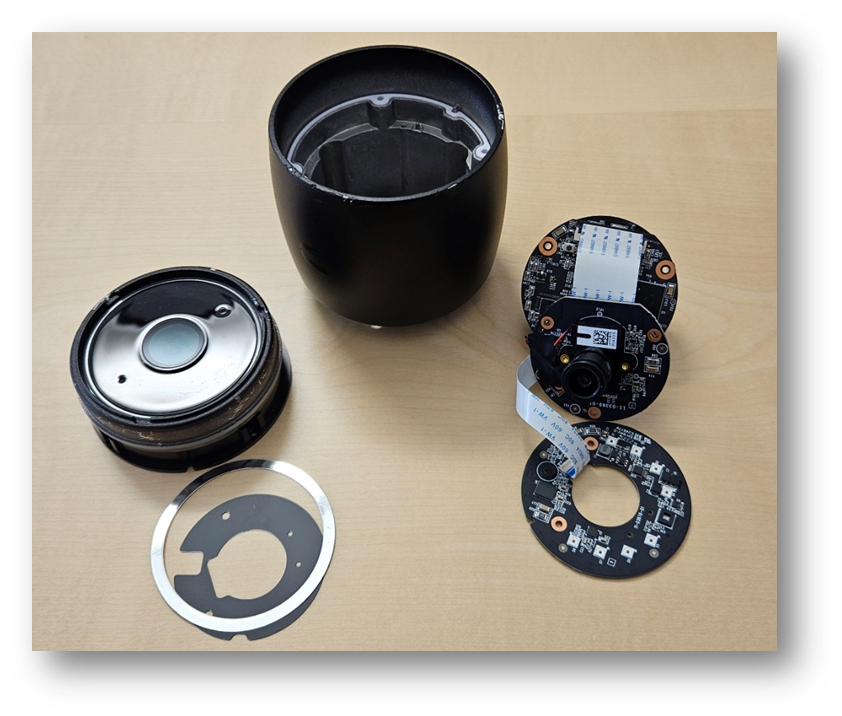
The Ubiquiti AI Bullet camera features a heavy metal enclosure. On the back, an ethernet port that is also used to power the camera via PoE is exposed.
As with some other devices, our first action was to try to open the device to have a look at the components. We wanted to look at the CPU, the memory and most importantly see if there were UART or other debugging ports exposed. This could hopefully help us to gain access to the firmware and get a shell on the device for easier debugging. Eager to explore, we forcefully pried the camera open – only to realize afterwards that there was an easier, intended way to do it.
While it was interesting to have a look at the inner workings, we did not immediately notice a debugging port. So we decided to power up the camera and have a look at what services are exposed. At that moment we realized that the Ubiquiti AI Bullet exposes SSH. After a quick Google search, we learned that many Ubiquiti devices provide shell access with default credentials (ubnt:ubnt). This allows us to gain shell access to extract the firmware and also have a debugging environment. Another reason to think twice before trying to force open the next device we will examine.
Attack Surface
Using netstat, we see that lighthttpd is listening on ports 80 and 443. Furthermore, dropbear is used as SSHserver and finally there is infctld that is listening on UDP port 10001.
UVC AI Bullet-4.72.38# netstat -tulpn
Active Internet connections (only servers)
Proto Recv-Q Send-Q Local Address  Foreign Address State  PID/Program name
tcp        0      0 0.0.0.0:443    0.0.0.0:*       LISTEN 1056/lighttpd
tcp        0      0 0.0.0.0:80     0.0.0.0:*       LISTEN 1056/lighttpd
tcp        0      0 0.0.0.0:22     0.0.0.0:*       LISTEN 1065/dropbear
udp        0      0 0.0.0.0:10001  0.0.0.0:*              1199/infctld
The web interface requires authentication for most actions. While we found some inconsistent behaviors, they couldn’t be leveraged for unauthenticated compromise.
Finally, the camera uses DHCP to obtain an IP address, meaning DHCP responses are an additional attack surface. This is the route we finally decided to go down and exploit.
Unauthenticated Remote Code Execution
This chapter describes how we abused a missing input validation vulnerability to gain unauthenticated remote code execution (RCE) on the Ubiquiti AI Bullet camera.
Root Cause
When a new DHCPv4 message is received, the /bin/udhcpc binary processes it by parsing and analyzing the incoming message. This binary then creates several environment variables for each value extracted from the received message and executes the script referenced inside the -s option:
The content of the /bin/udhcpc_cb.sh script is shown below. This script does not perform any validation on the environment values received from udhcp; instead, the domain (and other) variables are used to create a JSON message that is sent via IPC by the /bin/ubnt_ipc_cli binary in the final line:
The flags used in the call to /bin/ubnt_ipc_cli are the following:
-z: If specified, no logging will be performed.
-b: Will broadcast the message to all available IPC-enabled processes. Keep this in mind, as it will be important later.
-m: The message to be sent. Must be specified inline with all the UNIX style constraints for a command-line parameter (e.g. escaping characters).
Since the script above does not validate any field from the DHCP message. This could allow us to escape the predefined JSON structure. In theory, we could send our payload in any of the variables present in the JSON message sent by the /bin/ubnt_ipc_cli binary. However, since these values are extracted from the incoming DHCP message, they must comply with the DHCP standard, which may impose strict validations on certain fields (e.g., IP addresses, subnet values, etc.). We decided to target the domain DHCP field because it is simply a string and can contain any value.
Using this, the idea is to break the JSON structure and insert additional JSON values into the message being sent. For example, if the domain value is set to csnc1234","aaa":"bbb, it would inject a new JSON key called aaa with the value bbb into the message:
The unescaped JSON message shows the injected aaa JSON key. This allows altering the content of the JSON message being sent to all the IPC-enabled processes:
After some reversing, we did not find any JSON keys we could inject that would be interesting for us. But we noticed that if the same JSON key is present multiple times, only the latest one is processed. Thus, we started to investigate if we can somehow abuse one of the existing JSON keys.
For example, we could try to inject a second functionName key. In the following example, myNewFunctionName would be processed instead of DhcpEvent, because it is defined later:
Recall that, as mentioned earlier, due to the -b flag in the /bin/ubnt_ipc_cli command, the JSON message will be broadcasted to all IPC-enabled processes.
The next step was to figure out all available values for the functionName key. The results showed that multiple functionName values were being utilized by different scripts to perform various actions, and several binaries also contained the hardcoded string functionName.
Each functionName shown in the previous output has its own unique JSON structure. This will not be an issue though as we can break the JSON structure of the message, adding new keys and thus adjusting it to match any target function.
After analyzing the binaries listed above, we discovered that the ubnt_cgi binary looked promising. For example, it handles actions like ChangeUsernamePassword. But this requires the old password, which we unfortunately don’t have. However, we came across the ResetToDefaults action, which looked very promising.
We reversed the code responsible for handling the ResetToDefaults action and discovered that the JSON message needed to trigger it was:
{
    "functionName":"ResetToDefaults"
}
So, we immediately decided to conduct a test to verify whether we could successfully trigger the ResetToDefaults function. To achieve this, we modified the domain field returned by our DHCP server to the following value:
csnc1234","functionName":"ResetToDefaults
This payload modifies the JSON message sent to all IPC-enabled processes as shown below:
We waited until the camera sent a new DHCP request message to the DHCP server and shortly after we observed that the camera rebooted. We tried accessing the SSH service using our credentials, but it didn’t work. Then we tried again using the default credentials, and it was successful. We tested this multiple times to confirm it wasn’t a fluke, and it worked every time. Thus, we found a way to remotely reset the camera and subsequently access it using the exposed SSH service and default credentials. All that was left to do was to automate the process by crafting an exploit.
Exploit
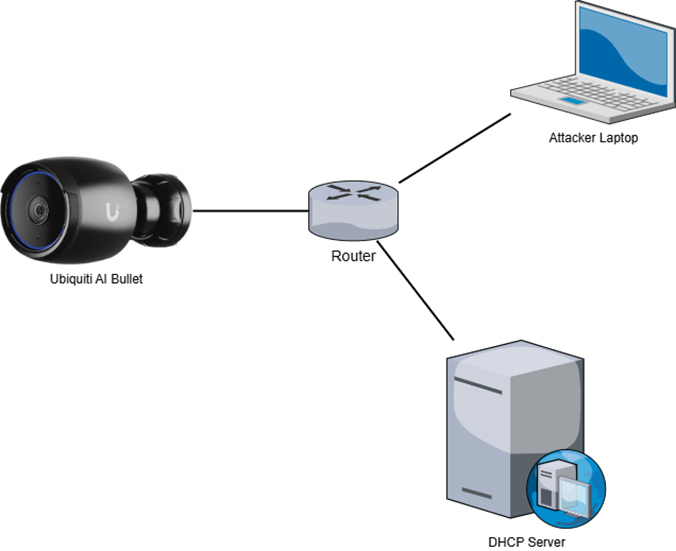
The next challenge we faced was figuring out how to trigger this exploit remotely without having access to the DHCP server and without altering the camera’s settings, to be in line with the Pwn2Own rules. After some internal discussion, we came up with the idea of creating a small rogue DHCP server to answer the camera’s DHCP requests, sending the payload in the domain field of the response to trigger the exploit. However, since the camera would always contact the configured DHCP server, we also decided to create an ARP spoofing script to poison the camera’s ARP cache and hopefully redirect the DHCP requests to our rogue DHCP server.
The setup looked as follows:
ARP Spoofing
The Python implementation of the ARP spoofing server is as follows:
This code is straightforward and continuously sends fake ARP (Address Resolution Protocol) messages into the local network to poison the camera’s ARP cache. There are four key variables:
DHCP_SERVER_IP: The IP address of the legitimate DHCP server to spoof.
MY_MAC: The MAC address of the device running the rogue DHCP server (in our case, our laptop).
TARGET_IP: The IP address of the camera.
TARGET_MAC: The MAC address of the camera, which will receive the ARP message.
DHCP Rogue Server
The Python implementation of the rogue DHCP server is as follows:
client_ip = packet[IP].src  # Source IP address from the request
client_mac = packet[BOOTP].chaddr  # Client MAC address
client_mac_str = ':'.join(f'{b:02x}' for b in client_mac)  # Convert to MAC address string format
trx_id = packet[BOOTP].xid

# Determine the domain name to return
if client_ip == TARGET_IP:
    response_domain = 'csnc1234","functionName":"ResetToDefaults'

    print(f"Client IP: {client_ip}, Client MAC: {':'.join('%02x' % b for b in client_mac[:6])}, TransactionID: {trx_id}")

    # Prepare DHCPACK packet
    dhcp_ack = (Ether(src=MY_MAC, dst=client_mac_str) /
                IP(src=DHCP_SERVER_IP, dst=client_ip) /
                UDP(sport=67, dport=68) /
                BOOTP(op=2,
                        htype=1,
                        hlen=6,
                        xid=trx_id,
                        yiaddr=DHCP_SERVER_IP
                        siaddr=DHCP_SERVER_IP
                        chaddr=client_mac)
                DHCP(options=[
                ("message-type", "ack"),
                ("server_id", DHCP_SERVER_IP),
                ("lease_time", DHCP_LEASE_TIME),
                ("domain", response_domain),
                "end"
            ]))
    # Send the DHCPOFFER packet
    sendp(dhcp_ack, iface=INTERFACE, verbose=True)

    print(f"Sent DHCPACK to {client_ip} with domain {response_domain}")
    if client_ip == TARGET_IP:
        RUNNING = False
        print("RUNNING is: ", RUNNING)
The server is designed to answer only requests received from the camera’s IP address, preventing it from affecting other devices on the network. For each DHCPREQUEST received, the server sends a DHCPACK response that includes the payload in the domain DHCP option.
Since we are impersonating the legitimate DHCP server, the source IP address of the DHCP response must match the real DHCP server’s IP address. This is why the src parameter in the IP function within the script is set to DHCP_SERVER_IP.
Once the DHCP response containing the payload is sent to the camera, the RUNNING variable is set to False, stopping both the rogue DHCP server and the ARP spoofing process. This step is crucial to prevent the camera from entering an infinite boot loop, constantly resetting its settings to the default ones.
SSH Connections
After the DHCP message is sent, the exploit waits for 15 seconds before repeatedly attempting to establish a connection to the camera’s exposed SSH service using the default credentials (ubnt:ubnt). It continues this process until the connection is successful. Once SSH access is granted, the exploit triggers the camera’s LEDs and uploads the required files to launch a web server, which serves a Compass Security-branded webpage.
With everything prepared, we registered for Pwn2Own Cork and started to prepare for the journey.
Pwn2Own Cork Experience
On Monday morning we were scheduled to fly to Dublin. Shortly after passing through security at the airport, we received a notification that a new beta firmware version of our target device had been released. Since ZDI had not released what versions were being used in the competition at the time, we were concerned that our vulnerability might have been patched in this beta release and that it would be the version of the device we would be targeting in Cork. Still at the airport, at the gates, we downloaded the latest beta firmware, unpacked it and quickly analyzed its contents. The script in the firmware that was critical to our exploit was still there, unchanged. Nothing relevant for our exploit seemed to have changed. Our colleagues in the office would test the exploit against the camera with the latest firmware, and we boarded the plane. Arriving in Dublin, we learned in an email from ZDI that the beta version of the firmware would not be used in the contest. Our target will have the exact same firmware that we tested our exploit against multiple times back in the office. Relieved, we boarded a bus to Cork. The drawing of the contestants was broadcast while we were still on the bus. With an unreliable internet connection and several interruptions, we watched the stream on YouTube. We were drawn fourth out of six contestants. Our hopes of not having a collision shrunk. In the evening, we finally arrived in Cork.
Our attempt was scheduled for Wednesday afternoon. We came to the TrendMicro offices on Tuesday anyway to register, gather some swag, and familiarize ourselves with the competition area. Watching other teams pwning their devices is interesting at first but considering that you cannot see any details of the exploit as a spectator, it loses some appeal after a while. However, the food and drinks and the company of the world’s best researchers still make it an amazing experience. In the evening, a social event was planned in one of Cork’s pubs. Obviously, we joined.
On Wednesday, we arrived at the TrendMicro office two hours before our scheduled attempt for a stout tasting. After enjoying the beer, snacks, other participants’ attempts, and watching fragments of projected hacker movies, it was finally time for our attempt. After setting up the target machine, all we were allowed to do was ping it to verify that we could reach it on a network level, and then we had to unplug the ethernet cable until we were allowed to start our attempt. Once we were ready to go, the ten-minute timer started and we were able to plug the cable into our machine. After a few seconds, the camera asked our machine for a new DHCP lease, shortly after that we got a root shell on it, and the camera lights blinked in the pattern we defined.
After the attempt, we went to the disclosure room to discuss the details of what we had done. It quickly became clear that our exploit was already known to ZDI. They were able to show us another team’s write-up that was almost identical to ours. Second time at pwn2own and unfortunately second collision. In the evening another social event was planned in another pub in Cork. Obviously, we joined.
On Thursday the last social event took place in an old prison in Cork. Obviously, we joined it as well. During this event the Master of Pwn was announced and awarded. Congratulations again to the Viettel team. On Friday we flew back to Zurich, satisfied that our exploit worked and happy to meet and share stories with some of the world’s best researchers in person.
https://www.backbox.org/wp-content/uploads/2018/09/website_backbox_text_black.png00adminhttps://www.backbox.org/wp-content/uploads/2018/09/website_backbox_text_black.pngadmin2025-06-26 13:07:012025-06-26 13:07:01Cloud Repatriation Driven by AI, Cost, and Security
The US Office of Cybersecurity finally banned WhatsApp on all staff devices, a move that has left many wondering why it took so long. The memo: Meta also confirmed this announcement, not that it needed confirmations, but more specifically, to express their concern regarding the ban. We can agree to disagree with both parties, since the US Office of Cybersecurity recommends MS Teams as an…
https://www.backbox.org/wp-content/uploads/2018/09/website_backbox_text_black.png00adminhttps://www.backbox.org/wp-content/uploads/2018/09/website_backbox_text_black.pngadmin2025-06-26 13:07:002025-06-26 13:07:00WhatsApp gets the boot: House of Representatives the app from official devices
SaaS Adoption is Skyrocketing, Resilience Hasn’t Kept Pace
SaaS platforms have revolutionized how businesses operate. They simplify collaboration, accelerate deployment, and reduce the overhead of managing infrastructure. But with their rise comes a subtle, dangerous assumption: that the convenience of SaaS extends to resilience.
It doesn’t.
These platforms weren’t built with full-scale data
https://www.backbox.org/wp-content/uploads/2018/09/website_backbox_text_black.png00adminhttps://www.backbox.org/wp-content/uploads/2018/09/website_backbox_text_black.pngadmin2025-06-26 12:06:582025-06-26 12:06:58The Hidden Risks of SaaS: Why Built-In Protections Aren’t Enough for Modern Data Resilience
https://www.backbox.org/wp-content/uploads/2018/09/website_backbox_text_black.png00adminhttps://www.backbox.org/wp-content/uploads/2018/09/website_backbox_text_black.pngadmin2025-06-26 12:06:572025-06-26 12:06:57British hacker ‘IntelBroker’ charged in US over spree of company breaches