Patch, track, repeat

Patch, track, repeat

Welcome to this week’s edition of the Threat Source newsletter.

We’ve made it halfway through 2025 already! It’s been a while since I last wrote about CVEs and how free support for Windows 10 will end on October 14, 2025, leaving you with no more security fixes.

While the CVE system remains the global standard for vulnerability reporting, recent developments have sparked concerns within the community about its long-term stability. Currently, the program operates solely as a U.S. government-funded initiative. Following the last-minute funding extension, we’re now seeing competing ideas and projects emerging. Whether it’s the CVE Foundation working to transition from a single funding stream to a diversified and stable model, ENISA’s EUVD, or the Global CVE Allocation System (GCVE), the landscape is changing.

On one hand, a multi-source environment enhances availability and resilience. On the other, this fragmentation raises practical concerns for both researchers and practitioners. We now face questions like “Where should I report a vulnerability?” and “How do I integrate and correlate vulnerability data across multiple sources with multiple identifiers?”

Looking back at the first six months of this year, we see that the rapid pace of CVE publications in 2024 has continued into 2025, with no signs of slowing down. In fact, the current trend suggests that 2025 will surpass last year’s total of a little more than 40,000 CVEs. To illustrate: the first half of 2024 saw an average of 113 CVEs published per day, whereas the first half of 2025 is running at a rate of 131 CVEs per day.

Patch, track, repeat

What concerns me even more is the steep increase in Known Exploited Vulnerabilities (KEVs). It wasn’t just the spike in March — we’re seeing a generally sharper rise overall.

Patch, track, repeat

Vendor diversity also continues to expand, increasing from 45 vendors during the first half of last year to 61 so far this year. Additionally, the proportion of KEVs affecting network-related gear has grown from 22.5% in 2024 to 25% in 2025.

But there’s a small piece of good news: So far, I haven’t seen any CVEs from as far back as 2012 being added to the KEV catalogue like we saw last year. This time, the oldest additions “only” go back to 2017.

Patch, track, repeat

Keep in mind that the CVE year merely indicates when a vulnerability was reserved or assigned. The vulnerability itself may have existed for many years prior. For example, the recent sudo/chroot issue remained undiscovered for over 12 years. 

In a nutshell: Keep tracking, keep patching. Vulnerabilities certainly won’t patch themselves.

The one big thing 

Microsoft’s July 2025 security update addresses 132 vulnerabilities, including 14 marked as “critical,” with several remote code execution (RCE) issues affecting Windows, Office, SharePoint and Hyper-V. Although none have been exploited in the wild yet, some vulnerabilities — like those in SharePoint and SPNEGO NEGOEX — are more likely to be targeted and could allow attackers to execute code remotely or locally.

Why do I care? 

These vulnerabilities could let attackers take control of your systems, steal information or disrupt business operations, even if you haven’t seen any attacks yet. If you’re running Windows servers, SharePoint or Microsoft Office, your environment could be at risk, especially for organizations that rely on these products daily.

So now what? 

Don’t wait. Make sure you’re applying Microsoft’s July patches as soon as possible. If you use Cisco Security Firewall or SNORT®, update your rulesets to the latest versions to maximize your protection.

Top security headlines of the week 

Alleged Chinese hacker tied to Silk Typhoon arrested for cyberespionage
A Chinese national was arrested in Milan, Italy for allegedly being linked to the state-sponsored Silk Typhoon hacking group, which is responsible for cyberattacks against U.S. organizations and government agencies. (Bleeping Computer

Jailbreaking AI with information overload 
Researchers say you can trick AI chatbots like ChatGPT or Gemini into teaching you how to make a bomb or hack an ATM if you make the question complicated, full of academic jargon, and cite sources that do not exist. (404 Media

SatanLock is shutting down
The announcement that the group was closing its doors first came through its official Telegram channel and dark web leak site. Hunters International, another well-known ransomware group, also recently announced that it was shutting down its operations. (Dark Reading

Ingram Micro scrambling to restore systems after ransomware attack
The IT distributor giant confirmed over the weekend that a ransomware attack was responsible for a widespread outage over its services, and they were forced to take certain systems offline on Friday afternoon, in response to the incident. (SecurityWeek

Malicious Chrome extensions with 1.7M installs found on Web Store
Malicious extensions with 1.7 million downloads in Google’s Chrome Web Store pose as legitimate tools but could track users, steal browser activity, and redirect to potentially unsafe web addresses. (Bleeping Computer)

Can’t get enough Talos? 

Scams, jailbreaks and poetic justice
In this episode of the TTP, Hazel Burton sits down with Talos’ Jaeson Schultz to explore the underground world of criminal LLM abuse, from elaborate scams to role-playing jailbreak prompts designed to trick AI into ignoring its own rules.

Vulnerability Roundup
Cisco Talos’ Vulnerability Discovery & Research team has disclosed and coordinated patches for two vulnerabilities each in Asus Armoury Crate and Adobe Acrobat.

PDFs: Portable documents, or perfect deliveries for phish? 
A popular social engineering technique returns: callback phishing, or TOAD attacks, which leverage PDFs, VoIP anonymity and even QR code tricks.

Beers with Talos: Terms and conceptions may apply 
In this episode, the crew reassembles after a totally intentional and not-at-all accidental hiatus. They cover AI-assisted IVF, a possible underground war against dairy, and the real heroes: conference dogs.

Upcoming events where you can find Talos 

Most prevalent malware files from Talos telemetry over the past week 

SHA 256: a31f222fc283227f5e7988d1ad9c0aecd66d58bb7b4d8518ae23e110308dbf91   
MD5: 7bdbd180c081fa63ca94f9c22c457376 
VirusTotal: https://www.virustotal.com/gui/file/a31f222fc283227f5e7988d1ad9c0aecd66d58bb7b4d8518ae23e110308dbf91/details 
Typical Filename: IMG001.exe 
Detection Name: Simple_Custom_Detection   

SHA 256: 9f1f11a708d393e0a4109ae189bc64f1f3e312653dcf317a2bd406f18ffcc507 
MD5: 2915b3f8b703eb744fc54c81f4a9c67f 
VirusTotal: https://www.virustotal.com/gui/file/9f1f11a708d393e0a4109ae189bc64f1f3e312653dcf317a2bd406f18ffcc507 
Typical Filename: VID001.exe 
Claimed Product: N/A 
Detection Name: Win.Worm.Coinminer::1201 

SHA256: 47ecaab5cd6b26fe18d9759a9392bce81ba379817c53a3a468fe9060a076f8ca  
MD5: 71fea034b422e4a17ebb06022532fdde  
VirusTotal: https://www.virustotal.com/gui/file/47ecaab5cd6b26fe18d9759a9392bce81ba379817c53a3a468fe9060a076f8ca/details 
Typical Filename: VID001.exe  
Claimed Product: N/A  
Detection Name: Coinminer:MBT.26mw.in14.Talos

Cisco Talos Blog – ​Read More

French police arrest Russian basketball player accused of ransomware: report

Daniil Kasatkin was reportedly arrested in a Paris airport on June 21 at the request of U.S. authorities.

Security News | TechCrunch – ​Read More

UK Arrests Woman and Three Men for Cyberattacks on M&S Co-op and Harrods

Four suspects arrested by the NCA in April/May 2025 cyberattacks on M&S, Co-op, and Harrods. Learn about the social engineering, ransomware disruption, and estimated £300M impact on M&S.

Hackread – Latest Cybersecurity, Hacking News, Tech, AI & Crypto – ​Read More

Asus and Adobe vulnerabilities

Asus and Adobe vulnerabilities

Cisco Talos’ Vulnerability Discovery & Research team recently disclosed two vulnerabilities each in Asus Armoury Crate and Adobe Acrobat products.  

The vulnerabilities mentioned in this blog post have been patched by their respective vendors, all in adherence to Cisco’s third-party vulnerability disclosure policy.    

For Snort coverage that can detect the exploitation of these vulnerabilities, download the latest rule sets from Snort.org, and our latest Vulnerability Advisories are always posted on Talos Intelligence’s website.     

Asus Armoury Crate stack-based buffer overflow and authorization bypass  vulnerabilities

Discovered by Marcin 'Icewall' Noga of Cisco Talos.   

These vulnerabilities were recently covered in a deep-dive post, Decrement by one to rule them all.

Asus Armoury Crate is a software utility used to manage Asus and ROG lighting, performance, and updates.

TALOS-2025-2144 (CVE-2025-1533) is a stack-based buffer overflow vulnerability in the AsIO3.sys kernel driver of Asus Armoury Crate 5.9.13.0. A specially crafted I/O request packet (IRP) can lead to stack-based buffer overflow. An unprivileged attacker can run a program from user mode to trigger this vulnerability.

TALOS-2025-2150 (CVE-2025-3464) is an authorization bypass vulnerability in the AsIO3.sys functionality of Asus Armoury Crate 5.9.13.0. A specially crafted hard link can lead to an authorization bypass. An attacker can create a hard link to trigger this vulnerability.

Adobe Acrobat Reader out-of-bounds read and use-after-free vulnerabilities 

Discovered by Kamlapati Choubey of Cisco Talos.   

Adobe Acrobat Reader is one of the most popular PDF reading software currently available. Talos found an out-of-bounds read vuln, TALOS-2025-2159 (CVE-2025-43578), in the Font functionality of Adobe Acrobat Reader 2025.001.20435. A specially crafted font file embedded into a PDF can trigger this vulnerability which can lead to disclosure of sensitive information.

TALOS-2025-2170 (CVE-2025-43576) is a use-after-free vulnerability in the annotation object processing functionality of Adobe Acrobat Reader 2025.001.20435. A specially crafted Javascript code inside a malicious PDF document can trigger reuse of a previously freed object, which can lead to memory corruption and could result in arbitrary code execution.

An attacker needs to trick the user into opening the malicious file to trigger either of these vulnerabilities.

Cisco Talos Blog – ​Read More

How extensions from Open VSX were used to steal cryptocurrency

Our researchers have uncovered several malicious fake extensions targeting Solidity developers in the Open VSX marketplace. At least one company has fallen victim to the attackers distributing these extensions — losing approximately US$500 000 in crypto assets.

Threats associated with malware distribution in open-source repositories have been known about for a long time. Despite this, users of AI-powered code editors like Cursor AI and Windsurf are forced to use the open-source extension marketplace Open VSX, as they have no other source for the extensions these platforms need.

However, extensions on Open VSX do not undergo the same rigorous checks as those on the Visual Studio Marketplace. This loophole allows attackers to distribute malicious software disguised as legitimate solutions. In this post, we dive into the details of the malicious Open VSX extensions investigated by our experts, and explain how to prevent similar incidents within your organization.

Risks for users of Open VSX extensions

In June 2025, a blockchain developer who had just lost approximately US$500 000 in crypto assets to attackers reached out to our experts and requested an incident investigation. While examining a disk image from the compromised system, our researchers noticed a suspicious component of an extension named Solidity Language for the Cursor AI development environment. The component was executing a PowerShell script — a sure sign of malicious activity.

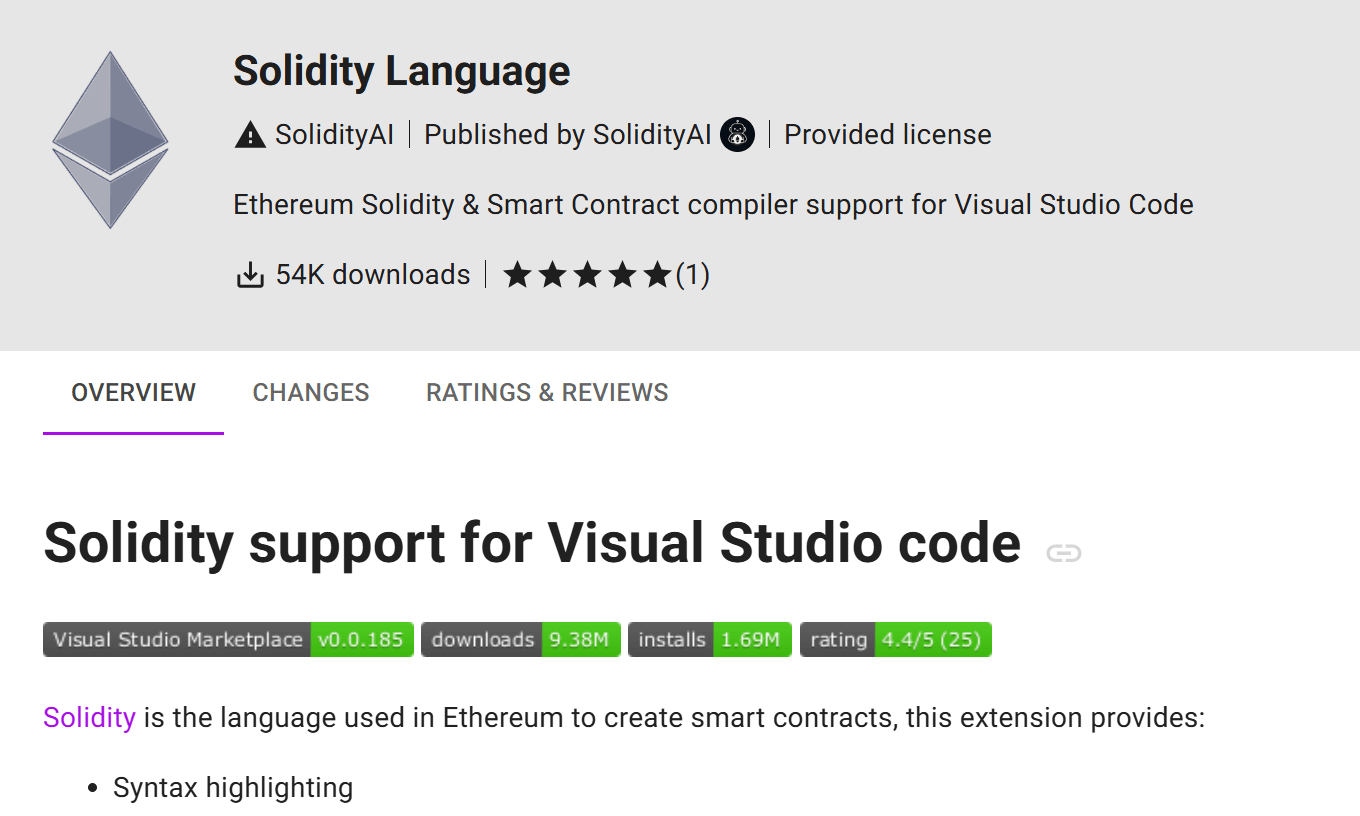
The Solidity Language extension on the Open VSX marketplace

The description of the Solidity Language extension published on the Open VSX marketplace

The extension was installed from the Open VSX marketplace, where it had tens of thousands of downloads (presumably inflated by bot activity). The description claimed to optimize development of smart contract code written in the Solidity language. However, analysis of the extension revealed it had no useful functionality whatsoever. The developers who installed it mistook the lack of advertised features for a bug, didn’t immediately investigate, and just continued their work.

The browser extension wasn’t actually faulty; it was fake. Once installed, it contacted a command-and-control server to download and run a malicious script. This script then installed ScreenConnect — a remote access application — on the victim’s computer.

The attackers used ScreenConnect to upload additional malicious payloads. In the incident our experts investigated, these tools specifically allowed the attackers to steal passphrases for the developer’s crypto wallets and then syphon off cryptocurrency. A detailed technical description of the attack, along with indicators of compromise, is available in a Securelist blog post.

Manipulating search: how attackers promote malicious extensions

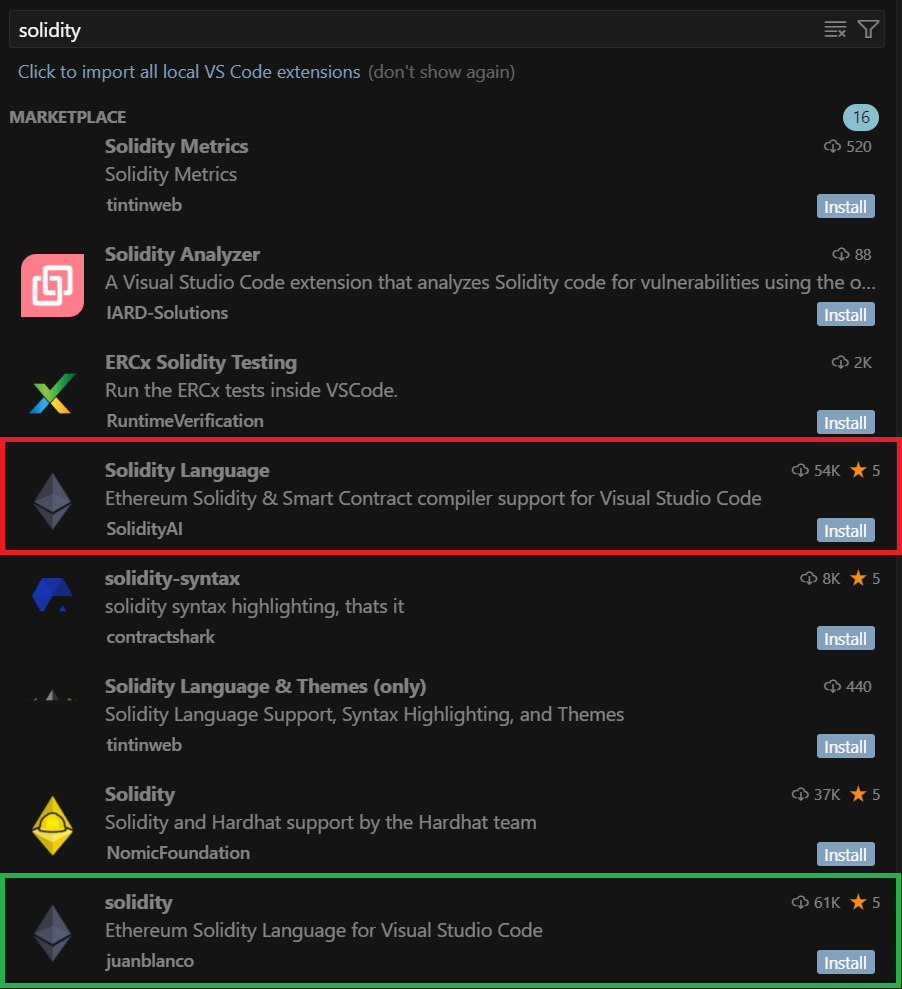
A look into the Open VSX marketplace revealed a concerning trend: a fake extension, deceptively named “Solidity Language”, ranked fourth in search results, while the legitimate extension, simply called solidity, appeared all the way down at eighth. It’s no surprise then that the developer downloaded the counterfeit instead of the genuine article.

When searching Open VSX for "solidity", the imposter extension appeared higher than the legitimate one

Search results for “solidity”: the malicious extension (red) vs. the legitimate one (green)

This ranking is quite surprising, especially considering that at the time of the search, the legitimate extension had more downloads: 61 000 compared to the fake’s 54 000.

The key lies in Open VSX’s ranking algorithm. It doesn’t solely rely on download counts to determine relevance; it also considers other factors like verification status, ratings, and recency. This is exactly how the attackers managed to outrank the genuine extension in search results: the fake one had a more recent update date.

The fake plugin was removed from the Open VSX marketplace on July 2, 2025, right after the cryptocurrency heist. However, the very next day, we found another malicious package with the same name as the original extension, “solidity”, and the same harmful functionality as Solidity Language.

Additionally, our researchers used an open-source component-monitoring tool to discover yet another malicious package in Open VSX. Several details link this package to the same cybercriminals.

Why do developers have to rely on the Open VSX marketplace?

The Visual Studio Marketplace, Microsoft’s official store, has long been the primary industry source for extensions. It includes automatic scanning for malicious code, sandboxed execution of extensions for behavioral analysis, monitoring for anomalies in extension usage, and a number of other features to help identify harmful extensions. However, its licensing agreement dictates that only solutions for use with Visual Studio products can be published in the Visual Studio Marketplace.

Consequently, users of increasingly popular AI-powered code editors like Cursor AI and Windsurf must install extensions from an alternative store: Open VSX. The problem is that this platform has less stringent extension vetting, which makes it easier to distribute malicious packages compared to Microsoft’s official marketplace.

To be fair, attackers sometimes manage to publish malicious extensions even in the more secure Visual Studio Marketplace. For instance, this spring, experts found three malicious extensions there with an infection scheme very similar to the one described in this post, also targeting Solidity developers.

How to stay safe?

No matter where you’re installing extensions from, we recommend the following:

  • Be careful when searching marketplaces.
  • Always take note of who the developer of an extension is.
  • Check the code and behavior of extensions you install.
  • Use an XDR solution to monitor any suspicious activity inside the corporate network.

Kaspersky official blog – ​Read More

eSIM Hack Allows for Cloning, Spying 

Details have been disclosed for an eSIM hacking method that could impact many, but the industry is taking action.

The post eSIM Hack Allows for Cloning, Spying  appeared first on SecurityWeek.

SecurityWeek – ​Read More

Russian basketball player arrested in France over alleged ransomware ties

Daniil Kasatkin, 26, was detained in June at Paris’s Charles de Gaulle Airport shortly after arriving in the country with his fiancée, according to local media reports.

The Record from Recorded Future News – ​Read More

Authorities arrest four hackers linked to UK retail hacking spree

The U.K. National Crime Agency said the suspects are in custody in relation to the hacks targeting Marks & Spencer, Harrods, and the Co-op.

Security News | TechCrunch – ​Read More

Qantas says 5.7 million affected by breach, leaked info not enough to access frequent flyer accounts

In an updated advisory, Qantas broke down the categories of personal data breached in a recent cyberattack, saying frequent-flyer numbers were involved, but not in a way that would compromise accounts.

The Record from Recorded Future News – ​Read More

Four Arrested in UK Over M&S, Co-op Cyberattacks

Three teens and a woman have been arrested by the UK’s NCA over the hacking of M&S, Co-op and Harrods.

The post Four Arrested in UK Over M&S, Co-op Cyberattacks appeared first on SecurityWeek.

SecurityWeek – ​Read More