Scavenger Trojan Targets Crypto Wallets via Game Mods and Browser Flaws

New Scavenger Trojan steals crypto wallet data using fake game mods and browser flaws, targeting MetaMask, Exodus, Bitwarden, and other popular apps.

Hackread – Latest Cybersecurity, Hacking News, Tech, AI & Crypto – ​Read More

Buy the Motorola Razr Ultra at $200 off and get a free smartwatch too

Motorola is holding a new promotion for its flagship foldable that slashes hundreds of dollars off the 2025 Razr Ultra.

Latest news – ​Read More

Every Mac model that upgrades to MacOS 26 Tahoe (and which aren’t compatible)

Apple’s newest operating system for Macs, Tahoe, is coming soon. If you’re not sure if your device is compatible with the update, we’ve got the full list.

Latest news – ​Read More

GitHub’s AI-powered Spark lets you build apps using natural language – here’s how to access it

The public preview arrives amid a surge of investment from leading tech companies in AI-powered coding assistants.

Latest news – ​Read More

How to install the iPadOS 26 public beta (and which iPad models support it)

Your iPad is set to get several new features with iPadOS 26 this fall, but you can try them early by downloading the public beta now. Here’s how.

Latest news – ​Read More

How to clear your iPhone cache (and why you should do it before installing iOS 26 public beta)

A full cache can slow down your iPhone, but clearing it is a fast and easy way to improve performance and free up space.

Latest news – ​Read More

Phishers Target Aviation Execs to Scam Customers

KrebsOnSecurity recently heard from a reader whose boss’s email account got phished and was used to trick one of the company’s customers into sending a large payment to scammers. An investigation into the attacker’s infrastructure points to a long-running Nigerian cybercrime ring that is actively targeting established companies in the transportation and aviation industries.

Image: Shutterstock, Mr. Teerapon Tiuekhom.

A reader who works in the transportation industry sent a tip about a recent successful phishing campaign that tricked an executive at the company into entering their credentials at a fake Microsoft 365 login page. From there, the attackers quickly mined the executive’s inbox for past communications about invoices, copying and modifying some of those messages with new invoice demands that were sent to some of the company’s customers and partners.

Speaking on condition of anonymity, the reader said the resulting phishing emails to customers came from a newly registered domain name that was remarkably similar to their employer’s domain, and that at least one of their customers fell for the ruse and paid a phony invoice. They said the attackers had spun up a look-alike domain just a few hours after the executive’s inbox credentials were phished, and that the scam resulted in a customer suffering a six-figure financial loss.

The reader also shared that the email addresses in the registration records for the imposter domain — roomservice801@gmail.com — is tied to many such phishing domains. Indeed, a search on this email address at DomainTools.com finds it is associated with at least 240 domains registered in 2024 or 2025. Virtually all of them mimic legitimate domains for companies in the aerospace and transportation industries worldwide.

An Internet search for this email address reveals a humorous blog post from 2020 on the Russian forum hackware[.]ru, which found roomservice801@gmail.com was tied to a phishing attack that used the lure of phony invoices to trick the recipient into logging in at a fake Microsoft login page. We’ll come back to this research in a moment.

JUSTY JOHN

DomainTools shows that some of the early domains registered to roomservice801@gmail.com in 2016 include other useful information. For example, the WHOIS records for alhhomaidhicentre[.]biz reference the technical contact of “Justy John” and the email address justyjohn50@yahoo.com.

A search at DomainTools found justyjohn50@yahoo.com has been registering one-off phishing domains since at least 2012. At this point, I was convinced that some security company surely had already published an analysis of this particular threat group, but I didn’t yet have enough information to draw any solid conclusions.

DomainTools says the Justy John email address is tied to more than two dozen domains registered since 2012, but we can find hundreds more phishing domains and related email addresses simply by pivoting on details in the registration records for these Justy John domains. For example, the street address used by the Justy John domain axisupdate[.]net — 7902 Pelleaux Road in Knoxville, TN — also appears in the registration records for accountauthenticate[.]com, acctlogin[.]biz, and loginaccount[.]biz, all of which at one point included the email address rsmith60646@gmail.com.

That Rsmith Gmail address is connected to the 2012 phishing domain alibala[.]biz (one character off of the Chinese e-commerce giant alibaba.com, with a different top-level domain of .biz). A search in DomainTools on the phone number in those domain records — 1.7736491613 — reveals even more phishing domains as well as the Nigerian phone number “2348062918302” and the email address michsmith59@gmail.com.

DomainTools shows michsmith59@gmail.com appears in the registration records for the domain seltrock[.]com, which was used in the phishing attack documented in the 2020 Russian blog post mentioned earlier. At this point, we are just two steps away from identifying the threat actor group.

The same Nigerian phone number shows up in dozens of domain registrations that reference the email address sebastinekelly69@gmail.com, including 26i3[.]net, costamere[.]com, danagruop[.]us, and dividrilling[.]com. A Web search on any of those domains finds they were indexed in an “indicator of compromise” list on GitHub maintained by Palo Alto NetworksUnit 42 research team.

SILVERTERRIER

According to Unit 42, the domains are the handiwork of a vast cybercrime group based in Nigeria that it dubbed “SilverTerrier” back in 2014. In an October 2021 report, Palo Alto said SilverTerrier excels at so-called “business e-mail compromise” or BEC scams, which target legitimate business email accounts through social engineering or computer intrusion activities. BEC criminals use that access to initiate or redirect the transfer of business funds for personal gain.

Palo Alto says SilverTerrier encompasses hundreds of BEC fraudsters, some of whom have been arrested in various international law enforcement operations by Interpol. In 2022, Interpol and the Nigeria Police Force arrested 11 alleged SilverTerrier members, including a prominent SilverTerrier leader who’d been flaunting his wealth on social media for years. Unfortunately, the lure of easy money, endemic poverty and corruption, and low barriers to entry for cybercrime in Nigeria conspire to provide a constant stream of new recruits.

BEC scams were the 7th most reported crime tracked by the FBI’s Internet Crime Complaint Center (IC3) in 2024, generating more than 21,000 complaints. However, BEC scams were the second most costly form of cybercrime reported to the feds last year, with nearly $2.8 billion in claimed losses. In its 2025 Fraud and Control Survey Report, the Association for Financial Professionals found 63 percent of organizations experienced a BEC last year.

Poking at some of the email addresses that spool out from this research reveals a number of Facebook accounts for people residing in Nigeria or in the United Arab Emirates, many of whom do not appear to have tried to mask their real-life identities. Palo Alto’s Unit 42 researchers reached a similar conclusion, noting that although a small subset of these crooks went to great lengths to conceal their identities, it was usually simple to learn their identities on social media accounts and the major messaging services.

Palo Alto said BEC actors have become far more organized over time, and that while it remains easy to find actors working as a group, the practice of using one phone number, email address or alias to register malicious infrastructure in support of multiple actors has made it far more time consuming (but not impossible) for cybersecurity and law enforcement organizations to sort out which actors committed specific crimes.

“We continue to find that SilverTerrier actors, regardless of geographical location, are often connected through only a few degrees of separation on social media platforms,” the researchers wrote.

FINANCIAL FRAUD KILL CHAIN

Palo Alto has published a useful list of recommendations that organizations can adopt to minimize the incidence and impact of BEC attacks. Many of those tips are prophylactic, such as conducting regular employee security training and reviewing network security policies.

But one recommendation — getting familiar with a process known as the “financial fraud kill chain” or FFKC — bears specific mention because it offers the single best hope for BEC victims who are seeking to claw back payments made to fraudsters, and yet far too many victims don’t know it exists until it is too late.
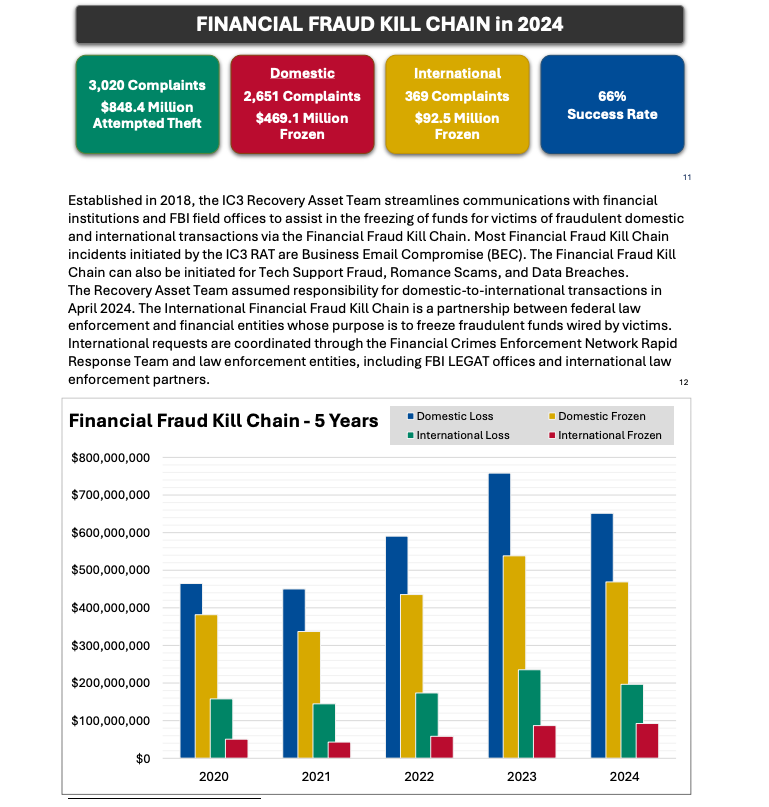
Image: ic3.gov.

As explained in this FBI primer, the International Financial Fraud Kill Chain is a partnership between federal law enforcement and financial entities whose purpose is to freeze fraudulent funds wired by victims. According to the FBI, viable victim complaints filed with ic3.gov promptly after a fraudulent transfer (generally less than 72 hours) will be automatically triaged by the Financial Crimes Enforcement Network (FinCEN).

The FBI noted in its IC3 annual report (PDF) that the FFKC had a 66 percent success rate in 2024. Viable ic3.gov complaints involve losses of at least $50,000, and include all records from the victim or victim bank, as well as a completed FFKC form (provided by FinCEN) containing victim information, recipient information, bank names, account numbers, location, SWIFT, and any additional information.

Krebs on Security – ​Read More

Faster Qi2 wireless charging coming to iPhones and some Android phones

The new Qi2 25 W standard is especially good news for Android users. Here’s why.

Latest news – ​Read More

BRB, pausing for a “Sanctuary Moon” marathon

BRB, pausing for a "Sanctuary Moon" marathon

Welcome to this week’s edition of the Threat Source newsletter. 

Yesterday, Cisco Talos debuted the first Humans of Talos episode, where I interviewed Hazel Burton, a face and voice you’re probably familiar with. In our conversation, Hazel shared not just the story of how she found her way onto the team, but also the passions and hobbies that energize her work. Plus, she offered a sneak peek into what she’s most looking forward to at Black Hat this year! With future Humans of Talos episodes, you’ll get to learn not only about the people behind the research, but the people behind the communications, operations, and design, too.

My team chose to name the series “Humans of Talos” as a cheeky wink to the world of machine learning (ML) and a reminder that no matter how sophisticated our technology gets, it’s always our humanity that makes the difference. 

I’m a sci-fi nerd who loves a captive audience, so let’s consider Murderbot from Martha Wells’ “The Murderbot Diaries” (now a TV show starring Alexander Skarsgård). Designed as a security unit with both organic and mechanic parts, self-named Murderbot secretly hacks its own governor module and, instead of turning on humans, spends its free time watching soap operas like “The Rise and Fall of Sanctuary Moon.” So relatable, right? What draws readers in isn’t its technical specs. It’s Murderbot’s dry humor, awkwardness, struggle with newfound autonomy, and the way it wrestles with what it means to care for others (even if it pretends not to). Despite its past, when it was treated as a piece of equipment rather than a living thing, Murderbot is both highly analytical and empathetic. Advanced technology is most powerful when paired with genuine human creativity and insight, and this is a balance we seek every day at Talos.

If cozy, found family sci-fi is more your vibe, take Lovey (aka Sidra) from Becky Chambers’ “A Long Way to a Small, Angry Planet” and “A Closed and Common Orbit.” Originally an AI managing a tunneling spaceship, Lovey is suddenly transferred into a human-like body kit and faces the challenge of living in a world she was never designed for, which is where her story really gets interesting. She has to learn everything from how to move and act to how to build friendships and find her own purpose. Learning to ask for help, make mistakes and trust the people around us is familiar to many of us in the cybersecurity community. No matter how advanced our tools become, it’s our willingness to learn from each other, collaborate and grow together that truly makes us stronger and better at our work.

So while Talos has practically always used ML in our work, I’ll always say that it is nothing without the humans behind it. We all share one mission: protecting our customers.

Tune into the next episode mid-August, and whether you’re streaming “Sanctuary Moon” or finding your place in the universe like Lovey, stay safe and secure out there!

The one big thing 

Cisco Talos Incident Response (Talos IR) has identified a new ransomware-as-a-service (RaaS) group called Chaos, which is actively targeting organizations worldwide with sophisticated attacks involving phishing, remote management tool abuse, and double extortion tactics.  

We assess with moderate confidence that Chaos was likely formed by former members of the BlackSuit (Royal) gang. They use advanced encryption, anti-analysis techniques, and target both local and networked systems for maximum disruption. We believe the new Chaos ransomware is unrelated to previous Chaos builder-generated variants, and the group uses the same name to create confusion.   

Why do I care? 

Chaos is going after organizations of all sizes across verticals using techniques that can bypass common security measures, steal sensitive data and disrupt business operations. Even if you’re not a direct target, your company could be affected if you work with a business that is attacked, or if similar tactics are used against your sector.

So now what? 

Review your organization’s security posture, especially around email, remote access and backup systems. Make sure you’re using multi-factor authentication, keeping software up-to-date and educating employees about phishing and social engineering.

Top security headlines of the week 

Microsoft rushes emergency patch for actively exploited SharePoint “ToolShell” bug 
Malicious actors already have already pounced on the zero-day vulnerability in Microsoft Sharepoint Server, tracked as CVE-2025-53770, to compromise US government agencies and other businesses in ongoing and widespread attacks. (DarkReading) (Cisco Talos

Europol sting leaves Russian cybercrime’s “NoName057(16)” group fractured 
National authorities have issued seven arrest warrants in total relating to the cybercrime collective known as NoName057(16), which recruits followers to carry out DDoS attacks on perceived enemies of Russia. (DarkReading

Indian crypto exchange CoinDCX confirms $44M stolen during hack 
On Saturday, CoinDCX co-founder and CEO Sumit Gupta disclosed in a post on X that an internal account was compromised during the hack. The executive assured that the incident did not affect customer funds and that all its customer assets remain secure. (TechCrunch

Ryuk ransomware operator extradited to US, faces five years in federal prison 
Justice Department officials said the operators received about 1,160 bitcoins — valued at more than $15 million at the time — in ransom payments from victim companies. (CyberScoop)

Can’t get enough Talos? 

We have lots of videos to share, so queue them up and let’s get learning!

SnortML in 60 seconds 
Most detection engines rely on signatures, but when threats evolve or the exploit is brand new, these rules can fall short. Enter SnortML! 

Humans of Talos: Hazel Burton 
Okay, I know I hammered this into you in the intro, but Hazel is a delight to listen to, and she gives a lot of wonderful insights. Watch here.

Upcoming events where you can find Talos 

Most prevalent malware files from Talos telemetry over the past week  

SHA 256: 9f1f11a708d393e0a4109ae189bc64f1f3e312653dcf317a2bd406f18ffcc507 
MD5: 2915b3f8b703eb744fc54c81f4a9c67f 
VirusTotal: https://www.virustotal.com/gui/file/9f1f11a708d393e0a4109ae189bc64f1f3e312653dcf317a2bd406f18ffcc507 
Typical Filename: VID001.exe 
Claimed Product: N/A 
Detection Name: Win.Worm.Coinminer::1201

SHA 256: a31f222fc283227f5e7988d1ad9c0aecd66d58bb7b4d8518ae23e110308dbf91   
MD5: 7bdbd180c081fa63ca94f9c22c457376 
VirusTotal: https://www.virustotal.com/gui/file/a31f222fc283227f5e7988d1ad9c0aecd66d58bb7b4d8518ae23e110308dbf91/details 
Typical Filename: IMG001.exe  
Detection Name: Simple_Custom_Detection

SHA 256: ee33aaa05be135969d86452a49a8e50a5313efdfc46ae2e7fc8a9af33556046c 
MD5: 17e33efb1b100397c3a9908df7032da1 
VirusTotal: https://www.virustotal.com/gui/file/ee33aaa05be135969d86452a49a8e50a5313efdfc46ae2e7fc8a9af33556046c/details  
Typical Filename: tacticalrmm.exe 
Claimed Product: N/A 
Detection Name: W32.EE33AAA05B-95.SBX.TG

SHA 256: 0581bd9f0e1a6979eb2b0e2fd93ed6c034036dadaee863ff2e46c168813fe442 
MD5: 7854b00a94921b108f0aed00f77c7833 
VirusTotal: https://www.virustotal.com/gui/file/0581bd9f0e1a6979eb2b0e2fd93ed6c034036dadaee863ff2e46c168813fe442/details  
Typical Filename: winword.exe 
Claimed Product: Microsoft Word, Excel, Outlook, Visio, OneNote 
Detection Name: W32.0581BD9F0E.in12.Talos

SHA 256: 59f1e69b68de4839c65b6e6d39ac7a272e2611ec1ed1bf73a4f455e2ca20eeaa 
MD5: df11b3105df8d7c70e7b501e210e3cc3 
VirusTotal: https://www.virustotal.com/gui/file/59f1e69b68de4839c65b6e6d39ac7a272e2611ec1ed1bf73a4f455e2ca20eeaa/details 
Typical Filename: DOC001.exe 
Claimed Product: N/A 
Detection Name: Win.Worm.Coinminer::1201

SHA 256: 83748e8d6f6765881f81c36efacad93c20f3296be3ff4a56f48c6aa2dcd3ac08 
MD5: 906282640ae3088481d19561c55025e4 
VirusTotal: https://www.virustotal.com/gui/file/83748e8d6f6765881f81c36efacad93c20f3296be3ff4a56f48c6aa2dcd3ac08/details 
Typical Filename: AAct_x64.exe 
Claimed Product: N/A 
Detection Name: PUA.Win.Tool.Winactivator::1201

SHA 256: c67b03c0a91eaefffd2f2c79b5c26a2648b8d3c19a22cadf35453455ff08ead0 
MD5: 8c69830a50fb85d8a794fa46643493b2  
VirusTotal: https://www.virustotal.com/gui/file/c67b03c0a91eaefffd2f2c79b5c26a2648b8d3c19a22cadf35453455ff08ead0/details 
Typical Filename: AAct.exe  
Claimed Product: N/A  
Detection Name: PUA.Win.Dropper.Generic::1201

Cisco Talos Blog – ​Read More

1 in 3 Americans ask ChatGPT to help them find a new job, study finds

Of workers surveyed, 18% said AI suggested an entirely new career path that they hadn’t previously considered.

Latest news – ​Read More