SOC Leader’s Playbook: 3 Practical Steps to Faster MTTR 

If you’ve ever looked at a SOC queue and thought, “Where do we even start?” you’re not alone. 

Most teams face more alerts than they can realistically investigate, tools that don’t always connect, and investigations that take longer than they should. 

In a recent webinar, we shared a simple framework for speeding up detection and response without overloading teams. You can watch the full recording here: SOC Leader’s Playbook 

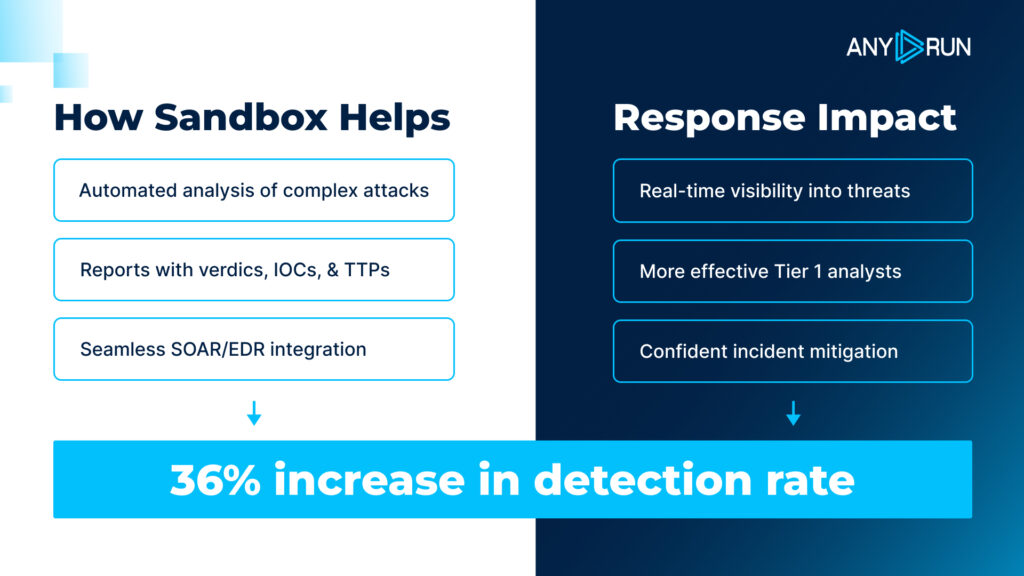
SOC teams that applied this approach have already seen measurable results: 

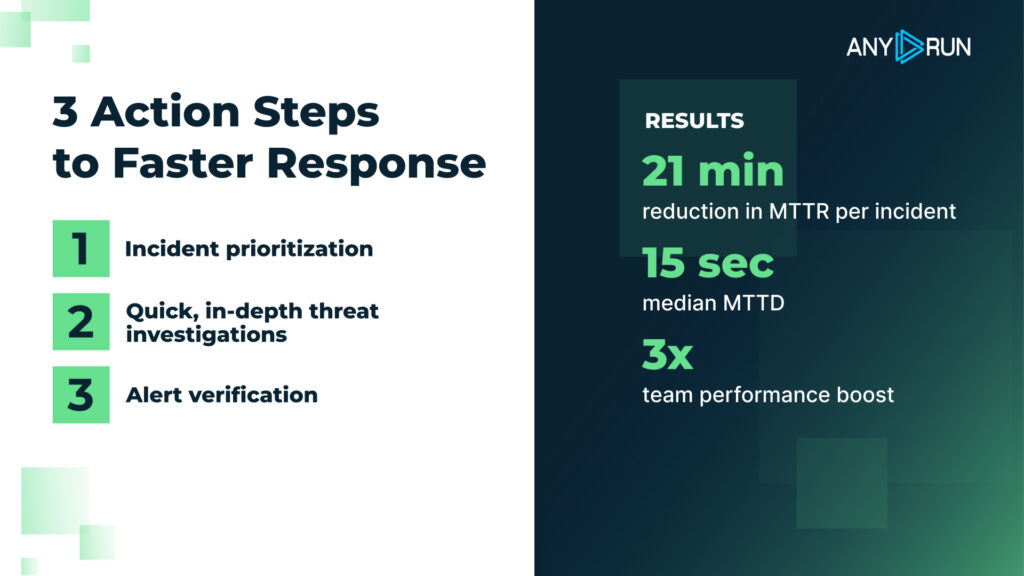
  • 21 minutes less MTTR per incident 
  • 15-second median MTTD 
  • 3× improvement in team throughput 

For now, let’s look at how you can apply the same ideas to help your SOC respond faster in real environments. 

The Cost of a Slow SOC 

When detection and response take too long, the impact shows up fast and in very practical ways. 
The high costs of slow response, including 4.4m data breach 
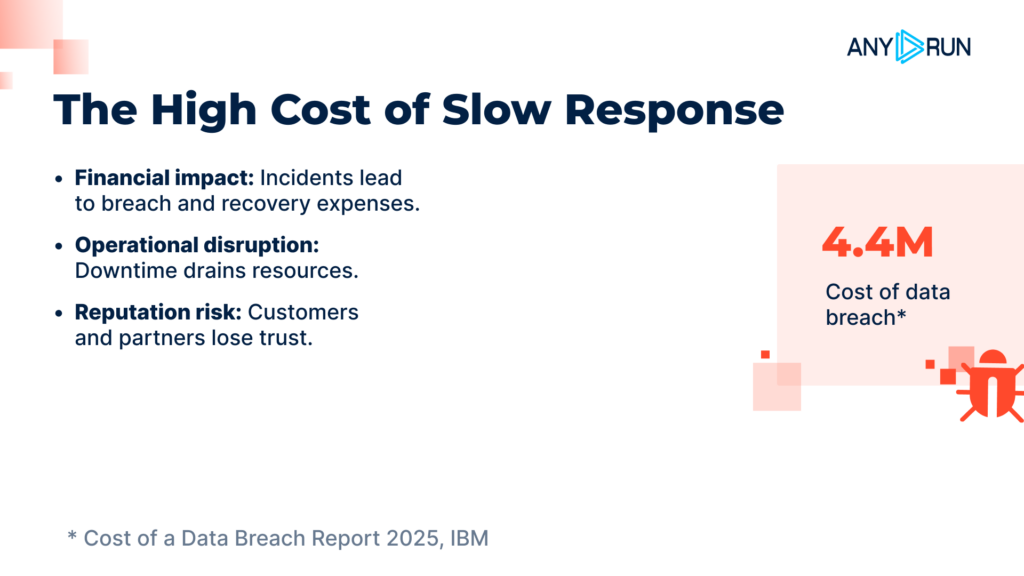
  • Incidents cost more: According to IBM’s Cost of a Data Breach Report 2025, the average breach now costs $4.4 million, and that number grows the longer attackers stay active. 
  • Downtime lasts longer: Delayed response means systems stay compromised, business processes slow down, and recovery becomes harder. 
  • Teams waste time on noise: Analysts spend hours chasing alerts that turn out to be harmless, often repeating the same checks across different tools. 
  • Real threats get missed: Fatigue and overload make it easier for serious incidents to slip through unnoticed. 
  • People burn out:  Constant pressure and reactive work drain focus and motivation, especially in Tier 1 teams. 

For SOC leaders, this creates a familiar loop: more alerts, slower response, higher risk, and exhausted teams. Breaking that loop starts with reducing time at every stage, from the first alert to final containment. 
3 main steps needed for faster response 

Step 1: Prioritize Incidents and Reduce False Positives 

Speed starts with focus. If your SOC treats every alert the same, response will always be slow. 

Most teams receive far more alerts than they can realistically investigate. Many are low-risk, duplicated, or lack context. Analysts lose time figuring out what an alert actually means instead of responding to real threats. 

The root issue is usually threat intelligence. 

Indicators pulled from public reports often arrive too late, after attackers have already changed infrastructure. Other feeds may be fast but offer no explanation beyond “malicious,” forcing analysts to investigate manually. Automation suffers, false positives rise, and the SOC stays reactive. 
Step 1: prioritize incidents and reduce false positives 

What works 

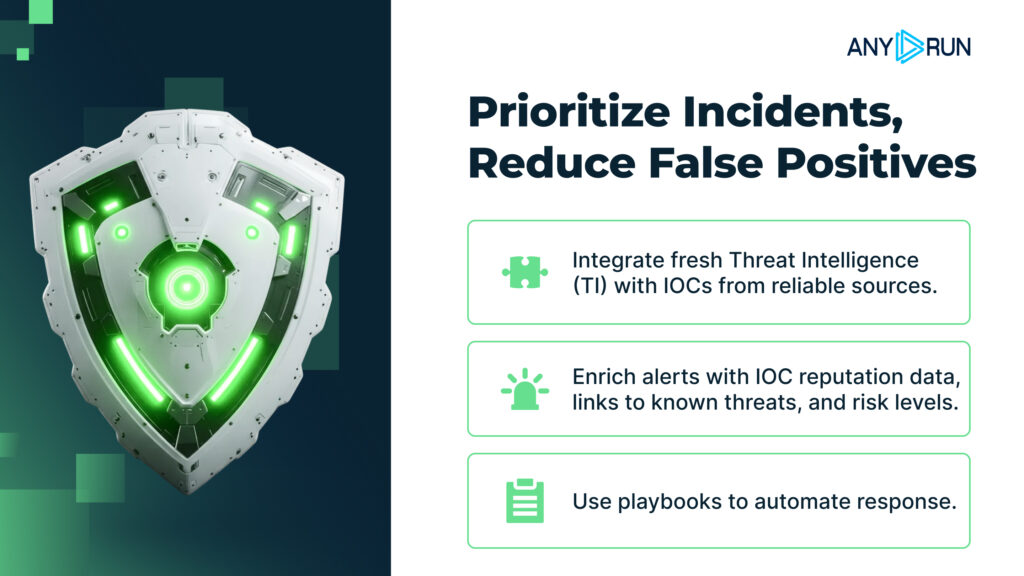
Effective prioritization depends on threat intelligence that is: 

  • Real-time, not report-based 
  • Context-rich, showing how an indicator is used 
  • Integrated, flowing directly into SIEM, SOAR, and EDR 

When alerts arrive already enriched with reputation, behavior, and risk level, teams can automate routine triage and focus on high-impact incidents. 
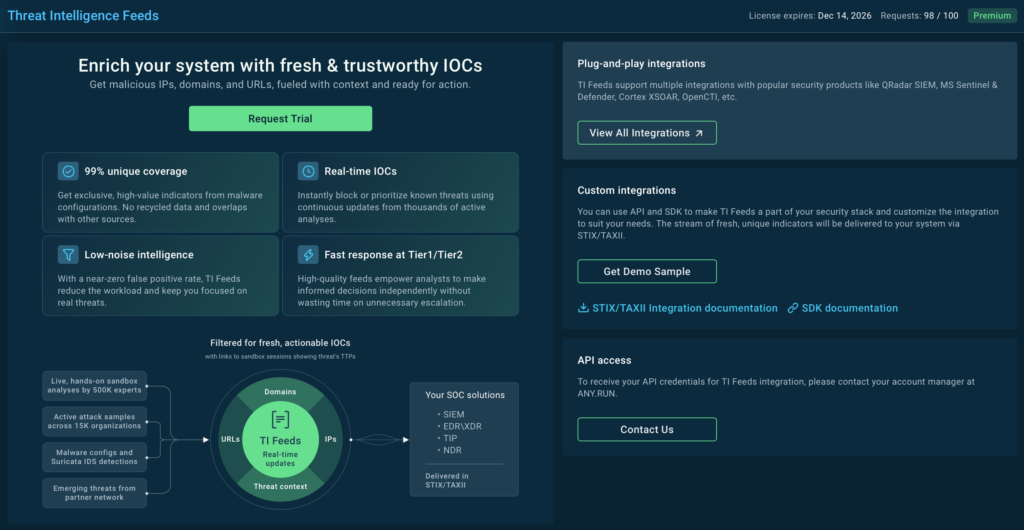
TI Feeds providing fresh data from 15k organizations 

How this looks with ANY.RUN 

ANY.RUN delivers this through its Threat Intelligence Feeds

TI Feeds provide real-time IOCs sourced from live attacks analyzed in ANY.RUN’s Interactive Sandbox by 15,000 organizations and 500,000 analysts. As a result, 99% of network IOCs are unique and come with links to full sandbox reports for immediate context. 

For SOC teams, this means earlier detection of new threats, fewer false positives, and up to a 20% reduction in Tier 1 workload

Expand threat coverage in your SOC
Rely on  99% unique IOCs from TI Feeds


Integrate now


Step 2: Speed Up Threat Investigations 

Once an alert is prioritized, the next bottleneck is investigation speed. 

Many SOCs still rely on static analysis. It’s fast, but it doesn’t show what actually happens when a file or link runs. Modern malware hides behind obfuscation, delayed execution, or multi-stage delivery, leaving analysts with partial answers and slow decisions. 

To respond quickly, teams need to see real behavior, not just a verdict. 
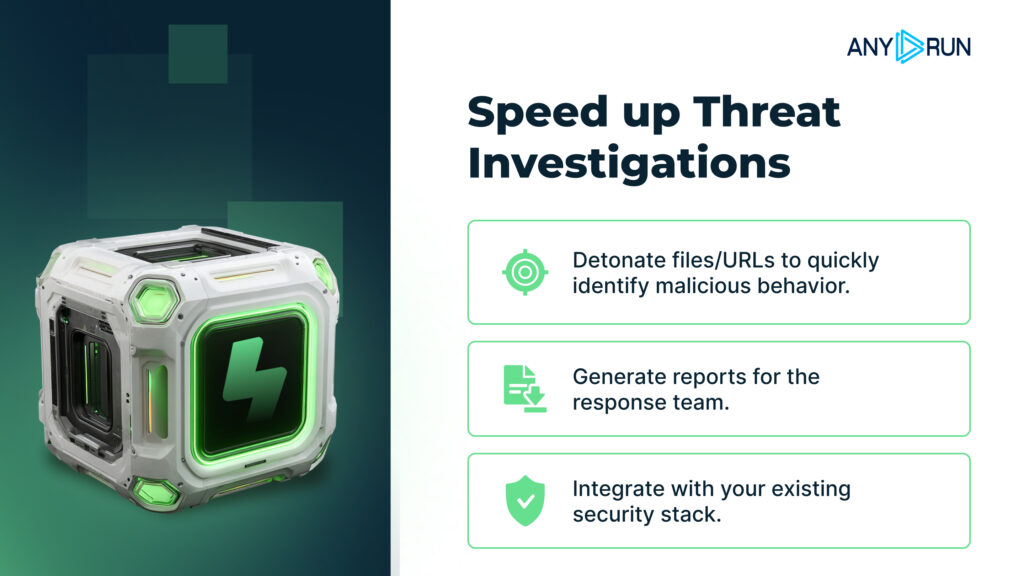
Step 2: Speed up threat investigations 

What actually speeds investigations up 

Effective investigations depend on dynamic analysis that: 

  • Integrate with your existing tools to automate investigations and avoid manual handoffs 
  • Expose real threat behavior quickly, even in multi-stage or silent attacks 
  • Deliver clear, actionable reports with verdicts, IOCs, and TTPs 
  • Defeat evasion techniques, forcing malware to reveal itself 

How teams do this with ANY.RUN 

ANY.RUN helps SOC teams move from alert to answer in under 60 seconds

By detonating files and URLs in real time, the Interactive Sandbox exposes the full attack chain and automatically generates clear reports with verdicts, IOCs, and attacker techniques. This allows teams to confirm threats quickly and move straight to containment, cutting up to 21 minutes from MTTR per incident

How ANY.RUN’s Sandbox helps in faster reponse 

Because the results are easy to interpret, even junior analysts can handle more alerts independently. Many teams report up to a 30% reduction in Tier 1–to–Tier 2 escalations, easing pressure on senior staff and speeding up response overall. 

For high-volume workflows, the sandbox also runs in Automated Interactivity mode. Files and URLs can be sent automatically via API, SDK, or native integrations with SOAR, EDR, and other security tools. The sandbox detonates the entire attack chain on its own and returns a conclusive verdict with full context in seconds. 

Check a real-world case inside sandbox 
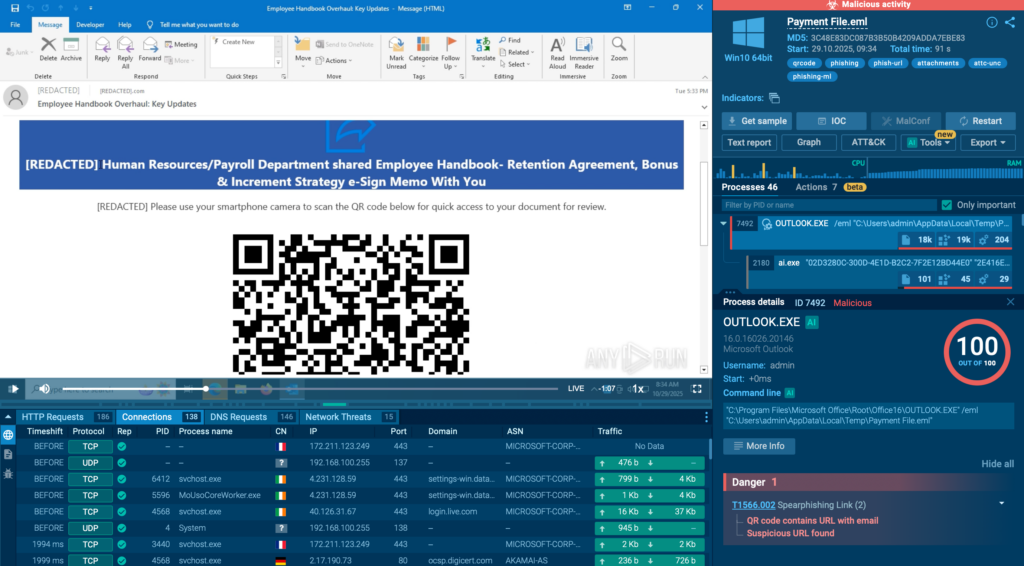
Multi-stage attack discovered inside ANY.RUN sandbox 

In this analysis, a QR code hidden in a phishing email leads to a CAPTCHA-protected page and then to a fake Microsoft 365 login designed to steal credentials. The sandbox detonates the full chain, reveals the phishing infrastructure, and confirms credential theft behavior in seconds. 

Detect complex threats in under 60 seconds
Integrate ANY.RUN’s Sandbox in your SOC


Request trial


Step 3: Verify Alerts Fast 

Not every alert points to a file you can detonate. 

Often, SOC teams see alerts tied to a suspicious IP, domain, URL, or process. In those cases, the key question is simple: Is this a real threat, or just noise? 
The faster you answer that, the faster you can move on. 

Where verification slows teams down 

Most alerts are enriched using free reputation services. These usually provide only a label like “malicious” with no explanation. 

There’s no context about: 

  • how the indicator was used, 
  • what malware or campaign it’s linked to, 
  • or what the attacker is actually doing. 

So, analysts start from zero. They search blogs, PDFs, forums, and tools, copy-paste the same indicator repeatedly, and hope something useful turns up. It’s slow, distracting, and often outdated. Even when teams cross-check multiple sources, the information can be incomplete or contradictory. 

The result is delayed decisions, unnecessary escalations, and analyst fatigue. 
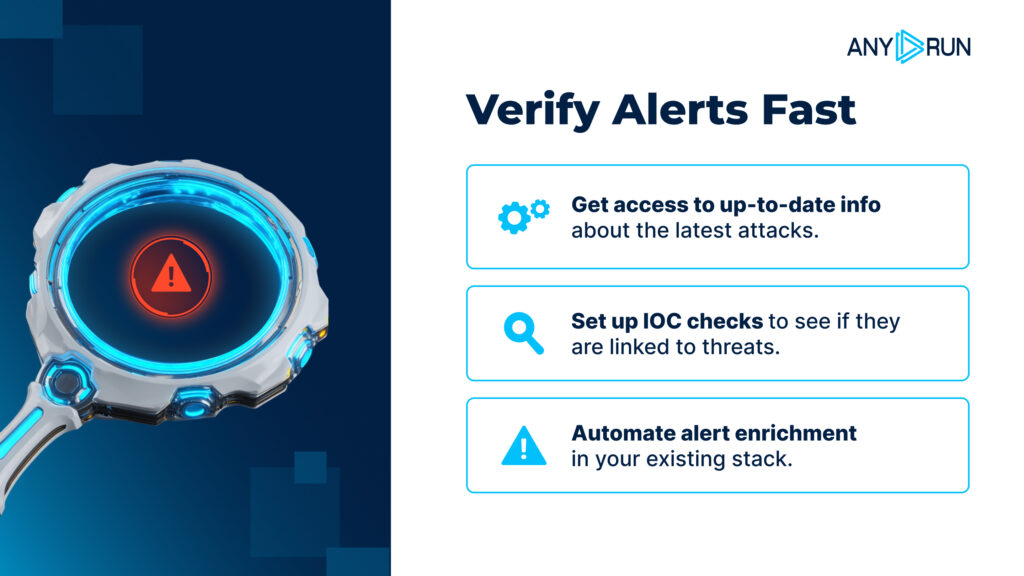
Step 3: Verify alerts fast  

What helps analysts verify alerts faster 

Analysts move faster when they have access to a single, reliable source of fresh threat intelligence that gives instant context for any indicator they see. 

The most effective solutions don’t rely on second hand reports. They pull data from their own live sources; real malware executions, active honeypots, and real victim environments. That means the intelligence is current, detailed, and available the moment an alert appears. 

With this level of context, analysts can make confident decisions in seconds instead of spending time searching, cross-checking, and guessing. 

How teams do this with ANY.RUN 

ANY.RUN enables fast alert verification through its Threat Intelligence Lookup

TI Lookup gives analysts instant access to live attack data for IPs, domains, URLs, file hashes, and behavioral indicators. Each lookup returns real-world context, including how the indicator is used, what malware it’s linked to, and where it was observed; all based on active threat analysis, not old reports. 

As the intelligence comes from real malware executions shared by 15,000 organizations and 500,000 analysts, analysts can verify alerts in seconds instead of starting from zero. 
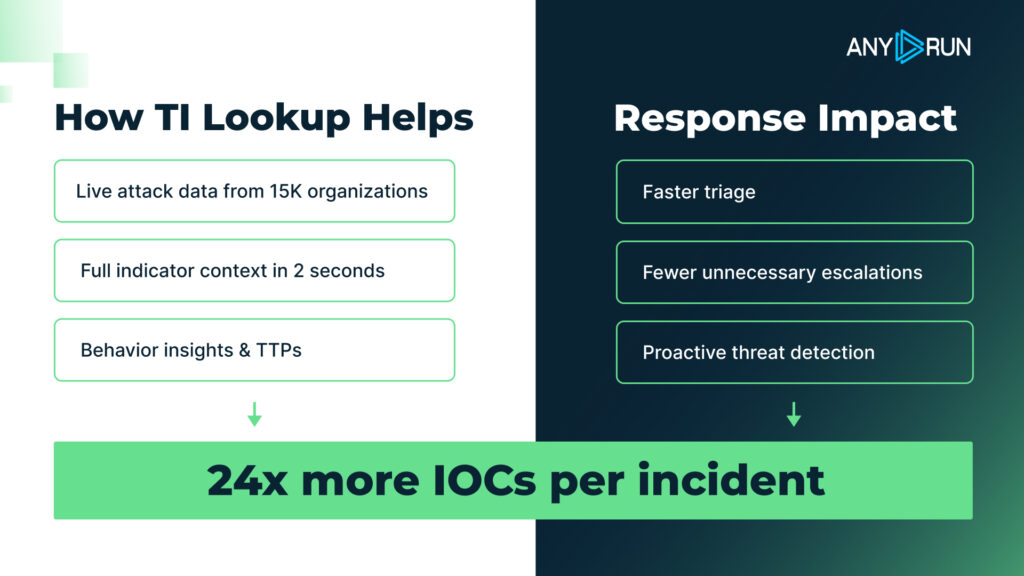
How ANY.RUN’s TI Lookup helps in faster response 

To see how this works in practice, imagine this: A SOC receives an alert about a connection to an unfamiliar IP address. A quick lookup shows it’s actively used in a Remcos malware campaign, with links to sandbox sessions where the same infrastructure was observed. With this context, the analyst can block the connection and close the alert confidently within minutes. 

TI Lookup query: destinationIP:”23.95.117.252″ 
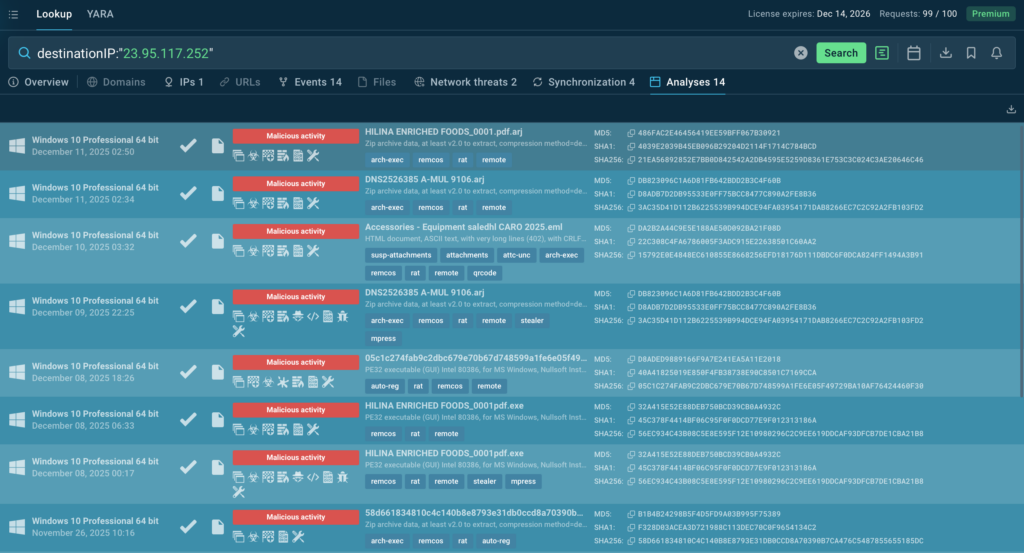
TI Lookup demonstrates recent analysis sessions related to the search IP address and Remcos malware campaign 

For even faster workflows, TI Lookup integrates directly with SIEM, SOAR, TIP, and XDR platforms. Alerts can be enriched automatically as they arrive, so reputation, behavior, and threat context are available immediately, reducing manual checks, unnecessary escalations, and investigation time. 

Speed up triage with rich threat context 
using ANY.RUN’s TI Lookup


Integrate now


Make Fast Response the Standard 

In most SOCs, the problem isn’t speed. It’s the delay between seeing an alert and knowing what to do next. 

When alerts arrive without context, investigations stall. When verification depends on manual research, response drags on. Fixing these gaps changes how the SOC operates: 

  • incidents are prioritized earlier, 
  • investigations reach clear answers faster, 
  • alerts are confirmed before they turn into distractions. 
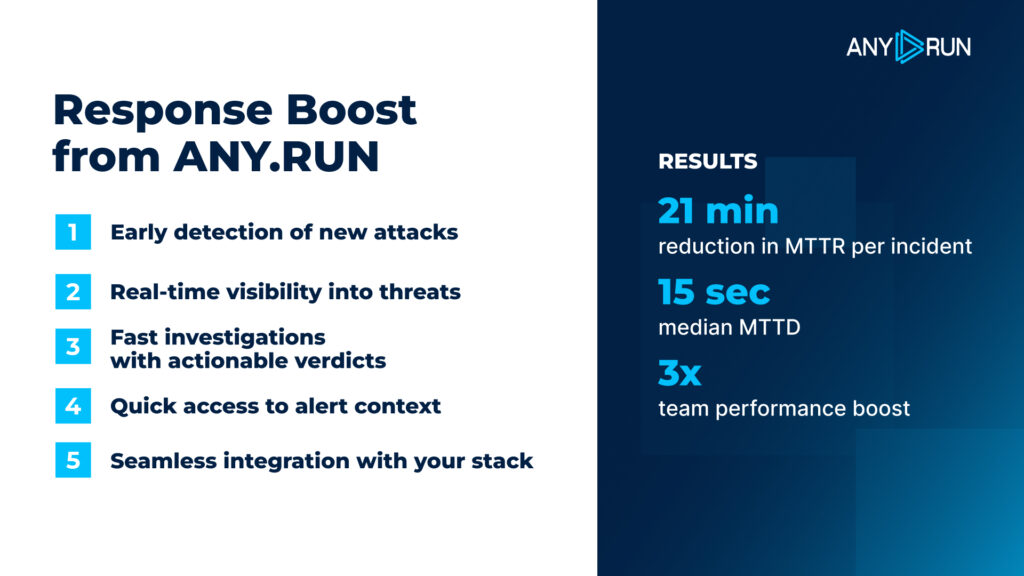
How ANY.RUN boosts response with its solutions 

Teams that apply this approach consistently reduce MTTR by 21 minutes, detect threats in a median of 15 seconds, and achieve a 3× increase in team efficiency, without adding pressure to the team. 

About ANY.RUN 

ANY.RUN provides interactive malware analysis and threat intelligence solutions used by 15,000 SOC teams to investigate threats and verify alerts. They enable analysts to observe real attacker behavior in controlled environments and access context from live attacks. The services support both hands-on investigation and automated workflows and integrates with SIEM, SOAR, and EDR tools commonly used in security operations. 

See ANY.RUN’s solutions in action with 14-day trial 

The post SOC Leader’s Playbook: 3 Practical Steps to Faster MTTR  appeared first on ANY.RUN’s Cybersecurity Blog.

ANY.RUN’s Cybersecurity Blog – ​Read More

React2Shell Vulnerability Actively Exploited to Deploy Linux Backdoors

The security vulnerability known as React2Shell is being exploited by threat actors to deliver malware families like KSwapDoor and ZnDoor, according to findings from Palo Alto Networks Unit 42 and NTT Security.
“KSwapDoor is a professionally engineered remote access tool designed with stealth in mind,” Justin Moore, senior manager of threat intel research at Palo Alto Networks Unit 42, said in a

The Hacker News – ​Read More

Coupang CEO Quits After Breach Hits 33.7M South Koreans

The e-commerce firm’s data breach exposed nearly two-thirds of the entire country’s population after hackers operated undetected for five months.

The post Coupang CEO Quits After Breach Hits 33.7M South Koreans appeared first on TechRepublic.

Security Archives – TechRepublic – ​Read More

The Week in Vulnerabilities: Cyble Tracks New ICS Threats, Zero-Days, and Active Exploitation

Top ICS and IT vulnerabilities

Last week’s reports from Cyble Research & Intelligence Labs (CRIL) to clients highlighted new flaws from December 03 through December 09, 2025, including newly disclosed IT vulnerabilities, ICS vulnerabilities, active exploitation attempts, and dark-web discussions around weaponized CVEs. Drawing from CISA alerts, CRIL’s global sensor network, and Cyble’s vulnerability intelligence platform, the findings outline rapid PoC release cycles, persistent automated exploitation, and targeted attacks against critical infrastructure. 

CRIL’s threat-hunting infrastructure deployed across multiple regions continues to record real-time malicious activity, including exploit attempts, brute-force intrusions, malware injections, and financially motivated attacks. There has been a sustained rise in botnet-driven campaigns and opportunistic exploitation of internet-exposed and misconfigured industrial devices throughout the reporting period. 

More broadly, CRIL’s weekly insight reveals a sharp increase in newly disclosed vulnerabilities. The Vulnerability Intelligence (VI) module identified 1,378 vulnerabilities this week, including over 131 with publicly available PoCs and three new zero-days.  

The Week’s Top IT Vulnerabilities 

CRIL’s weekly vulnerability intelligence analysis found multiple high-impact issues affecting enterprise technologies, software ecosystems, and internet-facing applications. Major vendors reporting significant vulnerability counts included Linux distributions, Google, Microsoft, Siemens, and Nextcloud. 

A subset of critical vulnerabilities drew community and industry attention: 

  • CVE-2025-67494: A critical server-side request forgery (SSRF) flaw in ZITADEL, enabling unauthorized network pivoting and data exposure. 

  • CVE-2025-59719: An authentication bypass impacting Fortinet products. 

  • CVE-2025-66516: A severe XML External Entity (XXE) vulnerability in Apache Tika affects modules such as tika-core, tika-pdf-module, and tika-parsers. 

These IT vulnerabilities present a direct risk to organizations due to their potential to enable unauthorized access, data theft, and remote code execution. Across all disclosures, CRIL identified 68 critical vulnerabilities under CVSS v3.1 and 23 rated critical under CVSS v4.0, making it another high-activity week in vulnerability disclosure trends. 

CISA – Known Exploited Vulnerabilities (KEV) Catalogue 

Between December 3 and December 9, 2025, CISA added six new exploited vulnerabilities to its CVE catalog. 

Notable additions include: 

  • CVE-2025-6218: A directory traversal flaw in RARLAB WinRAR enables remote code execution (RCE). 

  • CVE-2025-55182: A critical pre-authentication RCE in React Server Components (RSC) leveraging unsafe deserialization in the “Flight” protocol. 

The exploitation of CVE-2025-55182 began around December 08, employing payloads that diverged from the December 04 PoC publicly released by researchers. The variant techniques suggest rapid adaptation by attackers following disclosure. 

Notable Vulnerabilities Discussed in Open-Source Communities 

CRIL identified multiple trending vulnerabilities drawing attention across open-source security and research forums. 

Key discussions included: 

  • CVE-2025-62221: A use-after-free elevation of privilege vulnerability in the Windows Cloud Files Mini Filter Driver. A local attacker could gain SYSTEM-level privileges, and the flaw can be chained with phishing or browser exploits for full host compromise. 

  • CVE-2025-10573: A critical stored XSS vulnerability in Ivanti Endpoint Manager, allowing remote unauthenticated attackers to embed malicious JavaScript that executes when an administrator views the dashboard. 

Vulnerabilities Under Discussion on the Dark Web 

CRIL’s dark-web monitoring identified several vulnerabilities actively discussed, traded, or weaponized by threat actors

  • CVE-2025-6440: A critical arbitrary file upload vulnerability in the WooCommerce Designer Pro plugin for WordPress (also distributed with the Pricom Printing Company & Design Services theme). Allows unauthenticated file upload and remote code execution via malicious PHP web shells. 

  • CVE-2025-55182: Also referred to as “React2Shell” or “React4Shell,” actively weaponized on underground forums. The flaw affects React 19’s Server Components Flight protocol and frameworks such as Next.js. 

  • CVE-2025-66516: A severe XXE vulnerability in Apache Tika. The administrator of the “Proxy Bar” Telegram channel circulated exploit material demonstrating how malicious PDF files with embedded XFA forms could achieve arbitrary file read, SSRF, denial-of-service, and, in some cases, remote code execution. 

CRIL’s vulnerability intelligence timeline notes: 

CVE  Product  CVE Release  DW Capture  PoC 
CVE-2025-6440  WooCommerce Designer Pro  Oct 24, 2025  Dec 03, 2025  Yes 
CVE-2025-55182  React Server Components  Dec 03, 2025  Dec 05, 2025  Yes 
CVE-2025-66516  Apache Tika Modules  Dec 04, 2025  Dec 08, 2025  Yes 

Top ICS Vulnerabilities Tracked This Week 

CRIL highlighted multiple ICS vulnerabilities affecting industrial vendors across energy, manufacturing, and commercial facilities. 

Key issues included: 

  • Sunbird – DCIM dcTrack & Power IQ (≤ 9.2.0): Authentication bypass and hard-coded credentials vulnerabilities (CVSS 6.5 and 6.7), risking unauthorized access and credential compromise. 

  • Johnson Controls OpenBlue Workplace (2025.1.2 and prior): A CVSS 9.3 Forced Browsing vulnerability enabling unauthorized access to sensitive operations in critical infrastructure environments. 

Across the ICS landscape, most vulnerabilities were medium severity, while commercial facilities, critical manufacturing, and energy sectors accounted for 43% of total incidents. Multi-sector issues, including IT, government, healthcare, and transportation, accounted for an additional 29%. 

Recommendations and Mitigations 

CRIL’s report reiterates essential mitigation steps: 

  • Apply all vendor patches promptly, particularly for vulnerabilities listed in the KEV catalog. 

  • Implement a structured patch management program covering testing, deployment, and verification. 

  • Segment networks to isolate critical systems and reduce lateral movement. 

  • Deploy comprehensive monitoring and logging with SIEM correlation. 

  • Track alerts from vendors, CERTs, and government authorities. 

  • Conduct routine VAPT exercises and security audits. 

  • Maintain visibility into internal and external assets. 

  • Enforce strong password policies, replace all default credentials, and adopt MFA across all environments. 

Conclusion 

The wide range of vulnerabilities identified this week highlights the expanding threat landscape facing industrial and operational environments. Security teams must act quickly and focus on risk-based vulnerability management to protect critical systems. 

Key practices, such as network segmentation, restricting exposed assets, applying Zero-Trust principles, maintaining resilient backups, hardening configurations, and continuous monitoring, remain essential for reducing attack surface and improving incident response readiness. 

Cyble’s attack surface management solutions can support these efforts by detecting exposures across network and cloud environments, prioritizing remediation, and providing early indicators of potential cyberattacks. To see how Cyble can strengthen your industrial security posture, request a demo today. 

The post The Week in Vulnerabilities: Cyble Tracks New ICS Threats, Zero-Days, and Active Exploitation appeared first on Cyble.

Cyble – ​Read More

Fake ‘Leonardo DiCaprio’ Torrent Spreads Agent Tesla Malware

A fake Leonardo DiCaprio movie torrent is spreading Agent Tesla malware through trusted Windows tools

The post Fake ‘Leonardo DiCaprio’ Torrent Spreads Agent Tesla Malware appeared first on TechRepublic.

Security Archives – TechRepublic – ​Read More

Google to Shut Down Dark Web Monitoring Tool in February 2026

Google has announced that it’s discontinuing its dark web report tool in February 2026, less than two years after it was launched as a way for users to monitor if their personal information is found on the dark web.
To that end, scans for new dark web breaches will be stopped on January 15, 2026, and the feature will cease to exist effective February 16, 2026.
“While the report offered general

The Hacker News – ​Read More

BusenLabs Boron vs. Bohdi Linux: Which lightweight distro is right for you?

At first glance, these two distributions seem quite similar, but dive in with me, and you’ll soon appreciate the stark differences.

Latest news – ​Read More

LG unveils its first Micro RGB TV ahead of CES 2026, and it’s got OLED users feeling envy

LG’s upcoming flagship television model combines micro-LEDs, AI-powered processing, and advanced dimming to deliver top-tier visual quality.

Latest news – ​Read More

Google search chief talks future of news content amid AI scramble

Google’s Nick Fox acknowledged publisher struggles and explained what’s delaying Personal Context.

Latest news – ​Read More

Apple Patches More Zero-Days Used in ‘Sophisticated’ Attack

Two Apple zero-day vulnerabilities discovered this month have overlap with another mysterious zero-day flaw Google patched last week.

darkreading – ​Read More