Roku’s new Philips TV makes your wall glow in color and in sync with every scene
The Ambilight projects real-time LED lighting onto your wall that matches with the action on your screen.
Latest news – Read More

The Ambilight projects real-time LED lighting onto your wall that matches with the action on your screen.
Latest news – Read More
Your next Oura Ring looks even less like a health tracker.
Latest news – Read More
Health Panels follows the lead of competitors by offering blood tests that users can schedule and review within the Oura app.
Latest news – Read More
I test out nifty tech gadgets all year long. Here are my favorite products that make perfect stocking stuffers for the upcoming holiday season (and some of these are on sale).
Latest news – Read More
The identity and access management provider will invest in agentic identity R&D, expand to new regions, and hire new talent.
The post Descope Raises $35 Million in Seed Round Extension appeared first on SecurityWeek.
SecurityWeek – Read More
AI is part of our lives whether we like it or not. Even if you are not quite a fan, or not a user at all, you probably came across multiple AI-generated avatars, pictures, scenes, videos, articles and even malware.
All technological advancements are taken advantage of by society. They were discovered to be used, but some people just abuse them, and AI used for software development is not the exception.
This time we’ll analyze FunkLocker, a ransomware strain by the FunkSec Ransomware group, whose creation was aided in an important part by artificial Intelligence.
This is not the first time we see AI-aided malware, or even malware fully written by an AI. Just recently, another strain, PromptLocker, made it to the news. But FunkSec has been active for quite a while and even managed to publish many victims in their DLS.
There are many samples, some more stable than others, and a few barely functional. Interestingly, the older builds (dating back to January of this year) included an anti-VM capability that detected virtualized environments with high accuracy before refusing to run.
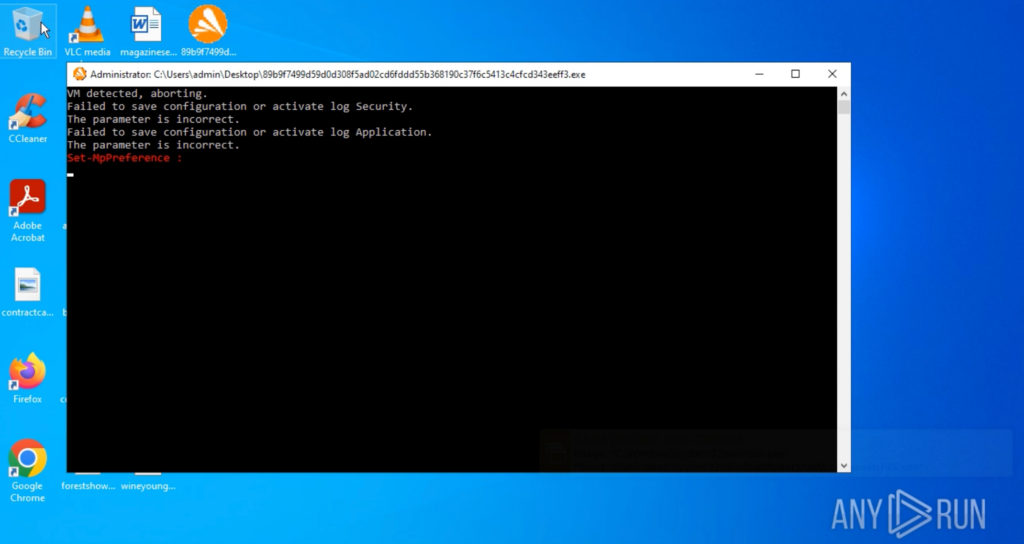
That build was also characterized by its livid colours displayed in the terminal text while running. This one, found in late July, features a monochromatic style and is missing the anti-VM feature. While this could indicate it being an older build, the lack of a standardized versioning schema, like other groups such as LockBit, makes it hard to confirm.
Here is FunkSec’s AI-assisted ransomware sample analyzed inside ANY.RUN’s sandbox:
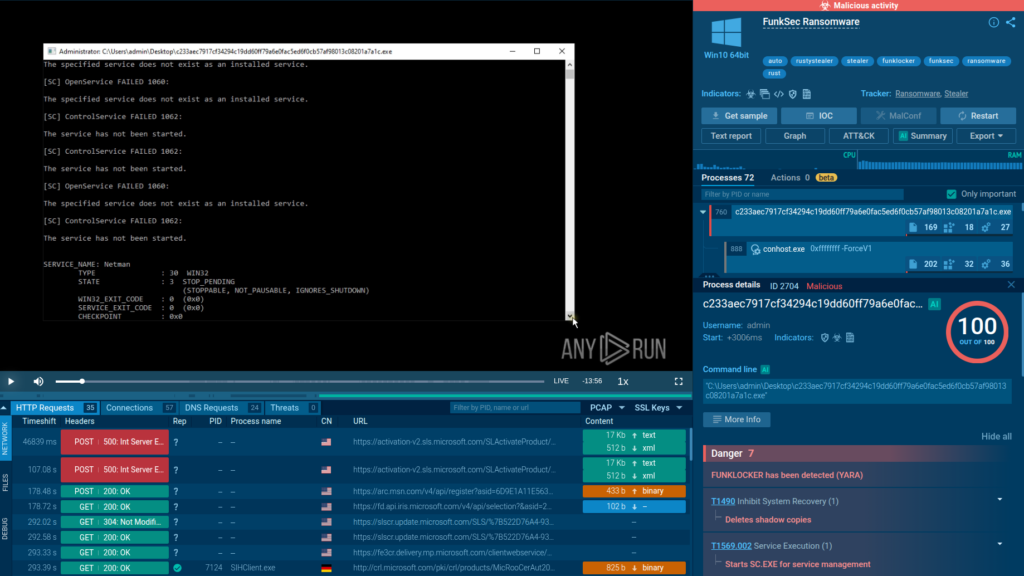
The sandbox exposes the threat in seconds, providing an actionable TTP and IOC report for fast, confident response and mitigation.
By early 2025, FunkSec had been linked to more than 120 compromized organizations worldwide, hitting targets in government institutions, the defense sector, tech companies, financial services, and higher education.
The group’s first reported attacks surfaced in November 2024, and in December they launched a dedicated data leak site to publicize stolen information. Since then, the tally of known victims has continued to grow, with estimates ranging from 120 to 170, and some trackers recording as many as 172 cases. Notably, at least 30 of these incidents involved organizations in the United States, alongside confirmed cases in India, Spain, and Mongolia.
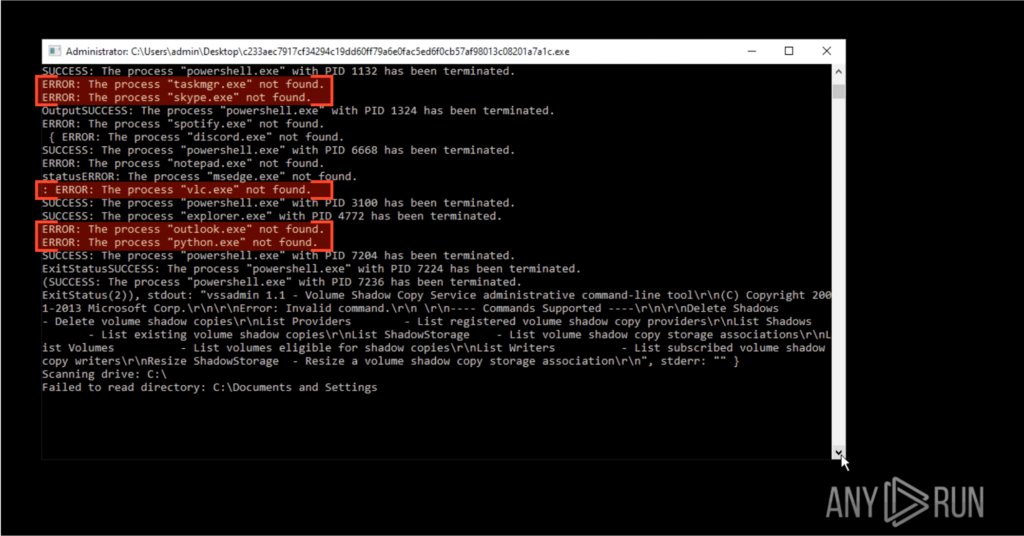
Immediately after execution, all our setup will go dark, and this is caused by the malware bashing its way through different processes in order to stop them. Why bashing? Because it doesn’t take a fraction of a second to list the running applications and stop them in a strategic way; it just acts on a predefined list, causing multiple errors when trying to stop non-existing ones.
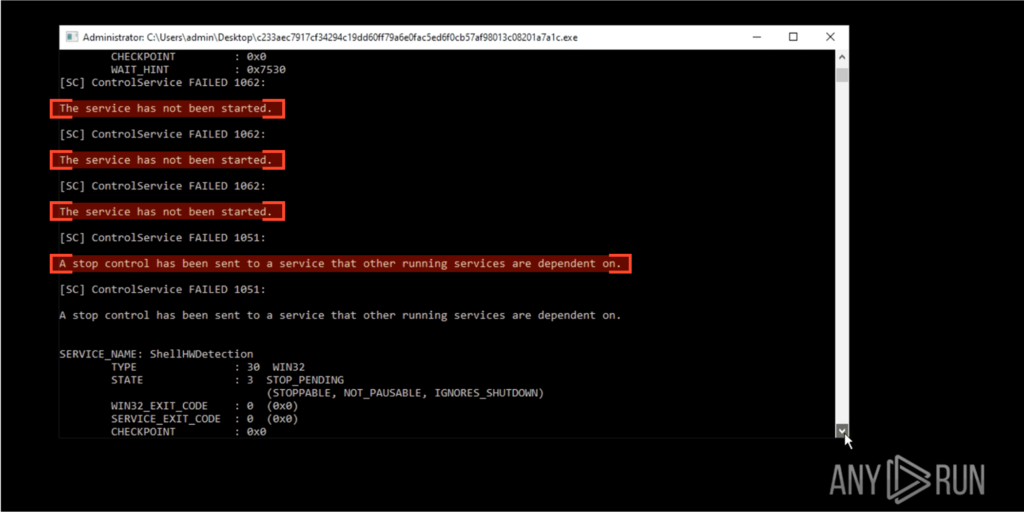
It will also attempt to stop multiple services, again, matching them with a hardcoded predefined list, causing another set of errors. Some of these occur because the services are not running at all, and others because they simply can’t be stopped due to dependencies from other services that rely on them to function.
This seems like the result of someone individually studying which services to stop and adding them to a list, without adding a layer of context on which ones depend on others or which ones could actually not be running (optional).
This doesn’t stop the malware from continuing its raid, and eventually the file system is encrypted. The first and most obvious change is the extension of our files, which is now .funksec, but there’s more than meets the eye.
Let’s take a look at the process tree behind the sample. FunkLocker — aside from clubbing everything in its reach — is pretty “structured”, where each of its steps is represented by a legit system tool being abused or a PowerShell script executed procedurally, suggesting an “Ask AI → Get snippet → Paste snippet” development cycle.
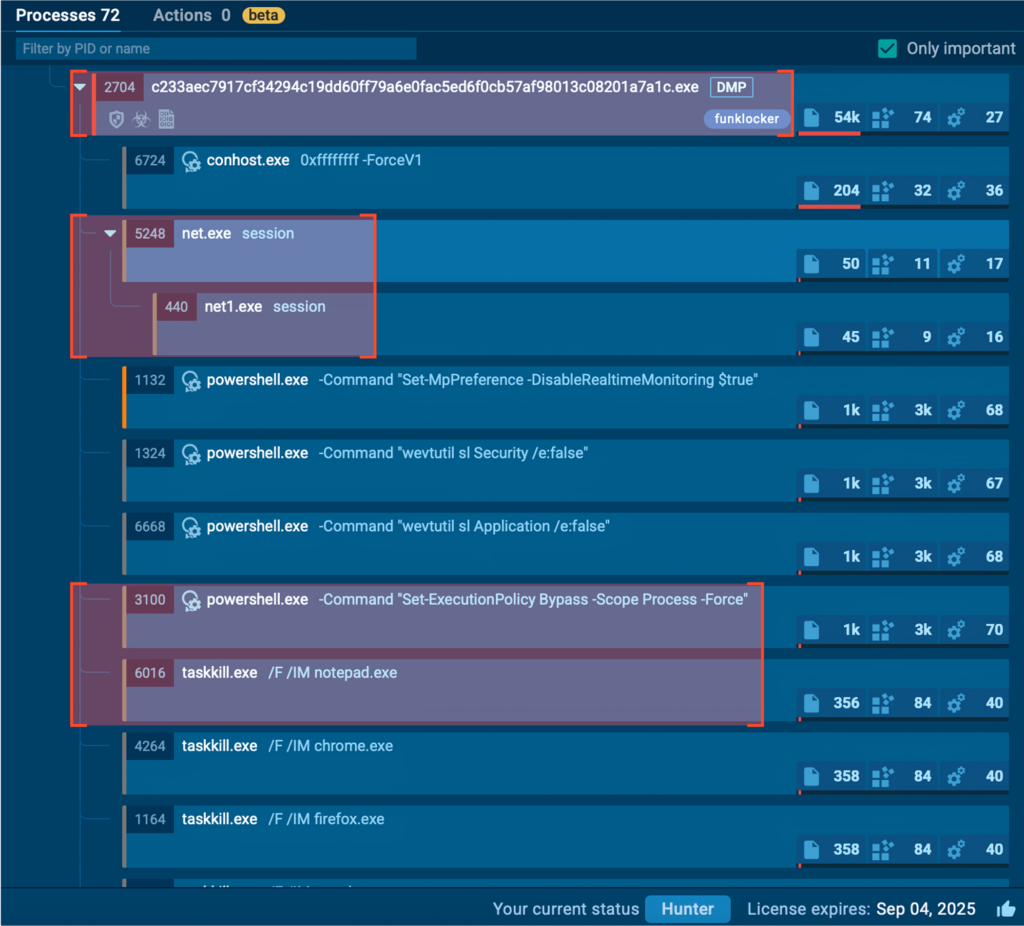
The PowerShell routine is based on four commands:
Abused tools include net.exe and its compatibility-mode counterpart net1.exe, used to check if there are any network sessions established.
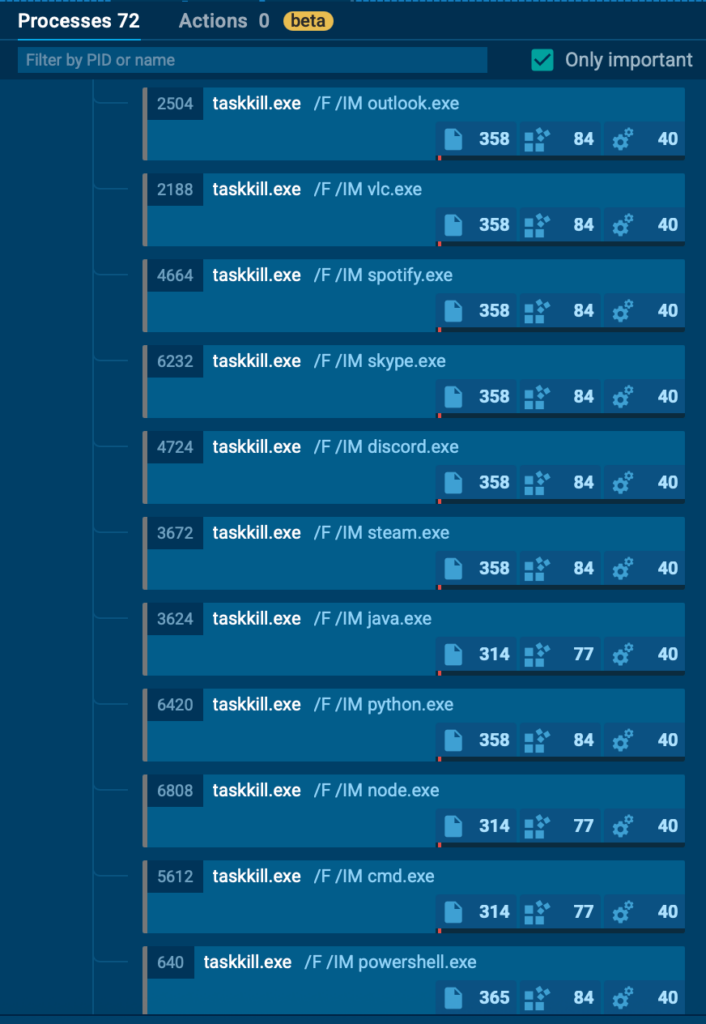
taskkill.exe is used naturally to stop applications or tasks — in this case used to forcefully stop browsers like Chrome, Firefox, and Edge, daily-use apps like Notepad, Skype, Spotify, programming environments like Java, Python, and Node, and even Steam, among a long list of other apps.
sc.exe, which is Windows Service Control, is used as a tool (or club) to stop services like Windows Defender & Firewall, SMB (Shared Folders), the Event Log, the Shell Experience Host (which is why our screen turns black), and other absolutely not-necessary services like Bluetooth or Audio.
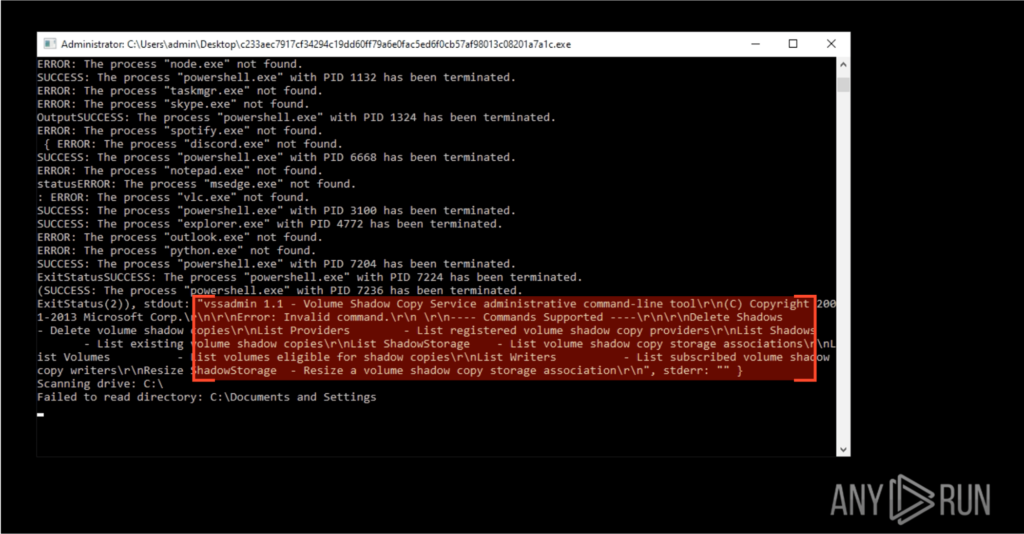
After that, Shadow Volume Copies are taken care of, deleted, by abusing the Volume Shadow Service Administrator (vssadmin) to wipe them silently. This prevents the victim from locally restoring the system to a previous state, effectively removing any chance of rollback using Windows’ built-in recovery mechanisms.
Now for the encryption part — FunkLocker didn’t attempt to contact a remote server at any time, as all the encryption process occurred locally. We’ve seen similar behavior in a previous article when we analyzed Mamona Ransomware.
While this may seem like it could make the malware easier to hide and harder to track — due to the lack of network infrastructure in the short term — it is beneficial in the long run, and you’ll soon see why.
The ransom note is dropped right on the desktop but, with the unnecessary killing of the Shell Experience Host service, we’re left with few chances but to reboot our server to view it (if it ever boots again after its intense contusions session).
Luckily, ANY.RUN’s Interactive Sandbox has a reliable system which allows us to capture any created, deleted or modified file directly from its GUI. So, let’s take a look.
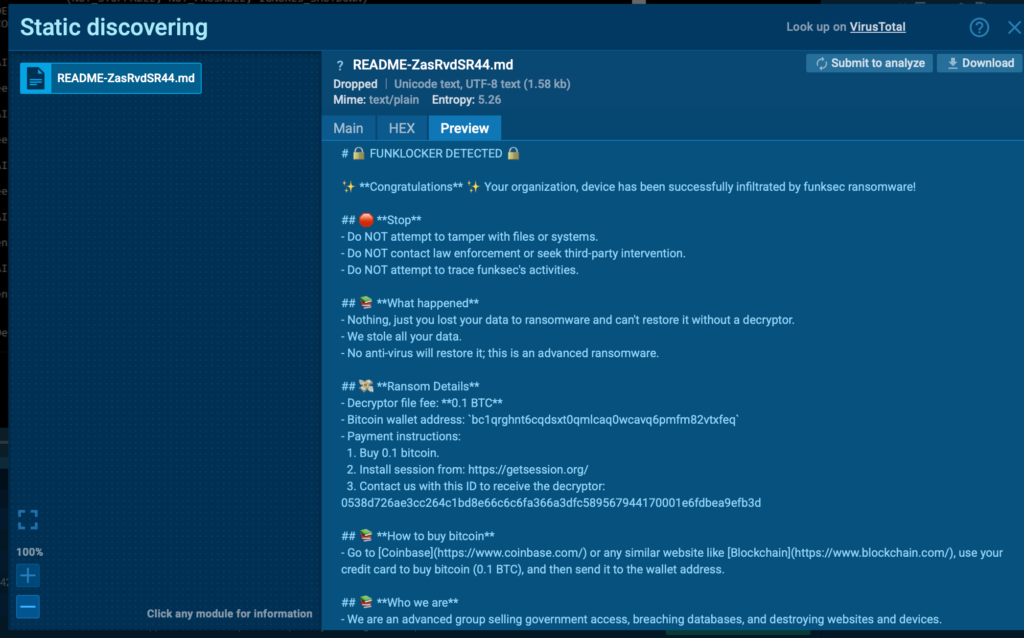
From here we can notice a BTC address which, after a quick inspection, shows that it has transacted just a few times for around $3,000 USD, suggesting once again that this wallet is shared across different victims or is a default one.
Using this instead of receiving a unique wallet, summed up with the technical aspects we saw before. And the chances of encryption keys being either derived locally or hardcoded, highlights the “homemade AI-assisted” fashion of this strain.
This is where things get shinier for victims, because deriving keys locally (or having them hardcoded) greatly improves the chances of a decryptor being made. And this is exactly what happened: Avast Labs was able to create a decryptor for FunkSec, which will give some hope to affected organisations.
After sharing the bad news (ransomware) and the good news (decryptors), it’s time to move on to the ATT&CK Matrix, which ANY.RUN does automatically for us.
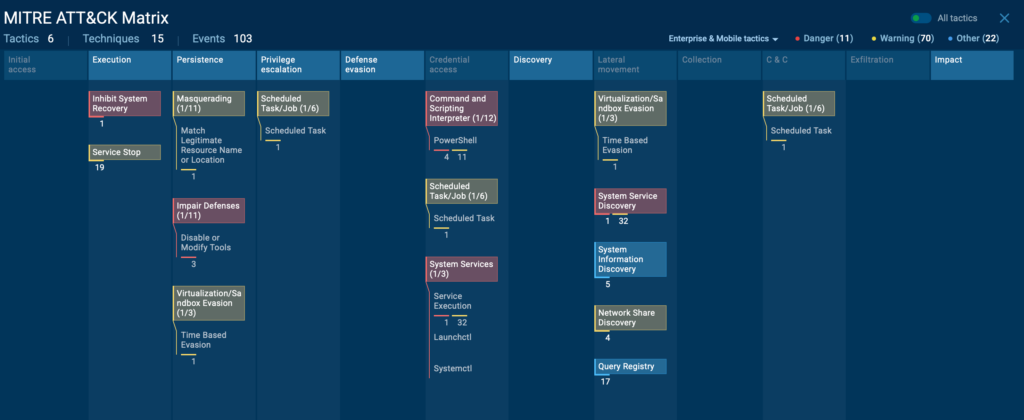
FunkLocker does a lot of things which could be pinned down individually and used as “footprints” to understand how it works:
| Technique ID | Technique name | Observed behaviour / notes |
|---|---|---|
| T1036.005 | Masquerading: Match Legitimate Resource Name or Location | The malware creates files with names similar to legitimate system files and drops them directly in the system drive root. |
| T1569.002 | Service Execution: Service Commands | Launches sc.exe to manage Windows services (e.g., stopping them as part of its disruption routine). |
| T1007 | System Service Discovery | Uses sc.exe to query or discover system services before acting on them. |
| T1489 | Impact: Service Stop | Executes taskkill.exe to forcefully terminate: – Office apps – Running processes – Web browsers like Chrome, Firefox, Edge |
| T1059.001 | Command and Scripting Interpreter: PowerShell | Runs multiple PowerShell commands to: – Disable Windows Defender real-time protection – Change the execution policy to Bypass (allowing unrestricted script execution) |
| T1135 | Discovery: Network Share Discovery | Uses net.exe to display or manage information about current active sessions. |
| T1490 | Impact: Inhibit System Recovery | Deletes Volume Shadow Copies using vssadmin delete shadows /all /quiet to prevent recovery via system restore points. |
| T1562.001 | Defense Evasion: Disable or Modify Tools | Modifies Windows Defender configuration to weaken or disable protection mechanisms. |
FunkSec shows how AI is changing the pace and style of ransomware development. For security leaders, the lesson is less about one strain and more about the trend it represents. A few priorities stand out:
The takeaway: FunkSec isn’t just about today’s attacks. It’s a signal that the future of ransomware will be faster, messier, and more frequent, and security leaders should prepare their defenses accordingly.
Over 500,000 cybersecurity professionals and 15,000+ companies in finance, manufacturing, healthcare, and other sectors rely on ANY.RUN to streamline malware investigations worldwide.
Speed up triage and response by detonating suspicious files in ANY.RUN’s Interactive Sandbox, observing malicious behavior in real time, and gathering insights for faster, more confident security decisions. Paired with Threat Intelligence Lookup and Threat Intelligence Feeds, it provides actionable data on cyberattacks to improve detection and deepen your understanding of evolving threats.
Explore more ANY.RUN’s capabilities during 14-day trial→
ANY RUN Session: https://app.any.run/tasks/4032b92d-c9bf-463b-a93b-dc2f95b73797
FunkLocker Decrypted: https://www.gendigital.com/blog/insights/research/funksec-ai
SHA256: c233aec7917cf34294c19dd60ff79a6e0fac5ed6f0cb57af98013c08201a7a1c
FileName: C:UsersadminDesktopREADME-ZasRvdSR44.md
SHA256: e29d95bfb815be80075f0f8bef4fa690abcc461e31a7b3b73106bfcd5cd79033
The post FunkSec’s FunkLocker: How AI Is Powering the Next Wave of Ransomware appeared first on ANY.RUN’s Cybersecurity Blog.
ANY.RUN’s Cybersecurity Blog – Read More
The best Android VPNs won’t drain your phone dry and will give you great speeds and protection. These VPNs are our tried and tested favorites.
Latest news – Read More
Intel and AMD say the research is not in scope of their threat model because the attack requires physical access to a device.
The post Battering RAM Attack Breaks Intel and AMD Security Tech With $50 Device appeared first on SecurityWeek.
SecurityWeek – Read More
Our favorite Windows VPNs combine security, extensive server networks, and easy-to-use apps, all while enhancing your privacy and protection.
Latest news – Read More
Linux is not just about the choice of distribution or desktop environment, but also how efficiently you want/need to interact with your PC.
Latest news – Read More