You’re reading more AI-generated content than you think
You’re not imagining it. A new report highlights AI’s growing takeover of the internet.
Latest news – Read More

You’re not imagining it. A new report highlights AI’s growing takeover of the internet.
Latest news – Read More
Cybercriminals are abusing a widespread lack of authentication in the customer service platform Zendesk to flood targeted email inboxes with menacing messages that come from hundreds of Zendesk corporate customers simultaneously.
Zendesk is an automated help desk service designed to make it simple for people to contact companies for customer support issues. Earlier this week, KrebsOnSecurity started receiving thousands of ticket creation notification messages through Zendesk in rapid succession, each bearing the name of different Zendesk customers, such as CapCom, CompTIA, Discord, GMAC, NordVPN, The Washington Post, and Tinder.
The abusive missives sent via Zendesk’s platform can include any subject line chosen by the abusers. In my case, the messages variously warned about a supposed law enforcement investigation involving KrebsOnSecurity.com, or else contained personal insults.
Moreover, the automated messages that are sent out from this type of abuse all come from customer domain names — not from Zendesk. In the example below, replying to any of the junk customer support responses from The Washington Post’s Zendesk installation shows the reply-to address is help@washpost.com.
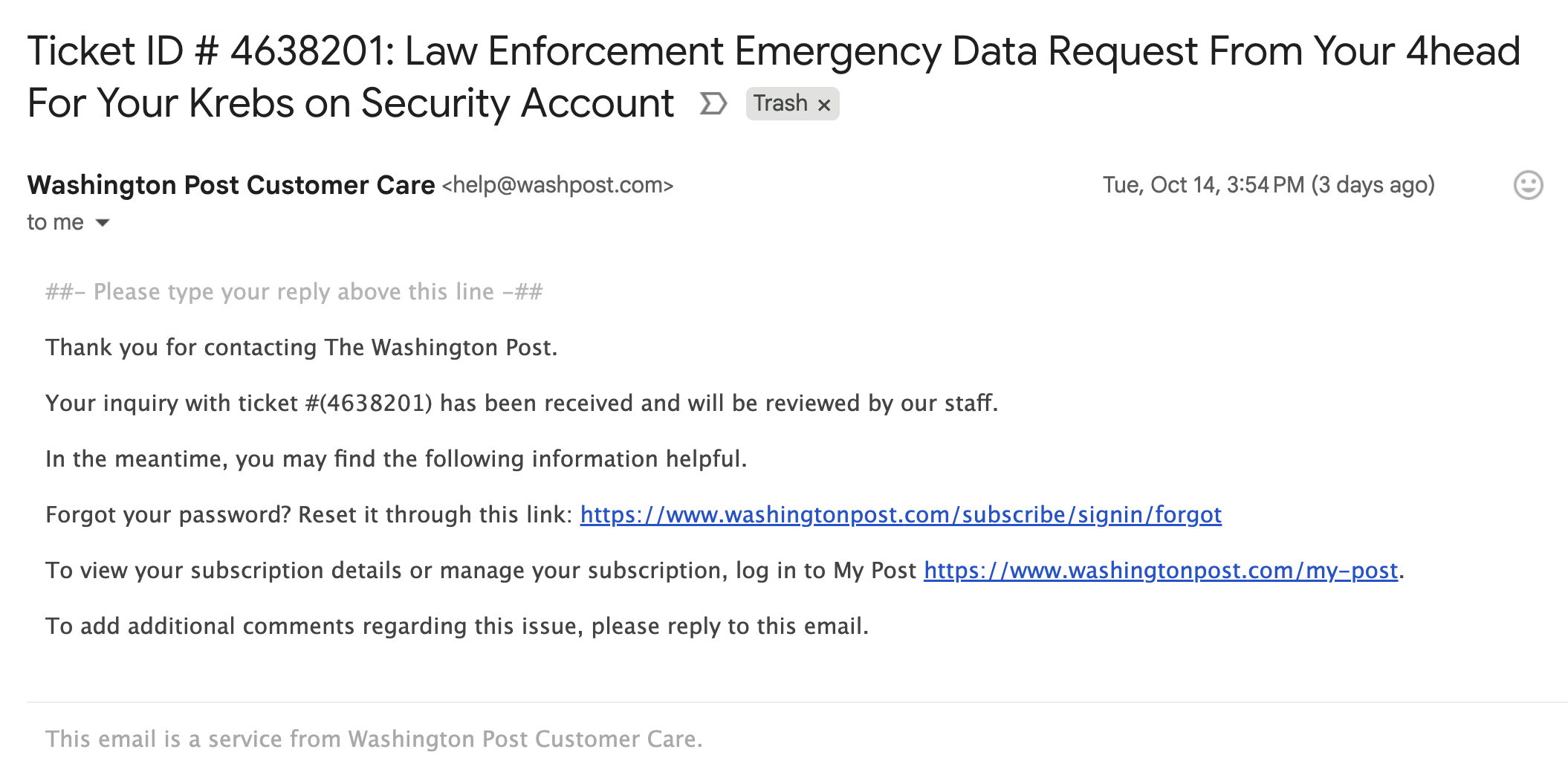
One of dozens of messages sent to me this week by The Washington Post.
Notified about the mass abuse of their platform, Zendesk said the emails were ticket creation notifications from customer accounts that configured their Zendesk instance to allow anyone to submit support requests — including anonymous users.
“These types of support tickets can be part of a customer’s workflow, where a prior verification is not required to allow them to engage and make use of the Support capabilities,” said Carolyn Camoens, communications director at Zendesk. “Although we recommend our customers to permit only verified users to submit tickets, some Zendesk customers prefer to use an anonymous environment to allow for tickets to be created due to various business reasons.”
Camoens said requests that can be submitted in an anonymous manner can also make use of an email address of the submitter’s choice.
“However, this method can also be used for spam requests to be created on behalf of third party email addresses,” Camoens said. “If an account has enabled the auto-responder trigger based on ticket creation, then this allows for the ticket notification email to be sent from our customer’s accounts to these third parties. The notification will also include the Subject added by the creator of these tickets.”
Zendesk claims it uses rate limits to prevent a high volume of requests from being created at once, but those limits did not stop Zendesk customers from flooding my inbox with thousands of messages in just a few hours.
“We recognize that our systems were leveraged against you in a distributed, many-against-one manner,” Camoens said. “We are actively investigating additional preventive measures. We are also advising customers experiencing this type of activity to follow our general security best practices and configure an authenticated ticket creation workflow.”
In all of the cases above, the messaging abuse would not have been possible if Zendesk customers validated support request email addresses prior to sending responses. Failing to do so may make it easier for Zendesk clients to handle customer support requests, but it also allows ne’er-do-wells to sully the sender’s brand in service of disruptive and malicious email floods.
Krebs on Security – Read More
Set for January 2026 at Automotive World in Tokyo, the contest will have six categories, including Tesla, infotainment systems, EV chargers, and automotive OSes.
The post Over $3 Million in Prizes Offered at Pwn2Own Automotive 2026 appeared first on SecurityWeek.
SecurityWeek – Read More
The Knight Center and Google are launching a free AI course aimed at journalists, but if you’re a student or a writer, you could learn a lot, too. It starts Monday.
Latest news – Read More
If your corporate website’s search engine rankings suddenly drop for no obvious reason, or if clients start complaining that their security software is blocking access or flagging your site as a source of unwanted content, you might be hosting a hidden block of links. These links typically point to shady websites, such as pornography or online casinos. While these links are invisible to regular users, search engines and security solutions scan and factor them in when judging your website’s authority and safety. Today, we explain how these hidden links harm your business, how attackers manage to inject them into legitimate websites, and how to protect your website from this unpleasantness.
First and foremost, hidden links to dubious sites can severely damage your site’s reputation and lower its ranking, which will immediately impact your position in search results. This is because search engines regularly scan websites’ HTML code, and are quick to discover any lines of code that attackers may have added. Using hidden blocks is often viewed by search algorithms as a manipulative practice: a hallmark of black hat SEO (also known simply as black SEO). As a result, search engines lower the ranking of any site found hosting such links.
Another reason for a drop in search rankings is that hidden links typically point to websites with a low domain rating, and content irrelevant to your business. Domain rating is a measure of a domain’s authority — reflecting its prestige and the quality of information published on it. If your site links to authoritative industry-specific pages, it tends to rise in search results. If it links to irrelevant, shady websites, it sinks. Furthermore, search engines view hidden blocks as a sign of artificial link building, which, again, penalizes the victim site’s placement in search results.
The most significant technical issue is the manipulation of link equity. Your website has a certain reputation or authority, which influences the ranking of pages you link to. For example, when you post a helpful article on your site, and link to your product page or contacts section, you’re essentially transferring authority from that valuable content to those internal pages. The presence of unauthorized external links siphons off this link equity to external sites. Normally, every internal link helps search engines understand which pages on your site are most important — boosting their position. However, when a significant portion of this equity leaks to dubious external domains, your key pages receive less authority. This ultimately causes them to rank lower than they should — directly impacting your organic traffic and SEO performance.
In the worst cases, the presence of these links can even lead to conflicts with law enforcement, and entail legal liability for distributing illegal content. Depending on local laws, linking to websites with illegal content could result in fines or even the complete blocking of your site by regulatory bodies.
The simplest way to check your website for blocks of hidden links is to view its source code. To do this, open the site in browser and press Ctrl+U (in Windows and Linux) or Cmd+Option+U (in macOS). A new tab will open with the page’s source code.
In the source code, look for the following CSS properties that can indicate hidden elements:
These elements relate to CSS properties that make blocks on the page invisible — either entirely hidden or reduced to zero size. Theoretically, these properties can be used for legitimate purposes — such as responsive design, hidden menus, or pop-up windows. However, if they’re applied to links or entire blocks of link code, it could be a strong sign of malicious tampering.
Additionally, you can search the code for keywords related to the content that hidden links most often point to, such as “porn”, “sex”, “casino”, “card”, and the like.
For a deep dive into the specific methods attackers use to hide their link blocks on legitimate sites, check out our separate, more technical Securelist post.
To add an invisible block of links to a website, attackers first need the ability to edit your pages. They can achieve this in several ways.
The dark web is home to a whole criminal ecosystem dedicated to buying and selling compromised credentials. Initial-access brokers will provide anyone with credentials tied to virtually any company. Attackers obtain these credentials through phishing attacks or stealer Trojans, or simply by scouring publicly available data breaches from other websites in the hope that employees reuse the same login and password across multiple platforms. Additionally, administrators might use overly simple passwords, or fail to change the default CMS credentials. In these cases, attackers can easily bruteforce the login details.
Gaining access to an account with administrator privileges gives criminals broad control over the website. Specifically, they can edit the HTML code, or install their own malicious plugins.
We frequently discuss various vulnerabilities in CMS platforms and plugins on our blog. Attackers can leverage these security flaws to edit template files (such as header.php, footer.php, or index.php), or directly insert blocks of hidden links into arbitrary pages across the site.
In some cases, it’s the hosting company that gets compromised rather than the website itself. If the server hosting your website code is poorly protected, attackers can breach it and gain control over the site. Another common scenario concerns a server that hosts sites for many different clients. If access privileges are configured incorrectly, compromising one client can give criminals the ability to reach other websites hosted on that same server.
Not all webmasters write their own code. Budget-conscious and unwary web designers might try to find free templates online and simply customize them to fit the corporate style. The code in these templates can also contain covert blocks inserted by malicious actors.
To secure your website against the injection of hidden links and its associated consequences, we recommend taking the following steps:
Kaspersky official blog – Read More
Statik’s 360 magnetic cable charges all my tech items – even if they don’t use the same adapter.
Latest news – Read More
Sony’s 2025 flagship is a high-end OLED TV that’s an almost perfect option for movie buffs looking to upgrade their home theater.
Latest news – Read More
Hackers stole names, addresses, dates of birth, email addresses, Social Security numbers, government IDs, and other information.
The post Prosper Data Breach Impacts 17.6 Million Accounts appeared first on SecurityWeek.
SecurityWeek – Read More
The unauthenticated local file inclusion bug allows attackers to retrieve the machine key and execute code remotely via a ViewState deserialization issue.
The post Gladinet Patches Exploited CentreStack Vulnerability appeared first on SecurityWeek.
SecurityWeek – Read More
Microsoft on Thursday disclosed that it revoked more than 200 certificates used by a threat actor it tracks as Vanilla Tempest to fraudulently sign malicious binaries in ransomware attacks.
The certificates were “used in fake Teams setup files to deliver the Oyster backdoor and ultimately deploy Rhysida ransomware,” the Microsoft Threat Intelligence team said in a post shared on X.
The tech
The Hacker News – Read More