Other noteworthy stories that might have slipped under the radar: Everest group takes credit for Collins Aerospace hack, Maryland launches VDP, gamers targeted with red teaming tool and RAT.
https://www.backbox.org/wp-content/uploads/2018/09/website_backbox_text_black.png00adminhttps://www.backbox.org/wp-content/uploads/2018/09/website_backbox_text_black.pngadmin2025-10-24 13:06:352025-10-24 13:06:35In Other News: iOS 26 Deletes Spyware Evidence, Shadow Escape Attack, Cyber Exec Sold Secrets to Russia
Does your organization suffer from a cybersecurity perception gap? Findings from the Bitdefender 2025 Cybersecurity Assessment suggest the answer is probably “yes” — and many leaders may not even realize it.
This disconnect matters. Small differences in perception today can evolve into major blind spots tomorrow. After all, perception influences what organizations prioritize, where they
https://www.backbox.org/wp-content/uploads/2018/09/website_backbox_text_black.png00adminhttps://www.backbox.org/wp-content/uploads/2018/09/website_backbox_text_black.pngadmin2025-10-24 12:07:052025-10-24 12:07:05Toys ‘R’ Us Canada Customer Information Leaked Online
A malicious network of YouTube accounts has been observed publishing and promoting videos that lead to malware downloads, essentially abusing the popularity and trust associated with the video hosting platform for propagating malicious payloads.
Active since 2021, the network has published more than 3,000 malicious videos to date, with the volume of such videos tripling since the start of the
We’ve relied on passwords for years to protect our online accounts, but they’ve also become one of the easiest ways attackers get in. Many people reuse or simplify passwords, or even write them down because it’s hard to remember so many. That makes it easier for attackers to take advantage of stolen or reused credentials, and even worse, one stolen password can sometimes unlock several accounts.
Did you know? According to Forbes, 244 million passwords were leaked on a single crime forum, and half of the world’s internet users have been exposed to reuse attacks.
That’s why passwordless authentication is becoming so important. It lets you prove who you are without typing a password, using things like your fingerprint, face, or a security key on your device. This makes sign-ins easier for you and harder for attackers to fake, helping protect against phishing and stolen or weak passwords.
Clearing up the biggest myths about passwordless
Even with all these benefits, a few common myths still make people hesitate about going passwordless. Let’s clear them up.
It’s easy to assume that “passwordless” means skipping an important layer of protection.
In reality, passwordless is multi-factor. It verifies who you are using both your device and something only you can provide like your fingerprint or PIN.
When you log in, your device unlocks a unique digital key that never leaves it. Your fingerprint, face or PIN is only checked locally, not sent online. This makes it nearly impossible for attackers to steal or fake your login, the same strength as MFA, just without the password hassle.
A PIN might look like a password, but it doesn’t work the same way. Instead of being sent over the internet or stored on a company server, your PIN only unlocks your device locally. That means there’s nothing for attackers to steal or guess remotely.
Even a short PIN can be strong because your device limits how many times someone can try it. An attacker would have to physically possess your device to even attempt it. If you want extra protection, you can use a biometric like a fingerprint or face scan instead.
Biometrics sometimes get a bad reputation because people remember early flaws or scary headlines like phones that could be fooled by photos or fake fingerprints. Those issues came from outdated, low-cost sensors that were easier to trick.
Modern systems like Face ID and Windows Hello use 3D mapping, infrared light and “liveness” detection to make spoofing extremely difficult. In passwordless authentication, your fingerprint or face simply unlocks a private key stored on your device. That key never leaves your phone or computer and can’t be reused on other sites. Because biometrics are checked locally, not online, they block the remote attacks that plague passwords.
Some worry that using biometrics means handing over personal data that could be stolen. That concern usually comes from news about biometric surveillance, where information is stored in large central databases.
Passwordless authentication works differently. Your biometric stays on your device and is only used to unlock a local security key — it’s never uploaded, shared, or compared against a massive database.
The difference matters. Surveillance biometrics identify you remotely by matching your data against millions of records. Authentication biometrics, like Face ID or Windows Hello, simply confirm that you are the one holding your own device. That local check is what keeps your biometric private and safe.
A truly phishing-resistant passwordless system has a few built-in protections against modern phishing techniques.
Each login uses a unique digital key that stays on your device and never gets sent to the website. Even if someone builds a fake login page, there’s nothing to steal or reuse. That’s because passwordless systems check that you’re on the real website, not a look-alike page. Your browser does that check automatically before letting your device complete the login.
And only trusted software on your device can trigger your authenticator to approve a login. Hidden apps or push-phishing attempts can’t reach it.
Together, these protections make phishing far harder and, in most cases, stop it completely.
The bottom line: Easier, safer sign-ins for everyone
Passwordless isn’t just a new way to log in. It’s a safer, simpler way to protect what matters most. Whether at home or at work, taking small steps toward passwordless helps reduce risk and makes security easier for everyone.
https://www.backbox.org/wp-content/uploads/2018/09/website_backbox_text_black.png00adminhttps://www.backbox.org/wp-content/uploads/2018/09/website_backbox_text_black.pngadmin2025-10-24 10:06:502025-10-24 10:06:50Think passwordless is too complicated? Let’s clear that up
https://www.backbox.org/wp-content/uploads/2018/09/website_backbox_text_black.png00adminhttps://www.backbox.org/wp-content/uploads/2018/09/website_backbox_text_black.pngadmin2025-10-24 09:06:382025-10-24 09:06:38I was prepared for an eSIM transfer nightmare, but this carrier changed my mind completely
Here at ANY.RUN, we know how crucial threat intelligence is for ensuring strong cybersecurity, especially in organizations.
This year, our efforts in promoting this data-driven approach to solving the needs of businesses were praised at CyberSecurity Breakthrough Awards. ANY.RUN was recognized as the Threat Intelligence Company of the Year 2025.
New Milestone on the Way to Safer Future
This wasn’t an easy win: the CyberSecurity Breakthrough Awards is a prestigious international program with an independent panel of industry experts in the jury. Our sincere thanks go to them for acknowledging our impact on leading innovative enterprise-grade solutions forward.
But above all, we’d like to thank our global community of clients, contributors, and partners. It’s a shared win for all of us.
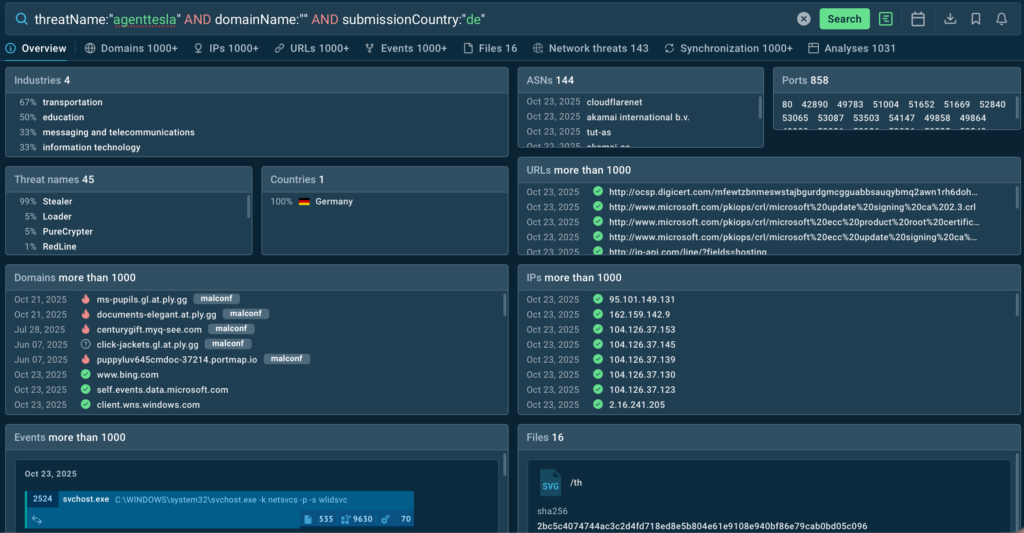
ANY.RUN’s TI Lookup providing IOCs related to Agent Tesla threats submitted in Germany
Threat Intelligence Changes Everything
Earlier this year, ANY.RUN’s solutions gained global acclaim and won multiple awards, like Globee Awards and Cybersecurity Excellence Awards. But this victory stands out, as it recognizes our influence as a company and reflects our approach focused on the integrity of a unified workflow.
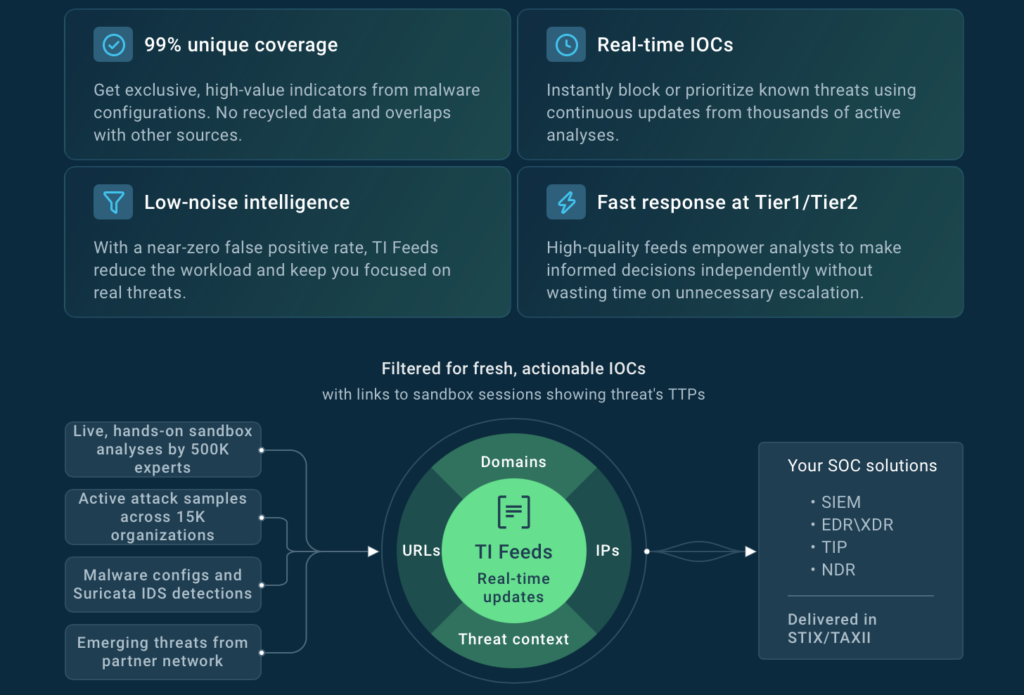
TI Feeds accumulate threat data and enrich your system with it for expanded threat coverage
ANY.RUN’s Threat Intelligence Feeds and Threat Intelligence Lookup are redefining how SOCs operate in today’s threat landscape. Instead of relying on outdated indicators from post-incident reports, ANY.RUN leverages insights from a global community of over 500,000 analysts and 15,000 organizations actively analyzing the latest threats in our Interactive Sandbox.
Gain 3x boost in performance rates Acclaimed TI solutions for your SOC
Continuously updated threat intelligence helps SOC teams gain automation and data needed to stay ahead of evolving attacks. Security leaders can make faster, more confident decisions, strengthen proactive defense strategies, and maximize the ROI of their security stack.
Access 24x more IOCs per incident for wider visibility: Live data on global attacks ensures comprehensive threat coverage of new malware and phishing.
Enrich your system with 99% unique IOCs to reduce workload: In-depth intel cuts Tier 1/Tier 2 investigations and promotes confident decisions.
Accelerate MTTR by 21 min per case for faster action: Threat behavior context for IOCs/IOAs/IOBs provides insights for streamlined incident mitigation.
About ANY.RUN
Over 500,000 cybersecurity professionals and 15,000+ organizations across finance, manufacturing, healthcare, and other industries trust ANY.RUN and accelerate their malware investigations worldwide.
Faster triage and response with ANY.RUN’s Interactive Sandbox: Safely detonate suspicious files, observe malicious behavior in real time, and gain insights for faster, confident security decisions.
https://www.backbox.org/wp-content/uploads/2018/09/website_backbox_text_black.png00adminhttps://www.backbox.org/wp-content/uploads/2018/09/website_backbox_text_black.pngadmin2025-10-24 09:06:352025-10-24 09:06:35ANY.RUN Recognized as Threat Intelligence Company of the Year 2025
Cybersecurity researchers have discovered a self-propagating worm that spreads via Visual Studio Code (VS Code) extensions on the Open VSX Registry and the Microsoft Extension Marketplace, underscoring how developers have become a prime target for attacks.
The sophisticated threat, codenamed GlassWorm by Koi Security, is the second such supply chain attack to hit the DevOps space within a span