Alleged Jabber Zeus Coder ‘MrICQ’ in U.S. Custody

A Ukrainian man indicted in 2012 for conspiring with a prolific hacking group to steal tens of millions of dollars from U.S. businesses was arrested in Italy and is now in custody in the United States, KrebsOnSecurity has learned.

Sources close to the investigation say Yuriy Igorevich Rybtsov, a 41-year-old from the Russia-controlled city of Donetsk, Ukraine, was previously referenced in U.S. federal charging documents only by his online handle “MrICQ.” According to a 13-year-old indictment (PDF) filed by prosecutors in Nebraska, MrICQ was a developer for a cybercrime group known as “Jabber Zeus.”

Image: lockedup dot wtf.

The Jabber Zeus name is derived from the malware they used — a custom version of the ZeuS banking trojan — that stole banking login credentials and would send the group a Jabber instant message each time a new victim entered a one-time passcode at a financial institution website. The gang targeted mostly small to mid-sized businesses, and they were an early pioneer of so-called “man-in-the-browser” attacks, malware that can silently intercept any data that victims submit in a web-based form.

Once inside a victim company’s accounts, the Jabber Zeus crew would modify the firm’s payroll to add dozens of “money mules,” people recruited through elaborate work-at-home schemes to handle bank transfers. The mules in turn would forward any stolen payroll deposits — minus their commissions — via wire transfers to other mules in Ukraine and the United Kingdom.

The 2012 indictment targeting the Jabber Zeus crew named MrICQ as “John Doe #3,” and said this person handled incoming notifications of newly compromised victims. The Department of Justice (DOJ) said MrICQ also helped the group launder the proceeds of their heists through electronic currency exchange services.

Two sources familiar with the Jabber Zeus investigation said Rybtsov was arrested in Italy, although the exact date and circumstances of his arrest remain unclear. A summary of recent decisions (PDF) published by the Italian Supreme Court states that in April 2025, Rybtsov lost a final appeal to avoid extradition to the United States.

According to the mugshot website lockedup[.]wtf, Rybtsov arrived in Nebraska on October 9, and was being held under an arrest warrant from the U.S. Federal Bureau of Investigation (FBI).

The data breach tracking service Constella Intelligence found breached records from the business profiling site bvdinfo[.]com showing that a 41-year-old Yuriy Igorevich Rybtsov worked in a building at 59 Barnaulska St. in Donetsk. Further searching on this address in Constella finds the same apartment building was shared by a business registered to Vyacheslav “Tank” Penchukov, the leader of the Jabber Zeus crew in Ukraine.

Vyacheslav “Tank” Penchukov, seen here performing as “DJ Slava Rich” in Ukraine, in an undated photo from social media.

Penchukov was arrested in 2022 while traveling to meet his wife in Switzerland. Last year, a federal court in Nebraska sentenced Penchukov to 18 years in prison and ordered him to pay more than $73 million in restitution.

Lawrence Baldwin is founder of myNetWatchman, a threat intelligence company based in Georgia that began tracking and disrupting the Jabber Zeus gang in 2009. myNetWatchman had secretly gained access to the Jabber chat server used by the Ukrainian hackers, allowing Baldwin to eavesdrop on the daily conversations between MrICQ and other Jabber Zeus members.

Baldwin shared those real-time chat records with multiple state and federal law enforcement agencies, and with this reporter. Between 2010 and 2013, I spent several hours each day alerting small businesses across the country that their payroll accounts were about to be drained by these cybercriminals.

Those notifications, and Baldwin’s tireless efforts, saved countless would-be victims a great deal of money. In most cases, however, we were already too late. Nevertheless, the pilfered Jabber Zeus group chats provided the basis for dozens of stories published here about small businesses fighting their banks in court over six- and seven-figure financial losses.

Baldwin said the Jabber Zeus crew was far ahead of its peers in several respects. For starters, their intercepted chats showed they worked to create a highly customized botnet directly with the author of the original Zeus Trojan — Evgeniy Mikhailovich Bogachev, a Russian man who has long been on the FBI’s “Most Wanted” list. The feds have a standing $3 million reward for information leading to Bogachev’s arrest.

Evgeniy M. Bogachev, in undated photos.

The core innovation of Jabber Zeus was an alert that MrICQ would receive each time a new victim entered a one-time password code into a phishing page mimicking their financial institution. The gang’s internal name for this component was “Leprechaun,” (the video below from myNetWatchman shows it in action). Jabber Zeus would actually re-write the HTML code as displayed in the victim’s browser, allowing them to intercept any passcodes sent by the victim’s bank for multi-factor authentication.

“These guys had compromised such a large number of victims that they were getting buried in a tsunami of stolen banking credentials,” Baldwin told KrebsOnSecurity. “But the whole point of Leprechaun was to isolate the highest-value credentials — the commercial bank accounts with two-factor authentication turned on. They knew these were far juicier targets because they clearly had a lot more money to protect.”

Baldwin said the Jabber Zeus trojan also included a custom “backconnect” component that allowed the hackers to relay their pilfering of commercial bank accounts through the victim’s own infected PC.

“The Jabber Zeus crew were literally connecting to the victim’s bank account from the victim’s IP address, or from the remote control function and by fully emulating the device,” he said. “That trojan was like a hot knife through butter of what everyone thought was state-of-the-art secure online banking at the time.”

Although the Jabber Zeus crew was in direct contact with the Zeus author, the chats intercepted by myNetWatchman show Bogachev frequently ignored the group’s pleas for help. The government says the real leader of the Jabber Zeus crew was Maksim Yakubets, a 38-year Ukrainian man with Russian citizenship who went by the hacker handle “Aqua.”

Alleged Evil Corp leader Maksim “Aqua” Yakubets. Image: FBI

The Jabber chats intercepted by Baldwin show that Aqua interacted almost daily with MrICQ, Tank and other members of the hacking team, often facilitating the group’s money mule and cashout activities remotely from Russia.

The government says Yakubets/Aqua would later emerge as the leader of an elite cybercrime ring of at least 17 hackers that referred to themselves internally as “Evil Corp.” Members of Evil Corp developed and used the Dridex (a.k.a. Bugat) trojan, which helped them siphon more than $100 million from hundreds of victim companies in the United States and Europe.

This 2019 story about the government’s $5 million bounty for information leading to Yakubets’s arrest includes excerpts of conversations between Aqua, Tank, Bogachev and other Jabber Zeus crew members discussing stories I’d written about their victims. Both Baldwin and I were interviewed at length for a new weekly six-part podcast by the BBC that delves deep into the history of Evil Corp. Episode One focuses on the evolution of Zeus, while the second episode centers on an investigation into the group by former FBI agent Jim Craig.

Image: https://www.bbc.co.uk/programmes/w3ct89y8

Krebs on Security – ​Read More

Samsung Galaxy Buds 3 Pro vs. Apple AirPods Pro 3: I compared both, and this one wins

It’s a battle of device ecosystems – but is one truly better? Here’s my verdict.

Latest news – ​Read More

New Kurdish Hacktivists Hezi Rash Behind 350 DDoS Attacks in 2 Months

New intelligence on Hezi Rash: See how the Kurdish group launched 350+ DDoS attacks and used DaaS platforms like EliteStress to lower entry barriers.

Hackread – Cybersecurity News, Data Breaches, Tech, AI, Crypto and More – ​Read More

ASD Warns of Ongoing BADCANDY Attacks Exploiting Cisco IOS XE Vulnerability

The Australian Signals Directorate (ASD) has issued a bulletin about ongoing cyber attacks targeting unpatched Cisco IOS XE devices in the country with a previously undocumented implant known as BADCANDY.
The activity, per the intelligence agency, involves the exploitation of CVE-2023-20198 (CVSS score: 10.0), a critical vulnerability that allows a remote, unauthenticated attacker to create an

The Hacker News – ​Read More

My Sonos Arc Ultra faced an unexpected challenger – and the soundbar met its match

I compared the Sonos Arc Ultra and Marshall Heston 120 – here’s what makes each one shine, and which might be the better fit for you.

Latest news – ​Read More

This AirPods hack is a game-changer for frequent flyers – how to find it in your iPhone settings

Gone are the days of falling asleep and waking up to an entire missed season of your favorite show.

Latest news – ​Read More

8 ways to help your teams build lasting responsible AI

Make responsible AI part of system design and deployment, not an afterthought. Industry experts offer guidelines for building and managing responsible applications.

Latest news – ​Read More

Release Notes: ANY.RUN & ThreatQ Integration, 3,000+ New Rules, and Expanded Detection Coverage 

October brought another strong round of updates to ANY.RUN, from a new ThreatQ integration that connects our real-time Threat Intelligence Feeds directly into one of the industry’s leading TIPs, to hundreds of new signatures and rules that sharpen network and behavioral detection. 

With 125 new behavior signatures17 YARA rules, and 3,264 Suricata rules, analysts can now spot emerging threats faster and with greater precision. Together with the ThreatQ connector, these improvements make it easier for SOCs and MSSPs to enrich alerts, automate response, and gain deeper visibility into live attack activity. 

Product Updates 

Expanding Threat Intelligence Reach: ANY.RUN & ThreatQ 

October brought another major milestone to ANY.RUN’s growing ecosystem; a new integration that links ANY.RUN’s Threat Intelligence Feeds directly with ThreatQ, one of the industry’s leading Threat Intelligence Platforms (TIPs). 

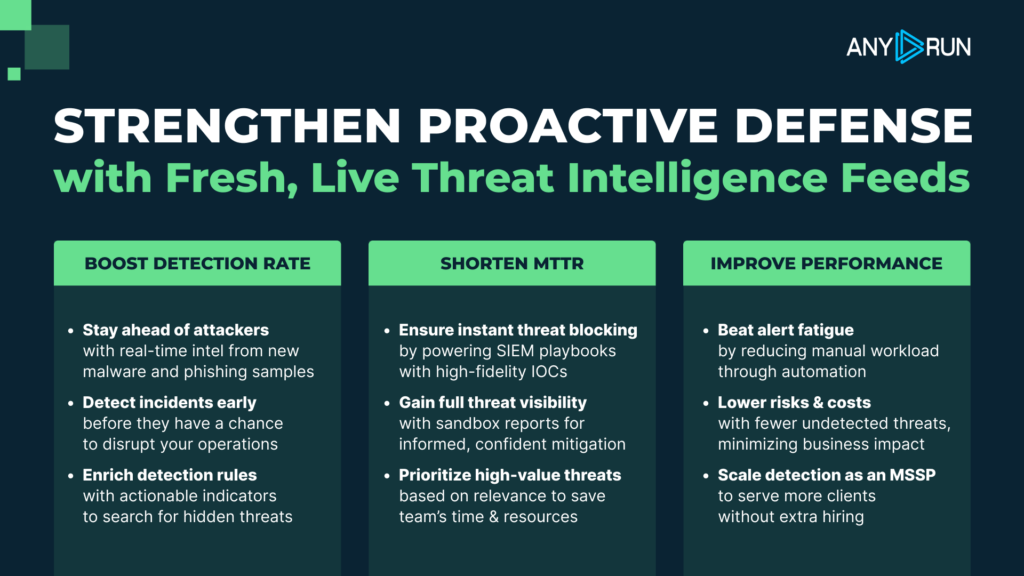
This integration helps SOC teams and MSSPs gain real-time visibility into active global threats, cut investigation time, and strengthen detection accuracy across phishing, malware, and network attack surfaces. 

Now, analysts using ThreatQ can automatically ingest fresh, high-confidence IOCs gathered from live sandbox investigations of malware samples detonated by 15,000+ organizations and 500,000+ analysts worldwide

How this update helps security teams: 

TI Feeds help SOCs boost key security metrics 
  • Early detection: Indicators are streamed into ThreatQ the moment they appear in ANY.RUN sandbox sessions, helping teams spot threats before they hit endpoints or networks. 
  • Expanded coverage: Up to 99% unique IOCs from recent phishing and malware attacks provide visibility beyond traditional feeds. 
  • Faster, smarter response: Each IOC includes a link to its sandbox analysis, giving full behavioral context for rapid validation and containment. 
  • Lower analyst workload: Feeds are filtered to include only verified malicious indicators, cutting false positives and Tier-1 triage time. 

Simple Setup, Instant Impact 

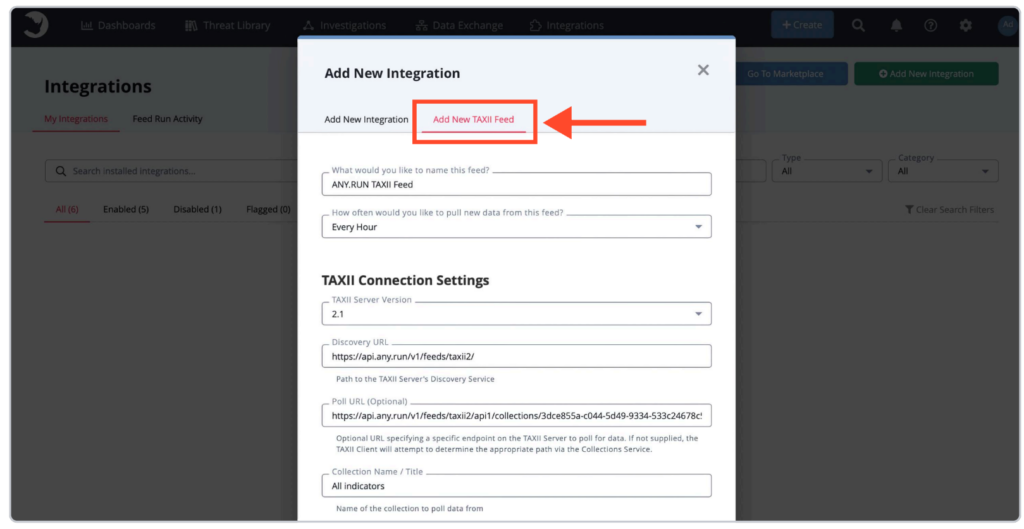
The connector works through the STIX/TAXII protocol, ensuring full compatibility with existing ThreatQ environments. Security teams can configure feeds to update hourly, daily, or on a custom schedule; no custom development or infrastructure changes required. 

Add New TAXII Feed to your integrations 

For detailed information, see ANY.RUN’s TAXII connection documentation

Integrate ANY.RUN’s products for stronger proactive security Request a quote or demo for your SOC 


Contact us 


Threat Coverage Update 

In October, our team continued to strengthen detection capabilities so SOCs can stay ahead of new and evolving threats: 

  • 125 new behavior signatures were added to improve coverage across ransomware, loaders, stealers, and RATs, helping analysts detect persistence and payload activity earlier in the attack chain. 
  • 17 new YARA rules went live in production, expanding visibility into credential-dumping tools, network scanners, and new loader families. 
  • 3,264 new Suricata rules were deployed, enhancing detection for phishing, APT infrastructure, and evasive network behaviors. 

These updates enable analysts to gain faster, more confident verdicts in the sandbox and enrich SIEM, SOAR, and IDS workflows with fresh, actionable IOCs. 

New Behavior Signatures 

This month’s updates focus on helping analysts catch stealthy activity earlier in the attack chain. The new behavior signatures detect payload downloads, privilege escalation attempts, and persistence mechanisms used by modern ransomware, stealers, and loaders. 

We also expanded coverage of mutex detections and legitimate administrative tools often abused by attackers. Together, these improvements provide clearer visibility into real-world execution flow and strengthen automated classification in the sandbox. 

Highlighted families and techniques include: 

New YARA Rules 

In October, we added 17 new YARA rules focused on detecting emerging malware families, credential-dumping utilities, and reconnaissance tools increasingly used in modern attack chains. 

These additions strengthen both automated detection and manual hunting, helping analysts identify threats that blend malicious code with legitimate administrative software. 

Several new rules were built directly from live samples analyzed in the sandbox, capturing real payloads, shellcode fragments, and memory artifacts tied to loaders, stealers, and botnets. This ensures faster and more reliable classification when scanning new samples or correlating incidents across environments. 

Highlighted YARA rules include: 

  • Maverick: Detection for a recently active loader family observed in targeted phishing campaigns. 
  • ChaosBot: Identifies obfuscated botnet samples distributing info-stealers via Discord channels. 
  • Hexa: Flags packed binaries linked to a new modular backdoor variant. 
  • Pmdump: Detects credential-dumping activity using memory process extraction tools. 
  • Task Manager DeLuxe: Identifies legitimate system tools often repurposed for lateral movement. 
  • Network Scanner: Flags reconnaissance utilities used to map internal networks. 
  • Yapm: Detects process-management tools frequently abused for privilege escalation. 
  • TaskExplorer: Expands visibility into post-exploitation tool use. 
  • Ophcrack: Detection of password-recovery tools commonly found in attacker toolkits. 

New Suricata Rules 

This month, the detection team delivered 3,264 new Suricata rules to improve coverage of phishing activity, APT operations, and evasive web-based malware behavior. 

These updates expand network visibility for SOCs and MSSPs, helping analysts detect malicious traffic even when it hides behind trusted services or multi-stage redirects. 

Highlighted additions include: 

  • Tycoon 2FA Domain Chain (sid:85004273, 85004828, 85005024): New heuristic rules based on set of web-resources loaded in specific order by Tycoon client-side code 

About ANY.RUN 

ANY.RUN supports more than 15,000 organizations worldwide across industries such as banking, manufacturing, telecom, healthcare, and technology, helping them build faster, smarter, and more resilient cybersecurity operations. 

Our cloud-based interactive sandbox enables teams to safely analyze threats targeting Windows, Linux, and Android systems in real time. Analysts can observe every system and network action, interact with running samples, and extract IOCs in under 40 seconds; all without complex infrastructure setup. 

Combined with Threat Intelligence Lookup and Threat Intelligence Feeds, ANY.RUN helps SOCs accelerate investigations, reduce noise, and improve detection accuracy. Teams can easily integrate these capabilities into SIEM and SOAR systems to automate enrichment and streamline response. 

Ready to see it in action? 
Start your 14-day trial of ANY.RUN 

The post Release Notes: ANY.RUN & ThreatQ Integration, 3,000+ New Rules, and Expanded Detection Coverage  appeared first on ANY.RUN’s Cybersecurity Blog.

ANY.RUN’s Cybersecurity Blog – ​Read More

This tank of a phone has a built-in projector, but that’s not why you should care about it

Tank by name, tank by nature, this smartphone takes overkill to another level.

Latest news – ​Read More

Thinking of buying an Arm-based Windows PC? These three issues might be dealbreakers

Is Windows 11 on Arm ready for primetime? After using three PCs with Snapdragon X processors for the past year, I discovered three issues that might make you think twice.

Latest news – ​Read More