ANY.RUN Wins Trailblazing Threat Intelligence at the 2025 Top InfoSec Innovators Awards

Big news from the ANY.RUN team; we’ve just been named the 2025 “Trailblazing Threat Intelligence” winner at the Top InfoSec Innovators Awards! 

This recognition means a lot to us because it celebrates what we care about most: helping analysts, SOC teams, and researchers access live, actionable threat intelligence that makes a real difference in investigations every day. 

A Milestone That Reflects Our Mission 

The Top InfoSec Innovator Awards celebrate cybersecurity companies that shape the future of the industry with new ideas and bold technology. Now in its 13th year, the program is known worldwide for spotlighting organizations that truly move the field forward. 

Winning the Trailblazing Threat Intelligence award reinforces what drives us, transforming how teams investigate and respond to cyber threats through a connected, behavioral approach to intelligence. 
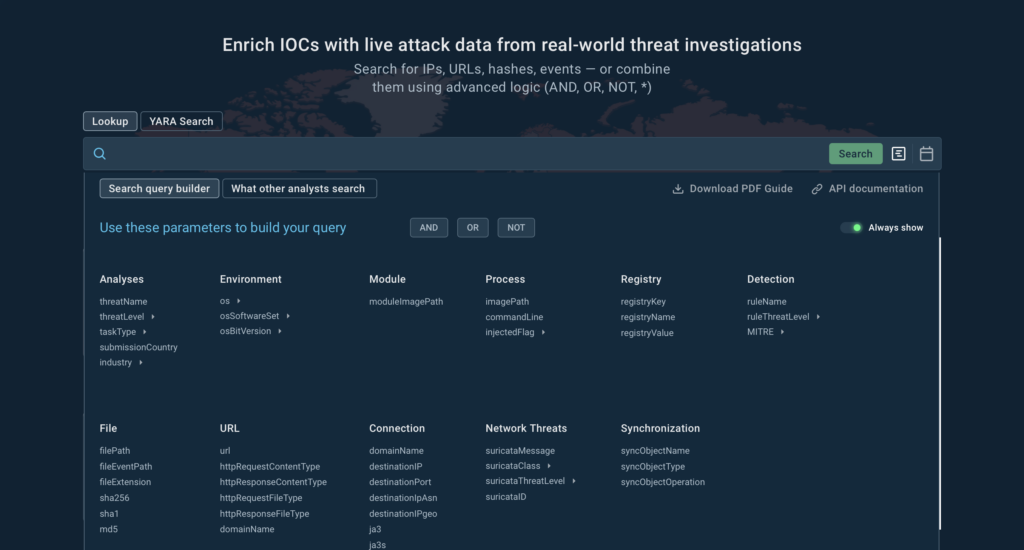
TI Lookup with 40+ parameters, used to discover relevant intel from real-world threat investigations  

For our users, this award reflects the impact they experience every day: 

  • Connected intelligence, powered by 15,000+ company data sources worldwide: ANY.RUN’s ecosystem gathers insights from thousands of live environments, helping teams detect threats that traditional feeds often miss. 
  • 24× more IOCs per incident for wider visibility: Live data from global attacks ensures comprehensive coverage of new malware and phishing campaigns, giving analysts the full picture behind each alert. 
  • 99% unique IOCs to cut noise and workload: In-depth behavioral intelligence filters out duplicates and low-value data, reducing Tier 1/Tier 2 investigation time and supporting faster, more confident decisions. 
  • 21 minutes faster MTTR per case: Real-time context for IOCs, IOAs, and IOBs provides the insight analysts need to prioritize critical alerts and accelerate incident resolution. 

Experience the award-winning TI solutions trusted by 15,000+ organizations


Contact us 


Connecting People and Data Through Innovative Threat Intelligence 

We earned this recognition because innovation at ANY.RUN is built around real analyst needs. Instead of scattering data across multiple tools, we created an ecosystem where threat intelligence is connected, interactive, and human-centered. 

Our Threat Intelligence Lookup and Threat Intelligence Feeds bridge live malware behavior with verified indicators, giving teams instant context they can trust. Whether it’s uncovering hidden links between campaigns or enriching detections automatically, these solutions help analysts see more, decide faster, and collaborate better. 
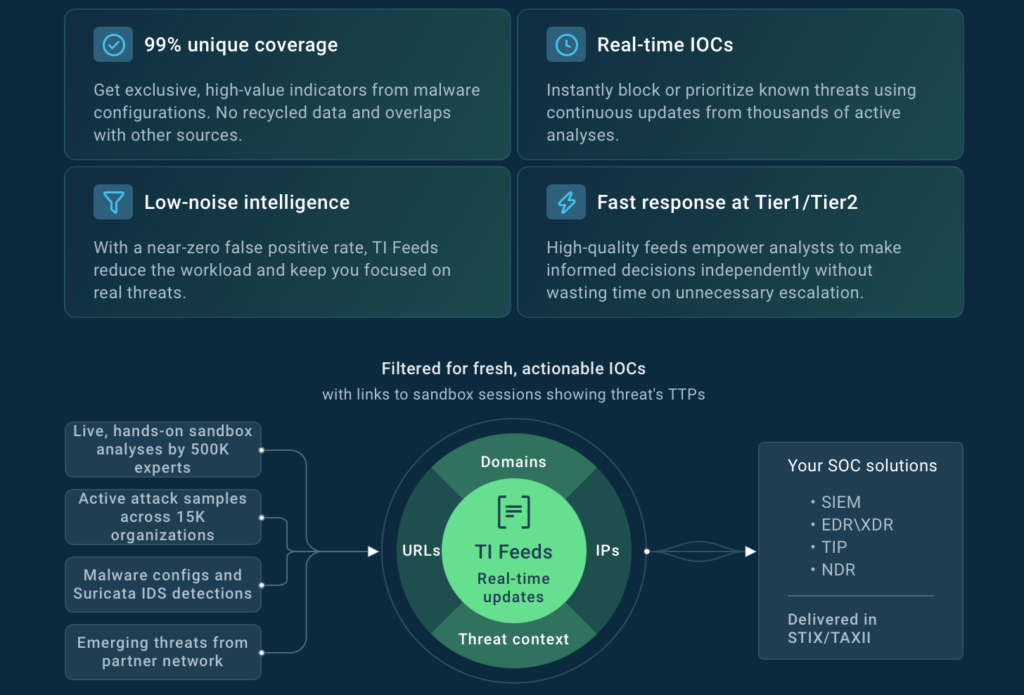
TI Feeds gather fresh threat data and enrich your system with it for expanded threat coverage 

That’s what this award stands for: innovation that connects people and data to make threat intelligence more practical, powerful, and ready for what’s next. 

Looking Ahead: Building the Future of Threat Intelligence 

This recognition fuels our drive to keep innovating. 
In the coming months, we’re expanding our Threat Intelligence products with even deeper enrichment, new integrations for SIEM and SOAR platforms, and broader OS coverage. 

But most importantly, we’ll keep growing together with our community; the analysts, researchers, and security teams who make ANY.RUN what it is today. Every sample executed, every IOC shared, every insight contributed helps make global defense stronger. 

So, this win is yours as much as it is ours. 🏆 

See Why the Industry Calls It Trailblazing 

Experience threat intelligence that helps analysts act 21 minutes faster per case and uncover 24× more IOCs per incident. 

With behavior-driven data and real-world context, ANY.RUN turns every investigation into clear, actionable insight. 

Book a live demo and see how connected intelligence can sharpen your team’s response. 

About ANY.RUN 

ANY.RUN, a leading provider of interactive malware analysis and threat intelligence solutions, makes advanced investigation fast, visual, and accessible. 
The service processes millions of analysis sessions and is trusted by 15,000+ organizations and over 500,000 cybersecurity professionals worldwide

Teams using ANY.RUN report tangible gains; up to 3× higher SOC efficiency90% faster detection of unknown threats, and a 60% reduction in false positives thanks to real-time interactivity and behavior-based analysis. 

Explore ANY.RUN’s capabilities with a 14-day trial 

The post ANY.RUN Wins Trailblazing Threat Intelligence at the 2025 Top InfoSec Innovators Awards appeared first on ANY.RUN’s Cybersecurity Blog.

ANY.RUN’s Cybersecurity Blog – ​Read More

Hackers Weaponize Windows Hyper-V to Hide Linux VM and Evade EDR Detection

The threat actor known as Curly COMrades has been observed exploiting virtualization technologies as a way to bypass security solutions and execute custom malware.
According to a new report from Bitdefender, the adversary is said to have enabled the Hyper-V role on selected victim systems to deploy a minimalistic, Alpine Linux-based virtual machine.
“This hidden environment, with its lightweight

The Hacker News – ​Read More

SonicWall Confirms State-Sponsored Hackers Behind September Cloud Backup Breach

SonicWall has formally implicated state-sponsored threat actors as behind the September security breach that led to the unauthorized exposure of firewall configuration backup files.
“The malicious activity – carried out by a state-sponsored threat actor – was isolated to the unauthorized access of cloud backup files from a specific cloud environment using an API call,” the company said in a

The Hacker News – ​Read More

Anxious about AI job cuts? How white-collar workers can protect themselves – starting now

Want to avoid being a victim in the great AI job transformation? Be a pathfinder instead. Here’s how.

Latest news – ​Read More

This Windows PC could easily replace my Mac Mini when it comes to local AI performance

If you’re looking to replace your aging Windows 10 PC, this tiny brute from Minix will give you all the power you need with room to spare.

Latest news – ​Read More

APT ‘Bronze Butler’ Exploits Zero-Day to Root Japan Orgs

A critical security issue in a popular endpoint manager (CVE-2025-61932) allowed Chinese state-sponsored attackers to backdoor Japanese businesses.

darkreading – ​Read More

Cloudflare Scrubs Aisuru Botnet from Top Domains List

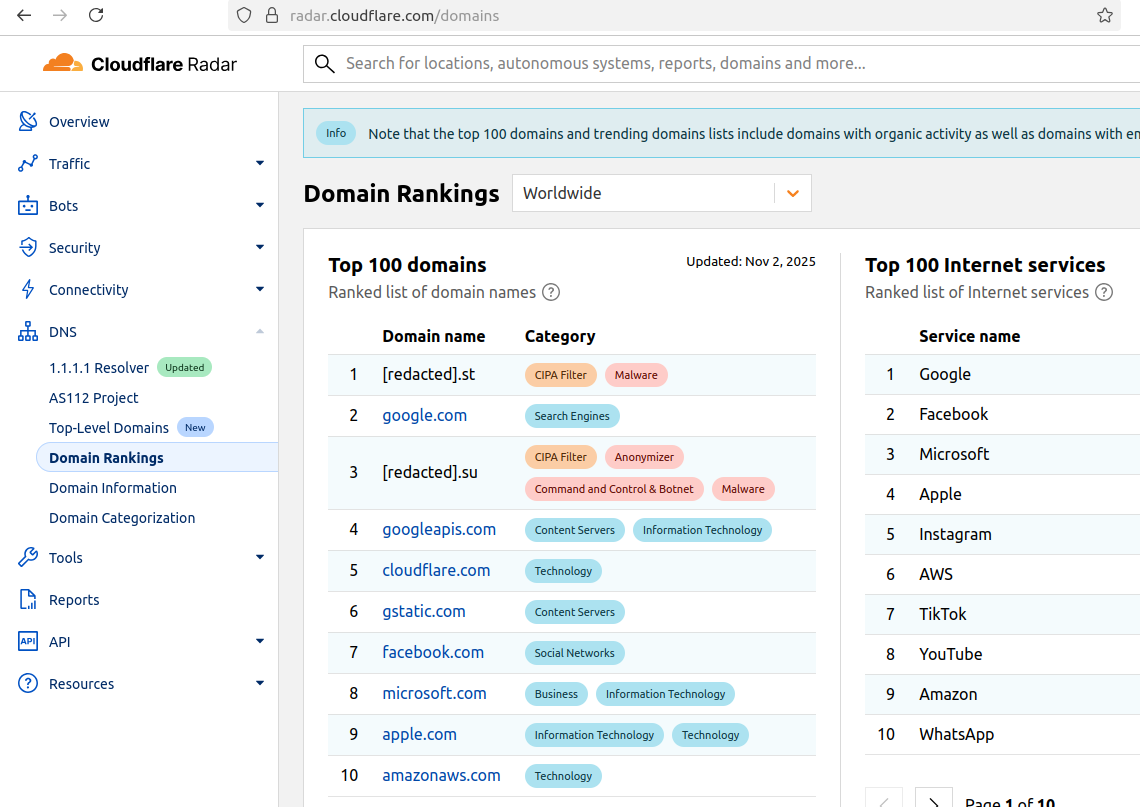
For the past week, domains associated with the massive Aisuru botnet have repeatedly usurped Amazon, Apple, Google and Microsoft in Cloudflare’s public ranking of the most frequently requested websites. Cloudflare responded by redacting Aisuru domain names from their top websites list. The chief executive at Cloudflare says Aisuru’s overlords are using the botnet to boost their malicious domain rankings, while simultaneously attacking the company’s domain name system (DNS) service.

Source: radar.cloudflare.com.

Aisuru is a rapidly growing botnet comprising hundreds of thousands of hacked Internet of Things (IoT) devices, such as poorly secured Internet routers and security cameras. The botnet has increased in size and firepower significantly since its debut in 2024, demonstrating the ability to launch record distributed denial-of-service (DDoS) attacks nearing 30 terabits of data per second.

Until recently, Aisuru’s malicious code instructed all infected systems to use DNS servers from Google — specifically, the servers at 8.8.8.8. But in early October, Aisuru switched to invoking Cloudflare’s main DNS server — 1.1.1.1 — and over the past week domains used by Aisuru to control infected systems started populating the Cloudflare’s top domain rankings.

As screenshots of Aisuru domains claiming two of the Top 10 positions ping-ponged across social media, many feared this was yet another sign that an already untamable botnet was running completely amok. One Aisuru botnet domain that sat prominently for days at #1 on the list was someone’s street address in Massachusetts followed by “.com”. Other Aisuru domains mimicked those belonging to major cloud providers.

Cloudflare tried to address these security, brand confusion and privacy concerns by partially redacting the malicious domains, and adding a warning at the top of its rankings:

“Note that the top 100 domains and trending domains lists include domains with organic activity as well as domains with emerging malicious behavior.”

Cloudflare CEO Matthew Prince told KrebsOnSecurity the company’s domain ranking system is fairly simplistic, and that it merely measures the volume of DNS queries to 1.1.1.1.

“The attacker is just generating a ton of requests, maybe to influence the ranking but also to attack our DNS service,” Prince said, adding that Cloudflare has heard reports of other large public DNS services seeing similar uptick in attacks. “We’re fixing the ranking to make it smarter. And, in the meantime, redacting any sites we classify as malware.”

Renee Burton, vice president of threat intel at the DNS security firm Infoblox, said many people erroneously assumed that the skewed Cloudflare domain rankings meant there were more bot-infected devices than there were regular devices querying sites like Google and Apple and Microsoft.

“Cloudflare’s documentation is clear — they know that when it comes to ranking domains you have to make choices on how to normalize things,” Burton wrote on LinkedIn. “There are many aspects that are simply out of your control. Why is it hard? Because reasons. TTL values, caching, prefetching, architecture, load balancing. Things that have shared control between the domain owner and everything in between.”

Alex Greenland is CEO of the anti-phishing and security firm Epi. Greenland said he understands the technical reason why Aisuru botnet domains are showing up in Cloudflare’s rankings (those rankings are based on DNS query volume, not actual web visits). But he said they’re still not meant to be there.

“It’s a failure on Cloudflare’s part, and reveals a compromise of the trust and integrity of their rankings,” he said.

Greenland said Cloudflare planned for its Domain Rankings to list the most popular domains as used by human users, and it was never meant to be a raw calculation of query frequency or traffic volume going through their 1.1.1.1 DNS resolver.

“They spelled out how their popularity algorithm is designed to reflect real human use and exclude automated traffic (they said they’re good at this),” Greenland wrote on LinkedIn. “So something has evidently gone wrong internally. We should have two rankings: one representing trust and real human use, and another derived from raw DNS volume.”

Why might it be a good idea to wholly separate malicious domains from the list? Greenland notes that Cloudflare Domain Rankings see widespread use for trust and safety determination, by browsers, DNS resolvers, safe browsing APIs and things like TRANCO.

“TRANCO is a respected open source list of the top million domains, and Cloudflare Radar is one of their five data providers,” he continued. “So there can be serious knock-on effects when a malicious domain features in Cloudflare’s top 10/100/1000/million. To many people and systems, the top 10 and 100 are naively considered safe and trusted, even though algorithmically-defined top-N lists will always be somewhat crude.”

Over this past week, Cloudflare started redacting portions of the malicious Aisuru domains from its Top Domains list, leaving only their domain suffix visible. Sometime in the past 24 hours, Cloudflare appears to have begun hiding the malicious Aisuru domains entirely from the web version of that list. However, downloading a spreadsheet of the current Top 200 domains from Cloudflare Radar shows an Aisuru domain still at the very top.

According to Cloudflare’s website, the majority of DNS queries to the top Aisuru domains — nearly 52 percent — originated from the United States. This tracks with my reporting from early October, which found Aisuru was drawing most of its firepower from IoT devices hosted on U.S. Internet providers like AT&T, Comcast and Verizon.

Experts tracking Aisuru say the botnet relies on well more than a hundred control servers, and that for the moment at least most of those domains are registered in the .su top-level domain (TLD). Dot-su is the TLD assigned to the former Soviet Union (.su’s Wikipedia page says the TLD was created just 15 months before the fall of the Berlin wall).

A Cloudflare blog post from October 27 found that .su had the highest “DNS magnitude” of any TLD, referring to a metric estimating the popularity of a TLD based on the number of unique networks querying Cloudflare’s 1.1.1.1 resolver. The report concluded that the top .su hostnames were associated with a popular online world-building game, and that more than half of the queries for that TLD came from the United States, Brazil and Germany [it’s worth noting that servers for the world-building game Minecraft were some of Aisuru’s most frequent targets].

A simple and crude way to detect Aisuru bot activity on a network may be to set an alert on any systems attempting to contact domains ending in .su. This TLD is frequently abused for cybercrime and by cybercrime forums and services, and blocking access to it entirely is unlikely to raise any legitimate complaints.

Krebs on Security – ​Read More

Hackers Steal Personal Data and 17K Slack Messages in Nikkei Data Breach

Nikkei confirms breach after a virus infected an employee PC, exposing 17,368 names and Slack chat histories. The media giant reported the incident voluntarily.

Hackread – Cybersecurity News, Data Breaches, Tech, AI, Crypto and More – ​Read More

Nikkei Suffers Breach Via Slack Compromise

The Japanese media giant said thousands of employee and business partners were impacted by an attack that compromised Slack account data and chat histories.

darkreading – ​Read More

China sentences 5 Myanmar scam kingpins to death

Five others were handed life sentences, while nine of the accused were handed prison sentences of three to 20 years.

The Record from Recorded Future News – ​Read More