https://www.backbox.org/wp-content/uploads/2018/09/website_backbox_text_black.png00https://www.backbox.org/wp-content/uploads/2018/09/website_backbox_text_black.png2024-12-16 13:06:432024-12-16 13:06:43Keepit Raises $50 Million for SaaS Data Protection Solution
New Guidelines Aim to Strengthen Security Against Scams, Phishing, and Smart Contract Exploits.
Overview
The rapid adoption of cryptocurrency has opened new doors for financial innovation and investment, but it has also made this digital asset an increasingly attractive target for cybercriminals. Recognizing the growing risks in this space, the Singapore Police Force (SPF) and the Cyber Security Agency of Singapore (CSA) have issued a joint advisory to help the public protect their cryptocurrency holdings. The advisory outlines the tactics employed by threat actors and provides best practices for safeguarding digital assets. This blog takes a closer look at the advisory, analyzes the evolving threats, and recommends preventive measures to ensure a safer cryptocurrency ecosystem in Singapore.
Threat Actors Target Cryptocurrency: Tactics to Watch Out For
As cryptocurrencies gain popularity, cybercriminals have refined their methods to exploit unsuspecting victims. SPF and CSA have highlighted several tactics used by threat actors:
Imposter Profiles
Cybercriminals impersonate legitimate blockchain entities on social media platforms, offering fake giveaways or promotions. Victims are tricked into verifying their wallets by sharing sensitive information such as login credentials.
In some cases, attackers pose as employers in cryptocurrency companies, asking victims to demonstrate their blockchain skills by executing malicious scripts, leading to unauthorized wallet transactions.
Phishing Websites
Fraudulent websites are created to mimic legitimate cryptocurrency wallets, exchanges, or platforms. These sites lure victims by promising lucrative investment opportunities or exclusive tokens with high returns.
Social media advertisements amplify the reach of these phishing schemes, making them more accessible to potential victims.
Exploiting Software Vulnerabilities
Threat actors actively identify and exploit software flaws in smart contracts, especially those involving multi-threading or recursion. One such example is the Re-entrancy Attack, where attackers interrupt ongoing smart contract transactions to execute unintended behaviors or repeat transactions.
Manipulating Automated Smart Contracts
Smart contracts designed for automated trading can be exploited. Cybercriminals deceive these contracts by creating liquidity pools that appear valuable, causing cryptocurrencies to flow into the attackers’ pools automatically.
Best Practices for Cryptocurrency Users
To counter these threats, SPF and CSA have outlined several precautionary measures:
Use Secure Wallets
Store cryptocurrencies in hardware wallets to keep them offline and shield them from online attacks.
If frequent transactions are necessary, use reputable software wallets and ensure they are updated with the latest security patches.
Set Strong Passwords and Enable Two-Factor Authentication (2FA)
Always use strong, unique passwords for wallets and online accounts.
Never share private keys, recovery phrases, or seed phrases. Keep them stored securely in physical form.
Enable 2FA for all accounts related to cryptocurrency to add an extra layer of protection.
Regularly Monitor Accounts
Frequently review wallet transactions to spot unauthorized activities.
Use tools like blockchain explorers to manage and revoke excessive token allowances.
Exercise Caution with Smart Contracts
Verify the legitimacy of smart contracts before interacting with them.
Avoid approving or signing transactions without fully understanding their implications.
Beware of Phishing Attempts
Avoid clicking on unsolicited links or downloading attachments from unknown sources.
Cross-check links and verify their authenticity through official channels.
Stay Informed
Keep up-to-date with emerging cryptocurrency threats and best practices by following trusted sources and industry updates.
Responding to Cryptocurrency Crimes
Despite precautions, falling victim to cryptocurrency crimes is still a possibility. SPF and CSA recommend the following steps if you suspect or confirm an incident:
Immediate Actions
Contact your cryptocurrency exchange to halt transactions or freeze your account.
Revoke any suspicious token approvals using wallet interfaces.
Transfer remaining assets from compromised wallets to secure ones immediately if a seed phrase is compromised.
Report the Incident
File a report with the Police and CSA’s SingCERT by emailing singcert@csa.gov.sg or using the reporting form on the CSA website.
For urgent assistance, call the Police Hotline at 1800-255-0000 or dial 999 for emergencies.
Use the ScamShield app or helpline (1799) to check, deter, and block scams.
Analyzing the Threat Landscape
The tactics outlined by SPF and CSA illustrate the deception of modern cybercriminals targeting cryptocurrency users. These methods leverage both technical exploits and psychological manipulation to deceive victims. For example:
Social Engineering: Imposter profiles and phishing schemes prey on human trust and curiosity. The promise of high returns or exclusive opportunities can cloud judgment, leading victims to unknowingly divulge critical information.
Technical Exploits: Attacks on software vulnerabilities highlight the need for rigorous testing of smart contracts and associated applications. Developers must adopt robust security practices to minimize risks.
Automation Exploitation: Automated trading mechanisms, while convenient, require enhanced safeguards to prevent exploitation by malicious actors.
Fostering a Secure Cryptocurrency Ecosystem
Cryptocurrency security is a shared responsibility among users, developers, and regulatory bodies. Here are some actionable recommendations:
User Awareness
Public education campaigns should emphasize the importance of cybersecurity hygiene and vigilance in cryptocurrency transactions.
Sharing real-life case studies of cryptocurrency scams can help users recognize red flags.
Developer Best Practices
Developers must prioritize security when designing and deploying smart contracts. Comprehensive testing and vulnerability assessments are crucial.
Implementing monitoring mechanisms can help identify suspicious activities in real-time.
Regulatory Collaboration
Regulatory bodies and law enforcement agencies should collaborate to track and disrupt cryptocurrency-related criminal networks.
Encouraging the adoption of global security standards can strengthen the resilience of cryptocurrency platforms.
A Call to Action
As threats in the cryptocurrency space continue to evolve, staying one step ahead of cybercriminals is critical. The joint advisory from SPF and CSA underscores the importance of proactive measures to protect digital assets. By adopting best practices, users can significantly reduce their risk of falling victim to scams and attacks.
It’s equally important to foster a culture of shared responsibility and collaboration. Whether you’re a cryptocurrency user, developer, or policymaker, your role is integral to creating a safer cryptocurrency ecosystem.
https://www.backbox.org/wp-content/uploads/2018/09/website_backbox_text_black.png00https://www.backbox.org/wp-content/uploads/2018/09/website_backbox_text_black.png2024-12-16 13:06:332024-12-16 13:06:33Singapore Warns Against Crypto Scams: Best Practices to Safeguard Digital Wealth
ANY.RUN’s Threat Intelligence (TI) feeds provide an invaluable solution for organizations seeking to detect and mitigate the latest malware and phishing campaigns, attacks, and cybercriminal tactics.
But what exactly is inside these feeds, and how can they help companies strengthen their cybersecurity?
Let’s dive into the details.
What Are ANY.RUN’s Threat Intelligence Feeds?
ANY.RUN’s Threat Intelligence (TI) feeds are a comprehensive collection of Indicators of Compromise (IOCs) that can expand security systems’ threat detection capabilities. These feeds don’t just give you the basics, they go deep, providing malicious IPs, URLs, domains, file hashes, and even links to actual analysis sessions, showing you how threats behave.
Where does this data come from? An international community of over 500,000 researchers and cybersecurity pros who upload and analyze real-world malware and phishing samples every day to ANY.RUN’s Public submissions repository.
Expand Threat Coverage: Extend your security systems’ ability to detect emerging malware and phishing attacks.
Improve Incident Response: Enrich incident response processes with contextual data from the feeds, providing deeper insights into threats and their behaviors.
Strengthen Security Posture: Ensure proactive defense against new and evolving threats.
Optimize Threat Hunting: Streamlinethreat hunting activities, identifying and investigating potential threats more efficiently.
Want to integrate CTI Feeds from ANY.RUN?? Reach out to us and we’ll help you set it up
Here’s what makes ANY.RUN’s CTI feeds valuable for cybersecurity teams:
Fresh Data: Contain data extracted from the latest public samples uploaded to our interactive sandbox by a global network of over 500,000 security professionals.
Actionable Indicators: Supply indicators from decompressed traffic, memory dumps, and malware configurations along with those manually collected by our team of malware analysts, as well as data from partners and OSINT sources.
Contextual Information: Offer more than just IOCs by providing direct links to full sandbox analysis sessions that include memory dumps, network traffic, and events.
Rigorous Pre-Processing: Use advanced algorithms and proprietary technology for data filtering and validation.
Continuous Updates: Updated every few hours, helping security teams stay ahead of emerging threats and respond quickly to new threats.
STIX and MISP Formats: Deliver threat intelligence feeds in the STIX and MISP formats, making it easy for security teams to integrate our data into their existing infrastructure.
API Support: Integrate into existing security systems via API for real-time threat updates and automated responses.
What’s Inside ANY.RUN’s CTI Feeds?
The IOCs include information on malicious IP addresses, domain names, and URLs, enriched with contextual details such as related files and ports. Here’s a closer look at what’s inside:
IP addresses
IP addresses are important for detecting and preventing malicious network activity. They serve as digital markers of cybercriminal operations, often linked to Command-and-Control (C2) servers or phishing campaigns.
By analyzing IP addresses, cybersecurity teams can:
Identify malicious sources: Pinpoint harmful traffic and proactively block it.
Trace attack origins: Gain insights into the geolocation and tactics of attackers.
Monitor threat patterns: Detect repeated use of IPs across campaigns.
Enhance network security: Use IP-based firewalls and intrusion prevention systems (IPS) to block unwanted traffic.
ANY.RUN’s TI feeds don’t just list malicious IPs. They provide detailed context that turns raw data into actionable insights for cybersecurity teams. This enriched information helps assess the behavior and impact of each IP. Here’s what’s usually included:
External references: Links to relevant sandbox sessions.
Label: Name of the malware family or campaign.
Detection timestamps: “Created” and “Modified” dates provide a timeline to understand if a threat is ongoing or historical.
Related objects: IDs of files and network indicators related to the object in question.
Score: Value representing the severity level of the IOC.
Revoked: Field indicating whether the IOC has been invalidated.
Domains
Domains play a crucial role in hosting malicious content, phishing campaigns, and distributing malware. They are often used as staging points for cyberattacks, making them a key focus for threat detection and mitigation.
ANY.RUN’s TI feeds provide comprehensive information about domains, including all the details available for IP addresses, such as threat names, types, detection timestamps, and related file hashes.
Keep in mind that domains provide a higher-level view of malicious activity, often connecting multiple IPs or malware instances within a single campaign.
Give CTI Feeds from ANY.RUN a try Start with a free demo sample in STIX or MISP
URLs play a significant role in cybercriminal operations, often serving as gateways to distribute malware, execute phishing campaigns, or redirect users to malicious content. Their flexibility and ease of use make them a preferred tool for attackers.
How URLs are used:
Malware delivery: Embedded in emails or websites, URLs download malware or redirect to exploit kits.
Phishing campaigns: Lead users to fake websites designed to steal sensitive information.
Command-and-Control (C2): Facilitate communication between malware and attackers for issuing commands or data exfiltration.
Exploitation and redirection: Redirect victims to malicious sites hosting drive-by downloads or exploits.
By analyzing URLs, cybersecurity teams can uncover attack patterns, block harmful traffic, and prevent unauthorized access to systems and data.
Note that URLs often serve as entry points for malicious activity, acting as gateways for malware delivery, phishing attacks, or redirection to exploit kits, making them critical for identifying and mitigating cyber threats.
Additional Indicators in ANY.RUN’s TI Feeds
In addition to the core Indicators of Compromise (IOCs) such as URLs, domains, and IPs, ANY.RUN’s CTI feeds include a wealth of contextual information.
This additional data enriches the IOCs, offering deeper insights into the nature and behavior of each indicator.
Files
For file indicators, ANY.RUN’s CTI feeds provide detailed information to help identify and assess malicious files. Here are the key data fields included:
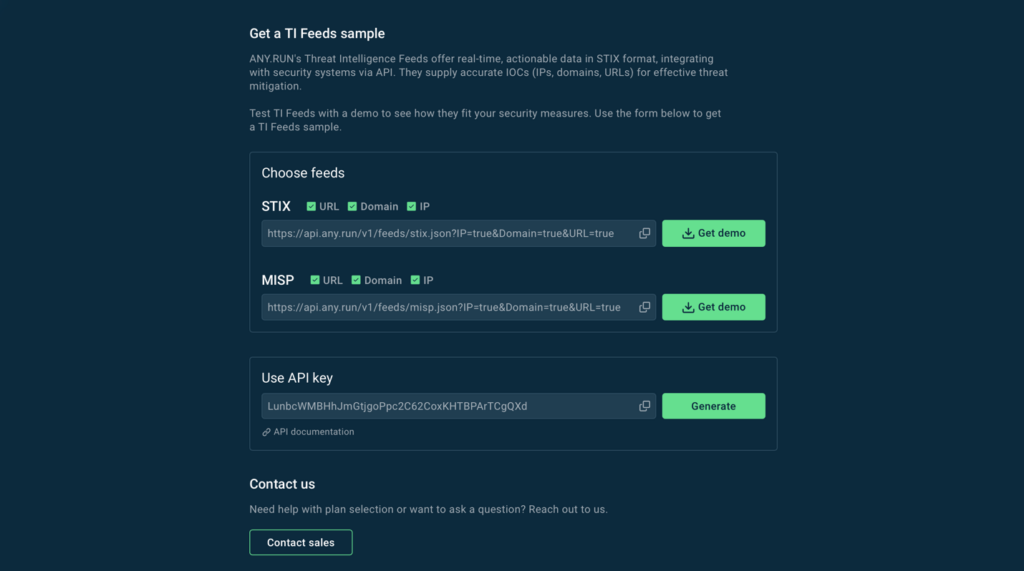
ANY.RUN offers demo feeds samples in STIX and MISP formats
You can test ANY.RUN’s Threat Intelligence Feeds in STIX and MISP formats completely for free by getting a free demo sample here.
ANY.RUN also runs a dedicated MISP instance that you can syncronize your server with or connect to your security solutions. To get started, contact our team via this page.
About ANY.RUN
ANY.RUN helps more than 500,000 cybersecurity professionals worldwide. Our interactive sandbox simplifies malware analysis of threats that target both Windows and Linux systems. Our threat intelligence products, TI Lookup, YARA Search and Feeds, help you find IOCs or files to learn more about the threats and respond to incidents faster.
With the evolution of modern software development, CI/CD pipeline governance has emerged as a critical factor in maintaining both agility and compliance. As we enter the age of artificial intelligence (AI), the importance of robust pipeline governance has only intensified. With that said, we’ll explore the concept of CI/CD pipeline governance and why it’s vital, especially as AI becomes
https://www.backbox.org/wp-content/uploads/2018/09/website_backbox_text_black.png00https://www.backbox.org/wp-content/uploads/2018/09/website_backbox_text_black.png2024-12-16 12:06:542024-12-16 12:06:54Data Governance in DevOps: Ensuring Compliance in the AI Era
Staffers at the Cybersecurity and Infrastructure Security Agency tell WIRED they fear the new administration will cut programs that keep the US safe—and “persecution.”
https://www.backbox.org/wp-content/uploads/2018/09/website_backbox_text_black.png00https://www.backbox.org/wp-content/uploads/2018/09/website_backbox_text_black.png2024-12-16 12:06:532024-12-16 12:06:53The Top Cybersecurity Agency in the US Is Bracing for Donald Trump
Cybersecurity researchers have discovered a new PHP-based backdoor called Glutton that has been put to use in cyber attacks targeting China, the United States, Cambodia, Pakistan, and South Africa.
QiAnXin XLab, which discovered the malicious activity in late April 2024, attributed the previously unknown malware with moderate confidence to the prolific Chinese nation-state group tracked Winnti (
https://www.backbox.org/wp-content/uploads/2018/09/website_backbox_text_black.png00https://www.backbox.org/wp-content/uploads/2018/09/website_backbox_text_black.png2024-12-16 11:06:502024-12-16 11:06:50New Glutton Malware Exploits Popular PHP Frameworks Like Laravel and ThinkPHP
Cybersecurity researchers are calling attention to a new kind of investment scam that leverages a combination of social media malvertising, company-branded posts, and artificial intelligence (AI) powered video testimonials featuring famous personalities, ultimately leading to financial and data loss.
“The main goal of the fraudsters is to lead victims to phishing websites and forms that harvest
https://www.backbox.org/wp-content/uploads/2018/09/website_backbox_text_black.png00https://www.backbox.org/wp-content/uploads/2018/09/website_backbox_text_black.png2024-12-16 11:06:492024-12-16 11:06:49New Investment Scam Leverages AI, Social Media Ads to Target Victims Worldwide
Digital license plates sold by Reviver, already legal to buy in some states and drive with nationwide, can be hacked by their owners to evade traffic regulations or even law enforcement surveillance.
https://www.backbox.org/wp-content/uploads/2018/09/website_backbox_text_black.png00https://www.backbox.org/wp-content/uploads/2018/09/website_backbox_text_black.png2024-12-16 11:06:492024-12-16 11:06:49Hackers Can Jailbreak Digital License Plates to Make Others Pay Their Tolls and Tickets
Cyble Research and Intelligence Labs (CRIL) researchers investigated 16 IT vulnerabilities and 11 dark web exploits in the week ended Dec. 10, including actively exploited vulnerabilities in Cleo managed file transfer (MFT) software and Microsoft Windows.
Other vulnerabilities analyzed by Cyble affect WordPress and Ivanti Cloud Services Appliances (CSA), while dark web exploits include claims of an exploitable zero-day vulnerability in Palo Alto Networks devices.
Here are the vulnerabilities highlighted by Cyble’s vulnerability intelligence unit as meriting high-priority attention by security teams.
The Top IT Vulnerabilities
CVE-2024-50623 hasn’t been rated by NVD yet, but researchers have discovered that this high-severity vulnerability in Cleo managed file transfer (MFT) software solutions is being actively exploited in remote code execution (RCE) data theft and corporate network attacks, and CISA added the vulnerability to its Known Exploited Vulnerabilities (KEV) Catalog on Dec. 13. The vulnerability affects Cleo Harmony, Cleo VLTrader, and Cleo LexiCom MFT products used for secure and efficient data exchange between organizations. The flaw leads to unrestricted file upload and download, which could lead to RCE attacks.
CVE-2024-49138 is another high-severity vulnerability awaiting NVD analysis, but this one was added to CISA’s KEV Catalog as soon as Microsoft released a patch for it in its December 2024 Patch Tuesday updates. The flaw in the Windows Common Log File System (CLFS) Driver has been exploited in the wild and can enable attackers to gain SYSTEM privileges.
CVE-2024-38193 is a high-severity elevation of privilege vulnerability affecting Windows Ancillary Function Driver for WinSock, commonly referred to as afd.sys. The critical system driver in the Windows operating system plays a vital role in managing network communications and handles the Winsock API, which is essential for TCP/IP networking. The vulnerability was observed to be actively exploited by North Korean hackers to install a rootkit on targets in August 2024. With a recently released public proof of-concept (PoC) code available, there could be a new wave of exploitation attempts.
CVE-2024-49041 is a medium-severity spoofing vulnerability identified in Microsoft Edge (Chromium-based). The vulnerability arises from the user interface performing incorrect actions in response to user requests, which can lead to spoofing attacks. This means that an attacker could potentially manipulate the UI to mislead users into taking actions that they did not intend.
CVE-2024-11205 is an 8.5-severity vulnerability affecting WPForms, a widely used WordPress plugin designed for creating various types of online forms quickly and easily. The flaw can lead to unauthorized data modification due to a missing capability check on the ‘wpforms_is_admin_page’ function in versions starting from 1.8.4 up to and including 1.9.2.1. This makes it possible for authenticated attackers, with Subscriber-level access and above, to refund payments and cancel subscriptions.
CVE-2024-11639 is a 10.0-severity critical authentication bypass vulnerability in Ivanti Cloud Services Appliance (CSA), an internet appliance that serves as a secure gateway for enterprise users to access internal network resources. The flaw lies in the admin web console of Ivanti CSA before 5.0.3, allowing a remote, unauthenticated attacker to gain administrative access.
CVE-2024-11680 is a 9.8-severity improper authentication vulnerability affecting ProjectSend, an open-source file-sharing application designed for secure and private file management, particularly aimed at facilitating interactions between businesses and their clients. Remote, unauthenticated attackers can exploit this flaw by sending crafted HTTP requests to options.php, enabling unauthorized modification of the application’s configuration. Successful exploitation allows attackers to create accounts, upload webshells, and embed malicious JavaScript. Threat Actors were observed discussing exploits of the vulnerability on the dark web (see next section).
Vulnerabilities and Exploits on Underground Forums
CRIL researchers observed multiple Telegram channels and cybercrime forums where threat actors (TAs) shared or discussed exploits weaponizing vulnerabilities. Cyble also observed a TA offering an exploit chain for an undisclosed vulnerability present in Palo Alto Networks devices. The TA quoted a price of USD $5K for the exploit. The other vulnerabilities discussed by TAs include:
CVE-2024-51378: A critical security vulnerability in CyberPanel versions prior to 1c0c6cb that allows remote attackers to bypass authentication, enabling them to execute arbitrary commands on the server.
CVE-2024-11680: A critical authentication vulnerability affecting ProjectSend versions prior to r1720. Remote, unauthenticated attackers can exploit the flaw by sending crafted HTTP requests to the options.php endpoint.
CVE-2024-38144: A critical security vulnerability in Microsoft Windows, specifically related to the Kernel Streaming WOW Thunk Service Driver, that allows for Elevation of Privilege attacks.
CVE-2024-10914: A critical command injection vulnerability in legacy D-Link NAS devices that allows unauthenticated attackers to inject arbitrary OS commands via HTTP GET requests, exploiting the cgi_user_add function in the account_mgr.cgi script.
CVE-2024-50483: A critical vulnerability affecting the Meetup plugin for WordPress versions up to and including 0.1 that is characterized as Authorization Bypass Through User-Controlled Key, which allows unauthenticated attackers to gain access to user accounts by exploiting improper verification processes during authentication.
CVE-2024-42327: A critical SQL injection vulnerability affecting Zabbix server versions 6.0.0 to 6.0.31, 6.4.0 to 6.4.16, and 7.0.
CVE-2023-6553: A TA shared a list of about 100,000 websites vulnerable to this critical Remote Code Execution vulnerability identified in the Backup Migration plugin for WordPress. The vulnerability affects all versions up to 1.3.7.
CVE-2024-35286, an SQL injection vulnerability, and CVE-2024-41713, a path traversal vulnerability, impact the NuPoint Unified Messaging (NPM) component and are critical vulnerabilities that could be exploited in sequence.
CVE 2024-11477: A critical vulnerability affecting versions of 7-Zip prior to 24.07 that allows for remote code execution due to an integer underflow in its Zstandard decompression feature. A TA quoted a price of USD $8K for the exploit.
Cyble Recommendations
To protect against these vulnerabilities and exploits, organizations should implement the following best practices:
To mitigate vulnerabilities and protect against exploits, regularly update all software and hardware systems with the latest patches from official vendors.
Develop a comprehensive patch management strategy that includes inventory management, patch assessment, testing, deployment, and verification. Automate the process where possible to ensure consistency and efficiency.
Divide your network into distinct segments to isolate critical assets from less secure areas. Use firewalls, VLANs, and access controls to limit access and reduce the attack surface exposed to potential threats.
Create and maintain an incident response plan that outlines procedures for detecting, responding to, and recovering from security incidents, including ransomware-resistant backups. Regularly test and update the plan to ensure its effectiveness and alignment with current threats.
Implement comprehensive monitoring and logging solutions to detect and analyze suspicious activities. Use SIEM (Security Information and Event Management) systems to aggregate and correlate logs for real-time threat detection and response.
Subscribe to security advisories and alerts from official vendors, CERTs, and other authoritative sources. Regularly review and assess the impact of these alerts on your systems and take appropriate actions.
Conduct regular vulnerability assessment and penetration testing (VAPT) exercises to identify and remediate vulnerabilities in your systems. Complement these exercises with periodic security audits to ensure compliance with security policies and standards.
Conclusion
These vulnerabilities highlight the urgent need for security teams to prioritize patching exploitable vulnerabilities in important products, as well as vulnerabilities that could be weaponized as entry points for wider attacks. With increasing discussion of these exploits on dark web forums, organizations must stay vigilant and proactive.
Implementing strong security practices is essential to protecting sensitive data and maintaining system integrity. A comprehensive threat intelligence solution like Cyble can monitor for threats and leaks specific to your environment, allowing you to respond quickly to events and prevent them from becoming wider incidents.
https://www.backbox.org/wp-content/uploads/2018/09/website_backbox_text_black.png00https://www.backbox.org/wp-content/uploads/2018/09/website_backbox_text_black.png2024-12-16 11:06:382024-12-16 11:06:38IT Vulnerability Report: Cleo, Windows Flaws Under Attack