Thousands of DrayTek Routers at Risk From 14 Vulnerabilities
Several of the flaws enable remote code execution and denial-of-service attacks while others enable data theft, session hijacking, and other malicious activity.
darkreading – Read More

Several of the flaws enable remote code execution and denial-of-service attacks while others enable data theft, session hijacking, and other malicious activity.
darkreading – Read More
“Pig butchering,” generative AI, and spear-phishing have all transformed digital warfare.
darkreading – Read More
Michigan’s largest county has been dealing with a cyberattack that took government websites offline and limited county services.
The Record from Recorded Future News – Read More
Dubai Silicon Oasis, United Arab Emirates, 3rd October 2024, CyberNewsWire
Hackread – Latest Cybersecurity, Tech, Crypto & Hacking News – Read More
New Linux malware ‘Perfctl’ is targeting millions worldwide, mimicking system files to evade detection. This sophisticated malware compromises…
Hackread – Latest Cybersecurity, Tech, Crypto & Hacking News – Read More
The coordinated action resulted in the seizure of more than 100 domains used for spear-phishing targets in the US, UK, and Europe.
The post Microsoft, DOJ Dismantle Domains Used by Russian FSB-Linked Hacking Group appeared first on SecurityWeek.
SecurityWeek – Read More
Although the veto was a setback, it highlights key debates in the emerging field of AI governance and the potential for California to shape the future of AI regulation.
darkreading – Read More
In September 2024, a team of researchers from both the University of Florida and Texas Tech University presented a paper detailing a rather sophisticated method for intercepting text entered by users of the Apple Vision Pro mixed reality (MR) headset.
The researchers dubbed this method GAZEploit. In this post, we’ll explore how the attack works, the extent of the threat to owners of Apple VR/AR devices, and how best to protect your passwords and other sensitive information.
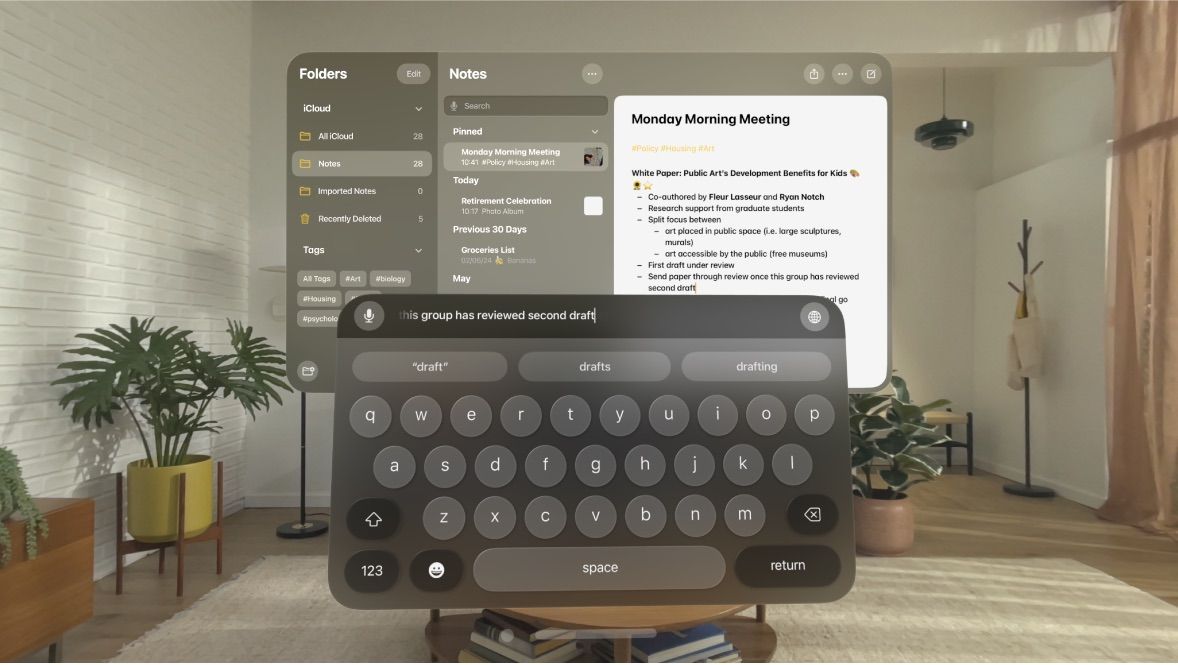
First, a bit about how text is input in visionOS — the operating system powering Apple Vision Pro. One of the most impressive innovations of Apple’s MR headset is its highly effective use of eye tracking.
Gaze direction serves as the primary method of user interaction with the visionOS interface. The tracking is so precise that it works even for the smallest interface elements — including the virtual keyboard.
visionOS uses a virtual keyboard and eye tracking to input text. Source
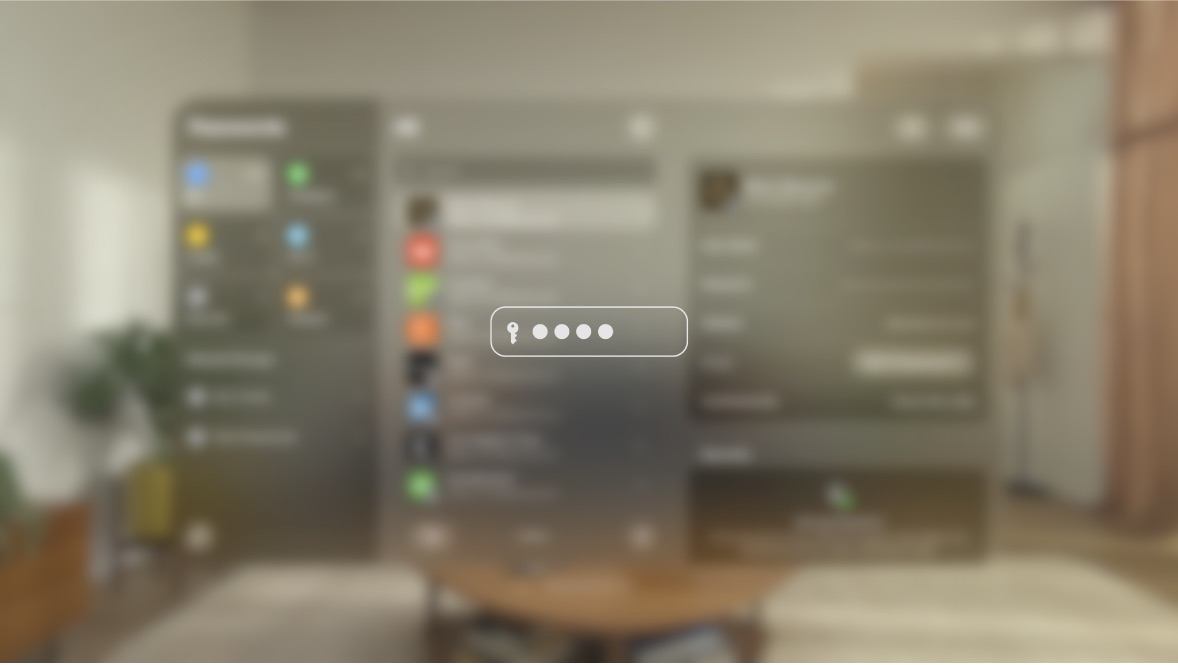
Although visionOS offers voice control, the virtual keyboard remains the primary text input method. For sensitive information such as passwords, visionOS provides protection against prying eyes: in screen-sharing mode, both the keyboard and the entered password are automatically hidden.
During screen sharing, visionOS automatically hides passwords entered by Vision Pro users. Source
Another key feature of Apple’s MR headset lies in its approach to video calls. Since the device sits directly on the user’s face, the standard front-camera option is no good for transmitting the user’s video image. On the other hand, using a separate external camera for video calls would be very un-Apple-like; plus, video-conference participants wearing headsets would look rather odd.
So Apple came up with a highly original technology that features a so-called virtual camera. Based on a 3D face scan, Vision Pro creates a digital avatar of the user (Apple calls it a Persona), which is what actually takes part in the video call. You can use your Persona in FaceTime and other video-conferencing apps.
By using lots of biometric data, the Persona digital avatar in visionOS looks truly lifelike. Source
The headset’s sensors track the user’s face in real-time, allowing the avatar to mimic head movements, lip movements, facial expressions, and so on.
For the GAZEploit researchers, the seminal feature of the Persona digital avatar is the use of data fed from the Vision Pro’s highly precise sensors to replicate the user’s eye movements with absolute pinpoint accuracy. And it was here that the team discovered a vulnerability enabling interception of input text.
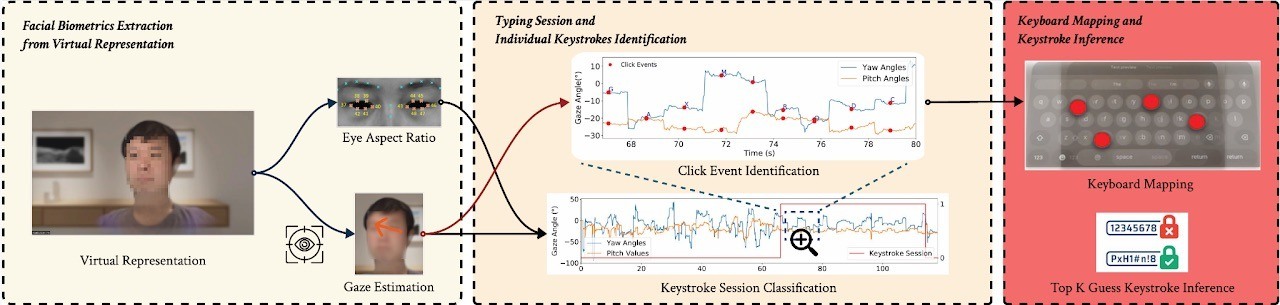
Here’s how GAZEploit works in principle — allowing an attacker to intercept text entered by an Apple Vision Pro user. Source
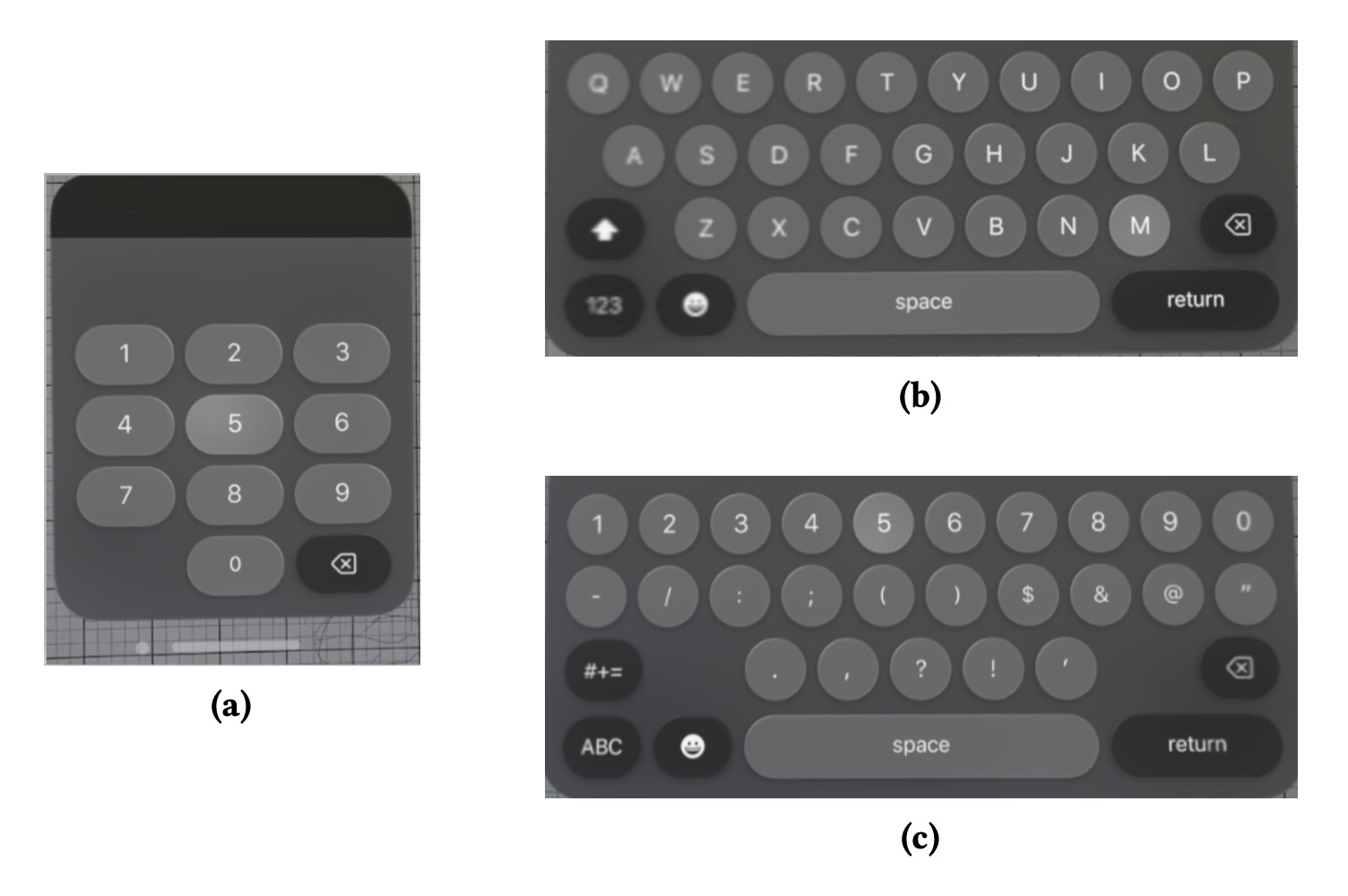
The attack’s core concept is quite simple: although the system carefully hides passwords entered during video calls, by tracking the user’s eye movements, mirrored by their digital avatar, a threat actor can reconstruct the characters entered on the virtual keyboard, or, rather, keyboards, as visionOS has three: passcode (PIN) keyboard, default QWERTY keyboard, and number and special character keyboard. This complicates the recognition process, since an outside observer doesn’t know which keyboard is in use.
visionOS actually has three different virtual keyboards: (а) for passcodes, (b) for letters, and (c) for numbers and special characters. Source
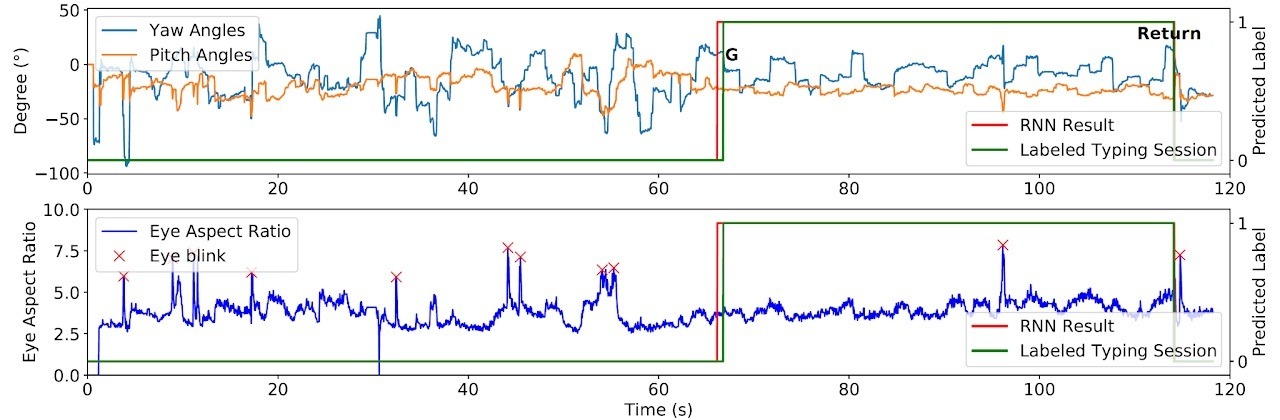
However, neural networks effectively automate the GAZEploit attack. The first stage of the attack uses a neural network to identify text-input sessions. Eye movement patterns during use of the virtual keyboard differ significantly from normal patterns: blink rates decrease, and gaze direction becomes more structured.
First, the neural network identifies when text is being entered on the virtual keyboard. Source
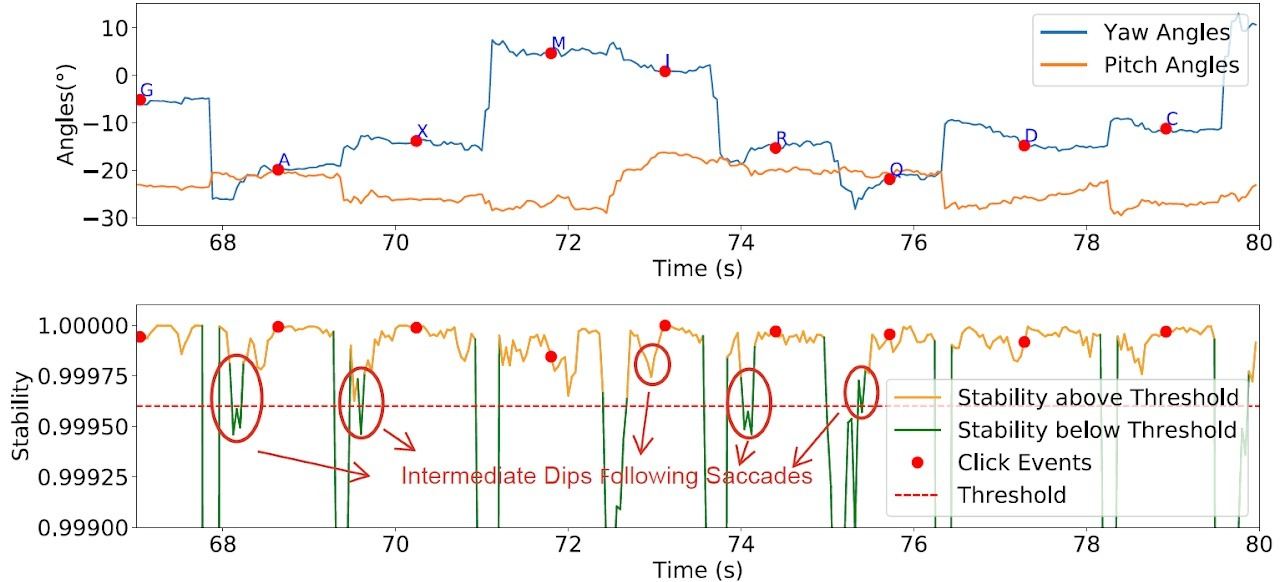
At the second stage, the neural network analyzes gaze stability changes to identify eye-based selection of characters, and uses characteristic patterns to pinpoint virtual key presses. Then, based on gaze direction, the system calculates which key the user was looking at.
Next, the neural network recognizes individual virtual keystrokes and the characters being entered. Source
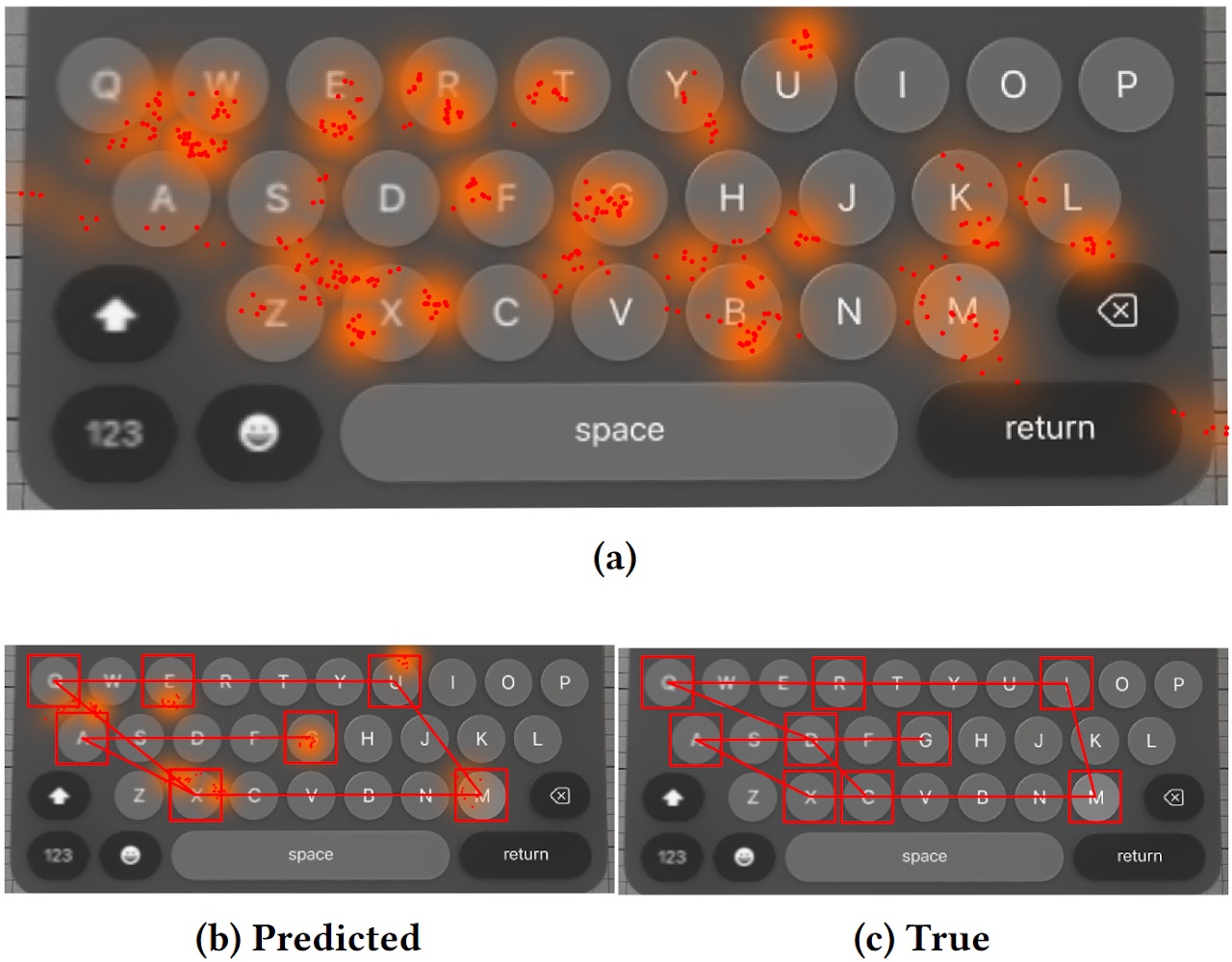
In actual fact, it’s all a bit more complicated than the graph above suggests. Calculations based on the avatar’s eye position generate a heatmap of probable points on the virtual keyboard where the user’s gaze might have landed during text entry.
Mapped gaze directions for keystroke inference of the demo attack: (a) adaptive virtual keyboard mapping, (b) predicted first guess keystrokes, (c) actual keystrokes. The accuracy isn’t perfect, but it’s no bad. Source
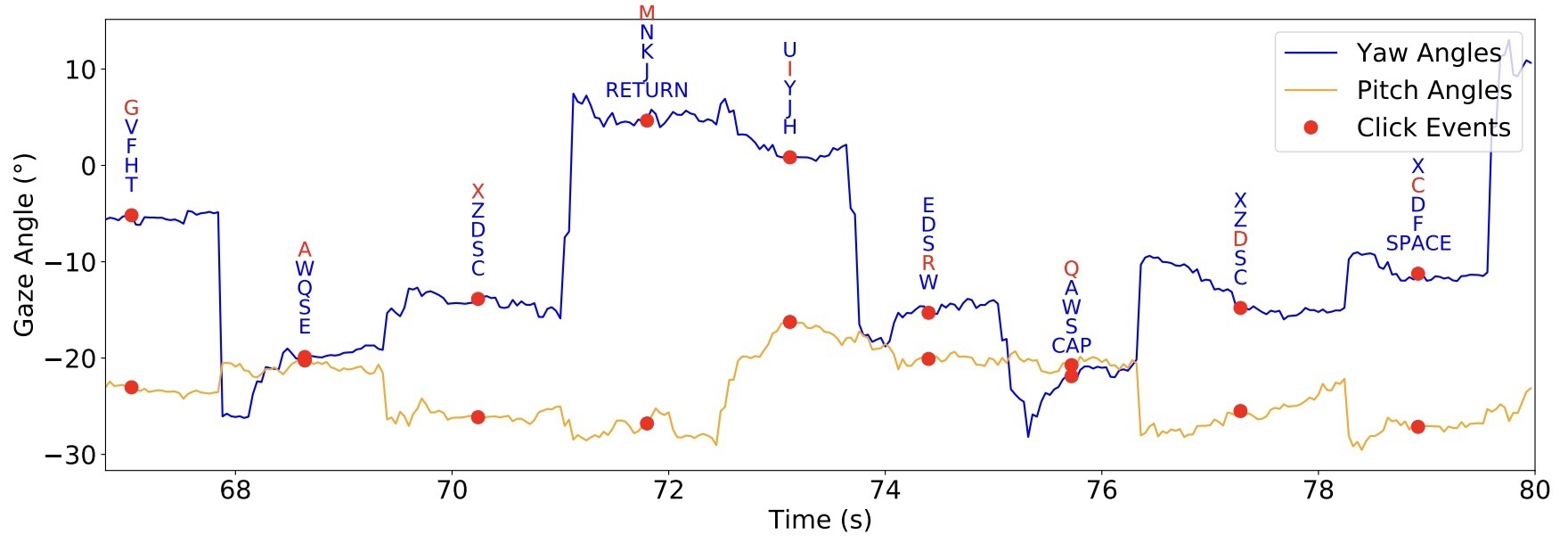
Then, the researchers’ model converts the collected information into a list of K virtual keys that were most likely “pressed” by the user. The model also provides for various data-entry scenarios (password, email address/link, PIN, arbitrary message), taking into account the specifics of each.
What’s more, the neural network uses a dictionary and additional techniques to improve interpretation. For example, due to its size, the spacebar is often a top-five candidate — producing many false positives that need filtering. The backspace key requires special attention: if the keystroke guess is correct, it means the previous character was deleted, but if it’s wrong, then two characters may get mistakenly discarded.
GAZEploit suggests the top-five most likely characters. Source
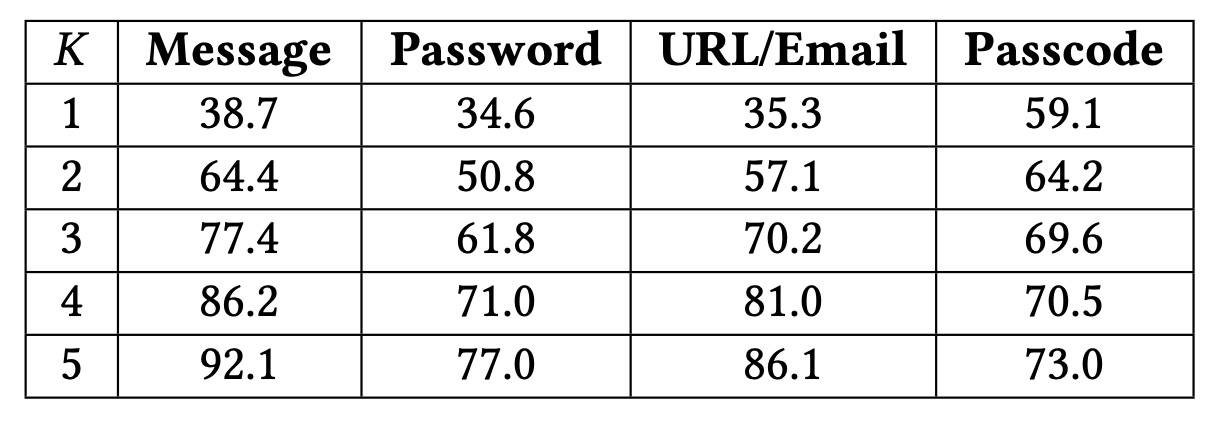
The researchers’ detailed error analysis shows that GAZEploit often confuses adjacent keys. At maximum precision (K=1), roughly one-third of entered characters are identified correctly. However, for groups of five most likely characters (K=5), depending on the specific scenario, the accuracy is already 73–92%.
The accuracy of GAZEploit recognition in various scenarios. Source
In practice, such accuracy means that potential attackers are unlikely to obtain the target password in ready-to-go form; but they can dramatically — by many orders of magnitude, in fact — reduce the number of attempts needed to brute-force it.
The researchers claim that for a six-digit PIN, it’ll only take 32 attempts to cover a quarter of all the most likely combinations. For a random eight-character alphanumeric password, the number of attempts is slashed from hundreds of trillions to hundreds of thousands (from 2.2×10¹⁴ to 3.9×10⁵, to be precise), which makes password cracking feasible even with a prehistoric Pentium CPU.
In light of this, GAZEploit could pose a serious enough threat and find practical application in high-profile targeted attacks. Fortunately, the vulnerability has already been patched: in the latest versions of visionOS, Persona is suspended when the virtual keyboard is in use.
Apple could conceivably protect users from such attacks in a more elegant way — by sprinkling some random distortions in the precise biometric data driving the digital avatar’s eye movements.
Regardless, Apple Vision Pro owners should update their devices to the latest version of visionOS — and breathe easily. One last thing, we advise them — and everyone else — to exercise caution when entering passwords during video calls: avoid it if you can, always use the strongest (long and random) character combinations possible, and use a password manager to create and store them.
Kaspersky official blog – Read More
Government-run water systems and other critical infrastructure are still at risk from state-sponsored actors, according to a renewed warning from the U.S. Cybersecurity and Infrastructure Security Agency.
CISA released an advisory last week on the matter of days after a small water treatment facility in Kansas was forced into manual operations after a cyber attack.
I feel like this is just the latest in a string of warnings that we’ve been talking about since the Colonial Pipeline attack in 2021 that forced a gasoline shortage across the Eastern U.S. We’ve been discussing the importance of defending critical infrastructure for years now, so what’s new now?
For starters, it seems like the frequency of these attacks seems to be on the rise. And many efforts to regulate cybersecurity policies and procedures in the industry have thus far fallen flat.
The White House is reportedly working on rolling out a second wave of cybersecurity recommendations for water treatment facilities on the back of the attack in Kansas that affected the public water supply of 11,000 people. Although the cyber attack did not actually affect anyone from getting their water, it does raise the question of how much of an issue this could be if a state-sponsored actor were to target a facility in a town with a larger population, or if there weren’t backup plans in place to operate the facility manually.
The U.S. Environmental Protection Agency (EPA) said last year that it had to pull a memo outlining cybersecurity standards at water treatment plants because of constant legal action from state and federal lawmakers and private water companies. And the American Water Works Association (a non-profit lobbying organization representing more than 50,000 members) has advocated for facilities and groups like the AWWA to write their own cybersecurity policies rather than relying on the U.S. government.
All of that is to say, despite what lessons we thought we learned from Colonial Pipeline, none of those lessons have been able to be put into practice, and we’re still where we were with cybersecurity policies and regulations three years ago.
Despite urging from the industry and some lawmakers, I’ve yet to see these groups write any of their own policies, so even if they have that power, they don’t seem to be taking advantage of it. So when CISA puts out this type of alert again in a few months after whatever future incident lies ahead, I would expect to see more action from all parties involved rather than another round of words warning that attacks can, and will, happen.
Talos has recently observed an attack leading to the deployment of a MedusaLocker ransomware variant known as “BabyLockerKZ.” This actor has been active since at least late 2022 and targets organizations worldwide, although the number of victims was higher than average in EU countries until mid-2023 and, since then, in South American countries. We assess with medium confidence that the actor is financially motivated, likely working as an IAB or an affiliate of a ransomware cartel.
The actor behind these attacks seems to be particularly active, infecting more than 100 organizations per month, according to Talos telemetry. This reveals the professional and highly aggressive nature of the attacks and is coherent with the activity we would expect from an IAB or ransomware affiliate. As with any ransomware, BabyLockerKZ looks to encrypt targets’ files and lock them down until the target pays the request ransom.
Talos has released several new Snort rules and ClamAV signatures that detect the activity of this group and BabyLockerKZ. This group is also known to use several publicly available tools in their attacks, such as Mimikatz, which are well-known to the security community at this point. For more on living-off-the-land binaries (LoLBins) that attackers like this one are increasingly using, read our blog post here.
International law enforcement agencies worked together to arrest and unmask four individuals believed to be associated with the LockBit ransomware group. As part of this campaign, investigators have also linked one of the LockBit members to Evil Corp, a Russian-backed cybercrime gang. At a press conference announcing the arrests, representatives from the U.K.’s National Crime Agency said that Evil Corp maintained a “privileged” relationship with the Russian government and was often asked to carry out targeted cyber attacks against NATO countries. LockBit is traditionally associated with financially motivated ransomware attacks targeting private companies, regardless of the country in which they reside. Europol, the U.K. NCA, the U.S. FBI and Japan’s National Police have also worked together to create and release a decryptor that can unlock files affected by the LockBit ransomware. The same agencies have been working since last year to target and seize assets and servers belonging to LockBit. The threat actor has taken credit for several major attacks over the past several years, including those targeting Boeing, Volkswagen, multiple major international ports and government-owned computers in Fulton County, Georgia. (Europol, TechCrunch)
The latest version of the U.S.’s National Institute of Standards and Technology’s password recommendations drop complexity in favor of length. NIST’s latest version of its Password Guidelines removes the recommendations that passwords use a mixture of character types and that they be changed often. Instead, the draft states that credential service providers (CSPs) recommend users create passwords between 15 and 64 characters that may include ASCII or Unicode characters. The previous version of the NIST standards led many users to adopt easy-to-guess passwords such as “Password1234!” or store the complicated passwords in easy-to-access places, such as written down on a piece of paper near their computer. CSPs are also instructed to drop knowledge-based authentication or security questions when selecting passwords. NIST standards are important because they formalize principles widely adopted by the U.S. government and major technology companies like Microsoft and Google. The latest draft also states that users only need to change their passwords in the event of a publicly reported data breach. (Infosecurity Magazine, Dark Reading)
A vulnerability in a web app from car manufacturer Kia could allow an attacker to view a car’s license plate, unlock the doors, and even remotely start the ignition. The since-patched vulnerability in Kia’s web portal could allow attackers to essentially build and deploy their own web app and reassign control of the internet-connected features of most modern Kia vehicles. The vulnerability could have allowed an adversary to immediately ping the location of a targeted vehicle, process its license plate number, and even honk the horn. This is the second such vulnerability the group of researchers has disclosed to a Hyundai-owned company in the past two years. The vulnerability highlights the risk that modern vehicles come with, many of which rely on internet connectivity for some of their features or interface with web apps, websites or mobile phone apps. A proof of concept from the researchers included a dashboard that could allow an attacker to type in a license plate number and then retrieve the owner’s personal information, eventually adding themselves as an “owner” of the car and executing commands on the vehicle. (Wired, Security Week)
Resurgence of Spam: Cisco Talos Sound Alarm on New Tactics Critical RCE vulnerability found in OpenPLC Simple Mail Transfer Pirates: How threat actors are abusing third-party infrastructure to send spam
MITRE ATT&CKcon 5.0 (Oct. 22 – 23)
McLean, Virginia and Virtual
Nicole Hoffman and James Nutland will provide a brief history of Akira ransomware and an overview of the Linux ransomware landscape. Then, morph into action as they take a technical deep dive into the latest Linux variant using the ATT&CK framework to uncover its techniques, tactics and procedures.
it-sa Expo & Congress (Oct. 22 – 24)
Nuremberg, Germany
White Hat Desert Con (Nov. 14)
Doha, Qatar
misecCON (Nov. 22)
Lansing, Michigan
Terryn Valikodath from Cisco Talos Incident Response will explore the core of DFIR, where digital forensics becomes detective work and incident response turns into firefighting.
SHA 256: 47ecaab5cd6b26fe18d9759a9392bce81ba379817c53a3a468fe9060a076f8ca
MD5: 71fea034b422e4a17ebb06022532fdde
Typical Filename: VID001.exe
Claimed Product: N/A
Detection Name: RF.Talos.80
SHA 256: 76491df69a26019139ac11117cd21bf5d0257a5ebd3d67837f558c8c9c3483d8
MD5: b209df2951e29ab5eab4009579b10b8d
Typical Filename: FileZilla_3.67.1_win64_sponsored2-setup.exe
Claimed Product: FileZilla
Detection Name: W32.76491DF69A-95.SBX.TG
SHA 256: c20fbc33680d745ec5ff7022c282a6fe969c6e6c7d77b7cfac34e6c19367cf9a
MD5: 3bc6d86fc4b3262137d8d33713ed6082
Typical Filename: 8c556f0a.dll
Claimed Product: N/A
Detection Name: Gen:Variant.Lazy.605353
SHA 256: f0d7a2bb0c5db162332418747ba4987027b8a746b24c919a24235ff3b70d25e3
MD5: 0d849044612667362bc88780baa1c1b7
Typical Filename: CryptX.dll
Claimed Product: N/A
Detection Name: Gen:Variant.Lazy.605353
SHA 256: 331fdf5f1f5679a6f6bb0baee8518058aba8081ef8f96e57fa3b74291fcbb814
MD5: f23b90fc9bc301baf3e399e189b6d2dc
Typical Filename: B.dll
Claimed Product: N/A
Detection Name: Gen:Variant.Lazy.605353
Cisco Talos Blog – Read More
For years, securing a company’s systems was synonymous with securing its “perimeter.” There was what was safe “inside” and the unsafe outside world. We built sturdy firewalls and deployed sophisticated detection systems, confident that keeping the barbarians outside the walls kept our data and systems safe.
The problem is that we no longer operate within the confines of physical on-prem
The Hacker News – Read More