Weekly Industrial Control System (ICS) Vulnerability Intelligence Report: New Flaws Affecting Siemens, Schneider Electric, and More 

Overview 

Cyble Research & Intelligence Labs (CRIL) has shared new details about weekly industrial control systems (ICS) vulnerabilities. These vulnerabilities were issued by the Cybersecurity and Infrastructure Security Agency (CISA) from October 15 to October 21, 2024. The report outlines critical security concerns affecting various vendors and highlights the urgency for organizations to address these vulnerabilities promptly.  

During the reporting period, CISA released seven security advisories targeting ICS, which collectively identified 13 distinct vulnerabilities across several companies, including Siemens, Schneider Electric, Elvaco, Mitsubishi Electric, HMS Networks, Kieback&Peter, and LCDS – Leão Consultoria e Desenvolvimento de Sistemas Ltda ME. Notably, Elvaco disclosed four vulnerabilities, while Kieback&Peter reported three.  

Among the highlighted vulnerabilities, particular attention is drawn to those affecting the Elvaco CMe3100 and Kieback&Peter DDC4000 Series. The Elvaco CMe3100 is a compact and intelligent communication gateway designed to remotely read energy meters. Cyble’s ODIN scanner has identified 1,186 instances of the CMe3100 exposed to the internet, with a large concentration of these devices in Sweden.  

The Kieback&Peter DDC4000 Series comprises digital controllers utilized primarily in building automation systems for HVAC (heating, ventilation, and air conditioning) management. The scanner detected eight instances of these controllers that require urgent attention. 

Vulnerability Overview 

The vulnerabilities reported by Cyble Research & Intelligence Labs (CRIL) provide critical insights for organizations aiming to prioritize their patching efforts.   

CVE-2024-3506: Among the key vulnerabilities identified, CVE-2024-3506 affects Siemens’ Siveillance Video Camera, with all versions prior to V13.2 vulnerable to a medium-severity classic buffer overflow, impacting physical access control systems and CCTV.   

CVE-2023-8531: Schneider Electric’s Data Center Expert, specifically versions 8.1.1.3 and prior, is susceptible to CVE-2023-8531, which involves high-severity improper verification of cryptographic signatures, affecting control systems such as DCS, SCADA, and BMS.  

CVE-2024-49396 and CVE-2024-49398: Elvaco’s CMe3100, version 1.12.1, is highlighted with multiple vulnerabilities, including CVE-2024-49396 for insufficiently protected credentials and CVE-2024-49398 for an unrestricted upload of files with dangerous types; both vulnerabilities are classified as high and critical respectively, posing risks to gateway and remote access systems.   

CVE-2024-41717: Kieback&Peter’s DDC4002 and related versions are affected by CVE-2024-41717, which presents a critical path traversal vulnerability impacting field controllers and IoT devices.   

CISA’s recent advisories reveal a predominance of such high-severity vulnerabilities within the ICS sector, highlighting the need for organizations to remain vigilant and implement effective mitigation strategies in response to these emerging threats. 

Recommendations for Mitigation 

Cyble emphasizes several key recommendations to enhance organizational cybersecurity: 


Organizations should closely track security advisories and alerts issued by vendors and relevant authorities to stay informed about potential vulnerabilities. 


Implement a risk-based vulnerability management strategy to minimize the likelihood of exploitation, while adopting a Zero-Trust security framework. 


Threat intelligence analysts should play a crucial role in the patch management process by continuously monitoring critical vulnerabilities identified in the CISA’s Known Exploited Vulnerabilities (KEV) catalog. 


Develop better patch management strategy that encompasses inventory management, assessment, testing, deployment, and verification of patches. Automation of these processes can enhance efficiency and consistency. 


Effective network segmentation is essential to limit attackers’ ability to move laterally within critical environments. 


Regular audits, vulnerability assessments, and penetration testing exercises are critical for identifying and addressing security gaps. 


Establishing ongoing monitoring and logging capabilities allows for early detection of network anomalies and potential threats. 


Leveraging Software Bill of Materials (SBOM) can improve visibility into the components and libraries in use, along with their associated vulnerabilities. 

Conclusion 

The ISC vulnerability report highlights the pressing need for organizations to address the high-severity vulnerabilities identified by the Cybersecurity and Infrastructure Security Agency.  

With significant risks affecting major vendors like Siemens and Schneider Electric, it is crucial for businesses to adopt proactive measures, including patch management strategies and effective network segmentation.  

By staying vigilant and responsive to these vulnerabilities, organizations can better protect their critical infrastructure and enhance their overall cybersecurity posture. 

The post Weekly Industrial Control System (ICS) Vulnerability Intelligence Report: New Flaws Affecting Siemens, Schneider Electric, and More  appeared first on Cyble.

Blog – Cyble – ​Read More

New Fortinet Zero-Day Exploited for Months Before Patch

A Fortinet zero-day tracked as CVE-2024-47575 and named FortiJump has been exploited since at least June 2024.

The post New Fortinet Zero-Day Exploited for Months Before Patch appeared first on SecurityWeek.

SecurityWeek – ​Read More

What Is PCI Compliance? A Simple Guide for Businesses

Safeguard your customers’ card data using these industry-standard security protocols.

Security | TechRepublic – ​Read More

Notifications in Threat Intelligence Lookup 

We are thrilled to announce a significant enhancement to Threat Intelligence Lookup — Notifications. The new functionality allows users to subscribe to real-time notifications for new results related to their specified queries.

Tracking emerging and evolving cyber threats has never been easier.

What Are Lookup Notifications? 

Lookup Notifications enable users to receive timely updates on relevant Indicators of Compromise (IOCs), Indicators of Attack (IOAs), and Indicators of Behavior (IOBs) that matter to their organizations. 

Use TI notifications to stay updated on your query results

Previously, users needed to perform regular searches to receive new results, risking the chance of missing important updates.

Collect threat intel on the latest malware and phishing campaigns with TI Lookup 


Get 20 free requests


With Lookup Notifications, users can now subscribe to specific queries. When new results appear, a notification will be displayed in the dashboard — new results will be highlighted in green, making it easy to identify fresh information at a glance. 

New results for the queries are highlighted in green

If the number of new results exceeds 1,000, the subscription will pause, alerting you to review the accumulated results before proceeding. This ensures that you stay informed without being overwhelmed by excessive data. 

Key Benefits of Lookup Notifications 

Real-Time Updates 

Regularly receive fresh threat data of your interest. The service monitors results and stores updates automatically, ensuring you never miss critical information. 

Global Insights 

Quickly track changes in IOCs, IOAs, and IOBs extracted from public samples analyzed in ANY.RUN’s Interactive Sandbox by over 500,000 security professionals. Our data is sourced from a diverse community, ranging from freelancers to large corporations, providing comprehensive coverage of potential threats. 

Enhanced Monitoring 

Monitor the frequency of IOCs, IOAs, and IOBs that are of interest to you. If you identify something suspicious in your SIEM, you can verify it against TI Lookup’s database. 

Proactive Defense 

Strengthen your organization’s security by enhancing your detection rules, enriching your data with relevant indicators, and staying informed about changing threats. This proactive approach enables better threat management and response strategies. 

Learn to Track Emerging Cyber Threats

Check out expert guide to collecting intelligence on emerging threats with TI Lookup


How to Use Lookup Notifications 

Lookup Notifications are available for all paid users. Subscribing to notifications is straightforward: you can easily add or remove specific queries from your notifications by clicking the bell to the right of the search box. 

Save the query by pressing the bell button

You can also unsubscribe from the query, pin, delete or mark it as viewed by clicking three dots near subscription in your TI dashboard. 

Press the three dots, and you will see all available options for the query

Each update subscription uses only a single request from your total quota. All additional updates collected under this subscription do not consume extra search requests, allowing for efficient use of your resources. 

Wrapping Up 

With the introduction of Lookup Notifications, ANY.RUN‘s TI Lookup becomes a powerful tool not just for operational investigations but also for strategic planning. By enabling real-time alerts and streamlined monitoring, we are committed to helping your organization strengthen resilience against evolving risks.

About ANY.RUN  

ANY.RUN helps more than 500,000 cybersecurity professionals worldwide. Our interactive sandbox simplifies malware analysis of threats that target both Windows and Linux systems. Our threat intelligence products, TI LookupYARA Search and Feeds, help you find IOCs or files to learn more about the threats and respond to incidents faster.  

With ANY.RUN you can: 

Detect malware in seconds

Interact with samples in real time

Save time and money on sandbox setup and maintenance 

Record and study all aspects of malware behavior

Collaborate with your team 

Scale as you need

Request free trial → 

The post Notifications in Threat Intelligence Lookup  appeared first on ANY.RUN’s Cybersecurity Blog.

ANY.RUN’s Cybersecurity Blog – ​Read More

Security and privacy settings in adidas Running | Kaspersky official blog

As we’ve discussed before, one does not simply install a fitness tracking app and start using it straight away without first configuring the privacy settings both on the phone and in the app itself. With default settings, these apps often share full details of your workouts with the entire internet, including your precise location. And criminals and fraudsters can use this data for their nefarious purposes.

If you care even in the slightest about your privacy, check out our previously published guides for general smartphone settings and other popular fitness apps: Strava, Nike Run Club, and MapMyRun. Today’s post is for all fans of the famous three stripes: we’ll be setting up privacy in the adidas Running app (available for Android and iOS).

Formerly known as Runtastic, this fitness app now belongs to Europe’s largest sportswear manufacturer and is simply called adidas Running. While adidas Running doesn’t offer as granular privacy controls as, say, Strava, it’s still crucial to make sure everything is configured correctly.

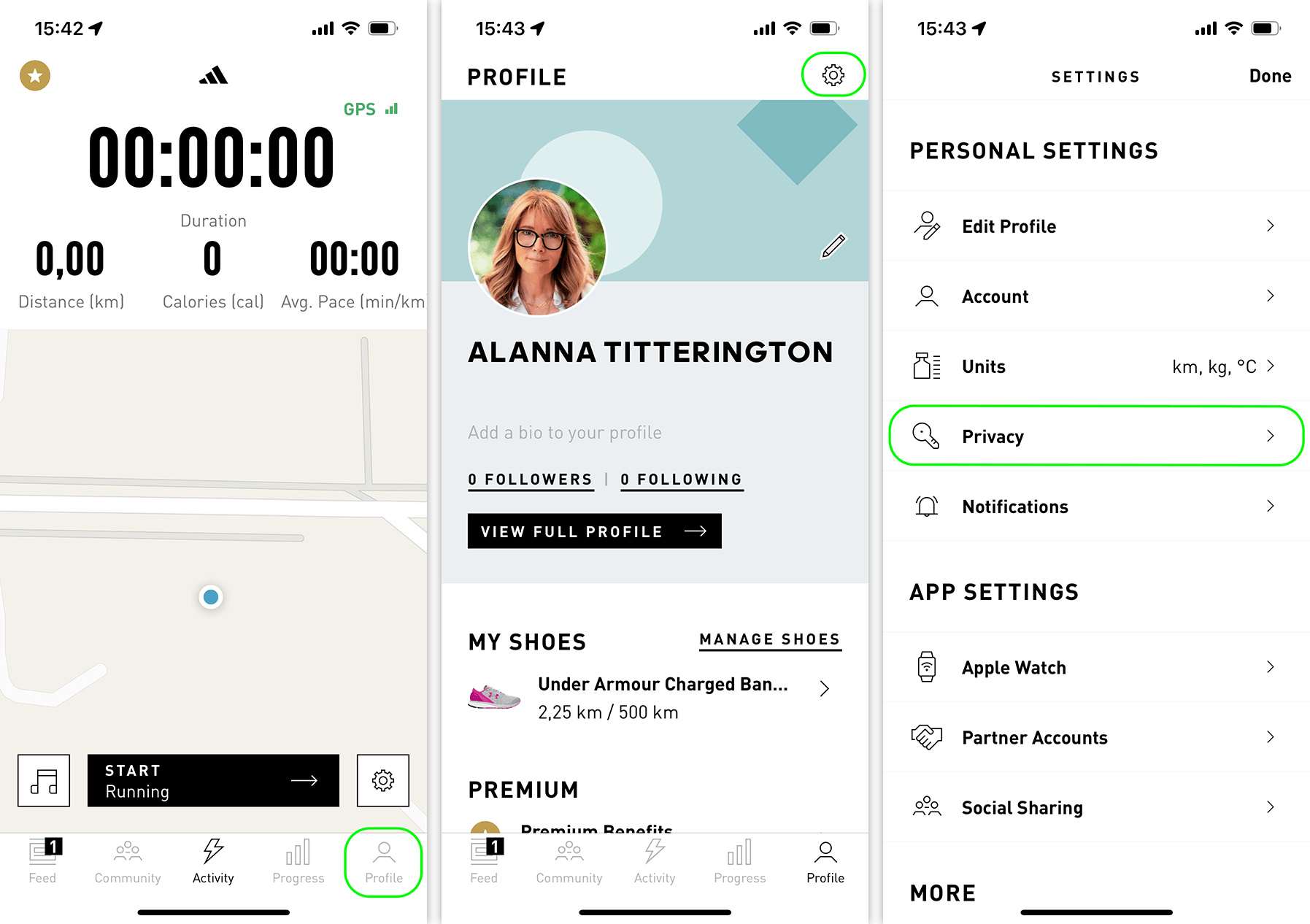
To access the privacy settings in adidas Running, tap Profile in the bottom right corner, then the cog icon in the top right, then select Privacy.

Where to find the privacy settings in adidas Running (Runtastic): Profile → Settings → Privacy

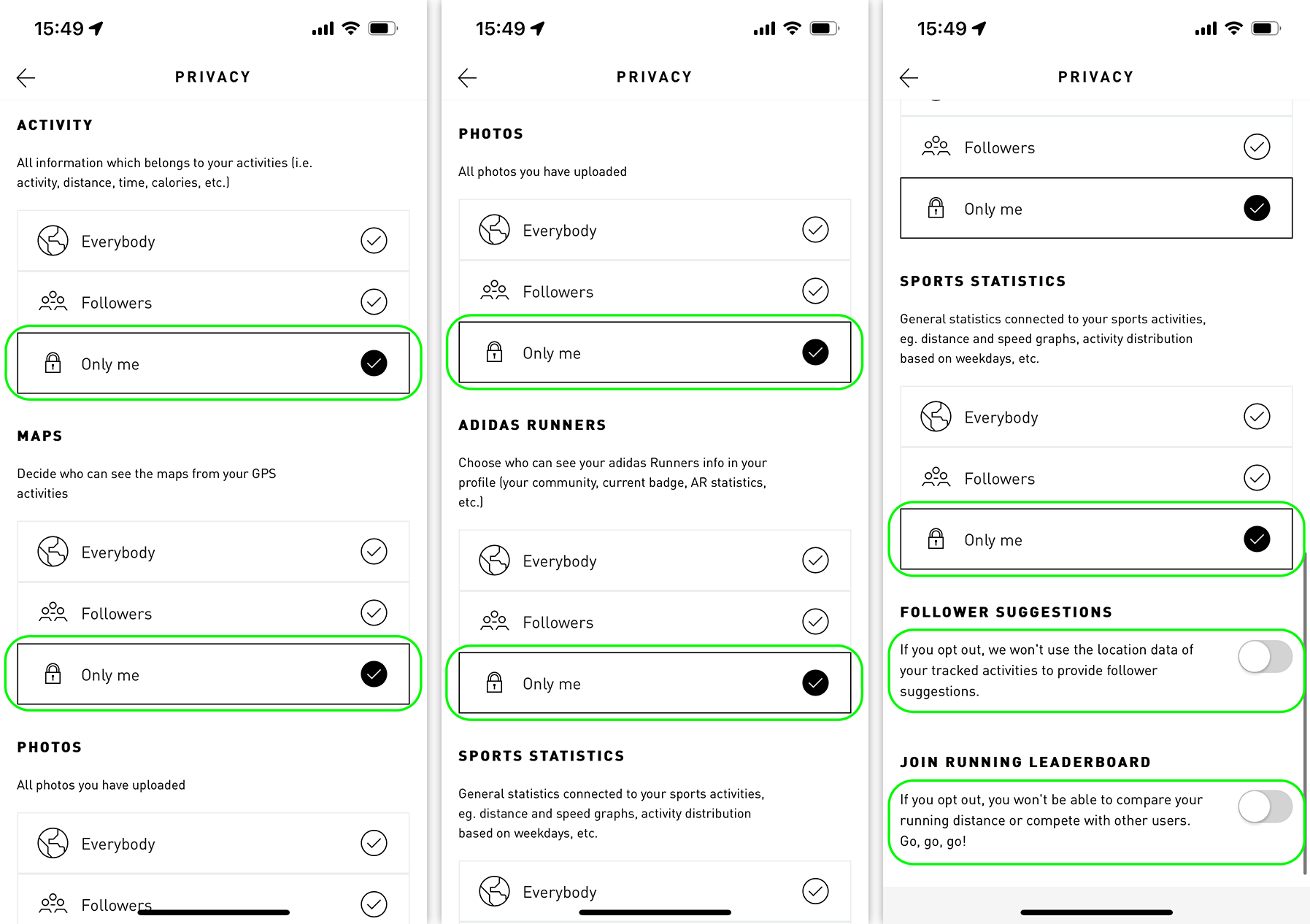
The first thing you’ll want to check is the Maps section (who can see your maps) — make sure it’s set to either Followers or, even better, Only me.

Next, do the same for Activity (who can see your activity) — again, select either Followers or Only me. The remaining settings are slightly less critical, but it’s still a good idea to ensure they’re also set to at least Followers or, ideally, Only me.

Recommended privacy settings in adidas Running (Runtastic)

I also recommend toggling off the switches at the bottom of the page next to Follower suggestions and Join running leaderboard. The app won’t be bothering you as much.

Finally, consider disabling excessive notifications from adidas Running. Go back to Settings, select Notifications, and go through the (rather extensive) list of options.

If you decide to stop using adidas Running altogether, remember to delete your profile data. To do this, go to SettingsAccount, tap the big red Delete account button, and follow the prompts.

If you use other fitness apps to track your workouts, you can set their privacy settings using our guides:

Strava
Nike Run Club
MapMyRun
(ASICS Runkeeper – still to come)

You can also learn how to configure privacy in other apps — from social networks to browsers — on our website Privacy Checker.

And Kaspersky Premium will maximize your privacy protection and shield you from digital identity theft on all your devices.

Don’t forget to subscribe to our blog to stay ahead of scammers with more guides and helpful articles.

Kaspersky official blog – ​Read More

Penn State Settles for $1.25M Over Failure to Comply With DoD, NASA Cybersecurity Requirements

The Penn State university has agreed to pay $1.25 million to settle alleged failure to meet cybersecurity requirements for DoD and NASA contracts.

The post Penn State Settles for $1.25M Over Failure to Comply With DoD, NASA Cybersecurity Requirements appeared first on SecurityWeek.

SecurityWeek – ​Read More

New Scoring System Helps Secure the Open Source AI Model Supply Chain

AI models from Hugging Face can contain similar hidden problems to OSS downloads from repositories such as GitHub.

The post New Scoring System Helps Secure the Open Source AI Model Supply Chain appeared first on SecurityWeek.

SecurityWeek – ​Read More

Talos IR trends Q3 2024: Identity-based operations loom large

Threat actors are increasingly conducting identity-based attacks across a range of operations that are proving highly effective, with credential theft being the main goal in a quarter of incident response engagements.

These attacks were primarily facilitated by living-off-the-land binaries (LoLBins), open-source applications, command line utilities, and common infostealers, highlighting the relative ease at which these operations can be carried out. In addition to outright credential harvesting, we also saw password spraying and brute force attacks, adversary-in-the-middle (AitM) operations, and insider threats, underscoring the variety of ways in which actors are compromising users’ identities.  

Identity-based attacks are concerning because they often involve actors launching internal attacks from a compromised, valid account–making such activity difficult to detect. Moreover, once account compromise is achieved, an actor can carry out any number of malicious activities, including account creation, escalating privileges to gain access to more sensitive information, and launching social engineering attacks, like business email compromise (BEC), against other users on the network. 

Threats against identity 

This quarter, Cisco Talos Incident Response (Talos IR) has responded to a growing number of engagements in which adversaries have leveraged password-spraying campaigns to obtain valid usernames and passwords to facilitate initial access. This quarter, 25 percent of incidents involved password spraying and/or brute force attempts to steal valid credentials. This method involves an adversary using a password, or a small list of commonly used passwords, against many different accounts on a network, a strategy that helps avoid account lockouts that would typically occur when brute-forcing a single account with many passwords. Although adversaries have been using password-spraying attacks for credential access for years, the activity illustrates that organizations should continue to stress the importance of multi-factor authentication (MFA) and strong password policies to limit unauthorized attempts.  

Talos IR observed AitM phishing attacks play out in a number of ways this quarter, where adversaries attempted to trick users into entering their credentials into fake login pages. In one engagement, Talos IR investigated a phishing case where, after clicking a malicious link in a phishing email, the victim was redirected to a site prompting them to enter their credentials, and subsequently approved an MFA request. In another engagement, an initial phishing email redirected a user to a page that simulates a Microsoft O365 login and MFA portal, capturing the user’s credentials and subsequently logging in on their behalf. The first login by the adversary was seen 20 minutes after the initial phishing email, highlighting the speed, ease, and effectiveness of these operations. 

Ransomware 

Ransomware, pre-ransomware, and data theft extortion – in which cybercriminals steal and threaten to release victims’ files or other data without using any encryption mechanisms — accounted for nearly 40 percent of engagements this quarter. Talos IR observed RansomHub, RCRU64, and DragonForce ransomware variants for the first time this quarter, while also responding to previously seen ransomware variants, such as BlackByte, Cerber, and BlackSuit. 

A third of these engagements involved exploitation of known vulnerabilities that are consistently leveraged by ransomware operators/affiliates to deploy ransomware, according to public reporting. For example, in one BlackByte ransomware engagement, we observed an admin account created and added to an “ESX Admin” group as part of exploitation of the ESXi hypervisor vulnerability, CVE-2024-37085. This vulnerability, which has reportedly been exploited by other ransomware operators, involves a domain group whose members are granted full administrative access to the ESXi hypervisor by default without proper validation. 

As part of a years-long trend in greater democratization of ransomware adversaries, we continue to see new variants and ransomware operations emerging. In an incident involving the RCRU64 ransomware –a malware family that has received limited public reporting – the adversary used stolen credentials on an accidentally exposed remote desktop protocol (RDP) account to gain initial access. The threat actor then performed a dump of all domain credentials using publicly available tools, such as fgdump and pwdump, to steal Windows hashes. The threat actor also deployed custom tools, including “saxcvz.exe” and “close.exe”, to kill processes and close SQL servers running on the host, respectively. Open-source tools such as Mimikatz, Advanced Port Scanner, and IObit Unlocker were also used to facilitate the compromise. Of note, Talos has not previously seen IObit Unlocker used in a ransomware incident, though the tool has been used in Play ransomware attacks, according to the U.S. Cybersecurity and Infrastructure Security Agency (CISA). 

Looking forward: While there are constantly new ransomware groups entering the threat landscape, some established operations still pose a risk and should not be ignored. We saw this most recently last quarter with RansomHub, where Talos IR not only observed RansomHub actors in two separate incidents, but also using two different extortion models: double-extortion and data theft extortion. For example, we observed RansomHub affiliates conduct data theft extortion, where affiliates steal and threaten to release data without deploying ransomware or using any encryption mechanisms, as well as leverage a double-extortion model by deploying ransomware and encrypting systems and exfiltrating data to extort victims, respectively. In late August, this activity coincided with a CISA advisory on the RansomHub ransomware group, which disseminated indicators of compromise (IOCs) and tactics, techniques and procedures (TTPs) identified as recently as August. While RansomHub was first discovered in February 2024, the recent Talos IR incidents and CISA advisory warrants that this continues to be a ransomware threat to monitor. 

Targeting 

Organizations in the education, manufacturing, and financial services verticals were most affected this quarter, where combined, these sectors accounted for more than 30 percent of compromises. This finding is in line with targeting trends from Q1 2024 (January – March), where the education and manufacturing companies were the most targeted. 

Initial access 

For the fourth consecutive time in over a year, the most observed means of gaining initial access was the use of valid accounts, accounting for 66 percent of engagements when initial access could be determined. This is a slight increase compared to the previous quarter (60 percent). Additionally, 20 percent of engagements featured adversaries exploiting or leveraging vulnerable and public-facing applications for initial access. 

Looking forward: Talos IR identified a sophisticated actor targeting a critical infrastructure entity leveraging several known vulnerabilities in internet-facing web servers and two F5 BIG-IP network appliances, consistent with Talos’ reporting on state-sponsored and other sophisticated adversaries’ increased interest in targeting network devices. We assess that networking equipment will remain an attractive target due to the large attack surface it presents and potential access to victim networks it can offer, highlighting the dichotomy of high value and weak security in these devices that makes them a prime target for exploitation. This activity is another reminder of the importance of patching systems, especially network-facing devices. 

Security weaknesses 

We continue to see a significant number of compromises that could have been prevented with the presence of certain security fundamentals, like MFA and proper configuration of endpoint detection products. In nearly 40 percent of engagements, misconfigured MFA, lack of MFA, and MFA bypass accounted for the top observed security weaknesses this quarter. Additionally, in 100 percent of the engagements that involved threat actors sending phishing emails to victims, MFA was bypassed or not fully enabled, while over 20 percent of incidents where ransomware was deployed did not have MFA enabled on VPNs. 

Other security weaknesses, which we commonly see every quarter, involved improper endpoint detection and response (EDR) or security solution misconfigurations. For example, lack of EDR on all systems and/or poorly configured EDR solutions accounted for nearly 30 percent of incidents this quarter. Additionally, nearly 20 percent of engagements this quarter had misconfigured or not fully enabled network security solutions. 

In an incident involving SocGholish, a drive-by malware framework, Talos IR recommended configuring Cisco Umbrella properly to block unwanted content, which could have helped to prevent this attack. Blocking “uncategorized” websites in Cisco Umbrella’s “Web Content Categories” will help proactively mitigate suspicious or malicious activity. 

Top-observed MITRE ATT&CK techniques 

The table below represents the MITRE ATT&CK techniques observed in this quarter’s Talos IR engagement. Given that some techniques can fall under multiple tactics, we grouped them under the most relevant tactic in which they were leveraged. Please note, this is not an exhaustive list. 

Key findings from the MITRE ATT&CK appendix include:  

In terms of identity-based attacks, we consistently saw adversaries leveraging reconnaissance tactics to identify/gather credentials and then use those valid accounts to gain initial access. This also contributes to the growing trend this quarter in which adversaries are leveraging password spraying to obtain credentials. Nearly 20 percent of engagements this quarter featured proxy usage for command and control (C2). This activity included tools such as the Fast Reverse Proxy (FRPC) to establish a connection, or the Neo-reGoerg proxy tool to set up a SOCKS proxy. In a significant shift compared to previous quarters, we saw a decrease in adversary usage of remote access software, such as AnyDesk. Remote access software was used in less than 5 percent of engagements this quarter, compared to 35 percent last quarter (Q2 2024), where these tools provide the attacker an ability to control a target computer remotely. 

Tactic

Technique

Example

Initial Access (TA0001)

T1078 Valid Accounts

Adversary leveraged stolen or compromised credentials

Reconnaissance (TA0043)

T1592 Gather Victim Host Information

Text file contains details about host

Persistence (TA0003)

T1136 Create Account

Created a user to add to the local administrator’s group

Execution (TA0002)

T1059.001 Command and Scripting Interpreter: PowerShell

Executes PowerShell code to retrieve information about the client’s Active Directory environment

Discovery (TA0007)

T1046 Network Service Discovery

Use a network or port scanner utility

Credential Access (TA0006)

T1003 OS Credential Dumping

Deploy Mimikatz and publicly available password lookup utilities

Privilege Escalation (TA0004)

T1484 Domain Policy Modification

Modify GPOs to execute malicious files

Lateral Movement (TA0008)

T1021.002 Remote Services: SMB / Windows Admin Shares

Adversaries may abuse valid accounts using SMB to move laterally in a target environment.

Defense Evasion (TA0005)

T1562.001 Impair Defenses: Disable or Modify Tools

Adversaries may disable or uninstall security tools to evade detection

Command and Control (TA0011)

T1105 Ingress Tool Transfer

Adversaries may transfer tools from an external system to a compromised system

Impact (TA0040)

T1486 Data Encrypted for Impact

Deploy Hive ransomware and encrypt critical systems

Exfiltration (TA0010)

T1048.003 Exfiltration Over Alternative Protocol: Exfiltration Over Unencrypted Non-C2 Protocol

Use WinSCP for potential exfiltration of system information

Collection (TA0009)

T1074 Data Staged

Adversary collected data in a central location prior to exfiltration

Software/Tool

S0357 Impacket

An open-source collection of modules written in Python for programmatically constructing and manipulating network protocols

Cisco Talos Blog – ​Read More

Cisco Patches Vulnerability Exploited in Large-Scale Brute-Force Campaign

Cisco has released patches for multiple vulnerabilities in ASA, FMC, and FTD products, including an exploited flaw.

The post Cisco Patches Vulnerability Exploited in Large-Scale Brute-Force Campaign appeared first on SecurityWeek.

SecurityWeek – ​Read More

Technologist Bruce Schneier on security, society and why we need ‘public AI’ models

The renowned security expert says fully transparent models can help us turn AI into a tool that produces benefits for everyone.

Latest stories for ZDNET in Security – ​Read More